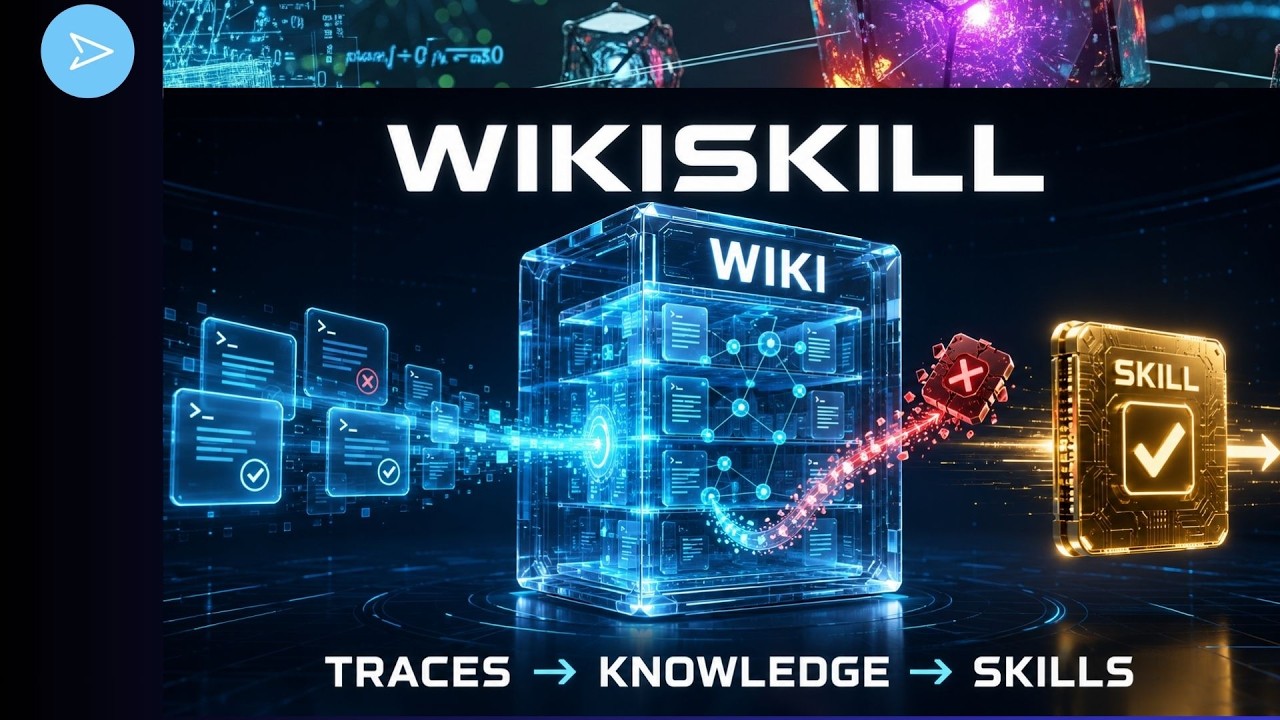
Discover AI explains the new AAR Sword v2 method for efficient latent reasoning in LLMs, reducing token costs while improving accuracy.
Key Takeaways
- AAR Sword v2 introduces a geometric latent reasoning framework that reduces token usage and computational cost.
- Mapping reasoning steps in a 3D space helps visualize and understand AI thought processes and corrections.
- Maintaining all reasoning steps, including incorrect or abandoned branches, is crucial for downstream task success.
- The method significantly improves efficiency by compressing lengthy chains of thought without losing accuracy.
- This approach is supported by recent research from leading global universities and is available with open-source models.
What the video covers
- Introduction to a new mechanism called AAR Sword version two, a novel approach to latent reasoning in large language models (LLMs).
- The method maps reasoning processes into a three-dimensional geometric space to analyze reasoning steps via directional angles.
- Angles between 0°-30° indicate simplification or sprinting toward an answer, while 150°-180° angles indicate reconsideration or recalculation.
- The approach aims to reduce the computational and context costs associated with long chains of thought in LLMs.
- Existing chain-of-thought methods suffer from high token generation costs and pruning risks losing important intermediate reasoning steps.
- AAR Sword v2 offers a compressed algorithm to maintain reasoning quality while halving response length and doubling accuracy per computation unit.
- The video references the paper from top universities including Beijing University of Post and Telecommunication, Hong Kong Polytechnic, and Tsinghua University.
- The presenter encourages viewers to study the complex mathematical formulations in the paper to fully grasp the methodology.
- The method introduces an explicit-implicit interleaved reasoning architecture to optimize reasoning phases and token usage.
- Overall, the new approach promises more efficient, interpretable, and cost-effective reasoning in AI models.
Chapters
- 00:00Introduction to AAR Sword Version Two
- 02:03Visualizing Reasoning in 3D Space
- 03:59Challenges with Long Chain of Thought
- 05:50Overview of AAR Sword Paper and Algorithms
- 07:34Understanding the Mathematical Foundations
- 09:13Performance and Efficiency Gains
- 11:04Implications and Future Directions
- 13:59Conclusion and Viewer Engagement
Full Transcript — Download SRT & Markdown
Speaker A
Hello, community. So great that you are back. Let's talk about a brand new mechanism. Maybe you are familiar with AAR, but we have something new. We have a new paper on AAR Sword version two, and it is a completely new idea but a beautiful one.
Speaker A
So let me show you. We start here with a simple idea. Hey, can we map all the nice sort processes in a three-dimensional space? And maybe we find out no, we have to go to a 12-dimensional space. But in
Speaker A
this paper, we stay in a three-dimensional space. So let's have a look. So let's say we start somewhere in an argumentation of a mathematical reasoning space. We have some reasoning process, and we end somewhere. And now we say, listen, we just analyze now here the
Speaker A
angle, the angle, how much the angle changed here from start to end and within each step, and you see here, see the reasoning stages from all the different reasoning steps. We have here the directional angle, and you see in the
Speaker A
reasoning process, my goodness, we have quite some elongation, and then we maybe come up with some step semantics where we say, hmm, in the region from 0° to 30°, maybe there's a certain semantic implemented, or if you go from 60° to 90°,
Speaker A
maybe there's something. So let's have a look, let's explore this. So when a researcher looked at a sort that mapped you exactly here in a very narrow range in an angle from 0 to 30° angles, they found this was associated with words like, hey,
Speaker A
let's simplify this in the AI reasoning trace or the AI said, hey, therefore I can logically deduct that. So the AI was more or less sprinting toward kind of an answer, kind of the correct solution. But when they looked at the trajectory
Speaker A
spiking backwards, no, like suddenly they had 150° to 180° angle here, they found what AI was actually saying in the tokens. Yeah. I was saying, hey, wait, this is no, maybe this is not correct.
Speaker A
Hey, maybe there is a mistake. So maybe I have to recalculate or maybe I have to reconsider my reasoning traces. So suddenly we do have a visual three-dimensional representation that encodes here the, let's say, the jumps in the reasoning process here in the sorts
Speaker A
of an AI machine. And you might say, hey, how can we construct such a beautiful mathematical space? And of course, as a subscriber of my channel, you say, hey, we have learned this now in one of my last videos. I
Speaker A
showed you how to have a new state space geometry that we can build, and you are a genius. Yeah, this would be the complex answer, the real modern answer, the latest technology answer. But in this paper, we go with a simplified version.
Speaker A
We make it real simple to understand. And here we have it. This is here by Beijing University of Post and Telecommunication, Hong Kong Polytechnic University, and our beautiful MIT of China, Tsinghua University, one of the top universities in the world. And yes, some other
Speaker A
companies. Beautiful. And they tell us September 7th, 2026. Hey, we have a sort version two, and now we have an efficient latent reasoning via a general via the geometric dynamics of an LLM. So suddenly we have the geometry of an LLM
Speaker A
reasoning process for the latent reasoning, and you see why we have suddenly latent reasoning, and I'm so glad you asked this question. Now you remember in a classical chain of sort, it improves the reasoning ability of our LLMs, but we have substantial computation
Speaker A
cost and context cost, and remember sometimes a chain of sort goes in a circle for 1,000 times or sometimes it just goes into some blah blah blah nonsense for a certain time. So existing methodologies here either lose the
Speaker A
intermediate formations for some hard pruning or lack some principal criterium for a continuous compression. So companies try to handle this somehow.
Speaker A
No, and they say, "Listen, we just cut here the reasoning process at 5,000 tokens or whatever." Yeah. Now you can imagine this causes a dilemma. If we have a long chain of sort, if we have, I don't know, 5 hours of reasoning. Yeah.
Speaker A
And then we just said, let's preserve everything. Now if you are OpenAI or if you are Google, then you can say, okay, I don't mind what it costs. But normally for a normal human being nowadays, it is extremely expensive. But remember every
Speaker A
step must be generated as a discrete language token. So this increases now our decoding time. This increases our key value cache size. This increases our context window or carpentry. This increases our training cost, and this increases the response length of the
Speaker A
token and therefore again the cost in dollars. So this is not what we want.
Speaker A
And if anyone wants to be competitive, yeah, maybe we shall do something about this chain of sort length. Now the option two was prune the reasoning steps. No, and some companies tried this, but a step that looks indirect may
Speaker A
contain some essential correction or some verification or, you know what, some abandoned branching. So this means deleting it completely from the reasoning process just because currently it has no effect can destroy information that we need downstream in the task or
Speaker A
we need to understand, hey, we have been there and it was not successful. So, you know, we don't throw away any incorrect reasoning choices. We collect them and we learn from them. And then we have an option three. And this option three, yes,
Speaker A
this is the GitHub from AAR sort, and as you can see, and I just want to tell you in 2025 we have a paper, AAR sort paper, code, miles, and everything, and yeah, beautiful, and now we have an AAR sort
Speaker A
version two. Now I just want to tell you, do you have the paper to read the paper AAR sort? So the first version, not really, because this is a brand new idea that has some brand new algorithms, and
Speaker A
therefore I will not give you here the complete read-up of the old paper from 2025, but I will only focus here on the new insight because this is enough.
Speaker A
You have a Hugging Face, the model card. What is the model? Well, it's a fun mall. A star sort latent QN 3.5 0.8 billion DeepSeek version 3.2 2 special open R1 math 3K filtered version 10 angle 90°, and I will tell you why we
Speaker A
need this Q1 3.6 27B version 2.12. So in essence, it's a Q1 3.6 27 billion model, and you can download it for free.
Speaker A
Great. What is it help? What is the main idea of this new paper? Now if you go for code or if you go here for pure mathematical logic, this is it. This is a compressed algorithm here for the
Speaker A
compressed lengthy chain of sort, and you might say great. Now if you are a genius, I'm so jealous because you just look at this and you feel the mathematics, everything makes sense for you, you immediately understand it within seconds.
Speaker A
Unfortunately, and now I have to tell you a secret, I don't see it. I have to go sit down, take a piece of paper, take a pencil, and I have to go line by line. I have to write it down. I have to understand what
Speaker A
is the terminology, what are the definitions, what are here everything around in the environment that is true.
Speaker A
And then I have to work my way through every single line to understand it.
Speaker A
And I would kind of encourage you to do the same because I get some emails, hey, I don't get it. I look at this and I don't get it. Yeah, sit down, think about it. It is such a beautiful
Speaker A
methodology. And you know what? Over the weeks, over the month, you will get better. You will train your brain to understand this kind of methodology. And then you see this and you say, hmm, this looks familiar. Now you have an idea
Speaker A
what it could mean. Or you just continue to watch my video. So I will give you here the result because let's have a look. This is a Q1 3.5 9 billion and a Q1 3.6 6 27 billion, and you see here the
Speaker A
last line is here our new methodology, and it kind of outperforms everything else. Now you would think if you are not a critical thinker and if you would not have subscribed to this channel, hey, this is great. So we can half the response
Speaker A
length in the token, and we can double the accuracy per computation unit, ACU. Yeah, this is here the first impression, but we will go deeper. So just to make sure what we are talking about, the question is, hey, find the greatest
Speaker A
integer n such that the cubic polynomial.
Speaker A
with this output you have it here between the syncing token. So this is our chain of sword and then we have latent swords in there and you might say hm what is this? Now you know in a classical way know we had a question and
Speaker A
then we had a solution and a classical chain of sort was okay we have to go down down down down and then over there and then we come back and then we follow here this step and then we come back and
Speaker A
we have another idea. So this was a chain of sort. Now this has now if we start now to prune this here with we will encounter something what we call AI amnesia. In the past the developer tried to speed up here the models by just
Speaker A
deleting the messy exploring sort process. Now if the eye went down the wrong path and corrected itself the developer would just snip out the wrong path to save space. Guess what turns out this was a bad idea and this causes a
Speaker A
problem like giving here the eye localized amnesia. The eye loses here the context of why a certain path didn't work making it even harder for the AI system to formulate the final answer. We lose here the insight of lesson learned
Speaker A
from its own mistakes. So as I told you, not a good idea. Then we had the paper in 2025 of AAR sort skip it. We go directly to AAR sort version two. And look at this. We have a question. And
Speaker A
now we have a very particular solution path. And as you see suddenly we have here latent token. And this is here the reasoning trace. So we're here really in the sequence of reasoning traces in a higher dimensional mathematical space.
Speaker A
Do you get the feeling what we're seeing here? Yes, we have here the integration of the surrounding context. And if you have seen my last videos, especially we talked about the p in formalism and that we have to have some context that is
Speaker A
what is happening around the path in a graph representation for a particular domain complexity. You see more or less it's the same idea like I've shown you in two other videos in this week already. Okay, let's go with this. So
Speaker A
you see, okay, after projecting here the question, the steps and the solution. Yes, we enter the training phase representation into a three-dimensional PCA space. It measures now the alignment between each local transition and the global question to solution direction.
Speaker A
Ah, this is where the angle comes in. You might say, okay, this is a simple PCA. Great. Maybe we can use some advanced mathematical, but okay, we go with a simple PCA. Now align steps remain explicit text so human readable
Speaker A
whereas the deviating steps are now compressed into a new mathematical representation of a continuous latent token because guess what we are in the right mathematical space.
Speaker A
Now two elements happening now and the authors call this a little bit misleading but yeah I go with now with this terminology so you can read the paper afterwards. They call the first process embedding forcing. So this is
Speaker A
the mall take here a whole paragraph of self-correcting and squashes it into a single dense continuous mathematical vector. And this mathematical vector in a vector space they call a latent token representation. Guess what? It is an embedding. And you see this here on the
Speaker A
right hand side this four those four elements here. Yes. And they are multi-elements become now one single latent token. And this is kind of the beauty.
Speaker A
Now remember this token is not text. This is a string of numbers. It's a vector that cannot be read by a human.
Speaker A
You cannot understand here. Let's go in a 128 dimensional vector space. You have no idea what this vector means. So the eye stops talking out loud in this chain of sort for some part of its reasoning process and we cannot follow it anymore.
Speaker A
You know with Astra there's something similar going on because there are the reasoning traces is not transparent transparent anymore. What a coincidence.
Speaker A
So even so the sword isn't printed as text the meaning of that sword for the machine itself is perfectly preserved in this mathematical vector since we build a mathematical artificial vector space and we put exactly the vector in a place
Speaker A
where we know exactly this is the meaning on this particular location in this particular mathematical space we build it for this and now comes the second process and the second process is label forcing again a misleading terminology but I go with it because
Speaker A
this what the auto call it. So this latent vector is now trained. It is trained to carry a soft probability distribution in itself.
Speaker A
Meaning we have to understand what is this vector and this vector has to retain let's call it a hazy abstract vibe an idea and the correct semantics in the English language of the entire exploratory thought process of these
Speaker A
four elements because those four elements are some part of the reasoning trace maybe not relevant maybe not relevant in the moment but they provide context. So therefore we have to be able to have this mathematical vector and decrypt this mathematical vector in the
Speaker A
entire exploratory sort process otherwise we would lose this information. So this is context information that we need but now in a new mathematical representation.
Speaker A
That's it. Simple. Yeah. Embedding forcing controls what enters this latent position in the embedding structure and label forcing controls what the latent position must learn to represent those four little elements.
Speaker A
Now if you're new to EI a little bit of mathematics compressing an entire reasoning step is simple after the tokenization this step consists of a number of tokens yes of course and normally the AI model compresses now all
Speaker A
of this into some token embeddings where we have also a certain sequence. Now the idea is here of AAR sword version two to replace the complete step with all its inherent complexity with one latent position here with one vector. And you
Speaker A
might say but how can one position one latent position one vector in this particular mathematical space learn to carry the complete complex information of the entire step? Maybe it is here a particular skill complexity or has multiple elements in it.
Speaker A
Now I give you a simple example. Imagine teaching here a student to replace a paragraph of scratchwork with one private symbol. So you say listen all of this what we write down here on this p page is is now alpha one. So you just
Speaker A
have encoded this in a simple token in a simple prompt and embedding forcing says nothing else that hey here's a compact vector constructed from this paragraph from this scratch work from this piece of paper use this now as your internal
Speaker A
symbol that you know exactly when you encounter this alpha one you know exactly what I mean with this and label forcing is doing now exactly the opposite your internal symbol must still predict here the collection of all the
Speaker A
concept contained in in this paragraph on this piece of paper. So encoding decoding if you think about a T5 structure. Beautiful.
Speaker A
Now the embedding forcing is simple what it does. Every ordinary token has an embedding. You know this is it. W is here the m embedding matrix here. Our D is here the dimensionality of the model embedding dimension and E is simply here
Speaker A
the continuous vector representation. The vector representing here this particular token. And then what is embedding forcing doing? Guess what? Here's the formula.
Speaker A
It simply averages the old token embeddings belonging to the reason to this particular reasoning step.
Speaker A
So during the training, the model is not asked to invent here a latent vector by itself. The if you want training pipeline constructs directly from the known reasoning step and place it it into the model input sequence. The model
Speaker A
is therefore kind of quotation mark forced. This is not a correct term but okay forced to process now a compact representation of the complete step. Now you might say like I did seven years ago when we first encountered this kind of
Speaker A
idea with sentence birds. I said do you average a token embedding? You average here a vector representation that can have a high complexity with a a single vector.
Speaker A
Now guess what? This is the simple most easiest case you can do because it is an average of token embedding. So it approximately maybe yeah okay it preserves the following the vocabulary content the broad semantic topic. Hey, maybe we are talking about physics,
Speaker A
maybe we're talking about finance. The average direction of the step in the embedding space. But if you have a more complex um construct here, not really.
Speaker A
But let's make clear what it is not preserving. It explicitly is not preserving. You lose the information about the token order sequence, the sentence structure in itself, the exact equations and the full logical sequence of this.
Speaker A
So therefore, when I saw this methodology in this paper, I looked a little bit closer at what the authors claimed as a result.
Speaker A
And at the end of this video, I will tell you that I'm not really 100% um go with their result interpretation.
Speaker A
I will show you what result I would deduct from their data. Yeah. The second is label forcing. Guess what? The paper therefore constructs the soft label by surprise surprise averaging the one hard labels of every token in the same step.
Speaker A
And I may say my goodness. So the mall is therefore again forced quotation mark to make the latent state predictive of the vocabulary content of the entire compressed reasoning step. So here you have it two different mechanisms two
Speaker A
different one is on the input one is on the output different function embedding forcing simply has a function of insert a compact vector representing here the removed complexity of a reasoning step and label forcing teaches here the latent position what the semantic
Speaker A
content it should predict given here the full complexity. So if you want to hear the simplest way to define it, embedding forcing provides the compressed sort of the machine and label forcing teaches the AI model not to forget what this compressed sort
Speaker A
contained. Anyway, now there is this idea that this is somehow similar to the human intuition.
Speaker A
So let's talk about it. So when the I goes here to generate here the final coransera, it feeds that also human unreadable but machine readable latent token representation a special mathematical vector back into its own system because the AI machine knows
Speaker A
exactly how to handle vector operation in its matrix multiplication. So you could now theoretically say hm so you have two parts you have the textual part and then you have some unconsciousness part of reasoning which I don't really
Speaker A
like but okay so the something like human intuition where you are subconscious brain processes some patterns maybe you are not really aware of this and says hm this feels wrong no maybe I should go the other way or you
Speaker A
know but you you don't need here to explicitly have here your sort process here in the English language and you have here a logical deductional sequence. Now sometimes you have just have a feeling h maybe not and the idea is yeah this is not the
Speaker A
human intuition quotation mark that yeah uses here the latent token to guide its next steps.
Speaker A
So it retains all the rich uristic data of its trial and error processes also where it fails but the failure is kept entirely in the internal mathematical representation not converted here to human readable chain of sort segments.
Speaker A
Think about here or a beautiful GPT astron where you have no reasoning traces and it is hidden in an internal space representation. So therefore let's come back to what some one of my viewers called EI slop. Actually this is here a
Speaker A
technical infograph because this summarizes now here all the technology that we use here in a star sword version two.
Speaker A
We have here a geometric selection. So we have the known direction. We have here a particular training methodology where I showed you that here the angle here between the reasoning step has some information if we want to map this here
Speaker A
over PCA to a reduced threedimensional representation and maybe three dimension is wrong maybe we have to go with 28 direction but more about this later in the limitations and then we just talked about the embedding forcing and the label forcing
Speaker A
beautiful we have a last function we define and then we have let's call it a sort process by I machine where you see some part is text token. So explicit reasoning here in chain of sort where you really can read the reasoning trace
Speaker A
but then to accelerate and reduce tokens we have a latent state. We have here kind of a compressed reasoning where we have just the internal representation of the mathematical vector that is not human readable but provides you all the
Speaker A
information that the EI machine needs for the next uh explicit reasoning in text tokens. And we have here a reasoning process where the medical representation switches between human readable language and internal mathematical latent state representation.
Speaker A
Yeah. And then we just have the inference process. This was the training process. And on the right hand side you see the inference process. So we hope that this is now a learned pattern and this pattern of switching here between
Speaker A
latent and text token is learned for a particular domain knowledge. And now our new machine is able to use less amount of token and have an improved reasoning because now we have latent state reasoning integrated here into our chain
Speaker A
of sort. Beautiful. Coming back now to a textual representation from this beautiful image representation. So what we have the reasoning sequence becomes part then the machine goes into a latent mathematical space for the reasoning. Then it comes back to the text space chain of sort.
Speaker A
Then it goes back to the mathematical space and then maybe we already have an answer.
Speaker A
The orus of the paper called this an explicit implicit interled reasoning architecture and this makes sense. So you see cutting now the response length in half according to the results represented here or presented here by the orders.
Speaker A
What I really like is this simplified idea. Now that you have 0 to 30°, you have here the words like simplify or expense or hence. Then you go to 60 to 90°. No. And you have words like boxed,
Speaker A
compute, actually. And then and then you go here to 150 to 180° here and you have wait is there maybe a problem or perhaps I should reconsider this or maybe this was all wrong. No. So this is really
Speaker A
something nice that this idea of a geometric interpretation of a particular semantic content. I like this idea.
Speaker A
Maybe I do not like the presentation of the results. Let's talk about this later.
Speaker A
So in general, what is this paper? The actual core of this preprint is if you want an endpoint informed data compression methodology plus some supervised learning of alternating text and latent reasoning modes in our chain of sort.
Speaker A
So deciding now which step must remain symbolic and readable and which can move into a dense continuous mathematical vector representation channel is now a task that is done in the training.
Speaker A
Now, surprise surprise, some new elements in my video. I want to show you how easy it is. No, what what is the power of thinking? If you don't use your AI machine, if you use your human brain, I want to show you
Speaker A
that come up with new perspective to understand a complexity maybe to understand this particular code or represent this particular mathematical representation in this particular paper and I just want to show you how simple it can be. So we have here the code
Speaker A
beautiful and then I sort about so this is now my sort process this is not part of the paper just want to give you here some a little bit of a teaser here perspective one you can see this process
Speaker A
as reasoning as a geometric motion you know theoretical physicist I have my my simple ideas here I would have here that the particular angle is decomposed well decomposes the reasoning process itself into a longitudinal motion into a transverse motion here. Think
Speaker A
about your polarization of light and a backward motion. And a useful physical kind of simplification of course is an explicit text carries the longitudinal component of reasoning and the latent token with its particular mathematical vector representation carry part of its
Speaker A
transverse fluctuation that we need. Or what about perspective 2? We go now here to information theory and maybe you like it more and you say hm you know what this reasoning is kind of a rate distortion compression module no because
Speaker A
think about it from the perspective of an information theoretical analysis the model has two communication channels it has the channel of an explicit text readable audible precisely supervised but it costs us many tokens many dollars great and then we have a latent state
Speaker A
that is more dense and more compact But it is harder to supervise and it's kind of opaque. No, we cannot really analyze at least not with other machines this complex reasoning race. So we do have here in this view uh kind of a
Speaker A
functional compression. The compressed representation can preserve or improve the final task accuracy even though the original reasoning text is not recoverable.
Speaker A
A deeper contribution is therefore if you want you can see this complete process as an adaptive semantic codeex for reasoning.
Speaker A
What about another perspective learning with privileged future information? Now you know that the known solution in the training data supplies here some privileged future information. What was the solution? So it defines here if you want kind of a global direction. I have
Speaker A
here the query the problem but I know I have the known solution in this particular direction if I put it here with some mathematical magic in a vector space this direction tells you the pre-processing system which steps appear
Speaker A
solution aligned in a very simple term so if you see it here through this particular lens of perspective 3 I would argue that this makes here this paper here this preprint here resemble an endpoint informed teacher student system. No, because a teacher sees here
Speaker A
the complete solution. It geometrically labels here the reasoning to a trajectory in a particular meta space that we built and then it decides which steps have to become latent and which steps have to stay here in normal um
Speaker A
English language and then the student machine comes in and trains on this hybrid trajectory. And of course this is the end of training and then at the real job at inference the student generates hopefully the representation by itself
Speaker A
giving you its generalization capabilities. So you see three perspective of the same code. So you should have fun with understanding code with understanding mathematics and code equal mathematics. So therefore these are three perspective. I just wanted to show you whatever perspective
Speaker A
you like you want to go with find it. If you want to have some fun do yourself perspective four and perspective five for the kind of thinking that you like.
Speaker A
This perspective three for example is interesting because it tells you that the scientific novelty from this perspective is the model learns not only what to reason but in which mathematical representation medium each phase of the reasoning process itself should occur for an
Speaker A
optimization. So suddenly we have here not only what to know but also here an optimization process regarding the represational medium a vector space a token space just we stay with an auto reggressive the transformer architecture you know now it gets really interesting
Speaker A
here how you can combine this yeah I told you we have to talk about the results now contrary to what the artists tell you I find that the finest or the fairest comparison here is the same data supervised fine tuning there and if you
Speaker A
go with this you see that the Q13.5 the 9B that I already showed you the results the numerical results has actually just a jump from 89% to 91.5% for average accuracy while the average length falls yes it does fall but it falls from
Speaker A
16,000 tokens to about 13,000 tokens So more than 2x maybe not really. And for the Q1 3.6 27B where I show you the numerical data I think here the average accuracy goes from 92.9 to 93.9.
Speaker A
If you compare it here apples to apples here against the same data supervised fine tuning while the average length falls yes from 14,000 to 11,700 tokens.
Speaker A
So yeah, but maybe not really the amount yours um state because maybe this amount is here in a best case scenario. So if you want to be let's say pessimistic or realistic maybe I personally will go with this benchmark results
Speaker A
and I think that the headline of 2.29 29 times ACU gain compares here or you you only get it if you have the final model here with the untreated backbone but is this a fair comparison because you combine two effects with the new machine
Speaker A
you don't forget you have also a training on the open R1 mathematical data set and on this complexity so you do have a specific mathematical training and I think you should compare apples with apples but maybe this is just my
Speaker A
opinion and you want to go with the opinion of the authors of the paper agree However, at the end we have to talk about the limitation and there are some severe unresolved scientific questions I have personally. Now we work with a
Speaker A
three-dimensional PCA. You know this is not the optimal mathematical reduction mechanism. Three-dimensional is just what we humans use. But this is not a optimized mathematical space. Maybe it's 27 dimension. Maybe it's 56dimensional space. Well, big question mark. Okay,
Speaker A
it kind of reveals here in this threedimensional PCA some reasoning structure or is this just here just a kind of a projection effect from a mathematical mapping? We do not have enough data on this. Also the angle semantic is kind of stable but is also
Speaker A
stable across some unrelated architecture or some unrelated languages or some cross domain or some other domains that are not as simple to calculate. Does the geometry really reflect the semantic progress or partly token position the score style and formatting? This is not really
Speaker A
investigated. We have some hints and we have some indication and this is gorgeous. This is beautiful. But for a deeper understanding, we have also to answer the outstanding question.
Speaker A
We cannot learn nonlinear projection really outperform a per trajectory PCA construct. We have to go with better mathematical algorithms to have here a better understanding what is really going on here. But in general, this paper, yeah, it stimulates here the
Speaker A
human brain cells. And you say, wow, I want to know this. This is such an interesting idea. We have to investigate this further.
Speaker A
I hope you enjoyed it. Send me your ideas.
Topics:AAR Sword v2latent reasoninglarge language modelschain of thoughtAI reasoningtoken efficiencygeometric representationcompressed algorithmmachine learning researchTsinghua University