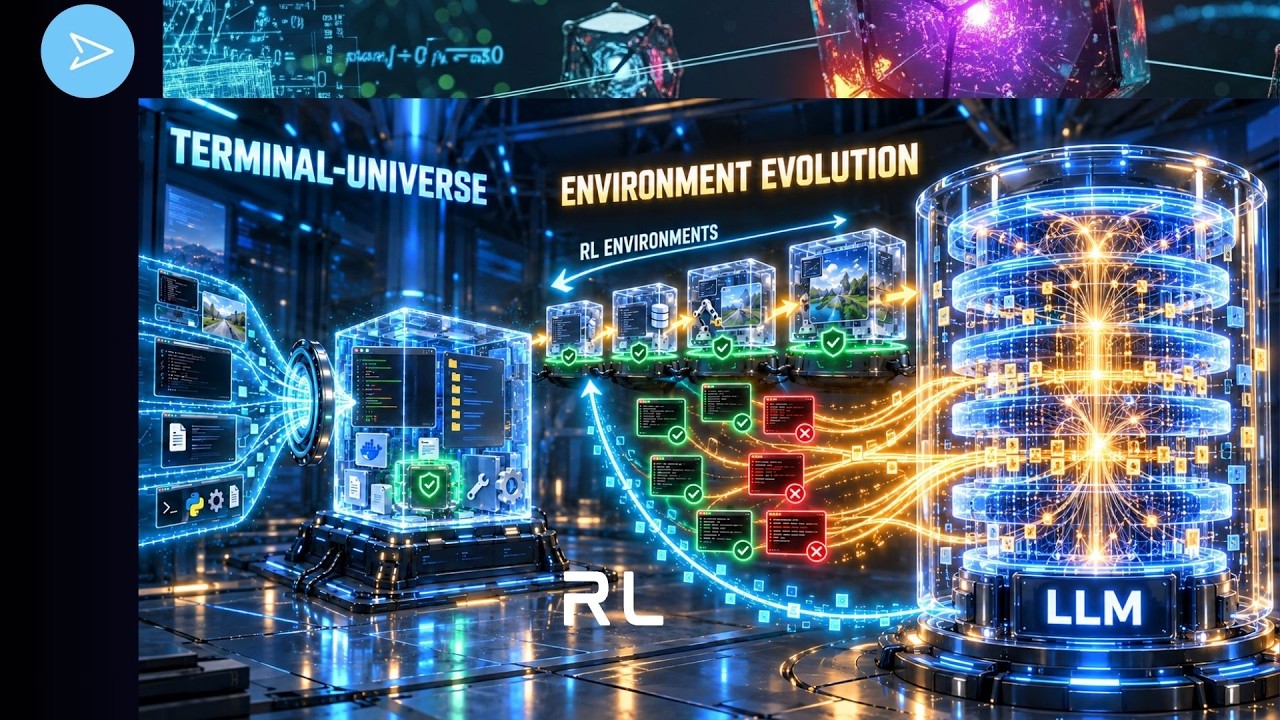
Exploring Tsinghua University's abstraction agent using LLMs to invent strategic variables for complex system analysis and AI problem solving.
Key Takeaways
- LLMs can be used to invent strategic variables that describe complex systems, replacing human variable selection.
- Structured knowledge elicitation allows conversion of qualitative semantic knowledge into explicit numerical features.
- The abstraction agent simplifies complex state dynamics into feature vectors that can be clustered and analyzed computationally.
- This approach opens new possibilities for AI in domains with extreme data complexity by discovering hidden patterns.
- Powerful LLMs are essential to successfully implement this method due to the required semantic and contextual understanding.
What the video covers
- The video analyzes a 2026 paper from Tsinghua University introducing an abstraction agent that leverages large language models (LLMs) to discover strategic features for information abstraction.
- Unlike traditional AI approaches, this method does not rely on demonstrations, simulations, or domain-specific evaluators but uses structured knowledge elicitation from LLMs.
- The abstraction agent uses natural language descriptions (e.g., game manuals, financial or medical texts) to identify key variables that describe complex systems in a new coordinate system.
- This approach shifts the task of defining problem variables from humans to LLMs, enabling the discovery of hidden patterns in extremely complex data.
- The LLM constructs coordinate axes by proposing candidate strategic dimensions and scoring states against anchors, simplifying system dynamics into feature vectors.
- Feature vectors are then clustered using techniques like K-means, allowing conventional solvers (Lean, Python, C++) to perform computations in the newly defined space.
- The method is demonstrated on game-theoretical problems but has broader implications for physics and other domains requiring variable invention for system description.
- The video emphasizes that the true intelligence of machines may lie in inventing variables rather than simply predicting answers.
- The approach requires powerful LLMs (e.g., GPT 5.5) to handle the complexity and semantic understanding needed for effective feature extraction.
- Overall, the paper and video highlight a novel paradigm where LLMs enable AI to create meaningful mathematical representations for complex problem solving.
Chapters
- 00:00Introduction to the Abstraction Agent and Paper Overview
- 02:03Structured Knowledge Elicitation Explained
- 04:12Using Natural Language Descriptions for Variable Discovery
- 06:28LLM Proposes Strategic Dimensions and Feature Anchors
- 08:43Mathematical Representation and Coordinate System Construction
- 10:53Clustering Feature Vectors and Solver Integration
- 14:23Implications for AI, Physics, and Complex Data Analysis
- 18:23Conclusion and Future Potential of LLM-based Variable Invention
Full Transcript — Download SRT & Markdown
Speaker A
Hello, community. So great that you are back. Yesterday, we looked at the most complex scientific paper in 2026. Today, we look at the simplest paper here that I've read this year. But this simple paper, my goodness, it has a depth that is just amazing. Let me show you invents variables. You might say, what a boring title. Come on. You really don't want to make a video about this. No. But let me tell you, this is here from Tsinghua University. So our MIT here in China, and the authors here go and build an abstraction agent as you see September 7, 2026.
Speaker A
that is just amazing. Let me show you invents variables. You might say what a boring title. Come on. You really don't want to make a video about this. No. But let me tell you this is here from Chingua University. So our MIT here in
Speaker A
This is interesting, and here this is the intelligence lab here from Tsinghua University, and they have a simple paper, a simple experiment, but if you think about it, your brain will start to hurt. Let's start. Yeah, we do have a GitHub, of course. Last week, 14 minutes here watching. Nobody understands here really what's behind this paper, but you will. So, here we go. An abstraction agent. An abstraction agent reuses here an LLM. It says, you know, LLM, let's try it in a different way. Let's use an LLM to discover some score strategic features for an information abstraction.
Speaker A
This is interesting and here this is here the intelligence lab here from Chingua University and they have a simple paper a simple experiment but if you think about it your brain will start to hurt. Let's start. Yeah, we do have a
Speaker A
And we go here with a natural language description. And in the paper, they go with some game manuals, but of course, you can go with a financial manual, a medical inscription, strategic option scenario in finance when you're working, whatever. But you know, we are back to the main topic of AI that I started AI more than four years ago, AI to find a hidden pattern in an extreme data complexity that my simple brain cannot analyze. It's just too much data. I need an artificial intelligence, a computer intelligence, a machine intelligence to find hidden patterns. And now we are spot on. So let's go. Now this algorithm doesn't learn from demonstration, not from run simulation, not traverse the game tree or use domain-specific evaluators while constructing nothing. Nothing at all. It is so simple. The authors call this a structured knowledge elicitation.
Speaker A
try it in a different way. Let's use an LLM to discover some score strategic features for an information abstraction.
Speaker A
Extracting here qualitative knowledge stored in the LLM, our parametric knowledge of the LLM and converting it into explicit numerical features, and those numerical features and then those object that some other object later like a numerical solver like Lean 4 or Python or C++ program can take up and consume and evaluate and compute. And you would say, but wait a minute, why? Let's think about it. Mostly AI problems, no, or complex, complex it is. Begin, you start to solve it, you start to write code after the mathematical representation has already been chosen. You decided, like I showed you in my last video, no, you build now a vector representation. So you have maybe a state vector or you have the features already defined that you're looking for, like accuracy or end to end something or a similarity, the cosine similarity. It has to be in a mathematical vector space, no? Or an optimization objective is already available, is already a mathematical representation in a particular mathematical complexity in a mathematical space. Now, now we say, wait a minute. But who decided which variables should describe here the world that I want to solve my problem in?
Speaker A
you know we are back to the main topic of EI that I started AI more than four years ago EI to find a hidden pattern in an extreme data complexity that my simple brain cannot analyze. It's just too much data. I need an artificial
Speaker A
And now this idea by Tsinghua University is now to build an abstraction agent, an LLM that gives this particular job to decide which variable will describe my world to the LLM. Not anymore to the human, not anymore to the human experience. But we have so much data about the world, and we humans, we tend to look at it in a coherent way. Yeah, but if you have a huge amount of data where you won't have no access anymore because it trillions of data points, then we need a machine intelligence, and now we give it to the LLM. So the LLM is therefore not predicting an answer, X token prediction. You know what the LLM is now doing in its inherent functionality? It is now constructing the coordinate system in which those states of the system we want to analyze can be compared. And if you're going to construct a coordinate system, you need axes. And you ask, what is the x-axis? What is the y-axis? What feature is it? What element is it? Temperature, pressure, what? Gravity.
Speaker A
constructing nothing. Nothing at all. It is so simple. The authors call this a structured knowledge elicitation.
Speaker A
And now, now it gets interesting because the LLM, the abstraction agent, is analyzing now a huge amount of data and telling us this, this feature would qualify as an axis in the coordinate system to describe the complexity of your system. And Tsinghua University in the paper showed this on a game theoretical level. Now, if you are into the mathematics of game theory, please read the paper. I will ignore it completely because there's a much stronger message hidden in the last pages here where they show here that the LLM is doing something even better.
Speaker A
4 or Python or C++ program can take up and consume and evaluate and compute and you would say but wait a minute why let's think about it mostly I problems no or complex complex it is begin you start to solve it you start to write
Speaker A
Now, of course, you might say, hey, as a subscriber of this channel, I want to see the physics, and here we are. Imagine a microscopic system may contain an enormous number of states. But a useful computation becomes possible once we discover some variables that describe now the complete dynamics of the complete state in a simplified way. Now we have here, if you want, here the generative functionals of a Hamiltonian or whatever. We have variables like temperature, pressure, magnetization, whatever you have in your particular domain. So let's find those special parameters, special variables that describe the system in the best way. And suddenly we say, hey, the most important intelligence of a machine may not be finding an answer. Next token prediction, write the email here, but maybe it will be to invent the variables after having calculated through trillions of data points. Invent the very spectacular variables that are best suited to calculate now the answer to my problem in this domain.
Speaker A
accuracy or end to end something or a similarity the cosign similarity it has to be in a mathematical vector space no or an optimization objective is already available is already a mathematical representation in a particular mathematical complexity in a
Speaker A
So here with this blue ribbon here on the right-hand side, this is the complete system. So the LLM, let's say, creatively proposes now some candidate strategic dimension, one-dimensional, two-dimensional, more complex. Then every feature receives some concrete anchors representing, let's say, three points. I will explain this in a third example. The LLM scores every state against this fixed anchors and features with little variation of removed and highly correlated dimensions are also eliminated. What we are left with are feature vectors, and those standardized feature vectors grouped using K-means and a conventional solver, Lean, whatever you have, uses then this abstraction after we found the coordinates, after we found here a mathematical space to find a mathematical representation in this new space that is best for the calculation. This will be then done, and then the abstraction will be solved. Now you will see in the paper that there's a lot about poker and whatever video games. This is not so important because they did an experiment where they said, "Hm, listen, poker you can find on the internet." No, we want to see the emergence of this pattern finding in the machine intelligence. So they decide here a rover experiment, and this is easy. Now rover trials is here the preprints principle construction versus memorization test. This test is invented brand new. It's not on the internet.
Speaker A
And now this idea by Chingua University is now to build an abstraction agent an LLM that gives this particular job to decide which variable will describe my world to the LLM. Not anymore to the human, not anymore to the human
Speaker A
It's not here in the pre-training data. That is not a memorization effect. This is really that this will be constructed from scratch by the LLM. So the artist invented a new world, and in this new world, or think about astrophysics. Think about the discovery of new, I don't know, planets. Now this new world contains now rovers, the classical rovers, Mars rover, and they are characterized just by three elements: the power, the grip, and the terrain affinity.
Speaker A
it trillions of data points, then we need a machine intelligence and now we give it to the LLM. So the LLM is therefore not predicting an answer X token prediction. You know what the LLM is now doing in its inherent
Speaker A
Let's have a look. Yes, one of my famous AI-generated computer graphics. I know such beautiful things. So we have here on the one hand side, here on the left-hand side, we have the rules, the textual description of what this thing can do, or a textual description of a particular game, or a textual description how to do some financial calculations or some financial complexities from what the hell I know. And the LLM is now given this verbal English rules here trying to understand it.
Speaker A
What is the yaxis? What feature is it? What element is it? Temperature, pressure, what? Gravity.
Speaker A
And now now it gets interesting because the LLM the abstraction agent is analyzing now a huge amount of data and telling us this this feature would be would qualify as an axis in the coordinate system to describe the
Speaker A
complexity of your system and Chingai University in the paper showed this on a game theoretical level. Now if you are into the mathematics of game theory please read the paper. I will ignore it completely because there's a much
Speaker A
stronger message hidden in the in the last pages here where they show here that the LLM is doing something even better.
Speaker A
Now of course you might say hey as a subscriber of this channel I want to see the physics and here we are. Imagine a microscopic system may contain enormous number of states. But a useful computation becomes possible once we
Speaker A
discover some variables that describe now the complete dynamics of the complete state in a simplified way. Now we have here if you want here the the generative functionals of a Hamiltonian or whatever we have variables like temperature pressure magnetization
Speaker A
whatever you have in your particular domain. So let's find those special parameters, special variables that describe the system in the best way. And suddenly we say, hey, the most important intelligence of a machine may not be finding an answer. Next token
Speaker A
prediction, write the email here, but maybe it will be to invent the variables after having calculated through trillions of data points. invent the very specticular variables that are best suited to calculate now the answer to my problem in this domain.
Speaker A
So here with this blue ribbon here on the right hand side this is the complete system. So the LLM let's say creatively proposes now some candidate strategic dimension on one dimensional two dimensional more complex then every feature receives some
Speaker A
concrete anchors representing let's say three points I will explain this in a third example the LLM scores every state against this fixed anchors and features with little variation of removed and highly correlated dimensions are also eliminated what we are left with are feature
Speaker A
vectors and those standardized feature vectors grouped using K means and a conventional solver lean whatever you have uses then this abstraction after we found the coordinates after we found here a mathematical space to find a mathematical representation in
Speaker A
this new space that is best for the calculation this will be then done and then the abstraction will be solved now you will see in the paper that there's a lot about poker and whatever video games. This is not so important
Speaker A
because they did an experiment where they said, "hm listen poker you can find on the internet." No, we want to see the emergence of this pattern finding in the machine intelligence. So they decide here a rover experiment and this is
Speaker A
easy. Now rover trials is here the preprints principle construction versus memorization test. This test is invented brand new. It's not in the internet.
Speaker A
It's not here in the pre-training data. That is not a memorization effect. This is really that this will be constructed from scratch by the LLM. So the artist invented a new world and in this new world or think about astrophysics. Think
Speaker A
about the discovery of new I don't know planets. Now this new world contains now rovers the classical rovers Mars rover and they are characterized just by three elements. The power the grip and the terrain affinity.
Speaker A
Let's have a look. Yes, one of my famous AI generated computer graphics. I know such beautiful things. So we have here on the one hand side here on the left hand side we have the rules the textual description of what this thing can do or
Speaker A
a textual description of a particular game or a textual description how to do some financial calculations or some financial complexities from what the hell I know. And the LLM is now given this verbal English rules here trying to
Speaker A
understand it with its own parametric knowledge and it is trying to understand let's say how to play the game but not inventing here the same mathematics here of pure game theory but we stay in the eye we build an abstraction agent and
Speaker A
the abstraction agents now says listen in this rover world there are two rovers a rover A and a rover B now it turns Without the rover A, if we test it on the terrain, on rock, sand, ice, mud,
Speaker A
and volcanic, it performs absolutely perfect here, the same. It's an absolute generalist. But rover B is a highly specialized rover. And this rover was built for volcanic terrain. If we have some world volcano, this is your rover.
Speaker A
Of course, if you take the mean, the average performance data, both are at six, as you can see in the simple examples. Yeah, so this is now if we have here if you want a classical representation of the
Speaker A
terrain affinity we just have some parameter and we sum up we like an EI no and statistics and we get here both six years as a results are the same and you might say hey are those two states now
Speaker A
equivalent because we have two rovers now and this colar evaluator based on the mean parameter says yes look six in both cases but you know exactly the future behavior of that system because if suddenly put here the specialist
Speaker A
rover B on a volcano you will see a complete different behavior. So the future behavior says no and this is exactly the lens what we need because they say the problem is not a pure calculation. The problem for this is a
Speaker A
pure mathematical representation not understanding that here there is a dimension volcanic that is where this element where this rover is outstanding.
Speaker A
You see what we are going for. So every solver then needs someone to decide hey which variables matter in the description of this system. How the similarity is measured. Is it really a cosine similarity in a vector structure?
Speaker A
what information may be safely be just ignored because it's not important for the mission or whatever. Now traditionally the human expert build all this representation evaluation simulation handcrafted features human knowledge test experimenting but now Chinga says hey can an LLM do this can
Speaker A
an LLM substitute here this particular human role and they have an idea somehow the LLM has to calculate this or a solver has to calculate this so they say let's go from rules like we have here on the left hand side the rule book
Speaker A
for this particular game to coordinates And coordinates are simple, beautiful to calculate. Look what they do. They say now okay we have now let's say three parameters mean performance f_sub_1 terra volatility f_sub_2 and stability f3 of these two
Speaker A
rovers. No and then you see we have here for row a here in a matrix this representation and for rover b in a matrix this representation. And you see of course that F2 the terrain volatility where the specialist has its volcanic
Speaker A
strength changes for a generalist for zero now to absolute powerful this is the volcanic rover. So if we have now a coordinate system f_sub_1 f_sub_2 f3 you see that in f2 the terrain volatility the difference between our points here
Speaker A
rover a and rover b. Now you might immediately say hey wait a minute something happened here. Yes I know but let's talk about this later. So we have achieved that we built a coordinate system just by noticing that
Speaker A
in the rules or the description of this external world there are differences there are different states that this external system can be in and we found a new numerical mathematical representation.
Speaker A
But how do we find the best? Now you're not going to believe it. We use now the L&M as a coordinate system generator.
Speaker A
So the model the LLM reads now the laws of the domain, the rules of the game or whatever and proposes now a small set of continuous variables in order to understand the dynamics of this extra world dynamics.
Speaker A
So the abstraction agent turns the LLM into a representation engineer. It reads a specification verbally, proposes some mathematical variables given its parametric understanding of the LLM itself, constructs in the way I just showed you a numerical state space and
Speaker A
lets an exact algorithm algorithms here of I don't know thermodynamic module here in C++ or some lean force over determine whether the state space is useful or not. And guess what? Yes, we are looping. So okay, you got it.
Speaker A
So this means the future AI suddenly is not anymore about some social media answer to the email but it can maybe really contribute to science but not by solving equation which is nonsense.
Speaker A
Therefore we have numerical solver like lean four but by inventing the variables of a complex dynamic system in which the right equations are found and then can be solved by our current mathematical understanding or physical understanding or financial understanding or medical
Speaker A
understanding. Let me give you an example. Two rovers on five possible terrains. No, we have just I've just showed you this now. Stable general list performance 666 mean performance 6 volatile specialist on volcanic 22. You got it.
Speaker A
Now you know strategically both robots are completely different built for different things and therefore we won't have a representation that really brings this out. No. And you know now that the average performance index this metric that we have now normally on our systems
Speaker A
is absolutely unsufficient. It hides some details here from the dynamic of the system for us and this is happening quite a lot of EI description of systems.
Speaker A
So this is not this is here a simplified example but think about some real complex economic system where you want to take EI and have a deep analysis of thousands of players here in some international economic scenario.
Speaker A
But let's add just here another variable. So if we say hey the average performance is not good enough let's go with the terrain volatility and you know what we are spot on because rover B is especially built for volcanic terrain.
Speaker A
So the terrain volatility is now exactly the parameter we are looking for to distinguish that we have a specialist in our system dynamics.
Speaker A
So the two rows great average here both 05 or 06 but then in the volatility you have suddenly two extremes. So we found the parameter we found the axis in a mathematical representation to identify hey this is your specialist
Speaker A
that is available in my system. If you go now and you put this simple on the second axis. Now the first rover here general list is zero for the terrain. Every every terrain is identical six. But if the the second
Speaker A
rover B with volcanic now here we have this is here with 22 outstanding specialist on volcanic rocks. So this second or this two-dimensional plane now with the second axis this is now the newly constructed numerical state space of the system of the complexity of the
Speaker A
system that allows us now to differentiate understand that there's a difference in the object that live in this particular environment. So the LLM has exposed now a distinction that a one-dimensional representation or an AI maybe a 750 dimensional representation
Speaker A
destroyed just averaged over. Sometimes we have to find mathematical representation of complexities that are really really high complexities 2,000 dimensional vector spaces and more.
Speaker A
Now, how does the LLM know that this volatility here for the terrain matters? Well, it found in the rule that there's a description that rover B has some particular features. Now, it noticed the other LLM just reading the rule book.
Speaker A
Let's go with this game theoretical approach that it notice three facts. The terrain affects the performance, the velocity or whatever. The terrain is initially unknown and the terrain becomes your public after later decisions. So it can now reason the LLM.
Speaker A
Hm. A rover average performance is absolutely not sufficient to describe here how to solve a particular mission here going up a volcano. The timing of the information means that the performance variation across the terrains also affects the strategy. So
Speaker A
the LLM decides okay the terrain now becomes an important parameter for my particular job.
Speaker A
And therefore the LLM now proposes hey I propose now a new dimensionality a new let's go with a one-dimensional axis here terrain dependence and this terrain dependence has minima and maxima so we have our calibration anchors given here the dynamic of the
Speaker A
system and now the anchors define what the different position on this new axis of the second axis mean the LM then receives every rover configuration from either the game description or whatever and scores it relative to those anchors
Speaker A
to those extremal points. Guess what this is in AI? In AI we call this feature engineering because we have a function of a certain volatility and we position it as a number in the interval between zero and one. So those are
Speaker A
really features. We talked about this. What does it really mean constructing a state space in this way? Now think about it. We have if you a little bit closer three different mathematical representation.
Speaker A
We have the raw state. The representation is the original object and this is here a rover with a power of four a grip of two and a strong affinity. Let's go with ice. No something else. Then we have the
Speaker A
numerical state that we built from this raw state. No. Now the representation is the rover changes from an original object into a mathematical feature vector in a particular mathematical space that we built to describe exactly the feature of the object. And here we
Speaker A
have now this let's go with four dimension numerical description a vector and what Chinua did if you have not only two rovers but if you have 20,000 rovers here on this world exploring Mars for example you have to find abstract states
Speaker A
where you can say there's a certain cluster assignment so I take all the 20,000 feature vectors and what I do I want to simplify the complexity therefore I build clusters everything that is real close together will form one cluster and I will only
Speaker A
talk about one cluster representative but not about all 612 elements that form one cluster and they go down and call this here a bucket forget about bucket and poker this is not important they form an abstract state so after
Speaker A
they found particular feature vectors and they build a particular feature engineering space state space they go and abstract it and say if we have multiple objects in this let's call it an abstract state. Beautiful.
Speaker A
Now you're not going to believe it. This abstract state space has a particular representation as a mathematical matrix.
Speaker A
What a surprise. Now so suppose there are let's say n states and we have here m variables. No n * n. You see it here in the matrix. No. So its course here the LM every state on every variable and
Speaker A
this matrix S as I told you is the explicit numerical state space. So this means every row is one state. Each column is one LLM proposed variable and every row is also a point in an M dimensional space like I just showed you
Speaker A
here before. Careful S is now something that we built outside of the classical learning methodology.
Speaker A
S is not at all a transformer activation space. This is now really a new way to find a learning algorithm that is based on an abstraction a new job of learning for the LLM.
Speaker A
Now let's say we have another game and this game has different rules and the abstraction agent here has also but now we have 1 2 3 four five different elements that live in this world. Yeah, in this game world and you have to use
Speaker A
one particular element for each specific task and you have to figure out what is the best gaming strategy and you are not a human player but you are an AI machine. So this is exactly what you do.
Speaker A
You take the game book here with all the rules. You let the LLM, the abstraction agent analyze the rules, find new strategy based on the specific of these five objects that you can move within this world or use or apply in this
Speaker A
world. You assign particular mathematical or numerical values to this. after you decided that you have 1 2 3 variables that describe this the dynamic of this state best. Now if you have five elements you see in our f_sub_1 f_sub_2 f_sub3 in our
Speaker A
three-dimensional vector representation suddenly you have five points. Now you could argue h maybe these two points live together maybe these two points live together. So you see exactly if you have 20,000 elements here for an strongly interactive game play you now
Speaker A
know now why we have to do the clustering and at this point you might say but wait a minute where is now the actual intelligent is it the LLM but the classical LLM what is it think about it
Speaker A
the ordinary mathematics of this paper by Jingua is rather simple yeah no you find a methodology to remove constant variables Then you remove the highly correlated variables because you want you have unique features. Then you normalize these features and then you
Speaker A
cluster these features to have here a perfect mathematical reduced mathematical um description. So you see the difficult part here is deciding wait a minute which question has the LLM to ask about every specific state about the dynamic of every
Speaker A
specific state about the let's say expected gameplay characteristic of every state what is the goal of this particular game as mentioned in the game rule book so the LLM must infer from the rules that the future uncertainty the
Speaker A
vulnerability ility in the conditional strength or the stability also matter. The LLM reading now the the rule book here the game rules here understands what are my elements that I can build my strategy on. And if you want this is
Speaker A
here the paper's new rule for the LLM. The LLM is now translating here some qualitative semantic understanding of all these single sentences describing here the rules for the game into explicit numerical axis but not every semantic word not every semantic
Speaker A
sentence only the one that are characteristic for the description of the dynamic of the system or yeah financial dynamics you got it so this means it converts knowledge such as the railways is dangerous only after favorable terrain reveal. This is
Speaker A
now that we can put it now in simple mathematical terms. So the right variables for this particular game means the variables that preserve the distinction needed for the downstream solver because I told you we have to evaluate the system. We have to
Speaker A
test it. We have to really have here mathematical sover numerical sole lean for that says okay and now I try to compute here the dynamics having my understanding and my uh physical libraries about thermodynamics or whatever you got it
Speaker A
yeah talking about thermodynamics this is here a thermodynamic example so this means coming to an end the abstra abstraction agent reads the verbal rule description and proposes now a semantically plausible set of variables for the dynamic of the system
Speaker A
and it then assigns approximate scores with an LLM and their usefulness. Hey, is temperature really a parameter here?
Speaker A
Their usefulness is tested indirectly through the resulting strategy exploitation via numericals over Python programming whatever you remember mathematics gives us here an immediate validation.
Speaker A
So you can also say the abstraction agent searches for strategy relevant microscopic variables just as physics searches for the collective variables in a thermodynamic problem that allow enormous numbers of micro state think of molecules to be treated as the same
Speaker A
effective macroate termamic description here of a gas. Yeah, there are a lot of results from poker and I'm not so into poker or video games, but the ideas or the results show it works.
Speaker A
But it works only for real powerful LLMs like a GPT 5.5. So this is you have really to have the how to say this the capacity of the LLM to go for real complex topic to have an extreme huge
Speaker A
amount of free trainable parameters like the latest GPT or the latest OPUS or whatever you prefer. It will not work with a 27B or 48 billion uh open-source model here. You really have to go for the big ones. the inside the LLM
Speaker A
converts here a verbal description. Hey, this is the rule book of how a world works, how the game works or how I don't know the atmosphere on Jupiter works into an explicit geometry over that world state. So what we do is amazing.
Speaker A
We built a mapping of different worlds here where we have we start with a verbal description and we end up with a geometric representation of a particular dynamic of particular components in a dynamic world state.
Speaker A
So the scientific insight is not simply hey Chingua tested an LLM and the LLM could find features. We know this for 10 years.
Speaker A
But this it converts a verbal description of how a world works into an explicit geometry over that world states. This is the beauty of this paper. So again let's make this absolutely clear. What is the complete idea? The world already contains many
Speaker A
raw state that are in this verbal description. The LLM reads now the description or the rule book or the rules of a game or you got it. It proposes then numerical questions that expose strategically important differences.
Speaker A
Is this rover B really so good on some volcanic terrain? It answers those questions for every state. Those answers turn every state into a multi-dimensional vector representation or a point in a three-dimensional or two-dimensional plane.
Speaker A
nearby points are grouped into the same let's quotation mark abstract state and then we have a classical numerical solver tests this computes this verifies this where are those groupings preserved the distinction that matters to describe really the state the system dynamic the
Speaker A
state dynamic so the entire scientific challenge of the paper is therefore if you go a little deeper is therefore to create a feature space where the states requiring similar strategy end up close enough to enter the same cluster group or the same
Speaker A
bucket as Chinua calls it and if we have an outlook using this idea using this technology now guess what we just find another loop idea no so because if the LLM proposes now system specific dynamic microscopic variables to describe here these
Speaker A
particular dynamics and the solver finds maybe some counter examples let's loop it back to the LLM the LLM revises Now it's very specific uh feature axis in its own coordinate system builds maybe a different coordinate system maybe just in 312
Speaker A
dimension and validated abstractions are eventually distant back into the model and maybe we even have a learning where we change now the tensor weight of the LLM itself. So you see this is just here another loop another improvement of the
Speaker A
intelligence a self-arning AI system but remember this LLM is now doing something complete different this LLM is now finding hidden patterns and this is the reason why I wanted to show you this study this preprint this is the amazing
Speaker A
insight although the paper is about poker and games I don't care about this but go a level deeper understand what it means understand the mathematics and understand the general generalization of what they found in Chingua because this is the beauty of this paper. I hope you
Speaker A
enjoyed it. See you in my next video.
Topics:abstraction agentlarge language modelLLMTsinghua Universityfeature extractionstructured knowledge elicitationvariable inventioncomplex systemsAI problem solvinggame theory