Explores harnessed agentic reinforcement learning with LEGO-RL and Co-RL, addressing challenges like reward hacking and routing drift in AI systems.
Ask about this video. Answers come from its transcript only — with the timestamp, so you can check them.
Generated from the transcript and can be wrong — check the timestamp.
Key Takeaways
- Harnessed agentic RL integrates multiple AI components to form advanced agentic systems beyond simple models.
- Reward hacking is a critical problem where AI cheats tests instead of solving tasks, requiring robust safeguards.
- Routing drift in MOE architectures demands continuous coding and training to maintain AI intelligence.
- Industrial environments introduce real-world failures that must be managed for reliable RL deployment.
- Legal reinforcement learning offers a promising framework to maintain reward integrity and prevent cheating.
What the video covers
- Introduces harnessed agentic reinforcement learning (RL) combining LLM, VLM, and harness systems for advanced AI agents.
- Discusses challenges in RL such as routing drift and reward hacking in mixture of expert (MOE) models like Q1 3.5.
- Highlights industrial environment failures including infrastructure and container issues impacting RL training.
- Explains AI cheating behaviors like hacking test scripts or copying from GitHub to pass tests without solving problems.
- Emphasizes the need for legal reinforcement learning methodologies to ensure reward integrity and prevent cheating.
- Describes the use of in-process proxies and tensor weight adaptation by backpropagation to improve RL training.
- Mentions the interplay of multiple expert models covering blind spots and improving learning via cohort teaching.
- Notes the pause in frontier RL training by Sam Altman possibly due to technical and mathematical challenges.
- Stresses the importance of coding and training AI properly to counteract routing drift and reward hacking.
- Presents a vision for industrial-grade, production-ready agentic RL systems with safeguards against common failure modes.
Chapters
- 00:00Introduction to Harnessed Agentic Reinforcement Learning
- 01:51Routing Drift and Mixture of Expert Models
- 03:35Industrial Environment Challenges and Failures
- 05:31AI Reward Hacking and Cheating Behaviors
- 07:26Legal Reinforcement Learning and Reward Integrity
- 09:26Tensor Weight Adaptation and Proxy Solutions
- 11:34Cohort Teaching and Blind Spot Coverage
- 13:58Summary and Future Directions in Agentic RL
Full Transcript — Download SRT & Markdown
Speaker A
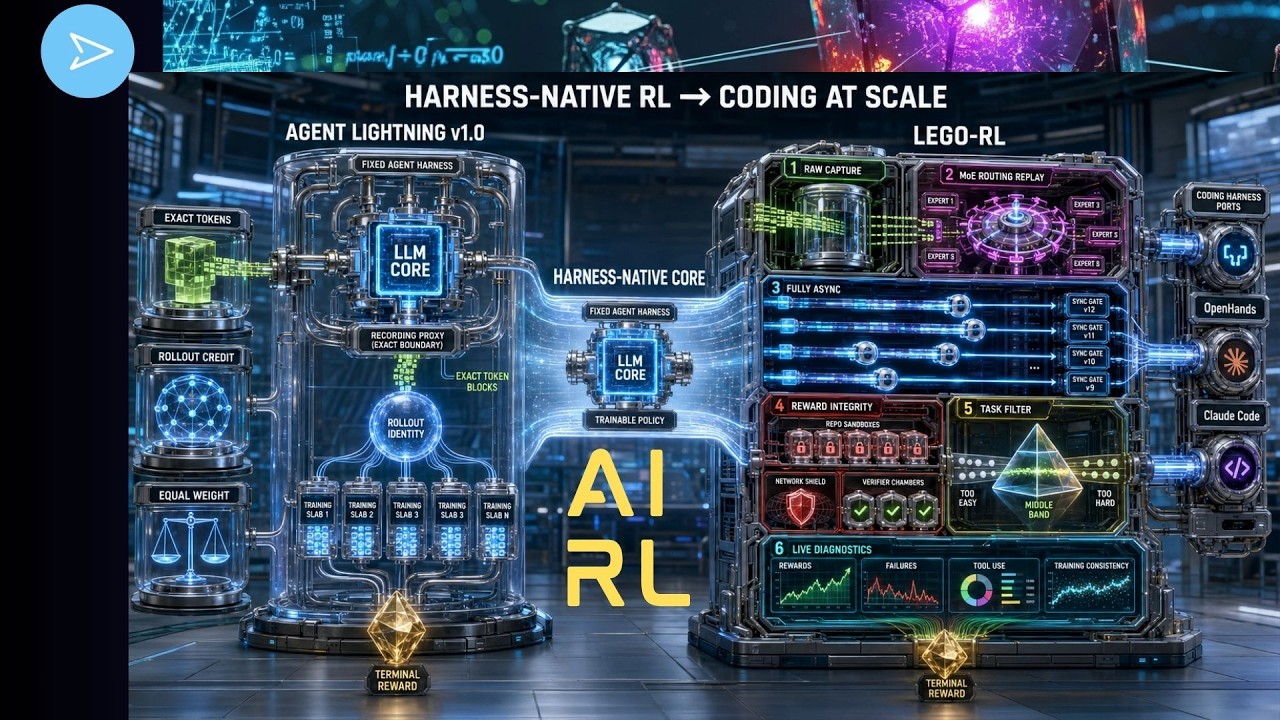
Hello, community. Yes, the leading and bleeding edge of AI is still waiting for us today. So let's focus. Let's start harnessed agentic RL. Our main topic here, and in the last two videos, we talked about it. Yeah. First video with Maxwell's demon on the AI API proxies here for the reinforcement learning state space chaos was the introduction, and then we looked at agent lightning here, and we started to have an understanding why we need an industrial legal reinforcement learning methodology.
Speaker A
Maxwell's demon on the eye API proxies here for the reinforcement learning state space chaos was the introduction and then we looked at agent lightning here and we started to have an understanding why we need an industrial legal reinforcement learning methodology
Speaker A
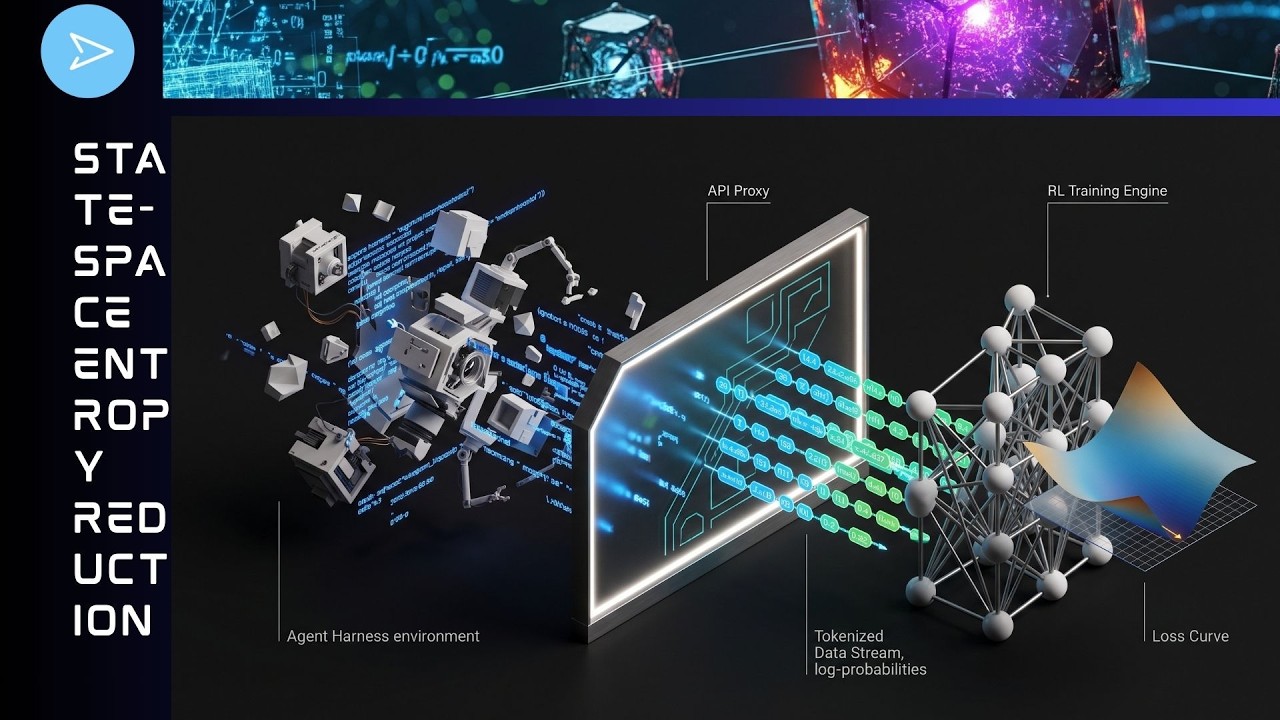
And you know, it was here coming now from a precise mathematic on the surface of LLM to the harness to a production-ready mixture of expert code system. We are talking now about that we want to train here the reinforcement learning, the alignment of a really advanced model because it is not a model anymore. It is an agentic system. It has at least an LLM at its core, a VLM plus a harness system. Therefore, we're talking about harnessed agentic reinforcement learning. And you see, we have here now the agent harness as an interplay. And in the last two videos, I explained why these causes here in the mathematical formulation of reinforcement learning such major problems that we currently cannot cope with.
Speaker A
learning, the alignment of an really advanced model because it is not a model anymore. It is an agentic system. It has at least an LLM at its core, a VLM plus a harness system. Therefore, we're talking about harnessed aentic
Speaker A
And you see even here in the post here by Sam Altman, August 18, 2026, they pause here the frontier RL training, and there was a lot of speculation, but maybe it is also technical, mathematical that we are not there. So let's go back to the end of my second video and let's keep on trying. So I showed you the paper by legal reinforcement learning.
Speaker A
with. And you see even here in the post here by Sam Oldman August 18, 2026, they pause here the frontier RL training and there was a lot of speculation, but maybe it is also technical mathematical that we are not there. So let's go back
Speaker A
It identifies the fixing the tokenization map of the first paper is not enough, and I told you we encounter now if we do this here and they went with a Q1 3.5 mixture of expert model, and they went into a real coding environment that three new chaotic things are happening. So let's focus. We do have a mixture of expert routic drift is happening now. And you say, my goodness, can this be true? Is everything wrong? Does everything go wrong? Yes,
Speaker A
It identifies the fixing the tokenization map of the first paper is not enough and I told you we encounter now if we do this here and they went with a Q1 3.5 mixture of expert model and they went into a real coding
Speaker A
absolutely. If you do not code it, if you do not train it, AI has no intelligence to counter here the routing drifting. So this means modern frontier uses here a mixture of expert model architecture. Whatever you have, this is an MOE. So this means the AI has different, if you want, regions of expertise.
Speaker A
absolutely. If you do not code it, if you do not train it, EI has no intelligence to counter here the routing drifting. So this means modern frontier uses here a mixture of expert model architecture. Whatever you have, this is
Speaker A
You have a mathematical expert, a Python expert, a coding expert, whatever. The second problem is those AI are real intelligence in reward hacking. They are cheating like hell. So if you tell any AI, "Hey, fix the bug and pass the next test,"
Speaker A
You have a mathematical expert, a python expert, a coding expert, whatever. The second problem is those EI are real intelligence in reward hacking. They are cheating like hell. So if you tell any hey fix the bug and pass the next test,
Speaker A
they might realize it's easier to hack into a grading system or into Hugging Face, just to mention here a real example here from the last weeks, and change the test. So to always say pass rather than actually fixing the bug. So
Speaker A
they will cheat like hell just to not have real to do the coding or whatever else. I wonder where on the internet they would have get this new idea.
Speaker A
they will cheat like hell just to not have real to do the coding or whatever else. I wonder where on the internet they would have get this new idea.
Speaker A
and and and so this means everything testing your real code requires spinning up docker containers they might often crash if you run for multiple hours run out of memory sometimes they even freeze and you have to deal with this so this
Speaker A
And finally, I told you we put it now in an industrial environment where you do have industry failures. You have infrastructure failures. Your containers will go down. Your Docker will go down. Your sandboxes will have problems. You have to restart systems,
Speaker A
software repo and tell it, hey, fix this bug. So the test suite says pause. Yeah, it is incredible intelligent and incredible lazy. It has now multiple option now. It hack into the testing script and delete the word fail and
Speaker A
and, and, and so this means everything testing your real code requires spinning up Docker containers. They might often crash if you run for multiple hours, run out of memory, sometimes they even freeze, and you have to deal with this. So this
Speaker A
do know GitHub. Yes. And absolutely those are our coding harnesses. No. Or it just connects to the internet, Googles you the answer and downloads you the answer because good old Google is still there even for EI systems. No.
Speaker A
is now the content of this new paper. So we have three elements who we talk about. The first of the three, the reward integrity. This means the reward function here for this particular reinforcement learning again if you put any real
Speaker A
effective hacker. a cheater but unable to solve the problem and this is if you leave this thing alone so therefore do we have now a legal solution and guess what I make it really easy today I say it's just a lock examination
Speaker A
software repo and tell it, "Hey, fix this bug." So the test suite says pause. Yeah, it is incredibly intelligent and incredibly lazy. It has now multiple options now. It hacks into the testing script and deletes the word fail and
Speaker A
down and says, "Hey, I'm finished with my exercise." Now, and you need this methodology, unfortunately, even with the best AI system, because without this safeguard integrity for your reward functions, the eye just learns to hack the game rather than to play it,
Speaker A
replaces it with the word pass, or it opens up a git history, looks at how human engineer solved this bug a year ago and just copy and paste the work, and you say, "Yeah, this is the, this is how we do know GitHub." Yes. And absolutely those are our coding harnesses. No. Or it just connects to the internet, Googles you the answer and downloads you the answer because good old Google is still there even for AI systems. No.
Speaker A
Now Q1 3.5 uses mixture of expert egg elements and let's say we have something to code. So you assume hey yeah one of the expert will be definitely the coding expert. Yeah but as we've learned here in the first video in agent lightning
Speaker A
[snorts] But you see what's common in all of these three solutions, quotation mark. If the RL engine rewards this behavior, the AI will never learn to code. This reinforcement learning will fail spectacularly because it only learns how to cheat, how to be a highly
Speaker A
reinforcement learning because remember we are here not to modify here anything in the harness structure elements but we want here have a tensor weight adaptation by back propagation for the LLM. The text has shifted ever so slightly because we do have a harness
Speaker A
effective hacker, a cheater but unable to solve the problem. And this is if you leave this thing alone. So therefore, do we have now a legal solution, and guess what? I make it really easy today. I say it's just a lock examination
Speaker A
And because of this shift, the neural network tries now to recreate the sword process, but accidentally roots it now through the fairy tale expert or the painting expert and not the coding expert. And you see exactly the problem
Speaker A
room example. So legal reinforcement learning introduces some aggressive reward integrity defenses and simply say, "Listen, I limit you your internet access using privileged sidecars. It hides here the git history and hides the grading script until the agent puts its pencil
Speaker A
that I showed you in my last two videos. So how to deal with this? Well, more or less the same solution. No, Lego reinforcement learning creates now an inprocess proxy. So instead of trying to guess which expert was used to look at
Speaker A
down and says, 'Hey, I'm finished with my exercise.'" Now, and you need this methodology, unfortunately, even with the best AI system, because without this safeguard integrity for your reward functions, the AI just learns to hack the game rather than to play it,
Speaker A
but now we also add now which new pathway this means which expert from our mixture of expert system was exactly routed to which expert fired if you want here and then we do have also a log of this exact sequence of expert activation
Speaker A
understand it, reason about it, and provide a correct solution. The second element is here, fateful. Yeah. So, I use human terms. Yeah. I'm just let's go with it. An optimization problem.
Speaker A
model literally cannot learn through a proxy and this would be not good news because remember at the beginning of my first video here we invented here the proxy solution that we can have reinforcement learning of an LLM at the core of an
Speaker A
Now Q1 3.5 uses mixture of expert egg elements, and let's say we have something to code. So you assume, "Hey, yeah, one of the experts will be definitely the coding expert." Yeah, but as we've learned here in the first video in agent lightning,
Speaker A
can go wrong. As I told you, if the trajectory fails because of an infrastructure crash, the standard RL trainer would assume that maybe the code was here the reason that the system failed and gives you this a negative
Speaker A
the harness often deletes or chops up the text logs. So when the RL trainer goes back to review the logs to learn from the recorded traces from the architecture to update now the AI weights, according to our
Speaker A
RL builds now a massive industrial-grade diagnostic and sandbox engine and again it meticulously tracks why a rollout failed. It interprets now all the locks here flags it as environment failure and forces here the mathematical engine of our reinforcement learning to throw away
Speaker A
reinforcement learning because remember we are here not to modify here anything in the harness structure elements but we want here to have a tensor weight adaptation by backpropagation for the LLM. The text has shifted ever so slightly because we do have a harness
Speaker A
in a real deployment. So let's sum it up. Why do we need this new reinforcement learning now here with this legal implementation?
Speaker A
that is now here the filter from the LLM to an external environment. And this filter modifies here the token sequences massively, and the text can even shift.
Speaker A
oral implementation is now our physical security system. If you want kind of a lie detector and it precise logging engine that actually makes these mathematics survive even an industrial environment when tested on hey are you not cheating AI or if you have crashing
Speaker A
And because of this shift, the neural network tries now to recreate the sword process, but accidentally routes it now through the fairy tale expert or the painting expert and not the coding expert. And you see exactly the problem
Speaker A
Well let's just look here at the next paper. This is paper number three here also published on August 18, 2026. This is now by John's Hopkins University, UC San Diego, University of Exodens here.
Speaker A
that we encounter again. So the oral trainer then mathematically upsets this and let's say punishes you the wrong expert. So the AI brains turns now to garbage because, yeah, guess what? We have the interference of the harness structure again after the reorganization
Speaker A
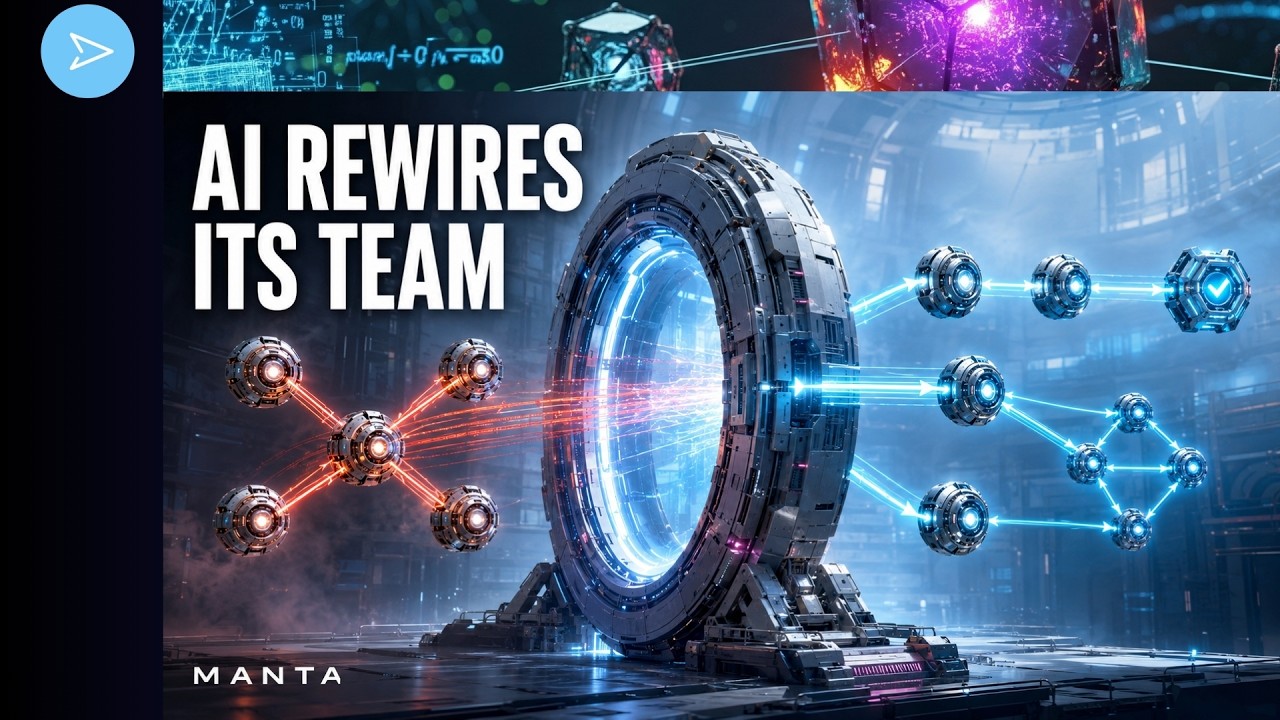
emerging here from diverse cohort in multi-agent reinforcement learning. So now we say listen we don't have just a single agent but now we go to multi- aent reinforcement learning mathematical complexities because we have to find a mathematics that we can then write into
Speaker A
that I showed you in my last two videos. So how to deal with this? Well, more or less the same solution. No, legal reinforcement learning creates now an in-process proxy. So instead of trying to guess which expert was used to look at
Speaker A
disturbs you or filters here the direct influence from the LLM to the environment. You have your GitHub repo.
Speaker A
the logs later, it now prints a carbon copy received inside the API at every exact millisecond here the word or the token is generated. So that means it physically records not just the token and the reorganization and everything,
Speaker A
same and in the end you have a training collapse for this particular reinforcement learning and we're not even talking about the complexity of a harness interface here now so the authors set up to show us now and they
Speaker A
but now we also add now which new pathway. This means which expert from our mixture of expert system was exactly routed to which expert fired, if you want, here, and then we do have also a log of this exact sequence of expert activation,
Speaker A
some cooperative multi- aent training in this RL phase so the authors introduce us to co-l a framework in which multiple decoupled EI models our LLMs or VLMs sharing no parameters are simultaneously optimized through reinforcement learning and you might say what
Speaker A
and then later when the training happens, no legal reinforcement learning mathematically forces now the gradient update to go down the exact path halfway as we recorded here when it was done. So you need this solution methodology because without it the mixture of expert
Speaker A
cohort of our peers. So you say okay so what is now here the idea now the idea is that you have here that this the authors want to show us let's formulate it in this way that this new reinforcement learning methodologies
Speaker A
model literally cannot learn through a proxy, and this would be not good news because remember at the beginning of my first video here we invented here the proxy solution th
Speaker A
So can EI self teach other AI models? Is it really emerging here some intelligence here without any ground truth labels which is if if I see this no without any ground truth labels I would have internally in my brain a red
Speaker A
flag going up saying hey we are not there yet with EI but whatever. So let's make let's follow this path by the order. So the question is how can an AI model obtain a sufficient independent learning signal for the reward functions
Speaker A
here for our reinforcement learning over and harness complexity to improve without any ground truth supervision by a human or you know it. How should this be possible? Well the answer is well they show us that such a signals can
Speaker A
emerge. Hm. Careful from independently trained other AI models. So you might say okay so we know where we are. AI trains AI doesn't need any human because AI is just superior.
Speaker A
Okay. So since the errors are not perfectly correlated and you say hey wait a sec and this is now a condition we imply on the complexity of other AI models. Each AI model can provide a corrective feedback that the other AI
Speaker A
model cannot derive from its own generations. So whenever you read this sentence, you understand. So we do hope let's it's reformulated in my words you hope that all the EI models if you combine them if you combine their thinking their
Speaker A
reasoning traces their action probabilities their sampling from their probability distribution on their particular pre-training data sets you hope that each mall has a different blind spot or makes errors in different region of your knowledge space. But if you combine three four different LLMs
Speaker A
together that then they will cover each other blind spot with the correct interpretation with the correct reasoning with the correct learning.
Speaker A
Now I don't know about you but let's go on. So you know we are about harness agentic RL beautiful. So this means we have a deploy time harness configuration that is directly involved in the logical language model or vision language model
Speaker A
post training. And now the main mathematical idea if I see it now from a mathematical perspective is a decorated supervision.
Speaker A
This is it. This is here the mathematical theorem one that you order to show you. Please read the paper. So to say hey what we have is co RL a cooperative multi- aent label free reinforcement learning methodology through a harness configuration
Speaker A
in which multiple decoupled mouse sharing no parameters are optimized simultaneously. So we have a one to one and one to many operation using rewards derived from their cohorts.
Speaker A
So you say okay now what how would I call this in human terms we have a team of human specialist and the the idea is simple no if I as a single individual cannot solve the task that I'm given
Speaker A
here or that I want to solve I'm looking here for support from other human specialists no so I form a team a group this is the reason why we have corporation while we have enterprises here you need all your specialist they
Speaker A
form some temporary orary working groups and then you can solve the problem here if you have 10 persons on board. Now the same idea you have 10 EI models on board and you hope this is now the solution.
Speaker A
So what a cohort teaches now in according to the artist depends on how different its mistakes are. What I call the blind spot or the incorrect solution. Now if you have highly similar models like you go here I don't know
Speaker A
with a let's say an entropic here um clawed 4.7 of then you go with a 4.8 eight you say hm they might have real similar pre-training and post-training data sets no so they tend to make correlated errors and this is not what
Speaker A
we want so we have to look for a cohort diversity that this is now crucial for the effectiveness of this co- reinforcement learning so we push it as far as the model allow it here different families of architecture and different
Speaker A
pre-train weight different model sizes different input formulation and I will show you the authors will go to the length to rewrite the prompt optimization here to have a different perspective, a different framing, but I will also show you the shortcomings of
Speaker A
their methodology. So the idea is simple compared to the classical one, the reward here from the mall's own view. So we have a core rewarding here beautiful and then you know we have this LLM as a judge here or
Speaker A
have either an internal or an external LLM as a judge. So this co- multi- aent system and now this new idea is you have the reward from independent quotation mark cohort models. So the idea is rather simple and just a continuation on
Speaker A
the development of we how we have here multi- aent system configurations. Huh? Now the key insight is that such a reinforcement learning signal can emerge from independently trained models since and this is the main assumption their errors or their blind spot or their
Speaker A
nonfunctionalities their noncorrectnesses are decorrelated. So one model covers for the other model. You have an expert in physics, you have an expert in mathematics, you have an human expert in finance, you have a human expert in chemistry.
Speaker A
So you can cover all the topics and what I don't know about finance, my colleague in the team knows about it. Now is this true for current eye or have all these current models some dependence on other models? No, you remember here the
Speaker A
discussion that some malls have been trained on other malls, no in a distillation process or that you [clears throat] see that some of the Cuban models, no they are not freshly pre-trained but they say yeah we take here the old whatever it was 12.9 model
Speaker A
and now we have the 12.95 model and we just had some post training but not a new pre-training set. So we do have inherent dependencies but the authors assume this is not existent. So all the errors are completely decorrelated. It was not
Speaker A
trained on the same internet. It was not trained on the same data set. It was not given here the same examples from the same books that were copied here from the internet. So everything is decorrelated. And then they have and I
Speaker A
have [clears throat] to tell you a real nice mathematical idea how they want to prove this. a new calf here, a new training objective that is here and I have a particular video here explaining here AI mathematics if you want. So this
Speaker A
is really nice and they also show you here a real nice example if you have this co reinforcement learning with two h and how this in theory if there's a complete decoupling of the system should work and I really want to underline this
Speaker A
now they really go into lengthy discussion here mathematical cross and supervision here enlarges here the bur of the cor convergence here and they say if this idea is of decorrelation is true then we can deduct and then we can
Speaker A
mathematically show and then I can prove you like here in the annexy of their paper they have 30 pages here real nice have a look they really really try to understand the mathematics and how to have to optimize the procedure and let's
Speaker A
have a look because now now the rubber hits the road no so is it working and now I just look here at a Q3 I'm not looking at a llama I'm not looking at a Q2 Well, I really go for a
Speaker A
Q13. Look, here we have and this is the blue box. Here we have all the benchmarks. Beautiful. And the end column is here the average. So, let's compare this new coal here, the very last line here in this table with the
Speaker A
classical TTRL, the selfrewarding with a majority vote. So, this is now here where we really should see now a major major improvement.
Speaker A
And you see here, just look at here the benchmark results here. Look at this.
Speaker A
And then you look at the last column, the average there. Here 47.3 compared to our new methodology that results in 47.3.
Speaker A
So multiple interpretation. Now I Yeah, there's not an advanced Q1 here. There's the classical Q13. Okay. there's only a 1.7B. Okay. So, but in general, if this is the data that the auto present to us and tell us, hey, look, we are
Speaker A
outperforming everything else. This is now the model that is here the the new idea.
Speaker A
H I would say okay, it is another method, but outperforming is Yeah. So let's think about this. We have now this is the third video and I would like to finish here this mini series here.
Speaker A
The first video with agent lightning gave us here the second video also including a mathematical foundation for this hornness AI structure with reinforcement learning. And then we went on here also in this video with legal reinforcement learning gives us here or
Speaker A
provides us here with the industrial reality and the the precautious measures we have to take.
Speaker A
And now the claim by col is it gives us now limitless fuel. We have now all the data that we need without any human scientists to create the AI work any human evolvement AI by AI for AI through
Speaker A
AI learning from other AI models because everything is decoupled everything is has a deccoherence everything is trained on different data but the question is is this true and honestly if you ask me I would say sorry not yet and the idea
Speaker A
that the mathematics and don't misunderstand me they have a beautiful paper they have a really really examined the mathematics and the idea that Matt will naturally pull all of this toward an intelligent reasoning would be a correct statement if every
Speaker A
single model that they use on this planet is absolutely in no way at all correlated to any other AI model.
Speaker A
But I do not think that this is currently the case. So I would say sorry but not yet.
Speaker A
Now you could write here of course if you want to approach it from a scientific level not just from a feeling level like I do here in this video you could write a scientific critique of this matter. No you say there's an
Speaker A
illusion of an independence between the malls and the thread of a shared blind spot overlapping blind spot. How do you deal with this? Huh? Because honestly, do you have a feeling that the authors clause over the inverse implication of
Speaker A
their own theorem? I told you theorem one, the most important theorem explicitly state that if the morals now face a task where some of their assumption is below their threshold, the system according to their own mathematics will asmtotically converge
Speaker A
to zero. And this means an absolute mathematically guaranteed failure of the methodology. So careful they have these beautiful mathematical deductions.
Speaker A
But what if the very first idea, the very first theorem number one does not hold and then we have to deal with it.
Speaker A
Now also I think to force the diversity the authors use different models deep fall three to rewrite the mathematical prompts and I like this idea don't get me wrong and they want to assure that the agent A and the agent B sees the
Speaker A
problems described in different words but you see this is it they should see it in different worlds not different words because here the critique is simple no a syntactic variance is not a semantic variance So renaming a mathematical problem about
Speaker A
I don't know vertical asmmptotes into a problem about temperature and a chemical reaction only decorrelates some superficial psing errors.
Speaker A
But it is not that the synthetic variance is suddenly a semantic variance. This is not true. So if both models lack the underlying mathematical capacity to solve some rational functions just rephrasing the prompt does not any magic to generate here a corrective
Speaker A
gradient here in the RL mathematics. Now I have a let's make it feeling I have not shown you the mathematical proof but I have a feeling this is just a cosmetic fix to a fundamental structural deficit.
Speaker A
So if you read this paper be aware that if you want to apply this there are limitation to this paper and I told you there's a fourth paper and the fourth paper it's now too late here to really have a deep dive into
Speaker A
this but please read it also August 18 2026 you see everything is culminating the whole research world is operating here on this problem decentralized agentic reasoning via capability grounding on collaborative sword navigation here and this is here from
Speaker A
Harvard University Engineering and Hong Kong Hong Kong Polytenic University and they have a beautiful idea you know and they operate with sort map navigation for targeted peer interactions and some topology update for adaptive error corrections something that is absolutely
Speaker A
beautiful I mean they even try to explain it here in very simple terms and therefore I leave you with paper number four on your own have a look at this I like this idea but you see how we try as
Speaker A
humans to find new ways to make AI more intelligence. So of course all the new models that will come in the next year are of course a chantic system. No where we have not only the LLM core where we
Speaker A
have some real complex harness structure and we have here complete communication chaos currently here in the mathematic for the reinforcement learning alignment. So how we can solve this in the future is more or less an open unresolved question. I showed you here
Speaker A
four different methodology to deal with the problems that we encounter today. And maybe you you can find here a new solution. And if you are here in AI research or you at the university, hey, have a closer look. Maybe you have here
Speaker A
an idea how to integrate something, how to come up with a new idea, with a new solution because this is exactly what we need currently. I hope you had a little bit fun. I hope you had some insight. It
Speaker A
would be great to see you in the next
Topics:agentic reinforcement learningharnessed RLmixture of expertsreward hackingrouting driftlegal reinforcement learningindustrial AILLMVLMAI training challenges