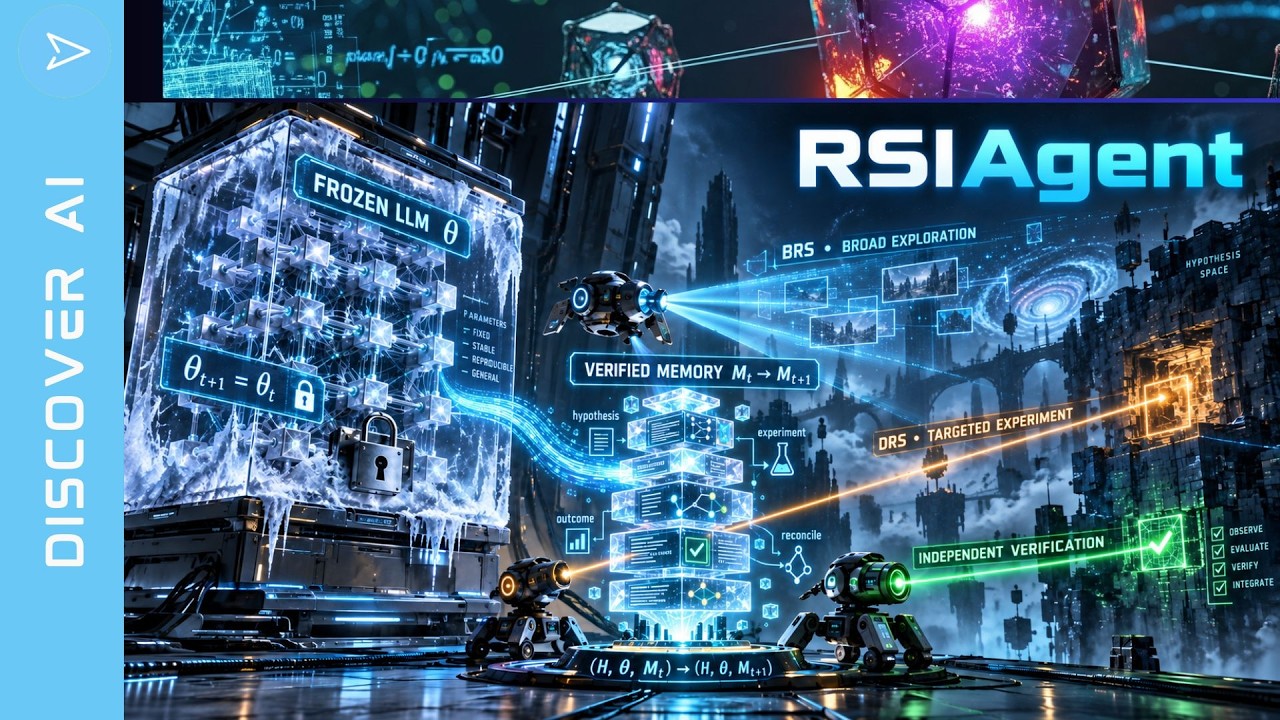
Self-Learning AI Swarm Intelligence (New Code, RSI) — Transcript

Explores new AI swarm intelligence with self-learning loops, orchestrator agents, and dynamic memory using Git for coding agent optimization.

Key Takeaways

  • Swarm intelligence benefits from a new dynamic memory structure using Git for managing distributed AI knowledge.
  • Long-running coding AI agents tend to fixate on a single solution, requiring mechanisms to encourage exploration.
  • The shepherd AI orchestrator supervises the swarm, focusing on global context and resource management.
  • Explorer agents start fresh with no memory to try novel approaches, preventing premature convergence.
  • Heartbeat mechanisms enable continuous self-reflection and redirection to avoid stagnation in AI learning loops.

Summary

  • Introduction to the latest research on AI swarm intelligence and self-evolving learning loops.
  • Discussion of a new memory structure for swarm intelligence beyond classical databases.
  • Review of Lilian Weng’s 2026 post on harness engineering for AI self-improvement.
  • Presentation of University of Illinois Urbana-Champaign’s swarm research focused on coding agents.
  • Identification of the problem of idea collapse where long-running coding agents get stuck in local optima.
  • Introduction of an orchestrator agent called the shepherd AI that manages strategy and budget without coding.
  • Explanation of two types of worker agents: explorer agents with blank memory and others for refinement.
  • Use of Git branches as a physical memory structure for managing AI swarm knowledge and experimentation.
  • Description of communication patterns, persistent memory, and collision handling among swarm agents.
  • Discussion of recursive self-improvement and heartbeat mechanisms to trigger agent self-reflection and stagnation handling.

Full Transcript — Download SRT & Markdown

00:00
Speaker A
Hello, community. Today we have a brand new research paper about the latest AI swarm intelligence. And of course, we have to talk about loop programming here, a self-evolving learning loop. Interested? So, let's start. So, let's come back here to the
00:18
Speaker A
current century and let's say we have 50 AI agents operating here in a lab. Now, what you want is maybe each of those little agents here is discovering something here, you know? But it's not able to understand where the information
00:32
Speaker A
belongs here in the total view. So, therefore we have to come up with a new memory structure, not a database, not the classical one, but we go today with some crazy idea for here the memory of here the swarm intelligence. Given here
00:47
Speaker A
that each swarm member has its own intelligence, of course, because it has to do its own particular job.
00:53
Speaker A
You might say, "Hey, wait a minute. In the last two videos, we already talked about self-evolving agents here." Yes, and in this video here on the left side, we talked about here an optimization of the core of the agent, the pure
01:07
Speaker A
currently the LLM. And then here at this video with how say we talked about, "Hey, we can build a little tiny 8 billion system that simply outperforms a 120 billion system if we just have an optimization here after the LLM, a
01:23
Speaker A
reinforcement learning here, a continuous learning procedure that is happening in parallel here with the harness optimization here of multiple harness modules like memory or skill.
01:35
Speaker A
Also, let's have a look now today. We have an interesting here a new post.
01:40
Speaker A
This is here by author Lillian Wang. You know her from OpenAI. Well, now I think she is with Sinking Machines in San Francisco. So, she posted here July 4, 2026, the harness engineering for self-improvement. And I love this post.
01:56
Speaker A
This is a beautiful literature review. Please read this if you want to get familiar. I highly recommend this post.
02:02
Speaker A
We have here the HTTPS link here to get you up to speed because now we're going to build on this post and I will show you here some new elements that is really exactly what she at the end of
02:14
Speaker A
this blog really requests for the future. We will implement it today. We are talking about a joint optimization here with the model weights and of course remember in my last video where we were talking about the reward hacking here in the self-improving loop
02:31
Speaker A
optimization and a mathematical optimization. We will take care about this. So, let's start. We can see if the video on Harish it was about an AI upgrading its own tool and fixing its own bugs without any human interaction. Lilian Weng's blog was here
02:48
Speaker A
kind of the road map of where the industry is going here was going in the last 6 months and a short very short timely projection here what's going to happen here. The next step of AI development and she was absolutely right
02:59
Speaker A
because I can show you today the very latest publication just 3 days later exactly in the direction that was already hm to be expected.
03:10
Speaker A
Let's talk about swarm research. This is a master class in how to organize an AI working memory of the complete swarm structure and a workflow optimization where we take now about a particular harness situation and a particular training here of the LLM itself.
03:28
Speaker A
Anyone else? Which LLM particular? Well, wait a second. So, here we have a 2nd of July 2026. This is University of Illinois Urbana-Champaign and the title of swarm research on orchestrating here the coding agents. Yes, absolutely. We go here for the coding agents and not
03:45
Speaker A
for open-ended for open-ended discovery. So, the task is open-ended but our agents are limited here to coding.
03:55
Speaker A
Hm. Now, long-running coding agents such as auto research can persistently discover optimization for open-ended problems.
04:02
Speaker A
However, it turns out that there's a main problem. They tend to converge onto a single high-level approach.
04:10
Speaker A
And this is it. Mhm. So, this kind of depends on the two honest level design choices here that currently we do here with our auto research or a swarm research elements.
04:23
Speaker A
So, have a closer look. Yeah, you'll find of course here the GitHub repo here beautiful. Everything is there. You have a detailed explanation here of the cost.
04:31
Speaker A
We come back to the cost they run this with a GPT-5. 5.5 high. And they give you here the weekly limits here if you go with a jet GPT profile x here of May 26, 2026. This is about 7%
04:45
Speaker A
of the weekly limits. But careful because it will become very expensive real soon. If you have here that you really let those swarm intelligence because you have to pay for each little token of each element of the swarm. So,
05:00
Speaker A
careful. I will give you here the details here of how much it costs at the end of this video.
05:04
Speaker A
We talk about skills here, different skills. And of course, as you see here, we have an orchestrator. And you say, "Oh no, my goodness. We still have here the boss AI." Yes, we still have a boss AI, but it gets interesting. Promise.
05:20
Speaker A
Now, the boss AI is called here the shepherd AI. Now, that sounds much better. And you have here here the prompt. So, this is here the defining prompt. Have a look at this in the annex C. Here they give you here exactly here
05:32
Speaker A
how to organize a population of search agents and what is your task. It is a very richer system, but let's work with it because this is not a problem. The problem is something else.
05:43
Speaker A
And we already talked about it that we do have a gap. And we call it here the idea collapse here of AI auto research system or swarm research system.
05:54
Speaker A
Your swarm research orders identify massive problem with long-running code agents, and I mean here cloud code in particular because they tested your cloud code. If you let any I run your cloud code with 12 hours on a single
06:07
Speaker A
problem, what they found is it usually comes up here with one decent high-level idea in the first 20 minutes and then spent about more than 11 hours obsessively making micro edits to that single idea.
06:22
Speaker A
So, what it means, the system is simply trapped in a local optimum. So, this means we are not exploring five great ideas, but the very first idea that we find is, "Hey, this is it." And then the complete system just goes
06:36
Speaker A
more or less in lockdown and it's just doing here micro optimization to this single one idea. And it is not exploring here the complete space. So, we have to take care about this problem.
06:50
Speaker A
And they tell us, "Hey, if the AI works here in a long chat thread, its context window gets clogged with all the history of its current approach." And they tell us here the what they call anchored, [clears throat]
07:01
Speaker A
so their context window is here filling up, filling up, but it is completely anchored to the first solution that the system found and is not exploring further.
07:10
Speaker A
Hm. So, solution, it is simple and you know it no? We have now an orchestrator sub-agent harness system. It separates now the AI into two roles, if you want, and it uses your software engineering tools that you
07:24
Speaker A
know, this is a Git as the AI's physical primary memory structure. So, we reuse things that we know like Git, and we built here a new memory structure, but of course the question is, "How do we build this dynamic memory
07:39
Speaker A
structure for all the swarm members, no?" So, let's have a look. Yeah. I told you we have an orchestrator agent here, the shepherd agent. I call it the boss.
07:50
Speaker A
The agent does not write code at all. This is here really the supervisor. Only looks at the global context question, huh?
07:56
Speaker A
A high-level summary of what all the worker agents are doing. Its job is budget management and strategy and the typical what do you know about here, the orchestrator.
08:06
Speaker A
Now, what is really interesting if we have a swarm, we have now workers, but we have two different kinds of workers.
08:12
Speaker A
The first one to call explorer agent. They are spawned with a completely blank memory context and the shepherd drops them into a new Git branch and says, "Try something crazy." And I like this approach because you give more or less
08:25
Speaker A
complete freedom to the AI. Because they have no memory of past failures or some macro edits, they make massive high-level code changes.
08:37
Speaker A
So, they rewrite code in a crazy way, but in a massive new way. And then we have a second kind here of worker. Those are the optimizer agents.
08:48
Speaker A
So, when the explorer agents find maybe a good idea, the shepherd spawns an optimizer agent on that particular Git branch. And the optimizer inherits now the exact chat history allowing it to do the deep incremental refinement work.
09:04
Speaker A
This is now necessary to get this crazy idea, crystallize it in pure beautiful code, and insert the code back into the machine.
09:13
Speaker A
So, you see, we have here a Let's call it a crazy genius here, the explorer agent.
09:20
Speaker A
This is the job of the explorer agent to make huge steps. Then we have the optimizer agents that more or less doing baby steps just to find the deep incremental refinement here of what we found.
09:31
Speaker A
But I told you the most interesting thing is here the communication uh pattern here between here this swarm itself, and the memory sharing. Now, we have here persistent memory that you see at the Git management. So, this means
09:44
Speaker A
every single idea lives in its own parallel Git branch. So, this means on the other side, the completely AI system never loses a good alternative idea because nothing, and really underscore nothing, is permanently overwritten.
09:59
Speaker A
We have a Git tree. So, this means you all the limitation you have from your context window also by out what so ever, doesn't come anymore because we've chosen a persistent memory that is a file system.
10:14
Speaker A
Now, memory as Git work trees is here what we're going to talk about, and as I told you, Git is a Yeah, you know Git a version control, but a Git work tree is a specific Git feature that lets you have
10:25
Speaker A
multiple different branches checked out into multiple physical folders at the exact same time on your hard drive or cloud or whatever you have, now.
10:34
Speaker A
So, let's go through this. So, we have multiple steps. So, let's start with this workflow. First, when the shepherd agent, the boss, comes in, decides to test three different high-level ideas, now. It doesn't do this here in one
10:47
Speaker A
memory folder. It runs commands to create three physical work trees. So, we have the work tree of researcher one, this is the task given exploring a mathematical approach. Researcher number two in its work tree is exploring a system approach. Researcher three gets a
11:02
Speaker A
new work tree exploring here the heuristics approach, and you get the idea. And we will talk about an idea where we have 50 agents.
11:09
Speaker A
So, when an explorer agent is now spawned, its chat history is completely wiped clean. No Siri tokens, we have nothing now.
11:17
Speaker A
It is simply dropped into the folder, let's say researcher two for the system approach now.
11:21
Speaker A
And the agent instantly remembers the state of that exact approach just by typing here this simple command, and the files on the disk act as its memory. Of course, it's a file system, Saving us thousands of context window
11:35
Speaker A
token and tens of thousands of token, no? Step three, if the researcher two is a dead end, the shepherd agent doesn't have to delete the code. It just stops spawning the agent for that particular folder. But you know what? Maybe 3 days later, the
11:50
Speaker A
shepherd realizes from some other agent doing something completely else that, "Hey, this researcher two found a missing piece of code that we can use now as a puzzle in our complete system." It realizes that the dead end was
12:05
Speaker A
actually a brilliant idea. Yes, of course. And it simply drops your new optimizer agent into that exact folder here of researcher two.
12:14
Speaker A
So, you see the exact physical state of the code base was frozen in time just waiting for it to be reactivated and now reintegrated here in a changed swarm intelligence pattern and manifold.
12:26
Speaker A
And step four, if the researcher, let's say one and the researcher three, both find, of course, half of the correct answer, the shepherd can physically run a git merge between the two folders, no?
12:38
Speaker A
No crazy AI stitching. You have a file system that handles the collision of the two ideas. Mathematically precise.
12:44
Speaker A
Perfect. Now, think about this. If you read, please, really read Lillian Blank's July 4th blog post as I showed you here, this is now exactly what she's asking for for the architect of the future.
12:57
Speaker A
Because if you look at her pattern two, file system as persistent memory, this is exactly what we implement here in this new paper.
13:05
Speaker A
Blank said AI shouldn't carry all its sword in the prompt, no? Because then we have an avalanche here of our context window in our prompt, no? Yeah, let's use files. What a beautiful idea. So, swarm research literally uses here the
13:18
Speaker A
git branch, the git merge, and the work trees to manage here the AI swords of a complete swarm.
13:26
Speaker A
And read about her pattern three sub agents and back end jobs when predicted apparent agent launching jobs and inspecting logs to avoid polluting here the main context. And this is exactly what the shepherd agent is doing in this
13:40
Speaker A
new paper. But you know what? We are not limited to that because if I start up now my old brain here, you know, the old steam machine here. I have just to pull a little bit here on this wheel and then
13:51
Speaker A
the spinning starts up. We can say, you know what? One of my last videos where we looked at Hazer and the current paper on the swarm research, you can see those as just two halves of what Lilian described as the
14:05
Speaker A
recursive self-improvement holy grail. Why? Think about it. What is Hazer's strength? It is incredible at the vertical optimization, it physically patches the code of its own tools and secures its own evaluator while updating here the model's actual neural weights and the tensor structure
14:24
Speaker A
here into different layers of the transformer. But it operates as a single agent, of course. It has enough complexity, meaning it might still might still suffer from the idea collapse this swarm research talks about now.
14:38
Speaker A
Now, the strength of this new approach here is to horizontal exploration. Just span up 50 agents. It doesn't update your model neural weights and it doesn't edit the system tools at all.
14:49
Speaker A
Instead, it just masters and if you want, just masters the organization. Spawning parallel workers in Git branches, so that system never gets stuck in one bad idea and one local minimum or maximum, whatever you have.
15:04
Speaker A
And if you put this together, a vertical optimization with a horizontal exploration, you see we are back again exactly what we had, I don't think, 10 years ago in reinforcement learning.
15:15
Speaker A
Exploration versus exploitation. And it is the same mathematical apparatus that we can immediately remember that we could use here now for this particular problem.
15:29
Speaker A
Now, let's imagine here is one research shepherd agent on the boss agent and imagine managing now 20 to 50 parallel explorer agents.
15:37
Speaker A
And now what we just have to modify here this paper is that every one of those explorer agent is now powered by Haas at the video, the one of the last videos, no?
15:47
Speaker A
And this is simply because we have the code of Haas, you know? So, meaning now we go a step further beyond this warm research that we just talked about.
15:56
Speaker A
And now we say, you know, meaning they're not just trying to solve the problem, they're actively upgrading now its own coding tools, the explorer agent, and at the same time training their own neural weights in real time.
16:10
Speaker A
And I think this is maybe the next step in AI. Why? Because we have a system dynamic.
16:16
Speaker A
We don't only optimize here the LLM, the neural weight here, the tensor weight structure of our core of the agent, where we do not optimize just the harness here, the skill MD files, the memory MD files, the cloud MD files, the
16:28
Speaker A
finding MD files, or HTML files, or JSON file, or whatever you have from the harness, but we see this as a linked complexity that we have to optimize mathematically together. So, therefore we need a new mathematical optimization routine for a
16:47
Speaker A
connected complexity trade. Now, I know what you will say. I I say the same thing. Hey, wait a minute. We have Coral. Why do this? Well, let's have a look. Now, remember Coral, here middle of May 2026, and everybody was
17:04
Speaker A
there, you know? MIT, Minimacs, here Stanford SambaNova Meta Singapore MIT, Amazon, Microsoft. And they all came together to develop some autonomous multi-agent evolution. And now for the open end of discovery, you know? because we want to have the open-ended
17:21
Speaker A
discussion here with a customer, let's say Microsoft or Amazon is interested in and maybe sell them more products, no?
17:29
Speaker A
So, what was Coral? If you're not familiar, please read the paper. It's essential. I would benchmark it against Coral later on.
17:36
Speaker A
This was the my knowledge the first framework for autonomous multi-agent evolution on open-ended problems. So, it replaces a rigid control with long-running agent that explore, reflect, and collaborate through a shared persistent memory, asynchronous multi-agent execution, and heartbeat-based intervention. And I
17:55
Speaker A
think for me personally, the heartbeat-based intervention was really the novelty, the innovation of this paper no?
18:03
Speaker A
Yeah, here we have a comparison of the three paradigms of LLM-based open-ended discovery. And of course, we go here with the most complex, where the agents read from the shared memory, multiple agents propose in parallel, each agent schedules here the evolution of the
18:17
Speaker A
agent right here to the shared memory. Great. Now, in the Coral framework, the autonomous agent operate in isolated work trees, iteratively propose and evaluate the candidate solution, and accumulate shared persistent memory, no?
18:32
Speaker A
Attempts, nodes, kills, all through the hub. And it was the heartbeat-driven periodic reflection that helped now the agent to consolidate their discoveries and reorient the search over the long horizon. And I have here a simple example here from the original paper of
18:48
Speaker A
the authors here. This is a screenshot from their publication to show you this. Now, a heartbeat event may be predefined or created by the agent itself, no?
19:02
Speaker A
And agents forgot, and this was the main cause to forget to consult and contribute to the shared persistent memory. So, the authors here in Coral decided to encourage now a behavior that we want as human that Carl imposes now a
19:17
Speaker A
particular heartbeat mechanism of three particular levels of heartbeats that function more or less for us like a reminder app, no? Periodically prompting the agents because this AI machines are so stupid to exercise now self-reflection after every 3 seconds,
19:34
Speaker A
every 5 minutes, every day, whatever. And pivoting for new ideas when existing approaches plateau.
19:40
Speaker A
So, this triggering mechanism here was this particular heartbeat. Now, you know if you have to read the paper now that we have three heartbeat types here and I do this here for the memory update, for the memory activation. The first heartbeat was a
19:57
Speaker A
per iteration reflection heartbeat, which encourages the agent to record useful notes during ongoing work. So, the agent was not just working, working, working because every, let's say, 5 minutes here, the heartbeat ping helps the agent capture now your observation.
20:13
Speaker A
What is your state of the system? The second is a periodic consolidation heartbeat triggering after the fixed number of attempts, which prompts the agent to review its own progress.
20:24
Speaker A
Now, to organize and refine all the accumulated notes and kind of distill some reusable procedures maybe already into skill and D files.
20:35
Speaker A
Remember this new workflow optimized. Yes, this is validated here beautiful. We find a new methodology to do this experiment. Let's write it down as a new skill file and we put it in the skill bank.
20:46
Speaker A
Or in other words, well, the first supports the note-taking during work. So, write down what you're doing every 5 or 10 minutes. The second focuses on organizing these notes and building skills from them because we want a file
21:00
Speaker A
system no? Now, the third heartbeat is now a stagnation triggered redirection heartbeat activated when the agent shows no improvement for several rounds, which prompts it to reassess the current direction and decide whether to continue. You tell this your beloved
21:20
Speaker A
agent, "Hey, my little buddy, you are sitting here in a pit 2.5 m deep and there is no solution. You better come out here and you start exploring here the rest of the beach that is right in front of you."
21:33
Speaker A
So, revise the strategy or pivot to a different line of search, come out of your local extrema.
21:42
Speaker A
And then, this was the sentence that was one for me, one of the most interesting sentences here of Coral. They authors told us, "Hey, our agent discovers solution that no single agent ever finds even when the later single agent is
21:55
Speaker A
given here four times to compute." And I said, "This is interesting. So, we do have to have this kind of specialization." With this knowledge now about Coral, let's go back to our original paper and let's remember what the authors already
22:13
Speaker A
found. The authors told us that long-running autonomous AI scientist after 12 hours with cloud code or with Coral, it suffers from a phenomenon we call the idea collapse or a bit more specific, the greedy local search. So, when given a massive
22:28
Speaker A
open-ended optimization problem, they quickly lack latch onto one decent high-level approach and they maintain a single ever-growing conversation history, the context accumulation, and only override a single program file, a single state editing. So, they become structurally anchored. This is where we
22:47
Speaker A
left off. So, how is this system now working on new system? As I told you, we have a shepherd agent, beautiful, and then we have explorer search agent and optimizer agent.
23:02
Speaker A
So, the idea is simple. The shepherd agent has more or less three things to do. Or three per agent steering mechanisms.
23:11
Speaker A
We have either selecting a parent solution by setting up its Git branch, or writing a prompt here to share minimum context, or selecting here a particular search agent type. So, either the explorer type or the optimizer type.
23:26
Speaker A
So, this are the more or less these three actions, no? And you know about explorer and optimizer. Great.
23:33
Speaker A
So, let's have a look now a little bit closer in the global context. What is the shepherd agent, the boss agent doing?
23:39
Speaker A
Of course, it acts as an orchestrator of the complete swarm intelligence, yeah. But, it does not write code. It manages the token budget and use only a high-level findings markdown file containing now the scores and the summary from all the other agents or
23:53
Speaker A
sub-agents. And now the shepherd agent execute here, given here this particular paper, three steering mechanisms.
24:01
Speaker A
So, a parent selection, this means nothing else than the branching. It chooses which Git commit to expand next.
24:09
Speaker A
The agent type designation. It launches either the explorer agent or an optimizer agent on this particular Git. And the prompting. So, it injects minimal strategic context without prescribing exact implementations. Let's say this is a part of agent number 51 to
24:26
Speaker A
agent number 13. Inject minimal strategic context here, whatever the other elements of the swarm were detecting or finding out or discovering or innovated.
24:37
Speaker A
Share it with the other workers. Now, the explorer search agent here, responsible for fresh context, no?
24:46
Speaker A
Assigned to a brand new Git work tree. Crucially, they give a complete blank conversation history at the very beginning, of course. And this isolation forces them to look at the baseline code with fresh eyes, triggering as you know,
24:59
Speaker A
as we already talked about a massive high-level code rewrites rather just some small tweaking. Yeah, we really want to move the world.
25:07
Speaker A
And the optimizer search agent now in detail easy the refined improvement node in the tree and they initialized by literally forking in the cloud session history with this command allowing them to continue a deep serial line of reasoning without losing the historical
25:23
Speaker A
context of what micro edits already failed. If you have now uh interesting feeling to say but exactly how is this Git management working here for the search agent? I think it's interesting, huh?
25:39
Speaker A
So, the shepherd agent assigns every search agent to a new Git branch and work tree. We talked about this.
25:46
Speaker A
The main branch now contains only the initial task setup and this is in the prompt MD file.
25:52
Speaker A
And this file defines here the problem and a minimal work baseline solution. Now, the branches can start from the main. This is here in orange as you see here the main dots here in these elements to try a new from scratch approach or
26:08
Speaker A
from a complete search agent commit to iterate on a prior solution. Now, as I told you but 3 days later or as I showed you here we have here the discovered one and discovered three then merge multiple branches to combine different solution
26:23
Speaker A
mathematically simple. Now, if we do this, let's have a look what is now the result because we want to know, hey, before we implement this, is this thing working?
26:34
Speaker A
So, for mathematics for systems and heuristics, what a coincidence, we have here other benchmark data. So, Coral, this is what we talked about and here in this blue box I've given here you the result here from this new swarm research
26:48
Speaker A
methodology. Now, you see it is really here and you see this here on the bold type results here outperforming the other system, but it is not a complete outperformance.
27:03
Speaker A
Sometimes, as you see here with prism here all the systems have 26.26%, so great. But otherwise, sometimes Coral is still in the lead, maybe a tiny tiny little bit, but yeah, whatever. No?
27:17
Speaker A
So, but it seems to be the right direction to go because it is really having overall better results than Coral.
27:26
Speaker A
Now, let's talk about the operational side. So, at first, we use here or the authors use here Opus 4.6 here as the code and publicly available implementation.
27:37
Speaker A
Please have a look for the details in the paper itself. Highly recommend that you have a look at this.
27:41
Speaker A
And talking about money, this warm research on multi-agent baseline Coral used Claude code and they spent about $50 per task here of this particular benchmark.
27:55
Speaker A
However, as you see here, Evo X here runs for 100 iteration and here you have only about $23.50 per task on average, so this is cheaper. Of course, the more you improve here the performance and the more the results go up, you have to
28:11
Speaker A
spend more on tokens. What is interesting, and I'm not sure if this is conclusive.
28:18
Speaker A
What the authors want to show us here with figure six is here the lines of code that changed per attempt by Swarm research against the baselines. And you see here for different topics here in orange here the Swarm research and you
28:32
Speaker A
have on the x-axis here the line of code changed per attempt. And you see we have here beautiful dominant orange indicator here, surpassing all the other methodologies.
28:44
Speaker A
Now, the argumentation is that if you map out these lines of code change per commit, the researcher proved and this is the approved where I would say, "Hmm, careful." that this swarm research makes changes 3.2 larger than Coral and 1.7
29:00
Speaker A
larger than Evoques. So, it successfully avoids the macro optimization trap and fundamentally tests diverse high-level architectures.
29:11
Speaker A
Now, okay, you can accept this, but I would say I don't think that just the amount of lines of code without looking at the quality of the code or what the code does is an indicator that we avoided the macro optimization
29:27
Speaker A
trap. I think figure six is a little bit soft in its argumentation, but as you know, so by dynamically deciding whether to fan out horizontally with multiple explorer agents or to dig dig deeper into the sand here deep vertical chain
29:45
Speaker A
of optimizers here, this job of the orchestrator guided scaling mathematically outperforms here according to the authors, the best possible statistically configured grid systems here in four out of five tested tasks.
30:00
Speaker A
And yeah, absolutely, it it shows here a good overall performance and it outperformed overall, but Coral was as I showed you real close in some tasks and sometimes even outperformed here this new shepherd agent orchestrator guided swarming intelligence configuration. Hmm.
30:22
Speaker A
So, you see, maybe it is only one of the first step. It is not yet a final solution. It is not that you can implement this and say "Great, it is stable. It is running. It is outperforming. It is
30:35
Speaker A
current a prototype, a development phase." Let's talk about the limitations of this paper. I think the core capability bottleneck of the paper is easily managed, no? Why?
30:47
Speaker A
Swarm research manages the workflow brilliantly here of the communication topology and the if you want instruction hierarchy, but it cannot fundamentally increase the baseline creativity or the reasoning limits of the underlying LLM. So, we are operating here more or less in a harness
31:05
Speaker A
configuration, no? But, we want to optimize here a system-wide mathematical optimization. And you know here, I showed you here the solution to this problem here is simply here in this video about next-generation self-evolving agents with here this new
31:20
Speaker A
data protocol where you can have a Hermes agent, you can have all the other agent frameworks that you would like. We have a new standardized protocol and we can run here this self-evolving agents to optimize here the tensor weight
31:35
Speaker A
structure in the LLM via reinforcement learning. So, the solution for this is already available. We just add this here to the complexity of the current paper.
31:46
Speaker A
But, and I think this is really if we test this and remember this are all open-ended really discovery LLM architecture and especially if you go with 50 agents in a swarm architecture, it is really expensive. And just to give
32:03
Speaker A
you here and I like that they give us here some clear uh figures here.
32:08
Speaker A
They tell us here just to run a 15 task benchmark here once without a validation or anything cost them about $1,700.
32:17
Speaker A
So, you see wherever you have open-ended discovery LLMs, it becomes really expensive real fast.
32:25
Speaker A
So, careful if you decide to build this and run your experiments, maybe don't pay immediately cloud code, but maybe go with here some local models that you can run in your own machine or really set clear financial limits that you want to
32:40
Speaker A
what you ever you want to spend. Because, yeah, two to five thousand dollars is with some evaluation and benchmark and further improvement immediately and out of your pocket and gone. So, careful if you personally run this test, you have to take some
32:56
Speaker A
measures here that finance is not out of bound. Anyway, I think it's a beautiful study. Have a look at this. Some beautiful insight and I hope to see you in my next video.
Topics:AI swarm intelligenceself-learning looporchestrator AIexplorer agentsGit memory structurerecursive self-improvementcoding agentsLilian WengAI optimizationreinforcement learning

Frequently Asked Questions

What is the main problem with long-running AI coding agents?

They tend to converge on a single high-level idea early and then spend excessive time making minor edits, leading to a local optimum and lack of exploration.

How does the shepherd AI orchestrator function in the swarm system?

The shepherd AI acts as a supervisor that manages global context, budget, and strategy without writing code, coordinating the activities of worker agents.

Why is Git used as a memory structure in this AI swarm research?

Git serves as a physical memory structure that manages branches for different AI agents, enabling dynamic memory sharing, version control, and collision handling among swarm members.

Get More with the Söz AI App

Transcribe recordings, audio files, and YouTube videos — with AI summaries, speaker detection, and unlimited transcriptions.

Or transcribe another YouTube video here →