Skip to content
Get App

Why Did Evolution Keep Autism?

Explores the evolutionary puzzle of why autism-linked genes persisted, linking them to human brain evolution, intelligence, and ancient survival roles like tool-making and tracking.

Key Takeaways

  • Autism-linked genetic variants appear to have been maintained by natural selection, not simply left as harmful leftovers.
  • The traits associated with autism may have contributed to human intelligence, tool innovation, and survival in ancient environments.
  • Autism is best understood as a polygenic spectrum shaped by dosage and environment, rather than a single gene defect.
  • Rising diagnosis rates may partly reflect a mismatch between ancient genetic tendencies and modern social and sensory environments.

What the video covers

  • A 2017 Yale study found autism-linked gene variants show signs of positive selection rather than fading out, a puzzle given reduced reproduction rates among autistic people.
  • Autism is roughly 80% genetic and polygenic, meaning hundreds of common variants combine, similar to how height is inherited.
  • The same variants correlate with higher childhood intelligence, more years of schooling, and faster brain cell growth.
  • A 2025 Stanford study found human layer two to three excitatory neurons evolved unusually fast, by dialing down stabilizer genes that overlap with autism-linked genes.
  • The video argues that a moderate dose of these variants may have been beneficial, while a double dose can overwhelm sensory and social wiring.
  • Simon Baron-Cohen's 'hyper-systemizing' concept suggests rule-based, detail-focused thinking was valuable for tool-making, hunting, and foraging.
  • Heightened sensory sensitivity would have helped early humans detect threats such as predators or spoiled food at night.
  • Ice Age cave art, with precise detail and photographic accuracy, is presented as possible evidence of detail-focused minds in prehistory.
  • Solitary foraging roles and resistance to conformity, like in the Asch line experiment, may have suited some individuals to long isolated tasks.
  • The video concludes that human evolution favored a diverse team of cognitive styles, and rising diagnosis rates reflect evolutionary mismatch with modern environments.

Answers

Questions about this video

What did the 2017 Yale study find about autism-linked genes?

The researchers, Renata Poli Monti and Joel Gelernter, found that autism-linked gene variants showed signs of positive selection rather than fading out. The video presents this as surprising because autistic people have lower reproduction rates.

How does the video explain the link between autism genes and intelligence?

The video says the same genetic variants correlated with higher childhood intelligence, more years of schooling, and faster brain cell growth. It describes a moderate dose as tuning the brain for speed and pattern recognition, while a heavy double dose can overwhelm sensory and social wiring.

What role does the video suggest autistic-linked traits played in ancient societies?

It suggests hyper-systemizing thinking, sharp sensory awareness, and detail focus were valuable for making tools, foraging, hunting, and detecting threats. The video frames these traits as a team asset, with diverse cognitive styles helping early human groups survive.

Full Transcript — Download SRT & Markdown

00:00
Speaker A
In 2017, a team of geneticists at Yale University went looking for a broken piece of code inside the human genome. They were scanning thousands of DNA samples to track the common gene variants linked to autism, expecting to see the usual
00:14
Speaker A
footprint of a harmful condition that biology is slowly trying to weed out over time. Instead, when researchers Renata Poli Monti and Joel Gelernter looked at the results, they found the exact opposite of what textbooks predicted. Those autism-linked genes
00:29
Speaker A
weren't fading away at all. They showed clear, unmistakable signs of positive selection, meaning that as our ancient ancestors evolved into modern humans, nature was actively keeping those genes and spreading them through the human family tree on purpose. And
00:44
Speaker A
that single discovery created one of the biggest puzzles in modern biology. Because in the modern world, autism is almost always talked about purely as a medical disorder. Large-scale twin studies and DNA sequencing show that autism is roughly 80% genetic, while
01:02
Speaker A
population studies show that autistic people today are much less likely to marry or have children than the average person.
01:09
Speaker A
On paper, any inherited trait that lowers birth rates generation after generation should quietly vanish from the human gene pool within just a few thousand years. Yet autism never vanished, and it shows up in every human population on every continent on Earth.
01:24
Speaker A
Even wilder, genomic studies show that many of the genetic variants behind autism are hundreds of thousands of years old, dating back before modern humans even split from Neanderthals.
01:35
Speaker A
Which means that for 99.9% of human history, those genes weren't a bug in the human operating system. They were doing a job so important for human survival that our species could not afford to lose them.
01:48
Speaker A
To see what that job was, we first have to clear up a myth about how autism is wired into our DNA. Most people talk about genetics as if there is a single switch for everything, like one gene for
01:59
Speaker A
tall and one gene for short. Autism doesn't work like that. While a small share of cases involve rare brand new mutations, most of the genetic pull toward autism comes from hundreds of common gene variants working together.
02:11
Speaker A
Scientists call this a polygenic trait, which is the exact same way your body builds height or skin color. Millions of people walking around today carry dozens of these autism linked variants without knowing it.
02:22
Speaker A
And when you carry a moderate dose of those variants, something remarkable happens to your brain. In the Yale study, those same genetic variants correlated strongly with higher childhood intelligence, more years of schooling, and faster growth of new brain cells. Think of it like tuning the
02:37
Speaker A
engine of a race car. If you turn the dial up a notch, the engine runs faster, spots patterns quicker, and solves harder problems. If two parents both carry a heavy load of those variants and pass a double dose to the same child,
02:50
Speaker A
the engine is tuned so high that the sensory and social wiring can get overwhelmed.
02:55
Speaker A
In 2025, biologists Alexander Star and Hunter Fraser at Stanford University found the smoking gun for this trade-off inside the human brain. Across almost all mammals, brain evolution follows a strict safety rule. The more common a type of brain cell is, the slower it is
03:12
Speaker A
allowed to evolve. When a single cell type makes up a huge chunk of your brain, changing its genes is risky because one bad tweak can crash the system. Yet, when the Stanford team compared human brains to the brains of
03:24
Speaker A
chimpanzees and gorillas, they found that humans broke that rule completely. The most abundant type of neuron in the outer layer of the human brain, known as layer two to three excitatory neurons, evolved at breakneck speed after our ancestors split from other apes. Those
03:41
Speaker A
cells wire different regions of your brain together, so you can use complex language, plan ahead, and think abstractly. And how did evolution upgrade those neurons so fast? It dialed down hundreds of stabilizer genes that normally keep brain wiring quiet and
03:55
Speaker A
predictable. And those exact genes are the ones linked to autism today. So, autism isn't a random error that happened alongside human intelligence.
04:04
Speaker A
It is the price our species paid to become smart in the first place. But evolution didn't just tolerate people on the far end of that spectrum as a side effect. Once early humans were living in hunter-gatherer bands, having
04:16
Speaker A
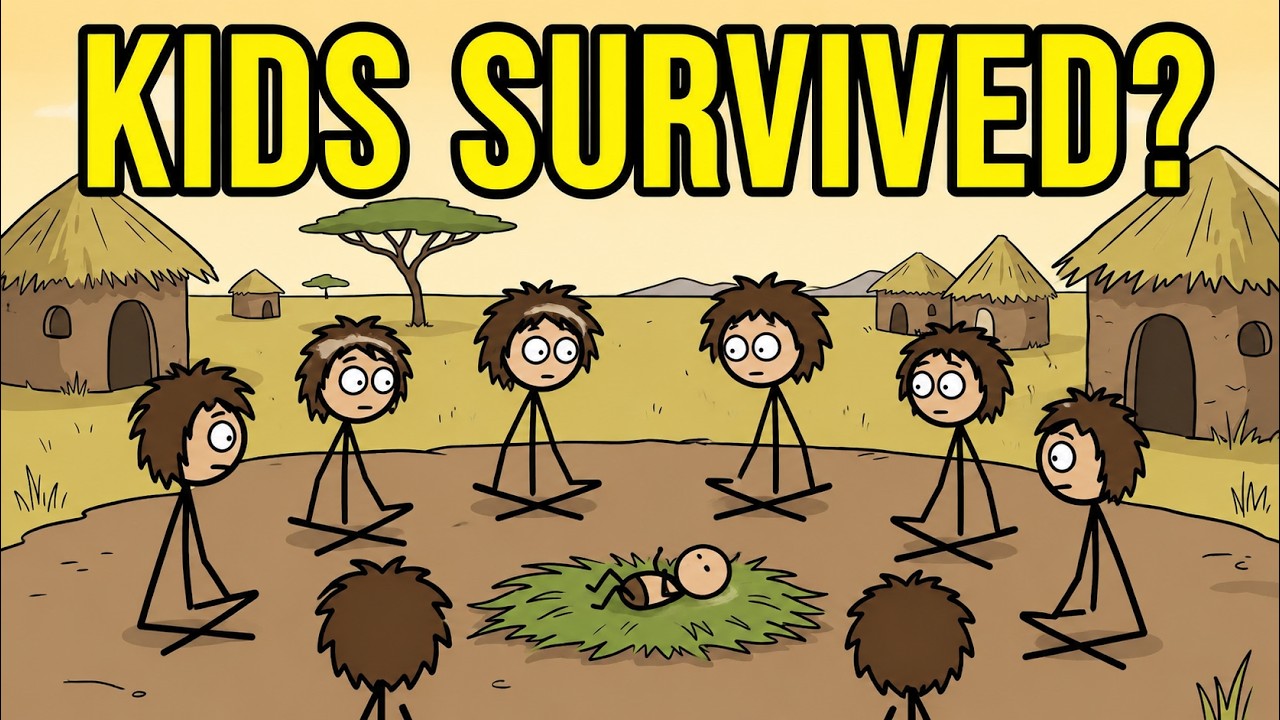
a few autistic minds inside the tribe turned out to be a massive survival advantage. Put yourself in a campsite 70,000 years ago in the middle of the last ice age. There are 50 people in your band. The temperature is dropping
04:28
Speaker A
below freezing and the herd you hunt hasn't shown up for 3 weeks. Now, imagine that all 50 people in your tribe have the exact same hyper-social, extroverted brain.
04:39
Speaker A
Everyone is wonderful at making eye contact, reading facial expressions, trading gossip around the fire, and figuring out who is popular. That sounds great for a party and by February, every person in that tribe is dead because you cannot sweet-talk a piece of flint into
04:54
Speaker A
becoming a spearhead. You cannot gossip your way into knowing which wild mushroom will feed your family and which one will shut down your liver in 4 hours. To survive the ice age, a human tribe needed a few people who cared less
05:07
Speaker A
about social drama and way more about how the physical world worked. Psychologist Simon Baron-Cohen at the University of Cambridge calls this style hyper-systemizing.
05:17
Speaker A
A systemizing brain looks at everything in nature as a system governed by strict if and then rules. If I strike this flint rock with a river stone at a 30° angle, it shatters into dust. If I strike it at a 45° angle near the thin
05:32
Speaker A
edge, it flakes off into a blade sharper than steel. If that cluster of stars rises over the ridge while the wind blows from the north, the reindeer herd will cross the valley 4 days later.
05:42
Speaker A
Think about what it took to invent the first bow and arrow or spin plant fibers into nets or breed wild grass into wheat.
05:49
Speaker A
There were no textbooks and no schools. So, someone had to sit alone for 12 hours a day doing the same repetitive motion thousands of times, noticing tiny changes that would bore a typical brain to tears. In a modern clinic, when a
06:02
Speaker A
child spends 8 hours lining up objects or obsessing over one narrow topic while ignoring small talk, we call it a restricted interest. In the Stone Age, that trait was the tribe's research and development department. The person sitting quietly at the edge of the fire,
06:17
Speaker A
uninterested in who was flirting with whom because they were testing 16 ways to harden a spear tip in the coals, was the reason the tribe ate dinner that week.
06:26
Speaker A
And their value didn't stop at inventing tools. Let's talk about another core feature of autism that makes modern life painful, sensory hypersensitivity. A crowded grocery store with buzzing fluorescent tubes, 20 conversations echoing off tile floors, beeping scanners, and strong perfume feels like
06:43
Speaker A
an assault to an autistic nervous system. That happens because a typical human brain comes with a heavy filter called sensory gating. When you sit in a noisy cafe, your brain deletes about 90% of the background sounds, sites, and
06:56
Speaker A
smells so you can focus on the person talking across the table. An autistic brain has a much lighter filter, letting every hum, flicker of light, and shift in smell pour straight in. In a shopping mall, having no sensory filter is a nightmare. Now, take
07:12
Speaker A
that unfiltered brain out of the mall and drop it into a dark forest 50,000 years ago. In the wild, filtering out 90% of your surroundings is a great way to get eaten by a leopard. When the tribe is asleep around dying embers at
07:25
Speaker A
3:00 in the morning, who hears a dry twig snap 80 m away in the brush? It is the person whose nervous system registers every tiny sound and shift in the wind.
07:36
Speaker A
Who smells the trace of wildfire smoke 20 minutes before anyone else? Or notices that the meat in the storage pit smells slightly off before the camp gets poisoned? And what about eyesight during the day? In 2009, neuroscientists Robert
07:48
Speaker A
Joseph, Brandon Keen, and Jeremy Wolfe tested how fast autistic and non-autistic people could spot hidden targets buried inside a messy screen of distracting shapes. Because typical brains blur details together to see the big picture, they get fooled by
08:03
Speaker A
camouflage, whereas autistic brains process each detail separately, so hidden shapes jump right out at them.
08:10
Speaker A
While a typical hunter looks at a wall of green bushes and just sees bushes, the detail-focused brain spots the brown antler tips sticking out behind a branch or the patch of edible roots hiding under dead leaves. And we don't have to
08:23
Speaker A
guess that prehistoric people had minds like this because they left their fingerprints all over the walls of Ice Age caves. Around 30,000 years ago in Europe, humans crawled deep into pitch-black caves like Chauvet and Lascaux in France and painted hundreds
08:38
Speaker A
of wild animals on the rock walls. Those Ice Age horses, bison, and lions aren't flat stick figures. They are drawn with three-dimensional depth, overlapping herds in motion, and muscle anatomy so accurate it looks like a freeze-frame from a camera. Even wilder,
08:56
Speaker A
the artists painted them in darkness by the flicker of grease lamps, working entirely from memory because you cannot bring a live woolly rhino half a mile underground to pose for you. In 1998, psychologist Nicholas Humphrey at Cambridge, followed by archaeologist
09:10
Speaker A
Penny Spikins at the University of York in 2018, pointed out a glaring fact about those cave walls.
09:17
Speaker A
Almost no typical human can draw like that from memory without years of geometry and perspective training. When a typical person looks at a horse, their brain stores a simple mental label of a head, body, and four legs. So, when they
09:29
Speaker A
draw it from memory, they draw a flat symbol. The only people who naturally draw complex moving animals from memory with photographic accuracy and zero lessons are individuals with an extreme detail focus, a style seen most famously in autistic savant artists. Spikins
09:46
Speaker A
argued that the explosion of lifelike Ice Age art and precision bone tools 30,000 years ago happened because early human groups began valuing members with autistic traits.
09:57
Speaker A
And if you want to see what a Stone Age specialist looks like in real life, you just need to visit Arctic Siberia.
10:03
Speaker A
Anthropologist Piers Vitebsky spent years living with the Eveny, a nomadic group of indigenous reindeer herders who move across some of the coldest terrain on the planet. Vitebsky described an older man in the camp who was uncomfortable with small talk, rarely
10:17
Speaker A
made eye contact, avoided noisy gatherings inside the tents, and preferred spending his days out in the wind with the animals. In a modern city, he would have been labeled socially impaired, but out on the Siberian tundra, he was the most indispensable
10:30
Speaker A
person for 100 miles. His community depended on a herd of roughly 2,500 reindeer, which to an outsider looked like an identical sea of brown fur and antlers. This one man held the entire herd in his head like a
10:43
Speaker A
living database, able to glance at any reindeer and tell you who its mother and grandmother were, what year it was born, every illness it had survived, and the fence it caught its leg on four winters ago. Nobody in the tribe cared that he
10:56
Speaker A
didn't want to chat over tea because his obsession with reindeer patterns kept the community from starving. Still, what about the moments in prehistory when there was no herd and no tribe left to support you?
11:07
Speaker A
When food is plentiful, living in a tight-knit band of 50 people is wonderful, but in 2011, evolutionary researcher Jared Edward Reser at the University of Southern California pointed out that prehistoric climates weren't always good times.
11:21
Speaker A
During harsh glacial peaks and long droughts, the food supply in a region would collapse so badly that a group of 50 people traveling together would starve within weeks. During those crashes, human bands had to scatter into tiny units or lone individuals foraging
11:35
Speaker A
across huge empty territories for months at a time. Because typical brains are wired to run on constant social feedback and oxytocin from peers, long-term isolation wrecks them, causing depression and a breakdown in daily routines. Reser proposed what he called the solitary forager
11:52
Speaker A
hypothesis. Every trait that looks like a social deficit in a modern classroom, like needing very little social approval, feeling comfortable alone, and sticking to strict daily routines is the exact toolkit you need when the group scatters.
12:08
Speaker A
While hyper-social humans fell apart without their tribe, individuals with solitary forager traits could range across empty landscapes, stick to survival habits without anyone reminding them, and walk back into camp months later alive. Even inside a crowded tribe, that independence from social
12:23
Speaker A
pressure protected the group from its own herd mentality. Because our ancestors depended on staying in the good graces of the group, natural selection wired most humans with a conformity bias, where people would rather be wrong together than right
12:37
Speaker A
alone. If the 10 loudest people around the fire point at a bush of toxic berries and say those are safe to eat, the 11th person will usually swallow their doubts and eat them just to fit in. Autistic brains
12:49
Speaker A
are remarkably immune to that trap. As researchers Abdul Fatah Yafai, Diarmuid Verrier, and Lisa Reidy proved in 2014 using the classic Asch line experiment.
12:59
Speaker A
When shown a line on a screen and fed fake results claiming everyone else had picked the wrong match, typical kids folded under social pressure and agreed with the crowd, while autistic kids barely budged and pointed right to the
13:11
Speaker A
true answer. A separate study in 2011 by neuroscientist Kai Izuma and his team at the California Institute of Technology found the same thing when they tested how adults donate to charity when watched versus when alone. Typical adults donated way more money when an
13:27
Speaker A
observer was watching so they could look generous and kept their money when alone, whereas autistic participants donated the exact same amount whether someone was staring at them or the room was empty.
13:39
Speaker A
In an ancient tribe, when a panicked crowd wanted to march across thin river ice or abandon a hunting ground because of a superstition, the person who didn't care about social approval was the only one who said the ice is too thin. Which
13:51
Speaker A
brings us to a big question. If hyper systemizing, sharp senses, photographic memory, and immunity to peer pressure were so useful, why didn't evolution make everyone autistic? Because human evolution wasn't building a single perfect person, it was building a team
14:05
Speaker A
through what biologists call balancing selection or the division of cognitive labor. If every person on an ancient boat is a social diplomat who loves chatting and keeping morale high. Everyone has a great time right up until the hull
14:19
Speaker A
springs a leak and nobody knows how to fix it. On the flip side, if every person on the boat is a solitary engineer who hates small talk and wants to sit in the corner redesigning the rudder for 12 hours, the crew stops
14:30
Speaker A
talking and the boat drifts off course. The tribe that conquered the planet was the one that carried a balanced portfolio of minds. 90% acting as the social glue and 5 to 10% carrying specialist systematizing genes.
14:44
Speaker A
So, if this system worked so well for 300,000 years, why does autism today so often feel like a disabling struggle?
14:51
Speaker A
And why have diagnosis rates climbed so fast? The answer is evolutionary mismatch. Your genes are still built for the world of 70,000 years ago, while the world outside your window changed beyond recognition in the last 200 years, which
15:05
Speaker A
is less than 1/10 of 1% of human history. For hundreds of thousands of years, humans lived in a quiet world of wind, water, and firelight, surrounded by the same 40 familiar relatives for life, doing focused hands-on work where
15:19
Speaker A
being quiet and obsessive made you a legend. Then we packed millions of strangers into concrete cities, locked 6-year-old children with sensitive ears and eyes inside classrooms of 30 kids under buzzing fluorescent lights, and rang a bell every 45 minutes to force them to
15:34
Speaker A
switch subjects. Even worse, we built an economy where almost every job requires passing a face-to-face interview with a stranger who judges your worth by how well you make eye contact, smile on cue, and make small talk in an open-plan
15:47
Speaker A
office. We built an obstacle course that punishes the exact traits that used to be survival strengths, and at the same time, modern society changed how humans pair up and have children.
15:58
Speaker A
In 2006, Simon Baron-Cohen pointed out that in the ancient world, people with high systematizing brains were scattered across small villages and almost always married typical partners, keeping those gene variants spread out. Then in the late 20th century, we created
16:13
Speaker A
universities, engineering firms, and tech hubs like Silicon Valley in California or Eindhoven in the Netherlands that pulled the most intense pattern seekers, coders, mathematicians, and engineers from around the globe into the same cities.
16:29
Speaker A
They met at university, worked at the same campuses, and had kids together, which is why Baron Cohen found that autism rates in tech hubs like Eindhoven were nearly three times higher than in other towns. When two high systematizing
16:40
Speaker A
parents pass their genes to the same child, the odds of that child inheriting a heavy concentration of those variants skyrocket, sometimes pushing brain development past the tipping point into language and sensory challenges.
16:53
Speaker A
Evolution didn't keep autism by mistake because every time humanity hit a wall that social charm couldn't solve, it was the quiet mind at the edge of the fire watching the angle of the flint, counting the stars, and refusing to lie
17:06
Speaker A
that found the way through. And the deepest irony is that the loud, hyperconnected modern world that overwhelms the autistic brain today, from agriculture and geometry to the code streaming this video to your screen right now, was built in large part by
17:19
Speaker A
the very minds it struggles to make room for. That's all for today. Anyway, please donate or subscribe to fund the next video.
Topics:autism evolutionpositive selectionpolygenic traitneurodiversityhuman brain evolutionhyper-systemizingSimon Baron-Cohenevolutionary psychologyIce Age cave artevolutionary mismatch

Get More with the SozAI App

Transcribe recordings, audio files, and YouTube videos — with AI summaries and speaker detection. 30 minutes free.

Or transcribe another YouTube video here →