Skip to content
Get App

Where Does Light Actually Get Its Speed From (Its Impossible!)

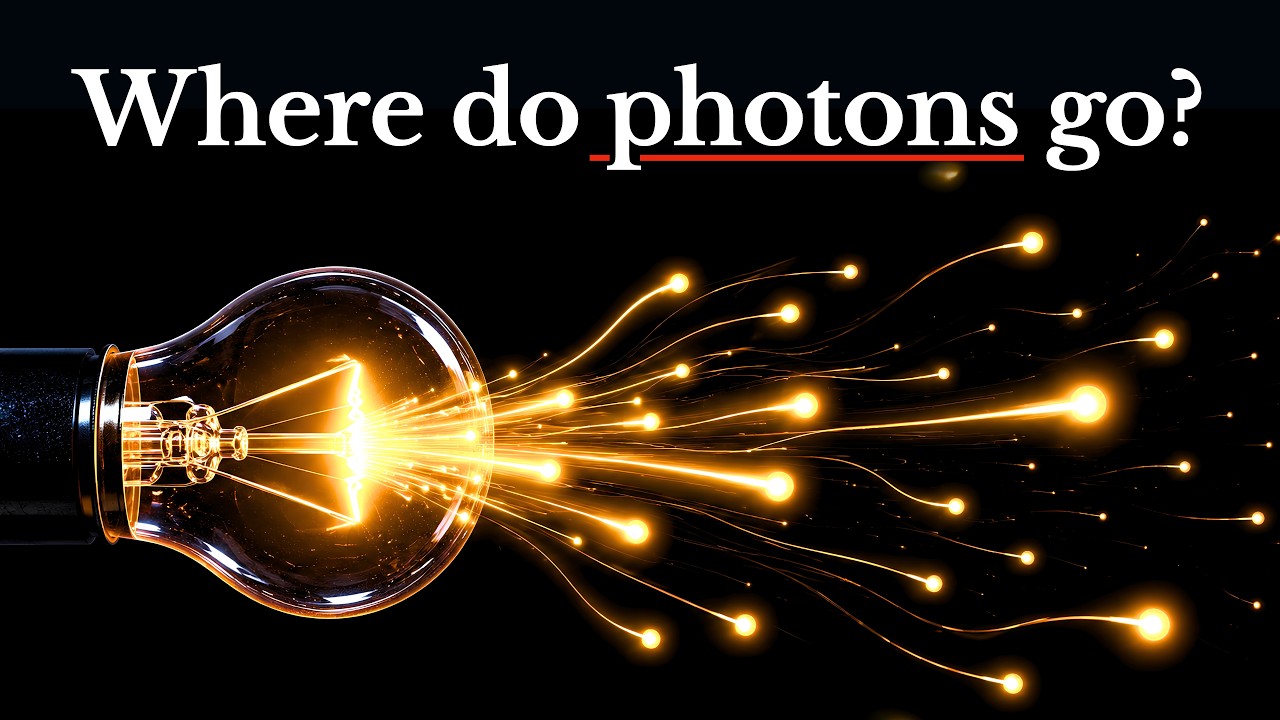
Light never accelerates: as a massless particle, each photon is born already moving at the speed of light, set by the electric and magnetic properties of space.

Key Takeaways

  • Light has no mass, so it cannot accelerate; it always moves at the universe's speed limit in a vacuum.
  • The speed of light comes from the electric and magnetic properties of empty space, as Maxwell showed.
  • Light slows only in materials, because of interactions with matter, not because its intrinsic speed changes.

What the video covers

  • Light never speeds up because it has no mass and therefore no inertia; photons are created already moving at about 300,000 km/s.
  • Early attempts to measure light speed included Galileo's lantern experiment, Ole Rømer's observations of Jupiter's moon Io, and Hippolyte Fizeau's toothed-wheel measurement.
  • Michael Faraday's discovery that changing magnetic fields create electric fields revealed a deep link between electricity and magnetism.
  • James Clerk Maxwell showed that changing electric and magnetic fields leapfrog each other as self-sustaining electromagnetic waves.
  • Maxwell calculated the wave speed from two constants of empty space, the electric constant and magnetic constant, and got the measured speed of light.
  • Light's speed is a property of spacetime itself, not a push from a source, so the source's speed does not change it.
  • Since 1983 the metre has been defined using the fixed speed of light, making its value a matter of definition rather than measurement.
  • Light slows in materials like water and glass because it interacts with electrons, but in vacuum it always travels at the same speed.
  • Cherenkov radiation occurs when charged particles exceed the light speed in a medium, producing a shock-wave-like glow.
  • Scientists continue to test whether the constants defining light speed have changed over cosmic time, with results showing any change is extremely tiny.

Answers

Questions about this video

Why doesn't light speed up like a car does?

Light has no mass, so there is no inertia to overcome. Each photon is created already moving at the speed of light and cannot travel at any other speed in a vacuum.

How did Maxwell figure out the speed of light without measuring it?

Maxwell combined the rules of electricity and magnetism into equations and found that electromagnetic waves should travel at a speed determined by two constants of empty space. That calculated speed matched the measured speed of light.

Why does light slow down in water or glass?

Light interacts with the electrons in the material, which absorb and re-emit it, delaying its overall progress. In empty space, there are no such interactions, so light travels at its full speed.

Full Transcript — Download SRT & Markdown

00:00
Speaker A
Flick on a light switch and the room fills with light instantly. Or at least it seems instant. But think about what just happened. Before you flick the switch, there was no light. A split second later, light was racing across
00:13
Speaker A
the room at about 300,000 km every second. Fast enough to circle the Earth 7 and 1 half times in a single second.
00:20
Speaker A
So, here's a question that sounds simple, but almost nobody asks. How did it get so fast so quickly? A car needs time to speed up. A rocket needs fuel and engines. Even a ball needs a throw.
00:32
Speaker A
But light never seems to speed up at all. It just appears already moving at the fastest speed in the universe. Where does that speed come from? Why that particular speed and not faster or slower? And why does nothing ever seem
00:45
Speaker A
able to push light any faster? In this video, we're going to find out. And the answer will take us from lanterns on hilltops to the moons of Jupiter, from tiny sparks of electricity to the very fabric of space and time. Because the
00:58
Speaker A
speed of light isn't really something light gets. It's something the universe gives it. Let's start with a surprising fact. Light never speeds up. Think about how anything else gets moving. A sprinter at the start of a race begins
01:10
Speaker A
at zero. They push off, pick up speed, and reach their top speed a few seconds later. A car does the same. So does a plane. Even a bullet takes a moment to accelerate down the barrel of a gun.
01:21
Speaker A
Everything with mass has to speed up from zero. That's what inertia means. Heavy things resist being pushed, so it takes time and effort to get them moving. But light is different. Light has no mass. And if you watched our
01:33
Speaker A
video on the Higs Bzon, you'll remember what that means. Something with no mass has no inertia. There's nothing to resist being pushed. And it turns out that anything massless has no choice. It can't travel at any speed it likes. It
01:46
Speaker A
must always move at exactly the speed of light. So when a light bulb switches on, there's no acceleration phase. There's no moment where the light is moving slowly and then picking up speed. Each particle of light, each photon is
01:59
Speaker A
created already moving at full speed. From the very first instant it exists, it's racing at about 300,000 km/s. Where does the photon come from? Inside the bulb, atoms get energized by electricity. Their electrons jump up to higher energy levels. When they drop
02:15
Speaker A
back down, they release that extra energy as a photon. The energy turns into light, and the light leaves at full speed. And here's another surprise. When light hits something and gets absorbed, it doesn't slow down first. It simply
02:27
Speaker A
disappears, giving its energy to the atom that caught it. A photon only ever has two states. Racing at the speed of light or not existing at all. So, the question, how does light speed up? has a strange answer. It doesn't. The real
02:41
Speaker A
question is something deeper. Why is the speed that light is born with exactly what it is? Why about 300,000 km/s and not some other number? To answer that, we first need to know how anyone ever measured something so fast. For most of
02:56
Speaker A
history, people assumed light was instant. When you open your eyes, you see the world straight away. It seemed obvious that light didn't need any time to travel at all. The Italian scientist Galileo wasn't so sure. In a book
03:09
Speaker A
published in 1638, he described an experiment. Two people stand on distant hilltops, each holding a lantern with a cover. The first person uncovers their lantern. As soon as the second person sees the light, they uncover theirs. The first person then measures how long it
03:24
Speaker A
took for the light to come back. The experiment failed. Light was simply far too fast. Any delay was much shorter than the time it took people to react.
03:32
Speaker A
Galileo could only conclude that if light did take time to travel, it was extraordinarily fast. The first real measurement came from space. In the 1670s, the Danish astronomer Ole Roma was studying Io, one of the moons of Jupiter. Io regularly disappears behind
03:49
Speaker A
Jupiter like clockwork. But Roma noticed something odd. When the Earth was moving away from Jupiter in its orbit, the disappearances seemed to happen later than predicted. When the Earth was moving closer, they happened earlier.
04:02
Speaker A
Roma realized what was happening. When Earth was further away, the light from Io had further to travel, so it arrived later. Light wasn't instant. It took several minutes to cross the extra distance. Using his observations, scientists made the first estimate of
04:16
Speaker A
light speed and it was in the right ballpark. Then in 1849, the French physicist Hippolit Fizo measured it on Earth. He shone a beam of light through the gaps in a spinning tooththed wheel, sent it to a mirror more than 8 km away,
04:30
Speaker A
and watched it come back. By spinning the wheel just fast enough, the returning light was blocked by the next tooth. From the wheel's speed, he could calculate how fast the light had traveled. His answer was close to today's value. So, by the 1850s,
04:44
Speaker A
scientists knew how fast light goes, but they had no idea why. But before we find out, a quick favor. If you're enjoying this and you'd like more videos that explain the strangest parts of physics in simple language, consider subscribing
04:57
Speaker A
and turning on notifications. It genuinely helps the channel grow and it means you won't miss the next one.
05:03
Speaker A
Okay, so what is light? Actually, the answer to why light moves at its speed starts with a discovery that seemed to have nothing to do with light at all. It came from playing with magnets and wires. In 1831, the English scientist
05:16
Speaker A
Michael Faraday found that if you move a magnet near a coil of wire, an electric current starts to flow. A changing magnetic field creates an electric field. It's the same idea that powers almost every electricity generator on Earth today. Scientists already knew the
05:30
Speaker A
reverse was true, too. An electric current flowing through a wire creates a magnetic field around it. That's how electromagnets work. So, electricity and magnetism were deeply linked. A changing magnetic field makes an electric field.
05:44
Speaker A
A changing electric field makes a magnetic field. In the 1860s, the Scottish physicist James Clerk Maxwell put all of this together into a set of equations. And he noticed something incredible hidden inside them. Imagine you wiggle an electric charge back and
05:57
Speaker A
forth that creates a changing electric field around it. But a changing electric field creates a changing magnetic field.
06:04
Speaker A
And that changing magnetic field creates a new changing electric field a little further away which creates a new magnetic field even further away and so on. The two fields leapfrog each other each one creating the next traveling outward through space. It's a self-
06:18
Speaker A
sustaining wave. It doesn't need anything to push it. Once it starts, it keeps itself going. Maxwell called this an electromagnetic wave. And when he worked out how fast these waves should travel using only the rules of electricity and magnetism, he got a
06:33
Speaker A
number about 300,000 km/s. That was exactly the speed scientists had measured for light. It couldn't be a coincidence. Light, Maxwell realized, is an electromagnetic wave, a ripple of electric and magnetic fields leaprogging through space. This was one of the
06:48
Speaker A
greatest moments in the history of science. Electricity, magnetism, and light. Three things that seemed completely separate, turned out to be the same thing. But here's the really important part for our question. Maxwell didn't need to measure light to find its
07:02
Speaker A
speed. He calculated it from two numbers that describe electricity and magnetism. So, what are those two numbers? Here's something that sounds strange at first.
07:10
Speaker A
Empty space isn't completely blank. It has properties. And two of those properties decide exactly how fast light travels. The first property tells us how strongly empty space responds to electric fields. Imagine two electric charges sitting some distance apart in
07:25
Speaker A
empty space. They push or pull on each other. How strong is that push? That depends on a number that describes empty space itself. Physicists call it the electric constant. The second property tells us how strongly empty space responds to magnetic fields. Two wires
07:41
Speaker A
carrying electric current side by side pull toward each other. How strong is that pull? that depends on a second number describing empty space.
07:49
Speaker A
Physicists call it the magnetic constant. You can measure both of these numbers with nothing more than charges, wires, and very careful equipment. No light needed at all. And in 1856, two German scientists, Wilhelm Vber and Rudolph Krash, did exactly that. They
08:05
Speaker A
measured how electric and magnetic effects compared to each other. When Maxwell combined their two numbers in his equations, out popped a speed, and that speed matched the speed of light.
08:14
Speaker A
So here's our first real answer to the question. Light gets its speed from the properties of empty space itself.
08:20
Speaker A
Specifically from how space responds to electric and magnetic fields. Think of it like this. When an electric field changes, it has to create a magnetic field. And when a magnetic field changes, it has to create an electric field. How quickly can each one create
08:35
Speaker A
the other? That depends on how stiff or stretchy space is for electricity and for magnetism. Those two numbers set the pace of the leaprog. And that pace is the speed of light. This also explains why light doesn't need to speed up. The
08:49
Speaker A
wave isn't something pushed from behind. Its speed comes from the rules of the space it's traveling through. As soon as an electromagnetic wave exists, it has no choice but to move at the pace that space allows. But stiff and stretchy
09:02
Speaker A
might sound a bit abstract, so let's make it more concrete with a rope. Imagine two people holding the ends of a long rope pulled tight. One person gives their end a quick flick. A bump appears in the rope and travels along it to the
09:14
Speaker A
other side. Here's a question. What decides how fast that bump travels? It's not how hard you flick. A bigger flick makes a bigger bump, but it doesn't make the bump travel faster. The speed of the bump depends on the rope itself. Two
09:28
Speaker A
things matter. First, how tightly the rope is pulled. Pull it tighter and the bump travels faster. A tight rope snaps back quickly, passing the bump along.
09:37
Speaker A
Second, how heavy the rope is. A heavy rope is sluggish. it resists being moved. So, the bump travels more slowly.
09:44
Speaker A
So, the speed of a wave on a rope comes from two properties of the rope. How strongly it snaps back and how much it resists being moved. Light is surprisingly similar. In a way, empty space plays the role of the rope. The
09:57
Speaker A
electric constant and the magnetic constant are like the rope's tightness and heaviness. They decide how quickly a disturbance in the electric and magnetic fields passes from one point to the next. And just like the rope, it doesn't matter how strong the light is. A dim
10:11
Speaker A
glow from a candle and a powerful laser beam both travel at exactly the same speed. Their brightness is like the size of the bump. Their speed is set by space. The color of light doesn't change its speed either. Red light, blue light,
10:24
Speaker A
radio waves, x-rays, they're all electromagnetic waves. And in empty space, they all travel at exactly the same speed. Now, there's one big difference between light and a wave on a rope. A rope is made of something. It has atoms in it. Light doesn't need any
10:37
Speaker A
material at all. It can travel through a perfect vacuum across billions of kilometers of empty space. In the 1800s, scientists found this so hard to accept that they invented an invisible substance called the ether to be light's rope. But as we saw in our video on why
10:54
Speaker A
time stops at the speed of light, experiments found no sign of it. Which leads to one of the strangest facts about light speed. For almost everything in daily life, speeds add up. If you're on a train going 100 km hour and you
11:07
Speaker A
throw a ball forward at 20, someone on the platform sees the ball moving at 120. And if you throw it backwards, they see it moving at 80. So, you'd expect light to behave the same way. Shine a torch forward from a speeding rocket,
11:20
Speaker A
and surely the light should go faster than normal. But it doesn't. Every experiment ever done shows that light always travels at exactly the same speed, no matter how fast its source is moving, and no matter how fast you're
11:32
Speaker A
moving when you measure it. And now we can see why that makes sense. Remember, light speed doesn't come from whatever made it. It doesn't come from the torch or the rocket or the light bulb. It comes from the properties of empty space
11:44
Speaker A
and those properties are the same for everyone. This is the first rule of Einstein's relativity. The laws of physics are the same for everyone moving steadily. Maxwell's equations are laws of physics. So, everyone everywhere gets the same electric constant, the same
11:59
Speaker A
magnetic constant, and therefore the same speed of light. Think about what would happen otherwise. If light speed depended on how fast you were moving, then by measuring it, you could work out your true speed through space. There would be a special privileged point of
12:13
Speaker A
view, a cosmic resting place. But nature doesn't seem to have one. This is also where things get strange. If everyone measures the same speed for light, then something else has to give. As we saw in our videos on stopping time and the
12:27
Speaker A
speed of light, what gives is time and distance themselves. They stretch and squeeze depending on how you move. So that light speed always stays the same.
12:37
Speaker A
So far we've said that light gets its speed from the electric and magnetic properties of space. That's true, but modern physics goes one step deeper and it turns the whole question on its head.
12:47
Speaker A
In our video on why time stops at the speed of light, we explored an idea from Einstein and his teacher Herman Minkovsky. Space and time aren't separate. They're woven together into one fabric called spacetime. And everything moves through spaceime at the
13:01
Speaker A
same rate. You can share that motion between space and time, like steering a car between two roads, but you can never change the total. The speed of light is the point where all of that motion goes into space, and none is left for time.
13:13
Speaker A
It's the maximum speed that anything can travel through space. And it's not really a property of light at all. It's a property of space-time itself. It's the conversion rate between distances in space and distances in time. Here's a
13:25
Speaker A
way to picture that. In everyday life, we measure distance in meters and time in seconds, as if they were completely different things. But in spacetime, they're two parts of the same thing. And the speed of light is the exchange rate
13:37
Speaker A
between them. Roughly 300,000 km of space is worth 1 second of time. Now, think about what this means for light.
13:46
Speaker A
Light has no mass. And as we saw in the Higs Bzon video, anything with no mass has nothing slowing it down. So, it moves at the fastest speed spaceime allows. Light isn't fast because something special pushes it. It's fast
13:58
Speaker A
because nothing holds it back. That's why some physicists say the name speed of light is a bit misleading. A better name might be the speed of spaceime or the speed of cause and effect. Light just happens to travel at it because
14:11
Speaker A
it's massless. Gravity travels at the same speed. So do gluons, the particles that hold quarks together. So here's our deeper answer. Light gets its speed from the very structure of spaceime.
14:22
Speaker A
Maxwell's electric and magnetic constants are how that speed shows up in the rules of electricity and magnetism.
14:28
Speaker A
But there's still one question we haven't answered. Why is it 300,000 km/s? Why that number and not some other one? Today, the speed of light in empty space is exactly 299,792,458 m/s. Not roughly, exactly. And the reason it's exact is surprising. In
14:49
Speaker A
1983, scientists decided to use the speed of light to define the meter itself. A meter is now officially the distance light travels in empty space in 1 divided by 299492,458 of a second. So, the speed of light can't be measured any more precisely.
15:06
Speaker A
It's fixed by definition. This tells us something important. The number 2999458 isn't special in itself. It only looks that way because of how we chose to measure things. If humans had picked different units like feet and minutes, the speed of light would be a completely
15:23
Speaker A
different looking number. In feet pers, for example, it's about 983 million. So asking why is light speed 299 h 792,458 is a bit like asking why a sprint race is 100 m long rather than 109 yd. The number depends on the units. The race
15:42
Speaker A
itself is the same. The deeper question is this. Why is the universe built the way it is? And physicists think the most meaningful way to ask that is with numbers that don't depend on units at all. The most famous of these is called
15:54
Speaker A
the fine structure constant. It combines the speed of light with the strength of electric charge. And another basic number from quantum physics. It comes out at about 1 / 137. No matter what units you use, it describes how strongly
16:07
Speaker A
light and electrons interact. If that number were even a little different, atoms would behave differently. Stars might burn differently. Chemistry might not work the way it does. Nobody knows why it has the value it has. It's one of
16:20
Speaker A
the great unsolved puzzles of physics. So, the honest answer to why that speed is this. The number itself comes from our choice of units. But why the universe has the structure it does, nobody knows yet. Here's a puzzle that
16:32
Speaker A
seems to break everything we've said. Light travels at about 300,000 km/s in empty space. But in water it travels at only about 3/4 of that speed. In glass about 2/3 and in diamond less than half.
16:45
Speaker A
And then when the light comes out the other side it goes straight back to full speed. But how? We said light doesn't need anything to push it. So what pushes it back up to speed when it leaves the
16:55
Speaker A
glass? The answer is that the light never really slows down at all. At least not in the way a car slows down. Inside the glass, the light is passing between atoms. Each atom has electrons. And when the light wave passes by, it makes those
17:10
Speaker A
electrons wiggle back and forth. But wiggling electrons create their own little electromagnetic waves. So now there are two kinds of waves in the glass. The original light wave and all the tiny waves coming from the wiggling electrons. These waves overlap and
17:24
Speaker A
combine into a new combined wave. And that combined wave moves forward more slowly than light in empty space. It's a bit like a group of people walking through a crowd. Each person can walk at their normal speed, but the group as a
17:36
Speaker A
whole moves slowly because everyone keeps getting caught up with the people around them. In the tiny gaps between atoms, the light itself is still traveling at its normal speed. It's only the overall wave made of light plus all
17:48
Speaker A
the wiggling electrons that crawls along. And when the light leaves the glass, there are no more electrons wiggling around it. The extra waves stop. What's left is simply light in empty space. And light in empty space always travels at the speed set by
18:02
Speaker A
spacetime. No push is needed. It's just following the same rules as always. This effect is why lenses work. Light bends as it enters and leaves glass, letting glasses, cameras, and telescopes focus it. It's also why rainbows form because
18:17
Speaker A
different colors slow down by slightly different amounts in water droplets. And it leads to something truly surprising.
18:23
Speaker A
If light slows down in water, could something else go faster? If you ever look into the pool of water surrounding the core of a nuclear research reactor, you'll see something remarkable. The water glows a brilliant ghostly blue.
18:36
Speaker A
That glow comes from particles traveling faster than light, but not faster than light in empty space. Nothing with mass can do that. They're traveling faster than light moves through water.
18:45
Speaker A
Remember, in water, light's combined wave crawls along at about 3/4 of its normal speed. But a fastoving electron shot out by the reactor can travel faster than that. It's still slower than light in empty space, but it's outrunning light in the water around it.
19:00
Speaker A
And when that happens, something like a sonic boom occurs. When a jet flies faster than sound, it creates a shock wave of sound, a sonic boom. When a charged particle flies through water faster than light can travel through
19:12
Speaker A
that water, it creates a shock wave of light. That's the blue glow. It's called Cherinkov radiation after the Soviet physicist Pavle Cherinkov, who studied it in the 1930s and later shared the Nobel Prize for it. Today, scientists use it in huge underground detectors to
19:28
Speaker A
catch ghostly particles called nutrinos from space. If light speed comes from the properties of spaceime, could those properties ever change? Could light have been faster or slower in the distant past? Some physicists have explored this idea. If the speed of light had been
19:43
Speaker A
different early in the universe's history, it might help explain some puzzles about how the cosmos began. But these ideas remain speculative, and most physicists think the speed of light has always been the same. Scientists have actually tested this. Remember the fine
19:57
Speaker A
structure constant, that number of about 1 / 137. If the speed of light or other basic constants had changed over time, that number would have changed, too.
20:07
Speaker A
Astronomers study light from incredibly distant objects called quazars, that light set off billions of years ago. And as it passed through clouds of gas, it picked up a fingerprint of how atoms behaved back then. By comparing those fingerprints to atoms in labs today,
20:22
Speaker A
scientists can check whether the rules have changed. So far, the results show that if these constants have changed at all, it's by an incredibly tiny amount.
20:30
Speaker A
A few studies have hinted at very small changes, but those hints haven't been confirmed. As far as we can tell, the speed of light has stayed the same across almost the entire history of the universe. So, let's bring it all
20:41
Speaker A
together. Where does light actually get its speed from? First, light never speeds up. It has no mass. So, it's born already moving at full speed and it stays that way until it's absorbed.
20:52
Speaker A
Then, we saw how people first measured that speed from Galileo's lanterns to the moons of Jupiter and Fizo's spinning wheel. Maxwell showed that light is a wave of electric and magnetic fields leaprogging through space and that its speed comes from two properties of empty
21:06
Speaker A
space itself. The way a wave on a rope gets its speed from the rope. Because those properties are the same for everyone, everyone measures the same speed of light. And at the deepest level, that speed is built into
21:17
Speaker A
space-time itself. It's the universe's speed limit, the exchange rate between space and time. Light travels at it simply because nothing holds it back.
21:26
Speaker A
Here's a thought to leave you with. Every time you flick on a light, you're watching the universe's own speed limit in action. The light filling your room didn't need a push. It's just doing what spaceime allows. If you enjoyed this,
21:38
Speaker A
check out our video on why time stops at the speed of light. Thanks for watching.
21:42
Speaker A
See you next time.
Topics:speed of lightphotonselectromagnetismMaxwell equationsFaradayvacuumspecial relativityHiggs bosonCherenkov radiationphysics

Get More with the SozAI App

Transcribe recordings, audio files, and YouTube videos — with AI summaries and speaker detection. 30 minutes free.

Or transcribe another YouTube video here →