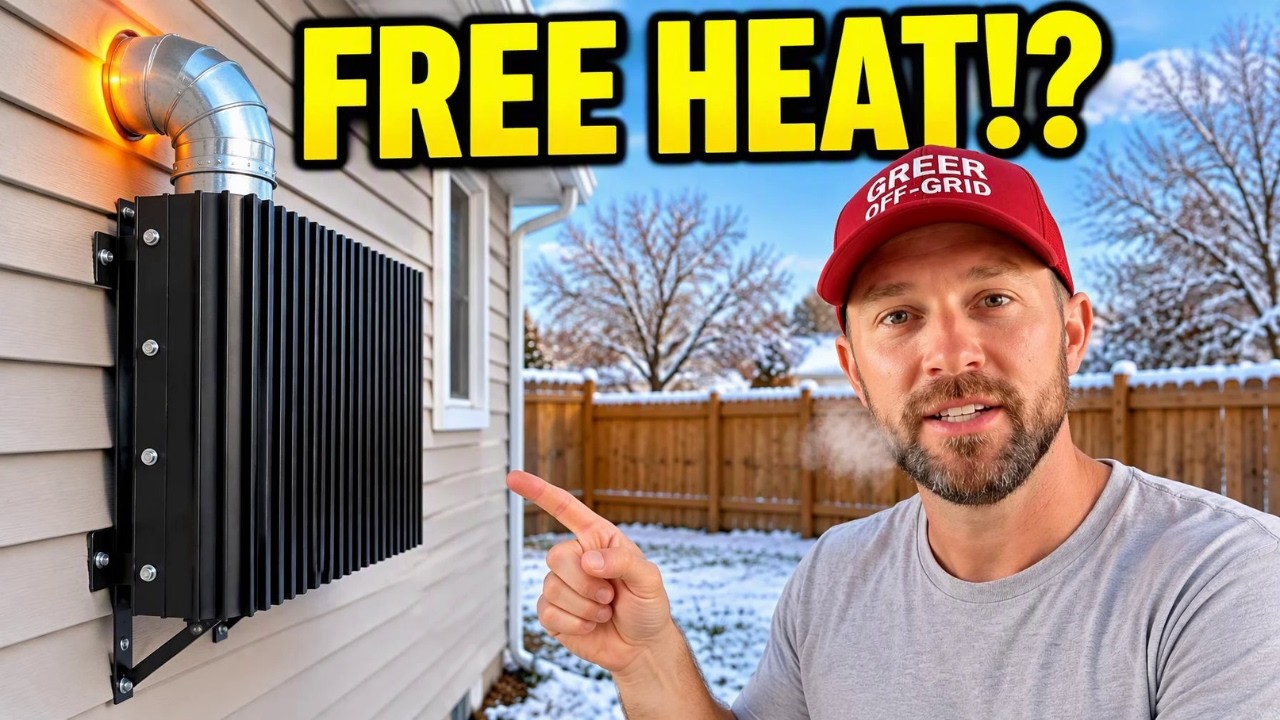
Caleb Greer builds a DIY solar air heater from corrugated steel roofing, lava rock and polycarbonate that delivers 184°F air without power, storing heat in rock for cloudy periods.
Key Takeaways
- Corrugated roofing plus a tight polycarbonate cover creates efficient sealed air channels for solar air heating.
- Thermal storage in rock or fire brick is what keeps solar air heaters producing warm air through clouds and evenings.
- Proper surface prep and high-temperature paint are essential for durability and safe operation of a galvanized steel absorber.
- Size the collector to the space; a single panel suits a small room or workshop rather than a full house.
What the video covers
- Corrugated steel roofing sheets painted black act as the solar absorber, with corrugation waves creating sealed air channels that increase heat transfer.
- A divider strip forces air to travel up and back down the panel, doubling the effective 8 ft air path to 16 ft.
- Lava rock and fire brick under the collector store heat, letting the heater keep outputting warm air during clouds and after sunset.
- Lava rock is chosen for its dark color and porous surface area, which absorbs light and speeds heat transfer to air.
- The box uses 2x6 lumber, plywood and foil-faced foam insulation, with a twin-wall polycarbonate cover sealed with foil tape.
- Galvanized steel must be cleaned with vinegar and scuffed before painting with 1200°F-rated flat black stove paint, avoiding asphalt coatings that off-gas.
- A 12V DC fan powered by a 10 W solar panel moves air into the house, with a thermostat-style control so the fan runs only when air is hot.
- The build is sized for a workshop, garage, greenhouse or single room of roughly 200-300 sq ft rather than a whole house.
- Cost comparison: running a 1,500 W electric heater 6 hours costs about $1.50 per sunny day, while the solar setup uses free sunlight.
- The video promotes Greer's book of 126 off-grid methods at the end, which is a sales plug rather than technical content.
Full Transcript — Download SRT & Markdown
Speaker A
Every square foot of ground in full winter sun takes in about 300 BTU of energy every hour. A single sheet of corrugated steel roofing, 26 in wide and 8 ft long, covers 17 square ft. That is over 5,000 BTU an hour landing on a
Speaker A
piece of metal that costs about $20 at any farm store. I built a solar heater out of two of those sheets, a scrap lumber box, a sheet of clear polycarbonate, and 150 lbs of black lava rock. On a 22° morning with snow on the
Speaker A
ground, the air coming out of the top of that box hit 184° on my infrared thermometer. A small solar fan pushes that air through a window insert straight into my workshop. No gas, no grid power, no fuel at all. And here is
Speaker A
the part that makes this build different from every other solar air heater I have shown you. When a cloud bank rolls over, it keeps blowing hot air. When the sun drops behind the tree line, it keeps blowing hot air. Because the heat is not
Speaker A
just in the metal. It is stored in the rock underneath it. Before we get into it, everything I cover on this channel, every system, every build, I put in one book. 126 methods sourced and tested.
Speaker A
caleb greeroffgrid.com. That is all I will say about it for now. Here is why corrugated roofing works so well for this and why most homemade solar heaters run lukewarm. A solar air heater has exactly one job. Catch sunlight on a dark surface, turn it into
Speaker A
heat, and then get that heat off the metal and into moving air. The first part is easy. Any black surface in direct sun gets hot fast. The second part is where almost every DIY build loses. Air is lazy. If you give it an
Speaker A
open box, it takes the shortest path from the bottom vent to the top vent and barely touches the hot metal on the way.
Speaker A
Gary Raa at Build It Solar ran side byside tests of homemade collectors. All four by 8 ft. All tested in winter sun with the same airflow. The plain empty box, black back, and a clear cover produced 50 to 60% less heat than the
Speaker A
best design he tested. Same sun, same size, same paint, half the heat. The difference was entirely in how well the air was forced to touch the hot surface.
Speaker A
That is exactly the problem corrugated roofing solves for free. A corrugated sheet is not flat. It is pressed into a row of deep waves, and those waves add roughly 15 to 30% more surface area than a flat sheet of the same width,
Speaker A
depending on the profile. More metal touching the air means more heat transfer. But the real trick happens when you lay a clear cover tight across the tops of those waves. Every valley between two ridges becomes a sealed tunnel. A 26-in sheet with standard
Speaker A
corrugation gives you about eight of those tunnels, each one running the full 8 ft. The air has no shortcut. It has to travel down the inside of a black steel channel the whole way and it scrubs heat off the metal every inch of that trip.
Speaker A
Then I doubled the trip down the center of the panel. I ran a divider strip so the air comes in at the bottom, travels up the channels on the left side, makes a U-turn at the top and comes back down
Speaker A
the channels on the right side before it reaches the outlet. That turns an 8-ft collector into a 16 ft air path. Twice the time in contact with hot steel. Same box, same sun. Now, the part that makes this a heater you can actually live
Speaker A
with, the rock. Every solar air heater has the same weakness. Thin roofing steel holds almost no heat. A 26 gauge sheet is about a 50th of an inch thick.
Speaker A
When a cloud covers the sun, that sheet loses its heat in a couple of minutes, and the air coming out of your vent goes from hot to cold before you even notice the light changed. In the northern half
Speaker A
of the country, a winter day is full of clouds sliding across the sun. That on and off cycling is what makes most people give up on solar air heat. Rock fixes it. Purdue University's agricultural engineering department published design guidance for rock bed
Speaker A
heat storage decades ago for farm solar systems. Rock has a specific heat of about 0.2 BTU per pound per degree. That means every pound of rock you heat up by 100° stores 20 BTU. It sounds small until you put 150 lb of it under your
Speaker A
collector. Their guidance puts a fully charged rock bed at 130 to 150°. Mine runs hotter than that because the rock sits in direct contact with the back of the steel, not at the end of a duct. I chose lava rock for two reasons. It is
Speaker A
black or dark red all the way through, so any sunlight that gets past the steel is absorbed, not reflected. And it is full of tiny pores, which gives it an enormous surface area for its weight.
Speaker A
Air moving past porous rock picks up heat far faster than air moving past smooth riverstone. You can buy it in 40 lb bags at any garden center for landscaping and gas fire pits, usually 10 to $15 a bag. I also mixed in a dozen
Speaker A
fire bricks split in half. Fire brick is dense, around 120 lb per cubic foot, so it packs a lot of heat storage into a small space. Here is how I built it. The frame is a box made of 2x6 lumber.
Speaker A
Outside dimensions about 4'6 in wide by 8' 3 in tall that fits two 26-in corrugated sheets side by side with a little room for the frame. Use exterior screws and glue every joint. This box will see temperatures from below zero at
Speaker A
night to well over 180 inside on a sunny afternoon and it needs to stay tight.
Speaker A
The back of the box is a sheet of/2-in plywood. On the inside face of that plywood, I glued 2-in foil-faced polyo foam board, foil side facing in.
Speaker A
Everything behind the rock bed is insulation. Any heat that leaks out the back of the box is heat that never reaches your house. On top of the foam goes the rock bed. I laid down a layer of hardware cloth first so the rock does
Speaker A
not grind into the foam. Then I spread 150 lbs of lava rock and the split fire bricks about 3 in deep and leveled it with a board. That rock bed sits directly under the corrugated steel, filling the waves from underneath, so
Speaker A
the back of every channel is in contact with stone. The absorber is two sheets of 26in x 8 ft galvanized corrugated steel roofing. Galvanized steel has a zinc coating and paint does not stick to fresh zinc. If you skip the prep, the
Speaker A
paint will flake off in a season. Wipe the sheets down with white vinegar, let them dry, then scuff them with 80 grit sandpaper, then spray them with high temperature flat black stove paint, the kind rated for 1200°, not barbecue
Speaker A
enamel, not regular spray paint, and never asphalt roof coating. Those will cook and off gas when the panel gets hot, and you will smell it in the house.
Speaker A
After painting, set the sheets out in the sun for a full afternoon and let the paint cure before they go in the box.
Speaker A
That burns off the solvent smell outside instead of inside. The sheets lay right on top of the rock bed, waves down into the stone. Then the divider strip, a length of 1x 2 down the center, sealed with high temperature silicone so air
Speaker A
cannot leak across. The cover is twin wall polycarbonate greenhouse panel 8 mm cut to fit the frame. It lets most of the sunlight through. The air space between its two walls acts as insulation, and it shrugs off hail and
Speaker A
branches that would shatter glass. Screw it down tight to the tops of the corrugation ridges using screws with rubber washers. That tight contact is what turns the open waves into sealed tunnels. Seal every edge of the polycarbonate to the frame with foil
Speaker A
tape, not cloth duct tape. Duct tape dries out and lets go after one season of baking and freezing. the air connections. At the bottom of the left half of the panel, a 4-in collar for the cold air intake. At the bottom of the
Speaker A
right half, a 4-in collar for the hot air outlet. Both connect to 4-in insulated flexible duct running to the house. Now, the controls, because this is what makes it run itself. On the hot outlet, I mounted a 12vt DC fan, the
Speaker A
kind sold for RV vents and solar attic fans, powered by a 10 watt solar panel mounted on the side of the frame. No battery, no grid. When the sun shines, the panel powers the fan. But I do not
Speaker A
want the fan running first thing in the morning when the box is still cold because it would just blow cold air into the room. So, the fan is wired through a snap disc thermostat. These are the little round switches furnaces use for
Speaker A
their blower fans. The one I used, a White Rogers 3F01110, is about $10. It closes the circuit when it hits 110° and opens again when it drops to 90. Mounted on the inside of the box near the top where the air is
Speaker A
hottest. Now the fan stays off until the air in the collector is actually hot.
Speaker A
Clicks on by itself at 110, runs all day, and keeps running after the sun goes down until the rock bed cools below 90. Then it clicks off. No timer, no controller, no programming. And on the outlet duct, I added a spring-loaded
Speaker A
backdraft damper, about $15 at the hardware store. When the fan blows, the flap opens. When the fan stops, the flap snaps shut. That matters because at night, the system wants to run backward.
Speaker A
Cold air sinks out of the collector, pulls warm air out of your room behind it, and you lose heat all night through the very box that is supposed to be heating you. The damper stops that completely. Connecting it to the house.
Speaker A
I did not want to cut holes in my siding for a test, so I made a window insert. A piece of 2-in rigid foam cut to fit snugly in an open window with two 4-in holes for the supply and return ducts
Speaker A
and foam weather strip around the edges. Slide the window down on top of it and it seals. When winter is over, pull it out and close the window. No permanent holes. Mounting. The panel faces due south. In winter, the sun sits low in
Speaker A
the sky. So, the steeper the panel, the more directly it faces the sun. A good rule is to tilt it at your latitude plus 15°. In most of the United States, that lands between 50 and 60°. I set mine on
Speaker A
a simple lean-to stand at 60° sitting in the snow on the south side of the shop.
Speaker A
A bonus of the steep angle is that snow slides right off the polycarbonate. Why lava rock and not water? People ask me this all the time because water stores about five times more heat per pound than rock. One BTU per pound per degree
Speaker A
against 0.2 for stone. On paper, a row of black water jugs behind the steel should beat a rock bed. In practice, it does not for three reasons. First, air needs to move through the storage to pick up the heat, and you cannot blow
Speaker A
air through a jug. Rock gives you thousands of little air paths through the bed. Second, water freezes. One cold, cloudy night with the jug sitting in a box outside and you have split containers and a flooded collector.
Speaker A
Third, water inside a sealed jug in a box that hits 180° builds pressure. Rock does not care. It cannot freeze. It cannot leak. It cannot burst. And it will still be doing the same job in 50 years. And why not just regular gravel?
Speaker A
You can use it and it will work. But gray or white gravel reflects a good share of the light that reaches it. And smooth stone has far less surface area for its weight. Lava rock is dark all the way through and full of pores, so it
Speaker A
soaks up every bit of heat that reaches it and hands it to the air faster. For the few extra dollars, it is worth it.
Speaker A
Sizing the fan. This is where a lot of builds go wrong. So, here is the actual formula heating engineers use. Heat delivered in BTU per hour equals 1.08 08 * the air flow in cubic feet per minute time the temperature rise. My collector
Speaker A
puts out about 5,000 BTU an hour. If I want the air coming out around 90° hotter than the air going in, that works out to 5,000 divided by 1.08 * 90, about 50 cubic feet per minute. So you want a
Speaker A
12vt fan rated somewhere around 50 to 80 CFM, which leaves room for the resistance of the duct and the rock bed.
Speaker A
A tiny computer fan moving 10 CFM will give you a scorching outlet temperature and almost no heat in the room. A big fan moving 200 CFM will give you a lot of lukewarm air. Match the fan to the
Speaker A
panel and you get the best of both. One more detail, drill two small weep holes about an eighth of an inch at the lowest corner of the frame. Any condensation that forms inside the box on a cold morning drains out instead of soaking
Speaker A
the rock and the foam. It is the kind of thing nobody mentions until their collector is full of mold in March. Here are the real numbers. The panel is about 34 square ft. On a clear winter day, it
Speaker A
sees roughly 300 BTU per square foot per hour at midday. Around 10,000 BTU an hour hitting the glass. A well-built air heater captures about half of that. So, I am putting around 5,000 BTU an hour into the room. Close to 1500 watts of
Speaker A
heat. That is exactly what a standard electric space heater puts out on high. Except this one has no power cord and no bill. On a 22° morning, the outlet started at ambient. The thermostat clicked on about 25 minutes after the
Speaker A
sun hit the panel, and by late morning, the air coming out of the duct was steady in the 170s. At midday, it peaked at 184°. Then the clouds. Around 1:00, a thick bank came over and the sun was
Speaker A
gone for about 20 minutes. On a bare metal collector, the outlet would have dropped to near outside temperature within minutes. With the rock bed under it, the outlet sagged to the low 140s and held there. The fan never shut off.
Speaker A
When the sun came back, it climbed right back up. After sunset, the rock bed kept the fan running for about 45 more minutes before the thermostat dropped below 90 and clicked it off. That last stretch of heat comes exactly when the
Speaker A
shop starts cooling down for the evening. The rock math backs that up. 150 lbs of lava rock and fire brick heated 100° above room temperature stores roughly 3,000 BTU. That is not enough to heat your house all night. And
Speaker A
I am not going to tell you it is. But it is exactly enough to ride through the clouds that kill other solar heaters and to stretch your heat well past sundown.
Speaker A
Total cost breakdown. Two corrugated sheets, about $40. Twin wall polycarbonate, $50. Four bags of lava rock, $45 on sale. And the fire bricks were left over from an old project.
Speaker A
Foil-faced foam board, $25. High temperature paint, $10. Foil tape and silicone, $15. 4in insulated duct and collars, $25. 12volt fan and 10 watt panel, $35. Snap disc thermostat $10.
Speaker A
Backdraft damper $15. The frame, the stand, and the plywood back all came out of my scrap pile. Total about $270.
Speaker A
Compare that to running a 1,500 W electric heater 6 hours a day. That is 9 kwatt hours a day. At 17 cents a kilowatt hour, it cost you about a dollar and a half every sunny day. Over a heating season with 100 good Sundays,
Speaker A
that is $150. The panel pays for itself in under two winters and then keeps going. The polycarbonate lasts 10 to 15 years before it yellows. The steel and the rock last forever. Now, the honest limitations because I would rather you
Speaker A
build this knowing exactly what it does. First, this is a daytime and early evening heater. The rock carries it through clouds and past sunset, but it will not heat your house at 3:00 in the morning. If you want true overnight
Speaker A
solar storage, you need a much bigger rock bed, hundreds of cubic feet in an insulated bin under the floor, and that is a different project. Second, it needs real sun. A southacing spot with direct sun from about 9 in the morning to 3:00
Speaker A
in the afternoon. a tree or a neighbor's garage shading it at noon cuts your output to almost nothing. On a week of solid gray skies, it does very little.
Speaker A
Third, size it to the space. One panel like this will make a real difference in a workshop, a garage, a greenhouse, or a single room of 2000 to 300 square ft. It will not heat a 2,000 ft house on its
Speaker A
own. For a house, build two or three and run them as a daytime supplement.
Speaker A
Fourth, keep the paint and the ducts clean. Let the stove paint fully cure outdoors before you ever connect it to the house and put a piece of furnace filter material over the cold air intake so you are not pulling household dust
Speaker A
through the rock bed all winter. Fifth, the solar fan matters. Without it, natural convection still works, but air flow is weak and the outlet runs hotter while the room gets less heat. If you want to scale this up, everything is
Speaker A
modular. Corrugated sheets come in 8, 10, and 12t lengths. A 12T version on a two-story south wall gets you half again the output. Mount two panels side by side on a barn or shop wall and run them into a shared duct. Double the rock bed
Speaker A
to 300 lb and you will see the post sunset run stretch past an hour. And for a greenhouse, skip the duct entirely.
Speaker A
Mount the panel right on the south wall with the outlet venting straight into the growing space and you are keeping seedlings above freezing on a sunny February day with zero electricity. If you want every one of these systems in
Speaker A
one place step by step, it's at caleb greeroffgrid.com.
Topics:solar air heaterDIY solar heatercorrugated roofinglava rock thermal storageoff-grid heatingpolycarbonate solar collectorpassive solarwinter solar heatDIY workshop heatingrenewable heating