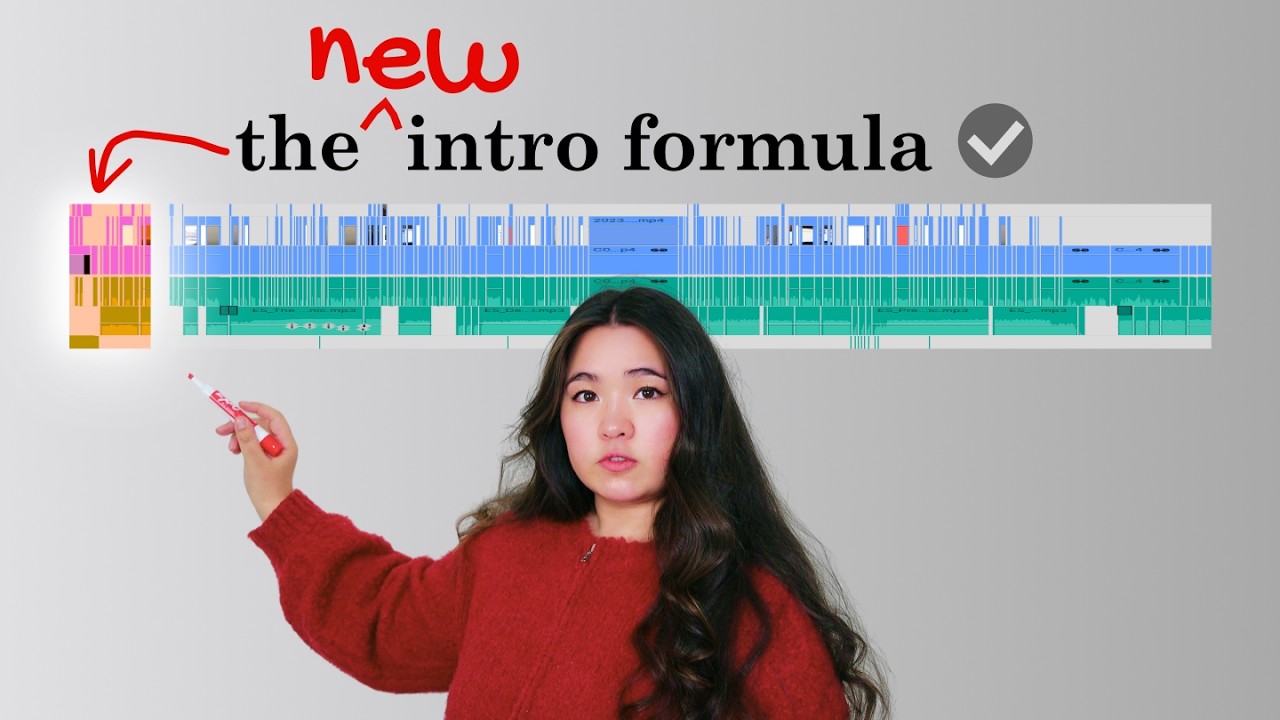
Breaks down MrBeast's video hook framework: matching title and thumbnail in the first 5 seconds, then context, stakes, and a curiosity gap in 20 seconds, plus input bias.
Key Takeaways
- Match the title and thumbnail expectations immediately to minimize early drop-off.
- Use the first 20 seconds to deliver context, stakes or payoff, and a curiosity gap.
- Exceed viewer expectations by visibly showing effort, leveraging input bias.
- Alternate high and low energy throughout the video to sustain retention across the whole runtime.
What the video covers
- MrBeast reportedly achieves around 70% audience retention on his videos, a benchmark the creator uses to frame the analysis.
- His hooks begin by matching expectations set by the title and thumbnail within the first five seconds to minimize viewer drop-off.
- The two-step formula: the first sentence matches the title, and the first shot matches the thumbnail (e.g., the Antarctica and 'Ages 1 Through 100' examples).
- Within the first 20 seconds, MrBeast provides context about the video setup, introduces the stakes or payoff, and creates a curiosity gap.
- Beyond those three elements, a fourth 'secret' element is input bias: viewers value content more when they see the effort put into it.
- Exceeding expectations, not merely meeting them, is presented as key to keeping retention high.
- Retention curves stay level rather than steadily declining because of three interrelated techniques, including periodic energy cycling.
- Energy cycling alternates high-intensity moments (e.g., a frigid climb) with lower-energy moments (e.g., base camp antics), preventing viewer fatigue.
- Videos are structured in repeating cycles of high and low energy, each cycle introducing a new tactic, explaining it, and giving examples.
- The framework is presented as applicable beyond MrBeast-style videos, including talking-head content, and doesn't require expensive production.
Chapters
- 00:00Introduction: MrBeast's 70% retention benchmark
- 00:58Matching the title and thumbnail in the first five seconds
- 01:58The 'Ages 1 Through 100' example
- 02:59The first 20 seconds: context, stakes, and curiosity gap
- 03:58Exceeding expectations and input bias
- 05:06Applying the hook to other video styles
- 07:05The three secrets to retention curves
- 08:13Energy cycling and high/low intensity
Full Transcript — Download SRT & Markdown
Speaker A
Mr Beast has solved YouTube retention, hitting the golden benchmark of 70% retention with every video he makes. 70%. That's what you need. But how does Mr Beast reach this magic number? To find out, I spent a week closely studying as many Mr Beast interviews, videos, and tweets as I could find, and I started to realize something. Across his content, Mr Beast has revealed the exact framework he applies to each of his videos to get their attention so high. And it starts with the first five seconds of the video.
Speaker A
many Mr Beast interviews videos and tweets as I could find and I started to realize something Baird across his content Mr Beast has revealed the exact framework he applies to each of his videos to get their attention so high
Speaker A
Before I rush the hell out of people who like have boring first five seconds, here's how Mr Beast approaches this crucial time frame. Essentially, your title and thumbnail set expectations, and at the very beginning of the video, to minimize drop-off, you want to assure them that those expectations are being met. Mr Beast is very clear that in the first five seconds of a video, you need to meet the expectations of your viewer. And to do that, he applies a two-step formula to the very beginning of every one of his videos. First, his first sentence matches his title. And second, his first shot matches his thumbnail.
Speaker A
expectations and at the very beginning of the video to minimize drop-off you want to assure them that those expectations are being met Mr Beast is very clear that in the first five seconds of a video you need to meet the
Speaker A
Let's take a look at an example. Check out the title and thumbnail for this video. In the thumbnail, there's a close-up of Mr Beast with views of an icy Antarctica behind him. The primary colors used are red, white, and blue. The title of the video is "I Survived 50 Hours in Antarctica." Now let's take a look at the first five seconds of the video.

Speaker A
at an example check out the title and thumbnail for this video in the thumbnail there's a close-up of Mr Beast with views of an icy Antarctica behind him the primary colors used are red white and blue the title of the video is
Speaker A
"He just landed Antarctica. We're gonna survive the next 50 hours here."
Speaker A
thumbnail there are Snowy Mountains a blue sky a close-up of Mr Beast and the primary colors are red white and blue and Mr B's first sentence he just landed Antarctica we want to survived the next 50 hours here very closely matches his
Speaker A
Did you catch it? The very first shot closely resembles the thumbnail. There are snowy mountains, a blue sky, a close-up of Mr Beast, and the primary colors are red, white, and blue. And Mr Beast's first sentence, "He just landed Antarctica. We're gonna survive the next 50 hours here," very closely matches his title.
Speaker A
colors used here are red white and black now let's take a look at the first five seconds behind me are 100 people and they range from the H1 all the way through age 100. the first shot matches the concept of the thumbnail Mr Beast
Speaker A
Let's take a look at another example. This video is titled "Ages 1 Through 100 Fight for $500,000." The thumbnail depicts a close-up of Mr Beast in front of a hundred people in red jumpsuits. The main colors used here are red, white, and black. Now let's take a look at the first five seconds.
Speaker A
all the way through age 100. match is the first part of the title by using the first five seconds to immediately match the title and thumbnail Mr Beast minimizes drop off from the very get-go and if you're wondering about the second
Speaker A
"Behind me are 100 people, and they range from age one all the way through age 100."
Speaker A
keep the retention up throughout the entire hook the first 20 seconds of each of Mr BEAST's videos contain the same Three core elements he provides context he introduces the stakes or payoff and he creates a curiosity Gap let's hop
Speaker A
The first shot matches the concept of the thumbnail: a Mr Beast close-up with a mass of people in red jumpsuits behind him. The next shot further illustrates the point, with all 100 people lined up in order of age. And the first sentence, "Behind me are 100 people, and they range from age one all the way through age 100," matches the first part of the title. By using the first five seconds to immediately match the title and thumbnail, Mr Beast minimizes drop-off from the very get-go. And if you're wondering about the second part of that title, don't worry, we'll get to that next.
Speaker A
very own glass cubes go the last one to leave their cube is going to win half a million dollars the challenge has officially begun let's see which age is the best in the first 20 seconds Mr Beast has provided context about the
Speaker A
Because after applying his two-step formula to the first five seconds of this video, Mr Beast moves on to the first 20 seconds. This is where it gets interesting, because to keep retention up throughout the entire hook, the first 20 seconds of each of Mr Beast's videos contain the same three core elements. He provides context, he introduces the stakes or payoff, and he creates a curiosity gap.
Speaker A
wins he does all of that in less than 20 seconds but it doesn't stop there because in addition to those three core elements there's actually one more secret element that Mr P supplies to every one of his hooks he alludes to it
Speaker A
Let's hop back to the "Ages 1 Through 100" video to see each of these elements in action. We last left off this video after he showed 100 people. "See if you can follow along. I've trapped each of them in their very own glass cubes. Go. The last one to leave their cube is going to win half a million dollars. The challenge has officially begun. Let's see which age is the best."
Speaker A
it's not enough to Simply match the expectations set by the title and thumbnail to get that retention through the roof Mr Beast exceeds those expectations how does he do that it's simple he puts in effort a lot of people
Speaker A
In the first 20 seconds, Mr Beast has provided context about the video setup, has introduced a juicy payoff, which by the way finishes meeting the expectations from the title and thumbnail, and creates a curiosity gap that entices viewers to stick around and wait to the end to figure out which age wins. He does all of that in less than 20 seconds. But it doesn't stop there, because in addition to those three core elements, there's actually one more secret element that Mr Beast supplies to every one of his hooks. He alludes to it here.
Speaker A
a lot of effort when Mr Beast talks about effort what he's really doing is leveraging something called input bias which is the idea that the more input we put into something whether that be time or energy or cost the more we'll value
Speaker A
So at the very beginning, match the expectations, and then you want to exceed them. You want to assure people that what they clicked on is what they're getting, and then blow their minds and be like, "What, you're also getting even more?" It's not enough to simply match the expectations set by the title and thumbnail to get that retention through the roof. Mr Beast exceeds those expectations. How does he do that? It's simple. He puts in effort.
Speaker A
that makes Mr beasts hooks so retentive if we revisit the first 20 seconds of the ages 1 through 100 video we can see input bias being leveraged starting here this shot is masterful in one glance you instantly get the sense that an immense
Speaker A
A lot of people underestimate effort. Viewers aren't stupid. They can tell when you half-ass a video, or if you really put in effort. I don't know if I'm allowed to curse, but if they can tell you're putting in a lot of effort, when Mr Beast talks about effort, what he's really doing is leveraging something called input bias. Input bias is the idea that the more input we put into something, whether that be time, energy, or cost, the more we'll value it. As an example of input bias, if we pay $50 for a bottle of wine, we'll value that more than if we had paid $20 for the same bottle of wine. Leveraging this bias is a special sauce that makes Mr Beast's hooks so retentive.
Speaker A
expectation that 100 people will find fight for 500k but exceeds that expectation by showing how much work was put into this idea now I know what you're probably thinking how can you leverage input bias when you don't have
Speaker A
If we revisit the first 20 seconds of the "Ages 1 Through 100" video, we can see input bias being leveraged starting here. This shot is masterful. In one glance, you instantly get the sense that an immense amount of time, effort, and money has gone into the making of this video. The next few seconds heighten this effect, showing the full magnitude of all the effort that went into the video. This is how Mr Beast not only meets the expectation that 100 people will fight for $500K, but exceeds that expectation by showing how much work was put into this idea.
Speaker A
studying as many Mr Beast interviews videos and tweets I could find at the beginning of this video I specifically mentioned how much time I spent researching for this video my editing shows a high degree of effort as well as
Speaker A
Now, I know what you're probably thinking: how can you leverage input bias when you don't have a Mr Beast budget? Well, you don't need a huge warehouse or a flashy set to trigger input bias. I did it at the beginning of this video. Did you catch it? To find out, I spent a week closely studying as many Mr Beast interviews, videos, and tweets as I could find. At the beginning of this video, I specifically mentioned how much time I spent researching for this video. My editing shows a high degree of effort as well. As a result, you as a viewer hopefully started to value my video more, because you could tell how much work I put into it.
Speaker A
in the hook to this video Mr Beast has solved YouTube retention hitting the golden Benchmark of 70 retention with every video he makes 70 that's what you need but how does Mr Beast reach this magic number to find out I spent a week
Speaker A
The other elements of Mr Beast's hooks aren't exclusive to Mr Beast-style videos either. See if you can spot them in the hook to this video. "Mr Beast has solved YouTube retention, hitting the golden benchmark of 70% retention with every video he makes. 70%. That's what you need. But how does Mr Beast reach this magic number? To find out, I spent a week closely studying as many Mr Beast interviews, videos, and tweets as I could find, and I started to realize something. Across his content, Mr Beast has revealed the exact framework he applies to each of his videos to get their attention so high. And it starts with the first five seconds of the video."
Speaker A
high and it starts with the first five seconds of the video now my hook is nowhere near perfect and it makes one big mistake that Mr Beast is always careful to avoid each of his intros is always no longer than 20 seconds long Mr
Speaker A
Now, my hook is nowhere near perfect, and it makes one big mistake that Mr Beast is always careful to avoid. Each of his intros is no longer than 20 seconds long. Mr Beast knows that the largest drop-off happens during the hook, so he jumps into the action as soon as possible. In his "Ages 1 Through 100" video, he says, "The challenge has officially begun. Let's see which age is the best," at the 12-second mark. In his video comparing the one-dollar yacht to the one-billion-dollar yacht, his experience of the one-dollar yacht starts at the 18-second mark. For Mr Beast, jumping to the action usually means starting the first challenger experience. For a video like mine, it could mean jumping into the first point. Regardless, Mr Beast starts the body of his video no later than 20 seconds in, because he knows the sooner the retention curve starts to level off, the better.
Speaker A
his video comparing the one dollar yacht to the one billion dollar yacht his experience of the one dollar yacht starts at the 18 second Mark for Mr Beast jumping to the action usually means starting the first Challenger experience for a video like mine it
Speaker A
The question then becomes: how do you keep the retention curve level? What is Mr Beast's secret to retention?
Speaker A
you keep the retention curve level what is Mr B's secret to retention curves that look like this versus these steadily declining line that so many of us are familiar with as it turns out it's not one secret it's three and it
Speaker A
starts with visual variety when it comes to visuals Mr Beast is quite clear where he stands if I just talk to a camera for 10 seconds without a cut like a lot of people will just like get bored or
Speaker A
they'll lose interest to avoid this Mr abuse maintains visual variety with a cut at least every three to five seconds to break things up one of the best examples of this is in his Antarctica survival video take a look at the timing
Speaker A
of his Cuts during this clip oh my gosh oh don't slip oh this is wild I'm so terrified there's a drop to my right if I fall backwards I roll for 2000 feet oh really what we're 30 hours in oh it's
Speaker A
yes this is a huge Cliff no joke no joking if we fall down there we die yeah 100 the process of hiking a mountain could have easily become quite boring but by using eight different shots within 20 seconds of footage Mr Beast is
Speaker A
able to hold your attention throughout the entire process of climbing a mountain and you don't need expensive drones or multiple cameramen to pull this off if you do talking head videos could you put another camera at an angle
Speaker A
and then switch between the two to add variety alternatively if you're like me and are too broke to afford two cameras you can incorporate different levels of scale zooming in and out in between Clips to keep things visually Dynamic
Speaker A
but even the most frequent changes in camera angles still can't make walking in a steep line interesting forever attention spans are shorter than they've ever been a fact that Mr Beast is quite aware of it's very hard with a single
Speaker A
storyline if you're doing like a double digit minute video to just have that one thing drip their entire attention throughout the whole video and at payoff at the end and that's where secret number two comes in consistent contrast
Speaker A
instead of an entire 12 minute video featuring an Antarctic Trek Mr Beast breaks things up using contrast from the moment Mr Beast sets off on his hike a Side Story is introduced now operation bull come on for the duration of the hike to break up
Speaker A
stretches of Mr BEAST's Mountain Journey the viewers periodically taken back to base camp to see the boys digging a hole the contrast between the intensity of a frigid climb and the tomfoolery the base camp Shenanigans prevents the snowy
Speaker A
footage from Ever Getting stale and before you start thinking but Side Stories don't work for my particular style of video there are other ways to incorporate contrast for a talking head video like this one I try to do this by
Speaker A
blending footage of me talking with clips from Mr BEAST's videos or interviews hopefully that contrast prevents you from getting too bored of my talking head now is it working I hope so and while visual variety and consistent contrast are integral
Speaker A
components of Mr Beast videos the final secret to the body of his videos is the most retentive of them all the final secret is good pacing this is a concept often stated broadly but rarely seen in detail so let's get real specific most
Speaker A
videos look like this at the beginning of the video there is high energy from your hook at the end of the video there's high energy from your payoff but this middle bit is low energy in comparison steadily declining in energy
Speaker A
until the Boost from the payoff at the end in comparison Mr BEAST's videos look like this with frequent cycles of high and low energy what do I mean by high and low energy it depends on the video in Mr Beast one dollar versus one
Speaker A
billion dollar yacht video each cycle is the experience of a new tier of yacht the cycle starts with a high energy exciting introduction of new yacht followed by the lower energy of the act of exploring the yacht followed by a new
Speaker A
cycle with a new exciting yacht introduction this keeps the pacing up throughout the entire duration of the video right up until the final high energy payoff of the billion dollar yacht at the end each of Mr B's Cycles
Speaker A
tends to be between two to four minutes long from start to finish with the shorter Cycles towards the front of the video and longer Cycles towards the back of the video the slower more emotional parts of Mr abuse videos are reserved
Speaker A
for the last 20 of his videos with the beginning allocated for lighter content and of course the concept of energy cycling for good pacing is not unique to Mr B's Style videos for this video each new retention tactic I mentioned starts
Speaker A
a new cycle with the cycle starting with the high energy introduction of a new tactic followed by the lower energy of explaining and giving examples followed by a new cycle with a new tactic the use of energy cycling keeps miservous
Speaker A
retention as flat as possible until the very end of his video and when it comes to those final seconds well they're more important than most people give them credit for most people tend to see long drop-offs at the end of their videos
Speaker A
which hurts their overall retention but Mr Beast keeps his retention up right until his final ad read to do this he applies a two-part equation first he reveals a big payoff and second he makes sure to end the videos on a high note
Speaker A
whether that be a dramatic wholesome or funny to see this in action check out the end of the ages 1 through 100 video I don't think it's in there I think I'm going to pick my case you're going to keep this locked in all right
Speaker A
Joe what is inside your briefcase [Music] [Applause] literally said he had it oh my gosh what a crazy funny what is wrong with you he told the truth and he got it we said all along good guys can win so it pays
Speaker A
off to be honest even though you didn't win we still want to give you ten thousand dollars in your family a trip to Disneyland uh you're still gonna go we took items Mr B's eyes when Audrey because he is contractually obvious to
Speaker A
do so but regardless you're still left with the high of the big half a million dollar payoff and the wholesomeness of the loser still being gifted ten thousand dollars and a trip to Disneyland of course you don't need to
Speaker A
Shell out thousands of dollars in each of your videos but to ensure your viewers leave your videos wanting to come back for more and on a high note you'd think that would be the end right but no despite being so intentional
Speaker A
about every component of the video in the first five seconds the first 20 to the body until the very end Mr B still has one final secret he applies to hit that 70 retention after the entire video is made from start to finish Mr peace
Speaker A
will go back and cut out every doll moment how does he identify these doll moments simple he'll have 10 fans of roses videos and he'll watch people watch his videos he trusts his friends to not hold back when shelling out
Speaker A
criticism and when watching people watch his videos he looks specifically for when they get bored or reach for their phones he'll go back to those moments in his videos and either rework them or cut them completely and that's how Mr Beast
Speaker A
solved retention here's the full guide to Mr B's retention solution and don't forget to subscribe
Topics:MrBeastYouTube retentionvideo hookaudience retentioninput biasenergy cyclingcuriosity gapthumbnail and titleYouTube strategyvideo editing