Skip to content
Get App

Boolean Algebra 2 – Simplifying Complex Expressions

Learn to simplify complex Boolean expressions using Boolean algebra laws like annulment, distributive, identity, complement, and absorptive laws to reduce logic gates.

Key Takeaways

  • Simplifying Boolean expressions reduces the number of logic gates, improving reliability, speed, heat, and cost
  • Recognizing law patterns is key, and expanding brackets can sometimes create simplification opportunities
  • Factorization and the absorptive law are powerful tools for reducing complex expressions
  • Practice and multiple approaches are needed, as many solution paths can reach the same minimized result

What the video covers

  • Introduces simplifying Boolean expressions to minimize logic operations and produce equivalent circuits with fewer gates
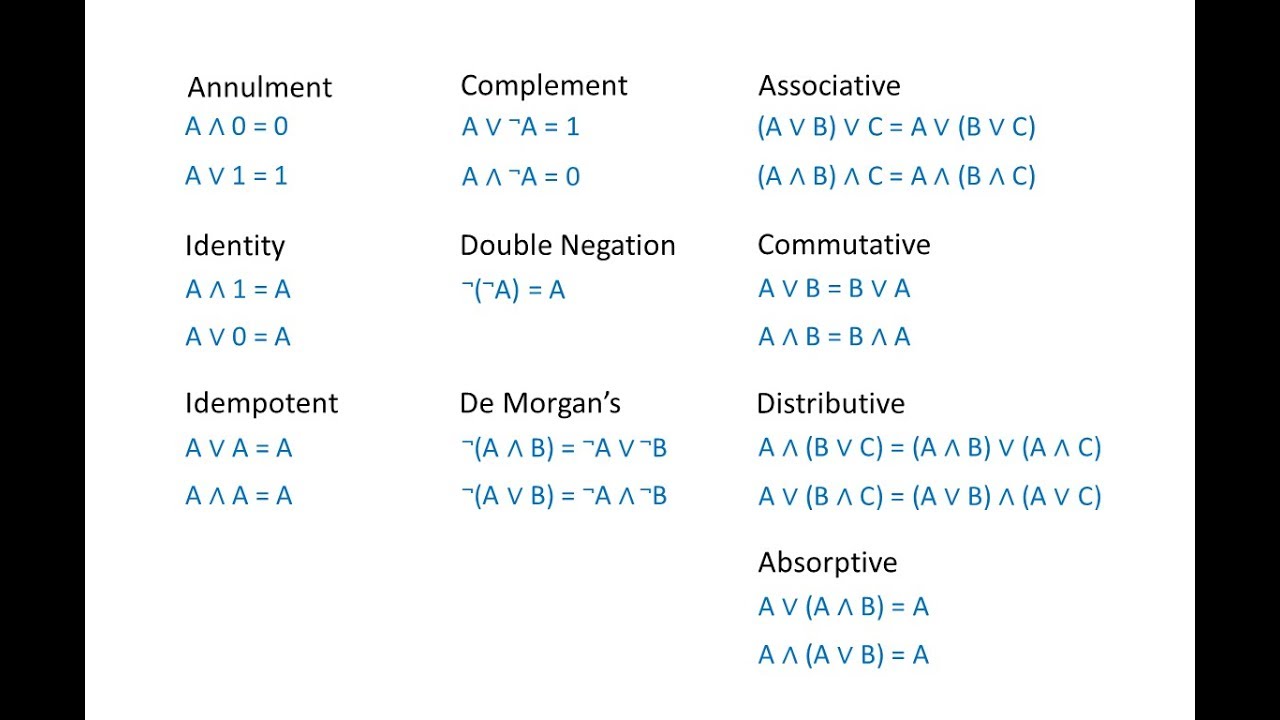
  • Reviews key laws: annulment, identity, complement, double negation, commutative, and distributive laws
  • Explains that any variable ANDed with 0 gives 0, and any variable ORed with 1 gives 1
  • Covers the OR and AND variations of the distributive law, comparing expansion to binomial expansion
  • Explains factorization as the reverse of distributive expansion for collecting common terms
  • Demonstrates recognizing patterns where a bracketed group acts as a single variable
  • Works through examples showing a complex circuit reducing to a single OR gate, and another reducing to a direct connection
  • Shows how expanding brackets can create opportunities to eliminate terms, similar to sacrificing pieces in chess
  • Derives the absorptive law (A + AB = A) from the other laws without directly applying it
  • Recommends using an online Boolean algebra calculator to check intermediate forms

Answers

Questions about this video

What is the annulment law and how is it used?

The annulment law states that any variable ANDed with 0 equals 0, and any variable ORed with 1 equals 1. The video uses this to replace terms like D + 0 with 0 alone and to simplify expressions containing a 1 in an OR.

Why does simplifying a Boolean expression matter in practice?

Simplifying reduces the number of logic gates needed for an equivalent circuit. The video notes that fewer components make a circuit more reliable, faster, cooler-running, and cheaper to manufacture.

How does the absorptive law get derived in this video?

The video starts by rewriting a single A as A + 1, then applies the distributive law and other laws step by step. It shows that A + AB reduces to A, proving part of the absorptive law without citing it directly.

Full Transcript — Download SRT & Markdown

00:00
Speaker A
this video is about simplifying complex boolean expressions using the laws of boolean algebra it follows on from a video that explains how the various laws of boolean algebra can be derived ideally you should familiarize yourself with these laws first simplifying a
00:19
Speaker A
boolean expression minimizes the number of logical operations involved because a boolean expression represents a combination of logic gates an equivalent expression with fewer operations represents an equivalent circuit but with fewer gates this video shows you how it's done
00:38
Speaker A
application of demorgan's theorum is covered in the next video these are the laws of boolean algebra you're going to need them handy learning to apply these laws is a bit like learning to play chess first you need to learn the basic
00:53
Speaker A
moves then over time and with practice you'll get better and better at combining sequences of moves in a game before seeing these laws in action let's risk stating the obvious these laws illustrate patterns of variables and operators that we'll be
01:10
Speaker A
attempting to identify within complex expressions for example if we see the term d + 0 within a complex expression then we can apply the annulment law and replace this term with 0 alone if we see the term not not C within an expression
01:30
Speaker A
this is an example of double negation and the term can be replaced with just C let's also take a look at some useful interpretations of these laws before we see them in action the annulment law states that any variable ANDed with 0 is
01:49
Speaker A
0 think about it any number of different variables ANDed together with at least one 0 in the mix will also result in 0 this becomes clear when you examine this combination of and gates the annulment law also states that any variable Ord
02:09
Speaker A
with a 1 is equal to 1 in indeed any number of variables aught together with a 1 will result in a 1 this set of all gates makes it obvious in fact we can go even further and say that anything odd with a
02:28
Speaker A
1 is a 1 so for example not a and B or 1 is also equal to 1 we can also infer some variations of the distributive law suppose we identified this term within a complex expression there are 4 variables
02:47
Speaker A
a b c and d and two sets of brackets but this is just the variation of the first part of the distributive law the so called or distributive law we can go ahead and expand this term by anding
03:02
Speaker A
each variable in the first pair of brackets with each variable in the second pair the four new terms we generated are now ORD together you may have come across an analogue of this method of expanding brackets in regular
03:16
Speaker A
base 10 algebra some people call it the crab claw method in regular algebra it's properly known as binomial expansion here's a similar variation of the other part of the distributive law the and distributive law when it comes to
03:35
Speaker A
simplifying complex expressions expanding brackets might seem like a backwards of step because it increases the number of operators in an expression making it even more complex but you'll soon see that expanding a term often creates opportunities to eliminate other
03:51
Speaker A
terms just like playing chess sometimes it's worth making a few sacrifices to advance your game performing the distributive process in the opposite direction is also very useful being able to identify and collect together common terms is called factorization spotting
04:12
Speaker A
opportunities to factorize takes practice but if you can spot them factorization is a very useful technique indeed here's another variation of the distributive law there are two sets brackets again but only three variables this time a b and c we can expand these
04:33
Speaker A
brackets in the same way making sure that we end each variable on the left with each variable on the right notice this time we generated the term a and a which can be reduced to just a using the
04:47
Speaker A
ident law here's a similar variation of the and counterpart of the law you can see that this time the expansion generates a or a which again equates to simply a at first sight this term doesn't look like a candidate for
05:05
Speaker A
expansion using the distributive law the pattern of and and all operators is not the same as in all the other examples let's add some brackets for clarity we can see that in every other example with two pairs of brackets the operators
05:21
Speaker A
within the brackets match and the operator between the pairs of brackets is different from the operators inside the brackets but if we think of the contents of the first pair of brackets here as a single variable then the
05:40
Speaker A
pattern of terms and operators now looks more like an example of the original or distributive law and we can go ahead and expand this term this particular interpretation of the distributive law is extremely useful and well worth keeping an eye out for you'll see all of
05:59
Speaker A
these variations in action soon let's put these laws to use here's an expression with one or operation one not operation and one and operation this is the combination of logic gates that it represents it has one or gate one not
06:20
Speaker A
gate and one and gate as you'd expect our objective is to simplify the expression minimizing the number of operations involved there's nothing obvious that can be eliminated immediately so let's expand the brackets according to the distributive law and
06:37
Speaker A
see where it takes us now we can see an opportunity to reduce the term a or not a to one by applying the complement law the identity law states that anything ANDed with a 1 is itself so one and A or B is a or B this
06:59
Speaker A
is about as simple as we can get with two variables the brackets aren't needed here so the original combination of logic gates can be replaced with a solitary or gate as a check you can see that the truth table of the original combination
07:15
Speaker A
is the same as that of an or gate but clearly a single or gate is much simpler it needs fewer electronic components so it's more reliable it's faster it generates less heat and it's cheaper to make here's another example of an
07:34
Speaker A
expression that we might be able to simplify this is the circuit that matches the expression the term a or not a jumps out at us this can be reduced to 1 according to the complement law now we can see one or not B the annulment law
07:55
Speaker A
allows us to reduce this to 1 because anything Ord with a 1 is a 1 finally the identity all can be applied because anything ANDed with a 1 is itself so these two expressions are equivalent examine the truth table for the original
08:13
Speaker A
circuit and you can see that this is indeed the case the output of the circuit is always the same as a in other words the original combination of gates is essentially useless a simple connection from A to Z will do exactly
08:28
Speaker A
the same job here's another example and the circuit it represents if there's no obvious place to begin there's wisdom in adding a few extra brackets for the sake of clarity it's really important not to change the meaning of the expression
08:49
Speaker A
when doing this notice that terms that handed together are still ANDed together now we can more easily see that part of the expression can be expanded using the distributive law the combination of variables and operators highlighted doesn't immediately suggest that this is
09:10
Speaker A
possible but by treating the term B and C as a single variable then we can end it with B in the second term and we can end it with C in the second term now brackets can be great for improving the
09:25
Speaker A
clarity of an expression but sometimes they can have the opposite effect this is starting to look a bit too busy so let's get rid of some of the unnecessary brackets this time the meaning of this expression hasn't changed but what we've
09:39
Speaker A
done has revealed opportunities to use the identity law twice in fact B and B becomes b and c and c becomes c yet another opportunity to use the ID empat --nt law has become apparent if a or a is a it follows that B and C or B
10:02
Speaker A
and C is B and C we're nearly finished our final move is to make use of the distributive law to factorize the expression by pulling B out of each term in brackets so these different combinations of logic gates do exactly
10:24
Speaker A
the same job once again one of them is much simpler making it more efficient and more cost-effective this fairly simple expression has two variables and one or operation and one and operation but there's scope to simplify it this is
10:46
Speaker A
the combination of logic gates that it represents first let's add some brackets for clarity strictly speaking these brackets aren't necessary because the and operation has a higher precedence than the or anyway at this stage you might have spotted that we can use the
11:04
Speaker A
absorptive law and simplify this expression in just one step but suppose for a moment that we don't know about the absorptive law there are some useful transformations to learn about here we'll begin by converting this single a into a + 1
11:22
Speaker A
using the identity law at first sight a backwards step the expression is bigger than it was but keep watching this counterintuitive move has a purpose we can now apply the distributive law to factorize this expression here it is
11:40
Speaker A
with one of the A's factored out this has revealed an opportunity to use the annulment law which states that a variable Ord with a 1 is a 1 here the variable B is being ordered with the 1 so it becomes simply 1 finally we can
11:59
Speaker A
apply the identity law any variable handed with a 1 results in itself were left with Z equals a so these two expressions are equivalent the output of the circuit is always the same as the input the circuit is redundant in fact
12:19
Speaker A
what we've just done is prove part of the absorptive law the or absorptive law that is a or a and B equals a let's see another example again let's pretend we haven't spotted that we can use the absorptive law yet
12:38
Speaker A
note that the brackets are essential this time they specify that the or operation should occur before the and we'll expand the brackets according to the distributive law then a and a can be reduced to just a according to the ID
12:56
Speaker A
important law what we have now is exactly the same as the previous example we could simply say let's now reduce it to a using the half of the absorptive law that we've already proved or we can work through exactly the same steps
13:11
Speaker A
again and ultimately we'll arrive at nothing more than a we've just proved the second part of the absorptive law the and absorptive law a and a or B equals a let's look at an example that makes use of the absorptive
13:38
Speaker A
law perhaps you'd like to try it for yourself before I show you a solution there's a multitude of ways that you can approach this problem and they're all fine if they arrive at the same result you shouldn't be afraid to try something
13:50
Speaker A
out and backtrack if it leads to a dead end pause the video now if you'd like to give it a go and I'll show you one possible solution in a moment let's run through a solution then straight away we
14:08
Speaker A
can see an opportunity to apply the and absorptive law now it's tempting to remove one of the B's sitting outside of the brackets because B or B is B but be careful these extra brackets make it clear why this would be wrong the
14:23
Speaker A
leftmost B is being ANDed with an A and this operation has a higher precedence than oaring the B with anything else however these brackets have revealed an opportunity to apply the or absorptive law a and B or a is essentially the same
14:40
Speaker A
as a or a and B remember the commutative law so this term can be reduced simply to a with no other obvious reductions to be made yet I'm now going to expand these brackets according to the and distributive law with a little
14:57
Speaker A
rearrangement as permitted by the commutative law we've revealed an opportunity to absorb again and so we have our final simplified expression these two very different combinations of logic gates will do exactly the same job here's a few different expressions you
15:23
Speaker A
can attempt to simplify yourself pause the video now if you want to give them a try take your time and I'll run through some salu when you resume playing here's solution one I'm going to use the distributive law to expand the whole term I can now
15:47
Speaker A
use the identity law to reduce a or a down to a I can use the absorptive law to turn this term into simply a and I can use the absorptive law again with three variables this is probably as
16:05
Speaker A
simple as it gets here's solution to first thing I'm going to do is expand this part of the expression using the distributive law now I'm going to use the complement law to reduce not C or C down to one the
16:27
Speaker A
idempotent law allows me to reduce B or B down to B there's an opportunity to absorb here there's another opportunity to absorb and yet another opportunity to use the absorptive law finally B and one becomes B according to the identity law
16:53
Speaker A
solution 3 this one's tricky but definitely worthy of study I'm going to add some brackets for clarity notice how the or operation is now more prominent but the terms that were being handed together are still being ANDed together
17:09
Speaker A
I haven't changed the meaning of this expression I'm going to use the distributive law to factorize it I've pulled a out of each set of brackets my next move is to use the identity law to change not to C into not C and one this
17:27
Speaker A
might seem like a pointless move but look at what I do next I'm going to factorize again but this time I'm pulling not see out of the expression by doing so I've revealed an opportunity to use the annulments law B or 1 becomes 1
17:44
Speaker A
and this has revealed an opportunity to use the identity law Nazi and one becomes not see there's my final expression to summarize simplifying a complex boolean expression minimizes the number of logical operations and variables involved this makes it a
18:08
Speaker A
powerful technique for simplifying complex logic circuits the laws of boolean algebra represent patterns of variables and operations that can be manipulated reduced and ultimately eliminated from a complex expression mastering these laws takes care and plenty of practice occasionally you'll
18:31
Speaker A
run into a dead end so you'll need to backtrack and try another approach knowing you've succeeded in simplifying an expression as far as it will go is one of the challenges you face when learning this skill unlike a game of
18:46
Speaker A
chess you don't always know when you've won an online boolean algebra calculator can help you with this it will let you see the minimized form of a complex expression and it will let you check that your intermediate forms are on the
19:02
Speaker A
right track
Topics:boolean algebrasimplifying boolean expressionslogic gatesdistributive lawabsorptive lawdigital logicfactorizationcomputer scienceboolean lawscircuit simplification

Get More with the SozAI App

Transcribe recordings, audio files, and YouTube videos — with AI summaries and speaker detection. 30 minutes free.

Or transcribe another YouTube video here →
