Skip to content
Get App

This ONE AI Agent Will Make You So Productive It's Almost Unfair

A former tech CEO explains how one well-trained personal AI agent can fight productivity drains like app fragmentation and information floods, using interview prep and inbox filtering demos.

Key Takeaways

  • One deeply personalized AI agent delivers more value than many disconnected AI tools.
  • Use agents to reduce app-switching and information hunting, freeing attention for judgment and creative work.
  • Delegate filtering and triage of communications, but keep the human in control of final decisions.
  • Use agents for rehearsal and simulation, such as interview practice, where repetition is low-risk.
  • Be deliberate about privacy and which data you connect to an AI agent.

What the video covers

  • The speaker, a former CEO and board member in tech and AI companies, argues one AI tool that knows you well beats ten generic ones.
  • Personal AI agents differ from chatbots: they are autonomous (pursue goals and act), continuous (keep working after you leave), and tailored (remember your goals and preferences).
  • The speaker demos ChatGPT's personal agent but notes the principles apply to Claude, Gemini, Meta's Muse, and Grok.
  • A core rule: let the agent manage and execute, but the human makes the final decision.
  • The first force, fragmentation: a Harvard Business Review study found workers switch apps about 1,200 times a day, costing hours and attention.
  • The agent should act as glue connecting apps and information so the user spends time using information rather than hunting for it.
  • Interview prep example: the agent gathers resume, notes, emails, and company research, then simulates a tough interviewer for repeated practice.
  • The second force, floods: Microsoft survey data shows about 117 emails and 153 chat messages daily, most getting under a minute of attention.
  • Filtering prompt: the agent checks email, messages, and calendar at set times, flags only decisions needing the user, and batches the rest into an end-of-day summary.
  • Complexity example: an agent can explain a lease or insurance terms, citing a study where only 14% of Americans correctly defined four basic insurance terms.

Answers

Questions about this video

What three qualities does the speaker say make personal AI agents different from chatbots?

The speaker says personal AI agents are autonomous, meaning they pursue goals and take actions on their own; continuous, meaning they keep working when you close the chat or laptop; and tailored, meaning they remember your goals, preferences, and how you like things done.

How much time does app fragmentation cost according to the video?

The speaker cites a 2022 Harvard Business Review study in which employees switched apps about 1,200 times a day. Each switch costs roughly 2 seconds, adding up to about 40 minutes daily, but the speaker stresses the hidden cost to attention quality is even greater.

What filtering approach does the speaker recommend for overwhelming email and messages?

He suggests prompting the agent to check email, messages, and calendar at set times such as 10 a.m., 1 p.m., and 4 p.m., flag only decisions and deadlines that need the user, and park everything else in a 5 p.m. summary so focus is protected.

Full Transcript — Download SRT & Markdown

00:00
Speaker A
I have spent many years as a CEO and board member in tech companies and AI companies and here's what I am seeing.
00:09
Speaker A
One AI tool that knows you really well is better than 10 that don't. And the longer you use it, the more productive you become. So, in this video podcast, I will show you how to build that one personal AI agent, whichever platform
00:25
Speaker A
you use, and we will use that personal AI agent to defeat the four forces that drain your productivity. The first three forces steal your hours, but the last one steals your years. The best AI tool is the one that saves you from opening
00:42
Speaker A
another one. Whatever you're trying to accomplish, your time and your attention are limited by default. The more you spend managing the little things, the less you'll have left for the things that matter. So, here's the challenge.
00:57
Speaker A
Instead of one great AI chief of staff, we end up hiring a crowd of AI interns, and you end up spending more time managing them, and you become their chief of staff, and that needs to change. So, what makes these personal AI
01:13
Speaker A
agents different from the chatbots that you've already used? Well, there are three things. How do you remember them?
01:20
Speaker A
The easiest way to think about it is what I call act. First, they're autonomous. So, you give it a goal and it figures out how to get the job done. It runs on its own computer in the cloud. It can work with
01:35
Speaker A
other tools, other agents, other apps. It can browse the web. It can take actions. Second, it's continuous. So, it doesn't stop working when you close the tab or you close the chat or you close your laptop. It can orchestrate a task
01:53
Speaker A
that can run for hours. It'll come back to you when it's done. And third, tailored. It is crafted and trained with personalization in mind. So, it remembers your goals, your preferences, and how you like things done. And by the
02:10
Speaker A
way, I'm going to use Cache PT's DOTS, which is their personal AI agent for the demos in this video, but the principles apply to all personal AI agents, whether you're using Claude Co-work or Google's Gemini agent or Meta has Muse now or
02:28
Speaker A
Grock has Grockbot. So you can pick your favorite tool. The approach is the same.
02:35
Speaker A
Now one rule to remember, let them manage, let them execute, let them partner with you, but it's you who makes the final call. Otherwise, your agent might end up posting your bank statement on your Instagram story. So be careful.
02:53
Speaker A
Let's start with the first force, fragments. There is a job you do 1,200 times a day and it's not in your job description. Sometimes all these AI tools make me feel like I am a tool. In 2022, researchers published an article in
03:12
Speaker A
Harvard Business Review. They tracked employees of Fortune 500 companies over a month and they tracked and logged every time someone switched from one app or website to another. The average person switched nearly 1,200 times a day. Now each switch costs only about 2
03:34
Speaker A
seconds. So that's about 40 minutes a day. But that's as long as a lunch break. But there's something more alarming in terms of hidden cost. So fragmentation damages the the quality of your attention. Why? Because the information we need is scattered
03:53
Speaker A
everywhere. So you spend time hunting for the information you need to do the work before you can actually do the work. That's the first force. Your personal AI agent has to fight. that force and that AI agent needs to become
04:08
Speaker A
the glue that connects all your apps and information islands so you can focus on harvesting the info not hunting for it.
04:18
Speaker A
Let's go through an example. Imagine you have landed an interview for a job you have wanted for years. This could change your career. But now what? Because your resume is in Google Drive somewhere.
04:32
Speaker A
Your notes from previous interviews sit somewhere else. The job description is somewhere else. Your conversations with the recruiter are in some emails. The company background is out there somewhere. The evidence of your best work is actually scattered across the
04:48
Speaker A
entire drive in presentations and documents and emails. So, this would take days to consolidate. How do you position yourself for this interview?
04:59
Speaker A
Why not try something different? You can go for a walk with your personal AI agent. You can prompt it. You can say, "I've got an interview for a job I have wanted for years. Help me walk in as the most prepared candidate they've
05:19
Speaker A
ever seen. Use my resume, my past work, my emails, company background, and research the company's interview process." Now, this could be any company, but here's what companies are doing right now. McKenzie, for example, is testing AI agents that play a client
05:40
Speaker A
in interviews for entry-level consultants. So, the candidate has to work through the client's problem live while the human interviewer is watching and scoring them. That's the world we're walking into. So, your interview prep has to move up a level, too, right? You
05:58
Speaker A
tell your AI agent to simulate that interview. The prompt would be something like, "Now simulate the interview based on what you've learned about me and the role and the company. Ask me realistic questions, challenge my answers, and push back when my reasoning is weak.
06:17
Speaker A
Don't make it easy." And then when you're finished, you can ask it to critique your performance, your answers.
06:23
Speaker A
You can write up notes, and you can do it again. Now, here's the best part. If the interview goes badly, hey, who cares? That was just a rehearsal. Do it again and again. At least you got your 10,000 steps in. So, your agent gathers
06:41
Speaker A
everything. It visits seven different tools and apps and acts like your interviewer. And you focus on just one thing, getting better and getting that job. Now remember that these agents can get information from other places only after you connect them to those specific
07:00
Speaker A
apps and tools. Now let's move to fighting the second force that slows down productivity flood. 117 emails, 153 chat messages every single day. The best thing your AI agent can do might be what it never shows you. In 2025, Microsoft
07:21
Speaker A
surveyed about 31,000 people. The average worker received 117 emails and 153 Teams messages a day. Most of those emails got less than a minute of attention, sure, but that's the flood of information. And that's not even including the social media stuff that
07:44
Speaker A
comes at you from every direction. And somewhere in there is that one message that actually mattered. And also the things that matter are usually pretty complex. So researchers at Carnegie Melon tested Americans with private insurance on four basic terms like
08:06
Speaker A
deductible and co-ay. And only 14% got all four definitions right. So you're fighting two floods really. Too much reaches you all the time and at times it is too dense to act on. And this is where your personal AI agent
08:24
Speaker A
comes in handy. It can filter the noise and decide what deserves your attention and simplify what deserves your judgment. And that's exactly what a chief of staff would do. Right? Of course that's also the risk. Whoever or whatever is the gatekeeper decides what
08:45
Speaker A
you get to see. So don't stop at setting the goals. Check the work and keep refining. So let's create that filter.
08:54
Speaker A
Prompt your personal AI agent something like I want to protect my focus and I want to only get pulled away for what truly needs me. So, at 10:00 a.m., 100 p.m., and 400 p.m., check my emails, my messages, my calendar, and flag only
09:12
Speaker A
decisions waiting for me. Deadlines that moved or changes that I need to know about, park everything else for a 5:00 p.m. summary. And this is a great prompt. I use it all the time because you'll be surprised how much of your
09:29
Speaker A
urgent work can wait until 5:00 p.m. and some of it can even wait until you retire. And okay, what about the complexity? Well, this is how you untangle it. Let's say you're reviewing the lease for your new apartment. Okay,
09:47
Speaker A
get it and give it to your personal agent and it will help. You can say something like, "I'm about to sign this lease and I want to know exactly what I'm agreeing to." You see, in all of these prompts, you're giving objectives,
10:02
Speaker A
not just instructions, goals, not just guidance. Flag anything that could cost me money or limit what I can do, and show me the exact clauses. Great prompt.
10:15
Speaker A
You now have a translation layer between complexity and simplicity. You can quickly move from consuming information to making decisions. And that brings us to the third force, frequency. The work that keeps coming back whether you're ready or not. You remember to eat dinner
10:37
Speaker A
every night. It's a habit. You'll remember you're flying to Paris with the love of your life 3 weeks from now and you can't wait to start packing. You're counting days. It's a headline event.
10:50
Speaker A
But why do you have trouble remembering to take that vitamin once a week? I do for two reasons. First, a habit is built by repetition. And a weekly task doesn't get enough repetition to become a habit.
11:07
Speaker A
Second, we all need a trigger to remind us about those infrequent but recurring tasks. No habit, no headline, no hope of tracking it. Unless, of course, you have your friendly neighborhood AI agent. Let me give you a a real example.
11:26
Speaker A
A few weeks ago, I bought my iPhone 18. You know, I usually buy my iPhone every four years or so.
11:36
Speaker A
There's no reason to upgrade it otherwise. But 2 days ago, my agent reminded me, "Hey, your trade-in kit arrived about 14 days ago. So today is the last day for you to return your old iPhone for your trade in." I was like,
11:52
Speaker A
"Oh, wow. Thank you, Capes." That's her name, by the way. In my mind, she's a superhero who can juggle a hundred things at once. and I can't remember where I left my phone. So, here's another example. My jaw used to block my
12:09
Speaker A
air waves when I used to sleep. So, I would wake up 34 times every hour because my brain would jolt me awake every time I stopped breathing. So, it's it's fixed now. Uh, but the other day I sent Capes a quick line saying, "When
12:29
Speaker A
was the last time I saw my pulmonologist, the sleep disorder specialist?" And of course, she came back and said, "It's been a year." So, I asked her to set up an appointment. And then, this is the most important thing.
12:44
Speaker A
I said, "Make sure I see my doctor every 3 to four months." And that's how you make your agent your trigger. And here's another thing to keep in mind. My AI agent only set the appointment. It did not have my health records or any
13:02
Speaker A
financial information. Now, I'm not comfortable sharing any of that with AI. That's my choice for now. You can make your own judgment. So, here's your action item. Pick one thing in your life with no habit and no headline and hand
13:19
Speaker A
it to your agent this week. And by the way, if you like these ideas, you'll enjoy my newsletter as well. It goes out every Tuesday. One inside, one tool, one practice, and it's free. I love writing it. The link is right below. So far,
13:35
Speaker A
these agents are helping you earn back your attention, your evenings, your peace of mind. But that leads us to a bigger question. What are you going to do with it? That's the fourth force, future. The first three forces steal
13:53
Speaker A
your hours. This one steals your years. I'll do it later. Is how life slips away. There is a famous video on YouTube called the last lecture. You may have seen it already. It's by computer science professor Randy Pouch and he
14:15
Speaker A
gave it many years ago when he knew that he only had a few months to live. He had pancreatic cancer and um he also gave another lecture before passing away and that was on time management. In that one, he talks about how Americans
14:39
Speaker A
as a culture are very interested in money, how much someone earns, how they spend it, their net worth, and so on and on. But we're not that interested in time.
14:55
Speaker A
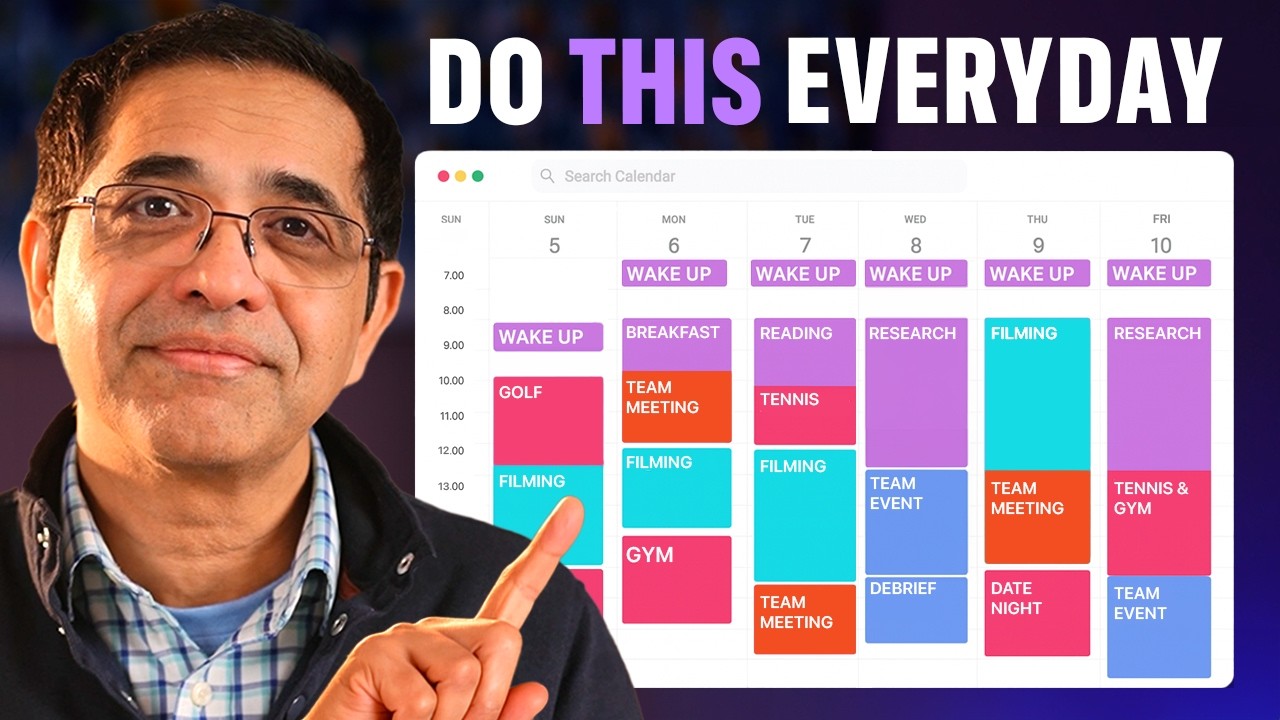
We make a budget on how we spend money, but we don't budget how we spend time.
15:01
Speaker A
And Ry's insight was we have it backwards. He passed away less than a year after that lecture. He was 47 and he knew the value of time. So he spent it on what mattered the most.
15:19
Speaker A
So here's the real question. AI agents will give you back time. What are you going to do with it? Productivity is great only when it helps you achieve your purpose. So, here's the action item. Write down three things you keep
15:36
Speaker A
saving for the future. And then tell your agent, "These are the priorities. Every Sunday evening, review my calendar and work from this week. Tell me what I did to achieve these priorities and what I should change next week." Now your
15:55
Speaker A
agent moves you to what matters to you and toward your future. The strange thing about time is that it feels precious only when there is less of it left.
16:11
Speaker A
So take a look at your watch. Really look. You know what time it is? It's your time.
16:22
Speaker A
Thank you. And I love you.
Topics:personal AI agentproductivityAI productivity toolsfragmentationemail managementinterview preparationChatGPT agenttime managementAI chief of staffdigital attention

Get More with the SozAI App

Transcribe recordings, audio files, and YouTube videos — with AI summaries and speaker detection. 30 minutes free.

Or transcribe another YouTube video here →