Skip to content

How Quant Finance Made Me $1.6M Trading Prop Firms

JJ Simon shares how quantitative finance shaped his $1.6M prop firm trading journey, revealing key lessons from failures and market realities.

Key Takeaways

  • Quantitative finance teaches the improbability of consistently predicting markets, preventing overconfidence.
  • Many trading strategies that appear profitable are statistical coincidences due to small sample sizes and overfitting.
  • Risk management and position sizing are more important than finding the 'perfect' trading strategy.
  • Prop firm trading demands strict adherence to rules and adapting strategies to constrained environments.
  • Experience and learning from failures are essential for long-term success in trading prop firms.

What the video covers

  • JJ Simon earned over $1.6 million trading with prop firms after graduating with a degree in quantitative finance at 19.
  • His education taught him that predicting markets reliably is nearly impossible and most perceived edges are coincidences.
  • He experienced four major account blow-ups, each teaching critical lessons about trading and risk management.
  • Simon emphasizes that prop firm trading is highly rule-constrained, requiring adaptation beyond typical strategies.
  • He highlights the dangers of overfitting strategies to limited data and the importance of understanding sample size limitations.
  • Simon’s background includes learning trading in a classroom environment, contrasting with many self-taught traders on social media.
  • He shares how poker helped him develop risk and probability skills applicable to trading.
  • Proper position sizing and risk management were more crucial to his success than finding perfect trade setups.
  • He stresses that surviving in the prop firm environment is a key indicator of a strategy’s robustness, not market prediction.
  • Simon’s journey includes evolving from blaming external factors to understanding the trading environment and his own mistakes.

Answers

Questions about this video

Did studying quantitative finance help JJ Simon predict the market?

No, JJ Simon explains that quantitative finance taught him that almost nobody can reliably predict the market, and most perceived edges are statistical coincidences.

What were the key lessons JJ learned from his trading losses?

JJ learned that blaming strategies or setups was misguided; instead, understanding the trading environment, proper risk management, and position sizing were crucial to avoid blowing accounts.

How did poker influence JJ Simon’s trading approach?

Poker helped JJ develop mathematical and probabilistic thinking, which he applied to trading, improving his risk assessment and confidence in managing trades.

Full Transcript — Download SRT & Markdown

00:00
Speaker A
I've been paid more than $1.6 million by prop firms, and I graduated college with a degree in quantitative finance when I was 19 years old. Now, I'm going to tell you the opposite of what you probably expect to hear from that. Studying quantitative finance did not teach me how to predict the market. It taught me that almost nobody can. So, most people that think they found an edge most likely have just found a coincidence with really good marketing. Now, that sounds like it probably made me a worse trader, but it actually is the only thing that kept me from going broke.
00:09
Speaker A
quantitative finance did not teach me how to predict the market. It taught me that almost nobody can. So, most people that think they found an edge most likely have just found a coincidence with really good marketing. Now, that
00:18
Speaker A
Because here's the thing. There's been four main parts to my journey, all 10 times larger than the last, that actually made an impact on my lasting success with prop firms. Started with a $50 loss when I was 14, then 500, then 5,000, and then more than $50,000 just last year. So, I had four blow-ups. They taught me four lessons, and I'm going to get you through all of them in just this video.
00:23
Speaker A
Because here's the thing. There's been four main parts to my journey, all 10 times larger than the last that actually made an impact on my lasting success with prop firms. Started with a $50 loss when I was 14, then 500, then 5,000, and
00:34
Speaker A
All right, so here is my degree. It is from the University of Washington. I have a degree in computational finance and risk management for the official degree title. I graduated when I was 19 years old. I was in college for two years. I had taken a lot of college classes during high school. So, when I got into college, it was pretty easy to finish the remaining credits. So, just two years in college, did the internship in the industry, and I have been trading prop firms full-time since my graduation, which was about May of 2025. And I'm not showing you that degree because it makes me right or anything.
00:40
Speaker A
All right, so here is my degree. It is from the University of Washington. I have a degree in computational finance and risk management for the official degree title. I graduated when I was 19 years old. I was in college for two
00:51
Speaker A
There's literally guys who have PhDs that have blown up entire hedge funds. There's also a bunch of people on this app that are making money with no degree at all. I just wanted to change what kind of video this is. Most of the people in the space learned trading from someone else on this app, but I learned it in a classroom from people who were literally telling me everything I was doing was wrong. Then I went and applied it to the prop firm space, which is a pretty interesting combination if you ask me. Prop firms are pretty much the most rule-constrained environment of all time in the financial industry. So, I think it's a pretty interesting combination, and I think it's worth 20 minutes of your time. Everything else in this video is just going to go over what happened after those two things collided. Also, I know I'm probably younger than most people watching, and I'm not going to pretend I have the life experience that you do. However, I have been taking 20 trades a day for the past 16 months. This is literally what I studied in college. It's what I worked in the industry for. I just decided to quit and work for myself because prop firm trading was so profitable for me. But let me get back to before the education because I was not smart about it at the start at all. I had literally $50 to my name. I got a top evaluation, and I blew it after that. I just kept working. I was a tutor at Kumon Math just trying to make $15 an hour so I could get my next top eval, hoping something would change.
01:01
Speaker A
prop firms full-time since my graduation, which was about May of 2025. And I'm not showing you that degree because it makes me write or anything.
01:09
Speaker A
I just kept blowing the accounts within a week. And honestly, I wish I could tell you that I learned something from this experience, but I didn't. My only conclusion back then was that $50 wasn't enough. Two accounts wasn't enough. I just needed more sample size. Now, in hindsight, that's obviously the wrong lesson. And unfortunately, it's the one that most people think they're learning when they blow their first account.
01:17
Speaker A
people in the space learned trading from someone else on this app, but I learned it in a classroom from people who were literally telling me everything I was doing was wrong. Then I went and applied it to the prop firm space, which is a
01:26
Speaker A
Then, for the next four years, while I was still in high school, I was trying to learn everything about trading and prop firm trading from online, YouTube, basically any knowledge that I could find, I was trying to consume it. I was so focused on the strategy, so focused on looking for the right setup that I didn't realize the environment that I was trading in was actually a ton of rules meant to constrain profitable trading strategies. So, every single time I lost, I would just blame the setup. I'd blame the charts, not myself, for not understanding what environment I was actually trading in. I went through probably 10 or more strategies. I'd maybe give it 10 to 20 trades in live and then just quit after I lost maybe three or four times. And you should remember that because in a few minutes, I'm going to show you the math behind how absurd that actually is. So when I graduated high school, I was going to college for engineering. But as soon as I got to college, I started playing poker, started learning more about finance, and I realized, why not study quantitative finance? It's going to teach me how money works, going to teach me how the markets work, going to make me better at poker, math, statistics, pretty much the enjoyable things from engineering, but then I could actually apply it to making money. So, seemed like a no-brainer for me to switch to quant finance after I did. That is why I am sitting here in front of you today. All right, this is the part of the video that is actually about quantitative finance, and I'm not going to water it down because my audience is quite smart.
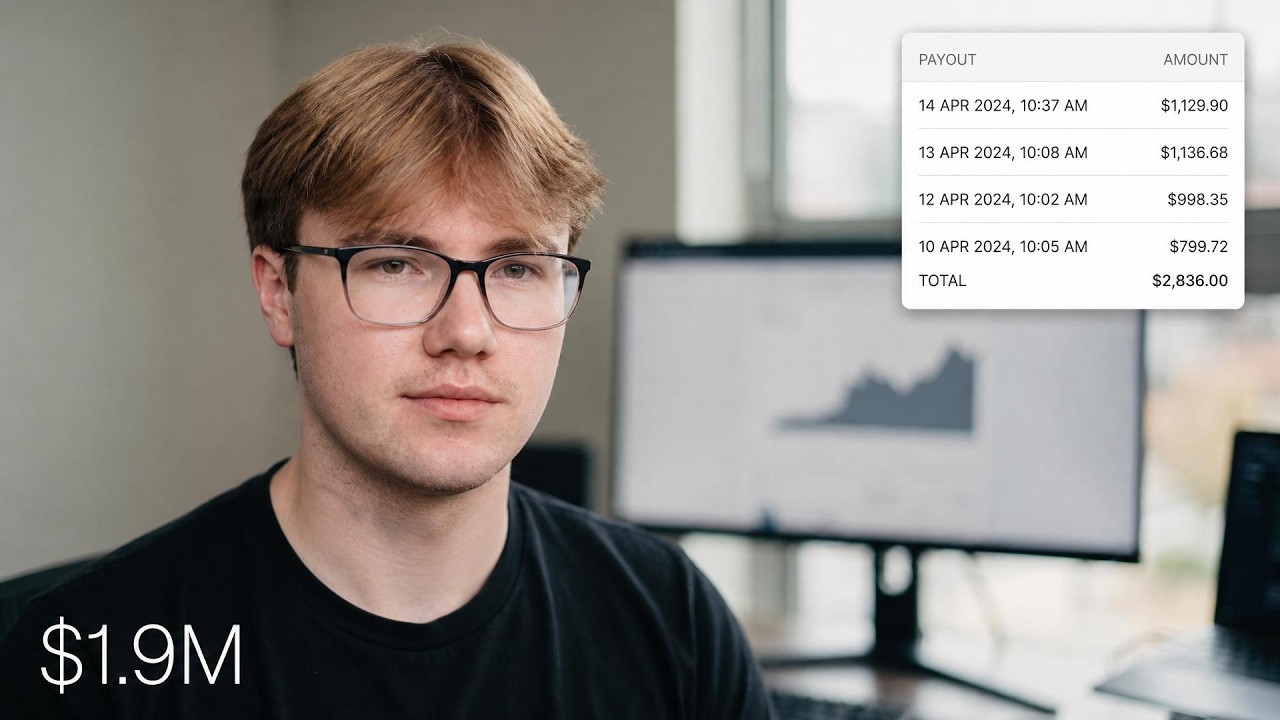
01:37
Speaker A
this video is just going to go over what happened after those two things collided. Also, I know I'm probably younger than most people watching and I'm not going to pretend I have the life experience that you do. However, I have
01:44
Speaker A
So, let's get into it. There's three things that I learned in college that taught me more about trading, and unfortunately, it did make me a little bit less confident. First, the surge process. Assume you're testing 100 strategies on the same exact data. They're pretty much pure noise because there's not enough sample size. And it is literally going to have one best result and one worst result. That's just how it works. And one of them is going to look amazing, right? Because you tested 100 on the same data set. One is going to look amazing. So the best out of n samples is not representative of the actual sample size. Past the sample boundary, meaning where the strategy stops checking, you're going to test it on real live data or maybe even on more backtested data. Because if you're looking at a specific time period, obviously one strategy is going to work best in that specific time period. From there, it could 100% go completely flat after that, and it was never the skill or the ability to do these trading strategies. It was literally just the maximum, literally like the best possible strategy out of 100 on a specific set of data. Personally, I never ran 100 backtests. I probably did thousands and didn't count a single one.
01:54
Speaker A
let me get back to before the education because I was not smart about it at the start at all. I had literally $50 to my name. I got a top evaluation and I blew it after that. I just kept working. I
02:04
Speaker A
Every single pattern that I noticed was chosen because it had already worked. Now, it's not a strategy problem. It's more of a memory problem, and it's now the reason a record is worth a lot more than a specific setup. Second, you cannot know your edge in 30 trades. This is literally just simple math. T statistic is approximately calculated by the Sharpe ratio times the square root of the number of years that something has been running for. And you can see running it for 6 weeks gives you a t stat of 0.34, 6 months 0.71, 1 year 1, and four years 2. So, if you want a t-stat of two, which is the loosest t-stat that you should probably use for statistical significance, and your strategy has a Sharpe of one, then you're good. But it would possibly take you four years to find that out. Also, a losing month is not enough evidence to draw statistical significance. And just think about how people in this trading space talk. Somebody will literally trade something for like 6 weeks, make money, post about it, but 6 weeks at a Sharpe of one is literally a 0.34 t stat, which is weak evidence. This is like pretty much a coin flip. And this is what I was doing before college. 10 trades, 20 trades, and then I would just decide automatically this is good, this is bad. But here's the half of it that actually made me money because it cuts both ways. The losing month basically has no information about if a strategy is profitable or not just because the sample size is so small. The correct response to a bad month is not to change the strategy. And that's pretty much the most expensive habit that I had to break. I ke
02:09
Speaker A
I just kept blowing the accounts within a week. And honestly, I wish I could tell you that I learned something from this experience, but I didn't. My only conclusion back then was that $50 wasn't enough. Two accounts wasn't enough. I
02:18
Speaker A
just needed more sample size. Now, in hindsight, that's obviously the wrong lesson. And unfortunately, it's the one that most people think they're learning when they blow their first account.
02:25
Speaker A
Then, for the next four years, while I was still in high school, I was trying to learn everything about trading and prop firm trading from online, YouTube, basically any knowledge that I could find, I was trying to consume it. I was
02:35
Speaker A
so focused on the strategy, so focused on looking for the right setup that I didn't realize the environment that I was trading in was actually a ton of rules meant to constrain profitable trading strategies. So, every single time I lost, I would just blame the
02:46
Speaker A
setup. I'd blame the charts, not myself, for not understanding what environment I was actually trading in. I went through probably 10 or more strategies. I'd maybe give it 10 to 20 trades in live and then just quit after I lost maybe
02:57
Speaker A
three or four times. And you should remember that because in a few minutes, I'm going to show you the math behind how absurd that actually is. So when I graduated high school, I was going to college for engineering. But as soon as
03:07
Speaker A
I got to college, I started playing poker, started learning more about finance, and I realized, why not study quantitative finance? It's going to teach me how money works, going to teach me how the markets work, going to make
03:14
Speaker A
me better at poker, math, statistics, pretty much the enjoyable things from engineering, but then I could actually apply it to making money. So, seemed like a no-brainer for me to switch to quant finance after I did. That is why I
03:25
Speaker A
am sitting here in front of you today. All right, this is the part of video that is actually about quantitative finance, and I'm not going to water it down because my audience is quite smart.
03:32
Speaker A
So, let's get into it. There's three things that I learned in college that taught me more about trading and unfortunately it did make me a little bit less confident. First, the surge process. Assume you're testing a 100 strategies on the same exact data.
03:43
Speaker A
They're pretty much pure noise because there's not enough sample size. And it is literally going to have one best result and one worst result. That's just how it works. And one of them is going to look amazing, right? Because you
03:51
Speaker A
tested 100 on the same data set. One is going to look amazing. So the best out of n samples is not representative of the actual sample size. past the sample boundary, meaning where the strategy stops checking, you're going to test it
04:03
Speaker A
on real live data or maybe even on more back tested data. Because if you're looking at a specific time period, obviously one strategy is going to work best in that specific time period. From there, it could 100% go completely flat
04:13
Speaker A
after that and it was never the skill or the ability to do these trading strategies. It was literally just the maximum, literally like the best possible strategy out of a 100 on a specific set of data. Personally, I
04:23
Speaker A
never ran 100 back tests. I probably did thousands and didn't count a single one.
04:27
Speaker A
Every single pattern that I noticed was chosen because it had already worked. Now, it's not a strategy problem. It's more of a memory problem and it's now the reason a record is worth a lot more than a specific setup. Second, you
04:37
Speaker A
cannot know your edge in 30 trades. This is literally just simple math. T statistic is approximately calculated by the sharp ratio times the square root of the number of years that something has been running for. And you can see
04:46
Speaker A
running it for 6 weeks gives you a t stat of 0.34, 6 months 0.71, 1 year 1, and four years 2. So, if you want a T-stat of two, which is the loosest T-stat that you should probably use for
04:58
Speaker A
statistical significance, and your strategy has a sharp of one, then you're good. But it would possibly take you four years to find that out. Also, a losing month is not enough evidence to draw statistical significance. And just think about how people in this trading
05:11
Speaker A
space talk. Somebody will literally trade something for like 6 weeks, make money, post about it, but 6 weeks at a sharp of one is literally a 0.34t stat, which is not weak evidence. This is like pretty much a coin flip. And uh this is
05:23
Speaker A
what I was doing before college. 10 trades, 20 trades, and then I would just decide automatically this is good, this is bad. But here's the half of it that actually made me money because it cuts both ways. The losing month basically
05:34
Speaker A
has no information about if a strategy is profitable or not just because the sample size is so small. The correct response to a bad month is not to change the strategy. And that's pretty much the most expensive habit that I had to
05:43
Speaker A
break. I kept strategy hopping between different strategies and I could never experience that positive curve in the equity curve. If every time there was a slight draw down, I would just quit. If you know my strategy, you know I love
05:53
Speaker A
news reversions. News is always priced in. So, I'm going to trade a reversion to the pre-news price. And then my first ever news reversion trade actually lost and it is now the most profitable trade that I take. So, basically, it can take
06:04
Speaker A
almost four years just to prove that your edge is non zero. 6 weeks is literally a coin flip. Next, let's go over losing streaks because losing streaks are literally statistically possible and probably statistically likely depending on your win rate and
06:17
Speaker A
risk-to-reward. So, streaks are mathematically based. Imagine you have a 50% win rate, so basically a coin flip, and you're going to take 100 trades.
06:24
Speaker A
Your chance of losing four in a row is more than 97%. Your chance of losing five in a row is 81%. And your chance of losing six in a row is 55%. So a six streak loss is literally a coin flip.
06:33
Speaker A
It's not supposed to happen, but it's most likely going to happen. Most likely meaning 55% chance if you take 100 trades once. I even lost 11 times in a row, but my riskto-reward is higher. So my win rate is below 50%. So the losses
06:45
Speaker A
are literally supposed to be more than the wins. But if I had quit at three losses, then I would never have found out that my strategy is profitable. Now, here's the part that tied it together, and it wasn't actually in the classroom.
06:55
Speaker A
While I was in college, I was playing poker. I started with probably $100 and I turned into more than $25,000. I started playing low stakes in person, online poker club in the university.
07:05
Speaker A
Eventually, I got pretty good and I decided I was going to go to the card room nearby for some higher stakes. What I studied in college gave me the math behind poker and behind trading. But poker is how I was actually able to
07:15
Speaker A
apply it when it was 2:00 a.m. I was tired, I was tilted, and I didn't know up from down. They are completely different skills. Learning something in theory, just memorizing for tests and the transcript versus actually putting it into practice at the poker table or
07:27
Speaker A
in the markets. Now, the one thing that changed everything for me was something called GTO Wizard. GTO Wizard is basically a computer trying to solve the game of poker for the most optimal decision at every single point in a
07:38
Speaker A
decision tree. So you could be dealt a specific hand, have a specific set of whole cards in the middle, and then the computer would output the most optimal play based on your stack size, the cards you were given, the cards other people
07:48
Speaker A
might have, the betting that someone else has done, all that sort of stuff. Just the most mathematically optimal play. Then you'll find out the most optimal play is something that feels really bad. It's telling you to call because you have the pot odds, but
07:58
Speaker A
you're just so sure that that dude isn't bluffing. Technically, you should call because you only need to be right a certain percentage of the time to be profitable in that specific situation.
08:06
Speaker A
But theory against practice is very, very different. That was when expected value stopped being just a phrase to me and something more that I could act on.
08:12
Speaker A
So, you're not trying to win the hand. You're not trying to win every single hand you play. You're just trying to make the best decision possible given the information that you are given. Then basically, you arrive to the decision
08:21
Speaker A
that on average makes money if you complete the same decision every single time in the same exact scenario. And you probably already know where this is going because that is pretty much what a trading edge is. So, you could get it in
08:30
Speaker A
really good. You could be a 4 to one favorite. You could have aces, someone else has kings. You go all in pre flop.
08:35
Speaker A
That even happened to me once. I had pretty much my entire net worth on the table. Bad bankroll management by me.
08:39
Speaker A
But thankfully, I came out on top. I did have the advantage. So, statistically, I was much more likely to win the hand.
08:45
Speaker A
But losing in situations like that tell you being right and actually winning and seeing the result are two very, very different things. Also, from that, poker gave me a very strong standing of emotional mistakes. How costly they can
08:57
Speaker A
be in both that game and in trading. Like I said, I unfortunately went to the card room with pretty much all of my net worth. And if I would ever suffer a bad beat, I would just go to the ATM,
09:06
Speaker A
withdraw more money, and then one night when I was probably worth about $8,000, I lost $2,000 at Holdem, and then moved over to the PLO tables. And if you know anything about poker, you know how crazy those tables can get. Now, there's one
09:17
Speaker A
thing that poker taught me that is actually completely wrong when it comes to trading. Almost all probabilities in poker can be solved for. If you have a specific hand, your opponent has a specific hand, then you can automatically just find out your exact
09:28
Speaker A
percentage of winning a specific runout. Basically, aces beat kings a specific percentage of the time, and that number is never going to change. That meant I walked out of poker and into trading thinking that an edge is something that
09:39
Speaker A
you can know. Unfortunately, markets do not work like that. The sample will never be large enough to tell you your exact edge, whereas in a poker game, you could simulate it infinite times and find out your edge in a specific
09:48
Speaker A
situation pretty quickly. So, I took all that confidence I had gained from poker, turning $100 into $25,000, and applied it somewhere I shouldn't in the markets.
09:56
Speaker A
I started with $5,000 of my 25k bankroll and I turned that into 17k. After that, I was pretty confident in what I was doing and I even grew one funded account from 50k up to $110,000. I was just
10:07
Speaker A
trying to go for some record payout just assuming I had an edge. I was going to keep replicating the same thing over and over and over until I could get that record payout until I ended up losing all $60,000 on my funded account in one
10:17
Speaker A
day. So, I said earlier one of these things cost me the most amount of money to learn. And well, here it is. It is position sizing. I know it's a boring one and I know how that might sound.
10:26
Speaker A
Position sizing. Everyone tells you to manage your risk, but nobody changes anything after they hear it. They're just going to use a smaller contract number and hope that, okay, maybe I'm managing my risk a little bit better.
10:34
Speaker A
Let me show you the actual numbers here. Imagine $2,000 max loss on our EVO out and we're going to risk $500 per trade.
10:40
Speaker A
Obviously, you lose four in a row and then you've lost your account. Now, like I showed you earlier, the chance of four in a row over 100 trades is 97%. So, if you take 100 trades, there's a 97%
10:49
Speaker A
chance that you will lose an account. And you're not losing the account because you're trading bad or because the strategy was bad. just because it's statistically extremely likely to have a loss streak of four in a 100 trade
10:59
Speaker A
sample. Obviously, you can't win every trade and you are statistically guaranteed almost to blow this account.
11:04
Speaker A
The strategy does not mean anything obviously because we're looking at statistics. Now, profirms are a completely different game than a live account. As I'm sure you've heard me say before, live account, all you have to do is maximize your profit. In this
11:14
Speaker A
example, imagine chips are equal to dollars. Like at a poker table, one chip is $1. In a poker tournament, one chip is not $1. There are different implications for how much your chip is worth based on where you are at in that
11:25
Speaker A
tournament. If you're early on, if you're near the bubble, which is like when the first person makes money, there's 100 people and 10 make money and there's 12 people left, you're near the bubble. So chips become worth a lot
11:34
Speaker A
more. You maybe want to play more conservatively. Maybe you want to play more aggressively based on the specific implications of chip equal to dollar or chip not equal to dollar. Hopefully that makes sense. And on the profit account,
11:44
Speaker A
instead of optimizing for your max profit, you want to optimize for your chance of not hitting the max loss because once you don't hit the max loss, you can experience exponential growth.
11:52
Speaker A
And again, it is not one. This basically is 1:1 because you're on a live account.
11:57
Speaker A
It's your money. What you win, you withdraw. On a prop, clearly not one to one. On a funded account, you don't get a payout for everything that you make whenever you want. And on the Eval, of course, even more different because you
12:06
Speaker A
have to pass the eval to get to the funded. So, the EVA is not really worth anything except for a chance to trade the funded account. And because chips are not equal to dollars, meaning SIM money is not equal to actual dollars,
12:15
Speaker A
taking what looks like or could statistically be a plus EV trade might not actually be plus EV because you're increasing your risk in a spot where you shouldn't, which is basically making you more likely to hit the max draw down
12:27
Speaker A
limit than you should be. Obviously, the account is not money in a proper environment. It is a claim on every payout that you would have made. So, a prop from account is worth $0 as soon as it's breached, and it still has some
12:37
Speaker A
value as soon as long as it's alive. Now, let's go over more math. Here's how a plus EV trade can still be the wrong trade to take. Obviously, based on the profit specific environment, you can solve for your probability of ruin using
12:48
Speaker A
this formula here. E to the power of this, this, this, and this. So, you have a specific volatility that you insert into your formula, and that will give you a pretty close approximation to your chance of failing. This is solved for
12:58
Speaker A
using brownie in motion, sharp ratio of one, and a 10% static draw down limit, which is even more than most of these futures prop firms give you. I think they give like 4% usually. So much more draw down and you can still see even
13:10
Speaker A
with more draw down how the impact of increasing volatility increases your chance of filling the account exponentially. Also trailing draw down is much worse. Don't buy the trailing draw down accounts. They are significantly less EV than the end of
13:21
Speaker A
day accounts. So all of this here is the same exact trader with the same exact edge as the formula is the same except increasing your volatility correspondingly increases your chance of failing the account obviously because you're in a profit specific environment.
13:32
Speaker A
So in this exponent here, if you want to decrease your probability of ruin, then since this is negative, you want want to increase your sharp ratio or decrease your volatility, which is at the bottom.
13:43
Speaker A
So increasing your sharp ratio is very very hard. It's likely going to take you multiple years just to become a better trader. Basically, decreasing volatility should be an overnight fix. I literally spent years trying to fix the one thing
13:53
Speaker A
that I couldn't fix, which is making the strategy significantly better. You can always add 1 to 2% probably to a trading strategy, but realistically the changes that you could make changing your position size are infinitely more profitable than changing the actual
14:05
Speaker A
strategy both in the profer environment and in the live account environment. I've lost way more accounts to bad sizing than I have ever lost to bad trades. And that is why in my mentorship, I like to focus mostly on
14:14
Speaker A
risk management because in the profer specific environment, it's the most important thing. We go over the statistically optimal take-profit, stop-loss, contract sizing for your account based on what platform you're trading on, your balance, and your available draw down. It is an
14:26
Speaker A
application, so I do keep it small on purpose. If there is a link in the description, then that means the program is open and you could go ahead and apply. So, I graduated college when I was 19, and for the past 16, 17, 18
14:36
Speaker A
months, this has been the only thing that I do. Literally 20 trades a day for every single month. I've probably taken more trades than anybody else on YouTube. And here's what that actually taught me. It didn't make me better at
14:45
Speaker A
reading a chart. I'm probably the same as I was 16 months ago. What it bought me was sample size. 20 trades a day for 16 months, that's over 7,000 trades.
14:53
Speaker A
Somebody trading one setup a day is only going to get 252 setups in a year. That is nowhere near enough sample size to determine if the strategy is profitable.
15:00
Speaker A
So that's the main advantage of trading for this long with this approach is I was able to find out about 20 times faster if the approach was actually profitable or not in the live markets.
15:09
Speaker A
Obviously, you can back test as many trades as you want, but I'm sure you know markets are changing over time.
15:13
Speaker A
Profit rules are changing over time, and you have to make sure that you're profitable on the proper environment if you're trading on them. Here's my current process for trading with my strategy and on the proper environment as well. So basically the strategy is
15:24
Speaker A
assuming that the market opens at a fair price and any move away from that is unfair unless news comes out and would actually change the fair price of the futures that we're trading. So I'm looking for reversions to the market
15:33
Speaker A
open. Now how do I trade it in a profit specific environment? Well, pretty much based on what the market is showing me.
15:38
Speaker A
I would like to choose a different profer account for my specific trade or use a different risk management technique. For example, this trade here off a displacement candle back towards the fair price gives me 28 points in my
15:47
Speaker A
favor. Here's a very similar trade. This one, if I was to enter here, only gives me 22 points in my favor. Now, obviously, not a large difference, but as you keep looking for different size trades, this one's also 22. As you keep
15:57
Speaker A
looking for different size trades, this one's also 22, but as you keep looking for differentiz trades, eventually I'll get there, you would take this displacement, which is giving you 50 points in your favor towards a fair price approximately. So, you want to
16:08
Speaker A
capitalize on that entire thing. On a live account, obviously, you just enter once and let your trade ride all the way until your take-profit. That's literally the most optimal way to trade this specific strategy on live. And you would
16:18
Speaker A
optimize only for hitting your exact profit target and then using a riskmanagement technique that benefits your profit factor the most. But on a profit environment, that is not what we're optimizing for. We're optimizing for the expected value of our account.
16:30
Speaker A
So first, what I would do is I would look at the specific profit rules and I would see if I win x amount on my account, how much am I going to get in terms of payouts over the lifetime of
16:39
Speaker A
this account? Will I be moved to live? What is my risk of ruin? a bunch of different statistics that are going to tell me what is the optimal value to win on my specific proper account. And maybe a specific account needs a one contract
16:49
Speaker A
25 point trade, so maybe it's good for this one. Maybe a different account needs a two contract 20 point trade, so it's good for this one. Maybe a different account needs a three contract 50 point trade, which is a lot of money.
16:59
Speaker A
Maybe that's better for this one. So very different trades, all as close as possible to fair price and using a different prop from account based on what the market is showing me. Every stop loss that I use is static. I'm not
17:10
Speaker A
going to put my stop loss at the previous low or above the previous high because that's what a lot of strategies do. But that's not what the prop firm draw down does. So it's kind of nonsensical to be using a chart specific
17:19
Speaker A
strategy and then trying to throw that in plus a bunch of profit rules and just hoping for the best. Okay, I'm going to put my stop loss above here, optimize for the market, and then hope, okay, well, I'm optimizing for the market in
17:28
Speaker A
the trade. Hopefully the profit respects that. Obviously, they're not because profirms have to make money. That's why they add all of these rules. To be honest, I still break my own rules. I break my discipline just because I have
17:37
Speaker A
a lot of accounts and I feel like speed is something really important that I pride myself on to be able to get through all of my accounts in a certain day. Obviously, that's not discipline.
17:44
Speaker A
That is me being impatient and it does cost me a little bit of expected value.
17:47
Speaker A
So, I'm not sitting in front of you here as a perfect trader. I'm sitting in front of you here as someone who has made a ton of mistakes, but thankfully they were cheap and I've been able to come back from all of them. When I was
17:57
Speaker A
14 years old, I blew my first $50 on the Topstep Eval. Then when I was 20 years old, I blew over $60,000 in a single day, which is more than a quarter of my net worth at the time. I knew what I was
18:06
Speaker A
doing. I just sized the position wrong. Anyways, now that $1.6 million worth of profit payouts isn't proof that I know where the market is going. It's proof that my trading strategy can survive in the proper specific environment, which
18:16
Speaker A
is literally an environment designed for people to fail. The thing that finally worked was not a better trading edge or a strategy. It was taking a small working edge and sizing it perfectly so that one losing streak would not kill me
18:27
Speaker A
and I could experience the exponential growth that proper would allow. So studying quantitative finance made me less confident but it made me more precise which both happen to be the same upgrade. And if you're interested in learning how to trade proper from me
18:38
Speaker A
then there is a link in the description to apply for my mentorship. If there is no link then the mentorship is closed and I will see you in the next
Topics:quantitative financeprop firm tradingtrading strategiesrisk managementposition sizingmarket predictiontrading psychologyoverfittingsample sizepoker and trading

Get More with the SozAI App

Transcribe recordings, audio files, and YouTube videos — with AI summaries, speaker detection, and unlimited transcriptions.

Or transcribe another YouTube video here →