Skip to content

How Prop Firms Actually Work (And How to Beat Them)

Understand how prop firms operate, why passing evals differs from payouts, and how to optimize your trading strategy for maximum expected value.

Key Takeaways

  • Passing the eval does not guarantee payouts; they are governed by different rules and math.
  • Focus on maximizing expected payout value rather than just simulated account balance or win rate.
  • Prop firms profit from eval fees and use strict rules to limit trader payouts.
  • Backtesting with firm-specific rules can predict profitability and payout likelihood.
  • Reading and optimizing for all rules is essential to consistently earning payouts from prop firms.

What the video covers

  • Passing a prop firm evaluation (eval) and getting a payout are two distinct challenges with different mathematical optimizations.
  • Most traders focus on maximizing simulated account balance or win rate, but should instead optimize for payout probability and size (expected value).
  • Prop firms make money primarily from eval fees, not trading or data sales, and use strict rules to minimize trader payouts.
  • The advertised account size is often misleading; actual risk limits and profit targets define the real trading constraints.
  • The eval tests your ability to meet specific profit and loss targets under certain rules, while the funded account has different constraints and payout rules.
  • Traders often fail to optimize their strategy for funded account rules, leading to missed payouts despite profitable trading.
  • Backtesting with the prop firm’s rules in mind can help estimate pass rates and expected payouts before paying eval fees.
  • Optimizing for the funded account’s payout rules rather than just the eval or simulated balance is key to long-term profitability.
  • Scaling your approach and continuously optimizing risk management and profit targets according to each firm’s rules can maximize returns.
  • The video emphasizes reading and understanding all prop firm rules thoroughly to build mathematically optimized strategies for both evals and funded accounts.

Answers

Questions about this video

Why does passing the prop firm eval not guarantee a payout?

Passing the eval only means you met the profit and loss targets under one set of rules. The funded account has different constraints and payout rules, so you must optimize separately for payouts.

How do prop firms make money if they pay out traders?

Prop firms primarily make money from the evaluation fees traders pay. The payout amounts are generally less than the total fees collected, and strict rules reduce expected payouts to keep firms profitable.

What should traders focus on to maximize their earnings with prop firms?

Traders should optimize their strategies for the expected value of payouts by understanding and adapting to the specific rules and constraints of both the eval and funded accounts, rather than just focusing on simulated account balances or win rates.

Full Transcript — Download SRT & Markdown

00:00
Speaker A
You pass the eval, you got funded, and you're profitable on the market, but you just can't get a payout. And it's not because the prop firm is scamming you, you just didn't know that passing the eval and getting a payout were two
00:08
Speaker A
completely different math tests, and you only studied for one of them. I'm going to show you the full chain from the eval fee to the payout hitting your bank account, and where most traders get stuck. Once you see the whole system,
00:16
Speaker A
you'll realize your strategy was never the problem, your math was. The number in your simulated account balance is not the number in your bank account. You already know that. You have to actually get payouts and qualify for them for the
00:25
Speaker A
money to hit your bank account. But, the expected value and how you can actually maximize it is much different than you might think. Most traders optimize for their account balance, their win rate, [music] how much money they can make on
00:33
Speaker A
a sim funded account, which is not a bad thing, but it's not the best thing. They need to optimize for their chance of a payout and the size of the payout, basically the expected value that actually hits your bank account. Now,
00:41
Speaker A
there's actually good traders who can pass evals, get to funded accounts, and even get payouts, but the problem is they're not optimizing it. They're not able to get the max amount of expected value out of a funded account as they
00:49
Speaker A
should for their strategy. And usually it's because they don't have the optimized risk management and profit target sizing for the specific rule set that they've been given. They've made a lot of money, but maybe they don't qualify for a payout. They think the
00:59
Speaker A
system is rigged, and maybe they just quit. But, we all know the system isn't rigged. There's people doing seven figures worth of payouts. The rules are real, and they're literally published online. The traders just don't read them. They're so focused on the strategy
01:08
Speaker A
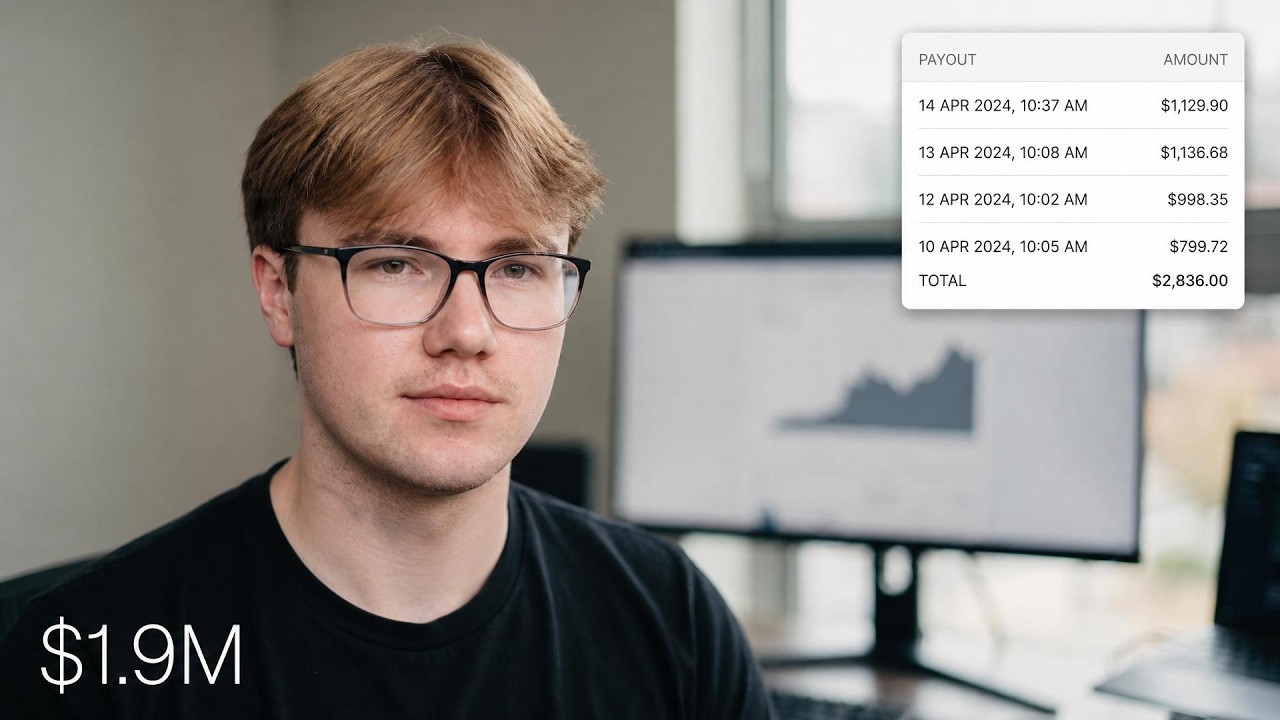
and maximizing that dollar amount in their account. The account balance is just marketing, and the rules determine if you're actually going to get a payout. I've done over 1.8 million dollars worth of prop firm payouts in the last 18 months, and that is not
01:17
Speaker A
account balances, that is literally payouts hitting my bank account. The difference between me and traders who cannot get payouts is not the strategy.
01:23
Speaker A
It's that I read every single rule that there is, and I built my math and optimized it around them. Now, you have to understand how a prop firm makes money. The only time a prop firm ever makes money is when you pay them an eval
01:32
Speaker A
fee. They are not copy trading, they are not selling data, nothing like that. They just make money off eval fees, and they have to pay out money to people who win, but those payouts are less than the eval fees, which keeps them consistently
01:41
Speaker A
profitable. That is why they put so many rules on the eval, so many rules on the funded account, is because they want to reduce your expected value as much as possible, so they can keep making as much money as possible, which is the
01:49
Speaker A
entire reason why the money that you see in your sim funded account can never fully be withdrawn as a payout, and that is why rules are what actually matter on prop firms more than the strategy. They have an account label of $50,000, but
01:59
Speaker A
once you realize you're only given $2,000 of max loss, you have a $3,000 profit target, you have a 50% consistency rule. Once you get to the funded account, well, now you have to make another X amount of dollars, you
02:08
Speaker A
have to achieve a buffer, you have to meet consistency, you have to meet their winning day rule, and then you can only take out 50% of what you make. That $50,000 is literally just marketing, it is a story. The math is behind those
02:18
Speaker A
actual rules and constraints that you're given because remember, when you're given a set of specific rules, there is a statistically optimal way to approach said problem. Now, passing the eval doesn't mean that you're going to get a payout. It does not even increase your
02:28
Speaker A
chances of getting a payout based on if you're doing good on an eval, and the reason why, again, you have two completely different goals. The only goal of the eval is to reach your profit target before hitting the max loss and
02:36
Speaker A
then follow the consistency rule if there is one. You have to make $3,000 before losing $2,000 on most of the common 50K evaluations and then follow a 50% consistency rule or sometimes even 40%. Those are math constraints, they
02:46
Speaker A
are not trading constraints, so make sure you optimize your profit target and stop loss for that specific environment.
02:50
Speaker A
So, that eval is basically testing your set of math on that specifically. Then, you become a funded trader, and on your funded account, you have a completely different set of constraints, new set of math, new optimization problem to solve
03:01
Speaker A
for because you no longer care about your pass rate or how often you can hit plus 3,000 before minus 2,000. Now, all you care about is generating the most expected value. Basically, if I'm given a funded account, what is my average
03:10
Speaker A
payout amount over the lifetime of that account? Most traders build their strategy for the eval and then never check if it works on the funded account, and then they're surprised when it doesn't. Passing the eval means that your strategy works under one set of
03:20
Speaker A
rules. Obviously, you need a large enough sample size in order to confirm that statement. However, if you're to run that on a funded account, it might not work or it might work, but it is definitely not optimized. And remember,
03:30
Speaker A
before you even buy a single evaluation, you can check if you're profitable on prop firms. Literally just backtest, but pretend that you have 50 evaluations.
03:37
Speaker A
See your pass rate over 50 evaluations instead of seeing your equity curve and your win rate like trading it on a live account, then being confused why you run the eval and it doesn't win. So, just backtest for the prop firm specific
03:46
Speaker A
environment, find your exact pass rate, then pretend you have 30 funded accounts. See how many total payouts you can get, divide that by 30, and now you know, if I got 30k in payouts over 30 accounts, I'm expected to make a
03:55
Speaker A
thousand dollars in payouts if I'm given one funded account. Now, can I pass an eval for less than a thousand dollars?
03:59
Speaker A
Most likely because they're only a hundred dollars and you can probably pass one out of ten. So, to sum that up, the eval and the funded account are two completely different math problems, two completely different optimizations, and two different tests. Problem is, you
04:09
Speaker A
probably only studied for one of them. The eval ends completely the instant you pass it. On a funded account though, it doesn't end until you breach a rule. You can take multiple payouts from a funded account. That should be your goal. On
04:19
Speaker A
some prop firms, obviously based on the rules and since different prop firms have different payout rules, a large simulated balance would be great because you could get multiple payouts from that. On others, it would be horrible because you'd be moved to a live account
04:29
Speaker A
very quickly and never realize any of that expected value. Your funded account balance is the ceiling, the payout rules are the floor. The problem is most traders get caught in between those. And then on top of that, there's traders who
04:38
Speaker A
optimize for the ceiling, which again is not the worst thing, but you should be optimizing for the floor. So, stop looking at your balance, stop looking at your equity curve, and start looking at the payout rules and how much expected
04:46
Speaker A
value you can generate per funded account. Now, you can have a profitable trading strategy, you can be a profitable lose evals and still lose funded accounts because you're not optimized for that specific environment.
04:55
Speaker A
For example, you could hit a max loss limit, you could hit a daily loss limit, or you could breach the consistency rule and have to make even more money, which reduces your chance of passing. Then, you would lose your eval pass, you'd
05:03
Speaker A
have to trade it even longer, m
05:12
Speaker A
literally because they set a ton of rules so that your expected value is as low as possible because most traders can't solve for an optimization problem when given that many constraints. Next, what if a trader is making money on a
05:20
Speaker A
funded account, but they don't have enough winning days or they've already withdrawn for that week? Because remember, most of the time you can't withdraw more than once per week, obviously depending on the firm rules, sometimes you can, but most firms are
05:29
Speaker A
going to let you get one payout every five winning days. So, you can make five thousand dollars in a week, but only be given one payout per week. The five thousand dollars just sits in your account until you're eventually able to
05:38
Speaker A
withdraw it, hoping you don't lose it. The problem is you're profitable on these sim accounts, but you're not profitable in your bank account balance unless you're withdrawing actual payouts. So, being profitable in the actual market and being eligible for
05:47
Speaker A
prop firm payouts are in the same category, but they're not the exact same. The market test your strategy, but the rules test your math. So, you can actually beat prop firms if you specify your approach to fit within set rules.
05:57
Speaker A
Then, make sure you're optimized for the specific environment that you're given and the expected value of your account at said point in time. If you're trading prop firms and you can't get consistent payouts, then there's a link in the
06:05
Speaker A
description to book a call with someone from my team. I have a mentorship where I go over the statistically optimal risk and profit target for every trade you ever take based on your account balance, what firm you're on, and what rules
06:15
Speaker A
you're given. We're going to maximize your expected value given any specific rule set. All of that math, I do it for you. That's how the traders I teach are making consistent five, six figures a month on prop firms. Now that you
06:24
Speaker A
understand all the ways to fail prop firms, let's talk about how you can beat prop firms. First, you know what your strategy is. Hopefully, you know your win rate on your strategy. Well, based on that, if five different firms exist
06:34
Speaker A
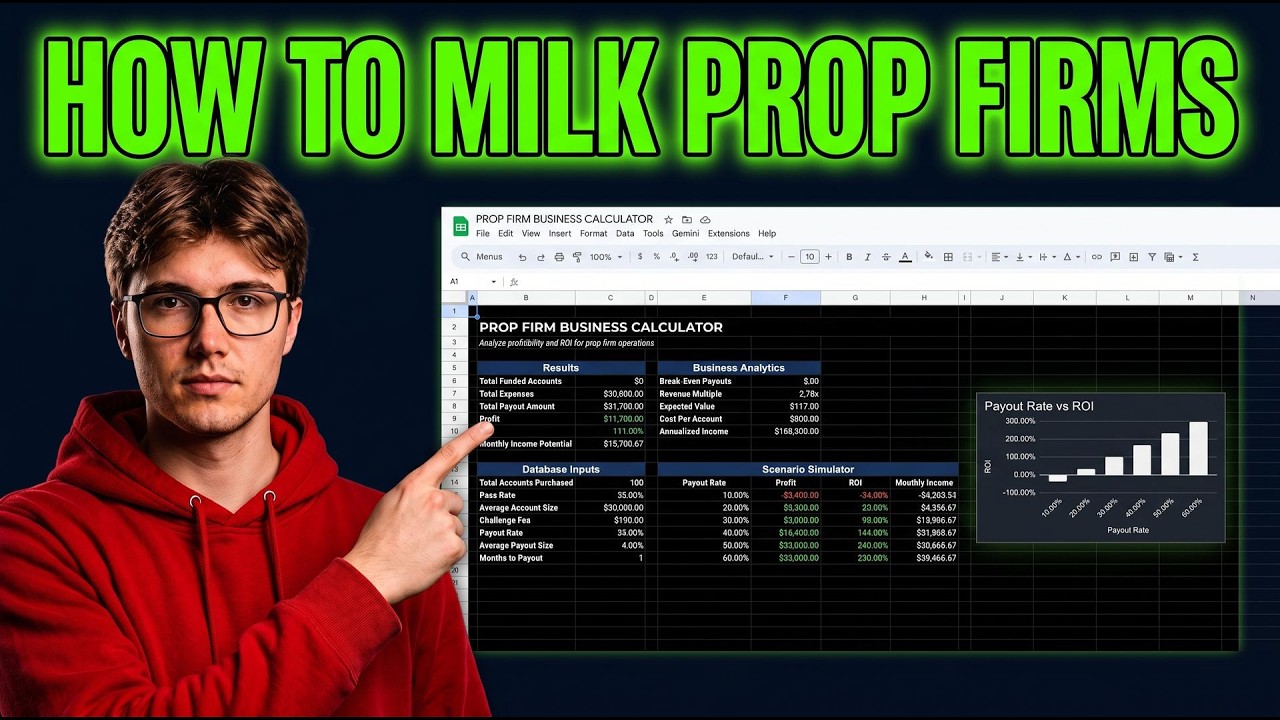
with five different rule structures, your strategy must be optimal on one of those five. It's up to you to figure out which one it is. Compare your cost to reach the funded state. Take the cost of an eval and divide it by your pass rate
06:45
Speaker A
to see your cost of funded. Then, you could take the drawdown of the funded account and divide it by the cost per funded account to see what is your cost per drawdown on a funded account. That's a nice optimization that will help you
06:54
Speaker A
make cheaper decisions on funded accounts. But, of course, the most important one is to find out your average expectancy, your expected value, how much you're going to get in payouts on average if you're given one funded account. Since all the firms have
07:05
Speaker A
different rules, then different strategies and different risk to reward are going to perform better on different firms. That's why I don't trade a strategy that has a static or set risk to reward for every single trade. I trade a strategy that adapts as the
07:15
Speaker A
market does, so I'm able to take a trade on a ton of different prop firms while still being optimized for the prop firm environment. And I get asked this a lot, but there is no best prop firm. It is
07:23
Speaker A
the best one for you if you have a different strategy, a different risk to reward than me. So, stop asking which firm is best and start asking which firm is going to pay you the most in expected value, or which firm is going to get you
07:33
Speaker A
to a funded account that for the cheapest amount of cost. Now, for your tracking, make sure you're tracking your net result. Please stop tracking your win rate, and please stop tracking your equity curve. All you need to track is
07:41
Speaker A
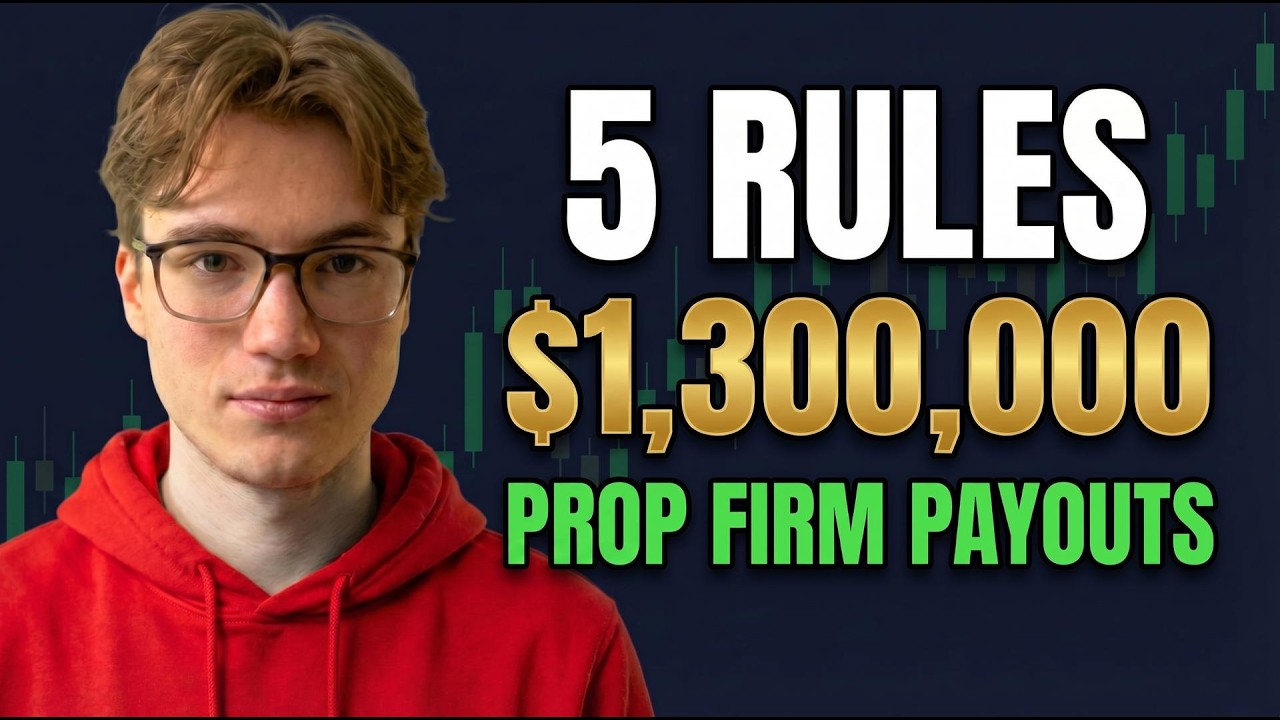
how much in payout that your bank account and how much you spent on evaluation fees. If I'm able to spend $550,000 on evals, but take more than $1.8 million worth of prop firm payouts, well, that's $1.3 million worth of
07:51
Speaker A
profit, and I'm sure you'd love to have that be you, too. That is the only thing that I track. I run my simulations and I prove that my strategy is going to execute properly and generate me that positive expected value of about a 3.5
08:01
Speaker A
times return on my investment within a month. You could also track by different firms. I just find I'm going to adapt my strategy to the rules in an optimal way, so I don't even need to track that because I'm already knowing it's going
08:10
Speaker A
to work. But, before you're confirming it, then it is best to simulate it specifically for each different firm before you even try because remember, you can determine if you're going to make money on a prop firm before you buy
08:19
Speaker A
a single eval. So, most traders are tracking their account balance and their win rates. All I'm tracking is how much I spend on evals and how much I'm getting back in payouts. If that number is positive, well, I'm going to keep
08:27
Speaker A
doing it as much as possible and I'm going to spend as much money as possible because I know I'm getting a positive return on my investment. If your prop firm account balances keep going up, but your bank account balance is not going
08:36
Speaker A
up, that means something is wrong. So, make sure you identify where did that result change from your eval to your funded to your payout instead of focusing more on fixing your strategy.
08:44
Speaker A
Find out where your expected value is dropping off. So, all you have to do to beat a prop firm is choose the most optimal prop firm based on your specific strategy and win rate, then trade the eval to optimize for your pass rate.
08:53
Speaker A
Next, trade the funded account to optimize for your expected value, which is the average amount of payouts you're going to get from an account, and then lastly, scale that as much as physically possible as soon as you have an edge.
09:02
Speaker A
The eval, the funded account, and your bank account all measure something differently. Your strategy has to make it through the eval, then the funded account before it reaches the third, which is your bank account in the form of a payout. If you want to see the full
09:11
Speaker A
mathematical framework behind how I pass evals, trade funded accounts, and optimize for the specific rule set that I'm given, then book a call with the link in the description. I have a trading mentorship and I'm going to teach you the exact math behind my
09:21
Speaker A
approach. So, that's the system. Understand the rules, build your math around it, and then optimize for what actually hits your bank account. Your strategy was never the problem. Your math was.
Topics:prop firmstrading evaluationfunded trading accountstrading strategy optimizationrisk managementpayout rulesexpected valuetrading mathprop firm payoutstrading consistency

Get More with the SozAI App

Transcribe recordings, audio files, and YouTube videos — with AI summaries, speaker detection, and unlimited transcriptions.

Or transcribe another YouTube video here →