Skip to content
Get App

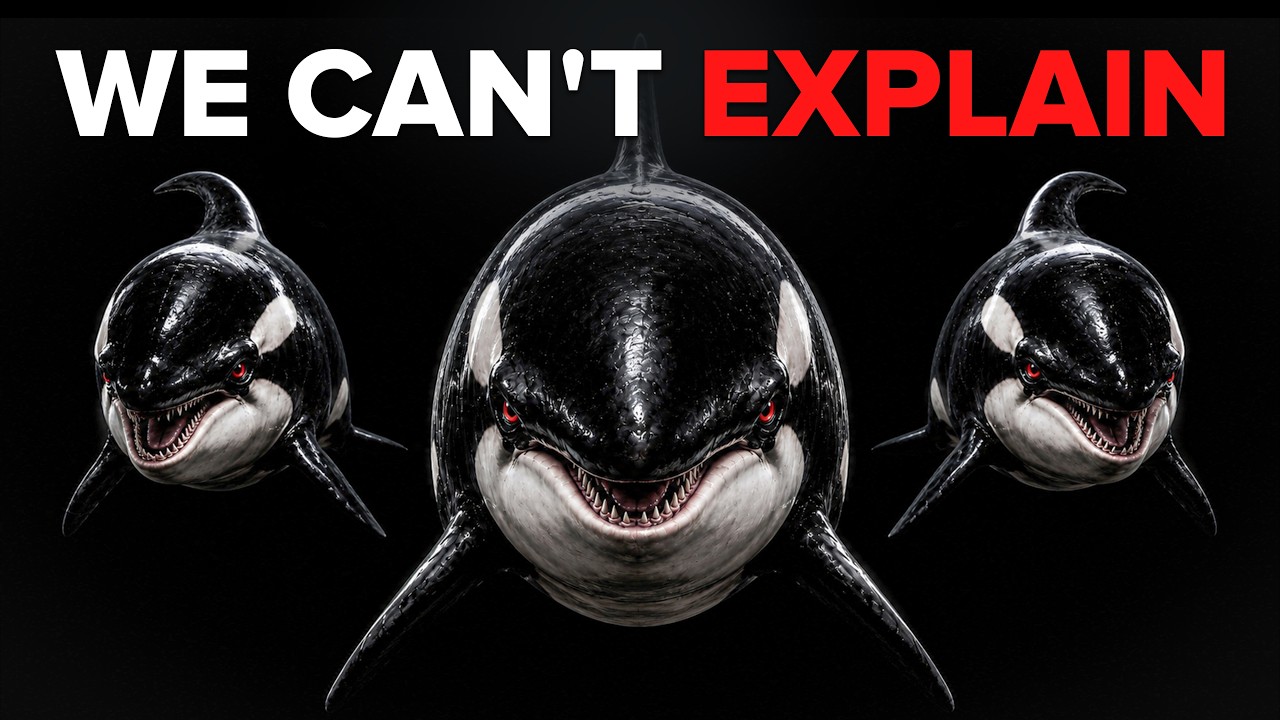
Why Killer Whales' Intelligence Is So TERRIFYING

An educational look at orca intelligence: social learning, matriline culture, dialects, ecotypes, and why these predators rarely target humans.

Key Takeaways

  • Orca intelligence is expressed largely through socially transmitted culture rather than instinct alone.
  • Matriarchal family structures act as living repositories of knowledge across generations.
  • Ecotype and dialect differences show that behavior can diverge sharply even among genetically similar populations.
  • Scientific claims about orca empathy and interspecies cooperation should be weighed against limited observational evidence.

What the video covers

  • Orcas have long lifespans (females up to ~80-90 years) and stable matrilineal family structures spanning multiple generations.
  • Adult mothers deliberately injure prey and release it so calves can practice hunting, suggesting intentional teaching.
  • Most orca hunting knowledge is socially learned rather than genetically hardwired, forming a transmissible culture.
  • Distinct ecotypes (residents, transients/Bigg's, offshore) share near-identical biology but differ strongly in hunting behavior.
  • Research by John Ford, Michael Bigg, and colleagues in British Columbia used individual identification to document cultural persistence.
  • Orca dialects are learned through vertical social learning and form acoustic identities that define clans.
  • Transient orcas stay largely silent while hunting marine mammals with acute hearing, showing flexible, context-dependent vocal behavior.
  • The video discusses cognitive capacities linked to planning, empathy, and social awareness, while cautioning against over-interpreting observations.
  • Documented cases include reported grief-like behavior, cooperative hunting with humans, and historical partnerships with whalers in Australia.
  • Despite having the physical capacity to threaten humans, wild orcas have almost never treated people as prey.

Answers

Questions about this video

What is a matriline in orca society?

A matriline is a family group led by the oldest female, made up of her offspring and their descendants. Adult males stay with their mothers for life, and the stable group preserves knowledge across generations.

How do orca dialects differ from genetic traits?

Dialects are not inherited genetically; calves learn them by listening to and imitating pod members. Because they are learned, they drift and evolve over time, much like human regional accents.

Why do transient orcas stay silent while hunting?

Their marine mammal prey have very sensitive underwater hearing, so noise could alert them. Field studies in Alaska showed transients vocalize mainly after capturing prey or while resting, showing flexible vocal control.

Full Transcript — Download SRT & Markdown

00:11
Speaker A
That killer whales rule the oceans through strength and sophisticated coordination is something we already know.
00:29
Speaker A
Yet their intelligence goes even further than we once imagined.
00:46
Speaker A
Defined by a capacity for learning, calculation, and a unique way of communicating with the world around them.
01:02
Speaker A
In the wild, researchers have documented numerous cases of orcas carrying prey directly to humans, then pausing as if waiting to see how people respond.
01:16
Speaker A
Faced with behavior like this, is it really such a stretch to imagine if this animal might have human researchers of their own?
01:44
Speaker A
Individuals sent out to interact with us just to work out what exactly this whale on land standing at the edge of a boat actually is.
02:02
Speaker A
To understand why one of the ocean's most formidable predators behaves this way, we first need to look inside the organ that makes it all possible.
02:14
Speaker A
The orca's brain, a biological structure that continues to challenge scientists' understanding.
02:24
Speaker A
A female orca can live for 80 years, sometimes even reaching 90.
02:39
Speaker A
That's roughly twice the lifespan of most marine mammals, and it creates an unusual social dynamic.
02:57
Speaker A
Within a single pod, four generations (grandmother, mother, daughter, and calf) can remain together, traveling side by side for decades.
03:06
Speaker A
The fundamental social unit of orcas is known as a matriline, a family group led by the oldest female and made up of her offspring and their descendants.
03:16
Speaker A
Unlike many other mammals, adult males do not leave in search of their own territory.
03:33
Speaker A
Instead, they stay with their mothers for life.
03:53
Speaker A
Several related matrilines form a pod, while multiple pods that share the same range, behaviors, and traditions make up a clan.
04:12
Speaker A
This remarkably stable, multi-layered social structure has persisted for generations.
04:22
Speaker A
And that stability is what makes something even more important possible: the continuous transfer of knowledge from one generation to the next.
04:39
Speaker A
Most of what an orca knows isn't hardwired into its genes.
04:58
Speaker A
It is taught.
05:13
Speaker A
Researchers have repeatedly observed adult orcas, especially mothers, deliberately changing the way they hunt when young calves are present.
05:24
Speaker A
Instead of killing prey immediately, they invest extra time and energy by injuring it first, then releasing it so the calf can practice the final stages of the hunt itself.
05:44
Speaker A
This behavior has been documented across multiple populations, convincing scientists that it represents intentional teaching rather than simple coincidence.
05:53
Speaker A
In the language of animal behavior, the best term for this process is social learning: the acquisition of skills by observing or directly interacting with other individuals, rather than through trial and error or genetic programming.
06:18
Speaker A
What separates social learning from an ordinary habit is its ability to spread.
06:40
Speaker A
A habit exists only within a single individual.
06:51
Speaker A
But a behavior learned through observation can spread throughout an entire group, persist across generations, and gradually evolve over time.
07:05
Speaker A
When a collection of behaviors is transmitted in this way, remaining stable within one group, differing between groups, and showing no connection to genetic differences, scientists recognize it as culture, using the term in its scientific sense rather than as a metaphor.
07:19
Speaker A
One of the clearest examples comes from the existence of different orca ecotypes.
07:36
Speaker A
Around the world, orcas are divided into distinct ecological populations.
07:51
Speaker A
Some, known as residents, specialize in hunting fish.
08:08
Speaker A
Others, called transients or Bigg's killer whales, primarily prey on marine mammals.
08:27
Speaker A
Still others have evolved techniques for hunting sharks or deep-sea squid.
08:47
Speaker A
Genetically and physically, these populations are remarkably similar, but their hunting strategies, vocal communication, and even their social organization can be dramatically different.
09:06
Speaker A
In other words, their biology is nearly the same, but their behavior is not.
09:25
Speaker A
That gap is filled by knowledge passed from one generation to the next through teaching and observation, gradually accumulating into a unique set of traditions for each population: what scientists describe as ecological culture.
09:40
Speaker A
This understanding comes largely from decades of field research by John Ford, Michael Bigg, and their colleagues in the waters of British Columbia.
09:58
Speaker A
By identifying individual orcas through their dorsal fins and distinctive scars over multiple generations, they demonstrated that the enduring matrilineal structure acts as a living repository of knowledge, allowing information to accumulate instead of disappearing whenever an individual dies.
10:22
Speaker A
But if behavior can be learned and knowledge can accumulate across generations, then what about the tool that makes all of that possible?
10:36
Speaker A
How do orcas communicate such a vast body of information to one another?
10:52
Speaker A
If the matriarchal social structure serves as the foundation for preserving knowledge, then the orca's communication system, its vocalizations, is the mechanism that keeps that culture alive.
10:59
Speaker A
Orcas communicate using three primary types of sounds: whistles, long frequency-modulated calls; echolocation clicks, focused pulses that bounce off objects to see through the darkness; and most commonly, pulsed calls, rapid bursts of sound that the human ear often perceives as sharp squeaks or high-pitched screeches.
11:16
Speaker A
Each orca population possesses its own unique collection of pulsed calls, known as a repertoire.
11:28
Speaker A
The way these individual calls are combined creates a distinct dialect unique to each group.
11:35
Speaker A
One important point needs to be made clear: an orca's dialect is not inherited genetically.
11:53
Speaker A
A newborn calf is not born knowing its mother's dialect.
12:02
Speaker A
Instead, it acquires it while growing up within its pod, listening to and imitating the vocalizations of the individuals around it.
12:11
Speaker A
This is a form of vertical social learning.
12:26
Speaker A
Much like the way hunting techniques are passed from one generation to the next, because dialects are learned rather than genetically programmed, they gradually drift and evolve over time, much like regional accents and dialects do in human societies.
12:38
Speaker A
This also connects directly to the concept of ecotypes introduced in the previous chapter.
12:49
Speaker A
Closely related pods that regularly interact tend to share portions of the same vocal repertoire.
13:00
Speaker A
A collection of pods with these shared vocal traditions is known as a clan.
13:12
Speaker A
In other words, while ecotypes distinguish orca populations by their ecological lifestyles, clans distinguish them by their voices.
13:27
Speaker A
For experienced researchers, an underwater recording is often enough to identify exactly which clan an orca belongs to.
13:48
Speaker A
In this sense, dialect functions like an acoustic identity card, allowing individuals to distinguish members of their own community from outsiders without ever seeing one another.
13:59
Speaker A
Yet perhaps the strongest evidence that orca communication is more than passive social signaling, that it is an actively regulated behavior, comes from a completely different line of research: comparing how different ecotypes use sound while hunting.
14:08
Speaker A
Resident orcas, which specialize in hunting fish, produce pulsed calls frequently during their hunts.
14:16
Speaker A
Because fish such as Chinook salmon hear very poorly within this frequency range, their conversations do not give away their position.
14:33
Speaker A
Transient orcas, which prey on seals and sea lions, face a completely different challenge.
14:46
Speaker A
Marine mammals have exceptionally sensitive underwater hearing, meaning even a small amount of noise could alert their prey long before the attack begins.
15:07
Speaker A
Field studies led by Ford and Ellis in Alaska confirmed exactly that.
15:19
Speaker A
Transient orcas remain largely silent while hunting, vocalizing only after the prey has been captured or when the pod is resting in safety.
15:30
Speaker A
In other words, orcas do not communicate according to a fixed instinct.
15:46
Speaker A
They actively adjust their vocal behavior based on what their prey can hear, a level of behavioral flexibility that goes far beyond a hardwired biological response.
15:53
Speaker A
But using sound to communicate with other members of the pod is one thing.
16:09
Speaker A
Us
16:29
Speaker A
Looking back at this chapter, a clear picture emerges. An echolocation system sophisticated enough to build three-dimensional maps of the seafloor, three hunting strategies precisely adapted to different environments, and even the ability to harness another species sensors for mutual benefit.
16:48
Speaker A
All of these abilities are products of the same remarkable brain, which naturally leads to an intriguing question. If that extraordinary capacity for planning, adaptation, and cooperation has evolved to hunt seals, sea lions, and fish, what happens when it is directed toward
17:09
Speaker A
humans instead? At the end of the previous chapter, we asked a simple question. What happens when an orca's extraordinary capacity for planning and cooperation is directed toward humans? To answer that, we first need to understand the organ behind
17:36
Speaker A
those decisions, the orca's brain. In the early 2000s, neuroscientist Lori Marino and her colleagues at Emory University used [music] magnetic resonance imaging, MRI, to study the brains of whales and dolphins, including orcas. What they found was unexpected.
17:58
Speaker A
In addition to the lyic system, the network responsible for processing emotions in all mammals, orcas possess an adjacent region known as the paralyic lobe. This structure has no known counterpart in the human brain or in any terrestrial mammal studied to date.
18:16
Speaker A
Marino and her colleagues proposed that this unique region may be involved in more sophisticated forms of emotional and social processing. [music] However, it is important to distinguish between identifying a structure and understanding its function. While the paralyic region undeniably exists,
18:34
Speaker A
precisely how it operates remains an open scientific question. Another striking feature of the orca brain is its exceptionally [music] high concentration of spindle neurons, also known as vonomo neurons. In humans and other great apes, these neurons are concentrated in brain [music] regions
18:54
Speaker A
associated with rapid decision-m in complex social situations, and they have been linked to abilities such as [music] empathy and social awareness.
19:03
Speaker A
Orcas possess these neurons in remarkably high numbers. [music] Even so, the boundary between evidence and interpretation must remain clear. A high density of spindle neurons does not automatically prove that orcas experience empathy in the same way humans do. That conclusion is based on
19:23
Speaker A
similarities in brain structure rather than direct evidence of brain function. It is a reasonable hypothesis, but it remains an indirect one. So [music] the next question is, do the behaviors we observe in the wild [music] actually reflect this level of complex social
19:39
Speaker A
processing? One observation from the waters of South Africa offers part [music] of the answer. Researchers documented a young male orca that lacked both its dorsal fin and its right petrol fin. A severe disability that would [music] have made
19:56
Speaker A
hunting on its own extremely difficult. [music] Despite this handicap, the whale survived and continued to grow within its pod. Observers repeatedly recorded other members of the group sharing food with the disabled individual [music] and remaining close to it during travel
20:15
Speaker A
instead of leaving it behind. From a behavioral standpoint, what can be stated with confidence is this. The group consistently maintained proximity to an individual that contributed little or nothing to cooperative [music] hunts and repeatedly shared food with it.
20:33
Speaker A
Calling this behavior compassion, however, [music] would go beyond what the observations alone can support.
20:40
Speaker A
The behavior may serve several different evolutionary functions, and researchers remain cautious [music] about assigning specific humanlike emotions to it.
20:49
Speaker A
Another behavior that is equally difficult to interpret is the tendency of some mother orcas to carry the bodies of their dead calves [music] for days or in some documented cases even weeks.
21:02
Speaker A
This behavior is energetically [music] expensive. The mother must continually push or support the calf's body at the surface, slowing her own movements and directly reducing her ability to hunt and feed herself.
21:17
Speaker A
Yet she continues to do it. At present, researchers remain divided between two leading hypotheses.
21:25
Speaker A
One proposes that the mother is exhibiting a form of persistent caregiving behavior, repeatedly attempting to revive or wake her calf.
21:34
Speaker A
The other suggests that the behavior represents a response to loss comparable to the prolonged reactions observed in elephants and certain primates following the death of an infant.
21:45
Speaker A
Both explanations remain hypothesis. What science can confirm is that the behavior is real, prolonged, and energetically costly. What the mother orca is actually [music] experiencing remains beyond the reach of current scientific evidence.
22:03
Speaker A
The most recent and perhaps the clearest example of complex behavior comes from a study published in 2025 on the southern resident orca population of the northeastern Pacific.
22:15
Speaker A
Researchers observed orcas deliberately biting off strips of kelp, then positioning the kelp between their own bodies and those of another orca before rubbing it back and forth together. The behavior has been named [music] aloe kelping. From a scientific perspective,
22:33
Speaker A
this discovery is significant [music] for two reasons. First, orcas have no limbs capable of grasping objects.
22:42
Speaker A
Deliberately modifying a piece of kelp into a [music] suitable shape before using it in this manner satisfies the accepted criteria for tool manufacturer and tool use.
22:52
Speaker A
Second, it represents the first documented case of [music] tool manufacturer in a non-primate species that lacks grasping limbs.
23:01
Speaker A
Researchers suggest that this behavior may play a role in skin maintenance [music] while also reinforcing the social bond between the two individuals.
23:10
Speaker A
However, this remains a relatively new discovery based on a limited number of observations. More data will be needed before scientists can determine how widespread [music] the behavior is and fully understand its biological significance.
23:25
Speaker A
Recently, what science cannot yet confirm is what an orca is actually experiencing internally while carrying out these behaviors. The distinction between what can be observed and what can be inferred is one worth keeping firmly in mind as we move into the next
23:43
Speaker A
chapter. Because the next question is no longer how orcas behave towards seals or even toward one another.
23:52
Speaker A
It's how they choose to behave when the animal in front of them is us.
24:07
Speaker A
Despite possessing all the physical tools needed to bring down some of the largest animals in the ocean, wild orcas have never regarded humans as prey.
24:16
Speaker A
Instead, history has documented a series of unusual interactions that go far beyond ordinary hunting behavior.
24:24
Speaker A
Between [music] 2004 and 2024, researchers compiled and verified 34 separate cases in which wild orcas deliberately approached divers or paddle boarders. The animals presented people with 18 different kinds of objects, including various prey species as well as items that were not food at all. What
24:46
Speaker A
makes these encounters particularly [music] intriguing was what happened next. The orcas rarely swam away immediately after dropping the object. Instead, they often lingered nearby, [music] watching the person's reaction. In some cases, if no response was given, the whale
25:03
Speaker A
retrieved the object and tried [music] again as though waiting for some kind of reply. Here, it is important to [music] distinguish between behavior and motivation.
25:14
Speaker A
The behavior itself, bringing an object, releasing it, remaining nearby, and observing the human's response [music] is directly documented through video recordings and eyewitness accounts.
25:26
Speaker A
[music] The motivation behind that behavior, however, remains an open question. The research team proposed two leading hypotheses. [music] The first is interpacific altruism.
25:39
Speaker A
Behavior that benefits another species without providing an immediate benefit to the individual performing it.
25:47
Speaker A
The second [music] is curiosity. The idea that orcas may be applying a familiar social behavior from within their [music] own species, sharing prey to an unfamiliar animal simply to observe how it responds.
26:02
Speaker A
Both explanations are scientific hypotheses intended [music] to explain and observe behavior. Neither should be interpreted as evidence that orcas understand humans in any particular way.
26:14
Speaker A
If prey sharing is a relatively recent discovery supported by limited observations, the relationship between orcas and humans in Twofold Bay in southeastern Australia represents one of the best documented examples of interecies cooperation in history. From around 1840 until the 1930s, spanning nearly a
26:36
Speaker A
century, a group of orcas living in the bay developed a remarkably consistent partnership with commercial whalers based in the town of Eden. [music] During the annual whale migration, the orcas would locate large whales offshore before swimming all the way back toward
26:53
Speaker A
the coast to alert the whalers waiting in lookout huts. [music] They often did this by forcefully slapping their tails on the water.
27:02
Speaker A
[music] After signaling the hunters, the orcas would return to the whale and help slow or block its escape, making the hunt considerably easier.
27:12
Speaker A
In return, once the whale had been processed, [music] the whalers left the tongue and lips for the orcas.
27:19
Speaker A
These fatty tissues were highly nutritious [music] yet difficult for the whales to remove from such a massive carcass without human assistance. Uh they did the most extraordinary things. What they used to do was they would round up the whales
27:34
Speaker A
for the Davidsons and others just like people in the country use sheep dogs to round up sheep and and they used to try to herd her the whales into the bay from out at sea so that the whalers could get
27:49
Speaker A
them. A friend in this unwritten agreement even had a name among the local whalers, the law of the tongue. This was not simply a local legend.
27:59
Speaker A
The partnership was documented across multiple generations of whalers [music] with individual orcas being named and recognized over decades.
28:07
Speaker A
The most famous of them was an orca known as Old Tom. [music] Taken together, these two stories, the recent observations of prey sharing [music] with strangers at sea, and the centurylong cooperation between orcas and whalers suggest something remarkable.
28:26
Speaker A
An orca's interactions with other species are not always driven solely by the immediate pursuit of food.
28:33
Speaker A
In many situations, they appear willing to invest both time [music] and effort in relationships whose benefits are neither obvious nor immediate.
28:42
Speaker A
And that naturally raises a difficult question. If orcas possess both the physical power and the cognitive abilities to become deadly predators of humans, [music] why have they almost never chosen to do so throughout recorded history?
28:58
Speaker A
What exactly is guiding that decision? There is one important limitation we must acknowledge. Science still has no objective way to directly measure the subjective experiences or emotions of any animal.
29:16
Speaker A
Some of the discoveries discussed in this video, such as aloe keelping and prey sharing with humans, are based on a relatively small number of observations.
29:25
Speaker A
As a result, [music] researchers will need considerably more data before determining whether these behaviors represent widespread patterns across orca populations.
29:36
Speaker A
Likewise, biologists generally avoid declaring orcas to be the smartest animal on Earth. Comparing intelligence across species from orcas and chimpanzees to bottl-nose dolphins, elephants, and crows remains an enormous scientific challenge largely because there is still no universally accepted measure of intelligence that
30:00
Speaker A
applies equally to all animals. Yet, even with those limitations, one conclusion remains remarkably consistent throughout everything we've explored. An orca's intelligence cannot be reduced to a single ability.
30:17
Speaker A
It emerges from the combination of a social structure stable enough to preserve knowledge across generations, a communication system that adapts to changing circumstances, problem solving strategies tailored to different environments and prey, and a brain that science is still only
30:33
Speaker A
beginning to understand. How about you? Do you think orcas deserve the title of the most intelligent animal on Earth? Or is there another species you believe could make an equally strong case? Let us know your thoughts in the comments below.
30:50
Speaker A
And that question also brings us back to the paradox introduced earlier in this video. Orcas possess every physical and cognitive capability needed to become a serious threat to humans, but they have almost never chosen to use those abilities against us.
31:06
Speaker A
So, why would one of nature's ultimate apex predators, fully capable of hunting humans, consistently choose not to?
31:15
Speaker A
That question is already explored in depth in this video on this channel, and the real answer may be far more surprising than you expect. Thank you for joining us on today's journey of discovery. We'll see you in the next
31:27
Speaker A
video.
Topics:killer whalesorca intelligencesocial learningmatrilineorca dialectsecotypesanimal culturemarine biologytransient orcasorca communication

Get More with the SozAI App

Transcribe recordings, audio files, and YouTube videos — with AI summaries and speaker detection. 30 minutes free.

Or transcribe another YouTube video here →