Skip to content
Get App

It’s Dumb, But It Builds Muscle Almost 4x Faster

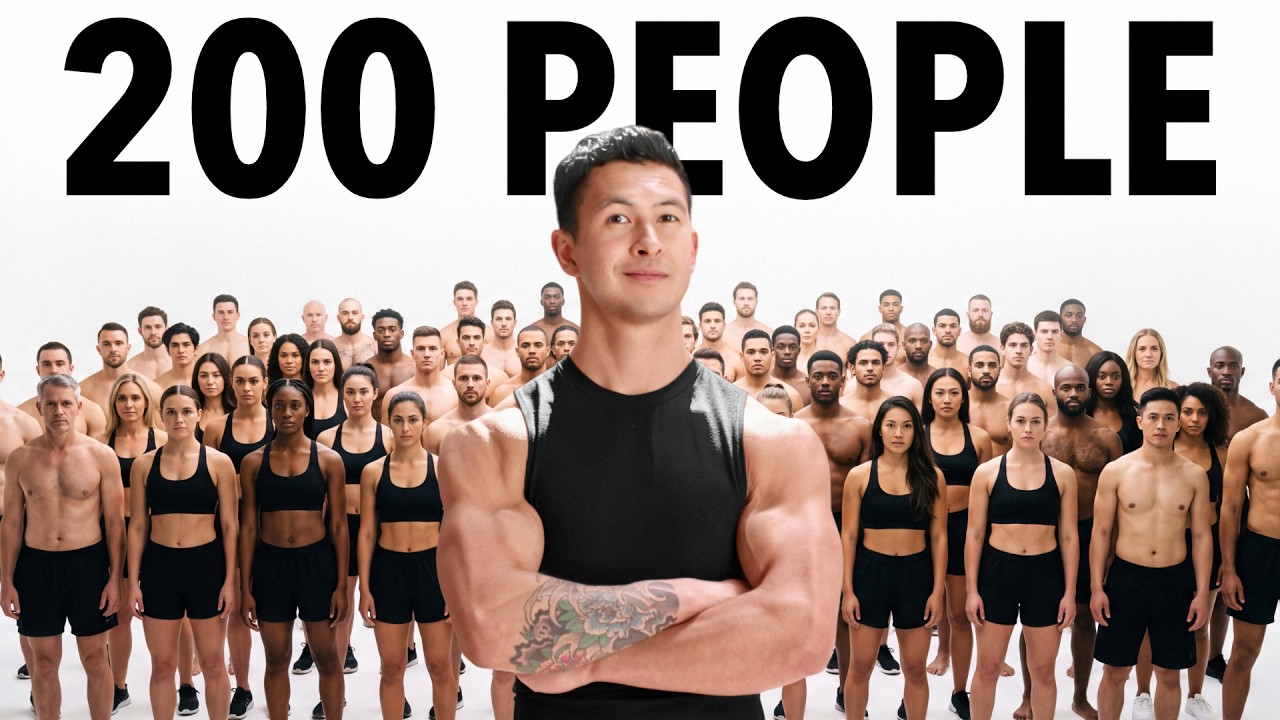
Jeremy Ethier tests training one muscle every day for 30 days, using MRI scans and expert input to see if daily training builds muscle faster than twice-weekly training.

Key Takeaways

  • Daily training can increase total weekly volume and strength, but total volume and effort matter more than training frequency alone.
  • Muscle soreness is not a reliable indicator of whether a muscle can perform well again; strength and force production recover before soreness peaks.
  • The repeated bout effect means soreness decreases with consistent exposure to the same training stimulus.
  • Joints and tendons adapt more slowly than muscles, so daily training carries injury risk that muscle adaptation alone does not address.
  • Spreading high weekly volume across several sessions is a more practical and sustainable approach than cramming dozens of hard sets into one workout.

What the video covers

  • Three participants train one side of their body (chest, arms, legs) every day while the other side trains twice a week over a 30-day experiment.
  • MRI scans on day one and day thirty measure muscle growth on each side objectively.
  • Conventional wisdom holds that muscles need 24-48 hours of recovery between hard sessions to grow.
  • Muscle soreness (DOMS) faded within about eight days due to the repeated bout effect, as muscles adapted to repeated damage.
  • Force production recovered to baseline well before soreness peaked, suggesting muscles can be ready to train again while still sore.
  • The everyday-trained side performed roughly 35 hard sets per week versus about 10 on the twice-weekly side, creating much higher total volume.
  • Strength on the daily-trained side climbed week by week and eventually pulled ahead of the control side in workout logs.
  • Max experienced sharp knee pain during leg extensions, raising concerns that joints and tendons may not adapt as quickly as muscles.
  • Dr. Eric Helms explained that total weekly volume and proximity to failure are the main drivers of growth, and that spreading volume across more days is practical.
  • Research cited shows that heavy daily bench training over 34 days produced large strength gains but injured over half of participants.

Answers

Questions about this video

What was the main goal of the 30-day experiment?

The experiment tested whether training one muscle every day, rather than twice a week, would build muscle faster. Each participant trained one side daily and the other side twice weekly, with MRI scans measuring growth at the start and end.

Did soreness stop the participants from training daily?

Soreness was significant early on, but it faded around day eight through the repeated bout effect. Strength remained stable or improved, and force production recovered before soreness peaked, so training could continue.

What was the risk identified with daily training?

Max developed sharp knee pain during leg extensions, and a cited study found that over half of lifters who trained the bench press daily got hurt. The presenter noted that muscles can adapt faster than joints and tendons.

Full Transcript — Download SRT & Markdown

00:00
Speaker A
What if you could force months of muscle growth into just 30 days? I have a theory you can, using a method everyone says shouldn't work: training a muscle every single day. And I'm testing it on these three people to see if it actually works and how different muscles respond. Chest for Brandon, arms for Yolinda, and legs for Max.
00:12
Speaker A
But to compare just how effective it is, each person will work out their right side every day and the other side just twice a week.
00:25
Speaker A
The side grew almost 20%.
00:33
Speaker A
[music]
00:44
Speaker A
What?
00:55
Speaker A
It'll be five sets, eight to 12, and it's going to be hard sets.
01:01
Speaker A
Um, what happens when you're really sore?
01:12
Speaker A
[laughter]
01:17
Speaker A
That's part of the experiment.
01:22
Speaker A
[music]
01:32
Speaker A
So we'll try to do five sets of nine to 12 every day with this right leg.
01:38
Speaker A
You're the horse.
01:53
Speaker A
Build some horse legs.
02:07
Speaker A
Some of you might remember Max from our past experiment where he ate only chicken, potatoes, and broccoli for 30 days. He's the only person I could find crazy enough to work out one leg every day.
02:21
Speaker A
Got a text from Jeremy, and I just came straight here, and here we are again, another 30-day challenge.
02:29
Speaker A
On day one, all three participants got MRI scans of each side to measure their baseline. We'll scan them again on day 30. And we already have mixed predictions on which side will grow more.
02:37
Speaker A
Probably the one that's trained
02:43
Speaker A
[music]
02:47
Speaker A
every day.
02:59
Speaker A
It's hard to guess.
03:09
Speaker A
Really? No rest days needed?
03:19
Speaker A
I'm still young.
03:27
Speaker A
I think rest will make you recover.
03:36
Speaker A
Rest will make you recover and grow more. That's locked in?
03:40
Speaker A
That's locked in. That's locked in.
03:53
Speaker A
Okay, $1,000? That's his twice.
04:00
Speaker A
$1,000?
04:10
Speaker A
[laughter]
04:22
Speaker A
Now, Max's and Yolinda's guesses line up with what gym bros and researchers have preached for years. If you don't allow enough time for the recovery phase, you're not going to get the growth phase at the end.
04:28
Speaker A
And these guys aren't wrong. When you train hard, your muscle fibers experience extremely high tension, which delivers a powerful signal for them to grow, but it also makes them temporarily weaker. So within hours, immune cells move in to help clean up damaged tissue and coordinate repair, and muscle protein synthesis, which is the process that actually grows your muscle, begins and often continues for 24 to 48 hours after training.
04:38
Speaker A
If you train again before this healing process is complete, you interrupt it, which is why most programs recommend at least one to two days of rest between training the same muscle.
04:52
Speaker A
But what happens if you don't wait? Can your body adapt to no longer need rest? Or will all that unrepaired damage lead to something worse?
05:03
Speaker A
So it's day four of this one-leg challenge. I've been training my right leg every day, and I don't know, I'm feeling really sore now.
05:12
Speaker A
Definitely feeling the fatigue in my every-day arm. Other days are just flies, because the press puts so much stress on my shoulder and tricep.
05:20
Speaker A
So far, things aren't looking too promising.
05:33
Speaker A
On top of that, fitting in a workout every single day has
05:50
Speaker A
[music]
06:01
Speaker A
been a challenge.
06:11
Speaker A
It is currently 11:00 p.m. Instead of going to sleep, I'm going to go work out.
06:24
Speaker A
I just got home from a hockey game, and I realized that I didn't do my workout today. I was sitting on my adjustable bench for 5 to 10 minutes just debating whether to push through one more chest workout.
06:34
Speaker A
Meanwhile, Max is actually loving the daily leg training until he notices something serious. When I do squats, I feel like it's a little bit off balance now.
06:43
Speaker A
Well, for now, everyone's biggest concern is the soreness. If a muscle's still sore, it's damaged. And if it's still damaged, training it again is, well, just dumb, right?
06:54
Speaker A
There's a reason it's called delayed onset muscle soreness. There's typically a one to two-day delay for most people to experience the peak of soreness.
07:07
Speaker A
That's Dr. Eric Helms, a muscle growth researcher who is on a mission to crack the top five on the world's most competitive natural bodybuilding stage.
07:20
Speaker A
And what he told me about muscle soreness went against everything I thought I knew.
07:34
Speaker A
If you train today, really, really hard, to the point that it'll generate DOMS, your force production decline will be lowest, of course, the same day, within that same session. And then it gets progressively better and recovers. And often, the time point at which delayed onset muscle soreness is the highest is right around the same time when force production has returned to baseline or close to it.
07:47
Speaker A
Basically, your muscles can be ready to train again well before the soreness actually goes away.
07:58
Speaker A
So, even though everyone's muscles felt destroyed, the real test was whether they could still perform.
08:06
Speaker A
I've been doing these Bulgarian split squats every day for my right leg, and it's not really affecting my strength, so it's good. The soreness is just there, but strength is still maintaining here.
08:20
Speaker A
When I do play pickleball, I almost slipped the other day, and I was able to catch myself with my right leg.
08:31
Speaker A
And then, just 8 days into the experiment, something interesting happened. Honestly, the soreness just kind of faded away. Now, just keep going with this one leg. Feels fine.
08:41
Speaker A
Now, according to Eric, there's actually a name for this. It's called the repeated bout effect, which just means that when you repetitively do the same thing that challenges the muscle and produces muscle damage, the damage gets drastically reduced with time and with exposure. The daily training was forcing their muscles to adapt and recover much faster, to the point where they were no longer getting sore at all.
08:53
Speaker A
But so far, it was very difficult to tell which side was winning. I haven't noticed too much on the muscle development here. Both legs look quite similar in size. So, no change.
09:03
Speaker A
My every-day arm feels stronger than the other one, but appearance-wise, I think it might still be a little too early to tell.
09:15
Speaker A
Now, you can't expect to see huge visual muscle growth in just a few weeks, which is exactly why we're using MRI to detect changes the eye and most basic lab equipment just can't pick up. But there was one sign daily training might be working.
09:28
Speaker A
Very happy to report that I have been consistently curling 15-pound dumbbells, with some plates here and there, for my bicep curls. I have never been able to curl anything over 12 pounds before, so very happy to see the improvement.
09:34
Speaker A
In fact, based on the workout logs in their Built With Science app, even though each person had bad days where the everyday side got weaker, week by week its strength kept climbing and actually started pulling ahead of their normally trained side.
09:45
Speaker A
But just as the everyday side started looking like the winner, during a set of leg extensions, Max felt a sharp pain in his knee. And that's when I started getting worried.
09:59
Speaker A
Because even if your muscles can adapt to daily training, the same isn't true for your joints and tendons. In fact, in a study published just last year, trained lifters benched every single day for 34 days straight. By the end of it, every single one of them gained insane amounts of strength, shattering their day one personal records. But over half of them ended up getting hurt.
10:10
Speaker A
So, before letting the experiment continue, I wanted to ask Eric for his honest prediction of whether daily training could work or not. Otherwise, I might just be risking getting people injured for nothing.
10:18
Speaker A
I think whichever side was doing more total volume, and that was
10:30
Speaker A
[music]
10:45
Speaker A
doing more of that total volume closer to failure, would probably have slightly more growth.
10:56
Speaker A
See, the everyday side isn't just training more often. It's doing way more total work, about 35 hard sets per week compared to 10. And one of the most consistent findings in exercise science is that the more hard sets you do for a muscle, the more it tends to grow.
11:11
Speaker A
But here is the problem. Most people just can't cram 30-plus hard sets for a muscle into a single workout without the quality falling apart. To make that much volume useful, you should spread it across more days. Now, we just took it as far as possible by doing a little bit every single day. So, the real question is, does all that extra volume
11:19
Speaker A
What? [laughter] And when you look at his chest from the side, that's when you can see.
11:25
Speaker A
And even though we didn't measure it, his triceps on his everyday side also seem to now be much bigger than his left. Sorry, Brandon. Now, keep in mind, this is just a three-person experiment.
11:34
Speaker A
While it is possible some muscles or even some people like Brandon just respond better to daily training, the fact that all three of them saw more growth on their everyday side, [music] I don't think it's coincidence. Before you start training your muscle every
11:46
Speaker A
single day, I actually don't think that's the smartest way to apply this. You see, the daily training side won because we gave the muscle a small enough dose each day that it could still recover, but enough total work across
11:58
Speaker A
the week to grow faster. After talking with Eric, he proposed a unique strategy that can get you a lot of the same benefit without requiring 7 days in the gym.
12:07
Speaker A
You can absolutely do what we call a specialization cycle. First thing, train those specialized muscles. So, let's say you decided that you wanted to do a deltoid specialization. You'd start your lower body days and your upper body days
12:19
Speaker A
doing some lateral raises or overhead press first for two to three sets, and train them reasonably hard. Is your chest press going to suffer a little bit? Yes.
12:27
Speaker A
Are your second iteration of shoulder press or lateral raise going to suffer a little bit? Yes.
12:31
Speaker A
[music] Will your delts grow more? Yes. But there's one important rule. Don't hammer the exact same exercise every time. Just like we did in this experiment, you want to pick two movements for that muscle and rotate them to avoid overusing the same
12:45
Speaker A
tendons. So, what exercises should you rotate between? Before I show you, if you don't want to figure out the programming yourself, our Built With Science app will take care of all that for you. Building you a personalized workout and nutrition plan based on how
12:57
Speaker A
your body's progressing every week. Just head to builtwithscience.com or scan this QR code right here to get 2 weeks free of our Built With Science Coaching app. But if you want to do it yourself, here are the two exercises I'd recommend
13:08
Speaker A
for each muscle. Thanks so much for watching, and I'll see you next time.
Topics:muscle growthdaily trainingmuscle frequencyDOMSrepeated bout effecthypertrophyMRI muscle measurementtraining volumeprogressive overloadfitness experiment

Get More with the SozAI App

Transcribe recordings, audio files, and YouTube videos — with AI summaries and speaker detection. 30 minutes free.

Or transcribe another YouTube video here →