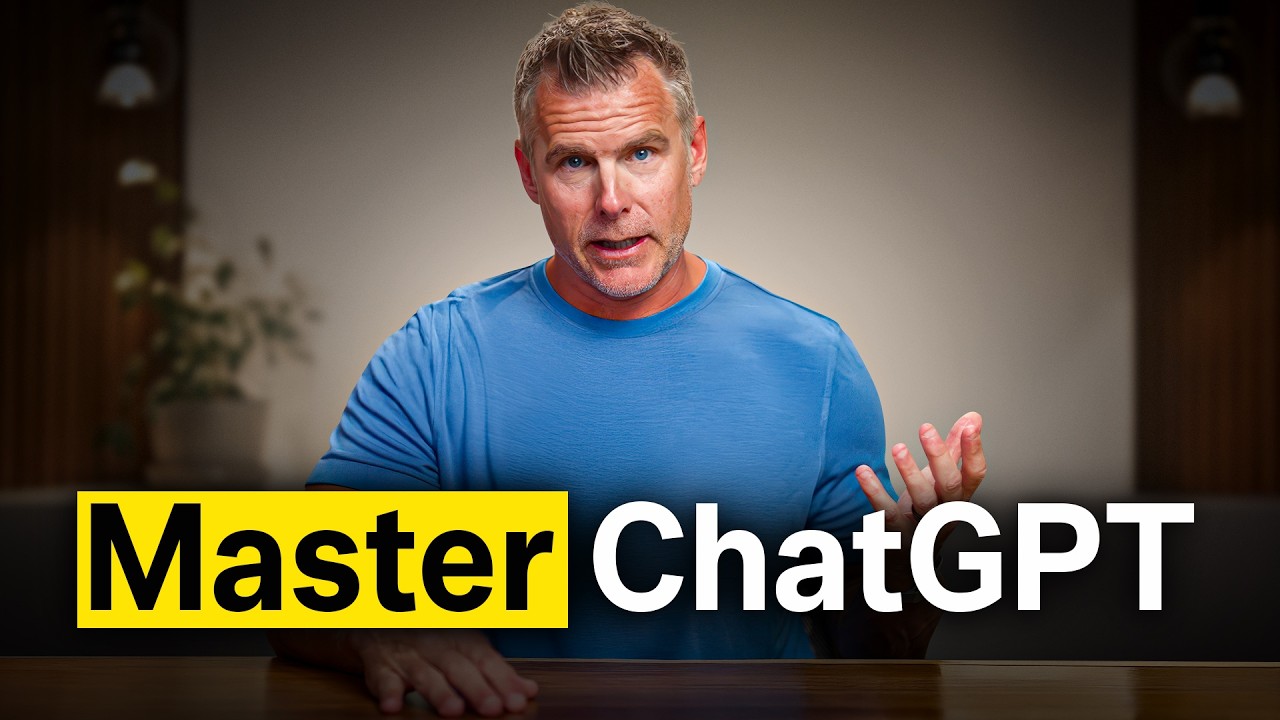
Dan Martell explains how to unblock a stalled business by finding the single bottleneck constraint, mapping workflow steps, and measuring the right KPIs instead of guessing.
Key Takeaways
- Identify and fix the single bottleneck rather than improving everything at once
- Use data and conversion metrics to diagnose the constraint instead of guessing
- Map your workflow into distinct steps and measure conversion at each step
- Fix the constraint first; polishing non-bottleneck areas is wasted effort
- Build a measurement scorecard so the business can repeat this process over time
What the video covers
- Businesses hit walls when growth stalls, and the fix is identifying the one constraint holding them back
- Being busy doesn't solve the problem; improving non-constraint steps wastes effort
- Throughput is limited by the narrowest point in a workflow, the constraint, often described via pipeline/water analogies
- Look for where work or inventory piles up; the step after the pile-up is usually the constraint
- Check the numbers before deciding what to fix, e.g. churn rate vs total customers rather than reacting to anecdotes
- Misdiagnosis example: a friend wanted to redesign his program when the real problem was a marketing gap
- Every bottleneck is a hidden KPI; measuring the right things reveals what to fix
- Theory of Constraints (from manufacturing, via Dan's father's Siemens experience) provides the framework
- Map the business steps (leads, qualify, book, show, close) and ask what breaks if volume increases 10x
- Create a scorecard/dashboard for the metrics so the problem is visible and solutions can be tested
Chapters
- 00:00Why Businesses Get Stuck
- 00:48Step One: Diagnosing Why Growth Stalls
- 03:48Understanding Constraints and Throughput
- 08:00Finding Where Work Piles Up
- 11:38Step Two: Using Data to Find the Bottleneck
- 19:11Mapping Steps and the Magic Question
- 22:54Measuring and Building Your Team
- 26:25Next Steps and Commitment
Full Transcript — Download SRT & Markdown
Speaker A
There will be a point where your business feels completely stuck. It doesn't matter what you do, how much you change, the business doesn't seem to grow. Even a couple months ago in one of my companies, the business hit a wall, slowly declining, and then we implemented exactly what I'm going to share with you today, and we just finished having a record month.
Speaker A
Every business I've worked with hits a wall at some point. Even the biggest entrepreneurs face this exact issue.
Speaker A
And what I found is there's only one way to unblock your business. It starts with finding the one thing that's holding the business back.
Speaker A
Today, I'm going to show you how to find that one thing and fix it so that you can get your business moving forward again and build a machine that works even when you're not there.
Speaker A
Step one, we need to figure out why growth is stalling.
Speaker A
If you don't have a process for fixing things, you will feel like a chicken with its head cut off.
Speaker A
I felt like I was working.
Speaker A
It just didn't change anything.
Speaker A
Then I realized being busy doesn't solve the problem.
Speaker A
So I want to draw a picture that's going to make this clear as day.
Speaker A
You have a lot of things in your business you could be doing.
Speaker A
You could be doing marketing.
Speaker A
You could be doing operations.
Speaker A
You can do even sales.
Speaker A
The challenge is, your business is like a pipeline.
Speaker A
It flows.
Speaker A
You have ideas.
Speaker A
You turn them into products.
Speaker A
People buy the products.
Speaker A
It's like a flow of traffic.
Speaker A
But what if all of that ends up in a constraint?
Speaker A
If you have all these ideas producing, but there's this one point in the middle that is a constraint.
Speaker A
Think of it like water.
Speaker A
If the water flows in on the left, this is your team working really hard, but then it gets pinched in the middle, then the backside will be limited.
Speaker A
See, you can't have it flow because of the constraint.
Speaker A
And what people do is they keep saying, "Hey, Dan, I've got to do more stuff here.
Speaker A
I've got to do more stuff there."
Speaker A
And I'm like, but you don't even know what this is.
Speaker A
And throughput is the narrowest point of any workflow.
Speaker A
The mistake is making the other steps faster.
Speaker A
You're like, oh, we need to do more marketing.
Speaker A
We need to do more sales.
Speaker A
We need to do more automation.
Speaker A
We need some AI.
Speaker A
But what if the delivery team is the bottleneck and they can't onboard clients?
Speaker A
So everybody else gets faster, faster, faster, and then it just stalls.
Speaker A
That becomes the bottleneck.
Speaker A
That is the focus.
Speaker A
When I was starting to write software and I realized that, hey, I can write all the software I want, but if I can't get people to buy, the business doesn't have any money.
Speaker A
Writing more code didn't make me more money, but as a software developer, it felt safe.
Speaker A
And that's usually what happens: your team will do the thing they know how to do, but that's not necessarily the right thing to do to increase the output.
Speaker A
If there is a workflow, I want to figure out where the work is piling up.
Speaker A
Usually, wherever inventory or work is piling up, the step after it is your constraint.
Speaker A
If you don't know where to look, just walk down the process.
Speaker A
It could be that you're involved in having to approve every invoice.
Speaker A
It could be that somebody else on your team is waiting for another person to do something.
Speaker A
It could be that decisions or approvals or processes are just not automated.
Speaker A
I've seen it where customers are upset because they only want to deal with you, and that's the constraint because of a sales script that doesn't communicate that they're going to work with somebody on their team.
Speaker A
So there's a little bait and switch.
Speaker A
It can happen all over the place.
Speaker A
I just need you to understand there's only one problem right now in your business that needs to be solved.
Speaker A
Running a business really comes down to one job.
Speaker A
We've got to find the bottleneck.
Speaker A
We have to solve it, and we've got to repeat that process.
Speaker A
Solving the right thing in the wrong order is still a loss.
Speaker A
Like we don't polish a car if the engine is on fire.
Speaker A
So we do have to fix what's stopping it from moving forward.
Speaker A
So how do you find the thing that's limiting your growth right now?
Speaker A
Step two, this is how we find your bottleneck.
Speaker A
And the best way to do that is we've got to check the numbers before deciding what to fix.
Speaker A
For example, one of my buddies came to me a few years ago and he's like, "Hey man, I need to redesign my whole program."
Speaker A
I said, "Why?"
Speaker A
He goes, "We lost some customers."
Speaker A
How many customers did you lose last month?
Speaker A
I lost three.
Speaker A
How many customers do you have total in your business?
Speaker A
300.
Speaker A
Hm.
Speaker A
Let's look at the percent of total customers that left in regards to the ones you have.
Speaker A
Three out of 300 is 1% on a monthly basis.
Speaker A
You could have up to 2 or 3% and still have an incredible business.
Speaker A
Let me ask you a question.
Speaker A
How many people are on your marketing team?
Speaker A
I've got to be honest with you, Dan.
Speaker A
Nobody.
Speaker A
Yeah.
Speaker A
Not surprised.
Speaker A
What I knew from his answer and the assessment of the data is that he didn't have a product adoption problem.
Speaker A
He didn't have a product quality problem.
Speaker A
He didn't have a retention problem.
Speaker A
He had a marketing problem.
Speaker A
He misdiagnosed it.
Speaker A
He was about to go down the path of spending the next three to six months redesigning a program to reintroduce new things that could have cost him way more people canceling than the ones that left, because he didn't know they had a marketing problem.
Speaker A
This might sound simple to you.
Speaker A
I will tell you every day entrepreneurs are making decisions around the bottleneck they need to fix, and most of them are wrong because they don't understand this process.
Speaker A
One of my beliefs around this is that every bottleneck is just a hidden KPI.
Speaker A
Meaning that if we measured the right things in the business, then we'd know exactly what we need to fix.
Speaker A
If we don't have the right measurement, then we don't know what to fix.
Speaker A
Then we just start guessing.
Speaker A
And that's what, unfortunately, business owners do every day.
Speaker A
If you want to go deeper on this, it's called the theory of constraints.
Speaker A
It's an incredible book that was written for manufacturing, which I learned through my dad, because my dad worked at a big company called Siemens, and they brought in experts to talk about black belts and Six Sigma and lean manufacturing, and it was just something that I saw on the shop floor that they talked about all the time.
Speaker A
The way I look at it is that a process not well defined is a process I can't solve.
Speaker A
In the process of theory of constraints, the first step we have to do is map the steps.
Speaker A
So for example, maybe you've got leads.
Speaker A
That's your first step.
Speaker A
Then it goes to qualify.
Speaker A
Are these the right people?
Speaker A
Then you've got book.
Speaker A
This is getting them on a call.
Speaker A
Then you have show.
Speaker A
Did they show?
Speaker A
And then you have close.
Speaker A
Did the person enroll in your program?
Speaker A
That gives us the simple mapping.
Speaker A
If you have a team member, ask them to go to a whiteboard and draw something that looks like this.
Speaker A
But you want to have the distinct steps in the business outlined.
Speaker A
Then we ask the magic question.
Speaker A
This is my favorite question to ask, because it usually gets to the point of the problem incredibly quickly.
Speaker A
I ask the question in any workflow: if I 10x the volume of leads in this example, what breaks?
Speaker A
Because when you do that, all of a sudden I'm pushing water through the system, and it becomes very evident that the issue to solve, as an example in this step, is book.
Speaker A
It wasn't the show rate.
Speaker A
It wasn't the close.
Speaker A
Those are relatively good for the industry, but the number of qualified people we've actually been able to book on a call isn't high.
Speaker A
And that's where we have to get the data.
Speaker A
That's where the numbers don't lie.
Speaker A
If you don't have a spreadsheet that outlines the steps and the conversions in each step, then how are you going to know?
Speaker A
Yesterday, I walked into one of my offices and there were one, two, three, four, five, six dashboards in that one room.
Speaker A
That's the level of measurement that I like to see.
Speaker A
Now, do you need it to be on a TV on a dashboard?
Speaker A
No.
Speaker A
Should it be in a spreadsheet?
Speaker A
Mhm.
Speaker A
Can I ask my AI to help me design that?
Speaker A
You sure can.
Speaker A
So, a lot of pe
Speaker A
If you empower them to just solve them themselves, you will get a data point to then go, "What's that smell? What's going on over there?" For example, one of my editors didn't want to wait for the designer, so he went and spent 50
Speaker A
bucks to get the design done himself. Well, turns out bottleneck, the designer didn't have enough capacity because he only had 10 hours a week. He was on contract. Leader, hey, how about we give him 20 hours a week? Perfect. Bottleneck
Speaker A
solved. And then third, this is measure. This is where we create a scorecard or a metric on what we're going to measure to ensure that we know what is the problem.
Speaker A
I do this all day long. One of my favorite things to do is I walk around, I look at a dashboard and it tells me exactly in all my companies where I should be asking better questions. Every one of my dashboards has a name next to
Speaker A
the metric of the person who owns it, DRI, as well as their cell number. I know, next level. But once I have that, then we go to the last level, which is my favorite, which goes around all of
Speaker A
this, which is to coach. Coach to success. We have to remind ourselves that [music] there was some moment in our lives where we didn't know how to do the thing that we do that we're pretty good at today. And somebody taught it to
Speaker A
us. We either read a book or we went to a seminar, we hired a mentor, we hired a coach. And I think it is the coolest thing to remind ourselves that when we work with people on our team, our job is
Speaker A
to develop them. Our job is to empower them. Our job is to show up and let them know like, hey, this thing I saw you do.
Speaker A
I used to do that. Here's what happened to me. Somebody pulled me aside. Share this with me. Does that resonate with you? Yes. What did you take from that?
Speaker A
This. Perfect. Can you make a commitment in the future? You'll do that. Yes. Do that. Okay, I will. That is coaching.
Speaker A
And I get it. It can feel slow. But what'll happen when you start building your people? You'll wake up one day and you'll realize that they started coaching [music] your other team members. and they start saying the same
Speaker A
thing that you said to them and you don't have to repeat yourself and at some point you'll wake up and you'll have a team of badass people building problems solving bottlenecks for you and you're not there and that is how you get
Speaker A
unstuck in your business by you stop being the bottleneck and implementing this process and I just want to share this I understand that entrepreneurship is hard things will always be broken they're never fixed by definition of being in business and being an
Speaker A
entrepreneur to go on a journey journey of prneuring which means to create that we're always solving problems. What I want to invite you to consider is maybe the process of how you solve problems in the past has been flawed. This hopefully
Speaker A
introduces you to a different approach. But I need you to make one commitment and just let me know out of everything I shared with you. Was it the testing? Was it the coaching? Was it the process for finding constraints? Was it the
Speaker A
measurement? Whatever resonated with you, leave me a comment below and let me know. And for those that are looking for my support in helping them grow their business, I do have that free scale your business workbook. You can just click
Speaker A
the link or the QR code to download it for free. And the coolest part is that whole workbook. I created a whole video walking through the entire thing step by step. And it's one of my favorite videos and I want you to watch it. So, just
Speaker A
click here and I'll see you on the other
Topics:bottlenecktheory of constraintsbusiness growthKPIsworkflow optimizationentrepreneurshipthroughputbusiness strategymetricsscaling a business