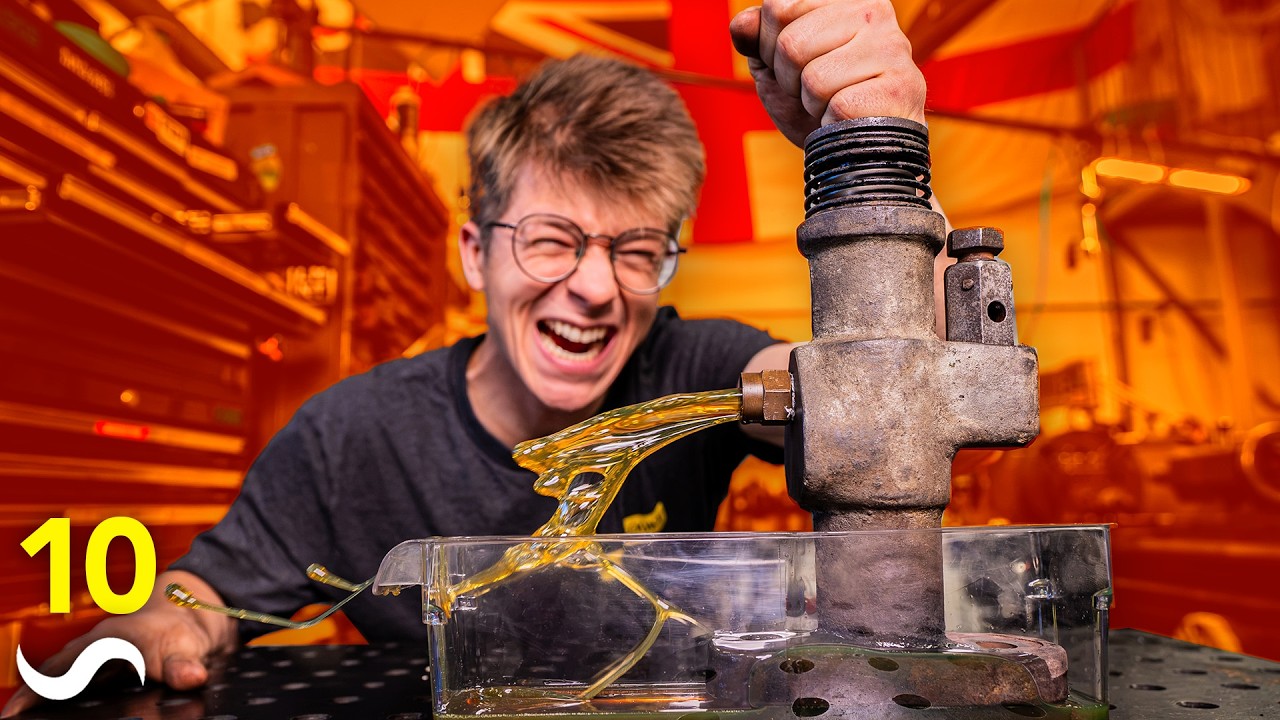
Alec Steele restores a heavily rusted Massie Clear Space 500 power hammer, disassembling and refurbishing parts with heat and custom CNC-machined dies.
Ask about this video. Answers come from its transcript only — with the timestamp, so you can check them.
Generated from the transcript and can be wrong — check the timestamp.
Key Takeaways
- Restoring vintage machinery often requires complete disassembly due to severe rust and seizure.
- Applying heat can effectively free stuck mechanical parts without damage.
- Custom CNC machining services like PCB Way are valuable for producing replacement parts.
- Patience and creative problem-solving are essential in complex restoration projects.
- Sponsorships can help fund restoration projects while providing useful resources.
What the video covers
- Alec Steele continues restoring a Massie Clear Space 500 power hammer that was rusted after 20 years outdoors.
- He begins by disassembling the hand lever and treddle linkage, encountering seized and jammed parts.
- Heat is applied to free stuck components, including tapered pins and springs.
- A custom top die is designed and CNC machined by sponsor PCB Way to replace the missing original.
- The video features detailed problem-solving techniques for freeing rusted mechanical linkages.
- Alec highlights the usefulness of outsourcing complex machining tasks to PCB Way.
- He demonstrates perseverance with difficult pins and linkages, using custom tools and heat.
- The restoration involves cleaning, disassembling, and preparing parts for reassembly.
- The video includes a promotional segment for PCB Way with a discount code for viewers.
- Overall, the episode focuses on the challenges and progress in restoring a vintage power hammer.
Chapters
- 00:00Introduction and initial disassembly
- 01:41Freeing seized linkage and pins
- 03:32Removing tapered pin from oil sump
- 05:40Sponsor segment: PCB Way custom die creation
- 07:30Testing and fitting the new die
- 08:30Continuing disassembly and troubleshooting
- 09:45Removing rear cylinder cover and piston
- 12:00Cleaning and inspecting internal components
- 14:06Final steps and preparing for reassembly
Full Transcript — Download SRT & Markdown
Speaker A
Welcome back. This is part two of restoring my dream power hammer. This is a Massie Clear Space 500 weight power hammer that spent 20 years sitting in a bush. I thought that this was just going to need a clean up, a lick of paint, you know, tidy up the pitted ram, but by goodness did we find some problems in the last episode. This thing is super rusted inside and outside. And I've determined that I need to completely disassemble the entire thing. First job of the day is to get the hand lever and treddle linkage off the hammer.
Speaker A
know, tidy up the pitted ram, but by goodness did we find some problems in the last episode. This thing is super rusted inside and outside. And I've determined that I need to completely disassemble the entire thing. First job
Speaker A
Oh, that's stiffer than it was. Oh, there we go. Progress. See this handle here? It has this kind of catch on it. As you squeeze this, the little bar at the back should be clicking into this slot, that slot, that slot, or that slot. But it's all jammed. And this handle is jammed to that plate. Even though it shouldn't be, like most things that are jammed, it's not what you want.
Speaker A
Oh, that's stiffer than it was. Oh, there we go. Progress. See this handle here? It has this kind of catch on it. As you squeeze this, the little bar at the back should be clicking into this slot, that slot,
Speaker A
Oh, and we've got movement. Oh, the power of heat. Oh, it's so much better.
Speaker A
OH, AND WE'VE GOT MOVEMENT. OH, THE POWER OF HEAT. OH, it's so much better.
Speaker A
Ain't that good? We're doing it. But it's not moving at the treddle. No. And we still... This pin is still not going. I think the issue now is this rod is jammed into that plate. The rod wants to be able to move separate from the rear plate. And they're currently tied together. See if I can shock them apart. Oh, I see movement. I bet what's happened is we've been able to get the whole bar to move, but it's still seized in here. And do a little bit more heat. Okay, we've got the two things separate. The only trouble is that little spring that engages in the catch is still seized. That's okay. If things are free moving here, it means that we're going to have a chance of getting it out of this boss and then we can deal with it when it's on the workbench. Now, on the other side of the boss inside the machine, that's where it connects. And you'll see there is what looks like a tapered pin above a square shaft. I'm going to try and knock that out. Get these springs off of there and then hopefully that whole assembly will just slide right out. Hopefully.
Speaker A
rear plate. And they're currently tied together. See if I can shock them apart. Oh, I see movement. I bet what's happened is is we've been able to get the whole bar to move, but it's still seized in here. And do a little bit more
Speaker A
Is it moving? No. Oh yeah, baby. Come on. Yeeha. It's so hard. I just can't see anything inside of there. Like if the whole linkage is disconnected first, maybe this will just pivot straight up and then I can knock it out when it's in straight up position. Now that this is all free enough that that moves, great. I can push it down as far as it goes before it hits this stop lever here.
Speaker A
it out of this boss and then we can deal with it when it's on the workbench. Now, on the other side of the boss inside the machine, that's where it connects. And you'll see there is what looks like a
Speaker A
Boom. Still don't have the access. So, I'm going to try and extricate the stop lever first.
Speaker A
Is it moving? No. Oh yeah, baby. COME ON. YEEHA. It's so hard. I just can't see anything inside of there. Like if the whole linkage is disconnected first, maybe this will just pivot straight up and then I can knock it out when it's in
Speaker A
God, it's so difficult. Ah, you booger. It's that tapered pin I'm now trying to knock out. And it's proving as difficult to knock out as the previous tapered pin. Come on. Yes. Yes.
Speaker A
Boom. Still don't have the access. So, I'm going to try and extricate the stop lever first.
Speaker A
God, you more heat. Actually, I've got an idea. Unless I set fire to the whole thing at this point, though. Oh, okay.
Speaker A
God you more heat. Actually, I've got an idea. Unless I set fire to the whole thing at this point, though. Oh, okay.
Speaker A
Made a tool to hopefully be able to drive the pin out. I've got no idea where the hole is. I'm just beating aimlessly.
Speaker A
Where are you? Are the saxophones getting louder? The saxophones are getting louder. Baby, I got it out. It is at the bottom of the oil sump. That tapered pin. She flew out, baby. Right now, can I get you
Speaker A
Where are you? Are the saxophones getting louder? The saxophones are getting louder. Baby, I got it out. It is at the bottom of the oil sump. That tapered pin. She flew out, baby. Right now, can I get you out? Come on. How about this for an idea? Bronze breaker. Dropped my bit of bronze. It now moves 360, which is good.
Speaker A
I have faith. If I hadn't dropped my bit of bronze in the sump, I could have kept going really easily. Oh, it's not stuck in the sump. It's on a ledge.
Speaker A
I have faith. If I hadn't dropped my bit of bronze in the sump, I could have kept going really easily. Oh, it's not stuck in the sump. It's on a ledge.
Speaker A
about the dyes on this hammer. That is the enormous bottom dye, but it didn't come with a top dye. So, I drew up a model and I had today's sponsor, PCB Way, make up a new die. PCB Way is a
Speaker A
The retaining piece came off. Oh, thank goodness. At last, something's happened. That was a special moment. Okay, question is, will that now allow us to get the other tapered pin out? Right, being forward thinking, we got to think about the dies on this hammer. That is the enormous bottom die, but it didn't come with a top die. So, I drew up a model and I had today's sponsor, PCB Way, make up a new die. PCB Way is a one-stop prototype service provider. Whether it is PCB design, CNC machining, sheet metal bending, laser cutting, and an enormous range of 3D printing options.
Speaker A
You can even get some crazy alloy metal parts 3D printed with PCB way, which is pretty sick. Now, I've been finding PCB way super useful um for their CNC machining capabilities. is a power hammer die is something that I can make,
Speaker A
You can even get some crazy alloy metal parts 3D printed with PCB Way, which is pretty sick. Now, I've been finding PCB Way super useful for their CNC machining capabilities. A power hammer die is something that I can make, but it's sometimes the case that to keep the workshop running, you need to outsource the work. Oh my goodness, that is so beautiful. Look at that surface finish. And when I need to outsource a job, PCB Way is absolutely fantastic.
Speaker A
Golly, it's just gorgeous. It's super simple cuz you just import your uh drawing from your CAD software. You can select from countless materials, you know, even titanium, copper, mild steel.
Speaker A
Golly, it's just gorgeous. It's super simple because you just import your drawing from your CAD software. You can select from countless materials, you know, even titanium, copper, mild steel.
Speaker A
It's really heavy. That's a big boy. Oh hello. Super. Please go try using PCB way for your next project by clicking my special link in the description. And the first thousand of you to use code Forge-10 are going to get $10 off orders over $30,
Speaker A
In this case, I opted for 4340 steel. And I specified that they should please harden it to 45 Rockwell. But the proof is in the pudding, and the pudding is in seeing if it fits in the dovetails.
Speaker A
The first evening it rains in bloody months and the top pollen came off and all the valve balls are exposed.
Speaker A
It's really heavy. That's a big boy. Oh hello. Super. Please go try using PCB Way for your next project by clicking my special link in the description. And the first thousand of you to use code Forge-10 are going to get $10 off orders over $30, not including shipping. Click the link in the description, use code Forge-10. Let's get back to it. Ah, my finger.
Speaker A
Who needs a rust-free front cylinder anyway? Let's see what we can do with this handle now. Ah, no, it's dripping.
Speaker A
The first evening it rains in bloody months and the top pollen came off and all the valve balls are exposed.
Speaker A
More precise heat on it perhaps. YES, we're out of there. Success. It's free here. However, still pinned there.
Speaker A
Cylinder is open to the elements. Oh yeah, I love that. I love water in my freshly opened and oiled valve. Sick.
Speaker A
soft, wobbly spring. Ah, my finger. Oh, it's a picture. Yeah. Come on now. Now we're cooking with gas.
Speaker A
Who needs a rust-free front cylinder anyway? Let's see what we can do with this handle now. Ah, no, it's dripping.
Speaker A
would then now let the spring pop up and I could like hang it up there. But God, IT'S JUST SO OH, MAYBE MAYBE. Come on now. God, look at me being too much of a pessimist here. IT MIGHT GO.
Speaker A
More heat. Running out of oxygen. Yes, success. Oh, come on now. That is super stubborn.
Speaker A
Yeah. Yeah. Slowly inching our way up now. Okay, that should be out of the heat enough hopefully cuz I don't really want to do any more fine. I'll do some more.
Speaker A
More precise heat on it perhaps. Yes, we're out of there. Success. It's free here. However, still pinned there.
Speaker A
Now we can just absolutely obliterate this thing with heat. Basically, we have a completely rusted cotter pin that is going through this retaining ring and the pin that holds the treddle spring arm to the treddle. Need to get this so
Speaker A
Let's see if we can get that loose. I really want to get this spring off of here because I'm putting a lot of heat in here and I don't want to lose the temper. Otherwise, we will end up with a soft, wobbly spring. Ah, my finger. Oh, it's a picture. Yeah. Come on now. Now we're cooking with gas.
Speaker A
It's untake outable. Oh, wait a second. Did I just not have the faith? Cuz I just took half of it out. Yeah. Another little bit.
Speaker A
We done it. Now that is funny. That's the first time I've seen anything like that. Round pin where they've filed two flats so that it lives on that flat surface. Very neat. But that will need to be remade. Well, the hope was that would then now let the spring pop up and I could like hang it up there. But God, it's just so... Oh, maybe, maybe. Come on now. God, look at me being too much of a pessimist here. It might go.
Speaker A
Come on, we've done it. It's happening. Question is now there's nothing retaining the treddle. Will it move?
Speaker A
Yeah, baby. Come on. My scheme worked. Potentially at the expense of losing the temper on this portion of the spring while we had to heat that up, but it'll hopefully mean that we can pull that up to save losing the temper there. Yeah.
Speaker A
is around this side. Huh. Would you look at that? It's already prepared for me.
Speaker A
Yeah. Yeah. Slowly inching our way up now. Okay, that should be out of the heat enough hopefully because I don't really want to do any more fine. I'll do some more.
Speaker A
It's bad. OKAY. OH, IT'S GOT ALL OVER MY SHOE. YUCK. I'm trying. I'M TRYING.
Speaker A
Just have to imagine how expensive this spring will be to replace. Okay, don't you ping on me now.
Speaker A
There we go. Tada. And I can now reach that tapered pin. Yes. Apart from the fact that it's also now at the bottom of the sump. Sick. We know there are two tapered pins at the bottom of the sump. Now, everybody
Speaker A
Now we can just absolutely obliterate this thing with heat. Basically, we have a completely rusted cotter pin that is going through this retaining ring and the pin that holds the treddle spring arm to the treddle. Need to get this so hot that we can just shear through the rusted cotter pin because it is going to be impossible to pull out.
Speaker A
That looks like the housing that the treddle pivots around. That looks pretty nasty. There's a whole block back there that it's completely seized in. Uh, which I might be able to access once we separate the upper standard from the base plate.
Speaker A
It's untake outable. Oh, wait a second. Did I just not have the faith? Because I just took half of it out. Yeah. Another little bit.
Speaker A
Crowbar. Yep. That's absolutely not going anywhere. Oh, no. I see another tapered pin to remove. No. Everything about this is challenging. There is no like easy access. As nice as it is that they made a better performing machine,
Speaker A
Another little bit. Yes. Should come out easy as pie now. Yes. We got that bit off.
Speaker A
get into the nuts and bolts is about a million times easier. So, like back here, I found another tapered pin in there. And I just simply have no idea how we're going to drive that out. Oh, maybe if I put a bar across here, I can
Speaker A
Come on, we've done it. It's happening. Question is now there's nothing retaining the treddle. Will it move?
Speaker A
Ah. Maybe something's moving. No. No. The holes still line up perfectly. Now I might have to wait till I've got more oxygen and I can get the oxy fuel on there. Why don't we have a look in here? Let's try and find some work. We
Speaker A
No, it's only bending. It is still completely seized inside that hole. So, I want to put some heat on it. But the trouble is this is right beneath the oil reservoir. So, I'd like to drain out all the old oil first. I think the oil drain is around this side. Huh. Would you look at that? It's already prepared for me.
Speaker A
Going to need some impact. Oh, no. It doesn't like me. Yes, it likes me.
Speaker A
It is totally full. Woo! Ah, you see that? That's water.
Speaker A
Yeah. Beautiful. What are you meant to see from here? You can't see anything here anyway other than a lake of oil.
Speaker A
So, we got to drain that. Ah, delightful. A pre-rounded Allen head fastener. My favorite. Oh, bother. What if that's actually a a brass fitting and that's not the reservoir drain? Let's have a quick check of the manual. 98
Speaker A
down here. Reservoir drain I don't know why they needed to add that in there. That is going to be a bit of a penis to get out of there.
Speaker A
I'll get a screw extractor on it. It'll be fine. I love that it's just driving itself in, but it's not undoing it.
Speaker A
The screw extractor is not meant to just bury itself inside. I might have to drill it.
Speaker A
Is there not a hole all the way through it? No. Is there a hole the whole way through? How the hell did that happen?
Speaker A
That's way above the level of this oil then. I don't know how we're going to get this oil out. I have the solution. I dug a sucker off the back shelf.
Speaker A
Oh yeah, that's a noise. Y OF ME. OH, THAT WAS A GOOD ONE. Didn't get much air in that.
Speaker A
I think that's about as much progress as we can make. So, I think we mangled the by I think so. So, I think we mangled the drain by trying to shove the screw extractor in it and it'll have to be drilled out. Let's
Speaker A
see if I can separate this somehow. Come on now. Is it just still going? This must be an infinity thread. Oh, no. It was off. It's now going to need to come back down through the hole though for us
Speaker A
to get the top off. Oh, hello. Why might you have a slot here? Perhaps you unthread. Oh, that's a satisfying one.
Speaker A
Yes. Look at that awesome contraption. It's just two halves pushed in. So that now we can lift the top standard off without having to destroy this fitting. Good on you Massie engineers from the 40s and 50s for coming up with that. So, I'm
Speaker A
trying to figure out what I have to do next to separate the upper standard from the base plate. I think all that's left is the uh crank and rear piston.
Speaker A
Obviously, again, because this is a self-contained hammer as compared to a steam or an air hammer, it's compressing its own air in this rear cylinder back here. Thanks to this crankshaft, there's the bottom of the piston. Somehow, you're meant to be able to disassemble
Speaker A
that thing from the wrist pin, but it's not seeming very intuitive at the moment. So, I think I can have a little scan of the manual again. I've been saying the word wrong. It's a connecting rod. Trunk pin. What's the word? Looking
Speaker A
at the manual, I don't see any other option other than getting that nut off that bolt and getting that nut off that bolt. We got a split pin on a castle nut. Bend that back. Loosen the castle nut. Oh yes, that's a that's a big boy.
Speaker A
It's good there's a camera in the way cuz this would just be like too easy otherwise. Now that needs to go that way. If I drive a little punch in there, maybe. You know what? I'm going to put
Speaker A
an angle grinder. I'm just going to cut the the end of the cotter pin.
Speaker A
Just put some grinding dust inside my oil reservoir. you know, like provides a little bit of grit to really bed in those uh piston rings.
Speaker A
Today on the most dangerous thing you can do with an angle grinder. Yep. Never again.
Speaker A
Now switch over to the special. You're standing on it, love. Thank you. The pin pusher 3000.
Speaker A
It was almost working. We spin the wheel so it's at least closer. Would that be easier if I put it more upright? There we go. Now it's moving.
Speaker A
That's going to be Much better access. Yes. Come on. Yes. Yes. A significantly harder one is yet to come. You're not going to see much action here. I think you're just going to see a plumbers's crack. Imagine plenty of swear words between now and
Speaker A
the next clip where I announce to you that the split pin is out. One pair of pants later.
Speaker A
I've been unable to get the pin out. Let's try undoing this. Should we just try and get that done?
Speaker A
Come on. Let's let's we'll we'll try our best to have some happy feelings. Let's get that castle nut off THE FRONT PIECE.
Speaker A
OH, BABY. COME ON. GOOD NEWS. How are you going to do it on the other side?
Speaker A
That's a good question. Okao might do job because Oh, it fits. I wouldn't be surprised if that hasn't come off that bowl in 67 years. Once we get that split nut off, I'm hoping Yeah, that'll fit like a ABSOLUTE DREAM.
Speaker A
TURNS OUT THE WEIGHT OF this alone is enough for the trigger to actuate. I now put that in there.
Speaker A
Oh, it's twisting. God, I'm like a contortionist. Smashed the thumb. Oh, don't want to take off the glove. Ready? Three, two, one.
Speaker A
Wait, wait, wait, wait, wait, wait. You ready? Three, two, one. Glad that that was less exciting than it could have been. Yeah, I like this idea.
Speaker A
Get my fingers out of the line of fire. Come on. Say goodbye to a screwdriver.
Speaker A
Goodbye. Is it happening? Is that progress? You think that's progress? Oh, yeah. Come on. Come on.
Speaker A
I'm going to see if we can shear that pin. Luck. Didn't budge an inch.
Speaker A
We did it. There we go. That's what was giving us all that trouble. There's the castle nut.
Speaker A
What on earth was that noise? Did I just break the lifting eye? That's not good.
Speaker A
Next step, need to get the rear cylinder cover off. Once that's off, we'll hopefully be able to pull the rear piston and connecting rod in one go.
Speaker A
Now we lift this cover off. Yeah, we're free. Oh, don't like doing this. It's not like we're making it any worse than it already is. So, this is a stuffing box I'm trying to get off. This is how a
Speaker A
seal is maintained on the actual ram itself. So, it's got packing in there as well as some guide plates, but obviously is uh it has not moved in a little while. Trying to get it loose so that we
Speaker A
can drop it onto the forklift forks. Hopefully, in a controlled fashion. It's moving. It's leaking. That means we've cracked the seal on that side. I can't see anything.
Speaker A
YES. SO CLOSE. It just keeps getting bound up. Yes, that might be it. Nope. Oh, come on.
Speaker A
Oh, for goodness sake. It just stays on there. Go on, you silly Billy. I mean, jolly good. OH, COME ON.
Speaker A
YES. I think that has to be it. Success. Hello, friend. Oh, no. I'm sorry. We're taking your home. This has been my house for 67 years, and you've just come along and move it. You're joking. Look what I've just found. See that? That's not a
Speaker A
bolt hole. That's a set screw hole for doing what I had to do with a hammer and chisel. There is another one. I could have put an Allen screw in it and driven the Allen screw in, and that would have
Speaker A
lowered that down. Let's go take you to nature. You ready, pal? Off. Off. Here's a good chapo.
Speaker A
That is some serious gunk. We can now see straight through the front cylinder. Here's our rear cylinder, rear piston.
Speaker A
It's got a threaded hole for a lifting eye. And I ordered a whole box of them that just arrived. I think it's 5/8 or 3/4. Let's see. Hopefully, one of these will do the job. Oh, hello. 3/4 goes
Speaker A
right in. First time's the charm. Crankshaft is upright. I'm hoping that those two components separate and the connecting rod lifts up. Oh, I feel tension. Anything happening?
Speaker A
Did it go? Oh, what happened? Nothing. What on EARTH WAS THAT NOISE? THAT SHOULD be inside that threaded hole. Why did you come out? It just stripped the threads. Time to go cry.
Speaker A
Maybe it wasn't this thread. Actually, looking at it with your eye, this thread looks a little bit different to that thread. Well, that's what it should be if it's 3/4 in witworth. That's definitely not the same thread pitch.
Speaker A
So, this is a 3/4 in witworth that I tried to put in there. It did thread in, but it did rip out. Obviously, it's not the same as what's in the hole. We need British standard witworth fine, which is
Speaker A
not fine cuz I don't have it. In a shocking turn of events, after further inspection, it turns out that it's a pipe thread. A halfin British standard pipe thread is the exact thread. It screws in better than anything else.
Speaker A
Thread gauge says it's that. The inside dimension says it's that. Why is there a pipe thread for a lifting eye?
Speaker A
We've turned a little solid spigot and thank you to neighbor Steve, we're going to borrow this pipe threader and hopefully cobble ourselves a lifting eye together. It's like a ratcheting thing here. Do this and then Oh, she's cutting good.
Speaker A
Okay, I think that'll do. Only old thread. Yep, that threads beautifully. Let's hope that works. If any of you guys have a good reason for why you'd put a pipe thread in this, please let me know. Upwards.
Speaker A
Is it moving? No. Is it moving? No. I hate that it's not moving. It moved.
Speaker A
Wait, it did. Is it like starting to separate at the joint? No. Weird. The whole assembly is moving.
Speaker A
Well, like the whole crankshaft is moving. Yeah. Well, that that's probably not good. That probably means there'll just play in it. I need to have another look there. See if I'm missing something.
Speaker A
Doesn't look like we're missing anything, does it? There's the connecting rod from the other view.
Speaker A
Trying to separate this from that. We've got those castle nuts off the connecting rod bolts. I need that to just go, but it won't. I think I maybe give it a little tickle with a hammer. Bit naughty. That's all I can think of.
Speaker A
This is difficult, guys. This is difficult. I do not want to damage things unnecessarily by pulling too hard. Maybe it needs a little bit of heat. You know, heat has been our friend a lot of the time. Let's do that.
Speaker A
Oh, it's separating. Something's happening. We have a gap. That's more than it was. Right.
Speaker A
Absolutely. More heat, more pull. Oh, I don't like the amount of play in there though. As you pull on it, you can see that whole assembly.
Speaker A
That whole assembly is flexing. Oh, come on. Look at it. That's definitely making it some progress. Dead solid. The other side and see if you can feel a gap on the other side.
Speaker A
I don't think there's a gap on the other side. You don't reckon you're going to feel anything either, eh?
Speaker A
No, there's no gap. Once you get a gap the other side, that will start to then Yeah. waddle itself away.
Speaker A
Yeah. Knock it over. True. You see? Yeah. It wants to go, but it won't go.
Speaker A
I have a proper gap on both sides. It's still not free, though. But it is going.
Speaker A
Give up already and get out of there. No big answers come to you, do they? We keep We keep looking at it like an answer will come. Thought this is like a paint job and that's it.
Speaker A
I thought, "Oh, what a deal." And now I understand. So, we're making progress. The bolt on this near face is almost out or at least it's almost level with the top portion.
Speaker A
We're getting space at the back AS WELL. LET'S GO. WE'RE ALMOST THERE. Thank you, Steve. Soon. Almost.
Speaker A
If I make a punch, I think I can have access to hit this with a hammer. Maybe I think I need a bit of bronze that's a bit shorter.
Speaker A
This is so hard to access. Come on, you Nelly. There's just no room. Ah, maybe it moved. It's moving.
Speaker A
Very hard to get a hammer swing on it. Try a little pulling again. Oh, I think it's going. Okay, a little knock.
Speaker A
YES, WE DID IT. AT LAST. Look at that. You ready? Ready. Ready. YES, IT'S OUT OF THERE. AT LAST. SHE'S OFF.
Speaker A
That is the big end separated. Come on. That was a pig. Wait, did we just spend the whole day on that?
Speaker A
Yeah. Was that the whole day? Yeah. Yeah. We now got to see if we can get that up through that hole. Let's hope we can.
Speaker A
Have a look at that piston ring. That is ginormous. This is so exciting. Look inside the bowels of the finest power hammer design ever to exist. Bottom of the connecting rod is through the hole. A little bit further to go.
Speaker A
We're officially out. What did you get up to today, Alec? Oh, me. I just released two bolts. That was the extent of my productivity for the day. Still feels pretty epic, though. Good. And now we can start coming down.
Speaker A
IT'S OUT OF THERE. THAT THING MIGHT HAVE NOT TOUCHED THE ground in 67 years. Look at how beautiful this forged connection bolt is. That connecting rod was forged in the ' 50s in Manchester in open dyes, probably on a hammer just like this.
Speaker A
Small recap. This is the rear piston that compresses the air to power the front piston that has the ram. The crankshaft that we separated this connecting rod from goes around and up and down. Pushing that up and down doing
Speaker A
the whole pushy pushy sucky sucky. And with it off, all that we have to do now in order to make progress on our goal of cleaning this thing up fabulously is we've got to get these bolts undone because I want to take the upper
Speaker A
standard off of the base plate. It's going to make fully cleaning everything so much easier. It's going to make painting it easier. And if I keep them separated, it's going to make install a breeze. The concern was is that this is
Speaker A
actually quite heavy. And it is within the lifting capability of my forklift. But it'll definitely go smoother if it's lighter. What we got to do now is we got to get those nuts undone. And let me tell you, they look like they have
Speaker A
suffered from the time that this thing spent outside in a bush because they are very corroded. Another use for the old big barker. Actually, does it go big enough? Yes, it does. Right. What do you reckon, guys? Quick tug and it'll come
Speaker A
undone. Go. Got to make a nice landing path for when this nut breaks free. Right away in three two one.
Speaker A
Right, that's not moving. How about this one? Come. Nope. I can feel my spine screaming. Nothing.
Speaker A
Of course there's nothing. There is zero chance they were coming undone. Oh, there we go. That'll work.
Speaker A
I tell you what, it shook off a lot of the rust though. Maybe it does something, you know, shake it a little bit. Yes, that obviously did absolutely nothing. Tell you what, though. When my oxygen cylinders come in in the morning,
Speaker A
we're going to basically turn them liquid and they'll come right off. Barbecue time. My oxygen delivery arrived at last and we can begin.
Speaker A
Here we go. Oh, that's still pretty damn stuck. Nope. That ain't going. Not only are we barbecuing bolts, but we're barbecuing meat. This is the type of multitasking I can get behind.
Speaker A
Let's now try the Franken Wrench. If this doesn't get it, I don't know what will. In three, two, one. Pull.
Speaker A
PULL. OH, IT WENT. YES. LOOK AT THAT. WE DID IT. WOO! Need some more from the Franken Wrench.
Speaker A
Yeah MAMA. I'm getting my cardio in. Turning a bolt. Oh no. We're not going to be able to get it on the other side, are we?
Speaker A
This is the sound of my knees now. I'm getting old. We are definitely making progress.
Speaker A
YES. That is one bolt out of there. And this over here is one hot nut. Booyah. It's out. And the great news is that bolt fell down. The fact that that bolt fell down means that I don't have to pound on
Speaker A
it with a sledgehammer. That is one of four done. My biggest concern actually is these plaques here. Because if I need to heat this nut, as much as I needed to heat that nut, which I hope I don't have
Speaker A
to do because this nut here caught the brunt of the corrosion. But if I do need to put heat on this, I don't want to damage that plaque. And I don't know how to keep it safe. It stays on there. But
Speaker A
I also don't know how to safely get it off. You want to know my heat? Did you hear what that was? The bolt fell out. Is it all the way to the ground? Oh my goodness.
Speaker A
That is outrageously large. That is crazy. And look, you can still see clean, shiny machined surfaces where that has been so tightly installed in there that not a drop of water, not a drop of oxygen could get to it. That is
Speaker A
a beautiful bolt. What a lovely bit of engineering. Now, Mr. Steel just had a great idea. Why don't we just see if this will come loose without any heat?
Speaker A
We have the Franken Breaker. Who knows? Maybe it just comes like that. You imagine? No chance it's coming, right?
Speaker A
Ready? Three, two, one. Oh, baby. Let's go. What an idea. Look at that. We did it. Okay, so we know that one's loose. So, let's put it back before the hammer falls over.
Speaker A
Yep, I got movement. Yes, I got movement. This We're going to be able to undo this with this bar. We can undo all these bolts, no problem. So, if we want to get it in half, we got to bring it
Speaker A
out into uh into a little bit more space. It's a nice quiet time in the business park. Do we do it now or do we do it later? There is a wasp on the camera lady. So, the camera is gone.
Speaker A
Now, I guess if we want to do this, we want to do it on a nice quiet moment. I think we have to loosen these plates at the back cuz it might connect between standard and base plate.
Speaker A
Nice. Oh, effortless. Thank you. I'm putting you to work. Let's see if it goes like this. If only there was some things you could put on your ears to stop loud noises hurting them.
Speaker A
Oh, that's just fabulous. ISN'T THAT BRILLIANT? WOO! MAMA, that is amazing. I'm so happy. You ever seen nuts this big?
Speaker A
Yeah. NO, you know, I think I might put a little bit of heat on it cuz it's starting to get stiffer.
Speaker A
Woohoo! Super. One more to go. There we go. Got it loose now. There we go. That's the last one done.
Speaker A
Now we just got to get it off. Oh yeah. Hello. This is just so ridiculously exciting.
Speaker A
You're joking. It stands like that. That progress did not come easy. My goodness, does it feel good. Thank you so much for watching. Thank you to PCB Way for sponsoring this episode. Check them out the link in the description. I
Speaker A
can't wait to have this thing running hopefully like new. It's a whole different scale of things when the machines get this big and we're learning a lot. See you in the next one. It's the buy.
Topics:Alec Steelepower hammer restorationMassie Clear Space 500rust removalCNC machiningPCB Waymetalworkingblacksmith toolsmachine restorationcustom dies