Skip to content

If You Don't Understand Prop Firms, You Don't Understand Trading

Learn why most traders fail prop firm accounts and how to optimize strategies for survival and profit in funded trading environments.

Key Takeaways

  • Prop firm trading requires adapting strategies to firm-specific risk and payout rules, not just applying live trading methods.
  • Survival and pass rate optimization are more important than pure profit in funded accounts.
  • Trailing drawdowns and consistency rules significantly impact trader success and must be modeled mathematically.
  • Static risk and take-profit settings aligned with firm constraints improve long-term profitability.
  • Understanding the true cost and value of evaluations and funded accounts is essential for sustainable trading.

What the video covers

  • Most traders fail prop firm accounts not due to psychology or discipline but because they don't adapt to the unique constraints and rules of prop firms.
  • Prop firm trading optimizes for survival, pass rate, and expected value, unlike live accounts which optimize purely for profit.
  • Trailing drawdowns, minimum trading days, and consistency rules limit optimal strategies and increase risk of ruin.
  • A trader profitable on their own money can fail in a prop firm environment due to these constraints.
  • Risk and reward must be adjusted specifically for the prop firm's evaluation and funded account rules, often favoring a 1:1.5 risk-to-reward ratio.
  • Evaluation fees and funded account profits create asymmetric risk profiles that traders must understand and manage.
  • Account size advertised by prop firms is marketing; actual capital is limited by strict max loss and trailing drawdown rules.
  • Different prop firms have different rules requiring tailored strategies to avoid capped upside and premature account loss.
  • Static risk and take-profit levels per trade aligned with firm rules improve survival and profitability.
  • Understanding and optimizing for firm-specific rules is critical, and mentorship can help traders develop these tailored strategies.

Answers

Questions about this video

Why do most traders fail prop firm accounts despite being profitable on their own money?

Most traders fail because they do not adapt their strategies to the unique constraints of prop firms, such as trailing drawdowns, minimum trading days, and consistency rules, which limit optimal trading strategies.

What should traders optimize for when trading funded prop firm accounts?

Traders should optimize for survival, pass rate, and expected value rather than pure profit, as the goal is to meet the firm's constraints and stay within risk limits to maximize long-term returns.

How does the risk-to-reward ratio affect passing prop firm evaluations?

A risk-to-reward ratio around 1:1.5 is often optimal for passing evaluations because it aligns with the firm's trailing drawdown and profit target rules, increasing the likelihood of survival and success.

Full Transcript — Download SRT & Markdown

00:00
Speaker A
Most people trading on prop firms are doing it completely wrong. And it's not what you're thinking. It's not their psychology. It's not their discipline.
00:05
Speaker A
It's not that they don't journal trades. The traders failing these accounts are not bad traders. Here's why they fail.
00:10
Speaker A
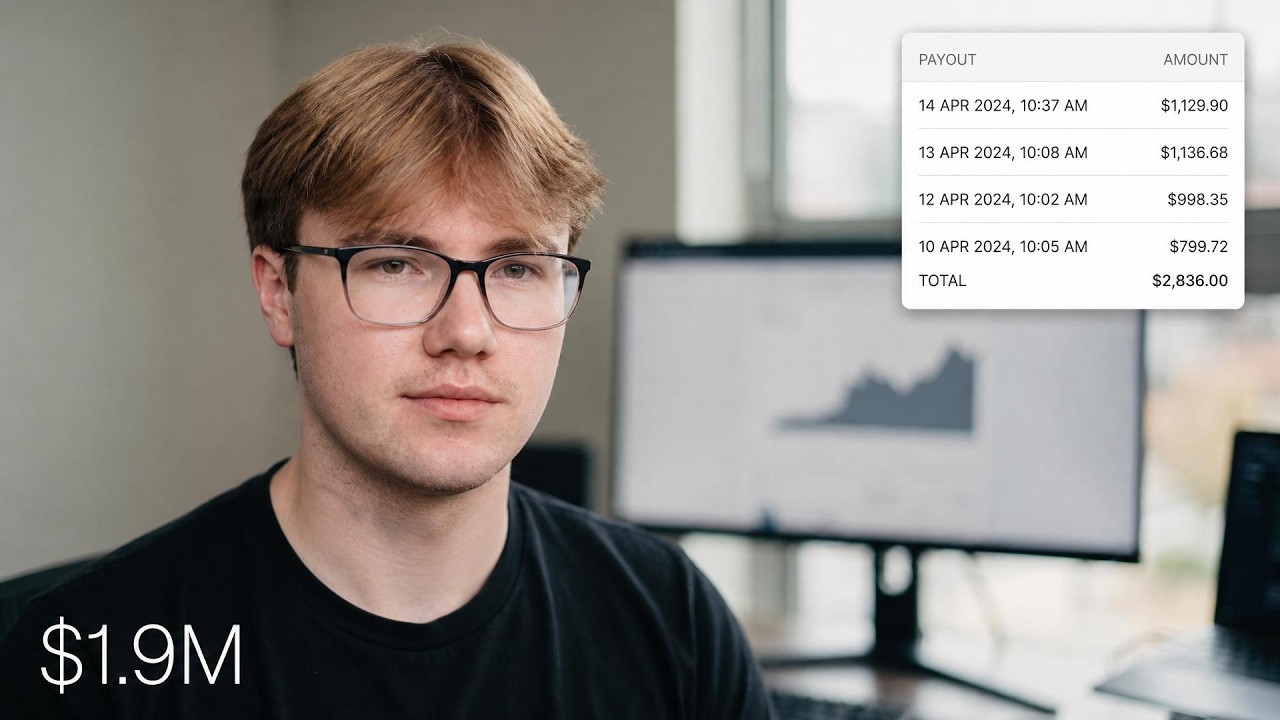
On a live account, you're optimizing for profit. On a funded account, you're optimizing for your pass rate, expected value, and survival. Those are completely different jobs. The problem is most people don't switch between them. I've withdrawn over $1.5 million
00:22
Speaker A
from prop firms, and it's not because I'm good at predicting the market. Honestly, I'm wrong constantly. I've blown tons of accounts. The real reason I make money is because I understand that prop firm accounts are not just trading accounts. They're products that
00:32
Speaker A
are sold to customers. You have to be trading them as so. The rules that kill prop accounts aren't the ones people read before they buy. Take a trader with a real edge. 50% win rate, 1.5 risk-to-reward. They would be genuinely
00:43
Speaker A
profitable on their own money over the course of a year. But as soon as you plug them into a prop firm environment, now they have a trailing drawdown, minimum day requirements, consistency rules, so many rules meant to limit
00:52
Speaker A
optimal strategies. A large share of these traders are going to fail accounts before the 40th trade just based on simple risk of ruin. Nothing ever went wrong with their trading. They just didn't model it against the product and
01:02
Speaker A
the constraints that they were given. I'll show you the exact simulation later, and I'll come back to what fails most accounts that most people don't even realize. Now, in proper trading, you're not really trading. You're just operating under someone else's specific
01:12
Speaker A
risk budget that they give you. On a live account, you should optimize for your profit and minimize your risk of ruin. When you're on a funded account, all you have to do is optimize for your survival. That is going to increase your
01:23
Speaker A
returns exponentially because as your account survives longer, your edge is allowed to play out over more trades for a longer period of time. And it all starts with the evaluation on the prop firm. You're given $2,000 of max loss in
01:32
Speaker A
a $3,000 profit target. That in and of itself is a 1 to 1.5 risk-to-reward. So, if you split up your trades into 1 to 1.5 risk-to-reward trades throughout the entire evaluation, then automatically you're going to have a larger pass rate
01:44
Speaker A
just because of how that trailing drawdown trails after every trade you place. Most people never look at the rules and treat these accounts like an actual math problem that they are. That's why when they bring over these strategies with a
01:54
Speaker A
three R or a one risk-to-reward, they're confused why it doesn't work. They're confused why their pass rate is so small when other traders are getting great pass rates just following a 1.5 risk-to-reward. Now, you need to understand the price behind what you're
02:04
Speaker A
actually buying. Remember, when you're on an evaluation, the only thing at risk is your evaluation fee, whether it's $100, $200, $300. Once you get to the funded account, though, that must have cost more. For example, if you try four
02:15
Speaker A
evaluations and you pass one, each eval is $100. Total, that's $400. So, if you lose the funded account, now you're losing $400 since that's what it cost you to get there. Then, once you're on a funded account, maybe you're $3,000 in
02:27
Speaker A
profit. Over the lifetime of that account, if you're a breakeven trader, you can expect to withdraw about $3,000 from that account. So, we're taking these same simulated accounts, but first we're risking 100, then we're risking 400, now we're risking 3,000. The risk
02:39
Speaker A
increases exponentially. But there's a key asymmetry with prop firms. You're allowed to have high evaluation expenses, but even higher payouts.
02:46
Speaker A
That's just because your downside is capped when you're on the eval to just that fee that you paid. But as soon as you're in profit on these funded accounts, your capital is actually limited. If you're $3,000 in profit,
02:57
Speaker A
that account is technically only worth $2,700 because prop firms give you a 90% profit split. At that point, if you're trading with this $3,000 account like it's your own, it's worth 90% of that.
03:08
Speaker A
So, you might as well just go to a live account and trade with $2,700 of your own money. It's the exact same thing, except you have better payout rules than a live account. The mistake that most traders make is not
03:17
Speaker A
re-evaluating where they're at after they're funded and after they start making profit on these accounts. Since the risk changes exponentially, you need to change your strategy exactly like that. Now, moving on. The account size is marketing. The drawdown is the
03:30
Speaker A
actual account that you're given. If you buy a $100,000 profit eBay, you're not given $100,000 worth of capital to trade. You're usually given a max loss limit of $3,000. Anytime you hit that max loss, so you reach a $97,000 balance
03:42
Speaker A
or lower, your account is gone. That max loss limit also trails. So, as you make money, it follows you up. If you win $3,000, then your new max loss limit would be at $100,000. So, you could be a
03:54
Speaker A
breakeven trader. You could win 3,000, next day lose 3,000. You still lose the account. So, you have to make sure that you understand exactly how every single prop firm rule works before you even spend money with them. Now, because the
04:04
Speaker A
drawdown rules are so specific to these firms, each firm has different rules. Because of that, I'm trading a little bit of a different strategy and a different risk-to-reward on all firms.
04:12
Speaker A
That way, my upside is never capped. Some firms are going to give me a consistency rule. So, my max win on those firms should be $1,000. Other firms don't have consistency. I can shoot for three, four, $5,000 wins, and
04:22
Speaker A
I'm not getting my upside capped. Then with my risk on the accounts with trailing drawdown, every time it trails, you're losing a little bit of expected value because maybe you win $2,000, but the drawdown's still going
04:32
Speaker A
to trail and now you only have $2,000 again even though you won money. Since the drawdown trails, you need to make sure that you can survive more than four losses in a row so that you don't hit
04:41
Speaker A
the max loss on a bad streak, especially as your funded account grows in balance and it's worth significantly more. The best way to trade these prop firms is with a static risk and a static take-profit. Every trade I enter, before
04:52
Speaker A
I even enter, I automatically know on that account exactly how much I'm going to risk and exactly what my profit target is. I've designed an entire trading plan and as long as I follow it step by step, I know through my win rate
05:02
Speaker A
and my simulations that I'm going to make money on these firms. Now, another thing most traders are doing wrong, they're so focused on their win rate, the risk-to-reward, which are inversely correlated. And if everyone's focused on their win rate, they're not focused on
05:14
Speaker A
the rules that the firm is actually giving you. Remember, if you're given a set of rules that you must abide by in order to receive payouts and pass the evaluations, there must exist one optimal risk-to-reward based on the
05:26
Speaker A
rules that you're given. Different firms have different optimal risk-to-reward. Now, risk management is what I cover in the mentorship that I run. Optimal take-profit, optimal stop-losses, risk-to-reward based on the firm that you're trading, your balance, your draw
05:37
Speaker A
down, payout rules, absolutely everything. Optimize for the prop firm specific environment and then we fit the strategy to the constraints. If you're interested, there is an application link in the description. If not, let's keep going. A profitable strategy on a live
05:49
Speaker A
account might fail on a prop firm. Much more than you'd think. The end goal of the evaluation and the end goal of the funded account are both to meet these constraints. Evaluation just to make $3,000. Funded account to make any
06:01
Speaker A
amount of money, five winning days, and then take a pay.
06:11
Speaker A
you're taking a 100 trade sample size, then you are statistically extremely likely to have a loss streak of four in a row with a 50% win rate. Same with five in a row. Same with six in a row.
06:20
Speaker A
Loss streaks are so common that you need to make sure it won't breach your prop firm account. Or if it does, you need to have backup accounts so that your edge is still able to be realized over all of
06:30
Speaker A
your accounts. As soon as you start proper trading, you should make sure that your risk of ruin is less than 5%.
06:35
Speaker A
Ideally, it's less than 0.5% if you're trying to be conservative. If you ever perform at worse than 0.5% of traders, meaning outside of statistical likeliness, then something is wrong with your strategy. Another thing most traders do wrong on proper is they're
06:48
Speaker A
exiting way too early. Like I said earlier, a static take-profit and a static stop-loss for every trade I ever enter based on the specific rules I'm given just because one value must be optimal. So, when people go, they exit
06:59
Speaker A
early when they're in profit. They exit early when they're in draw down. Obviously, that's not optimal. Just because you're given a specific set of rules, you have to follow the rules to the tea and you have to optimize your
07:09
Speaker A
approach specifically to fit within those rules. Exiting early is not going to do that. Quickly, I want to go over which specific trading strategies get penalized on prop firms. First, any strategies with small stop losses. On a prop firm, you're trying to realize a
07:22
Speaker A
bias over time so that your edge given to you by the profirm capital is able to be scaled exponentially over all of your accounts. And when you're in a trade that has a bias, the larger your stop-loss, the more likely you are to
07:34
Speaker A
realize that bias. High win rate strategies are also usually super bad on prop firms. The reason why is if you have a high win rate, you likely have a very small risk-to-reward, maybe one or even smaller. And the problem with small
07:45
Speaker A
risk-to-reward like that of a 1:1 is anytime you win money, the draw down trails up. So if you win $1,000 three times and you reach $3,000, each time you win, the draw down trails. So you're essentially risking $2,000 worth of draw
07:58
Speaker A
down to make no new draw down. You are getting closer to your profit target, but as you shrink your profit target from a th00and all the way down to maybe 100, your pass rate will get worse by exactly 33%. Another strategy that
08:11
Speaker A
doesn't usually work on prop firms is these super high profit target strategies. People going for $10,000 in a trade, $15,000, even more than $5,000.
08:20
Speaker A
Most firms give you consistency rules, but even if it's on a firm with no consistency and you win $15,000, now you're most likely going to be moved to a live account with these prop firms.
08:28
Speaker A
The way the live accounts work is that they delete your SIM capital and they give you a live account. Usually the exact same rules as a new funded account, but with a slight bonus if you perform well. So basically, you made a
08:39
Speaker A
bunch of profit on the same account, and if you made too much, now you're sent to the live account. You don't actually get payouts from that same profit that you made. There's also a bunch of requirements that you need to meet for
08:48
Speaker A
these payouts that aren't given to you on the main page. They're in the help center. So, make sure you do your research before you even purchase these prop firm challenges. Some of them, if you take payouts, you have minimum
08:57
Speaker A
balance requirements. You have minimum winning days, withdraw thresholds, consistency rules, things that will reset your cycle if you miss them. Some prop firms have holding time requirements, no news trading, no high leverage trading, max win limits, a bunch of different rules. As long as
09:11
Speaker A
you're able to read the help center and find out all of the rules on the exact firm that you're trading with, you should be fine, though. The environments are designed where live account specific strategies will fail. It's not
09:20
Speaker A
intentionally malicious. These prop firms have to make money to survive as a business. So, what they do is they add a bunch of rules that limit this whole section of super profitable live account trading strategies that couldn't come
09:31
Speaker A
over here to Prop Firm and make an absolute ton of money. So all of these strategies that people are teaching online, back testing with live account equity curves, when that's brought over to a prop firm, the rules are going to
09:40
Speaker A
cut down all of that profitability. That's why I personally run a strategy that was built for a prop firm environment. I didn't build my strategy to run on a live account and then try it on a prop firm. I built my strategy to
09:51
Speaker A
run on a prop firm. The firm basically sells a bunch of constraints and they price it as given by the price tag. Once you see all these rules as more of specs on an account instead of an obstacle,
10:01
Speaker A
that's when you can really make good profit on prop firms. Now, the way prop firms make money is only through evaluation fees. They're not copy trading you. They're not selling data, nothing like that. They make money when you lose and they lose money when you
10:13
Speaker A
win. Now, everybody models risk differently, but almost nobody models the risk that the prop firm doesn't pay.
10:19
Speaker A
That's called counterparty risk. It is the largest risk in the prop firm model, and it's uncompensated exposure. You're not paid extra for carrying this risk.
10:27
Speaker A
It's just how some firms work. Some firms go out of business. Some firms move you to a live account early. Some firms have rules you didn't notice. Some firms have discretionary rules. I've lost over $300,000 worth of profit
10:37
Speaker A
payouts in my 16 months trading on them just because of discretionary changes like this. But now I have a specific list of 20 trusted firms, the only 20 firms that I will spend my money on. I already know the optimal strategy, the
10:48
Speaker A
optimal risk, and take profit for all these firms. So for me, I'm currently trading aggressively across all of my accounts, renewing the ones that fail because this model likely has a limited lifespan. Since the prop firms might not
10:58
Speaker A
exist forever, I'm trying to get maximum exposure to my personal edge trading them, spreading out across over 45 proper accounts at a time. Now, proferms are not just cheaper trading. It's a totally different instrument with a bunch of different variables that you
11:10
Speaker A
have to account for and optimize for. You have to optimize for your survival. You have to size against the draw down that they give you, not the actual positions that you're in. You have to read every single payout rule before you
11:19
Speaker A
buy the accounts. And you have to treat the firm itself as a position that you're financially exposed to. Now, most people are trading profits wrong because they're just treating as a discounted way of trading. It's not. It's because
11:30
Speaker A
of these constraints that they give you. The $1.5 million I've made from profirms is not proof that I know where the market's going. It's proof that I can survive the proper environment. The traders who don't make it in profit
11:39
Speaker A
trading, they're not worse traders than me at all. They're just losing to bad math, optimizations, and executions. If you're not ready to pay anyone anything, start with the boring way. Track every single trade you take, your win rate,
11:48
Speaker A
your expectancy, your risk-to-reward. Then you can find your pass rate, find your payout chance, find your payout size, find the expected value you're generating from the funded account, find out how much it cost you to get that funded account through a pass rate and
11:58
Speaker A
an eval cost. And then you'll see if you're profitable on proper before you even spend a dime. And if you'd rather have me look at your actual trades instead of just figuring out on your own, there is an application link in the
12:07
Speaker A
description to work with me. It's an application and I keep it small. But that's it. Thank you guys for watching.
12:11
Speaker A
and I'll see you in the next one.
Topics:prop firm tradingfunded accountstrailing drawdownrisk managementtrading strategyrisk to rewardevaluation feetrading psychologyprop firm rulestrading mentorship

Get More with the SozAI App

Transcribe recordings, audio files, and YouTube videos — with AI summaries, speaker detection, and unlimited transcriptions.

Or transcribe another YouTube video here →