JJ Simon explains why he cannot share his prop firm risk management system and how to optimize trading strategies for funded accounts.
Key Takeaways
- Risk management for prop firms is complex and highly specific to account type and firm rules.
- Backtesting prop firm equity curves and drawdown limits is essential for strategy optimization.
- Expected payout is the primary metric to optimize, not just profit or account longevity.
- Sharing a complete risk management system publicly would reduce its effectiveness and hurt profitability.
- Developing an effective system requires significant time, expertise, and quantitative analysis.
What the video covers
- JJ Simon addresses viewer requests to reveal his risk management system but explains why it is not feasible to share publicly.
- Risk management depends heavily on the specific prop firm account type, including evaluation, funded, and live accounts with multiple states.
- There are thousands of risk management combinations due to different firms, plans, drawdown rules, and account statuses.
- JJ emphasizes the importance of backtesting prop firm equity curves and drawdown rules rather than personal live equity curves.
- He shares that it took him 2-3 years and a quantitative finance degree to develop his system.
- The key metrics to optimize for are expected payout and net trading return rather than just profits or survival time.
- JJ highlights the need to size trades according to the current account state and prop firm rules to maximize expected value.
- He discourages leaking the system as it would harm profitability and force prop firms to raise prices.
- Simulations and coding are critical tools to efficiently test strategies against prop firm criteria.
- JJ offers educational programs to help traders develop personalized risk management tailored to their chosen prop firms.
Chapters
- 00:00Introduction: Why I Can't Show My Risk Management
- 01:04Complexity of Prop Firm Risk Management Systems
- 03:12Account Types and Their Impact on Risk Management
- 03:26Backtesting Prop Firm Equity Curves vs Live Equity Curves
- 04:34Optimizing for Expected Payout and Net Trading Return
- 05:42Using Bias-Based Strategies and Entry Criteria
- 06:42Importance of Simulations and Coding for Strategy Testing
- 09:00Summary: Why Sharing the System Would Harm Profitability
Full Transcript — Download SRT & Markdown
Speaker A
Every single comment on my last three YouTube videos is saying the exact same thing. JJ, can't you just show me your risk management? Well, not really. And this video is about why. So, I'm going to show you exactly why I can't, and
Speaker A
obviously why showing you would probably be the dumbest thing that I could do. First, risk management starts with the account, right? So, you're going to have a specific stop, a specific profit, and a specific position size, meaning contract sizing. And they're all going
Speaker A
obviously why showing you would probably be the dumbest thing that I could do. First, risk management starts with the account, right? So, you're going to have a specific stop, a specific profit, and a specific position size, meaning contract sizing. And they're all going
Speaker A
account sizes you choose from. So you multiply 25 by 3x3 and that is a lot of risk managements that I would need to show you. Plus we're not done there.
Speaker A
to work together. Um, and when I say it's based on the account, that means the specific rules that you're given. Obviously, there's more than 25 different prop firms. Each prop firm probably has three different plans you can choose from and three different
Speaker A
draw down. You could have a funded account in profit. Sorry, it's actually four because you could have a funded account after payout. Then there's two more because you could also have a live account. And then you want to approach
Speaker A
account sizes you choose from. So you multiply 25 by 3x3 and that is a lot of risk managements that I would need to show you. Plus we're not done there.
Speaker A
video. But I would like to show you as best I can the best way for you to find it. Personally, it took me two to three years to figure out all of these values and also a degree in quantitative
Speaker A
This is just for evals. After evals you get to the funded account. So multiply that by another three because there's three different states on a funded account. You could have a new funded account. You'd have a funded account in
Speaker A
firm specific environment. So stop back testing your live equity curve. It doesn't matter. All right, start back testing the prop firm equity curve. I'll go into that in more detail in a bit in a minute, but just back test your prop
Speaker A
draw down. You could have a funded account in profit. Sorry, it's actually four because you could have a funded account after payout. Then there's two more because you could also have a live account. And then you want to approach
Speaker A
large sample size. Then once you get to the funded account, same thing. See how much payout you can generate over 50 funded accounts and maybe you get 50k in payouts. Now, you know, if I get a funded account, my expected payout is
Speaker A
the live account differently if it's new versus in profit or in draw down. But it's basically two. So there are this many different risk management combinations. So I obviously can't show you whatever this number is just in a
Speaker A
combinations, but some of them are pretty similar, like when you have a new live, a new funded, a new eval to a new funded a little bit similar, but it's the same idea with a bias-based strategy. And that's why I trade a bias
Speaker A
video. But I would like to show you as best I can the best way for you to find it. Personally, it took me two to three years to figure out all of these values and also a degree in quantitative
Speaker A
criteria because a specific entry criteria with maybe like an $832 profit target and a $516 stop loss. I mean, that's good. It's probably optimized for the strategy, but when you plug it into this or this or this or this or this,
Speaker A
finance. But I'll do my best to explain everything here. The most important thing you should do is test. So whether you're good at coding, definitely back test with code. Maybe you're not good at coding, then just back test for the prop
Speaker A
risk management, I will mean your stop-loss, your profit target, and your contract sizing. And the reason why I can't just post my risk management dashboard for free on the internet is it is actually a an entire system. It's not
Speaker A
firm specific environment. So stop back testing your live equity curve. It doesn't matter. All right, start back testing the prop
Speaker A
basically the one that generates the most expected value based on the account's current status. That is obviously something I cannot show in a video and it is something I'm not going to put online because proference would cease to exist within probably a month.
Speaker A
firm equity curve and see exactly how many evals pass. Maybe you lose one on the draw down. Maybe you pass one here, maybe you lose one draw down here, maybe you pass one there. So maybe you pass three out of five. You need this over a
Speaker A
solve for. First is the live account. This is a proper live account and it's your own live account technically if you were to be trading your own. All you really care about is your net trading return. Obviously, you could make some
Speaker A
large sample size. Then once you get to the funded account, same thing. See how much payout you can generate over 50 funded accounts and maybe you get 50k in payouts. Now, you know, if I get a funded account, my expected payout is
Speaker A
you already know that. The only thing that matters on an eval is your probability of reaching the target before you lose the account. You can account for time. You probably don't need to account for fees. I know it is
Speaker A
$1,000. Now, can I get to the funded account for less than $1,000? Hopefully. Now, the entry matters as well. And most importantly, the account that you put the entry on matters as well. I know there's a bunch of different
Speaker A
account, you want to optimize for your expected cash withdrawal. Nothing else matters. It doesn't matter how much money you make. It doesn't matter how long your account survives. The only thing that matters is how much in payouts can you get from one account.
Speaker A
combinations, but some of them are pretty similar, like when you have a new live, a new funded, a new eval to a new funded a little bit similar, but it's the same idea with a bias-based strategy. And that's why I trade a bias
Speaker A
proper account is your balance, distance to the max loss, your top balance because the draw down trails, and then payout eligibility. You could also have a winning back test, like literally very positive equity curve, but that might not pass your reval because it has a
Speaker A
based strategy. I just assume that a slight linear drift in the direction of my bias and then I can put in a prop firm account trade on any point in my bias. I don't need a very specific entry
Speaker A
Different objectives on these three things will have very different settings that are more optimal. Uh they could also be a tie, but it's not going to be too common. Now, obviously, everybody already knows through my content that you should be optimizing for the prop
Speaker A
criteria because a specific entry criteria with maybe like an $832 profit target and a $516 stop loss. I mean, that's good. It's probably optimized for the strategy, but when you plug it into this or this or this or this or this,
Speaker A
it's simulated. Obviously, there could be basically infinite different outcomes based on an infinite combinations of balances and and draw down and payout statuses you could have. It did take me an entire degree in quant finance to build. If I was to leak it and put it up
Speaker A
well, then it's automatically not going to be optimal because you're given a specific rule set and you're not following it. So, in this video, I'm going to go over some different illustrations about price pass, simplified rules. And whenever I say
Speaker A
I keep a very small group of 200 250 people max actively trading prop firms exactly the way I do. It would be insanely minus EV for me to leak it because if prop firms basically have to increase their prices so much, then I
Speaker A
risk management, I will mean your stop-loss, your profit target, and your contract sizing. And the reason why I can't just post my risk management dashboard for free on the internet is it is actually an entire system. It's not
Speaker A
of theory and a lot of how I would do it if I was starting out because I wish I had someone like me telling myself two years ago, stop focusing so much on one trade at a time. Start focusing on your
Speaker A
just a strategy. So, it simulates millions of combinations of take-profit and stop losses per firm, per account type, per balance, per draw down. Then, it outputs the one with a statistically optimal take-profit and stop-loss,
Speaker A
This means acquisition of a funded account. So, assume you're going to buy an eval for $100 and you pass one out of four. So you have a 25% pass rate. That means it cost you 400 bucks to get the
Speaker A
basically the one that generates the most expected value based on the account's current status. That is obviously something I cannot show in a video and it is something I'm not going to put online because prop firms would cease to exist within probably a month.
Speaker A
Our account is not worth $400. That's how much it cost, but the actual value is how much in payouts we're going to get in the future based on our expectancy. So expected future cash you can collect. Uh there aren't really any
Speaker A
Now, let's get into how you can do some optimizations yourself. First, there are three environments that we need to look at. Obviously, eval, funded, and live account. Pretty simple. They each have different objective functions. So, different optimizations that you want to
Speaker A
chance of making a $2,000 payout. That's just an assumption that we'll use for this example. You need to know this yourself. You can test it yourself. You can simulate it yourself based on your win rate. So, we'll just assume you have
Speaker A
solve for. First is the live account. This is a proper live account and it's your own live account technically if you were to be trading your own. All you really care about is your net trading return. Obviously, you could make some
Speaker A
profit per funded account. You could also assume that you have a 50% chance of this action occurring, which is you get the 2K payout, and you obviously already paid this money, so you take it away. You have a 50% chance of netting
Speaker A
adjustments based on draw down volatility, and then make sure to include fees, of course, but pretty much all you really care about is how much money you make on a live account. On an eval, that doesn't matter. Obviously,
Speaker A
technically two different ways you could calculate it. The 50% is just assumed. If you already own the account, meaning you got your $400, then the expected value of that account like the positive side going forward is $1,000. Multiple
Speaker A
you already know that. The only thing that matters on an eval is your probability of reaching the target before you lose the account. You can account for time. You probably don't need to account for fees. I know it is
Speaker A
draw down, they could have taken a payout, all that sort of stuff. So, for multiple payouts, then you just increase this number from 2,00 and beyond. You could also have a 50% chance of 2,000 plus maybe you have a 50% chance to get
Speaker A
sim, but there are still fees. It's not too big of a deal, though. Most importantly, actually, once you start making money, you want to optimize for your time instead of your profit or your pass rate. When you get to the funded
Speaker A
So basically just calculate expected value. You don't even have to calculate it. You don't even have to simulate it.
Speaker A
account, you want to optimize for your expected cash withdrawal. Nothing else matters. It doesn't matter how much money you make. It doesn't matter how long your account survives. The only thing that matters is how much in payouts can you get from one account.
Speaker A
Trade them over the course of a year back tested and see okay I had 50 fundeds and I received 50k in payouts.
Speaker A
Obviously, the account has a headline size like 50k, 150k. That doesn't mean anything. You're given 2k of draw down or maybe you're given 4.5k of draw down on the 150k. All you should be tracking over your course of existing in the
Speaker A
Now we're going to assume the same $1,000 risk. So we're going to risk $1,000 in both of these trade examples, but our account will be in a different state. Remember, like I mentioned earlier, there's basically infinite account states. Um, ignore this for now.
Speaker A
prop firm account is your balance, distance to the max loss, your top balance because the draw down trails, and then payout eligibility. You could also have a winning back test, like literally very positive equity curve, but that might not pass your reval because it has a
Speaker A
value is how much your account is worth. If you're up 2K, then we'll just assume that your value is $1,000 because you could take $1,000 payout from the account. If your account is fresh, let's assume it's worth $410 because that's
Speaker A
trailing draw down and it might not get you a payout because you might not meet all those specific requirements.
Speaker A
down and you just risked half of it. So, you just lost half the account. Now, after you lose half, it is worth exactly half as much. Right? This example here, we have 2K in profit. This account's worth probably $1,000 because you can
Speaker A
Different objectives on these three things will have very different settings that are more optimal. They could also be a tie, but it's not going to be too common. Now, obviously, everybody already knows through my content that you should be optimizing for the prop
Speaker A
what it's worth of $1,000. So, we had the exact same $1,000 risk. Like our trading view, our top sto,000 as our stop loss on both of these examples.
Speaker A
firms. It's not like a secret or anything. The actual secret is those optimized values specifically for the firm, the account size, the balance, all that sort of stuff. It is like thousands of data points, if not 10,000, just because
Speaker A
money. That should already make sense. Also, in this model, the same platform loss reduces expected cash by different amounts. You can see that here and here.
Speaker A
it's simulated. Obviously, there could be basically infinite different outcomes based on infinite combinations of balances and draw down and payout statuses you could have. It did take me an entire degree in quant finance to build. If I was to leak it and put it up
Speaker A
I am comparing them in a fixed policy way just based on their expected value and it is not a claim that the settings of minus,000 are optimal. So most important thing that you should do is size for the state of the account and
Speaker A
on the internet for free to all 30,000 people that subscribe to my YouTube channel, then I promise you prop firms would not exist in a month from now. And I assume you don't want that to happen.
Speaker A
Cash flow is the output. So account state is the input. Cash flow meaning value in value out is the output. So a payout can change that. A trailing draw down can change that. And a rule change will also change that. You could also
Speaker A
I keep a very small group of 200 to 250 people max actively trading prop firms exactly the way I do. It would be insanely minus EV for me to leak it because if prop firms basically have to increase their prices so much, then I
Speaker A
funded account. And you could technically optimize around the same thing as having a $2,000 live account.
Speaker A
wouldn't make $100,000 a month trading prop firms anymore. So I gain absolutely nothing by leaking it online for free. I try and do my best to help people, which is why I talk a lot a
Speaker A
So, the goal is to have a policy and a basically a strategy across every single different combination, not one specifically. Now, why do I not show my risk management online? Here's another reason. Well, if I was to show you, I
Speaker A
obviously cannot show you 1,800 different takeprofits, 1,800 different stop- losses, and list out every single firm for you. That's something you have to do for yourself. Or you could join my program and I'll do it for you. Now, I
Speaker A
obviously can't show you that many. Maybe I could show you like five, but the problem is if I go on here on YouTube and I say, "Here's the optimal way to approach the Lucid Flex account." Well, first of all, if everyone does it,
Speaker A
Lucid Flex is going to have to change the rules. Second, if I go on here and say, "Here's how you do Lucid Flex 50K account, 25K account." Some people are going to do the same thing on the Eval
Speaker A
and on the funded account. If I say risk this and go for this, some people are going to do that on the Lucid Flex Eval and they're going to do the same thing on the Lucid Flex funded account, which
Speaker A
we already know is not optimal. Next, they're probably going to take that exact same thing. They're going to bring it over here to Tradeify and they're just going to do that exact same thing on Tradeify and you're going to wonder,
Speaker A
"Oh why is it not working?" Well, because they have different rules. So, if I post one huge outcome or the optimal way to approach one specific firm and then people go and apply that to every firm, every funded account,
Speaker A
every single one of these 1,800 different states, then that's nowhere near optimal. They're going to be losing expected value possibly. If I was to take the same risk on evaluated, they might even lose EV. So, unfortunately, it is up to you to find those values
Speaker A
yourself. It did take me quite a while, which is why I now teach it so I can save people time. Now, let's go into some more simulations because simulations are key on prop firms if you know how to simulate and code. So, we're
Speaker A
going to assume 100 trades. Now, this is obviously going to take a long ass time to do 100 trades, right? And then we add the evout rule. So, we're just going to include a random market just assuming plus or minus 50 steps. It could go
Speaker A
anywhere because it's going to be just random simulated for this. We're going to have a break even win rate as well with a 1 to1 trade plus or - 500 bucks.
Speaker A
No drift cost slippage. Obviously, you should include those in your own simulations. We'll just assume not for ease of the example. So, we'll have the same pass and it's going to split into 10 attempts. Eval plus 3K before minus
Speaker A
2K and then we'll monitor the end of day max loss as it trails. So, we just simulated 100 times randomly. 47 win, 53 loss, whatever. Um, it looks like uh it lost overall 3K obviously because there's six more losses than wins. Now,
Speaker A
we still have some accounts that are open because we took 10 trades on each, right? And 10 trades you need at least plus six. You need six wins more than losses. So, it's obviously hard to get that within just 10. Uh, so we did have
Speaker A
two attempts fail, but the rest are open. That's over a 100 trades. That's going to take you a super long time to pass an eval. So, what you should do for yourself is back test it because you can
Speaker A
back test a very large amount of data in a very short period of time. So, it's not like you need to paper trade for a year just to find out if your strategy is profitable because things are obviously going to change by then. So,
Speaker A
back test for the prop environment. Make sure you trail that draw down and then you can literally see what your own pass rate is. If your pass rate is it's like 20%. Well, then do something else.
Speaker A
Different strategy, different risk management. Next, change target. Here's different targets. We'll assume the same break even win rate with a 1:1, 1 to 1.5, and 1:2. Obviously, these are just simulated. So, these win rates, this one's slightly below average. This one's
Speaker A
slightly above, and this one's extremely above average, but obviously it's just simulated. Most of these accounts are still open. That's the huge problem is when you're risking 500, it does take a while to pass the account. The less you
Speaker A
risk, less risk with more edge is going to increase your pass rate. More risk with less edge is going to increase your pass rate. So it depends on how much edge you have over the market what your optimal risk would be.
Speaker A
Now what does the simulation actually tell us? It is the same trade logic but different account rules are obviously going to give extremely different outcomes. First a good trade is only part of the picture. Your entry does not
Speaker A
tell you how an account will actually perform given that specific trade. The rules are most likely going to be way more important just because it's a proper environment. Next, passing and getting paid are different goals. The eval result is one step. So you have to
Speaker A
judge the entire journey. So what should you be actually tracking in profer trading? Well, a few main things. First, eval spend. That is the most important.
Speaker A
Second, number of payouts in dollars. That is the second most important. Technically, this is all that matters, right? All that matters is if money is hitting your bank account more than it is leaving your bank account. It doesn't
Speaker A
matter what your win rate is. Doesn't matter what your pass rate is. Doesn't matter what your payout rate is. All that matters is how much money is going to your pocket. Now, obviously, you can look a little bit deeper to see where
Speaker A
things are going wrong. So for money hitting your bank account basically you kind of just want to do the probability of getting a payout multiplied by the size of the payout. Um so nothing too crazy. Um but you could just see that's
Speaker A
like a pretty basic way to check. And then evals how much money is it costing to get your funded accounts. You can just take the cost of one eval and then divide it by your pass rate as a
Speaker A
percentage. So that should be pretty easy things for you to track honestly and then see where things are going wrong. Just optimize. How can I increase this without bringing this down too much? How can I bring this up without
Speaker A
bringing this one down too much? Because they are inversely correlated. How can I reduce this one? How can I increase this one? You could even take it a step further. How can you increase your pass rate? Well, that's your specific risk
Speaker A
management. How can I increase my payout percentage? It's also your risk management. How could I increase my size of the payout? Well, that's also your risk management. There is no universal risk setting. As I said earlier, there are 1,800
Speaker A
different combinations at the minimum, right? Based on the value of an account and how that changes. Hopefully this video gave a little bit more detail about how I'm able to solve for those values. But to be honest, most of it was
Speaker A
just stuff that I learned in college. Your account rules and your current position changed the entire context of how much your account is worth and therefore how much you should be risking. Also, how much you should be targeting for your profit targets. For
Speaker A
those who are pretty good at coding and math statistics and such, something more beneficial for you would be to understand at state number zero. Um, so starting at state zero, if you win versus if you lose, you're going to be
Speaker A
at a different new state. So you want to check your probability of winning, probability of losing, and then multiply that by the expected value of your next state on each of these two examples. And then you can see a little bit more in
Speaker A
depth into these processes over here about if it's actually generating value. Copying someone else's number is going to skip the entire context. So, if you see me risking X amount on a video when I'm live streaming or something, don't
Speaker A
do that on your account specifically because there's a completely different rule set. So, the most important thing you should do is test your account, not just that specific trade. Now, how do I build my own version? Well, first use
Speaker A
actual intraday trade pass, ideally back testing, and then model every single rule, every single fee, and every single payout result step by step. No mistakes.
Speaker A
And then test stop-loss take-profit sizing for every single balance, every single floor, every single eligibility state, every single eval balance, every single funded balance, new funded, funded in profit, funded after payout, new live account on a prop firm, profit
Speaker A
live account in profit, eval new, eval, eval in profit. Then do it for every single different plan that the prop firm exists on. Like Topstep, well, top only has one plan, but like Tradeify has some instant funage. They have a growth. They
Speaker A
have a select. Lucid has a daily. Lucid has a flex. Luca has a pro. Maybe Luca has a daily. I don't know if they deleted that, but there's like infinite different possibilities. So, make sure that you find the optimal approach to
Speaker A
every single one or just find one that you feel like has good rules and then find the optimal approach to that one and then just trade that one account.
Speaker A
Next, you have to understand a little bit for the unseen period. The market specifically is not going to create so much negative EV. Like, it is it is statistically impossible to perform so negative EV in a market sense because
Speaker A
theoretically you could just do the opposite of that and then be the most profitable trader in the world. So like realistically you can't lose too badly, right? That's why losing traders can't just inverse exactly what they're doing and then make infinite money. So the
Speaker A
market specifically is not going to remove expected value from the strategy. The only thing is would be losing streaks. So variance basically and then profit rule changes. And then at the end of your back testing, you should compare
Speaker A
the cash survival time is important and then uncertainty is not not really that easy to calculate in any sort of simulations. But basically if you're just back testing for win rate, it's it's not going to work. Now, you already
Speaker A
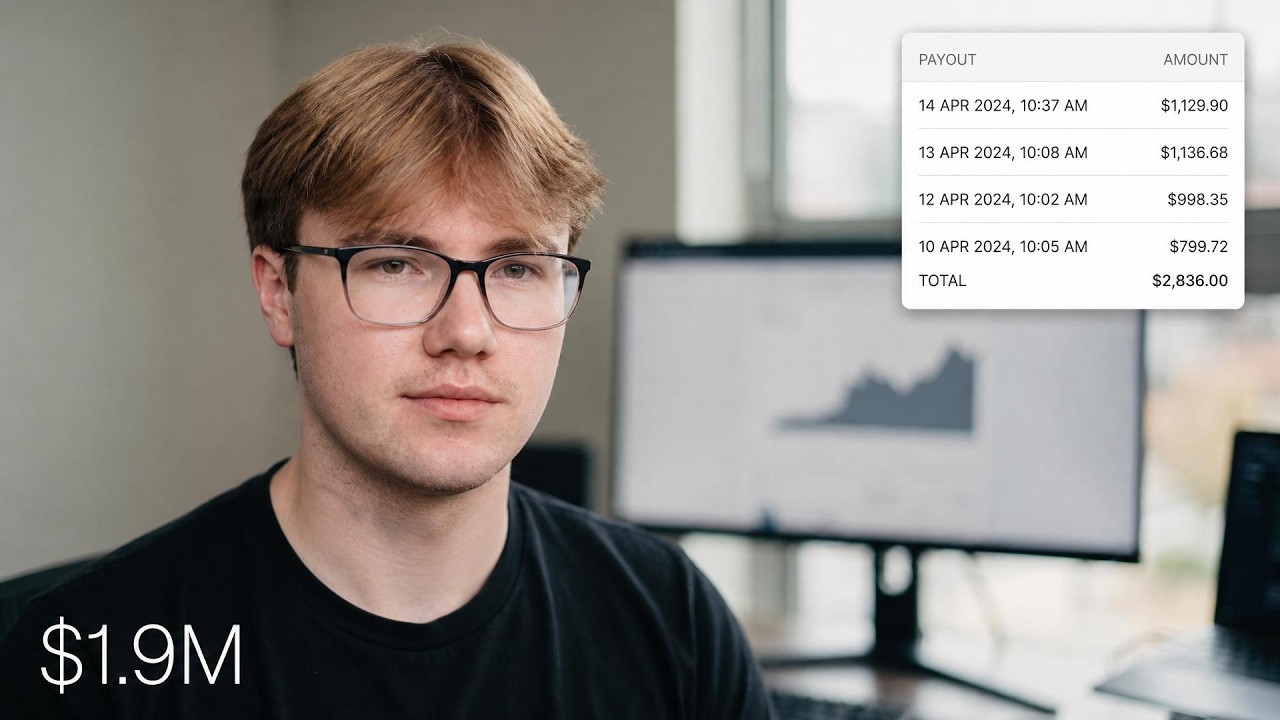
know this, but I give away more free content than anybody else in the trading space. I talk about my strategy, entry, sessions, bias, all of it. Everything that I've done to scale from zero to 1.8 million in profit and payouts, all is on
Speaker A
my channel for free. But the risk management stuff, the dashboard, the optimal sizing for all of those states I just talked about in this video is stuff that you could find. The only problem is it's probably going to take you 2 to 3
Speaker A
years and a degree in quantitative finance just like it took me. So, that is the actual product. If you would like it, if you would like to learn exactly how I trade more in detail, use the dashboard. Then there is a link in the
Speaker A
description to apply to work with me. We have to keep it small or else profits will not exist because the optimal approach cannot go too broad. If not, well, the free stuff is still going to make you better than 90% of the traders
Speaker A
because you're already thinking the right way now. You're already thinking, I have to approach the profits optimally. You could figure it out yourself. All right? Not going to take it away from you. I believe you're smart enough to. You just need to put in the
Speaker A
time and the effort for a few years to be able to do so. And then hopefully profits are still so profitable a few years down the line. Either way, I'm not going to be giving away the one thing
Speaker A
that people pay me for. That is my main mentorship component. That is what the link in the description is for. If not, all good.
Topics:risk managementprop firmsfunded accountstrading strategybacktestingequity curveexpected payoutquantitative financetrade sizingJJ Simon