JJ Simon shares lessons from 7,000+ trades, emphasizing the importance of large sample sizes, managing losing streaks, and optimizing prop firm strategies.
Key Takeaways
- Large sample sizes are essential to accurately evaluate trading strategies.
- Losing streaks are statistically normal and should not cause premature strategy changes.
- Big winners drive profitability in high risk-reward trading approaches.
- Optimizing prop firm selection and risk management maximizes expected value.
- Objective record keeping and external auditing improve trading discipline and results.
What the video covers
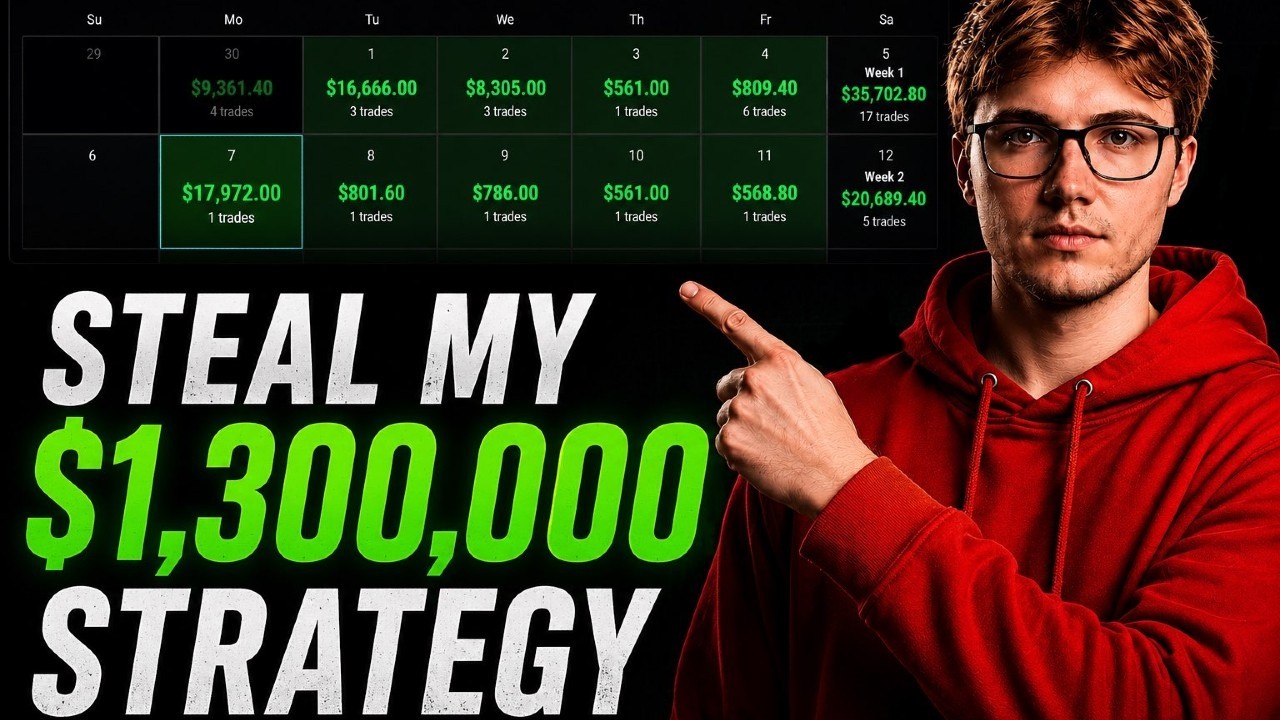
- JJ Simon has taken over 7,000 trades and earned $1.6 million in prop firm payouts over 16 months.
- He stresses that improvement came from trusting large sample sizes, not better market prediction.
- A minimum of 250 trades is needed to properly judge a strategy due to statistical significance.
- Losing streaks are normal and expected; a 50% win rate can still have long losing runs.
- High risk-reward strategies rely on a few big winners to offset many losses.
- Proper risk management and sticking to the strategy during drawdowns are crucial.
- Choosing the right prop firm account depends on the expected value of trades and firm rules.
- Tracking and auditing your trade records objectively is essential to avoid self-deception.
- Different strategies or risk profiles may be needed for evaluation versus funded accounts.
- JJ offers mentorship to help traders apply these principles with proven systems.
Chapters
- 00:00Introduction and Trading Background
- 00:23Lessons from Large Trade Samples
- 00:48News Reversion Strategy and Persistence
- 01:09Statistical Significance and Strategy Testing
- 01:38Understanding Losing Streaks and Risk
- 02:27Account Passing, Payout Rates, and Risk of Ruin
- 03:55High Risk-Reward Trading and Variance
- 05:22Optimizing Prop Firm Selection
- 05:46Importance of Objective Record Keeping
- 06:11Tracking Win Rates and Strategy Adaptation
Full Transcript — Download SRT & Markdown
Speaker A
I've been over $1.6 million worth of prop firm payouts, and I've probably taken more trades than anybody else on YouTube. Twenty trades a day for the last 16 months straight. And here's what's probably going to annoy some of you.
Speaker A
None of what I learned was actually from reading a chart better. I'm honestly not much better at predicting the market than I was 16 months ago. What actually changed is that I stopped trusting small numbers. Every expensive mistake I ever
Speaker A
made was from looking at 10 trades or 30 trades, and then thinking I was doing something wrong from that sample size.
Speaker A
So, here are four things a sample this big teaches you, stuff 100 trades can't.
Speaker A
I'm going to go over all four just in this video. Most people find out about a new strategy, and they're going to try it for maybe four trades. If it loses all four, they're automatically onto the next. How are you supposed to realize
Speaker A
expected value from a positive strategy if you're quitting the instant you see drawdown? Me personally, my first ever attempt at doing a news reversion actually failed, and thankfully, I stuck with it. That is now my most profitable trade. I'm now 100% convinced that news
Speaker A
is priced in every single time, so I'm so excited to revert the initial move.
Speaker A
But, imagine if I had quit when the first one didn't work out. Where would I be right now? Absolutely nowhere near $1.6 million worth of prop firm payouts.
Speaker A
You need a minimum of 250 trades before judging a strategy. And the problem with most strategies is they only give you one entry a day. So, you could have to test it for an entire year before you have statistical significance on if it
Speaker A
works or not. At least with my strategy, I take 20 trades a day. That allows me to determine statistical significance within just one month. But, you don't have to take it from me, you can take it from my results. The strategy works. So,
Speaker A
make sure you're counting your trades before you make an actual view on if the strategy works or not. This leads me into the math behind determining if a strategy works or not. Honestly, it's just the fact that a losing streak will
Speaker A
exist within a strategy. If you just lose five days in a row, you feel like the edge is gone. Now is definitely not the time to switch strategies. It might be time to reconsider if you're actually executing correctly, but definitely not
Speaker A
time enough to deviate from the strategy. [music] For example, if you have a 50% win rate then over 100 trades, your chance of losing four in a row is 91%. Your chance of losing five in a row, 72%, and your chance of losing
Speaker A
six in a row, about 50%. So, if you only have $2,000 worth of drawdown, and you're going to risk maybe 500 per trade, over 100 trades, there's a 91% chance that you'll blow an account. A run of losses is completely normal
Speaker A
within statistical significance, even to the point where you could blow accounts. One time, I even lost 11 times in a row.
Speaker A
That is because my risk to reward was so high that losses are much more likely than wins. So, it is very probable to lose 11 times, even more in a row. But, the most important thing is that I stuck
Speaker A
to the strategy because in example like this, I know I have a bias towards a fair price. If I stop buying as soon as three times loses or as soon as I lose one or two, then I'm not realizing the
Speaker A
end of my bias. Of course, there's times where you do need to cut it because the strategy is not playing out. But, in the long run, according to my strategy, I believe that it's going to revert towards a market open price. That's why
Speaker A
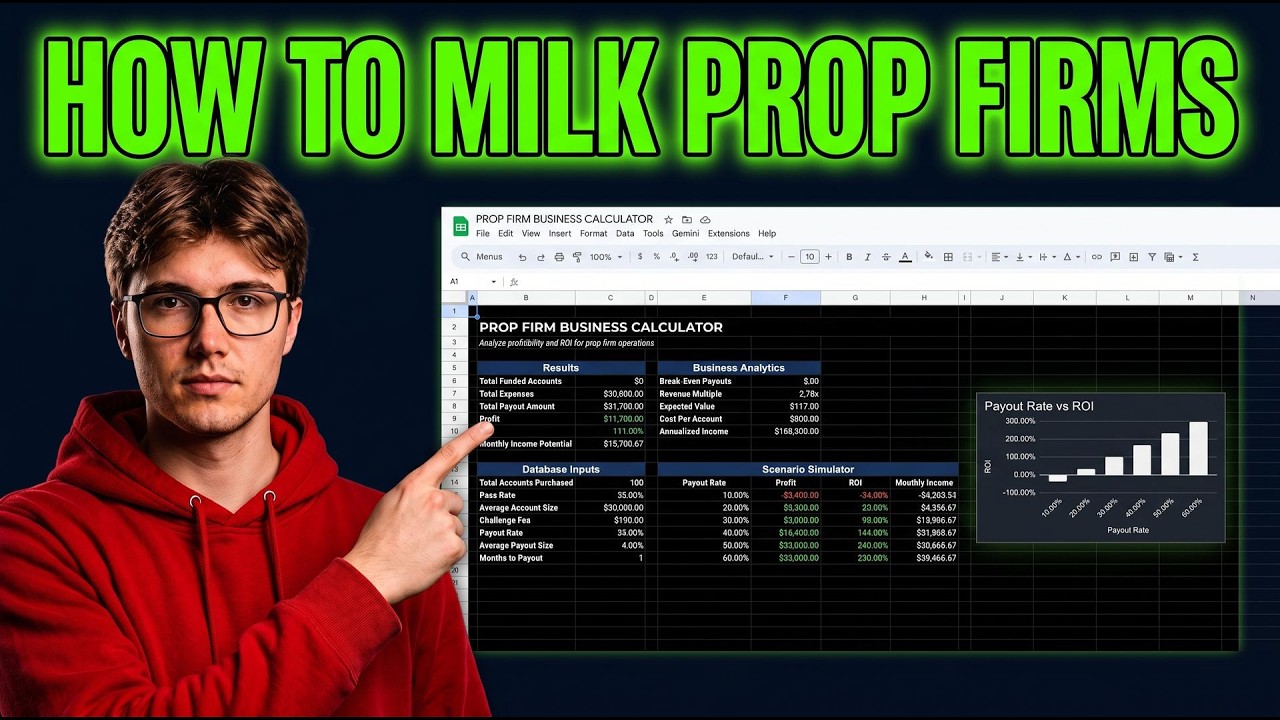
I keep buying off the entry criteria that I get. You also need to think about your loss streak in terms of account passing and account payouts. For example, [music] with a 33% pass rate and a 33% payout rate, your chance of
Speaker A
buying an eval and getting a payout is about 10% chance from said eval. [music] Now, that means you have a 90% chance of getting no payout. If you start with a $1,000 and you buy 10 evals, your chance of failing all 10 evals
Speaker A
[music] is 0.9 to the power of 10, which is about 33%. That means your risk of ruin is 33% on a $1,000 bankroll with these exact payout and [music] pass rate statistics. These could even be extremely profitable payout and pass
Speaker A
rate statistics. For example, if your payout was sized at $4,000, you'd have a 10% chance at making $4,000, which is about $400 worth of expected value for only a $100 eval. So, that means if your bankroll is smaller, you would like to
Speaker A
decrease this number, which means increasing this number, which means increasing this number. So, increase your payout chance or increase your pass rate by being more conservative as your bankroll is smaller. Now that you saw that math, you can see how it's most
Speaker A
important that you stick through it. A losing streak is 100% possible, but now the problem with that is a genuinely good strategy and a genuine bad strategy kind of feel the same when you're executing day in day out just because of
Speaker A
how large your sample size needs to be to determine if there's statistical significance. The only thing that tells strategies apart is the amount of trades that you execute. So, that's it on streaks. The next thing though is the
Speaker A
one that surprised me the most. A majority of the money I make comes from a handful of trades. That's because I trade a high risk and a high reward approach. Everything in the middle of the distribution honestly cancels out
Speaker A
and my big winners must be larger than the big losers. So, from there what I do is I cap the losers and I try to let the winners go as far as possible. Now, the problem with a high risk high reward
Speaker A
approach is obviously variance, but if you don't catch the winners, your sample size is going to be in trouble. If you miss the few, the many are not going to save you. Now, here's a good example. I had a break of structure and a bias at
Speaker A
least back towards this most recent consolidation with VWAP. This trade ended up being a loss or a break even and then the next trade literally just 10 minutes after there was another break of structure and this one could have
Speaker A
been traded all the way back towards VWAP. Just because these high risk high reward trades don't end up winning, obviously you're going to lose a majority of these trades because [music] the risk reward is so large. It's literally four, five, even six R
Speaker A
sometimes. So, expect to lose a majority of trades, but don't lose confidence when they lose. Remember, you're trying to realize your bias. That way, the longer you're in a position and the more often you're in a position, the more
Speaker A
money you're going to make on prop firms. [music] Obviously, only if you have optimal risk management. The whole game behind trading is being there on the chart, being active. So, when the right setup, the right approach, the right risk
Speaker A
reward shows up, you actually capitalize on it and put money in your pocket. So now, I choose a specific prop firm based on what the market is showing me. If there's 150 points in my favor, I need to take it on an account that allows me
Speaker A
to realize the expected value of a 150 point trade. If I do that on an Eval, I'm going to blow through consistency.
Speaker A
If I do it on a funded account, I might get moved to a live account. So, what I do is I optimize based on what the prop firm rules are giving me and I'll take it on a specific account so I can
Speaker A
realize all of that expected value. And that's why the last one matters more than these first three. This is exactly where most people fool themselves. They can't audit their own record correctly and honestly neither could I. Your memory keeps the trades that agree with
Speaker A
you and it deletes the ones that didn't. The only real fix is having someone else look at your numbers, or having someone else plug in a step-by-step system that is proven. That's the whole reason I run a mentorship. There's no application to
Speaker A
get in, and I keep it small. That's you, the link's in the description. If not, no problem. Here's the last one that ties everything together. The recor
Speaker A
trades, but a record does not. That's why it's important to keep one. There's only four main things that you actually need to track when prop firm trading.
Speaker A
First, your eval win rate. You should be trading a different strategy on the evaluation or the funded account. Maybe not a different strategy, but at least a different risk reward, because remember, there's different goals to either of them. But, you need to track your eval
Speaker A
win rate on that specific strategy, which will then give you an eval pass rate. So, if you buy 10, how many out of those do you pass? Once you become funded, track the exact same statistics.
Speaker A
How often are you winning your funded account trades? But then, instead of a just a pass rate, what is your payout rate? From your payout rate, multiplied by your payout size, you can learn about the expected value of your funded
Speaker A
account. It is most important to track your evaluation win rate and your funded account win rate. Those can be applied to different prop firms that have different rules, and you can automatically see if your strategy with your win rate would be profitable on one
Speaker A
of these new prop firm rule sets. Even if you have a large sample size, your memory's going to be skewed. You personally might focus too much on the winning trades, someone else might focus way too much on the losing trades. You
Speaker A
actually need to track your exact statistics. Over the long run, they'll give you a pass rate, they'll give you a payout rate, you can find your expected value, and you can see if the strategy works. Then, you can see if it works on
Speaker A
prop firms. The number of trades I took didn't make me better at predicting the market, it made me better at keeping a record of if my performance was accurate and expected within the strategy's deviations. Almost everybody quits because they can't tell the difference
Speaker A
between bad luck and a bad strategy. Now, to be honest with you, it's one record, it's one trader, and most people lose money when doing it this way. So, that's the four things. Your sample size is too small to make an accurate
Speaker A
decision on if the strategy works. A losing streak is usually just part of the math. A handful of trades carry the entire profitability, and none of it is visible unless you actually track it and write it down. Now, if you want the
Speaker A
setup itself, the exact window I trade, and how everything is built, it's this video on screen right now. Everything I just told you is what the strategy looks like once the sample size is big enough to trust it.
Topics:prop firm tradingtrading strategystatistical significancelosing streaksrisk managementhigh risk rewardtrade evaluationtrading mentorshipexpected valuetrade sample size