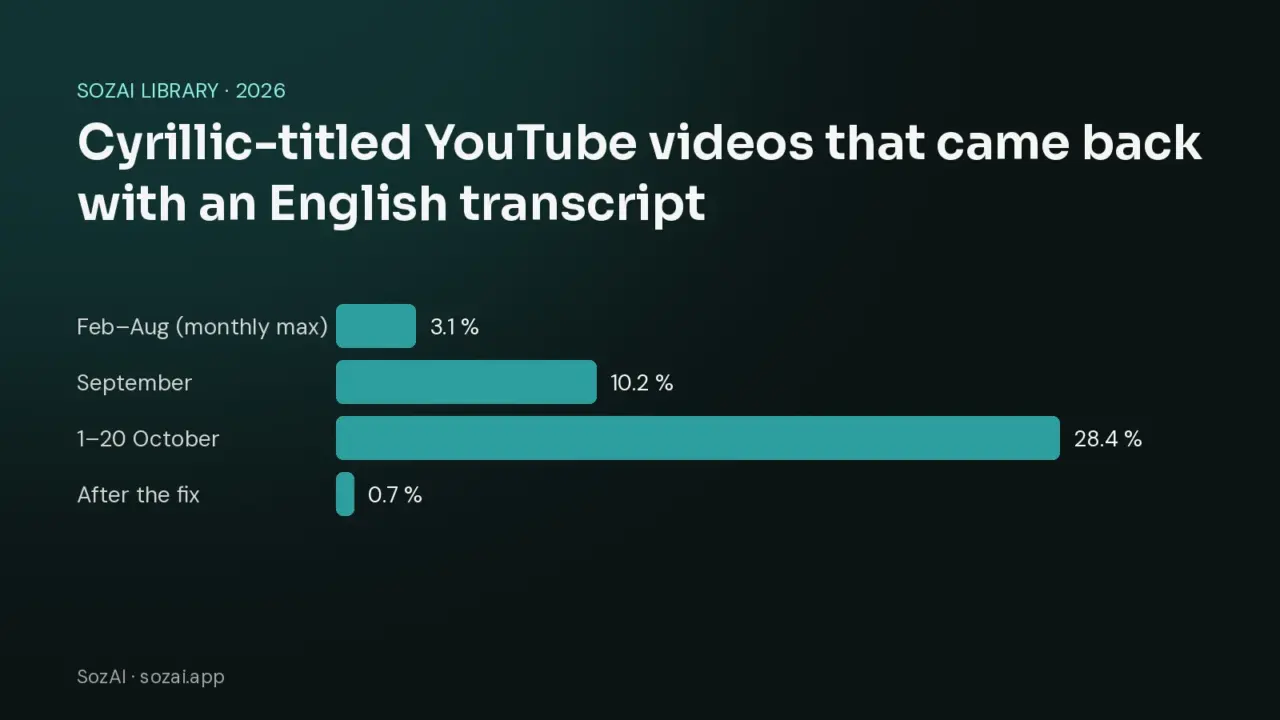
SozAI builds YouTube transcripts from the captions attached to a video, and in the first twenty days of October 2026, 28.4 % of the videos with Russian or other Cyrillic titles came back as English text. The videos were not in English. The cause was an English caption track that YouTube had added next to the original one, combined with a request on our side that never said which language we wanted. This article covers how we found it, how large it was, the cause and the fix.
Data snapshot: 24 October 2026, 05:13 UTC. Fix deployed: 20 October 2026, 13:56 UTC.
One video
On 20 October we checked a Russian-language interview on YouTube whose transcript had come back in English. The video player listed two audio tracks, “Russian (original)” and “English (US)”, and the English one was an automatic dub. The transcript on sozai.app was in English and began “In my opinion, you have a really great product…”. We then asked our captions provider for the same video twice. With no language specified, it returned English. With Russian specified, it returned “У вас, на мой взгляд, реально классный продукт…”, which is the same sentence in the language the speakers actually used.
The Russian captions had been there the whole time. They just were not the track that came back.
How large it was
We grouped every published transcript with a Cyrillic letter in its YouTube title by month. Then we counted how many were labelled English, and checked that against the text itself.
| Period (2026) | Cyrillic-titled transcripts | Labelled English | Share | Text mostly Latin script | Share |
|---|---|---|---|---|---|
| February | 73 | 2 | 2.7 % | 3 | 4.1 % |
| March | 100 | 2 | 2.0 % | 2 | 2.0 % |
| April | 227 | 3 | 1.3 % | 5 | 2.2 % |
| May | 618 | 13 | 2.1 % | 14 | 2.3 % |
| June | 732 | 23 | 3.1 % | 25 | 3.4 % |
| July | 1,096 | 30 | 2.7 % | 38 | 3.5 % |
| August | 1,248 | 28 | 2.2 % | 33 | 2.6 % |
| September | 1,248 | 127 | 10.2 % | 141 | 11.3 % |
| October 1–20, before the fix | 1,543 | 438 | 28.4 % | 459 | 29.7 % |
| October 20–24, after the fix | 283 | 2 | 0.7 % | 2 | 0.7 % |
From February to August the share stayed between 1.3 and 3.1 %. Some of those are real English-language videos with Russian titles. In September it went up to 10 %, and in October to 28 %. Our data shows the jump but not why it happened. We have no record of when YouTube added English tracks to particular videos.
The text check agrees with the labels. Of the 668 Cyrillic-titled transcripts labelled English, 651 have text that is mostly Latin script. Of the 5,758 labelled Russian, 5,751 have mostly Cyrillic text and only 2 are mostly Latin. A wrong label really did mean wrong text, not a tagging slip.
Why it happened
YouTube can add an automatically dubbed audio track in another language to a video. In the case above, a caption track in the dub’s language came with it, so the video offered captions in two languages: the original and the dub.
When a request does not name a language, our captions provider picks one of the tracks on its own. For the video above it picked English; its list of tracks read “en, ru”. Our request did not name a language. Nothing in the reply said “this is a dub”, so we accepted English as the language of the video.
Everything after that step relied on the same label. The page was filed under English, its summary, chapters and questions were written in English, and the address was built from an English title. Each video gets one page that later visitors reuse, so the wrong version was shown to everyone who asked for that video afterwards.
There was a second path that got this right. When we read captions straight from YouTube, the code finds the original language from YouTube’s automatic speech track and picks that. That path works for only a small share of requests from our servers, though, so most transcripts went through the provider.
The fix
YouTube’s Data API reports the original audio language of a video. We were already calling it once per video to get the duration, so asking for the language as well costs nothing extra. The reply is cached for a day. Since 20 October we send that language with every captions request.
We also save four new fields with every transcript: the original audio language according to YouTube, the caption languages the provider offered, the language we asked for, and a mismatch flag. The flag is set when the original language was on offer but the text came back in another language.
After the fix
| Measure, 20–24 October | Value |
|---|---|
| New transcripts with the new fields | 612 |
| Mismatch flag set | 0 |
| Russian-audio videos | 213 |
| Of them, transcript in Russian | 212 |
| Cyrillic-titled transcripts labelled English | 2 of 283 |
In the two remaining Cyrillic-titled cases, the provider had only an English track. That leaves nothing to choose.
The new fields also show how common the extra English track is:
| Original audio (per YouTube) | Videos | With an English caption track | Share | Exactly two tracks, original + English |
|---|---|---|---|---|
| Russian | 213 | 87 | 40.8 % | 82 |
| Ukrainian | 68 | 3 | 4.4 % | 2 |
| Any non-English language | 428 | 145 | 33.9 % | 122 |
Four in ten Russian-language videos requested since the fix carry an English caption track next to the Russian one. Our provider does not say whether a track is an automatic dub or a translation the author uploaded. The pattern of exactly two tracks, the original plus English, fits a single dub. Ukrainian videos almost never had one in this sample.
The four days also turned up a smaller issue in the other direction. In 44 videos, YouTube’s metadata named an audio language that the provider had no captions for. Fifteen were tagged Ukrainian but had only Russian captions. Others were tagged English but had only Arabic, Polish or Spanish captions. The original language was not on offer in those cases, so the provider returned a track in another language. Asking for the original could not change that result.
What we did not change
Pages created before 20 October were not rebuilt. Fetching their captions again would cost a paid request for each one. As of 24 October, 666 published transcripts with Cyrillic titles are still labelled English, out of 6,885 created before the fix. About 260 more have titles in Chinese, Japanese, Korean, Arabic, Thai, Hebrew or Devanagari script and the same label. Some of them may be genuinely English videos. Before September the same check found 1.3 to 3.1 % of Cyrillic-titled videos labelled English each month.
How we counted
- Scope. All transcripts with the status “published” on sozai.app at 05:13 UTC on 24 October 2026, which is 27,852 posts. We used read-only database queries and changed nothing.
- Cyrillic-titled means the YouTube title contains at least one Cyrillic letter. This is a proxy. It includes Ukrainian, Kazakh and Bulgarian videos, as well as English-language videos with Russian titles. The original 28 % was measured the same way on 20 October, over all posts regardless of status, and it gave the same figure.
- Labelled English is the language of the caption track the transcript was built from.
- Text mostly Latin script: in the first 2,000 characters of the transcript, Cyrillic letters make up no more than 20 % of all Cyrillic and Latin letters. We call text “Cyrillic” at 60 % or more.
- Original audio language is the value YouTube reports for the video, reduced to its base code (“pt-BR” becomes “pt”).
- English caption track means “en” appears in the list of caption languages the provider returned. We do not assume anything about which track it would have returned without a language.
- Months follow the publication date in the site’s time zone (London). The fix boundary is the first transcript that has the new fields.
- The post-fix sample covers four days and 612 transcripts. We will repeat the count once a full month has passed.
Related
- YouTube transcript generator — paste a link and get the transcript in the video’s original language.
- What 27,852 YouTube transcripts show — the library these numbers come from.
- About SozAI