Learn how to calculate volumes of solids using triple integrals with detailed examples and integration order strategies.
Key Takeaways
- Triple integrals can be used to calculate volumes of complex solids by integrating the function f(x,y,z) = 1 over the region.
- Determining the correct limits of integration is crucial and often involves analyzing 2D traces of the 3D region.
- The order of integration affects the complexity of the integral and should be chosen based on the given boundaries.
- Geometric intuition can help verify the results of triple integral volume calculations.
- More complex solids require careful setup of integration limits and algebraic manipulation to solve.
What the video covers
- Introduction to using triple integrals to find the volume of solid regions.
- Explanation of the integrand as the constant function f(x,y,z) = 1 for volume calculation.
- Discussion of six possible orders of integration due to three differentials.
- Step-by-step example finding the volume of a solid bounded by planes and coordinate constraints.
- Use of xy, xz, and yz traces to determine limits of integration.
- Integration order chosen based on ease of expressing limits, starting with y in the first example.
- Verification of volume result by comparing with geometric volume of a triangular prism.
- Second example involving a solid bounded by a parabola and planes, demonstrating more complex limits.
- Determination of integration limits and order for the second example (z, y, then x).
- Calculation of the volume using nested integrals and algebraic simplification.
Chapters
- 00:00Introduction to Triple Integrals and Volume
- 00:37Using Triple Integrals to Determine Volume
- 00:55Example 1: Volume of Solid Bounded by Planes
- 02:23Determining Limits of Integration Using Traces
- 03:09Setting Up the Integral and Integration Order
- 03:50Calculating Volume of the Triangular Prism
- 05:24Example 2: Volume Bounded by a Parabola and Planes
- 06:12Determining Limits and Integration Order for Example 2
- 08:12Computing the Volume for Example 2
- 10:31Conclusion and Preview of Part 2
Full Transcript — Download SRT & Markdown
Speaker A
Welcome to the first video on triple integrals and volume. We can determine the volume of a solid region V by using a triple integral over the region V integrated with respect to V.
Speaker A
Which means if we let the integrand equal the most basic function f[x,y,z] equals one and rewrite differential V as dxdydz or some other order of these three differentials and then let the limits of integration represent the solid V,
Speaker A
this will give us the volume of the solid. And this is very similar to how we use a double integral to determine area.
Speaker A
We can now use a triple integral to determine volume. And then remember because there are three differentials, there are six possible orders of integration.
Speaker A
In the intro video for triple integrals, we looked at this definition to evaluate triple integrals.
Speaker A
We're going to use this same principle to determine volume, but f[x,y,z] will equal one.
Speaker A
Let's take a look at an example. Here we're going to determine the volume of the solid bounded by y equals -2x plus four, z equals three with x, y, and z greater than or equal to zero.
Speaker A
So the most challenging part about determining this triple integral is going to be determining the limits of integration with respect to x, y, and z.
Speaker A
And to do that, it's often helpful to first take a look at the xy trace, xz trace, and yz trace.
Speaker A
And this example is pretty straightforward. The xy trace would be when z is equal to zero, so we'd have the equation y equals -2x plus four, so we'd have a y-intercept of four and a slope of -2, so we go down two, right one.
Speaker A
And we also know that x is greater than or equal to zero and y is also greater than or equal to zero.
Speaker A
So the xy trace would be this two-dimensional region here. Now let's take a look at the xz trace.
Speaker A
If we let this equal the z axis and equal the x axis, we'll go through each equation and let y equal zero.
Speaker A
This first equation here for y is equal to zero, we can solve this for x, x would be equal to two, that would be this vertical line here, z equals three would be here, and again because y and z are positive,
Speaker A
this would be the region in the xz plane. And then for the yz trace, if we let this equal the z axis and this equal the y axis, if x is zero we would have y equals four, that would be this line here.
Speaker A
Again, this is the y axis, z is equal to three, and again both y and z are positive, this would be the area of the yz trace.
Speaker A
And these will help us determine the limits of integration. But next we need to decide in which order we want to integrate.
Speaker A
Remember if we integrate first with respect to y, the limits of integration must be in terms of x and z, and since this equation here is already solved for y, we'll start with differential y and the order of the remaining two don't really matter,
Speaker A
let's go ahead and write this as dxdz. So the interval for y will be from zero all the way to this line, which is -2x plus four.
Speaker A
And then for x we'll go from zero all the way to two. And then lastly for z we can look at either of these two traces, z will be from zero all the way to three.
Speaker A
These intervals for y, x, and z form the region V and therefore will give us the volume of the solid.
Speaker A
If we take a look at V in three dimensions, the volume that we're determining will be the volume of this triangular prism here.
Speaker A
So let's go ahead and determine this volume. We'll first integrate with respect to y.
Speaker A
Now we'll evaluate this at the limits of integration. So we'll have -2x plus four minus zero and now we'll go ahead and integrate with respect to x, we'll go ahead and do that on the next slide.
Speaker A
So we'll have -2 times x squared over two, that'll be -x squared plus 4x and then when x is two we're going to have -4 plus 8, that'll be four and then when x is zero they'll both be zero.
Speaker A
And now we'll integrate with respect to z, we'll have 4z, so we'll have four times three, zero, that'll give us 12 cubic units.
Speaker A
Let's go back and take a look at that region in 3D. This distance here was two, this distance here was four, and the height was three.
Speaker A
So if we had a rectangular prism, it would have length times width times height or two times four times three, that would give us 24, and we can see geometrically that the volume that we wanted was half of that, 24 divided by two would be 12 cubic units.
Speaker A
And most of the problems we look at, we won't be able to use one of our basic geometric formulas, but we could have on this one and this does verify your answer.
Speaker A
Let's go ahead and take a look at another one that's a little bit more involved.
Speaker A
We've already determined the volume bounded by these three equations. Let's go ahead and take a look at our traces.
Speaker A
Let's start with the xy trace, so we'll set z equal to zero. Notice if z is equal to zero here we'd have y equals zero, that would be this line here.
Speaker A
Here we have the graph of y equals one minus x squared, that would be a parabola that opens down shifted up one unit so it looks something like this.
Speaker A
So the bounded region in the xy plane is this region here. So this was y equals zero and this was y equals 1 minus x squared.
Speaker A
Let's look at the xz trace now. So we'll call this z and we'll call this x.
Speaker A
So y would be equal to zero. If y is zero we have z equals zero, this line here.
Speaker A
If y is zero here we'd have, if y was equal to zero here we could add x squared to both sides, we'd have x squared equals one so x is equal to plus or minus one.
Speaker A
So we'd have this vertical line here and this vertical line here. And then lastly for the yz trace we set x equal to zero, so we have the line z equals y, that would be this line here, slope of one.
Speaker A
If x equals zero here we'd have y equals one, and this is the y axis here so it'd look like this and again z is equal to zero so we'd have this line here.
Speaker A
So we have this triangular region in the yz plane. So our volume would be equal to the triple integral over the region V with respect to V.
Speaker A
So now we need to determine the order of integration as well as the limits of integration.
Speaker A
This time I think we'll start with integration with respect to z, y, and then x.
Speaker A
So if the limits of integration with respect to z, it must be expressed in terms of y or x.
Speaker A
So let's look at the yz trace. Z is bounded by zero and this line z equals y.
Speaker A
So it will be from zero to y and then for the limits of integration with respect to y let's go ahead and take a look at this first trace.
Speaker A
Y is bounded by zero and this curve which is one minus x squared. So it will be from zero to one minus x squared and then lastly for x, x will be from -1 to +1 as we see here as well as what we see here.
Speaker A
And this triple integral will give us the volume of the solid. Let's go ahead and take a look at that solid.
Speaker A
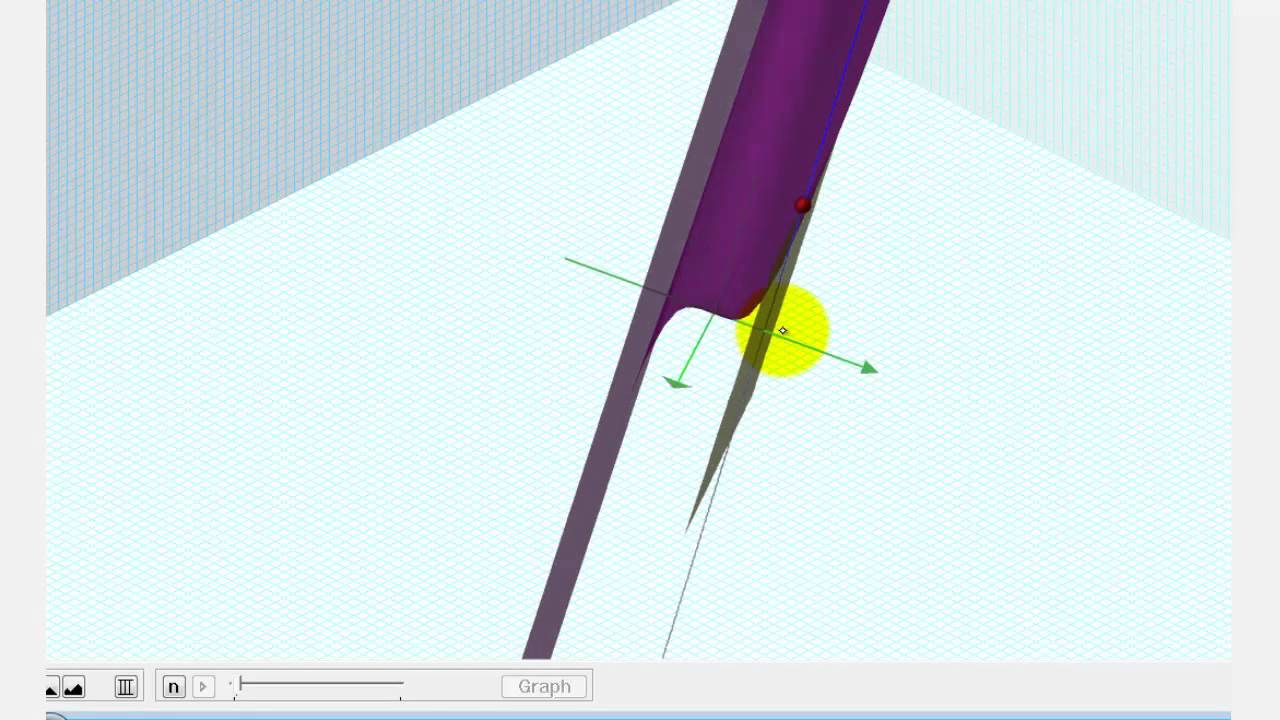
So the volume that we're determining is this region in here and as we angle this you can see each of the traces.
Speaker A
Let's go ahead and find that volume. Let's go ahead and start this on the next slide.
Speaker A
So we're going to go with respect to z first. If we place z with y, that'll give us y and then with zero so we'll just have y and now we'll integrate with respect to y, so we'll have y squared over two or 1/2 y squared
Speaker A
and replace y with 1 minus x squared we have to square this or foil it.
Speaker A
So we're going to have 1/2 and then we'll have times one minus two x squared plus x to the fourth.
Speaker A
And now we'll integrate with respect to x we'll have x minus two times x to the third over three plus x to the fifth over five.
Speaker A
So we'll have 1/2 times x minus 2/3 x cubed plus 1/5 x to the fifth. Let's go ahead and finish this on the next slide.
Speaker A
X is equal to one, we'll have one minus 2/3, that's 1/3 plus 1/5. 1/3 plus 1/5 will give us 18/15 and then when x is -1 we're going to have -1 plus 2/3, it'll be -1/3 plus a -1/5, that'll be -8/15.
Speaker A
So we have 1/2 times this will be 16/15 so we'll have 16/30 which simplifies to 8/15.
Speaker A
And again this gives us the volume of region V. So 8/15 is the volume of this solid region here bounded by this green plane and this blue plane and this gray surface.
Speaker A
We'll take a look at some additional examples in part two.
Topics:triple integralsvolume calculationmultivariable calculusintegration orderlimits of integrationsolid regionvolume of solidscalculus examples3D integrationMathispower4u