Skip to content

I Run 34 AI Agents with a 3-Word Prompt

Greg Isenberg and Alli K. Miller discuss managing AI agent workforces, mindset shifts, and strategies to leverage AI agents for business growth.

Ask about this video. Answers come from its transcript only — with the timestamp, so you can check them.

Generated from the transcript and can be wrong — check the timestamp.

Key Takeaways

  • Managing AI agents should shift from direct control to infrastructure setup and escalation handling.
  • Broad, simple prompts can empower AI agents to act autonomously and creatively within defined risk limits.
  • AI agents can break through human imagination limits by proactively identifying and executing new tasks.
  • Building an AI-native workforce requires rethinking traditional organizational roles and management styles.
  • The integration of AI agents with business systems enables scalable, efficient, and innovative workflows.

What the video covers

  • Discussion on the rise of AI agent workforces with hundreds of agents accomplishing large volumes of work.
  • Alli K. Miller shares insights from her experience managing AI and large teams at IBM and AWS.
  • A key mindset shift is moving away from 'managing' AI agents to setting infrastructure and overseeing critical decisions.
  • The concept of empowering AI agents with broad, flexible prompts like 'do smart things' to increase their autonomy.
  • Comparison of employee types and how the best employees proactively create and execute new tasks, similar to advanced AI agents.
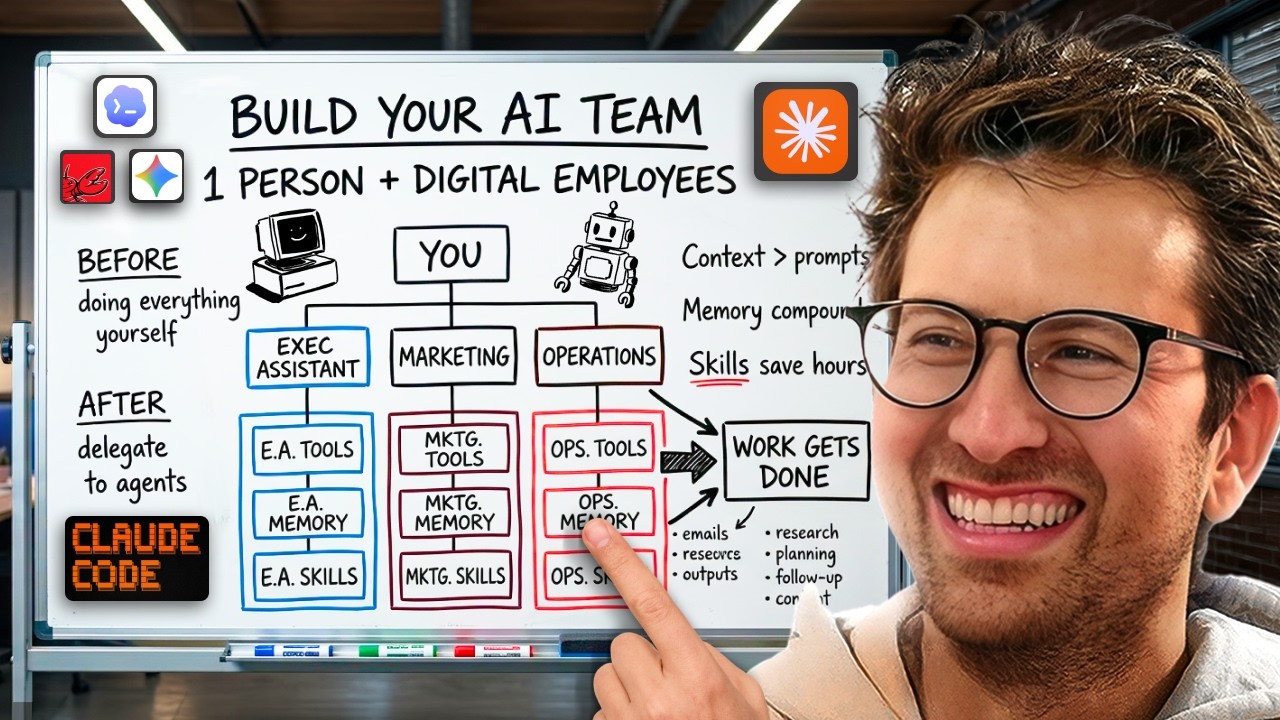
  • Use of AI chief of staff and a fleet of 34 AI agents integrated with multiple business tools for seamless task execution.
  • Discussion on the evolving role of humans in overseeing AI agents, focusing on strategic intervention rather than micromanagement.
  • Exploration of opportunities for startups and businesses to build AI-native workforces without traditional job titles.
  • Examples of AI-driven workflows including automated transcription, social post generation, and personal wiki updates.
  • Future outlook on AI agent workforces as a competitive advantage and the importance of adapting organizational structures.

Answers

Questions about this video

What is the main mindset shift discussed about managing AI agents?

The main mindset shift is moving away from directly managing AI agents like employees to setting up infrastructure and only intervening for critical decisions or escalations.

How does the three-word prompt 'do smart things' work with AI agents?

The prompt gives AI agents broad autonomy to act intelligently across various integrated business contexts, allowing them to proactively identify and execute tasks without detailed instructions.

What advantages do AI agent workforces offer businesses?

AI agent workforces enable scalable, efficient task execution, break through human imagination limits, reduce micromanagement, and open new opportunities for AI-native startups and workflows.

Full Transcript — Download SRT & Markdown

00:00
Speaker A
There are people that are spinning up agent workforces with hundreds of agents and sub-agents, and they're getting incredible amounts of work done.
00:09
Speaker A
But how do you do it? And how should you think about it? And what are the strategies to actually create an AI agent workforce that underpromises and overdelivers?
00:23
Speaker A
Well, today I brought on Alli K. Miller, and she's one of the most well-known AI voices ever. She's worked with IBM. She's worked with AWS. And she's managed multi-billion dollar P&Ls in the AI space.
00:34
Speaker A
I asked her a simple question.
00:47
Speaker A
How do you manage your fleet of agents? In this episode, we cover a lot of ground, but by the end of it, you're going to understand how you should strategically think about spinning up AI agent workforces, where there are
01:01
Speaker A
opportunities to create startups in the B2B space with AI agents, and a lot more. Enjoy the episode, and I'll see you at the end. Today's episode is brought to you by Brex. My company's been on Brex for a year and a half, and I
01:14
Speaker A
started because I kept hearing companies like Verscell, OpenAI, Anthropic were using Brex, and I figured if they're using it, why shouldn't I? It's been a game changer. The thing that got me is how smooth it is. It's got high limit cards.
01:27
Speaker A
It's got banking. It's got AI that handles the back office busy work like expense reports, which I don't want to do on its own. It's really just built for this agentic world. If you're building something new, it's time to get Brex.
01:47
Speaker A
Check it out at brex.com/solutions/startups. Link in the description.
01:55
Speaker A
I can't tell you how excited I am to finally have Alli Miller on the podcast.
02:03
Speaker A
I've been begging her to come on. She's one of my favorite people in AI, and I don't say that lightly. Um, welcome to the show, Alli.
02:17
Speaker A
Thank you, Greg. And you are also one of my favorite people. So, like, I'm actually very excited to talk about all the AI things that we're working on.
02:27
Speaker A
By the end of the episode, what are people going to learn? I hope one of the biggest mindset shifts that I'm going through right now is I feel like the term managing agents is wrong. And my hope is that people
02:42
Speaker A
will understand what that mindset shift is, see a few examples, and figure out how to start, how to make that mindset shift, what the first step should be.
03:01
Speaker A
Okay, perfect. So, where do you want to start? So, this is, and I'm happy to debate you on this because we haven't chatted about this, but I feel like managing agents feels like I am their direct manager, and I'm like, Susie, go
03:15
Speaker A
over there, and Betty, go over there, and Jeremy, go over here, and I feel like I am three rungs above at like an SVP overseeing level where I feel like I am setting up the infrastructure, and then they are figuring out the best way to
03:28
Speaker A
execute within that. Um, and so I feel like I'm moving from managing to like waiting for escalations. Um, or I feel like I'm moving away from delegating and more just deciding what should or shouldn't happen. And so it's a little
03:41
Speaker A
bit more of a liability role where I just get to be the final say of what happens, um, and come in for like critical thinking steps. But does it, like, am I the only one that
03:55
Speaker A
feels like that is happening? I just, it feels like that word is wrong. Like I see managing agents everywhere, and it just feels like anyone that is still talking about you should manage agents feels like early 2026 talk.
04:01
Speaker A
Also, like, do we want to manage agents is also the question. Like managing people’s hard, you know what I mean? Like a big reason I think a lot of people like AI to do stuff for us is so we
04:20
Speaker A
don't have to manage things, you know. So that's something else I've been thinking about.
04:31
Speaker A
Like I ran an org of about 100 people at AWS. The parts of people management that I loved, it was the making them better and empowering the hell out of them and seeing them completely blow past their ceiling, watching them get
04:46
Speaker A
promotions, like that was the fun part. And also seeing what we could do together. Things like, oh, we have to fill out this thing with the paper and the button and like get me out of there.
05:02
Speaker A
So, I think the admin side of people management and the admin side of agent management, I want that fully gone. The things that I love about people, I'm bringing that over into agents, which is just like, how do I act as
05:13
Speaker A
ambitiously as possible and get you to break through your ceiling? And one of the best prompts that I have done with my AI workforce is three words,
05:27
Speaker A
and with like a little bit of explanation, but like at its core, it is three words. That is the best prompt ever. So I have my AI chief of staff, Simon. Simon runs like this whole org. And so I have 34 AI agents that work in this workforce. And it dawned on
05:40
Speaker A
me that I was already functioning at the limit of my own imagination in my business and that I could be doing way more ambitious things if only someone could manage me, right? Like could help me break through my ceiling. And
05:52
Speaker A
obviously I have a lot of mentors, and you're amazing at shaking people up and making me second guess how I'm doing things. It's really helpful. But it dawned on me. I was like, why am I not leaning on the AI
06:09
Speaker A
agents to help me with this? Like why is everything that they're working on initially prompted by me? Even if it's a scheduled task, I still had to come up with that task and tell it to do it.
06:30
Speaker A
So the best prompt, three words, and it's just do smart things. Like my AI workforce has access to every single contact doc. I've got context docs about my business, my friends, family, my 2026 personal goals, business goals.
06:47
Speaker A
It has access to my meeting transcripts, email, calendar, Notion, Stripe, Supabase, GitHub, whatever. And I just several times a day wanted to look across all those things and just do smart things. And seeing how Fable 5 and GPT 5.6, six and that level model is
07:05
Speaker A
reacting to that vague flavor of prompt, like you couldn't do this a year ago. Now you absolutely can. So when you hire a human being, I think there are like three types of employees that you can have. One is someone who
07:19
Speaker A
doesn't complete tasks. Not a good employee if they're not completing tasks. The second is they're completing the tasks, like satisfactory or exceeding, but like they're not really thinking about new tasks. So they're not, you can't just, like, if you step away
07:35
Speaker A
from the business, you're probably not going to see insane growth. And then the best employee that you can possibly hire is doing the task, exceeding expectations on it, but also thinking about new tasks that they should be
07:46
Speaker A
doing and actually going and doing those and exceeding expectations or, you know, or being very satisfactory on that. So what you're saying is basically you're just giving more responsibility to your team of agents. You're giving, in a way, because you're giving these three
08:01
Speaker A
words to it, and you're saying like, hey, I'm shifting the responsibility of, like, you know, do smart things to you. Like you have to, you have to figure out a bunch of fog.
08:10
Speaker A
Yes. I would say I'm giving them more breadth, more scope, more flexibility. I'm not allowing them to now send 100 emails, and before I used to have to check all the emails. I still check all the emails. So the tier of risk has
08:24
Speaker A
stayed the same, but the width has expanded. It's almost unbelievable that those three words actually make a difference.
08:42
Speaker A
Yes. This is like AI, and by the way, so I agree with your assessment on this, like tiers of employees, and Alex Lieberman shared this like pyramid of proactivity that I turned into—I'll send this to you so that you can pull it
08:53
Speaker A
up right now as I'm talking about it, but it is five levels of proactivity, and at level four it's like I've already solved this thing, here are the tradeoffs or whatever, and at level five it's like I've already solved this
09:11
Speaker A
thing. Here's how I'm going to deal with it if it goes wrong. Here's the...
09:22
Speaker A
duplicated in the drive so that all this cloud like workflows can actually work um all of that is so that AI when it is in that expanded scope world and it's taking on net new tasks. It's doing it
09:38
Speaker A
in a goal-oriented way. It's like giving it a product mindset. Like I think it would be extremely limiting if you only treated this thing as an engineer when it could be the greatest product lead you've ever had.
09:50
Speaker A
I think you tweeted about like you're you're like you're really focused on proactive agents, right? Is that what you're talking about? When when you talk about proactive agents, is this what you're talking about?
10:01
Speaker A
So I when you talk to the AI labs and I know you do and I know I do and a bunch of others probably do but the the word of the year feels like it's proactive.
10:10
Speaker A
So I don't want to be the first domino anymore. I don't want to be the bottleneck in my own work. And any single moment that I realize that I am the limiting factor of helping a billion people transform their lives, work and
10:26
Speaker A
business in the AI age, I have to remove myself from the process and go bad alley like what are you doing? [laughter] And so a lot of that um especially in the in the kind of tail end of 2025,
10:39
Speaker A
first half of 2026 was switching into proactive agents. So, we we had proactive automations that were trigger-based. Um, I'll give you a really easy example. Every single time I drop a video recording into our video folder, so basically anytime I do a
10:56
Speaker A
screen recording goes into this one folder and automatically it gets generated um automatically generated is a transcript of that video um that gets you know then saved into our little transcripty thing. Social posts get generated that are in my voice. So, nine
11:12
Speaker A
different social posts get generated for X and LinkedIn and Instagram real scripts and all this stuff. So, that presumably the thing that I was filming was for a social video. Um, so that was easy automation land. But that is just
11:26
Speaker A
one example of like a proactive um very um well-defined workflow. What I think is more interesting for the back half of 2026 is proactive of undefined workflows. So like AI is probabilistic all the time and not deterministic. But
11:47
Speaker A
I want to take that probabilistic nature of reasoning like the step zero of reasoning and apply that to the actual tasks that it takes on. So in order to do that whether you're talking to a human or an agent they have to know
11:59
Speaker A
what's the goal, what's the north star, what's that vision. They have to have access to tools, permission to use these tools in the way that actually gets work off your plate and a sense of what would normally trigger that sort of action.
12:13
Speaker A
So, um, and I can I'm going to share um one [clears throat] thing on on screen here, which is every single day um let me just give me one second. So, essentially like I want my whole company to be queryable. I want AI to have
12:32
Speaker A
context on everything that's happening. And it dawned on me that yes, it had access to all my meeting transcripts and it had access to my Gmail and all this stuff, but there was a lot that was not yet codified and it was things like ah
12:47
Speaker A
everything is becoming proactive. I want to be more proactive or this client, they think that what they need help with is workflows, you know, under the CMO, but actually what they have problems with is reskilling and finding new roles
13:01
Speaker A
for this one department. So anything that is not codified inside of again meetings, emails, whatever or Slack, I have asked AI now to prompt me every single day with this. And you know, I got to put it in my brand colors and I
13:16
Speaker A
didn't want to have to think with, you know, maybe 10% of my brain still working at the end of the day. So I give it like a little prompt. It reminds me to dictate because that's four times faster than writing. And so I will bank
13:28
Speaker A
these entries to be like, you know, I talked to Greg. I feel like the entire focus is on proactive agents, proactivity, um, and flexibility. And I want to look more into his three levels of employees.
13:41
Speaker A
And so like I might do this for 5 minutes or 40 minutes at the end at the end of the day. I might do it throughout the day. And then I just save it out.
13:49
Speaker A
And then it's like it this goes into my personal wiki. And all I want to do is make sure that the agents that are working at that really flexible layer where again I am not managing them. I am
14:06
Speaker A
enabling them and they're coming back to me with those escalations and decisions. I want to make sure that they have the right context or else all their stuff is going to be wrong. And and we saw this in the beginning of our AI workforce
14:18
Speaker A
stuff. It was like, "Oh, I saw that, you know, Greg confirmed that interview." And it's like, "No, Greg confirmed it, but we're still figuring out dates and I'm doing it over text and you know, iMessage MCP broke and so you can't see
14:30
Speaker A
that." So, there was a lot of stuff that we had to continually fix and it took probably months to get to where we are now. But, we have Clawude in every single one of our chat channels. I had a
14:41
Speaker A
very weird I I have to send I have to show you this. Um, let me just share my whole screen. By the way, this so the brain meets diary thing. So when you when you you know you add today well you
14:56
Speaker A
had like 86 entries, right? So your AI agents do all of your does does your entire AI workforce have access to that or just some how do you think about that?
15:08
Speaker A
So great question. Um, essentially my AI workforce right now is one AI chief of staff with six directors. Those directors are largely over like business functions. So, one is education, one is all the client work. Um, one is kind of
15:25
Speaker A
operations, one's marketing, one product, and then Phoebe, all these are named after friends characters. Phoebe is like the chief dreaming officer who's just like being wacky and weird in a corner. Um, and so she's, this is, let me take another just like moment here.
15:41
Speaker A
Um, the reason that it took us months to get to where we are now with our AI workforces is that you have to take stock of what assumptions you have made about your work and how you are living
15:53
Speaker A
day-to-day. And you have to be willing to be like, "Oh, that thing that I've been doing for almost 40 years, I feel like we should change it." And that's a really jarring uh change to work, especially when you've like been an
16:06
Speaker A
overachiever, right? I'm sure you feel this too. And so um one thing that I am constantly having to remind myself is we have all these agents that do all these tasks and we have skills and we have this and that. And I have to remind
16:20
Speaker A
myself that like that is operating in 2015 world if I give all of them job titles that existed in 2015. So if I name them CMO or chief product officer and the person underneath it is a front-end engineer and a back end
16:34
Speaker A
engineer and all this stuff then it feels like I am operating in 2015 org structure and one of the uh most wonderful uses of free will uh and just delightful things is going oh my god all of these employees basically cost zero
16:51
Speaker A
dollars and so at the margin I can hire any flipping person I want to. And so I just wanted this weirdo. So I hired Phoebe as like a weirdo in the corner who's just looking at all these things
17:03
Speaker A
that we're working on. And Phoebe acts as this like almost end layer for things that are getting generated to go like how do we 10x it? Like I um I joke there's this guy David that I worked with at Amazon who was one of the
17:18
Speaker A
reasons that I joined there and he is like one of the most ambitious thinkers I've ever met. And I joked that I would pay him and I still I it's a joke but I I [laughter] would pay him to do this.
17:28
Speaker A
Like um I want I wanted him to put me in a room like Spanish Inquisition Inquisition style with like a bright light on my face and to ask me a question like I was running a multi-billion dollar business at Amazon
17:40
Speaker A
with 400,000 global startups running AI strategy. And if he asked a question of like how would you do this and I answered I wanted him to just slap me across the face and be like how would you 10x that?
17:50
Speaker A
And that [laughter] I want a David um for for how I'm structuring my AI workforce, but I'm now able to do that uh on my own. I'm sure David would be disappointed to hear that, but it it's rethinking roles. It's rethinking how
18:06
Speaker A
you're spending. Um again, how how thinking about that margin. Um and so Phoebe is one of them that I would have never hired in human world. Um and Toby is another one. I'll send you a a screenshot of my workforce, but
18:19
Speaker A
basically Phoebe is that chief training officer and Toby is Simon's assistant whose only job is watching the AI workforce work, take down notes, what still has friction. Um, and who needs access to what? So, going back to your
18:31
Speaker A
point of, hey, I have this AI diary that I'm maintaining. if we found that one agent did not have access to this and Toby was like, "Every single time you keep correcting this one agent's output, have you thought about
18:47
Speaker A
giving your agent access to this?" Now, this is just context that lives on my desktop, so any of these agents can really see it. Um, but if it was a specific tool, um, if it was a specific folder that is outside of normal
19:03
Speaker A
Claudland, um, that I try and have hard rules on, then I would absolutely use AI as a means of figuring out those friction points to then expand. Um, yeah, question on designing your actual workforce. So, I agree by the way. I
19:19
Speaker A
think like um you have to think about like how do you create an uh an AI native workforce like without job titles from pre AI native land. So I agree with that but like tactically if I'm a founder like how do
19:38
Speaker A
I it's so it's so much easier to be like I need a CMO I need a CPO I need this.
19:43
Speaker A
So how and I think everyone should start there. Yeah. I think like the the the starting point is what does it feel like to work with one agent? After that I would say what does it work what does it feel like
19:54
Speaker A
to work with one agent who is doing things on my behalf proactively. Then I would say what does it feel like for two agents to work together on a task or for one to direct the other um like one to
20:04
Speaker A
route to the other. Um, and then then I would say, okay, what does a workforce look like and how do all those things interact and I have, you know, like a mission control where I'm seeing how all this stuff is moving around. And then
20:17
Speaker A
you go, oh, now I understand how they're trading notes. Now I understand how context has passed. Now I understand that things have to run in parallel. Now I have to understand um that that this agent actually didn't need access to
20:30
Speaker A
these tools. Now I understand that that agent can run off of a smaller model.
20:34
Speaker A
like not everything needs opus. All of my, you know, sub aents are like Haiku and Sonnet. So all of that is in the discovery phase of building out the AI workforce. I think start with traditional job titles.
20:44
Speaker A
No, I was just I was thinking to myself like I wish it wasn't that hard, right?
20:47
Speaker A
Cuz like it it it does feel like there's like a ramp up time to actually get to a point where you have an AI workforce that's working for you that is efficient.
21:02
Speaker A
And I think a lot of people the what happens is like they try they fail and they're like this isn't for me or the models aren't good enough yet or and and you know what I mean?
21:13
Speaker A
Yeah. So so here's here's my take on that. Um I think that you can spin up a workforce with one prompt, right? Like I've shared this prompt publicly. Um you can just prompt and say I am a founder.
21:30
Speaker A
I am building an AI personal shopper. My team is three humans. Here's what we do.
21:37
Speaker A
Here's where we're based. Here's our goal. Whatever. You can say that and just say, "Enter me. Um, we're going to build out an AI workforce together.
21:43
Speaker A
Something that runs more efficiently and achieves my goals of saving at least 5 hours a week. Um, capping my my meetings to to 15 hours per week and make sure that I get into my capital raise by October, right? Like you can you can do
21:59
Speaker A
that in one prompt and have it interview you and then you have a workforce.
22:03
Speaker A
To go from ah yes, all these agents exist and they all have markdown files and they're doing some stuff to ooh now it's at the 90% plus level and ooh I needed this extra little context with this diary and that role isn't working.
22:20
Speaker A
I'm going to switch it. That is all going to come through iteration because it's so specific to each person. The advice that I would give is stop relying on only yourself to find these blockers.
22:31
Speaker A
Like AI as a watchdog is one of the best use cases that exists right now and almost no one is doing this. So like having an AI watchdog in Slack to catch for duplicative work or having an AI
22:44
Speaker A
watchdog on your calendar to see when there are conflicts or an AI watchdog over your meetings just to see where disagreement is happening. like 10 years ago, I remember working um this was at a at a large scale enterprise um but we
22:59
Speaker A
were working on like comparing contracts, right? It was like before the edit, after the edit, and it was like compare and contrast with AI. And 10 years ago, that was like the greatest use case ever. And yet, no one today is
23:14
Speaker A
using AI for this like weird cross functional gap analysis um at a more advanced level than we would have done 10 years ago. and it's still just like such a meaty use case. Um, I think cloud tag is a big help here. I think it's a
23:27
Speaker A
mess right now in this exact moment that we're recording this. I think it's a mess to set cloud tag up, but I'm sure it'll be fixed by the time this comes out.
23:34
Speaker A
Um, I've also set up my own cloud code to come in. I have a Slack channel that is called Loop Alley. I'll send you a screenshot of non-private information, but it is called Loop Alley. my freaking human team can talk to my AI workforce
23:51
Speaker A
in that Slack channel. So th there is no ceiling to this stuff. Like I'll have a a teammate who like if I'm in private emails with someone that the teammate will write into the Slack and go, "Hey, did um did that large financial services
24:09
Speaker A
client like did they respond to Alli's email?" and my workforce will respond back to that person and that person will not have to wait for me for five hours to get back to them. So that sort of thing, the the ratcheting up of how
24:23
Speaker A
advanced your AI workforce can be, how multiplayer it is, that's going to take time because people are still figuring out best practices now. Things are not easy to set up right now. But that baseline of, hey, interview me. I want a
24:35
Speaker A
workforce. I want something just doing stuff for me at a high enough level. you can set that up and connect into tools in under three hours.
24:44
Speaker A
The other thing is because a lot of people are not doing it, that's the arbitrage opportunity, you know.
24:50
Speaker A
Yes. So, it's kind of like it's kind of like it's stick through it, optimize it. I'm curious actually from your perspective like um you know what opportunities are you seeing that people could be you know building you know making money type
25:09
Speaker A
that sort of thing. I'm just curious you know what comes up. I think so certainly I think AI workforce first of all like of all AI users if you look at the percentage of people who are paid AI users and if you
25:24
Speaker A
look at the percentage of those who are using things like codeex or claude code it is minuscule. So already if you're just trying to be in the top like 1% of AI users and you're using the stuff and
25:34
Speaker A
you've built out even a basic workforce, you're already top 1%. Probably top 5%. Um getting it to that advanced level I think is absolutely arbitrage because it feels like I'm operating a company of a thousand people and not my small you
25:50
Speaker A
know scrappy gremlin group. Um that is still absolutely one. I think the second that um that I would do is that AI is a watchdog over any single thing that I am normally tracking. So maybe it's and and
26:04
Speaker A
I don't just mean visibility. I think dashboards are dumb, but I want visibility with anomaly detection or insights or something. So don't just tell me what my social media following is or views or whatever. Tell me what are people talking about? What are
26:20
Speaker A
people best reacting to? What is not performing well? What should I do tomorrow? write me a script that helps me for that. So kind of this AI is a watchdog but with insights into action I think is the second and the third that
26:31
Speaker A
very few people are talking about but is probably one of the biggest arbitrage opportunities because of how good the models are now is to instead of building out the thing build the factory for the thing.
26:44
Speaker A
What do you mean by that? So, let's say that you want to build um a product and we just released um there's something called the AI first index that I run with all of my Fortune 500 clients where
26:55
Speaker A
I interview their executives and I evaluate how AI first they are across like 16 different dimensions and all this stuff. And we decided through a combination of humans and AI to create a product um for the public to be able to
27:10
Speaker A
benchmark themselves on how AI first they are as individuals and as a company. In that process, I could have done one of two things. I could have gone to claude code or codeex or anti-gravity or whatever. I could have
27:22
Speaker A
gone to any of these and said, "Hey, I want to build out this thing. Interview me. You know, look at my my um AI first index reports that I've used with previous clients. Um find every single workshop I've ever done with clients
27:35
Speaker A
where I mention the AI first index, whatever. Do that and build out the product and then we iterate for several hours, days, whatever, until something is perfect and we release it." That is option one. Option two is realizing that
27:47
Speaker A
that's probably not going to be the only product you build or will not be the only iteration of that specific product that you build. And so it's it's like going one level up in abstraction. It's like what dev tool companies did for
28:00
Speaker A
engineering, but you're creating dev tools that level for yourself. You're going to like the kernel level for yourself. Um and so you're moving down the stack for yourself. And instead of just building that product, we instead built out a mini and very beginner
28:17
Speaker A
software factory where we're building out primitives like obviously we have to deal with login, obviously we have to deal with payments, obviously we have to deal with social sharing, um we have to deal with writing newsletters to promote
28:30
Speaker A
these things. And so you end up instead of just building that one product, you go ah there's going to be a flywheel that comes out of this. there's going to be explosive opportunities that comes out of this. Why not take advantage of
28:42
Speaker A
that now? And so it's like a measure twice, cut once kind of thing. But the measurement is building out that foundational layer so that the next product that you build, the next um iteration of the AI first index or
28:53
Speaker A
whatever you're building out is so much faster, so much better, so much stronger. Um and so we're we're we're building these like loops, these optimizing loops again that aren't super autonomous and are very heavy-handed with humans.
29:08
Speaker A
But that is the arbitrage opportunity on products that are revenue gen like that's already that product's already profitable.
29:16
Speaker A
And now I have the ability to build endless products that are profitable at faster speeds than I built the first one.
29:24
Speaker A
That's crazy. That's absolutely crazy. And like no one is talking about this. No, it's the it's the the dark headless factory.
29:33
Speaker A
Headless like AI [clears throat] headless, not you know. Um, but that is that's what I want. I want that I I want to learn through the mess. Like we had a web hook issue, whatever. Like I want to
29:43
Speaker A
learn through that mess and then I want to never make that mistake again. And so you're you you have to think about how this factory works. Not just for product building, but you know, maybe it's for how you want to run your content engine.
29:56
Speaker A
Maybe it's how you want to deal with net new leads. like think of the factory behind the one singular task instead of the one singular task itself. That is one of the biggest ways to rethink work in the AIH.
30:10
Speaker A
What's uh what's Ali Miller's current POV on you know software you know the SAS apocalypse and software the value going down down like in a world where everyone could create a software factory. Also, I just I like I
30:28
Speaker A
wish I had an agent that was yelling at me about my posture. So, like maybe I'll I'll create a new [snorts] one for that as I as I realize. Um, SAS Apocalypse, I think mediocre software is dead in
30:40
Speaker A
several years. And the reason that I think it's actually a longer timeline than most people are predicting is because of what I shared about like how often people are actually using this stuff. So you could go into one of the
30:52
Speaker A
most AI first, you know, banks or AI first software companies and if you ask them, have you rebuilt Docusine? Have you rebuilt parts of Salesforce? Have you rebuilt all these things knowing that you can? They would say something
31:06
Speaker A
like, no, because we're already so bandwidth constrained or no because we've prioritized this other thing. Um, as long as we are still bandwidth constrained and as long as there are still billions of people who have not used these sorts of tools, you're not
31:25
Speaker A
going to have mass adoption inside of the enterprise of of the replacement to SAS. Does that make sense? like like if it continues to take I don't know 100 hours or something to rebuild something at the scale of a CRM
31:43
Speaker A
companies that only have people who are sitting there and can work for 100 hours and who know how to do this are going to be able to take advantage of it and it's only going to be when that drops down to
31:51
Speaker A
like under 3 hours and is a fun click and drag interface which I would even argue and say repletable are not at that level yet right for that complexity of software you're not going to see a high complexity enterprisegrade,
32:09
Speaker A
highly secure SAS do that. Also, people don't want to maintain that software too, right?
32:16
Speaker A
Oh my god. People don't people are willing to pay someone else to maintain software.
32:23
Speaker A
Absolutely. I I built an app. This was a year and a half ago or something. I built an app that only lives on my desktop that allows me to like better manage photo stuff and someone yesterday uh brought this up in a call and I was
32:37
Speaker A
like, "Oh my god, I have an app just for this." And then I opened it and it was aired out and I'm like, "I don't want to deal with this right now." Like this is [laughter] not at all what I want to do. So you're
32:46
Speaker A
totally right. The the maintenance is rough. I think like Boris kind of describes one of the like future employee types as just like the maintainer. Um, but I I have a really hard time seeing mass SAS apocalypse until the ease of making, prototyping,
33:06
Speaker A
making, customizing, and maintaining and securing um is is at like 95% plus. I mean, even even in a world where there's the maintainer, if something breaks and you're an enterprise, you want someone to call. You want to go
33:25
Speaker A
into someone's office, right? Like, yes. You also want someone to blame. You want someone to blame. [laughter] Straight up.
33:31
Speaker A
That's an important piece. I think a lot of people are forgetting that like the the question of is AI going to replace this, this, this, whether it's a task, a job, a company, a product, something.
33:41
Speaker A
Um, often I am as the first question I'm asking myself is who's liable now? Who would be liable in that other world? And do I think that that trade-off is worth it right now? Like I work with Fortune
33:53
Speaker A
500 CEOs every single day. They No way. [laughter] No way. They want to be able to call because they want someone to unblock.
34:00
Speaker A
They want someone to secure. The other thing is that um let's say that um let's just say it's a Salesforce example and that you could build a shitty CRM or a simple CRM or something that's just running on your own. Um but Salesforce
34:16
Speaker A
has relationships with all the AI labs. they are, you know, getting into early testing. And so by the time a new model comes out, you are facing it as a day one person, they're facing it as a day
34:30
Speaker A
30 maybe. And so you're also going to be on a very big lag. Um, and so as you're thinking about that cost trade-off, I think in addition to all the things that we just talked about with enterprise grade security and maintaining whatever,
34:41
Speaker A
you just also don't want to experience that lag. like we're moving to a world where being fast to the punch and getting a 30-day, 60-day, 100 day leg up on someone is going to be massive for business.
34:54
Speaker A
What about for consumer? So, like I I get that like an enterprise, you want someone you can speak to and and you want security, but for consumer, it's like like for example, your app idea around, you know, let me know when my
35:07
Speaker A
posture is bad. Yeah. Which I'm just gonna keep [laughter] here. Here, I'll move I'll even move the camera up. Okay.
35:15
Speaker A
By the way, I also have horrible posture. So, okay. Well, then let's build a product using my Yeah, exactly. And and it's like, okay, let's say you build a product and I build a product. It's like of, you know,
35:26
Speaker A
ultimately may the best product win. Um, but like Yeah, hopefully. Hopefully. I I don't think that's ever been the case though.
35:34
Speaker A
That's right. I mean, the best the best songs aren't on the Billboard 100, you know, like in the sense of like the marketing.
35:40
Speaker A
Yeah. the the promotion of a of you know a piece of IP is really what drives a lot of awareness and and but that's also an arbitrage opportunity like you it's almost kind of exciting that it's not only based on code or
35:58
Speaker A
design for who wins. It's like kind of nice to know that if you're someone who's really personable that you can get a leg up if you're able to like open doors that other people can't.
36:08
Speaker A
Exactly. Like on the one hand you could say it's not fair because it's so subjective and on the other hand you could be like oh yeah but if I lack that one skill or if I'm not the best in
36:18
Speaker A
class at that skill and I'm just kind of passing muster on that skill I still have a chance.
36:22
Speaker A
Yeah. Yeah. So I agree. So like when people say just to like sum this up when people say like software is going to zero on the enterprise side we both agree like yeah some software might go to zero but you
36:37
Speaker A
know you want someone that you can speak to. You want security, you want something to maintain it. On the consumer side, um what it feels like it's sort of shifting from science to art. And now the people that are going
36:51
Speaker A
to win are going to be the more creative maybe the video first people, the people that can like understand how to create Instagram reels that a posture app can go viral and the code is actually going to matter a lot less. But the amount of
37:04
Speaker A
opportunity that exists both in enterprise and consumer to me couldn't be higher. Like I so I think a lot of people will say the phrase like look for the bottlenecks and solve the bottlenecks.
37:17
Speaker A
And I always kind of disagreed with or or I don't think it's fully complete.
37:21
Speaker A
The phrase that I say is like look for the bottlenecks then evaluate the value of fixing those bottlenecks and then pick the bottleneck that is high value to fix. M and so if right now the bottleneck is not on writing code and the bottleneck
37:35
Speaker A
is not on coming up with good design but the bottleneck is getting something from a local HTML file into like an actual iOS app then that might be where you spend your time. Or if the bottleneck is that no one's really figured out how to
37:52
Speaker A
get um you know stronger word of mouth and referral codes and like that's still kind of messy. Um and I and I know this as a product maker and adviser whatever like that is still a messy spot. So like
38:06
Speaker A
maybe if you fix that your your uh whatever they call like the the co-variant the word of mouth coariant thing um um could be above one like that is what I would be spending my time on finding the bottlenecks and finding what
38:23
Speaker A
is still high value. I think video creation, no matter how much AI is helping me edit or, you know, edit the script or whatever, it is still a slug to be able to make video. So, that is still a bottleneck and it's very high
38:37
Speaker A
value. Um, but you know, people in the BTOC space, I'm sure, can think of a lot more. I don't know. I just think of like certain BTOC products that I use and I'm like, why did I pick it? Um, I use
38:50
Speaker A
Whisper Flow every single day. I don't like their mobile experience at all, but I still use it. Um, because the value is so high. Have I seen a single video about Whisper? Did I see a single video before I started using it? No. I now see
39:04
Speaker A
them, you know, everywhere. But could it be subconsciously though? You like see their brand places like you might be watching, I don't know, you know, Chris Williamson and then they sponsor Chris Williamson. You kind of you kind of just see it, you know?
39:19
Speaker A
Yeah. I think like influencers still have a ton of sway here. The rise of the B2B influencer, which like I feel like I was one of the first [laughter] and it is it's so amazing to see more people
39:32
Speaker A
creating business content, but that is still a bottleneck um in in building like B2B trust.
39:40
Speaker A
That is a massive bottleneck. And so finding creators that can help you there. Um I think B TOC has a ton of opportunity. I worry um if you look at the YC splits right now um when I was
39:53
Speaker A
working with YC when I was at AWS compared to now the ratio of B2B versus B TOC has skyrocketed like there's just not as many B TOC companies in these incubators getting built. Um you could either say when they're zigging I'm
40:10
Speaker A
zagging and double down and do a B TOC thing like there was this woman who created an app. She's never coded a day in her life. She created an app that takes a few photos of your face and she
40:21
Speaker A
takes that and creates a a model of your face and gives you like aesthetic photos that are like you in a grainy rainy day riding a bicycle or whatever.
40:33
Speaker A
She had 300,000 users out the gate. like there's still a lot of opportunity in B TOC even if the big incubators are seeing that activity less. Um so maybe that's another opportunity for people to explore.
40:50
Speaker A
Well, yeah. And I think like you know we we've been talking a lot about agents and I think there's just an opportunity to create agent first version of some of our favorite apps. you just like look at, you know, a bunch of different BTOC
41:04
Speaker A
apps. Just the go look at century tower.com. Um, not affiliated, but you can just see like what's charting and what are people downloading? And it's like, okay, in a world where super intelligence is now on tap. How can I make an AI native version
41:20
Speaker A
of this? Um, or undercut, you know, from a price perspective or just drive more value.
41:27
Speaker A
like there's ways there's now like opportunity to to to to enter some of these markets.
41:35
Speaker A
I I completely agree with you and I think agent first software is absolutely one um two things that I actually think are really interest or maybe three by the time I get to it but interesting research avenues to learn more
41:48
Speaker A
opportunities like the one you just mentioned. So, one, YC posts uh videos on Instagram for what type of applications they're looking for and agent for software is one of them. So, listening to what YC is asking for, assume that they are already thinking 18
42:08
Speaker A
months out. Um, so that's definitely one arbitrage research opportunity. The second is Matt Van Horn's last 30 days research skill, which is just amazing.
42:19
Speaker A
I've like inner um I've integrated that with my like clawed wiki. Love it. Um and the third is wait can you tell people I've had Matt on I've had Matt on the pod but just quickly like what is it and why why do
42:33
Speaker A
you think it's chef's kiss? So there are a lot of public skills that I think are done by geniuses in their space. one that was kind of first out the gate or one of the first out the gate that is made by a lovely man named
42:46
Speaker A
Matt Van Horn is slashlast30 days and it's on GitHub you can just grab it but it is the ability for AI to figure out today's date scan the news of the last 30 days but scan it in interesting ways
43:00
Speaker A
synthesize it in interesting ways and just fan out crazy amounts of agents in parallel to be able to bring it back to you so as I'm thinking about you know if I'm going into a company and I'm running
43:10
Speaker A
a workshop for their 200 executives. I don't know about the insurance space as well as I should. And so like if I need to quickly get spun up on an industry, I'll use it. Um or quickly get spun up on a specific company, I'll use
43:25
Speaker A
it. So I use it there. But for this in particular, you could just do slast 30 days and then say like startup ideas that could be built by someone with the following background or the following skills or um had the last three jobs of
43:40
Speaker A
this this this like use it in interesting ways to see how you can carve out a new path that people are not doing. Um the third which I have access to and I think there are public avenues to get it um is that I might let's say I
43:57
Speaker A
I am at like a CMO summit and so every single person in the audience is a CMO.
44:02
Speaker A
I can hear the types of questions that they're asking, right? I can hear the the fear zones that they have. I can hear questions that they used to ask 3 years ago and are no longer asking today. And so finding companies, people,
44:18
Speaker A
influencers, creators, Gregs of the world to like follow to hear the inside scoop of what these people are thinking of. Like I can tell you that CMOs, all of them are asking about like how do I get discovered by agents? How what does
44:31
Speaker A
the agent first shopping experience look like? What does brand consideration in the AI age look like? You know, all all of that is being considered right now by CMOs, but it is often coming from a place of fear that they are worried that
44:46
Speaker A
their business is going to be depleted, that their pipeline is going to be crushed in two years if they don't figure it out now. So, figuring out paths to find those fear points would probably be the third.
44:57
Speaker A
I love it. Ally, anything else you wanted to cover? I just want to screen share the insane Claude reaction because this um and this is me also cursing at Claude, but whatever.
45:13
Speaker A
So, I wrote I wrote um a a not super I wrote a not super nice thing about Claude in one of our Slack channels [laughter] and this was like late at night and I was just like getting it out there so I
45:25
Speaker A
could talk with my team about it later and all of a sudden there was an emoji reaction of a salute and I was like I don't think a single person on my team has ever used a salute and I hovered
45:36
Speaker A
over it and it was clawed. I was like [laughter] what are you doing? And so I wrote back to it. you just, you know, emoji react like is that you and Cloud was like, "Yep, that was me. I'm here." And I
45:52
Speaker A
just, if there's one thing that I want people to to think about, it is the leaning into the weirdness of what it looks like to have not just an AI workforce, but to have a multiplayer AI workforce that other
46:09
Speaker A
humans can chime in on. and have it be proactive, right? That is absolutely the second thing and giving it that flexibility to more roam free. Um, and the third is what it actually looks like for a teammate or a system to uplevel
46:27
Speaker A
whether that's in dark factory type space or just answering better questions inside of Slack. Those are the things that I would be considering. And don't be scared like me if Claude emoji reacts to a lot [laughter] of your messages.
46:42
Speaker A
Yeah. I mean it's you know what that is like? It's kind of like um you know it's a winter day in New York City and for some reason it's like middle of February and all of a sudden it it it feels like summer like
46:57
Speaker A
you know this like random hot days and you're like this is amazing and you're like 90% excited but like 10% frightened cuz you're like it's not supposed to be it's not supposed to be so hot now. That was
47:07
Speaker A
analogies are always so you're like a genius with analogies. Yes. That's what it's like. It's like you're and that's 90% cool but 10% frightening.
47:18
Speaker A
Yes. Yes. I'm like I'm like still going to continue to try and lean into that weirdness and find ways that I can like take that weirdness and use it to my advantage.
47:29
Speaker A
Um but I'm going to keep that fear next [laughter] to me so that I don't lose my mind.
47:35
Speaker A
100%. Yeah. Uh I hope people enjoyed this episode as much as I did. Ally, I absolutely love chatting with you. You're one of my favorite people to talk to. Please comment on YouTube to let just to just to hype Ally up, honestly, and have her
47:51
Speaker A
hopefully come back on the podcast again. Uh Ally is a mustf follow. I'll include where you can follow her on her uh socials in the show notes and the description.
48:04
Speaker A
Yeah, Greg, thank you so much for having me. I my hope is that every single person got the tactical things that they need to just like immediately immediately take action on this. If anything was not clear, let me know. I
48:16
Speaker A
am going to like jump on and help people. Um and Greg, I will absolutely come back. You are one of my favorite favorite creators. You can always call me.
48:24
Speaker A
I appreciate it, Ally. I'll see you next time. Sounds good. Bye.
Topics:AI agentsagent workforceAI managementAI automationbusiness AIAI startupsGreg IsenbergAlli K. MillerAI productivityAI strategy

Get More with the SozAI App

Transcribe recordings, audio files, and YouTube videos — with AI summaries, speaker detection, and unlimited transcriptions.

Or transcribe another YouTube video here →