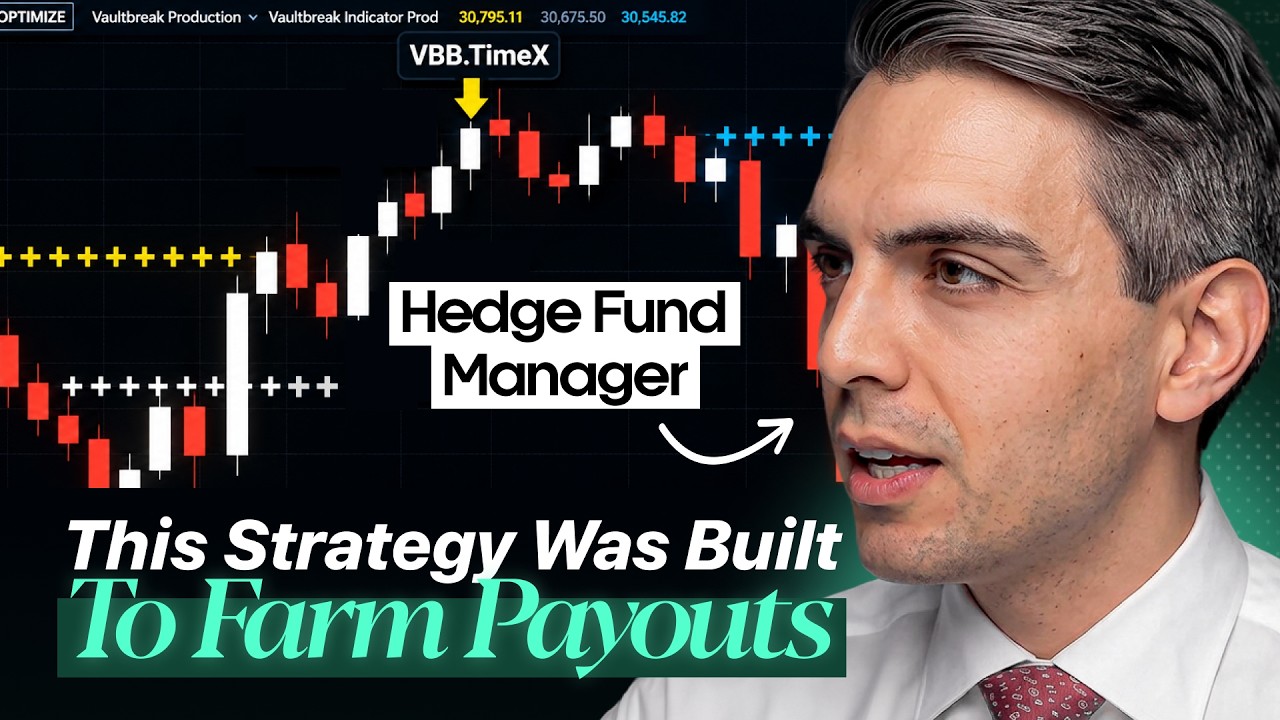
Matteo Conti reveals a high-probability VWAP trading strategy designed to pass prop firm challenges with a 93.6% success rate.
Ask about this video. Answers come from its transcript only — with the timestamp, so you can check them.
Generated from the transcript and can be wrong — check the timestamp.
Key Takeaways
- Focus on building and testing profitable trading strategies over many trades rather than chasing single trades.
- VWAP combined with market microstructure insights can reveal institutional buying/selling pressure.
- Systematic strategies can significantly increase the probability of passing prop firm challenges.
- Backtesting and simulation are essential steps to confirm a strategy's edge and avoid overfitting.
- Discipline and risk management, such as limiting losses per day, are crucial for long-term success.
What the video covers
- Matteo Conti, a 7-year market maker and CIO at SQR Capital, shares a systematic VWAP strategy called the drift VWAP pullback.
- The strategy was tested on over 4,000 trades and produced over 300% returns historically.
- It exploits institutional execution algorithms to detect buying and selling imbalances in the market.
- The approach is designed specifically to maximize the probability of passing prop firm funding challenges.
- The strategy has a 64% profitability rate and a 93.6% simulated chance of getting funded within four attempts.
- Matteo emphasizes the difference between retail traders focusing on individual trades versus institutions focusing on profitable strategies over many trades.
- Backtesting and simulations are critical to validating the strategy's edge and profitability.
- The video includes a live chart walkthrough using Nasdaq 100 futures on multiple timeframes with VWAP indicators.
- Risk management rules include stopping trading after two consecutive losses in a day.
- Matteo discusses avoiding overfitting by using optimal parameters and running simulations on unseen data.
Chapters
- 00:00Introduction to Matteo Conti and VWAP Strategy Overview
- 02:50Matteo's Institutional Trading Philosophy vs Retail Trading
- 05:03Importance of Backtesting and Simulations
- 06:52Live Chart Walkthrough: Nasdaq 100 Futures and VWAP Setup
- 09:49Strategy Mechanics and Market Microstructure Explanation
- 12:55Risk Management and Trade Execution Rules
- 16:54Avoiding Overfitting and Parameter Optimization
- 30:54Final Thoughts and Summary of Strategy Benefits
Full Transcript — Download SRT & Markdown
Speaker A
This is Mattio Conti. He's a 7-year market maker, member of World-Class Edge, and chief investment officer at SQR Capital, a quantitative hedge fund. But I brought him in to answer one question: How would a quant hedge fund exploit the mathematics of prop firms? His answer was a systematic VWAP strategy he built that produced over 300% across more than 4,000 trades in historical testing.
Speaker A
prop firms? His answer was a systematic VWAP strategy he built that produced over 300% across more than 4,000 trades in historical testing.
Speaker A
This one strategy that I would run is what I call the drift VWAP pullback. And this is a very simple long-short strategy. Like, the reason why this strategy is extremely good for prop firms is this number right here. So, this strategy's profitability rate is 64%. But VWAP alone isn't the real edge.
Speaker A
this strategy uh profitability rate, which is of 64%. But VWAP alone isn't the real edge.
Speaker A
Mattio specifically built this strategy around the execution algorithms used inside banks and brokerages, using what he learned as a market maker to identify when institutional buying and selling pressure exposes itself. And by identifying this exact edge, he built a strategy with a simulated 93.6% chance of getting funded within only four attempts. The imbalance between the amount of algorithms that are selling and the amount of algorithms that are buying gets actually revealed, and you have these sharp movements both on the downside or the upside. And this is what we are trying to exploit right here. We are trying to exploit exactly this behavior. By the time you use this exact same strategy within four challenges, you have a 93.6% chance of passing at least one. And that's why the people I work with, the people in my community, they call it the prop firm golden ticket because if you change—
Speaker A
strategy with a simulated 93.6% chance of getting funded within only four attempts. The imbalance between uh the amount of algorithms that are selling and amount of algorithms that are buying gets actually revealed and you have like these sharp movements both
Speaker A
In this episode, Matteo reveals the exact day trading VWAP strategy his community calls the prop firm golden ticket live on the chart and exposes the number one discipline that separates decent traders from great ones. Nothing in this video is financial advice. We're here to study how one of the most sophisticated traders we've ever interviewed actually executes. Now, let's see what Matteo is made of.
Speaker A
of passing at least one. And that's why the the people I work with, the people in my community, they call it prop firm golden ticket because if you change In this episode, Matteo reveals the exact day trading VWAP strategy his
Speaker A
Matteo, you spent years as a market maker at Nordea Markets, and today you run systematic strategies at SQR Capital. Obviously, this is institutional experience that goes well beyond almost every guest I've had here. Now, what did this experience teach you about trading profitably that most retail traders fundamentally misunderstand?
Speaker A
ever interviewed actually executes. Now, let's see what Matteo is made of. Matteo, you spent years as a market maker at Nordea Markets and today you run systematic strategies at SQR Capital. Obviously, this is institutional experience that goes well
Speaker A
Yeah. First of all, thank you so much for having me here. It is truly a pleasure. Like, every time that someone gives me a platform to talk about this, I find it extremely exciting.
Speaker A
Yeah. First of all, thank you so much for having me here. It is truly a pleasure. Like every time that someone gives me a platform to talk about this, I find it extremely exciting.
Speaker A
And the biggest misconception is that people are obsessed looking after trades. They want to find the next trade, and they want that next trade to be profitable. On the other hand, institutional traders are obsessed going after profitable trading strategies. This is the whole difference between institutional trading and retail trading. So, fundamentally then, focusing on a profitable strategy would be thinking over hundreds and hundreds and hundreds of trades over years, potentially, instead of looking for the next big setup, right?
Speaker A
strategies. This is the whole difference between institutional trading and retail trading. So, fundamentally then focusing on a profitable strategy would be thinking over hundreds and hundreds and hundreds of trades over years potentially instead of looking for the next big setup,
Speaker A
So, this kind of brings us into then, Matteo, how do you know that a strategy is actually profitable or has an edge?
Speaker A
Yeah, you need to test. And this is one of the steps that retail traders often skips because trading is actually about getting an idea around your trading strategy. It's about gathering data.
Speaker A
Yeah, you need to test. And this is one of the steps that retail traders often skip because trading is actually about getting an idea around your trading strategy. It's about gathering data. It's about encoding your trading strategy and then applying that piece of code to historical data so that you can do your backtest, checking if in the past that strategy is profitable, and afterwards running simulations.
Speaker A
Simulations that give you the confidence that the strategy is truly profitable and can make you money in the future.
Speaker A
Simulations that give you the confidence that the strategy is truly profitable and can make you money in the future.
Speaker A
Yeah, and to some degree because like one thing that I want to bring you here given the fact that it's like uh um um it's not that we want to have a strategy that is necessary going to make
Speaker A
Okay, so I want to unpack all of this later in specific, and specifically when we get on the chart, you'll be able to show us an example of this approach when we get on the chart, right?
Speaker A
Excellent, Matteo. Thank you so much. I want to keep talking about this, but I think that we should get on the chart and see exactly how we can step into this arena that, you know, you've been trading in now for a while. So, if you
Speaker A
Yeah, and to some degree, because like one thing that I want to bring you here, given the fact that it's like, um, it's not that we want to have a strategy that is necessarily going to make you money with your own capital, and we are in a prop firm context. I decided to bring something here, a strategy that maximizes the probabilities of actually getting funded, of passing a prop firm challenge.
Speaker A
100% Matteo, we're on the chart. This looks like multi-charts, which is a very sophisticated piece of software. But what exactly are you looking at here?
Speaker A
Excellent, Matteo. Thank you so much. I want to keep talking about this, but I think that we should get on the chart and see exactly how we can step into this arena that, you know, you've been trading in now for a while. So, if you don't mind, if you want to share your screen, let's see what you got.
Speaker A
And here is Nasdaq 100 futures using a 50-minute time frame. But then, let me give you a little bit of context because mhm the strategy that I want to bring here answers the question that I've been getting so many times. Like uh many
Speaker A
100%. Matteo, we're on the chart. This looks like MultiCharts, which is a very sophisticated piece of software. But what exactly are you looking at here?
Speaker A
the answer to that question. Um this one strategy that I would run is what I call the drift VWAP pullback.
Speaker A
So, right here, I just loaded two graphs. One is Nasdaq 100 futures using a 5-minute time frame.
Speaker A
Well, I'm excited to see it. I mean, I had no clue that this is what we we were going to do. So, please continue.
Speaker A
And here is Nasdaq 100 futures using a 50-minute time frame. But then, let me give you a little bit of context because, hmm, the strategy that I want to bring here answers the question that I've been getting so many times. Like, many people, many retail traders have been asking me, "Hmm, you as an institutional trader, what is that one strategy that you would run to pass prop firm challenges?" And that's what I want to bring here on this platform today. The answer to that question.
Speaker A
prop firm golden tickets and you will shortly see why. Um the beauty of this strategy as I say is like is extremely simple. And it has its foundation on the behavior of execution traders inside banks and brokerage.
Speaker A
This one strategy that I would run is what I call the drift VWAP pullback.
Speaker A
appealing for for this case. To trade it, we need to load the 5-minute charts of Nasdaq 100 futures, and we need to load the 15-minute chart of Nasdaq 100 futures as well. The third component, given especially the name of
Speaker A
And this is a very simple long-short strategy which I specifically designed to pass prop firm challenges.
Speaker A
[snorts] The VWAP, this specific VWAP, this specific VWAP displayed here, it is a VWAP based on the 15-minute chart, yet displayed on the top of the 5-minutes. And this is why we loaded both the historical time series.
Speaker A
Well, I'm excited to see it. I mean, I had no clue that this is what we were going to do. So, please continue.
Speaker A
Weighted by the volume. So, it's like um the price where the largest amount of money actually changed hands. Do you follow so far?
Speaker A
Yeah, okay. And specifically, this strategy has been used by many people that are followed, like young retail traders, to actually get funded. And they're getting so many good results that actually we call it a prop firm golden ticket, and you will shortly see why. The beauty of this strategy, as I say, is it is extremely simple. And it has its foundation on the behavior of execution traders inside banks and brokerage.
Speaker A
And the job of the execution trader is just taking the orders from the portfolio manager, which is the fund manager, the hedge fund manager, the actual person that is managing the capital, and executing their trades.
Speaker A
Hmm. So, like the why, the why this strategy that I'm going to show you is actually working, and it has like it is rooted in actual market microstructure. And that's what makes it look quite interesting and quite appealing for this case. To trade it, we need to load the 5-minute charts of Nasdaq 100 futures, and we need to load the 15-minute chart of Nasdaq 100 futures as well. The third component, given especially the name of the drift VWAP pullback, what we need to add is the VWAP, which you will see appearing on our charts right here.
Speaker A
Mhm, this this behavior, the fact that so many execution traders are using this specific algorithm, has a very important consequence. So, when the price pulls back towards the VWAP, there is a very intense trading activity of these execution algorithms.
Speaker A
The VWAP, this specific VWAP displayed here, it is a VWAP based on the 15-minute chart, yet displayed on the top of the 5-minute chart. And this is why we loaded both the historical time series.
Speaker A
the opposite, if we have like a pullback towards the VWAP, yet the buyers are in control, there is going to be a pushback uh on the upside. So, on a very high level, what this strategy is doing and
Speaker A
First of all, we need to give some information as well, like what is the VWAP and why it matters. The VWAP is the average price of everything traded up to that specific point, weighted by the volume. So, it's like the price where the largest amount of money actually changed hands. Do you follow so far?
Speaker A
selling pressure, so uh negative drift or a positive drift, and that's what is defined in this indicator with the red uh crosses versus the green crosses. And then once you have this pullback towards the VWAP, then if is from the upside,
Speaker A
Yes.
Speaker A
If we need to put it down in just one sentence, it waits the uh for the 15-minutes charts to show a clear established move in one direction.
Speaker A
Yeah, and why it is relevant. Not sure if you're aware, but inside banks and brokerage houses, there is a figure called the execution trader.
Speaker A
And then we buy or we sell at the first pullback towards the uh VWAP price. If again is from the lower side to uh towards the higher side, and we have this uh pullback, we go short. On the other
Speaker A
And the job of the execution trader is just taking the orders from the portfolio manager, which is the fund manager, the hedge fund manager, the actual person that is managing the capital, and executing their trades.
Speaker A
These pullbacks and bounces off the VWAP, what is the exact mechanic going on there? Right when price hits VWAP and then bounces off of it, what is the mechanic?
Speaker A
Ninety to ninety-five percent of these orders are executed using VWAP execution algorithms. So, algorithms that are targeting the execution around the VWAP.
Speaker A
closer to the VWAP, right? And that's why like it here around these points where we are closer to the VWAP, the imbalance between the amount of algorithms that are selling and the amount of algorithms that are buying gets actually revealed
Speaker A
Hmm, this behavior, the fact that so many execution traders are using this specific algorithm, has a very important consequence. So, when the price pulls back towards the VWAP, there is a very intense trading activity of these execution algorithms.
Speaker A
Now that we understand the philosophy and the why, are we able to systematically define an exact entry point in inside of this model? And how would you do that?
Speaker A
And this activity—
Speaker A
And the three conditions that must be true to answer the question yes or no are going to be if we take like for the long side first. Let's take the long.
Speaker A
For the long, we need to have the uh price above the VWAP. Condition number one. Condition number two, we need to have the VWAP that is rising over the past 15 minutes.
Speaker A
So that's why like when the cross is green, means that the VWAP from the past 15 minutes is increasing and that's uh condition number two. And condition number three is that over the past 1 hour the NQ price increased
Speaker A
at least 0. 1%. And these are the three conditions to that give tell us is there a positive trend, is there a drift that we should pay attention to. This one for the long.
Speaker A
Equally like for the short it's going to be short. So, price below the VWAP, VWAP falling over the past 15 minutes, and over the past 1 hour the price of NQ decreased at least 0.1%. Let's change color to
Speaker A
red. And that These are basically like just the condition that are telling us, "Okay, are we in this downtrend? Are we in on this uptrend?" And uh many of these, apart from the third one of the condition of the increase over
Speaker A
the past uh 4 15-minute bar, which is 1 hour, and needs to be higher of 0.1% or um smaller than minus 0.1%, like are all identified with these VWAP.
Speaker A
And an additional very important rule is that on the first hour, so from 9:30 Eastern Time to 10:30 Eastern Time, we are not going to trade because we want to give the market time to give us levels for the VWAP. We need to
Speaker A
understand where is the money that actually exchange uh hands over the past first hour.
Speaker A
Um say that once we identify the trend, so let's say it's after half past 10 here, we wait so they trigger our trade.
Speaker A
We call it trigger. It's going to be the first So, the trigger for the longs first um red candle towards the VWAP.
Speaker A
So, as we have a as we have a red candle that pulls towards the VWAP, then we open our long position. And as opposite for the shorts, first green candle after all the three conditions have been satisfied, the three condition that
Speaker A
we've seen. Real quick, for this long or this short, is this going to be on a limit order at the VWAP or at the close of the candle?
Speaker A
At the At the it's going to be at the opening of the next candle. So, you as the candle closes, you send a market order.
Speaker A
Excellent. Please continue. So, this one is going to be our trigger. Once we have the pullback, the first pullback, it doesn't matter how close it is to the VWAP. As we have the pullback, we try to get the short. Uh about risk
Speaker A
management and exit conditions, this is Before we get there, I do have to have have to ask you this for the audience.
Speaker A
Sure. These These three rules, right, and then the trigger. How did you come up with this as being a a good rule set to follow? Why these three specific rules?
Speaker A
Ever thought about getting into prop trading? Perfect timing. Right now, we have a huge offer for you. You can grab a 50K futures challenge for just nine bucks. Or if that's still too much, the 10K crypto challenge for only a single
Speaker A
dollar. Links in the description. And now, back to the video. Because these three specific rules, they give you the level, they give you the direction, and they give you the speed.
Speaker A
That's why I want that the three of them are going to be satisfied at the same time. And obviously, like again, I've been a market maker for 7 years, so like I do have a lot of understanding and
Speaker A
knowledge behind of how things works, especially with the execution of view up. And I know that for these specific pullbacks, if we are below if the price closes often below the view up, um there is the present of high uh selling
Speaker A
activity. Uh if um mm the view up keeps decreasing, means that we have a clear drift on the price. And uh obviously, like what is like uh the 0.1%?
Speaker A
Uh it has been defined doing doing an optimization in our in-sample data. We will get there as well to talk about it, because like uh this specific strategy has been developed using data between 2020 to 2024. And this uh 0.1%
Speaker A
was the um optimal parameters uh minimizing the risk of over fitting uh to to run this specific strategy. That's how you get them.
Speaker A
You do have supporting data then for this model? And if you do, we'll talk about it later. We'll get into the exits first. But I just wanted to clarify if if there was.
Speaker A
Yeah, yeah. Yeah, the uh this strategy has been developed using an in-sample data, as I said, between 2020 and 2024.
Speaker A
And uh it has been used over the past 6 months to pass many prop firm challenges. And we will get there as well why this one is so good to pass prop firm challenges. And the answer is behind the data. It's like
Speaker A
it's a strategy that really fits well the mathematics of prop firms. It's exciting stuff if you're a nerd like me.
Speaker A
[snorts] Okay, please. Let's Let's go over exits and risk management. Yes, sir. And about the exits, um we we left like for the longs or risk management. So, for the long we will put at risk 80 points to make
Speaker A
40 points. So, as you can see is a very low reward to risk ratio. And for the shorts, we have at risk 80 points to make for 50 points.
Speaker A
So, here as well we have a negative RR, as the retail traders say. Um so, and let's uh Let's This one is going to be our conditions to open and close a day position. And lastly, we have importance
Speaker A
uh guardrails. Cuz we need to have the last set of rules to make this strategy properly systematic, properly mechanical.
Speaker A
So guardrails. And these are one position at a time. Max four trades a day.
Speaker A
Max two losses a day. So, if you have two consecutive trades that are losing trades for the day, we stop trading it.
Speaker A
[snorts] And um, um, no new trades after 3:30 p.m. Eastern time. And uh, close all position at 3:55 p.m. Eastern time. So, before regular trading hours closes. And this is the last set of rules that we really want to
Speaker A
include. Um, the maximum two losses a day, maximum four trades a day is because uh, it's very hard to snipe what is the exact moment that it will revert or like when you will have this pullback. And if number four, like in
Speaker A
sample, again, during the development process of this strategy was showing that was the optimal um, number of trades to maximize the probabilities of passing a proper challenge. If we get uh, let's now um, get uh, the strategy in place like because one
Speaker A
thing that is very important is like the fact that we set all these rules this clearly allow us to translate the strategy on a piece of code. This is so much key because at that point we translate the strategy in the piece of
Speaker A
code, we can apply it to our data. In this case, I will only have uh, trading one single trade. So, like a maximum trade per day I put one, so we start seeing on a visual point of view how one
Speaker A
trade will look. And if we open the list of trades, let's take someone. So, here you can see that we have this positive drift.
Speaker A
So, we have the price above the view up price. Uh we have the VWAP that is increasing, right? So, over the past 15 minutes, it has been increasing. And we have the price of the underlying asset, so of um
Speaker A
NASDAQ that over the past hour increased more than 0.1%. So, all we did here was waiting for the pullback towards the VWAP and opening a long at the at the beginning of this opening of this bar.
Speaker A
And this one ended up in the in the money. If we Again, this one is like all the trades are applied over the our entire period because we encoded our strategy. So, it's not that we are backtesting manually like I've seen them
Speaker A
doing it online. But, this is one of the advantages of coding everything. So, as you can see here, it's well.
Speaker A
So, we have a negative trend, right? We have the VWAP that is decreasing. And here we have a very tiny pullback.
Speaker A
But, it is a positive pullback because it's the first positive bar. So, we open the short position and ended up in the money. So, this one is like how it works how it looks visually. And it should give you a good grasp of this
Speaker A
concept of like we get the pullback towards the VWAP. Then, if all the three conditions are met, we open the short or we open the long and we let the computer doing this magic. As I was saying, the optimal number of trades or maximum
Speaker A
number of trades is four. So, let's change that parameters and let's apply. Here we have four trades in this consecutively, where we have like three wins and one loss. So, and the the beauty is that now we can have a look at
Speaker A
how this strategy performed over the entire period. And this is the performance. This is the equity curve of this strategy since 2021. And as I said, like this strategy has been developed only using data up to 2024. So, like from 2024 to yesterday,
Speaker A
the second of August 2026, all of these is completely out of sample performance. Um so, it's not a matter of overfitting and the entire strategy. And uh I Matteo, why you make that point right there though? In sample, out of sample,
Speaker A
overfitting. I know there's going to be a lot of people watching who don't understand those three. Now, we could talk about it for 2 hours, but if you had to simply break it down, why is overfitting bad and why do you need to
Speaker A
test in sample and out of sample? Yeah, so overfitting is bad because can fool you making you think that you have the best strategy in the world, like you have an equity curve that is a straight line that just keeps rising. When
Speaker A
actually, the reason why you have that performance is because you added too many rules, too many conditions, and you over optimized your parameters. So, you cherry picked the values of your inputs, like what is the best take profit level,
Speaker A
what is the best stop loss level that I should use to make this strategy looks very good in the past. But all it does overfitting is like making your strategy look in the past, but once you run it on unseen
Speaker A
data, the strategy gets completely destroyed. Um on the other hand, if you take your data and you split your data, let's say we have data from 2021 to 2026, we split the data exactly in the middle, and we only do the research.
Speaker A
Like we add the our conditions. We change the parameters only on the first half. And then like we apply the parameters that we defined on the first half frozen in time on all the unseen data. And then we check what is
Speaker A
the performance. And in this case like we applied the we did this research on data until 2024. We applied this the same inputs from 2024 to 2025. Back then was and was looking at good performance.
Speaker A
Great. Uprising in sample, uprising out of sample. The probability that we are over fitting are little. This is the very first check that you should do in your development process. But say that like the reason why this strategy is extremely good for prop
Speaker A
firms is this number right here. So this strategy has a profitability rate which is of 64%.
Speaker A
Which is extremely high. And it is extremely high on the back obviously of the fact that we have a low reward to risk ratio. But even though this strategy has a very little average trade. So if you try to
Speaker A
apply this strategy on a private account on running it with your own money, this strategy is unlikely that it's going to make you money with your own capital. Yet the fact that it has as an average winning rate when it is
Speaker A
right 866, and when it loses 1,300, yet on the back of a 65% profitability rate, this strategy makes it extremely good to pass prop firm challenges.
Speaker A
It's not Matteo that is just saying that, but is uh um is uh statistics and he's running simulations on the back of this data.
Speaker A
Because what you can do is downloading all the trades since 2020, 2021 and feed them to a um piece of code to to Python where you code that uh model to run simulations, understand what is the actual probability of passing a prop
Speaker A
firm challenge. And this is what I did and this is what I'm going to show you on um right now. [clears throat] And here it is. Here is like what I did was just taking all the trades that you have
Speaker A
just seen. I wrote a small piece of code on Python to run 20,000 simulations and give me as a feedback what is the actual probability that I pass a prop firm challenge using this specific strategy.
Speaker A
And uh the single passing rate of any single prop firm challenge of this strategy is 50% or 49.8% meaning that if you take uh one prop firm challenge and you run this exact set of rules, you have a 50%
Speaker A
probability of passing it with an average time to pass of approximately 3 days. Where it gets interesting though is that yes, using one contract of NQ or 10 micro NQs, um you have a pass rate of 49.8%.
Speaker A
You have an average days to pass 3.4, so you are way within the limits of the 20 trading days. And um um what makes it interesting is that if you only take one challenge and you apply this specific strategy, you have a 49.8%
Speaker A
probability. But you have a 74.8% to pass a prop firm challenge within two attempts. And a 87.3% to pass at least one challenge within three attempts.
Speaker A
By the time you use this exact same strategy within four challenges, you have a 93.6% of passing at least one. And that's why the people I work with, the people in my community, they call it the prop firm golden ticket. Because if you
Speaker A
change the way you approach with prop firm and you start looking at at it like as a business almost, you know that now, let's say each prop firm challenge costs $50.
Speaker A
Now you're spending at maximum $200, you are almost guaranteed with a 93.6% to get funded on at least one of those accounts. And once you're funded, you will need to look for a strategy which maximizes the probabilities to get
Speaker A
a payout. And that one is going to be a conversation maybe on the next interview.
Speaker A
So so Mateo, let me clarify for the audience. You know, there's a lot of hoopla in the trading scene and people think there's like 90% win rates with like 10 to one reward risks. This doesn't happen. So if on your first
Speaker A
challenge, you theoretically have a 50/50 chance using a strategy, that is very that is very very good because I have the numbers, I've seen it all.
Speaker A
Way less than 50% of people pass a challenge. It's beautiful. I love it. Trust me, I want to sit here and nerd out about it with you. This is the stuff I do, too, but so before we jump off the
Speaker A
chart Matteo I Yes, sir. I want to make it clear to the audience, a lot of this is going to be beyond what they are naturally capable of doing.
Speaker A
So, is this strategy able to be traded manually, or would you not recommend that?
Speaker A
The issue of trading manually is that you really need to be very diligent, but um if you want to trade it manually, you can just still have it encoded and waiting for the trigger. That's how I would do it. Like in the in any case,
Speaker A
like you have the trigger, you say, "Okay, I trade it." And then you enter your trade manually. Trying to beat there to eyeball it, it might work, it might not work, but you don't have the confidence of knowing that your strategy is going
Speaker A
to have 50% probability of passing you the challenge. And that's what automation really gives you. This is the big advantage of like saying, "I have it encoded at least then." If you want to trade it manually on the
Speaker A
back of the signal that you receive from your machine, that's already one step forward that virtually any retail trader in 2026 can actually achieve.
Speaker A
Um if you go a little bit further and you manage to even automate the entire full process, it's not that you're going to run one strategy, you're going to run a set of three, four trading strategies that will
Speaker A
help you to make you money either on a prop firm context or with your own capital. And that's where you really start growing as a trader.
Speaker A
So, Matteo, before we jump off the chart, if you're going to take this seriously, trading in general or a strategy like this, you should start working yourself up to being able to automate.
Speaker A
100%, but that's the trend. We will like as as retail traders understand that it makes no sense that you have a computer in front of you and you're leveraging the hell out of it.
Speaker A
Like as people understand that that with few lines of code you can actually you're able to have your computer trading for you. You might be at work when US market opens and still having your your your prop firm challenge to be passed like it's
Speaker A
going to be uh life-changing not just from a financial point of view, but like from literally like a way of trading for many many people.
Speaker A
[snorts] And I have a one of the first guys that started following me on social media that this guy blew up like 47 prop firm challenges. And I was like, "Dude, I I cannot pass. It's impossible that I pass." And we started using this
Speaker A
approach of like, "Let's find a strategy that statistically is going to make you pass. Automate it and like not only was able to pass his first prop firm challenge with using this method, but he passed it while he was at work. And I was like
Speaker A
that one was the thing that was was blowing up his mind. He was like, "I was spending 10 hours a day on front of the screen waiting for my entry conditions to be fulfilled." And the actual prop firm challenge that I passed was while I
Speaker A
was at work and having my computer trading for me. Because the job of the institutional trader is 90% is research, development, and validation. 10% is monitoring risk and performance of your computer trading for you.
Speaker A
Michio, thank you so much. Let's jump off the chart. I feel like me and you could sit here and talk for probably 8 hours, but let's jump off the Let's jump off the chart and I'm going to ask you just a couple
Speaker A
more questions before we wrap it up here. Thank you so much for showing a validated system. The cumulative probability over time of passing a challenge while using this system as well as in sample out of sample performance metrics and things of this
Speaker A
nature. Audience will surely highly appreciate it. So, Mateusz, if someone understood everything we just talked about in this interview and started applying it, what could still prevent them from being profitable or passing challenges?
Speaker A
You need to have the control over the thinking that you know better than all the research that you have done before trading. Because once let's say you spend 10 hours developing one trading strategy, you find a trading strategy
Speaker A
that looks profitable, looks like it's going to make you money, then you automate it, then you really need to stay away from the urge of thinking you can do a better job. I can move this take profit. I can move this stop loss.
Speaker A
I can add this extra trade that will get a better result. No, you really did the work before. Right now you have your system trading for you. Just trust the work that you have done before. And that urge of like wanting to intervene,
Speaker A
wanting to I think I can do better, that is something that you really need to have under control and you need to respect uh the the the machine uh to some degree. And that's why it's the hard part of systematic trading. That is
Speaker A
the hard part of quantitative trading. That is the hard part of this mechanical and institutional trading. It has a whole like trust the research that you put down.
Speaker A
You did a good job. You know what you're doing. Trust it and have let the computer trading for you.
Speaker A
For anyone that comes straight out of this video and goes, "I'm going to automate." and they run their strategy, how do they know if the strategy is deployed and it starts doing bad? If it's just normal drawdown or regular
Speaker A
variance in the return structure or if they actually messed something up and the strategy is overfit, it it's garbage.
Speaker A
Yeah. Yeah, that's that's what the Monte Carlo is used for because Monte Carlo, when you run the simulation, gives you yardsticks. Like gives you, okay, you have only a 5% probability of get drawdown larger than $10,000 over 10 trades. So, obviously, if you
Speaker A
have a drawdown that is $5,000, all good. It is within the expected parameters. But if you have a drawdown of $15,000 over 10 trades, then you know that you have less than 5% probability of getting that type of drawdown, and
Speaker A
you know that you need to stop the strategy. So, you have yardsticks that you get from the validation phase of all your trading strategies, and they really that is what really give you the confidence of even knowing, okay, I know
Speaker A
that everything is within expected parameters, I don't need to be worried about it. On the other hand, once it gets outside the expected parameters, you need to be more cautious and you're like, okay, let's stop. Here, I it up.
Speaker A
Cannot run it live. Let's remove it. And that's like a skill that you always obviously you acquire over time, but it's pure like following a specific process, following a specific protocol. It's like it's nothing fancy, you just need to know
Speaker A
which are the steps that you need to follow between idea generation [snorts] to deployment. And once you deploy, what you need to do to monitor performance or risk.
Speaker A
Matteo, is there any part of trading that you think should stay discretionary? It really depends. Like some parts like even let let's put it this way. Like let's say there is you want to keep being a discretionary trader. Completely cool.
Speaker A
But knowing how to test what you're doing can only add you value. Like it's not that you need necessarily automate every single thing that you do. But for example, let's say you want to test a discretionary strategy. Cool. Like try
Speaker A
to simplify it in a way that you can test and you can at least see if you have a positive drift in the past if you apply those type of set of rules. That can only add you value. That's why it's
Speaker A
a skill set that every single modern trader should have. No matter if you want to trade manually, no matter if you're discretionary trading, there no matter if you want to automate 100% your trading process. And that's why it is important.
Speaker A
It's like it's a skill set that you get, you make it yours, and how to use it if you want to use it to just do some validation, if you want to use it to just do some optimization because like
Speaker A
yes, you usually have a tick profit at 20 points, but you're wondering, "Okay, but what if all the trades that I took over the past 5 years, I used 100 points, what would be my performance?" So really can can use it to extract
Speaker A
insights that you wouldn't be able to get otherwise. Matteo, is there any final piece of advice you'd like to leave for anyone watching that might be struggling trading?
Speaker A
If you don't know what you're doing, don't trade. If you want if if if you want to trade, first test what you're doing, understand if you are likely or not to make money with the strategy you're applying, and
Speaker A
once you find validated statistical evidence, that's the moment that you deploy capital. Matteo, thank you so much for coming on, showing the data, showing a validated strategy, the prop firm Golden Ticket.
Speaker A
I appreciate you coming on and it was an absolute great time. Thank you so much, brother. And uh let's do that again.
Speaker A
IQ Capital, built by traders, for traders. You can start your first challenge for as little as $1. Check the link in the description below. Terms and conditions do apply. Thank you so much for watching. We'll see you in the next
Speaker A
one.
Topics:VWAP strategyprop firm challengemarket makerquantitative tradingsystematic tradingbacktestingNasdaq 100 futuresprop firm fundingtrading disciplinerisk management