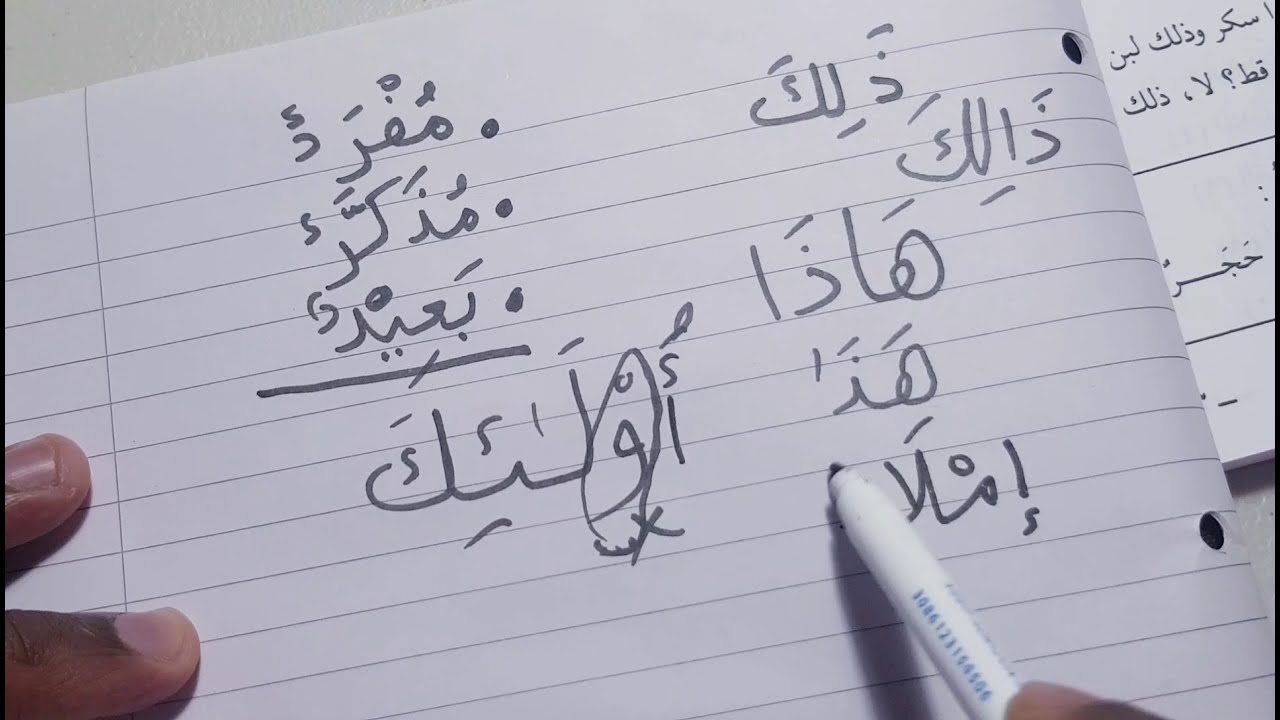
Madinah Arabic course | Book 1 – LESSON 1 (part 3) — Transcript

Learn basic Arabic question words and vocabulary in Madinah Arabic Course Book 1, Lesson 1 Part 3, focusing on 'ma', 'man', and Hamza usage.

Key Takeaways

  • 'Ma' means 'what' and is used to ask about objects or animals without intellect.
  • 'Man' means 'who' and is used to ask about people or beings with intellect.
  • Hamza at the start of a statement turns it into a yes/no question.
  • Vocabulary learning is integrated with question formation practice.
  • Proper pronunciation and differentiation of similar sounding words is important.

Summary

  • Review of homework exercises involving identifying objects and answering questions using 'ma' and Hamza.
  • Explanation of the difference between 'ma' (what) and Hamza for forming questions about objects.
  • Introduction of the question word 'man' meaning 'who', used for asking about people or beings with intellect.
  • Practice sentences using 'man hadha' (who is this) and 'ma hadha' (what is this) with vocabulary words.
  • Vocabulary introduced includes words for key, book, pen, door, house, chair, mosque, doctor, boy, student, man, merchant, dog, cat, donkey, horse, camel, rooster, and teacher.
  • Clarification on pronunciation differences, e.g., kalbun (dog) vs qalb (heart).
  • Emphasis on using 'man' for people and 'ma' for objects or animals without intellect.
  • Repeated practice of new vocabulary with meaning and pronunciation drills.
  • Encouragement to neatly complete homework in a dedicated notebook.
  • Combination of question words and vocabulary to build foundational Arabic language skills.

Full Transcript — Download SRT & Markdown

00:12
Speaker A
بسم الله الرحمن الرحيم، الحمد لله حمدا كثيرا طيبا مباركا فيه كما يحب ربنا ويرضاه.
00:20
Speaker A
This is part three, and inshallah the final part of lesson one.
00:24
Speaker A
Last lesson we set out, we set three pieces of homework which were related to what we took in our last lesson.
00:33
Speaker A
The first homework was to answer these questions referring to the pictures, what is this, and then you look at the picture and you answer it, and there's six questions on this page, and we promised that at the beginning of this lesson we're going to go over this homework.
00:52
Speaker A
So let's do that now.
02:36
Speaker A
طيب the first one, ما هذا؟
02:40
Speaker A
It's referring to a key.
02:43
Speaker A
And say this is a key.
03:49
Speaker A
هذا مفتاح. This is a key.
03:53
Speaker A
The next question is referring to a book.
03:59
Speaker A
A book.
04:17
Speaker A
هذا كتاب.
04:20
Speaker A
This is a book.
04:22
Speaker A
The next question is referring to a pen.
05:21
Speaker A
هذا قلم. This is a pen.
05:24
Speaker A
The next question is referring to a door.
05:40
Speaker A
This is a door.
05:45
Speaker A
The next question is referring to a house.
06:40
Speaker A
This is a house.
06:42
Speaker A
And the last question on that page is a chair.
07:05
Speaker A
This is exercise number one.
07:11
Speaker A
The second exercise we have one, two, three, four, four questions on the page.
07:20
Speaker A
And these questions have been put using the Hamza, whereas in the first page we had six questions which was put using ma.
07:37
Speaker A
I'm explaining last lesson that ma is where the questioner does not know what he is referring to, he wants you to tell him what that thing is, whereas a, when you ask with Hamza, the person has an idea, he just needs the answer, the one who is answering to confirm or negate.
08:42
Speaker A
Okay, so I'm going to write the first one, a hadha baitun.
09:10
Speaker A
Is this a house?
09:12
Speaker A
Let's look at the picture.
09:13
Speaker A
Is this a house?
09:15
Speaker A
No, this is not a house.
09:18
Speaker A
This is a mosque.
09:20
Speaker A
So I would say no.
10:29
Speaker A
No, this is a mosque.
10:34
Speaker A
Next question, is this a key?
10:39
Speaker A
The answer is no.
10:40
Speaker A
This is a pen.
12:09
Speaker A
This is a pen. Next question, is this a shirt?
12:16
Speaker A
Is this a shirt?
13:14
Speaker A
Yes.
13:38
Speaker A
This is a shirt. Next question, is this a star?
14:00
Speaker A
Yes.
15:06
Speaker A
This is the second exercise.
15:10
Speaker A
The final exercise is a reading and writing exercise.
15:16
Speaker A
This is the first sentence.
15:37
Speaker A
This is a desk.
15:41
Speaker A
Next one, this is a mosque.
16:40
Speaker A
This is a mosque. Next one, this is a pen.
17:01
Speaker A
This is a pen. Next one, this is a bed.
17:23
Speaker A
This is a bed.
17:27
Speaker A
The next one is a question.
17:30
Speaker A
What is this?
18:21
Speaker A
What is this? The next one is a statement.
18:26
Speaker A
This is a chair.
18:46
Speaker A
This is a chair.
18:48
Speaker A
The next one is a question.
18:51
Speaker A
Is this a house?
19:08
Speaker A
Is this a house? The next one, no, this is a mosque.
20:16
Speaker A
This is a mosque. The final one, what is this?
20:22
Speaker A
This is a key.
20:54
Speaker A
So this is what everyone should have inshallah.
20:57
Speaker A
The three pieces of homework.
21:39
Speaker A
And this is how the homework should be done neatly in the notebook.
21:44
Speaker A
Whoever homework you have, you should try and do it on a separate notebook.
21:48
Speaker A
Okay, let's begin today's class.
21:50
Speaker A
As for today's class, then we learn another tool for asking questions, another tool for asking questions, and that is this word, man.
22:11
Speaker A
What does man mean?
22:13
Speaker B
Who.
22:14
Speaker A
Okay, let's say it five times.
22:16
Speaker A
Man.
22:25
Speaker A
What does man mean?
22:26
Speaker B
Who.
22:27
Speaker A
Man hadha, who is this?
22:29
Speaker A
What does man hadha mean?
22:31
Speaker B
Who is this?
22:32
Speaker A
Who is this?
22:33
Speaker B
Who is this?
22:34
Speaker A
Man hadha means who is this?
22:36
Speaker A
So what's the difference between man and ma?
22:38
Speaker B
Ma means what?
22:40
Speaker A
What is this?
22:41
Speaker B
Yeah.
22:42
Speaker B
And man is who?
22:43
Speaker A
Who is this?
22:44
Speaker B
Who is this?
22:45
Speaker A
Man hadha means who is this?
22:47
Speaker A
Ma hadha means what is this?
22:52
Speaker A
So you use ma to ask about anything which has no intellect.
22:59
Speaker A
And you use man to ask about people.
23:03
Speaker A
Because people have intellect.
23:06
Speaker A
Or anything that has intellect, or anyone that has intellect, you ask using man.
23:13
Speaker A
Who is this?
23:14
Speaker A
Do I say man hadha if I'm talking about a qalam?
23:20
Speaker B
No.
23:21
Speaker A
No, because qalam, pen has no intellect.
23:26
Speaker A
It's an object.
23:27
Speaker A
Okay, so we've learned three things so far to ask questions.
23:30
Speaker A
We've learned ma, which means what.
23:32
Speaker A
And we've learned Hamza.
23:35
Speaker A
What's Hamza?
23:36
Speaker A
It turns a statement into a question.
23:40
Speaker A
Hamza, when you bring Hamza at the start, it turns a statement into a question.
23:45
Speaker A
This is a masjid.
23:48
Speaker A
This is a masjid.
23:50
Speaker A
What does that mean?
23:52
Speaker A
Is this a masjid?
23:53
Speaker A
So the third one is man.
23:56
Speaker A
What does man mean?
23:57
Speaker B
Who.
23:58
Speaker A
And you use it to ask about people.
24:00
Speaker A
Man hadha.
24:02
Speaker A
What does that mean?
24:03
Speaker B
Who is this?
24:04
Speaker A
Who is this?
24:05
Speaker B
Who is this?
24:06
Speaker A
Okay, let's read.
24:08
Speaker A
This is a doctor.
25:26
Speaker A
What's tabib?
25:27
Speaker B
Doctor.
25:28
Speaker A
This is a doctor. Let's say it five times.
25:33
Speaker A
This is a doctor.
25:56
Speaker A
Man hadha.
25:58
Speaker A
This is a doctor.
25:59
Speaker A
Next one, man hadha.
26:02
Speaker A
Who is this?
26:03
Speaker A
This is a boy.
26:53
Speaker A
What's walad?
26:54
Speaker B
Boy.
26:55
Speaker A
This is a boy. Five times.
26:58
Speaker A
This is a boy.
27:19
Speaker B
Boy.
27:20
Speaker A
Walad means boy.
27:21
Speaker A
Memorized, yeah?
27:23
Speaker A
Walad means boy.
27:24
Speaker B
Boy.
27:25
Speaker A
What's tabib?
27:26
Speaker B
Doctor.
27:27
Speaker A
Doctor, very good.
27:28
Speaker A
Next one, man hadha.
27:30
Speaker A
Who is this?
27:31
Speaker A
This is a student.
28:20
Speaker A
What's talib?
28:21
Speaker B
Student.
28:22
Speaker A
Student.
28:23
Speaker B
Student.
28:24
Speaker A
Let's say it five times.
28:26
Speaker A
This is a student.
28:50
Speaker A
What's talib?
28:51
Speaker B
Student.
28:52
Speaker A
What's tabib?
28:53
Speaker B
Doctor.
28:54
Speaker A
What's walad?
28:55
Speaker B
Boy.
28:56
Speaker A
Talib?
28:57
Speaker B
Student.
28:58
Speaker A
You should try and memorize it straight away, yeah?
29:00
Speaker A
Next one, is this a boy?
29:02
Speaker A
What does that mean?
29:04
Speaker B
Is this a boy?
29:05
Speaker A
Is this a boy?
29:06
Speaker A
This is not a boy.
29:08
Speaker A
This is a big man.
29:09
Speaker A
So we say no.
29:11
Speaker A
This is a man.
29:17
Speaker A
What's rajul?
29:18
Speaker B
Man.
29:19
Speaker A
Man.
29:20
Speaker A
Let's say it five times.
29:21
Speaker A
This is a man.
29:44
Speaker A
What's rajul mean?
29:45
Speaker B
Man.
29:46
Speaker A
What does hadha rajul mean?
29:48
Speaker B
This is a man.
29:49
Speaker A
Do we say ma hadha hadha rajul?
29:51
Speaker A
Or do we say man hadha?
29:53
Speaker B
Man hadha.
29:54
Speaker A
Why?
29:55
Speaker B
Because he has intellect.
29:56
Speaker A
Because he has intellect.
29:57
Speaker A
Very good. Next page.
30:36
Speaker A
On the next page we have a combination now, he's going to combine all of the things that we've learned.
30:46
Speaker A
So we have ma hadha, hadha masjidun, what is this?
30:54
Speaker A
This is a masjid.
30:55
Speaker A
We ask concerning the masjid using ma.
30:59
Speaker A
Ma.
31:00
Speaker A
Why?
31:01
Speaker A
Because the masjid has no intellect.
31:03
Speaker A
So we say ma hadha, hadha masjidun.
31:05
Speaker A
We learned that already, right?
31:07
Speaker B
Yeah.
31:08
Speaker A
Okay.
31:10
Speaker A
Now, today's lesson was man hadha.
31:12
Speaker A
Who is this?
31:13
Speaker A
When do we say man hadha?
31:15
Speaker A
If we're asking about people.
31:17
Speaker A
Who are we talking about?
31:18
Speaker A
We're talking about tajirun.
32:06
Speaker A
Tajir is a businessman, a merchant, someone who buys and sells.
32:12
Speaker A
Okay, we're going to say this five times because it's a new word.
32:15
Speaker A
This is a merchant.
32:38
Speaker B
Businessman.
32:39
Speaker A
What's tajir mean?
32:40
Speaker B
Businessman.
32:41
Speaker A
Businessman.
32:42
Speaker A
Okay.
32:43
Speaker A
Next word is kalbun.
33:28
Speaker A
What's kalbun?
33:29
Speaker B
Dog.
33:30
Speaker A
Does dog have intellect?
33:31
Speaker B
No.
33:32
Speaker A
No.
33:33
Speaker A
So do we say man hadha or do we say ma hadha?
33:36
Speaker B
Ma hadha.
33:37
Speaker A
If you're asking about dogs, we say ma hadha, hadha kalbun.
33:40
Speaker A
Okay, the sentence here says, this is a dog.
33:42
Speaker A
We have to say five times.
33:45
Speaker A
This is a dog.
34:08
Speaker A
Make sure you say ka, not qa.
34:11
Speaker A
If you say qalb, that means heart.
34:13
Speaker A
Qalb is heart.
34:15
Speaker A
Okay.
34:16
Speaker A
Be careful when you're pronouncing this, yeah?
34:18
Speaker A
Ka, ka, kalb.
34:19
Speaker A
Okay, is this a dog?
34:21
Speaker A
This is a cat.
35:11
Speaker A
No, this is a cat.
35:13
Speaker A
Qitt.
35:14
Speaker A
There should be a shaddah on the ta.
35:16
Speaker A
Qitt.
35:17
Speaker A
Okay, let's say this five times.
35:20
Speaker A
This is a new word.
35:22
Speaker A
This is a cat.
35:42
Speaker A
What's qitt?
35:43
Speaker B
Cat.
35:44
Speaker A
Cat.
35:45
Speaker A
What's kalbun?
35:46
Speaker B
Dog.
35:47
Speaker A
Dog.
35:48
Speaker A
Very good.
35:50
Speaker A
What's tajirun?
35:51
Speaker B
Businessman.
35:52
Speaker A
Businessman.
35:53
Speaker A
What's tabibun?
35:56
Speaker B
Doctor.
35:57
Speaker A
Doctor.
35:58
Speaker A
What's talibun?
35:59
Speaker B
Student.
35:59
Speaker A
Student.
36:00
Speaker A
What's rajulun?
36:01
Speaker B
Man.
36:02
Speaker A
Man.
36:03
Speaker A
What's waladun?
36:04
Speaker B
Boy.
36:05
Speaker A
Boy.
36:06
Speaker A
Okay, next one.
36:08
Speaker A
This is a donkey.
36:59
Speaker A
What's himar?
37:00
Speaker B
Donkey.
37:01
Speaker A
This is a donkey.
37:21
Speaker A
Is this a donkey?
37:23
Speaker A
Is this a donkey?
37:25
Speaker A
No.
37:26
Speaker A
This is a horse.
37:32
Speaker A
Hisan is horse.
37:33
Speaker A
What's hisan?
37:34
Speaker B
Horse.
37:35
Speaker A
Horse.
37:36
Speaker A
Let's say this five times.
37:37
Speaker A
This is a horse.
37:39
Speaker B
This is a horse. This is a horse. This is a horse. This is a horse. This is a horse.
38:20
Speaker A
This is a horse.
38:34
Speaker A
What's hisan?
38:35
Speaker B
Horse.
38:36
Speaker A
Horse.
38:37
Speaker A
What's himar?
38:38
Speaker B
Donkey.
38:39
Speaker A
Donkey.
38:40
Speaker A
What's kalbun?
38:41
Speaker B
Dog.
38:42
Speaker A
Dog.
38:43
Speaker A
What's qittun?
38:44
Speaker B
Cat.
38:45
Speaker A
Cat.
38:46
Speaker A
What's tabibun?
38:47
Speaker B
Doctor.
38:48
Speaker A
Doctor.
38:49
Speaker A
What's talibun?
38:50
Speaker B
Student.
38:51
Speaker A
Student.
38:52
Speaker A
What's rajulun?
38:53
Speaker B
Man.
38:54
Speaker A
Man.
38:55
Speaker A
What's waladun?
38:56
Speaker B
Boy.
38:57
Speaker A
Boy.
38:58
Speaker A
Okay.
38:59
Speaker A
Next one, and what is this?
39:02
Speaker A
What is this?
39:03
Speaker A
This is a camel.
40:17
Speaker A
This is a camel.
40:19
Speaker A
Let's say it five times.
40:21
Speaker A
This is a camel.
40:41
Speaker A
Okay.
40:42
Speaker A
Next page.
40:44
Speaker A
It says, what is this?
40:46
Speaker A
And then it has a picture of a rooster.
40:50
Speaker A
This is a rooster.
41:38
Speaker A
Let's say this five times.
41:40
Speaker A
This is a rooster.
42:05
Speaker A
Okay, dik is rooster.
42:06
Speaker A
Rooster.
42:07
Speaker A
Okay, next question.
42:09
Speaker A
Man hadha.
42:11
Speaker A
Who is this?
42:12
Speaker A
So the question from the question you understand that we're talking about an animal or a person?
42:14
Speaker B
Person.
42:15
Speaker A
Person.
42:16
Speaker A
Why? Because we asked with man.
42:18
Speaker A
Man is for people, yeah, with intellect.
42:21
Speaker A
So the answer, this is a teacher.
42:29
Speaker A
What's a mudarris?
42:30
Speaker B
Teacher.
42:31
Speaker A
Teacher.
42:32
Speaker A
Okay, five times.
42:34
Speaker A
This is a teacher.
42:37
Speaker B
This is a teacher.
42:39
Speaker A
This is a teacher. This is a teacher. This is a teacher. This is a teacher. This is a teacher.
43:20
Speaker B
This is a teacher.
43:37
Speaker A
This is a teacher. Okay, next one.
43:41
Speaker A
Is this a shirt?
43:44
Speaker A
Is this a shirt?
43:46
Speaker B
Shirt.
43:47
Speaker A
What's qamis?
43:48
Speaker B
Shirt.
43:49
Speaker A
Is this a shirt?
43:51
Speaker B
No.
43:52
Speaker A
Where is this? This is a handkerchief, use it to blow your nose, wipe your sweat and so on.
43:57
Speaker A
How do you say handkerchief in Arabic?
44:00
Speaker A
Mindilun.
44:09
Speaker A
Let's read this part five times.
44:11
Speaker A
This is a handkerchief.
44:36
Speaker A
Okay.
44:37
Speaker A
So we've learned a few new words, yeah?
44:39
Speaker A
These new words have to be memorized.
44:43
Speaker A
Okay, the homework.
44:45
Speaker A
We only have one homework for next lesson.
44:48
Speaker A
And it says, read and write.
44:50
Speaker A
What does read mean?
44:51
Speaker B
Read.
44:52
Speaker A
And?
44:53
Speaker B
And.
44:54
Speaker A
Write.
44:55
Speaker B
Write.
44:56
Speaker A
Read and write.
44:58
Speaker A
So you have to memorize everything that comes in this book.
45:02
Speaker A
You have to make sure you know it, yeah?
45:04
Speaker A
Read and write means read and write.
45:06
Speaker A
So the exercise is here.
45:09
Speaker A
What do you have to do? You have to be able to read these and write it out with the tashkil.
45:13
Speaker A
What's tashkil?
45:14
Speaker A
Fatha, kasra, damma, sukun, putting it where it's supposed to be placed.
45:18
Speaker A
Okay, so this is homework that has to be done on the notebook.
45:21
Speaker A
And before we end the class, important note is that as Muslims, we believe that it is haram for us to draw pictures of living beings, living creatures.
45:26
Speaker A
Humans and animals, anything that has a soul, we are not allowed to make pictures of them, okay?
45:32
Speaker A
This is why the author, he has taken the head off.
45:38
Speaker A
There's like a line here which, yani, he's trying to separate the head from the body.
45:42
Speaker A
So whenever we have pictures, we should try and cut the head off.
45:46
Speaker A
Or color it in, or separate it from the body.
45:49
Speaker A
Okay.
45:50
Speaker A
This is pictures of living beings.
45:55
Speaker A
As for pictures of masjids, non-living things, handkerchief and chairs and so on, it's okay to draw them and color them in.
45:59
Speaker A
But pictures of animals, pictures of people, it's haram, yeah?
46:02
Speaker A
The Prophet said, the people who will be severely punished on the Day of Judgment are the picture makers.
46:09
Speaker A
And the picture maker here is referring to the ones who makes pictures of people and animals, things which have souls.
46:14
Speaker A
So this is something important to bear in mind.
46:17
Speaker A
Okay.
46:18
Speaker A
Subhanakallahumma wa bihamdika, ashhadu alla ilaha illa anta, astaghfiruka wa atubu ilayk.
Topics:Madinah Arabic CourseArabic lessonArabic vocabularyArabic question wordsma meaning whatman meaning whoHamza questionbasic Arabic grammarArabic for beginnersArabic pronunciation

Frequently Asked Questions

What is the difference between 'ma' and 'man' in Arabic?

'Ma' means 'what' and is used to ask about objects or animals without intellect, while 'man' means 'who' and is used to ask about people or beings with intellect.

How does Hamza affect question formation in Arabic?

Adding Hamza at the beginning of a statement turns it into a yes/no question, for example, 'This is a mosque' becomes 'Is this a mosque?'.

What are some new vocabulary words introduced in this lesson?

The lesson introduces words such as key (miftah), book (kitab), pen (qalam), doctor (tabib), boy (walad), student (talib), man (rajul), merchant (tajir), dog (kalb), cat (qitt), donkey (himar), horse (hisan), camel (jamal), rooster (dik), and teacher (mudarris).

Get More with the Söz AI App

Transcribe recordings, audio files, and YouTube videos — with AI summaries, speaker detection, and unlimited transcriptions.

Or transcribe another YouTube video here →