Madinah Arabic course | Book 1 – LESSON 1 (part 1) — Transcript

Introduction to Madinah Arabic Course Book 1 focusing on Arabic parts of speech, especially nouns, their gender and number.

Key Takeaways

  • Arabic words are categorized into nouns, verbs, and particles.
  • Book 1 emphasizes learning nouns, their gender, and number.
  • Every Arabic noun has a gender: masculine or feminine.
  • Nouns can be singular, dual, or plural, with specific forms for each.
  • Effective learning requires focused listening before note-taking.

Summary

  • The video introduces the Madinah Arabic Course Book 1, designed for English-speaking students.
  • The course aims to make Arabic learning accessible from home, addressing common barriers like lack of teachers or high costs.
  • Arabic words (Kalimat) fall into three categories: Ism (noun), Fi'l (verb), and Harf (particle).
  • Book 1 focuses primarily on Ism (nouns), which make up about 60-70% of the Arabic language.
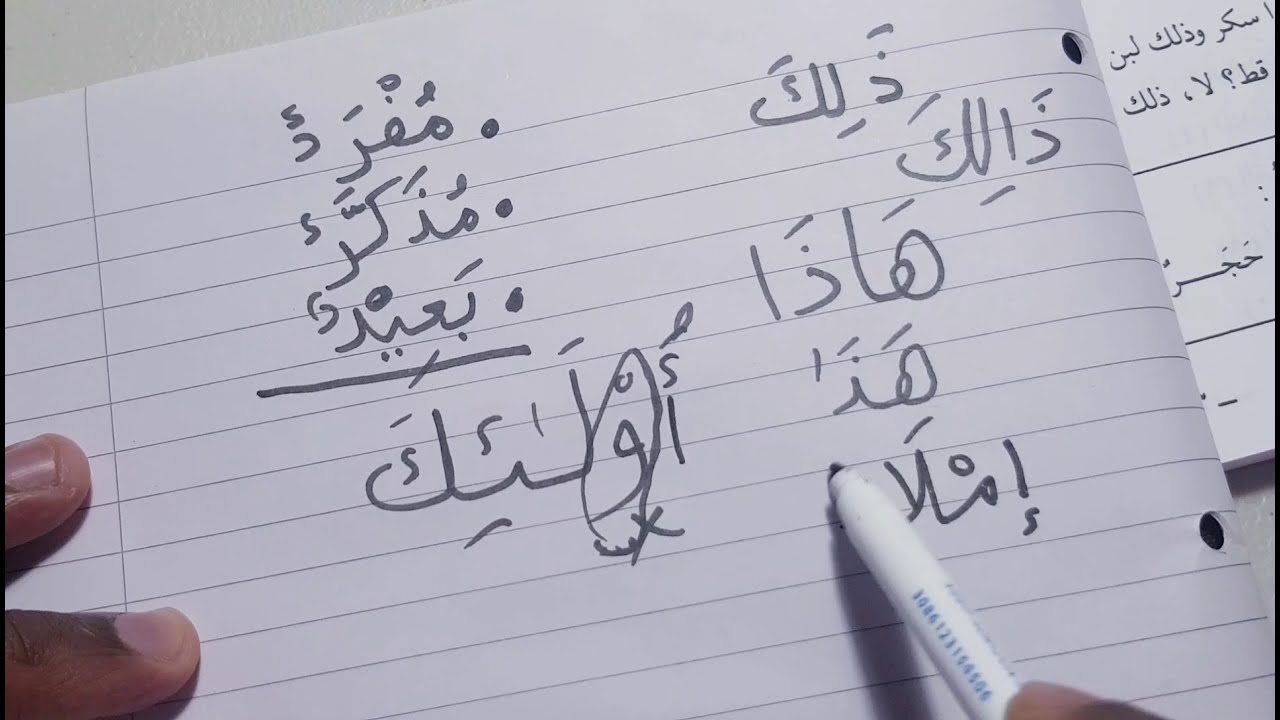
  • Nouns in Arabic have gender, either masculine (Mudhakkar) or feminine (Mu'annath).
  • Examples of masculine and feminine nouns are given, such as Kursiyyun (chair, masculine) and Sayyarah (car, feminine).
  • Nouns also have number: singular (Mufrad), dual (Muthanna), and plural (Jam').
  • Examples illustrate singular, dual, and plural forms of nouns like Kursiyyun, Kursiyyani, and Karasiyyu.
  • The instructor advises focusing on understanding explanations before taking notes for better comprehension.
  • The course will progress through three books, starting with Book 1, then Book 2, and eventually Ajrumiyyah.

Full Transcript — Download SRT & Markdown

00:00
Speaker A
ادع الى سبيل ربك بالحكمه والموعظه الحسنه وجادلهم بالتي هي احسن
00:11
Speaker A
Bismillahirrahmanirrahim, Alhamdulillahi hamdan kathiran tayyiban mubarakan fihi kama yuhibbu rabbuna wa yardah. Marhaban bikum ayyuhal mustami'un. I welcome you all to our first class in this Arabic program.
00:28
Speaker A
And the goal of this program, inshallah, is to enable people to study the Arabic language from the comforts of their own homes or wherever else they may be.
00:40
Speaker A
We find that there are many people who want to learn the Arabic language, but for one reason or another, it's not easy for them to do so.
00:58
Speaker A
Perhaps there's no teacher.
01:02
Speaker A
Or perhaps the teachers who are available are charging extortionate amounts of money.
01:10
Speaker A
Or perhaps it's difficult for them for one reason or another.
01:16
Speaker A
So, we've put together this class, inshallah, to make it easy for people to study in the comforts of their own home, inshallah.
01:34
Speaker A
And progress and gain gain understanding of the Arabic language.
01:40
Speaker A
So we ask Allah subhanho wa Ta'ala to accept this humble effort and make it a beneficial service for Islam and the Muslims.
01:49
Speaker A
This program, our Arabic program, is going to be based on the Arabic course of Madinah Islamic University for English-speaking students.
02:02
Speaker A
The course consists of three books.
02:10
Speaker A
It consists of three books.
02:13
Speaker A
Which was originally designed and taught at Madinah Islamic University.
02:19
Speaker A
The book that we're going to begin with here, this book here, is Madinah Book 1.
02:27
Speaker A
Madinah Book 1.
02:29
Speaker A
And this book here consists of 23 lessons.
02:35
Speaker A
There are 23 lessons in this book.
02:38
Speaker A
And this is what we're going to start with, Madinah Book 1, inshallah.
02:43
Speaker A
And then we're going to move on to Book 2.
02:49
Speaker A
And once we complete Book 2, inshallah, if we're still together on this journey.
02:56
Speaker A
We are going to start Ajrumiyyah, inshallah.
03:01
Speaker A
Tayyib.
03:02
Speaker A
So before we begin today's class, we are going to take a quick introduction.
03:10
Speaker A
Looking at the parts of speech in the Arabic language.
03:15
Speaker A
The parts of speech in the Arabic language.
03:20
Speaker A
The Arabic language, just like any other language, is made up of words, words.
03:26
Speaker A
A word in the Arabic language, we refer to it as Kalimah.
03:31
Speaker A
Kalimatun.
03:32
Speaker A
Kalimatun.
03:33
Speaker A
A Kalimah is a word.
03:35
Speaker A
A word in the Arabic language, whether it is read or spoken or written.
03:44
Speaker A
Any type of word in the Arabic language will either be one of these three things.
03:50
Speaker A
An Arabic word will either fall into one of these three categories.
03:54
Speaker A
It's either going to be an Ism.
03:56
Speaker A
Ismun.
03:57
Speaker A
Ismun.
03:58
Speaker A
Which is a noun.
04:00
Speaker A
An Ism is a noun.
04:01
Speaker A
Nouns are names of things, names of people, places.
04:06
Speaker A
Names of ideas, concepts.
04:09
Speaker A
Names of things are known as Ismun.
04:12
Speaker A
A noun, Ismun.
04:13
Speaker A
So this is the first category.
04:16
Speaker A
Second category is Fi'lun.
04:19
Speaker A
A verb.
04:20
Speaker A
An action or so or of some sort.
04:22
Speaker A
Fi'l.
04:23
Speaker A
Fi'lun.
04:25
Speaker A
Fi'lun.
04:26
Speaker A
A verb.
04:28
Speaker A
If the word is not Ism and it's not a Fi'l, then it's going to be a Harf.
04:32
Speaker A
Harfun.
04:34
Speaker A
Harfun.
04:35
Speaker A
Harfun, particle.
04:37
Speaker A
So we have Ismun, which is a noun.
04:40
Speaker A
Names of people, names of places, names of things.
04:45
Speaker A
Names of concepts, ideas.
04:48
Speaker A
Fi'lun, verbs.
04:49
Speaker A
Harfun, anything which is not an Ism or a Fi'l, then it's going to be called a Harf, a particle.
04:54
Speaker A
So parts of the Arabic language, we have three parts.
04:59
Speaker A
Parts of the Arabic language, there are three parts.
05:02
Speaker A
It's either going to be an Ism, a Fi'lun, or Harfun.
05:07
Speaker A
So when we go through this book, inshallah, you are going to find out that we do not come out of these three categories.
05:15
Speaker A
Every word that we take is going to fall into one of these three categories.
05:20
Speaker A
In Book 1, the author, he's going to concentrate on this category, Ismun.
05:27
Speaker A
He's going to concentrate on Ismun.
05:31
Speaker A
And nouns in the Arabic language, they make up the majority of the language.
05:40
Speaker A
Probably around 60% of the language or 70% is built up of nouns, Asma'.
05:48
Speaker A
So it's only fitting that the author, he concentrates more on this than anything else.
05:54
Speaker A
And this is what we're going to concentrate on in Book 1.
05:58
Speaker A
Nouns.
06:00
Speaker A
And when we look at nouns, we're going to look at nouns from various perspectives.
06:05
Speaker A
Nouns in the Arabic language, they all have a gender.
06:10
Speaker A
Nouns.
06:12
Speaker A
Have a gender.
06:14
Speaker A
And the gender is either going to be masculine or feminine.
06:20
Speaker A
Ismun.
06:24
Speaker A
Ismun.
06:27
Speaker A
In terms of gender, we have two types.
06:30
Speaker A
It's either going to be masculine.
06:33
Speaker A
We say masculine in Arabic.
06:37
Speaker A
Mudhakkarun.
06:40
Speaker A
Mudhakkarun.
06:42
Speaker A
Which is masculine.
06:44
Speaker A
Or it's either going to be feminine.
06:46
Speaker A
Feminine is Mu'annathun.
06:49
Speaker A
Mu'annathun.
06:51
Speaker A
Feminine.
06:53
Speaker A
Tayyib, so every noun in the Arabic language has a gender.
06:56
Speaker A
And this gender is either going to be masculine or feminine.
07:00
Speaker A
In Arabic we say Mudhakkar or Mu'annath.
07:02
Speaker A
Every noun has a gender, whether it's a living being or a thing or an object or a concept.
07:09
Speaker A
It's going to have a gender.
07:11
Speaker A
So for example.
07:13
Speaker A
Kursiyyun, for example.
07:15
Speaker A
Kursiyyun means chair.
07:17
Speaker A
This noun has a gender, and the gender is masculine.
07:21
Speaker A
Another example.
07:23
Speaker A
Sayyarah.
07:24
Speaker A
Sayyarah is a car.
07:26
Speaker A
Sayyarah means a car.
07:28
Speaker A
The gender of a car in the Arabic language is feminine.
07:32
Speaker A
Sabrun.
07:34
Speaker A
Sabrun means patience.
07:35
Speaker A
Patience is an idea, it's an it's a concept.
07:38
Speaker A
This concept has a gender, and it's Mudhakkar.
07:42
Speaker A
So when we refer to Sabr, we refer to it as a masculine.
07:46
Speaker A
The point is, every noun, every Ism in the Arabic language has a gender.
07:51
Speaker A
It's either going to be Mudhakkar, masculine.
07:54
Speaker A
Or Mu'annath, feminine.
07:57
Speaker A
This is point number 1.
07:59
Speaker A
The second point related to nouns that we need to bear in mind.
08:04
Speaker A
Is every noun consists of a number.
08:08
Speaker A
Every noun has a number.
08:11
Speaker A
And this number is either going to be Mufradun.
08:13
Speaker A
Mufradun.
08:15
Speaker A
The noun indicates to something which is singular.
08:17
Speaker A
Mufradun.
08:19
Speaker A
Jam'un.
08:21
Speaker A
Jam'un.
08:23
Speaker A
Plural.
08:24
Speaker A
The opposite of singular is plural.
08:26
Speaker A
So this is what we have in the English language.
08:29
Speaker A
We have things which are singular, pen.
08:31
Speaker A
Things which are plural, pens.
08:33
Speaker A
Pen, pens.
08:35
Speaker A
However, in the Arabic language, we have something which is between Mufrad and Jam'.
08:41
Speaker A
Something which comes between Mufrad and Jam', and that is Muthanna.
08:47
Speaker A
Muthanna.
08:48
Speaker A
What is Muthanna?
08:49
Speaker A
Muthanna is dual.
08:51
Speaker A
Two things.
08:53
Speaker A
The number two, indicates to two objects or two people or two things.
08:58
Speaker A
So we have Mufrad.
09:00
Speaker A
We have Muthanna.
09:01
Speaker A
And we have Jam'un.
09:03
Speaker A
What we're saying here, we're saying every noun.
09:07
Speaker A
In terms of number, every noun.
09:11
Speaker A
So the first categorization was in terms of gender.
09:14
Speaker A
Every noun has a gender.
09:16
Speaker A
The gender is either masculine, Mudhakkar.
09:19
Speaker A
Or feminine, Mu'annath, sorry.
09:22
Speaker A
Don't confuse this like me.
09:25
Speaker A
Between this and this.
09:27
Speaker A
There's a very similar.
09:29
Speaker A
So don't confuse between the two.
09:31
Speaker A
Muthanna, Mu'annath, Mu'annath, feminine.
09:33
Speaker A
In terms of number, every noun has consists of a number, carries a number within it.
09:38
Speaker A
It's either going to be singular, Muthanna.
09:41
Speaker A
Or Jam'.
09:42
Speaker A
Or Jam'un.
09:44
Speaker A
Mufradun, singular.
09:46
Speaker A
Muthanna, dual.
09:48
Speaker A
Or Jam'un, plural.
09:50
Speaker A
Mufradun, singular.
09:52
Speaker A
Muthanna, dual.
09:54
Speaker A
Jam', plural.
09:56
Speaker A
So, if I was to say Kursiyyun, the example that I used previously.
10:00
Speaker A
Kursiyyun is Mudhakkar, it's a masculine noun, Mudhakkar.
10:04
Speaker A
The gender within Kursiy is masculine.
10:08
Speaker A
The number within Kursiy, I'm referring to one chair.
10:11
Speaker A
So it's singular, Mufrad.
10:12
Speaker A
So Kursiyyun is Mufrad and it's Mudhakkar.
10:16
Speaker A
Tamam.
10:18
Speaker A
If I say Sayyarah, car.
10:20
Speaker A
Car is feminine.
10:22
Speaker A
And it's singular.
10:24
Speaker A
I'm talking about one car.
10:27
Speaker A
In the Arabic language, if we're referring to two things.
10:31
Speaker A
There's a construction that we form, and it becomes two.
10:35
Speaker A
So Kursiyyun, if I say Kursiyyani.
10:39
Speaker A
Kursiyyani.
10:41
Speaker A
It means two chairs.
10:43
Speaker A
If I say Sayyaratani.
10:45
Speaker A
Two cars.
10:47
Speaker A
Anything which is more than two goes to the category of Jam', plural.
10:51
Speaker A
Karasiyyu.
10:53
Speaker A
Is the plural of Kursiyyun.
10:55
Speaker A
More than two chairs, plural.
10:57
Speaker A
Chairs.
10:59
Speaker A
And Sayyaratun.
11:01
Speaker A
Cars is plural.
11:03
Speaker A
So the point here is that every noun consists of a number.
11:07
Speaker A
And this number is either going to be Mufrad, singular.
11:12
Speaker A
Dual or plural.
11:14
Speaker A
Tamam, so this is something that we need to bear in mind.
11:17
Speaker A
And when we explain these things, I hope that everyone concentrates on what's been explained.
11:23
Speaker A
As opposed to busy themselves with taking notes.
11:27
Speaker A
Firstly, concentrate and understand what's been explained.
11:30
Speaker A
Before you write away.
11:33
Speaker A
Otherwise, if you're writing while I'm explaining, you're not going to understand anything.
11:37
Speaker A
Or it's going to be difficult for you to understand.
11:40
Speaker A
So when things are being explained, try and focus, and then inshallah, you can pause the video and take notes.
11:47
Speaker A
You can take notes after you've understood.
11:50
Speaker A
So so far, we've taken words in the Arabic language are divided into three.
11:58
Speaker A
The parts of speech in the Arabic language are three.
12:02
Speaker A
Any word that you see will fall into one of these three categories.
12:06
Speaker A
It's either going to be a noun, Ismun.
12:08
Speaker A
Ismun is the name of a place, name of a thing, name of a person.
12:13
Speaker A
Name of anything, pronouns, adjectives.
12:17
Speaker A
They all come under this category.
12:19
Speaker A
Then we have Fi'lun.
12:20
Speaker A
Fi'lun is a verb.
12:22
Speaker A
Doing words.
12:24
Speaker A
Then anything which is not an Ism or a Fi'l is going to be a Harf.
12:27
Speaker A
And we said everything that we study in the Arabic language, including this book, is going to fall into one of these three categories.
12:35
Speaker A
Then we said in Book 1, the author is going to concentrate on Ism.
12:41
Speaker A
More so than the Fi'l and the Harf.
12:44
Speaker A
He's going to concentrate on Ism.
12:47
Speaker A
Mainly because the Arabic language consists more of nouns than anything else.
12:53
Speaker A
60 or 70% of the Arabic language is built up of Asma', nouns.
12:58
Speaker A
Because of that, we said we're going to focus on Ism.
13:00
Speaker A
And then we categorized Ism into two categories.
13:04
Speaker A
The first category is in terms of gender.
13:07
Speaker A
We said every Ism, every noun has a gender.
13:10
Speaker A
Carries within it a gender.
13:12
Speaker A
It's either going to be Mudhakkar or Mu'annath.
13:16
Speaker A
Mudhakkar is masculine.
13:17
Speaker A
Mu'annath is feminine.
13:20
Speaker A
And inshallah, just understand this categorization.
13:24
Speaker A
The example is not really important right now.
13:28
Speaker A
You will understand this more as we go through the book, inshallah.
13:32
Speaker A
The second categorization of the Ism is in terms of number.
13:37
Speaker A
Every Ism consists of a number.
13:40
Speaker A
Carries within it a number.
13:42
Speaker A
It's either going to point to one thing.
13:46
Speaker A
Which is Mufrad.
13:48
Speaker A
The noun is either going to point to two things.
13:51
Speaker A
Which is Muthanna.
13:53
Speaker A
Or more than two things, which is Jam'.
13:56
Speaker A
Jam', plural.
13:58
Speaker A
Tamam, so if this is understood.
14:00
Speaker A
Then we've understood today's lesson.
14:04
Speaker A
Okay, let's go back to today's lesson now.
14:07
Speaker A
The author in the first page, he mentions Hadha.
14:13
Speaker A
Hadha.
14:15
Speaker A
If we go back to the writing of Hadha.
14:19
Speaker A
There's a spelling rule here.
14:22
Speaker A
With Ha, when we when we say Ha, we are stretching it the same way we stretch the Dhal.
14:30
Speaker A
We say Ha Dha.
14:33
Speaker A
Two counts, this is two counts, this is two counts.
14:36
Speaker A
This being two counts is something understandable because we have Fathah and Alif.
14:40
Speaker A
Alif causes this to turn from one count, Dha, becomes Dha, two counts.
14:45
Speaker A
Because of the Alif.
14:47
Speaker A
Whereas this Ha is two counts, even though there's nothing here.
14:51
Speaker A
There's no Alif here.
14:53
Speaker A
However, there's a special rule with regards to Hadha, and that special rule is that we pronounce an Alif.
15:00
Speaker A
Even though it's not written.
15:03
Speaker A
There's an Alif here which is read, but it's not pronounced.
15:06
Speaker A
It's read, but it's not pronounced.
15:09
Speaker A
So if we were to read this, this actually says Hadha.
15:13
Speaker A
Hadha.
15:15
Speaker A
But because of that rule, we say Hadha.
15:18
Speaker A
What's the rule?
15:20
Speaker A
The rule is there is an Alif after the Ha, which is pronounced but not written.
15:26
Speaker A
So we don't write it like this.
15:29
Speaker A
But we pronounce it like this.
15:32
Speaker A
This says Hadha.
15:34
Speaker A
This Alif is not written.
15:37
Speaker A
So we join the Ha to the Dhal.
15:40
Speaker A
Hadha.
15:42
Speaker A
Something very important to bear in mind.
15:46
Speaker A
In the Quran, they have a small Alif which is written like this.
15:51
Speaker A
Just to make it easier for people so that they're not confused.
15:55
Speaker A
Yeah, because if they don't have this sign, people might just say Hadha.
16:00
Speaker A
Which is wrong.
16:01
Speaker A
So they add a little Alif to indicate that Alif which is not written.
16:05
Speaker A
So people can stretch this Ha.
16:09
Speaker A
They'll say Hadha.
16:11
Speaker A
And that's what the author does here.
16:12
Speaker A
He's added that small Alif.
16:15
Speaker A
Okay, so when you spell Hadha, when you write it out.
16:19
Speaker A
Make sure you write it without the Alif.
16:23
Speaker A
And there's only one Alif after the Dhal.
16:26
Speaker A
And when you pronounce it, make sure you read it with the Alif.
16:30
Speaker A
You pronounce the Ha, two counts.
16:33
Speaker A
And the Dha, two counts.
16:36
Speaker A
Hadha.
16:38
Speaker A
What does Hadha mean?
16:40
Speaker A
It means this.
16:42
Speaker A
Okay.
16:43
Speaker A
So there are six or nine words on this first page.
16:47
Speaker A
And you'll notice that all of these nine words that we're going to learn, they are nouns.
16:55
Speaker A
They are nouns.
16:57
Speaker A
Hadha is a noun also.
16:58
Speaker A
We mentioned it's a demonstrative pronoun, Ism al-Isharah.
17:02
Speaker A
The words after it.
17:04
Speaker A
The things that we're pointing out are also all nouns.
17:08
Speaker A
Nine in total.
17:10
Speaker A
And these nine nouns are all going to be masculine.
17:15
Speaker A
Masculine, Mudhakkarun.
17:17
Speaker A
Mudhakkarun, Mudhakkarun.
17:19
Speaker A
None of them are feminine.
17:20
Speaker A
All of these have a gender.
17:22
Speaker A
The gender is they are masculine.
17:25
Speaker A
And they're all singular.
17:27
Speaker A
And inshallah, they're all close to the speaker.
17:31
Speaker A
Who's pointing them out.
17:34
Speaker A
Hadha Baytun.
17:36
Speaker A
Together, this means this is a house.
17:39
Speaker A
This is a house.
17:43
Speaker A
Baytun.
17:45
Speaker A
Baytun means a house.
17:47
Speaker A
Masjidun.
17:49
Speaker A
Masjidun, a masjid.
17:51
Speaker A
A mosque.
17:53
Speaker A
Babun.
17:55
Speaker A
Babun.
17:57
Speaker A
A door.
17:59
Speaker A
Babun, a door.
18:01
Speaker A
Kitabun.
18:03
Speaker A
Kitabun, a book.
18:05
Speaker A
Kitabun.
18:07
Speaker A
Qalamun.
18:09
Speaker A
Qalamun, a pen.
18:11
Speaker A
Miftahun.
18:13
Speaker A
Miftahun, a key.
18:15
Speaker A
Maktabun.
18:17
Speaker A
Maktabun, a desk.
18:19
Speaker A
Sarirun.
18:21
Speaker A
Sarirun, a bed.
18:23
Speaker A
Kursiyyun.
18:25
Speaker A
Kursiyyun is a chair.
18:27
Speaker A
So all of these things that we're pointing out have a gender and they are Mudhakkar, they're all masculine.
18:31
Speaker A
And they're all singular.
18:33
Speaker A
And inshallah, they're all close to the speaker.
18:36
Speaker A
Who's pointing them out.
18:39
Speaker A
Hadha Baytun, together, this means this is a house.
18:43
Speaker A
This is a house.
18:46
Speaker A
The there's no equivalent translation or equivalent to is in the Arabic language.
18:50
Speaker A
Is is something that we add when we're translating into English.
18:55
Speaker A
Is and are, as he mentions in the notes at the back, they are called copula.
19:00
Speaker A
They are words which are added when you translate these kind of words into English.
19:06
Speaker A
Which attaches the Mubtada and the Khabar together to give a complete sentence.
19:10
Speaker A
Is and are.
19:12
Speaker A
We don't have a equivalent in the Arabic language.
19:17
Speaker A
So when we translate Hadha by itself, this.
19:20
Speaker A
This.
19:22
Speaker A
Baytun, a house.
19:24
Speaker A
This, a house.
19:27
Speaker A
We don't say this, this, a house.
19:30
Speaker A
We need to add that is when we translate into English.
19:34
Speaker A
To make the sentence complete.
19:38
Speaker A
This is a house.
19:41
Speaker A
This is a house.
19:44
Speaker A
Is is something that is is is not part of any of this.
19:48
Speaker A
It's just added to complete the meaning.
19:51
Speaker A
Hadha Baytun.
19:53
Speaker A
This is a house.
19:56
Speaker A
Hadha Masjidun.
19:58
Speaker A
This is a Masjid or mosque.
20:01
Speaker A
Hadha Babun.
20:03
Speaker A
This is a door.
20:05
Speaker A
Hadha Kitabun.
20:07
Speaker A
This is a book.
20:09
Speaker A
Hadha Qalamun.
20:11
Speaker A
This is a pen.
20:13
Speaker A
Hadha Miftahun.
20:15
Speaker A
This is a key.
20:17
Speaker A
Hadha Maktabun.
20:19
Speaker A
This is a desk.
20:21
Speaker A
Hadha Sarirun.
20:23
Speaker A
This is a bed.
20:25
Speaker A
Hadha Kursiyyun.
20:27
Speaker A
This is a chair.
20:29
Speaker A
So what we're going to do now is we're going to read each one five times.
20:34
Speaker A
My assistants are going to repeat after me, I'm going to say each one five times.
20:40
Speaker A
And inshallah, when we're saying these, we need to say as though we are speaking that language.
20:45
Speaker A
We're not going to read them like robots.
20:49
Speaker A
Hadha Baytun.
21:14
Speaker A
Okay, what does Hadha Baytun mean?
21:16
Speaker B
This is a house.
21:18
Speaker A
This is a house.
21:20
Speaker A
Remember, yeah, don't forget.
21:21
Speaker A
What does Hadha Baytun mean?
21:23
Speaker B
This is a house.
21:25
Speaker A
Okay, next one.
21:27
Speaker A
Hadha Masjidun.
21:51
Speaker A
Okay, what does Hadha Masjidun mean?
21:53
Speaker B
This is a Masjid.
21:55
Speaker A
What do you do in a Masjid?
21:56
Speaker B
Pray.
21:58
Speaker A
Next one.
22:00
Speaker A
Hadha Babun.
22:24
Speaker A
What does Hadha Babun mean?
22:26
Speaker B
This is a door.
22:28
Speaker A
Where is Bab?
22:30
Speaker B
Door.
22:31
Speaker A
Door.
22:33
Speaker A
Next one.
22:35
Speaker A
Hadha Kitabun.
22:59
Speaker A
What does Hadha Kitabun mean?
23:01
Speaker B
This is a book.
23:03
Speaker A
This is a book.
23:05
Speaker A
Usually, books that you read, we say Kitabun.
23:08
Speaker A
And books that you write notes on, we say Daftarun.
23:12
Speaker A
Daftarun, notebook.
23:14
Speaker A
So this is a Daftar.
23:15
Speaker A
This is a notebook.
23:17
Speaker A
And this is a Kitab.
23:19
Speaker A
Okay.
23:21
Speaker A
Hadha Kitabun.
23:24
Speaker A
What does that mean?
23:26
Speaker B
This is a book.
23:28
Speaker A
This is a book.
23:30
Speaker A
Next one.
23:32
Speaker A
Hadha Qalamun.
23:52
Speaker A
What's Qalam?
23:54
Speaker B
This is a pen.
23:55
Speaker A
Pen.
23:57
Speaker A
Qalam is a pen.
23:59
Speaker A
So Hadha Qalamun means this is a pen.
24:02
Speaker A
Very good.
24:04
Speaker A
Remember these words, yeah?
24:06
Speaker A
I'm going to test you at the end, inshallah.
24:09
Speaker A
Hadha Miftahun.
24:29
Speaker A
What does Hadha Miftahun mean?
24:31
Speaker B
This is a key.
24:33
Speaker A
Key.
24:35
Speaker A
Miftah is a key.
24:37
Speaker A
Next one.
24:40
Speaker A
Hadha Maktabun.
25:00
Speaker A
What's Maktab?
25:02
Speaker B
Desk.
25:03
Speaker A
Desk.
25:05
Speaker A
Okay, this is a desk.
25:08
Speaker A
What's Maktab?
25:10
Speaker B
Desk.
25:12
Speaker A
Desk or office, place where you do your work, yeah?
25:16
Speaker A
Hadha Maktabun.
25:19
Speaker A
Hadha Sarirun.
25:39
Speaker A
What's Sarir?
25:41
Speaker B
This is a bed.
25:42
Speaker A
Bed.
25:44
Speaker A
Very good.
25:46
Speaker A
This is a bed.
25:48
Speaker A
What's a Sarir?
25:50
Speaker B
Bed.
25:52
Speaker A
Bed.
25:54
Speaker A
Okay, last one now, yeah?
25:56
Speaker A
We're on the last one.
25:58
Speaker A
And remember all the ones that we took, yeah?
26:01
Speaker A
Hadha Kursiyyun.
26:25
Speaker A
What does Hadha Kursiyyun mean?
26:27
Speaker B
This is a chair.
26:29
Speaker A
Chair.
26:31
Speaker A
Chair.
26:33
Speaker A
Okay, this question's for you, yeah?
26:36
Speaker A
How do you say this is a pen?
26:41
Speaker B
Hadha Masjidun.
26:43
Speaker A
Wrong.
26:45
Speaker A
How do you say this is a book?
26:47
Speaker B
Hadha Kitabun.
26:49
Speaker A
Very good.
26:51
Speaker A
How do you say this is a book?
26:53
Speaker B
Hadha Kitabun.
26:55
Speaker A
Okay, how do you say this is a door?
26:58
Speaker B
Hadha Miftahun.
27:00
Speaker A
Wrong.
27:02
Speaker A
So that means you need to revise.
27:05
Speaker A
You have to revise until next lesson.
27:09
Speaker A
See, you're getting it wrong.
27:11
Speaker A
Thank you.
27:13
Speaker A
So now you need to revise, yeah?
27:16
Speaker A
Okay, go and revise, please.
27:18
Speaker A
Everybody revise.
27:20
Speaker A
This is the end of our lesson.
27:23
Speaker A
Everyone needs to revise.
Topics:Madinah Arabic CourseArabic language learningArabic nounsArabic grammarArabic parts of speechMudhakkarMu'annathMufradMuthannaJam'

Frequently Asked Questions

What are the three categories of words in Arabic?

Arabic words fall into three categories: Ism (noun), Fi'l (verb), and Harf (particle).

What does Book 1 of the Madinah Arabic Course focus on?

Book 1 focuses primarily on nouns (Ism), covering their gender and number.

How is gender expressed in Arabic nouns?

Every Arabic noun has a gender, which is either masculine (Mudhakkar) or feminine (Mu'annath).

Get More with the Söz AI App

Transcribe recordings, audio files, and YouTube videos — with AI summaries, speaker detection, and unlimited transcriptions.

Or transcribe another YouTube video here →