Madinah Arabic course | Book 1 – LESSON 3 (part 1) — Transcript

Lesson 3 of Madinah Arabic Book 1 covers noun definiteness, tanwin rules, and basic vocabulary with sentence examples.

Key Takeaways

  • Tanwin indicates indefinite nouns and is removed when 'al' is added to make nouns definite.
  • Nouns in Arabic are categorized as ma'rifah (definite) or nakirah (indefinite).
  • Lesson 3 introduces important grammar rules about noun definiteness and tanwin.
  • New vocabulary includes adjectives with opposites to enhance descriptive skills.
  • Understanding the use of conjunctions like 'waw' helps in sentence construction.

Summary

  • Review of Lesson 2 homework focusing on simple Arabic sentences.
  • Introduction to Lesson 3, described as more challenging than previous lessons.
  • Explanation of tanwin (nunation) types: dammatayn, fat-hatayn, kasratayn and their written forms.
  • Rule that adding 'al' (alif lam) to a noun removes the tanwin, making the noun definite.
  • Distinction between definite (ma'rifah) and indefinite (nakirah) nouns.
  • Examples of nouns with tanwin and with 'al' to show indefinite vs definite meanings.
  • New vocabulary introduced with adjectives and opposites: maksurun (broken), maftuhun (open), jalisun (sitting), waqifun (standing), jadidun (new), qadimun (old), saghirun (small), kabirun (big), wasikhun (dirty).
  • Use of conjunction 'waw' to join words and sentences.
  • Practice sentences combining vocabulary and grammar concepts.
  • Emphasis on pronunciation and repetition for learning new words.

Full Transcript — Download SRT & Markdown

00:11
Speaker A
Bismillahir Rahmanir Rahim, Alhamdulillahi hamdan kathiran tayyiban mubarakan fihi kama yuhibbu Rabbuna wa yardah. Last lesson we completed lesson two of this book, all that was left was to do the homework.
00:23
Speaker A
Iqra wa uktub, read and write. So this is what we're going to begin this lesson with.
00:28
Speaker A
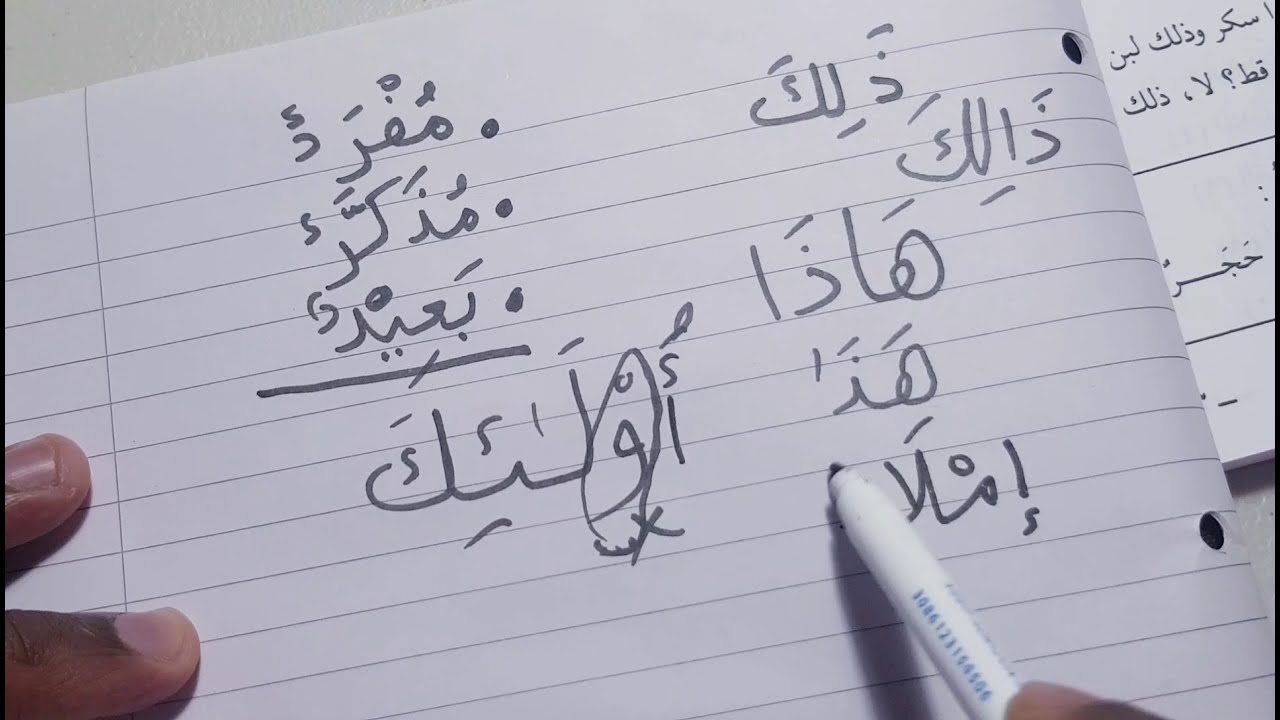
Number one, hadha sukkarun wa dhalika labanun. This is sugar and that is milk or yogurt.
00:58
Speaker A
Tayyib. Number two, man dhalika? Dhalika imamun. Who is that? That is an Imam, a leader.
02:13
Speaker A
Tayyib. Number three. Number three says, a dhalika qittun? La, dhalika kalbun. Is that a cat? No, that is a dog.
03:24
Speaker A
Number four is ma hadha? Hadha hajarun. What is this? This is a rock. So this was the exercise for lesson two.
03:44
Speaker A
Okay, so let's begin today's class. Ad-darsu ath-thalith.
04:00
Speaker A
Ad-darsu ath-thalith.
04:10
Speaker A
Ad-darsu means the lesson.
04:20
Speaker A
Ath-thalith means the third.
04:28
Speaker A
So together, if we read it together, we say ad-darsu ath-thalith.
04:37
Speaker A
Ad-darsu ath-thalith, the third lesson.
04:42
Speaker A
So we've covered ad-darsu al-awwal, the first lesson.
04:56
Speaker A
We've covered ad-darsu ath-thani, the second lesson.
05:04
Speaker A
Now we're on ad-darsu ath-thalith, the third lesson.
05:10
Speaker A
In the third lesson, we're going to learn several things.
05:23
Speaker A
We're going to learn several things in the third lesson.
05:32
Speaker A
And this lesson is one of the more challenging lessons in this book.
05:46
Speaker A
Yeah, I think lesson two, the one that we covered last lesson, is one of the most easiest lessons in this book.
06:00
Speaker A
And lesson three is one of the more challenging lessons in this book.
06:10
Speaker A
So with this lesson, we have to concentrate and pay a lot of attention.
06:19
Speaker A
The first thing that we learn in this lesson is demonstrated in these words.
06:29
Speaker A
So what he's saying is, baytun has tanwin dammatayn.
06:40
Speaker A
When you add this alif and lam, al, when you add this al to the start of the noun, the tanwin goes.
06:55
Speaker A
We take off one of the dammas, so we're going to be left with one damma.
07:01
Speaker A
Baytun.
07:03
Speaker A
This noon sakinah, this noon sakinah, this noon sakinah is not part of this word.
07:10
Speaker A
So if we write it like this, if we add the noon in writing like this, people would think that this is part of this word.
07:20
Speaker A
But it's not part of the word.
07:24
Speaker A
This noon is an extra noon, it's an additional noon that's added to the end of nouns.
07:34
Speaker A
Which is why they've, they represent this noon by doubling whatever harakah is on the last letter.
07:44
Speaker A
So here, the last letter has a damma.
07:56
Speaker A
So what we do is we're going to double the damma to represent this noon.
08:05
Speaker A
We're not going to write this noon out.
08:09
Speaker A
So it will be written like this.
08:12
Speaker A
Bayt.
08:20
Speaker A
So we have damma, okay?
08:23
Speaker A
Damma, so we're going to write another damma.
08:26
Speaker A
That's how we represent.
08:29
Speaker A
So this additional damma represents the noon.
08:35
Speaker A
So we're going to say baytun.
08:39
Speaker A
Baytun.
08:42
Speaker A
This is read the same way as this, but it's written like this.
08:49
Speaker A
Writing it like this is wrong, yeah?
08:52
Speaker A
This was just for demonstration's sake.
08:55
Speaker A
Baytun.
09:00
Speaker A
This noon sakinah is actually represented with this additional damma.
09:07
Speaker A
Baytan.
09:10
Speaker A
We'd write it like this.
09:12
Speaker A
Bayt.
09:15
Speaker A
And then we add another alif.
09:18
Speaker A
We add another fatha.
09:20
Speaker A
And with fat-hatayn, we usually have an alif, extra alif, and there are some exceptions where you don't add the alif, but generally you add an alif, extra alif.
09:29
Speaker A
So baytan.
09:31
Speaker A
Where do we get the noon from?
09:35
Speaker A
Baytan, the additional fatha.
09:39
Speaker A
Baytin.
09:41
Speaker A
We write it like this.
09:43
Speaker A
Bayt.
09:46
Speaker A
And then we add another kasra.
09:50
Speaker A
So this extra kasra represents the noon sakinah.
09:55
Speaker A
So this is baytun, baytan, baytin.
10:00
Speaker A
Okay.
10:02
Speaker A
Now what we're learning is, what we're learning now is,
10:10
Speaker A
when we add alif lam, al, to the beginning of the noun, hamzatul wasl and then lam sakinah, al, if we add al, this al,
10:30
Speaker A
the noon of tanwin gets taken off.
10:35
Speaker A
The tanwin gets taken off.
10:37
Speaker A
What's the tanwin?
10:40
Speaker A
The tanwin is the second, is the second damma.
10:45
Speaker A
The tanwin is the second fatha.
10:49
Speaker A
The tanwin is the second kasra.
10:53
Speaker A
When we take off the fatha, we take off the alif as well, yeah, for fat-hatayn.
10:59
Speaker A
So it become al-bayta.
11:02
Speaker A
Al-bayti.
11:04
Speaker A
Al-baytu.
11:06
Speaker A
The rule that we learn in lesson part one of lesson three is that when you add alif lam,
11:14
Speaker A
al, to the start of the noun, the tanwin goes.
11:20
Speaker A
Okay?
11:23
Speaker A
So nouns will either have tanwin or al, but never both.
11:30
Speaker A
These two will never be combined within the same noun.
11:36
Speaker A
You either have al at the start or tanwin at the end.
11:40
Speaker A
One of the two.
11:42
Speaker A
One of the two.
11:44
Speaker A
We add al to the noun, al-baytu.
11:50
Speaker A
That means the house.
11:53
Speaker A
The house, we're talking about a specific house.
11:58
Speaker A
So when al is added, it makes the noun definite.
12:10
Speaker A
It makes the noun specific and definite, you're talking about a specific house.
12:16
Speaker A
But if you take off al and you have tanwin, it becomes indefinite, unspecific.
12:25
Speaker A
So you say a house.
12:28
Speaker A
A house and so on.
12:30
Speaker A
So this is in terms of meaning, when you add al, it makes it definite.
12:36
Speaker A
When you take off al and you have tanwin, it becomes indefinite.
12:42
Speaker A
Tayyib, so we have three types of tanwins, fat-hatayn, kasratayn, dammatayn.
12:50
Speaker A
And the tanwin is actually the doubling of the last vowel.
12:57
Speaker A
The doubling of the last harakah.
13:00
Speaker A
Baytun, if we add alif lam, the second damma gets taken off, so we're left with al-baytu.
13:09
Speaker A
Baytun, al-baytu.
13:11
Speaker A
Baytun, a house.
13:13
Speaker A
Al-baytu, the house.
13:17
Speaker A
Kitabun, a book.
13:20
Speaker A
Al-kitabu, the book.
13:24
Speaker A
The book, I'm talking about a specific book.
13:26
Speaker A
Qalamun, a pen.
13:29
Speaker A
Al-qalamu, the pen.
13:32
Speaker A
A specific pen.
13:34
Speaker A
Jamalun, a camel.
13:36
Speaker A
Al-jamalu, the camel.
13:39
Speaker A
A specific camel.
13:41
Speaker A
So this is what we need to understand from this section here.
13:46
Speaker A
We take that the noun is two types in terms of it being definite or indefinite.
13:54
Speaker A
It's either going to be definite or indefinite.
13:57
Speaker A
Definite, we say ma'rifah.
14:00
Speaker A
Ma'rifah.
14:03
Speaker A
This is definite.
14:05
Speaker A
The noun is definite.
14:08
Speaker A
Tamam.
14:10
Speaker A
When the noun is definite, we say it's ma'rifah.
14:14
Speaker A
A specific noun when it has al, baytu.
14:20
Speaker A
This noun, we say it's ma'rifah, it's definite.
14:23
Speaker A
And indefinite, which is the opposite of ma'rifah, is nakirah.
14:27
Speaker A
Nakirah.
14:30
Speaker A
Nakirah is indefinite.
14:32
Speaker A
Something indefinite.
14:34
Speaker A
Indefinite.
14:36
Speaker A
So this is another categorization of the noun.
14:43
Speaker A
The noun is either ma'rifah, definite, or nakirah, indefinite.
14:49
Speaker A
Indefinite.
14:51
Speaker A
So let's read the sentences now.
14:53
Speaker A
The first sentence is al-qalamu maksurun.
15:00
Speaker A
Al-qalamu maksurun.
15:04
Speaker A
Maksurun means broken.
15:06
Speaker A
Maksurun means broken.
15:09
Speaker A
Let's say this word five times.
15:12
Speaker A
This is a new word.
15:14
Speaker A
Maksurun.
15:29
Speaker A
Al-qalamu maksurun, the pen is broken.
15:33
Speaker A
Next sentence.
15:36
Speaker A
Al-babu maftuhun.
15:40
Speaker A
Maftuhun means open.
15:43
Speaker A
Maftuhun means open.
15:45
Speaker A
Bab is a door.
15:47
Speaker A
Al-bab, the door.
15:49
Speaker A
So the door is open, maftuhun.
15:53
Speaker A
Maftuhun is a new word.
15:56
Speaker A
Let's say that five times.
15:58
Speaker A
Maftuhun.
16:13
Speaker A
Al-babu maftuhun, that means the door is open.
16:17
Speaker A
Next sentence.
16:20
Speaker A
Al-waladu jalisun.
16:24
Speaker A
Al-waladu jalisun.
16:27
Speaker A
Walad means boy.
16:29
Speaker A
Al-walad means the boy.
16:31
Speaker A
Jalisun is a new word.
16:34
Speaker A
It means sitting.
16:36
Speaker A
The boy is sitting.
16:38
Speaker A
Let's say jalisun five times.
16:40
Speaker A
Jalisun.
16:55
Speaker A
Wal-mudarrisu waqifun.
16:59
Speaker A
Wal-mudarrisu waqifun.
17:03
Speaker A
And the teacher is standing.
17:07
Speaker A
And the teacher is standing.
17:10
Speaker A
Jalisun, sitting.
17:12
Speaker A
Waqifun, opposite, standing.
17:15
Speaker A
Let's say this word five times.
17:17
Speaker A
Waqifun.
17:32
Speaker A
Standing.
17:34
Speaker A
Al-waladu jalisun, the boy is sitting.
17:40
Speaker A
Wal-mudarrisu waqifun, and the teacher is standing.
17:45
Speaker A
Two sentences.
17:47
Speaker A
So this waw, this joins together sentences.
17:50
Speaker A
And it joins together words.
17:54
Speaker A
You can join words together and you can join sentences together.
17:57
Speaker A
Tayyib.
18:00
Speaker A
Al-kitabu jadidun wal-qalamu qadimun.
18:05
Speaker A
Al-kitab, the book.
18:08
Speaker A
Jadidun means new.
18:10
Speaker A
Qadimun is old.
18:12
Speaker A
And this is a very good way of teaching when you learn the opposites.
18:17
Speaker A
New, old, sitting, standing.
18:20
Speaker A
Okay.
18:22
Speaker A
Jadidun means new.
18:24
Speaker A
Let's say this word five times.
18:26
Speaker A
Jadidun.
18:41
Speaker A
Qadimun means old.
18:43
Speaker A
Five times.
18:45
Speaker A
Qadimun.
19:00
Speaker A
Al-kitabu jadidun wal-qalamu qadimun.
19:06
Speaker A
The book is new and the pen is old.
19:10
Speaker A
Number two.
19:12
Speaker A
Al-himaru saghirun wal-hisanu kabirun.
19:18
Speaker A
Saghirun means small.
19:20
Speaker A
Kabirun is the opposite, big.
19:22
Speaker A
Kabir is big.
19:24
Speaker A
Al-himaru saghirun wal-hisanu kabirun.
19:30
Speaker A
The donkey is small and the horse is big.
19:36
Speaker A
Al-himaru saghirun wal-hisanu kabirun.
19:42
Speaker A
Saghirun, five times.
19:45
Speaker A
Saghirun, small, huh?
19:47
Speaker A
Saghirun.
20:02
Speaker A
Kabirun means big.
20:04
Speaker A
Kabirun.
20:20
Speaker A
Sentence number three.
20:22
Speaker A
Al-kursiyyu maksurun.
20:26
Speaker A
We've already learned this word.
20:28
Speaker A
Al-qalamu maksurun up there.
20:30
Speaker A
Maksurun means broken.
20:32
Speaker A
So we're not going to repeat this five times.
20:34
Speaker A
So what does it say? Al-kursiyyu, the chair is broken.
20:38
Speaker A
Al-kursiyyu maksurun.
20:42
Speaker A
Al-kursiyyu maksurun, the chair is broken.
20:45
Speaker A
Number four.
20:47
Speaker A
Al-mindilu wasikhun.
20:51
Speaker A
Wasikhun means dirty.
20:53
Speaker A
Al-mindil, we took this already, is handkerchief.
20:57
Speaker A
The handkerchief.
20:59
Speaker A
Wasikhun is dirty.
21:01
Speaker A
Wasikhun, five times.
21:03
Speaker A
Wasikhun.
21:21
Speaker A
Al-mindilu wasikhun, the handkerchief is dirty.
21:24
Speaker A
If you want to say the shirt is dirty,
21:26
Speaker A
we'll replace al-handkerchief with al-qamisu wasikhun.
21:31
Speaker A
The shirt is dirty.
21:33
Speaker A
Tayyib.
21:35
Speaker A
Al-ma'u baridun.
21:38
Speaker A
Al-ma'u baridun.
21:41
Speaker A
Which means the water is cold.
21:44
Speaker A
Barid means cold.
21:46
Speaker A
Al-ma', the water.
21:48
Speaker A
Baridun.
21:50
Speaker A
I think this sentence is new.
21:53
Speaker A
We haven't taken water or cold.
21:56
Speaker A
So we say the whole sentence five times.
21:59
Speaker A
Al-ma'u baridun.
22:14
Speaker A
The water is cold.
22:16
Speaker A
The water is cold.
22:18
Speaker A
Number six.
22:20
Speaker A
Al-qamaru jamilun.
22:23
Speaker A
Qamar is moon.
22:25
Speaker A
The moon is jamil, beautiful.
22:28
Speaker A
Al-qamaru jamilun, the moon is beautiful.
22:31
Speaker A
Jamil, five times.
22:33
Speaker A
Jamilun.
22:48
Speaker A
Jamilun, beautiful.
22:51
Speaker A
How do we say the camel is beautiful?
22:54
Speaker A
I'll give you three seconds to think about that.
22:57
Speaker A
The camel is beautiful.
23:00
Speaker A
We say al-jamalu jamilun.
23:03
Speaker A
Al-jamalu jamilun.
23:06
Speaker A
Jamal is camel.
23:08
Speaker A
Al-jamalu jamilun, the camel is beautiful.
23:11
Speaker A
Tayyib.
23:13
Speaker A
Number seven.
23:16
Speaker A
Al-baytu qaribun wal-masjidu ba'idun.
23:22
Speaker A
These two words we already took them in our previous lesson.
23:26
Speaker A
Qarib means close.
23:28
Speaker A
And ba'id is far.
23:31
Speaker A
We took this when we're explaining hadha.
23:35
Speaker A
Hadha is ishara, you use it to point at objects which are close, qarib.
23:40
Speaker A
And dhalika, you use it to point at objects which are far, ba'id.
23:46
Speaker A
So we know these two words already, inshallah.
23:48
Speaker A
Al-baytu qaribun wal-masjidu ba'idun.
23:54
Speaker A
The house is close, it's near, wal-masjidu ba'idun, and the masjid is far.
23:59
Speaker A
Number eight.
24:01
Speaker A
Al-hajaru thaqilun wal-waraqu khafifun.
24:06
Speaker A
Thaqilun means heavy.
24:08
Speaker A
Hajar is rock.
24:10
Speaker A
The rock is heavy.
24:13
Speaker A
Wal-waraqu.
24:15
Speaker A
Waraq can either mean paper or it can mean a leaf.
24:18
Speaker A
A leaf from a tree.
24:19
Speaker A
Waraq.
24:22
Speaker A
Wal-waraqu khafifun.
24:25
Speaker A
Khafifun, light.
24:27
Speaker A
Thaqilun, heavy.
24:29
Speaker A
All joined together, yeah.
24:31
Speaker A
It's slightly smudged here.
24:33
Speaker A
Al-hajaru thaqilun wal-waraqu khafifun.
24:38
Speaker A
The rock is heavy and the paper or the leaf is light.
24:44
Speaker A
Number nine.
24:46
Speaker A
Al-labanu harrun.
24:50
Speaker A
Harrun.
24:52
Speaker A
Al-laban, which we said is yogurt or natural yogurt.
24:54
Speaker A
Is harrun.
24:57
Speaker A
Harrun means hot.
24:59
Speaker A
And the ra has a shaddah.
25:02
Speaker A
Harrun.
25:04
Speaker A
Five times.
25:06
Speaker A
Harrun.
25:21
Speaker A
Hot.
25:23
Speaker A
What's the opposite of hot?
25:25
Speaker A
Do you know?
25:28
Speaker A
Baridun.
25:31
Speaker A
The opposite of hot is baridun, cold.
25:34
Speaker A
Al-labanu harrun.
25:37
Speaker A
The yogurt is hot.
25:40
Speaker A
The tenth sentence.
25:42
Speaker A
Al-qamisu nazifun.
25:45
Speaker A
Al-qamis means the shirt.
25:47
Speaker A
Nazif, new word, clean.
25:49
Speaker A
Nazifun, clean.
25:51
Speaker A
Five times.
25:53
Speaker A
Nazifun.
26:11
Speaker A
Clean.
26:13
Speaker A
Al-qamisu nazifun, the shirt is clean.
26:16
Speaker A
What's the opposite of clean?
26:19
Speaker A
Wasikhun.
26:21
Speaker A
Al-mindilu wasikhun, the handkerchief is dirty.
26:24
Speaker A
So it's very important that we memorize all of these words.
26:27
Speaker A
And if we have memorized these words and understood this rule that we just took,
26:33
Speaker A
then we should be able to do the homework.
26:35
Speaker A
The first piece of homework, and there's going to be several homeworks, four in total, inshallah.
26:40
Speaker A
Tamarin.
26:42
Speaker A
This is tamarin.
26:44
Speaker A
Tamarin is the plural of tamrin.
26:47
Speaker A
Tamrin is exercise.
26:50
Speaker A
Tamarin, tamarin, exercises.
26:54
Speaker A
Iqra wa uktub, read and write ma'a dabti awakhiril kalimat.
27:00
Speaker A
With dabt, vocalization or correct vocalization.
27:05
Speaker A
Awakhiril kalimat, of the last letters.
27:08
Speaker A
Or the endings of the word.
27:10
Speaker A
The endings of the word.
27:12
Speaker A
Read and write with the correct vocalization of the endings of the word.
27:18
Speaker A
So this is testing you to see if you have understood this point.
27:22
Speaker A
If there's tanwin or you take off the tanwin.
27:27
Speaker A
When do you take off the tanwin and when do you add the tanwin?
27:30
Speaker A
This is what is going to test you in this exercise, exercise number one.
27:35
Speaker A
So for example, we would say masjidun.
27:38
Speaker A
And we're going to write it as masjidun with tanwin.
27:42
Speaker A
But this one, we say al-masjidu.
27:45
Speaker A
No al-masjidun.
27:48
Speaker A
That's wrong.
27:50
Speaker A
Because we have al, no tanwin.
27:52
Speaker A
If we don't have al, we have tanwin.
27:55
Speaker A
So the two do not coexist in one word.
27:58
Speaker A
Masjidun, al-masjidu.
28:00
Speaker A
To the end.
28:02
Speaker A
That's the first exercise.
28:04
Speaker A
And that's going to be homework.
28:06
Speaker A
The second exercise is iqra wa uktub.
28:09
Speaker A
So here he's taken off the vocalization, the tashkil of the words.
28:14
Speaker A
So he's expecting you to know how to read these.
28:20
Speaker A
And you should be able to do this without cheating.
28:23
Speaker A
Obviously, you're not going to be looking and copying.
28:25
Speaker A
This is to test if you've understood and memorized the words.
28:30
Speaker A
Iqra wa uktub.
28:32
Speaker A
Al-maktabu maksurun, for example.
28:36
Speaker A
The desk is broken.
28:39
Speaker A
So here he might bring in words that were not mentioned here, but words that you've already taken.
28:44
Speaker A
Nothing in this exercise is going to be new.
28:47
Speaker A
So you should be able to write them out correctly with the correct vocalization.
28:52
Speaker A
And should be able to know what they mean.
28:54
Speaker A
The third exercise says imla' al-faragh fima yali bi wad'i al-kalimah al-munasibah min al-kalimat at-taliyah.
29:00
Speaker A
Imla' means fill.
29:02
Speaker A
Al-faragh, the gap.
29:04
Speaker A
Al-faragh means gap.
29:07
Speaker A
Imla' al-faragh, fill in the gap, fima yali, in that which follows.
29:13
Speaker A
Bi wad'i al-kalimah al-munasibah, the word, al-kalimah, the word.
29:18
Speaker A
Al-munasibah is suitable.
29:20
Speaker A
So fill in the gap in that which follows, the following gaps, by placing a suitable word.
29:26
Speaker A
By placing the suitable word.
29:30
Speaker A
By placing the suitable word from these.
29:33
Speaker A
Six, you're going to choose the most suitable word.
29:36
Speaker A
Min al-kalimat at-taliyah.
29:38
Speaker A
From the following words.
29:40
Speaker A
So you have six words here.
29:42
Speaker A
Which you have to use to complete these sentences.
29:46
Speaker A
So he's given you the first part of the sentence.
29:50
Speaker A
And he wants you to choose one of these, the most suitable one of these.
29:55
Speaker A
Because you're only going to be using them once.
29:57
Speaker A
You have to use them once.
29:59
Speaker A
The most suitable, you use it to complete the sentence.
30:02
Speaker A
So for example, al-hajaru.
30:04
Speaker A
The rock.
30:06
Speaker A
The rock is thaqilun.
30:08
Speaker A
It's heavy.
30:10
Speaker A
Al-hajaru thaqilun.
30:12
Speaker A
So I'd write thaqilun.
30:14
Speaker A
So this is exercise number three.
30:16
Speaker A
The fourth and final exercise, and this is all homework.
30:20
Speaker A
Also, you need to fill in the gap.
30:23
Speaker A
Except that he's given you the second part of the sentence, he wants you to fill the first part.
30:28
Speaker A
And he hasn't given you a list.
30:31
Speaker A
It says imla', imla' fill.
30:34
Speaker A
Al-faragh, empty space.
30:36
Speaker A
Imla' al-faragh, fill in the empty space.
30:40
Speaker A
Fima yali, in that which follows.
30:43
Speaker A
Bi wad'i kalimatin munasibah.
30:46
Speaker A
By placing a suitable word.
30:49
Speaker A
So for example, here it says nazifun.
30:51
Speaker A
And notice how none of this have harakah.
30:53
Speaker A
Because he's expecting you to already know them.
30:56
Speaker A
Because you've taken in the lesson.
30:58
Speaker A
Nazifun means new.
30:59
Speaker A
What's new?
31:01
Speaker A
Um, maybe the shirt.
31:03
Speaker A
How do I say shirt in Arabic?
31:05
Speaker A
Qamisun.
31:07
Speaker A
Okay.
31:09
Speaker A
Qamisun means a shirt.
31:11
Speaker A
I need to say the shirt.
31:13
Speaker A
So let me add al-qamisun becomes al-qamisu.
31:16
Speaker A
I have to take off the tanwin.
31:18
Speaker A
So al-qamisu nazifun.
31:21
Speaker A
The shirt is new.
31:24
Speaker A
And so on.
31:26
Speaker A
Subhanakallahumma wa bihamdika, ashhadu alla ilaha illa anta, astaghfiruka wa atubu ilayk.
Topics:Madinah ArabicArabic grammartanwindefinite nounsindefinite nounsArabic vocabularyArabic adjectiveslesson 3Arabic language learningma'rifah and nakirah

Frequently Asked Questions

What is the main grammar rule taught in Lesson 3?

Lesson 3 teaches that when the definite article 'al' is added to a noun, the tanwin (nunation) is removed, making the noun definite.

What are ma'rifah and nakirah in Arabic grammar?

Ma'rifah refers to definite nouns, usually with 'al' added, indicating specificity. Nakirah refers to indefinite nouns, often marked by tanwin.

How does the video explain the pronunciation and writing of tanwin?

The video explains that tanwin is represented by doubling the vowel harakah on the last letter and that the additional noon is not written but implied.

Get More with the Söz AI App

Transcribe recordings, audio files, and YouTube videos — with AI summaries, speaker detection, and unlimited transcriptions.

Or transcribe another YouTube video here →