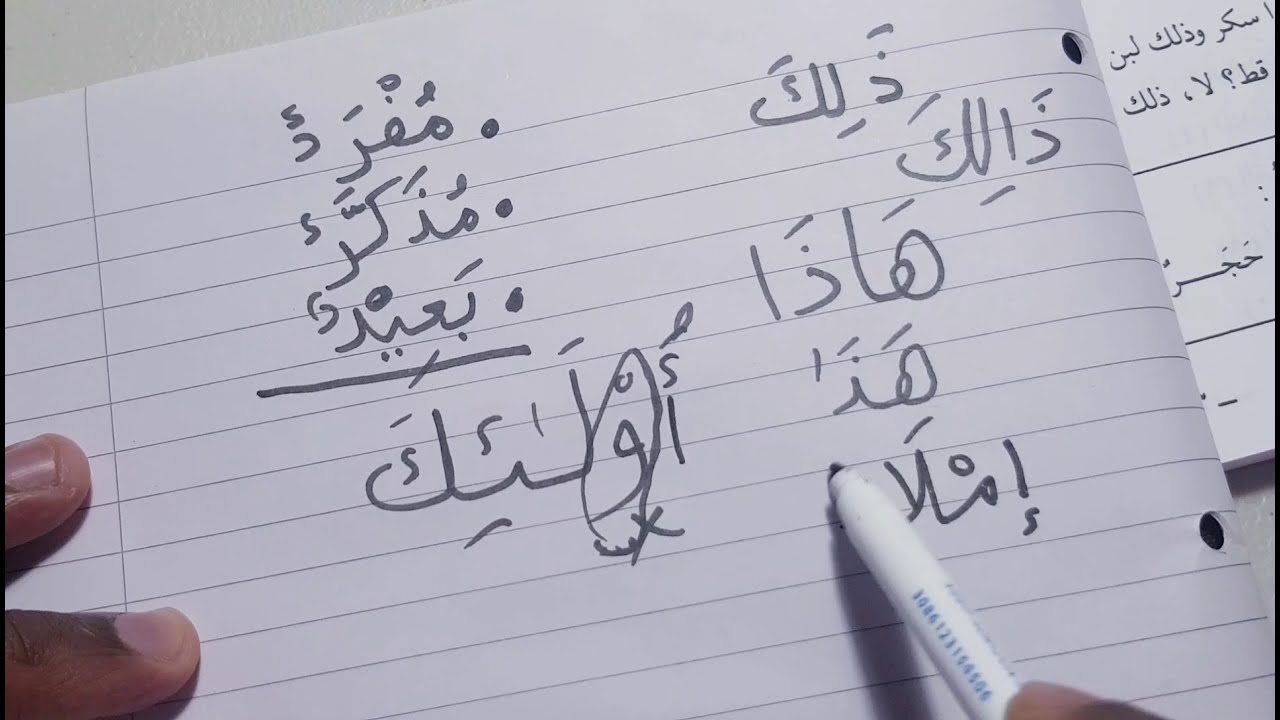
Madinah Arabic course | Book 1 – LESSON 3 (part 3) — Transcript

Lesson 3 of Madinah Arabic Book 1 teaches pronunciation rules of definite article 'al' and exercises on vocabulary and grammar.

Key Takeaways

  • The Arabic definite article 'al' has two pronunciation forms depending on the following letter: clear lam (qamariyah) or merged lam (shamsiyah).
  • Correct pronunciation affects reading fluency but not the definiteness or meaning of the word.
  • Huruf shamsiyah are solar letters that cause the 'lam' to be silent and the following letter to be doubled with shaddah.
  • Consistent practice with reading, writing, and vowelization is essential for mastering Arabic pronunciation rules.
  • Understanding these rules aids in accurate Quranic recitation and Arabic language learning.

Summary

  • Focus on differentiating the pronunciation of the Arabic definite article 'al' as clear (qamariyah) or merged (shamsiyah).
  • Explanation of when to pronounce the 'lam' clearly and when to merge it with the following letter.
  • Reading exercises to practice correct pronunciation and meaning of words with 'al'.
  • Introduction and memorization of huruf shamsiyah (solar letters) and huruf qamariyah (moon letters).
  • Vocabulary practice with words like star, man, rooster, student, merchant, and related adjectives.
  • Homework exercises include reading, writing with correct vowelization, and matching words with suitable adjectives.
  • Emphasis on correct placement of diacritics (tashkil) and shaddah in writing exercises.
  • Practice with common Arabic phrases and sentences to reinforce grammar and pronunciation rules.
  • Coverage of basic Arabic prayers and religious terms such as names of the five daily prayers.
  • Encouragement to write exercises in notebooks for better practice and retention.

Full Transcript — Download SRT & Markdown

00:00
Speaker A
ادع الى سبيل ربك بالحكمه والموعظه الحسنه وجادلهم بالتي هي احسن.
00:11
Speaker A
بسم الله الرحمن الرحيم الحمد لله حمدا كثيرا طيبا مباركا فيه كما يحب ربنا ويرضاه.
00:19
Speaker A
So last lesson we covered parts two of lesson three, part two of lesson three and the main theme was knowing the difference between and.
00:33
Speaker A
And all of this is so that we are able to differentiate between the al which is pronounced clearly with a sukoon and the lam which is merged into the letter after it.
00:45
Speaker A
So there's two ways of pronouncing this al, sometimes we read it clearly, al, al-Qalam, this is when it's followed by a.
00:55
Speaker A
But when it's followed by a we don't read the lam, we merge it into the letter after it, an-Najm.
01:02
Speaker A
Okay, so let's start.
01:03
Speaker A
Najmun, a star.
01:07
Speaker A
An-Najmu, the star.
01:09
Speaker A
Rajulun, a man.
01:12
Speaker A
Ar-Rajulu, ar-Rajulu, the man.
01:15
Speaker A
So we don't say al-Rajulu, we say ar-Rajulu.
01:22
Speaker A
So we should by now be able to differentiate between the and.
01:28
Speaker A
Diykun, a rooster.
01:31
Speaker A
Ad-Diyku, you should have a here.
01:35
Speaker A
Ad-Diyku, the rooster.
01:37
Speaker A
Talibun, a student.
01:40
Speaker A
At-Talibu, the student.
01:42
Speaker A
So their pronunciation doesn't affect the fact that the gets taken off or the meaning that it's become it becomes definite.
01:49
Speaker A
This is not affected.
01:50
Speaker A
So after knowing this, the author he takes us on to this reading exercise here.
01:55
Speaker A
So let's read.
01:56
Speaker A
Number one.
02:00
Speaker A
An-Najmu ba'idun.
02:02
Speaker A
An-Najmu ba'idun.
02:04
Speaker A
The star is far away.
02:08
Speaker A
Number two.
02:10
Speaker A
Ar-Rajulu waqifun.
02:12
Speaker A
Ar-Rajulu waqifun.
02:14
Speaker A
The man is standing.
02:16
Speaker A
Waqifun.
02:18
Speaker A
As-Sukkaru hulwun.
02:20
Speaker A
As-Sukkaru hulwun.
02:22
Speaker A
The sugar is sweet.
02:24
Speaker A
At-Talibu maridun.
02:26
Speaker A
At-Talibu maridun.
02:28
Speaker A
The student is sick.
02:30
Speaker A
Ad-Diyku jamilun.
02:32
Speaker A
Ad-Diyku jamilun.
02:34
Speaker A
The rooster is beautiful.
02:36
Speaker A
Ad-Daftaru jadidun.
02:38
Speaker A
Ad-Daftaru jadidun.
02:40
Speaker A
The notebook is new.
02:43
Speaker A
At-Tajiru ghaniyun.
02:45
Speaker A
At-Tajiru ghaniyun.
02:47
Speaker A
The merchant is rich.
02:50
Speaker A
Ad-Dukkanu maftuhun.
02:53
Speaker A
Ad-Dukkanu maftuhun.
02:55
Speaker A
The shop is open.
02:57
Speaker A
Number nine.
03:00
Speaker A
Al-Waladu faqirun.
03:02
Speaker A
Al-Waladu faqirun.
03:04
Speaker A
The boy is poor.
03:06
Speaker A
At-Tuffahu ladhidhun.
03:08
Speaker A
At-Tuffahu ladhidhun.
03:10
Speaker A
The apple is tasty.
03:12
Speaker A
Ladhidhun is usually used for foods that taste nice.
03:16
Speaker A
Whereas hulwun, sweet.
03:18
Speaker A
Something is sweet.
03:20
Speaker A
I could say at-Tuffahu hulwun if it was very sweet.
03:24
Speaker A
But ladhidh is generally what's used for describing food that tastes nice.
03:30
Speaker A
At-Tabibu tawilun wal-maridu qasirun.
03:34
Speaker A
At-Tabibu tawilun wal-maridu qasirun.
03:37
Speaker A
The doctor is tall and the patient is short.
03:42
Speaker A
So marid can either refer to a person who is sick or it can refer to a description of a person as being sick.
03:49
Speaker A
At-Talibu maridun, the student is sick.
03:52
Speaker A
Al-Marid, the sick or the patient, yeah, is short.
03:57
Speaker A
So this is the reading exercise.
04:00
Speaker A
Testing us to see whether we are able to pronounce the and.
04:06
Speaker A
When do we say al and when do we say at, ad, ad.
04:10
Speaker A
So here we said wal, we didn't say wa-maridun.
04:15
Speaker A
We said wal-maridun.
04:17
Speaker A
Why? Because mim is from the.
04:20
Speaker A
Here we said al-Walad, we didn't say aw-Walad.
04:25
Speaker A
Why? Because waw is from the so the lam has to be pronounced clearly with a sukoon.
04:30
Speaker A
Tamarun, exercises.
04:32
Speaker A
So there's more than one exercise.
04:34
Speaker A
And this was homework.
04:35
Speaker A
Exercise number one, iqra wa-ktub ma'a dabti awakhiril kalimat.
04:40
Speaker A
Read and write with vowelization of the endings of the words.
04:46
Speaker A
Correct vowelization of the endings of the words.
04:50
Speaker A
So this awakhiril kalimat really shouldn't be there because if you look at the words, all of them have al.
04:57
Speaker A
All of them have al.
05:02
Speaker A
So it's not really a testing of whether we take off the tanween or not.
05:08
Speaker A
It's actually testing of whether we can read the and differentiate between them correctly.
05:13
Speaker A
So this name or the exercise heading.
05:18
Speaker A
The endings of the words is not really appropriate.
05:20
Speaker A
Okay.
05:21
Speaker A
Al-Babu.
05:23
Speaker A
Or al-Babu.
05:24
Speaker A
Al-Babu.
05:25
Speaker A
Huruf.
05:26
Speaker A
Qamariyah.
05:27
Speaker A
The door.
05:28
Speaker A
At-Tajiru.
05:30
Speaker A
Or al-Tajiru.
05:31
Speaker A
Yes.
05:32
Speaker A
At-Tajiru.
05:33
Speaker A
Huruf.
05:34
Speaker A
Shamsiyah.
05:35
Speaker A
And we said.
05:36
Speaker A
Huruf shamsiyah is easy to memorize.
05:39
Speaker A
We memorize ta and tha.
05:42
Speaker A
And then we start from dal and count 10.
05:46
Speaker A
Dal, dhal, ra, za, sin, shin, sad, dad, ta, dha.
05:50
Speaker A
Then lam, nun.
05:52
Speaker A
And that's the huruf shamsiyah.
05:54
Speaker A
Whatever is not part of the huruf shamsiyah is from huruf qamariyah.
05:58
Speaker A
Ta is from the huruf shamsiyah.
06:00
Speaker A
At-Tajiru, the merchant.
06:02
Speaker A
An-Najmu, the star.
06:04
Speaker A
Al-Qamaru, the moon.
06:06
Speaker A
Ad-Diyku, the rooster.
06:08
Speaker A
Al-Ma'u, the water.
06:10
Speaker A
As-Sariru, the bed.
06:12
Speaker A
Al-Baytu, the house.
06:14
Speaker A
Al-Masjidu, the masjid or the mosque.
06:16
Speaker A
Ar-Rajulu, the man.
06:18
Speaker A
As-Sukkaru, two shaddahs.
06:20
Speaker A
Sin and the kaf.
06:22
Speaker A
As-Sukkaru, the sugar.
06:24
Speaker A
Al-Waraqu, the paper or the leaf.
06:31
Speaker A
Fill in the gap in that which follows by placing a suitable word.
06:35
Speaker A
So something or someone is ghaniyun.
06:38
Speaker A
Ghaniyun means rich.
06:39
Speaker A
Who is ghani?
06:40
Speaker A
I could say.
06:41
Speaker A
At-Tajiru ghaniyun.
06:43
Speaker A
The merchant is rich.
06:45
Speaker A
Something is sweet.
06:46
Speaker A
As-Sukkaru hulwun.
06:48
Speaker A
The sugar is sweet.
06:50
Speaker A
Someone is sick.
06:51
Speaker A
Ar-Rajulu maridun.
06:53
Speaker A
Ar-Rajulu maridun, the man is sick.
06:55
Speaker A
Something is tasty.
06:56
Speaker A
At-Tuffahu ladhidhun.
06:58
Speaker A
At-Tuffahu ladhidhun.
07:00
Speaker A
The apple is tasty.
07:02
Speaker A
At-Tabibu qasirun.
07:04
Speaker A
The doctor is short.
07:06
Speaker A
At-Tabibu qasirun.
07:08
Speaker A
That's exercise number two.
07:10
Speaker A
Okay, let's go to the next exercise.
07:12
Speaker A
Here it says ikhtar kalimah min al-qa'imah ba'a tunasib al-kalimah allati fi al-qa'imah hamzah.
07:19
Speaker A
Choose a word from list labeled ba which is suitable to the word in the list labeled hamzah.
07:26
Speaker A
So we need to choose one word from here which matches with the word from here.
07:29
Speaker A
Okay.
07:31
Speaker A
At-Talibu.
07:33
Speaker A
The student.
07:34
Speaker A
Something about the student.
07:36
Speaker A
I would say.
07:38
Speaker A
Maridun.
07:40
Speaker A
At-Talibu maridun.
07:42
Speaker A
The student is sick.
07:44
Speaker A
Ad-Dukkanu, the shop.
07:46
Speaker A
The shop is.
07:48
Speaker A
Maftuhun.
07:50
Speaker A
Ad-Dukkanu maftuhun.
07:52
Speaker A
So put a line.
07:53
Speaker A
At-Tuffahu.
07:55
Speaker A
At-Tuffahu.
07:57
Speaker A
The apple is.
07:59
Speaker A
Ladhidhun, tasty.
08:01
Speaker A
So put a line.
08:02
Speaker A
It's better to do it in the books, notebooks.
08:04
Speaker A
Not inside here.
08:05
Speaker A
It's better to write these exercises out in the notebook and do it.
08:09
Speaker A
Al-Ma'u, the water is.
08:11
Speaker A
Harrun.
08:13
Speaker A
The water is hot.
08:15
Speaker A
Al-Hajaru.
08:17
Speaker A
Al-Hajaru, something that I haven't used.
08:19
Speaker A
Thaqilun.
08:21
Speaker A
Al-Hajaru thaqilun.
08:23
Speaker A
The rock is heavy.
08:25
Speaker A
Al-Qalamu.
08:27
Speaker A
Maksurun.
08:29
Speaker A
Al-Qalamu maksurun.
08:31
Speaker A
The pen is broken.
08:33
Speaker A
Okay, al-Kalimat al-Jadidah.
08:35
Speaker A
We covered this last lesson.
08:37
Speaker A
So we have completed all of the homework.
08:40
Speaker A
Except for this final one.
08:42
Speaker A
Final one, tamrin, exercise.
08:44
Speaker A
This is also testing us with the, whether we can differentiate between the two in terms of pronunciation.
08:50
Speaker A
Iqra al-kalimat al-atiyah wa-ktubha muraiyan qawa'ida nutq al-huruf al-qamariyah.
08:55
Speaker A
Read the following words and write them out while bearing in mind or taking care of the principles related to nutq al-huruf al-qamariyah.
09:00
Speaker A
Pronouncing the and.
09:02
Speaker A
Al-Baytu.
09:04
Speaker A
Al-Baytu.
09:06
Speaker A
So this is a writing, I need to write it out in my book and place the correct tashkil.
09:08
Speaker A
So here with the lam I'm pronouncing it clearly so I would put lam, I'll put a sukoon on the lam.
09:12
Speaker A
Al-Baytu.
09:14
Speaker A
Ad-Diyku.
09:16
Speaker A
I would place a shaddah on the dal.
09:19
Speaker A
Ad-Diyku.
09:21
Speaker A
Ad-Diyku, the rooster.
09:23
Speaker A
Al-Mudarrisu, the teacher.
09:25
Speaker A
Al-Babu, the door.
09:27
Speaker A
At-Talibu, the student.
09:29
Speaker A
So here the lam no sukoon, ta has going to have a shaddah.
09:32
Speaker A
At-Ta.
09:34
Speaker A
Because ta is from the.
09:36
Speaker A
So the lam is not pronounced.
09:38
Speaker A
Rather the ta is going to have a shaddah.
09:40
Speaker A
At-Talibu.
09:42
Speaker A
As-Sukkaru.
09:44
Speaker A
As-Sukkaru.
09:46
Speaker A
Ad-Daftaru, the notebook.
09:48
Speaker A
Ad-Daftaru.
09:50
Speaker A
Al-Akhu.
09:52
Speaker A
Al-Akhu.
09:54
Speaker A
This hamzah is supposed to be on top here, on top of the alif here.
10:00
Speaker A
It's not supposed to be in the middle here.
10:02
Speaker A
Right now it's in the middle, it should be on top of the alif directly on top here.
10:05
Speaker A
Al-Akhu.
10:07
Speaker A
Al-Akhu, the brother.
10:09
Speaker A
Ar-Rasulu.
10:11
Speaker A
Ar-Rasulu, the messenger.
10:13
Speaker A
Muhammad.
10:15
Speaker A
Rasulullah.
10:17
Speaker A
Muhammad is the messenger of Allah.
10:19
Speaker A
Al-Wajhu.
10:21
Speaker A
Al-Wajhu, the face.
10:23
Speaker A
As-Siddiqu.
10:25
Speaker A
The friend.
10:27
Speaker A
Al-Qur'anu, the Quran, the speech of Allah.
10:29
Speaker A
As-Salatu, the prayer.
10:31
Speaker A
Al-Ka'batu, the Ka'bah.
10:33
Speaker A
Al-Ka'batu, the Ka'bah, which is in Makkah.
10:35
Speaker A
Ar-Ra'su.
10:37
Speaker A
Ar-Ra'su, the head.
10:39
Speaker A
Al-Isba'u.
10:41
Speaker A
Al-Isba'u is the finger.
10:43
Speaker A
The finger.
10:45
Speaker A
As-Sabunu.
10:47
Speaker A
As-Sabunu, the soap.
10:49
Speaker A
Soap.
10:51
Speaker A
Ad-Dufru, fingernail.
10:53
Speaker A
Ad-Dufru, fingernail.
10:55
Speaker A
Al-Fajru.
10:57
Speaker A
Al-Fajru, salat al-Fajr.
10:59
Speaker A
Or it can mean early part of the the day.
11:02
Speaker A
Al-Fajru.
11:04
Speaker A
Ad-Duhru, the Duhr prayer.
11:06
Speaker A
Ad-Duhru.
11:08
Speaker A
Al-Asru, the Asr prayer.
11:10
Speaker A
Salat al-Asr.
11:12
Speaker A
Al-Asr.
11:14
Speaker A
Asr.
11:16
Speaker A
It can refer to the evening.
11:18
Speaker A
Al-Maghribu.
11:20
Speaker A
Al-Maghribu.
11:22
Speaker A
The Isha or the Maghrib prayer and it can also refer to the time after sunset.
11:27
Speaker A
Al-Isha'u.
11:29
Speaker A
Al-Isha'u.
11:31
Speaker A
The Isha prayer.
11:33
Speaker A
So al-Fajru, ad-Duhru, al-Asru, al-Maghribu, al-Isha'u, the five obligatory prayers.
11:37
Speaker A
Then we have a picture of a hand.
11:39
Speaker A
Okay, this is the homework.
11:41
Speaker A
Inshallah we're going to start today's lesson.
11:43
Speaker A
Okay, in today's lesson we're not going to move on to lesson four.
11:50
Speaker A
In lesson three, there are several things that we need to mention before moving on.
12:02
Speaker A
Firstly, let's quickly recap what we've taken so far.
12:06
Speaker A
So we've taken so far that the Arabic language is made made up of words.
12:10
Speaker A
Kalimatun is a word.
12:12
Speaker A
Kalimatun.
12:13
Speaker A
Kalimatun is a word.
12:15
Speaker A
The plural of kalimatun is kalimatun.
12:18
Speaker A
Kalimatun.
12:20
Speaker A
Kalimatun, remember al-kalimat al-jadidah, the new words.
12:23
Speaker A
The new words.
12:25
Speaker A
Okay, kalimatun in the Arabic language, we said the words in the Arabic language are divided into three types.
12:30
Speaker A
There are three types of words.
12:32
Speaker A
We have ismun.
12:33
Speaker A
Then we have fi'lun and harfun.
12:37
Speaker A
So ismun is a noun, fi'lun is a verb and harfun is a particle.
12:40
Speaker A
Something which connects the two.
12:42
Speaker A
Harfun, a particle.
12:43
Speaker A
Then we said in book one we're going to concentrate on ismun more than fi'lun and harfun.
12:48
Speaker A
So we're going to concentrate on ismun.
12:50
Speaker A
Then we said ismun, we categorized ismun into several categorizations.
12:53
Speaker A
The first one was in terms of gender.
12:56
Speaker A
In terms of gender.
12:58
Speaker A
Ismun can either be muzakkarun.
13:00
Speaker A
Muzakkarun, masculine.
13:02
Speaker A
Or mu'annathun, feminine.
13:04
Speaker A
We said it's either muzakkarun or mu'annathun.
13:07
Speaker A
That's in terms of gender, the ism is either muzakkarun or mu'annathun.
13:11
Speaker A
Whether it's living or non-living, it always has a gender.
13:14
Speaker A
So what's the gender of qalamun?
13:16
Speaker A
The gender of qalamun.
13:18
Speaker A
The gender of qalamun is that it is muzakkar.
13:21
Speaker A
How do we know it's muzakkar?
13:23
Speaker A
Because we can say hadha qalamun.
13:26
Speaker A
It's correct to say hadha qalamun.
13:28
Speaker A
This is a pen.
13:30
Speaker A
Because hadha is used to point at point at things which are masculine.
13:34
Speaker A
Yeah.
13:35
Speaker A
So we can say hadha qalamun.
13:37
Speaker A
And that's correct.
13:39
Speaker A
Okay.
13:43
Speaker A
Can be categorized in terms of number.
13:46
Speaker A
In terms of number.
13:48
Speaker A
Every noun indicates one of three numbers.
13:51
Speaker A
Either mufradun, singular.
13:53
Speaker A
Mufradun.
13:55
Speaker A
Or muthanna.
13:57
Speaker A
Muthanna is dual.
13:59
Speaker A
Two.
14:01
Speaker A
If it's more than two, jam'un, plural.
14:03
Speaker A
Jam'un.
14:05
Speaker A
This is in terms of number.
14:07
Speaker A
We also mentioned previously that every noun is either.
14:10
Speaker A
Ma'rifah or nakirah.
14:12
Speaker A
Definite or indefinite.
14:14
Speaker A
Every noun in terms of it being definite.
14:16
Speaker A
Indicating something specific or something which is not specific.
14:19
Speaker A
Is split into two.
14:21
Speaker A
So we have ma'rifah.
14:23
Speaker A
Ma'rifah.
14:25
Speaker A
And here we have nakirah.
14:27
Speaker A
Nakirah.
14:29
Speaker A
What's nakirah?
14:31
Speaker A
Indefinite.
14:32
Speaker A
Something that is not specific.
14:34
Speaker A
What's ma'rifah?
14:35
Speaker A
Something specific.
14:36
Speaker A
Okay, so these are different categorizations of nouns.
14:40
Speaker A
In terms of gender, muzakkarun, mu'annathun, masculine, feminine.
14:43
Speaker A
In terms of number, it's either indicate something which is singular, dual or plural.
14:47
Speaker A
In terms of is it indicating something which is specific, it's either ma'rifah or unspecific, nakirah, definite, indefinite.
14:52
Speaker A
Okay, with words we use words to create sentences.
14:55
Speaker A
How do we say sentence in Arabic?
14:57
Speaker A
We say jumlatun.
14:59
Speaker A
Jumlatun.
15:01
Speaker A
What's a jumla?
15:03
Speaker A
A jumla is a sentence.
15:05
Speaker A
Jumlatun means sentence.
15:07
Speaker A
There are two types of sentences in the Arabic language.
15:10
Speaker A
First type is jumlatun ismiyatun.
15:13
Speaker A
Jumlatun ismiyatun.
15:15
Speaker A
Ism, we said is a noun.
15:17
Speaker A
So noun, something to do with noun.
15:20
Speaker A
A sentence to do dealing with nouns.
15:23
Speaker A
They translate it as a nominal, nominal sentence.
15:26
Speaker A
Or noun or sentence or nominal sentence.
15:29
Speaker A
And the second type of sentence is jumlatun fi'liyatun.
15:32
Speaker A
Jumlatun fi'liyatun.
15:35
Speaker A
Fi'l is a verb.
15:37
Speaker A
So some sentence which revolves around a verb.
15:40
Speaker A
We call it a verbal sentence.
15:42
Speaker A
Verbal sentence.
15:44
Speaker A
So we have a jumlatun ismiyatun and jumlatun fi'liyatun.
15:46
Speaker A
We said book one deals with nouns.
15:48
Speaker A
For that reason we're going to be concentrating on jumlatun ismiyatun, the nominal sentence.
15:52
Speaker A
Firstly, what's the difference between a jumlatun ismiyatun and a jumlatun fi'liyatun?
15:55
Speaker A
The main difference is that this one.
15:58
Speaker A
Starts with a noun.
16:00
Speaker A
Starts with a noun.
16:02
Speaker A
Starts with an ism.
16:04
Speaker A
And jumlatun fi'liyatun.
16:06
Speaker A
Starts with a verb.
16:08
Speaker A
Starts with a verb.
16:10
Speaker A
Starts with a fi'l.
16:12
Speaker A
Okay.
16:14
Speaker A
So that cancels out jumlatun fi'liyatun.
16:16
Speaker A
We're not going to be speaking about this.
16:18
Speaker A
Now we're going to be speaking about jumlatun ismiyatun.
16:20
Speaker A
We know the jumlatun ismiyatun is one which starts with a noun.
16:23
Speaker A
Okay.
16:24
Speaker A
How do we construct a jumlatun ismiyatun?
16:27
Speaker A
Jumlatun ismiyatun, to construct a jumlatun ismiyatun you have to have two parts.
16:30
Speaker A
You have to have two elements.
16:32
Speaker A
For any jumlatun ismiyatun you will always have these two elements.
16:35
Speaker A
The first element which is the subject.
16:39
Speaker A
You have to talk about something in your sentence.
16:42
Speaker A
What's the subject or the topic of that sentence?
16:45
Speaker A
Yeah, something that you're giving information about.
16:48
Speaker A
Something you're talking about.
16:50
Speaker A
The thing that you're talking about is called mubtada'un.
16:53
Speaker A
Mubtada'un.
16:55
Speaker A
What's mubtada?
16:56
Speaker A
The subject or the topic or the thing you're talking about.
17:00
Speaker A
Yeah.
17:01
Speaker A
Subject.
17:02
Speaker A
I'm going to write subject.
17:04
Speaker A
The subject of your sentence.
17:06
Speaker A
What is your sentence?
17:08
Speaker A
Revolving around.
17:10
Speaker A
You're informing about something.
17:12
Speaker A
What is this that you're talking about?
17:14
Speaker A
This is called mubtada.
17:16
Speaker A
Once you have something that you're talking about, you need to give information about this thing.
17:19
Speaker A
We use khabarun to give information about the subject.
17:22
Speaker A
Khabarun.
17:24
Speaker A
What's khabar?
17:25
Speaker A
The word that comes to give information.
17:28
Speaker A
They translate it as predicate, but I'm going to say information.
17:31
Speaker A
Information.
17:34
Speaker A
So we have subject, something that we're talking about and then information about this thing we're talking about.
17:37
Speaker A
That's how we create a sentence.
17:39
Speaker A
So let's give an example.
17:41
Speaker A
I'm going to say al-Qalamu.
17:43
Speaker A
Al-Qalamu.
17:45
Speaker A
Al-Qalamu is what I'm talking about.
17:48
Speaker A
So this is my mubtada.
17:50
Speaker A
So this is the first component, the first element of the sentence.
17:53
Speaker A
Okay, now I need to give information, khabar.
17:55
Speaker A
I could say al-Qalamu, is it tall, is it short, is it broken, is it new?
17:58
Speaker A
Okay, I'll say it's new.
18:00
Speaker A
Jadidun.
18:02
Speaker A
Al-Qalamu jadidun.
18:04
Speaker A
The pen is new.
18:06
Speaker A
The pen is new.
18:08
Speaker A
This is a complete sentence, I can put a full stop.
18:11
Speaker A
This is a jumla.
18:12
Speaker A
And this jumla, is it jumlatun fi'liyatun or jumlatun ismiyatun?
18:15
Speaker A
Okay, what's a jumlatun fi'liyatun?
18:17
Speaker A
Starts with a verb.
18:19
Speaker A
Is it starting with a verb?
18:21
Speaker A
This is not a verb.
18:23
Speaker A
Qalamun is not a verb.
18:25
Speaker A
Is it starting with a noun?
18:27
Speaker A
Al-Qalamu is a noun.
18:29
Speaker A
Yes, it's a noun.
18:30
Speaker A
So this must be a jumlatun ismiyatun because it's starting with a noun.
18:33
Speaker A
Okay.
18:35
Speaker A
Jumlatun ismiyatun is built up of mubtada and khabar.
18:38
Speaker A
Subject and something comes to give information about the subject.
18:41
Speaker A
Is that what I have?
18:42
Speaker A
Okay, let's see.
18:44
Speaker A
What am I talking about in this sentence?
18:46
Speaker A
Pen.
18:47
Speaker A
Okay, I have my mubtada.
18:49
Speaker A
Is there something which gives information about the mubtada?
18:51
Speaker A
Jadidun.
18:52
Speaker A
Okay, jadidun is my khabar.
18:54
Speaker A
So I have al-Qalamu jadidun.
18:56
Speaker A
Mubtada, khabar.
18:58
Speaker A
Mubtada, khabar.
19:00
Speaker A
My sentence is complete and it makes sense.
19:02
Speaker A
The pen is new.
19:04
Speaker A
So this is what we need to know within lesson three.
19:07
Speaker A
That the sentences that we've been constructing, the sentences that we've been.
19:11
Speaker A
Al-Qalamu jadidun.
19:13
Speaker A
The pen is new.
19:15
Speaker A
At-Tabibu qasirun.
19:17
Speaker A
The doctor is short.
19:19
Speaker A
All of these short sentences, they were actually jumlatun ismiyatun.
19:22
Speaker A
All of them were nominal sentences.
19:25
Speaker A
And the first part was our mubtada, subject.
19:28
Speaker A
Every part of those short sentences that we are reading.
19:31
Speaker A
We actually had jumlatun ismiyatun and the first part was our mubtada.
19:34
Speaker A
And the second part was our khabar.
19:37
Speaker A
So if we go back to the book.
19:38
Speaker A
So from the start, this is what the author was teaching us.
19:41
Speaker A
Al-Qalamu maksurun.
19:44
Speaker A
The pen is broken.
19:46
Speaker A
Jumlatun ismiyatun.
19:48
Speaker A
This is a nominal sentence.
19:50
Speaker A
This is our mubtada.
19:52
Speaker A
This is our khabar.
19:54
Speaker A
Al-Babu maftuhun.
19:56
Speaker A
The door is open.
19:58
Speaker A
Mubtada, khabar.
20:20
Speaker A
And then the exercises here.
20:22
Speaker A
He was giving you the mubtada, al-Hajaru.
20:26
Speaker A
So he's given you the mubtada, he wants you to fill in the blank.
20:30
Speaker A
What is this blank?
20:32
Speaker A
This is the khabar.
20:34
Speaker A
Information about the mubtada to complete the sentence.
20:37
Speaker A
Because you can't have one worded sentence, it won't make sense.
20:40
Speaker A
It needs to be a jumlatun mufidah.
20:43
Speaker A
Something which is beneficial.
20:45
Speaker A
Al-Hajaru.
20:47
Speaker A
What about the Hajar?
20:49
Speaker A
So far it's incomplete.
20:51
Speaker A
Al-Hajaru thaqilun.
20:53
Speaker A
So I give an appropriate khabar.
20:56
Speaker A
So here he's given me the mubtada, he wants a khabar.
20:59
Speaker A
And he does the opposite in the next exercise.
21:02
Speaker A
He's given me the khabar now.
21:05
Speaker A
He wants me to fill in the mubtada.
21:08
Speaker A
Al-Qamisu nazifun.
21:10
Speaker A
Yeah.
21:12
Speaker A
And the same here.
21:14
Speaker A
Yeah, these exercises were actually testing you to see if you can put in the correct mubtada and the correct khabar.
21:18
Speaker A
Yeah.
21:20
Speaker A
So all of this, these sentences.
21:22
Speaker A
They were giving you mubtada, khabar.
21:24
Speaker A
Mubtada, khabar.
21:26
Speaker A
I'm going to give another example sentence.
21:28
Speaker A
The example sentence is al-Kitabu kabirun.
21:30
Speaker A
Al-Kitabu kabirun.
21:32
Speaker A
Full stop.
21:34
Speaker A
Because this is a complete sentence.
21:36
Speaker A
Al-Kitabu kabirun.
21:38
Speaker A
The book is big.
21:40
Speaker A
The book is big.
21:42
Speaker A
What type of jumla is this?
21:44
Speaker A
What type of sentence is this?
21:46
Speaker A
This is a jumlatun ismiyatun.
21:48
Speaker A
Why is it a jumlatun ismiyatun?
21:50
Speaker A
Because it starts with a noun.
21:52
Speaker A
Okay, now the question is.
21:54
Speaker A
How do I know that this is a noun?
21:57
Speaker A
How do I know that this word is a noun?
22:00
Speaker A
I'm going to give you two signs which you should be looking for to identify whether a word is a noun or not.
22:05
Speaker A
Two signs.
22:07
Speaker A
The first one is alif lam, al.
22:10
Speaker A
Al.
22:12
Speaker A
This al, if you find al at the start or prefixed to a word.
22:17
Speaker A
Then you know that this word is a noun.
22:20
Speaker A
I know kitabun is a noun because al has been added to it.
22:23
Speaker A
The second one is tanween.
22:25
Speaker A
Tanween.
22:27
Speaker A
We know what tanween is.
22:29
Speaker A
We've spoken about it.
22:30
Speaker A
So tanween also is a sign that a word is a noun.
22:34
Speaker A
Is an ism.
22:36
Speaker A
I know this is an ism because of the tanween that's there.
22:38
Speaker A
So this sign comes at the beginning of the noun and this sign comes at the end of the noun.
22:41
Speaker A
I know this is a jumlatun ismiyatun because it starts with a noun.
22:44
Speaker A
I know this is a noun because it has al.
22:46
Speaker A
Okay, that's the first thing that we need to remember.
22:48
Speaker A
So look here now.
22:50
Speaker A
Al-Kitab, al-Kitab which is the thing that I'm talking about.
22:54
Speaker A
Is definite.
22:56
Speaker A
So mubtada.
22:58
Speaker A
The mubtada.
23:00
Speaker A
Which is what I'm talking about.
23:02
Speaker A
The subject of the sentence.
23:04
Speaker A
Comes first.
23:06
Speaker A
Yeah.
23:08
Speaker A
So the mubtada usually comes first.
23:10
Speaker A
And it's definite.
23:12
Speaker A
How is this definite?
23:14
Speaker A
It has al attached to it.
23:16
Speaker A
The book.
23:18
Speaker A
I'm talking about something specific.
23:20
Speaker A
And it's a noun.
23:22
Speaker A
The mubtada is going to be a noun.
23:24
Speaker A
Okay, let's look at the khabar now.
23:26
Speaker A
The khabar.
23:28
Speaker A
So if the mubtada comes first, that means the khabar comes after.
23:31
Speaker A
Comes after M.
23:33
Speaker A
Which is the mubtada.
23:35
Speaker A
That's number one.
23:37
Speaker A
Number two.
23:39
Speaker A
Is it definite or indefinite?
23:41
Speaker A
Indefinite.
23:43
Speaker A
And it's also a noun.
23:45
Speaker A
Number three.
23:47
Speaker A
And it's also a noun.
23:49
Speaker A
Okay, so these are the three characteristics for each.
23:51
Speaker A
Three characteristics.
23:53
Speaker A
The mubtada comes first.
23:55
Speaker A
And the mubtada is definite.
23:57
Speaker A
And it's a noun.
23:59
Speaker A
Our khabar should come after the mubtada.
24:02
Speaker A
It should be indefinite.
24:04
Speaker A
And it should be a noun also.
24:06
Speaker A
So three characteristics for each.
24:08
Speaker A
Three characteristics.
24:10
Speaker A
Okay.
24:12
Speaker A
Subhanakallahumma wa bihamdika ashhadu alla ilaha illa anta astaghfiruka wa atubu ilayk.
Topics:Madinah ArabicArabic grammardefinite article alhuruf shamsiyahhuruf qamariyahArabic pronunciationArabic vocabularyArabic exercisesQuranic ArabicArabic language learning

Frequently Asked Questions

What is the main focus of Lesson 3 in the Madinah Arabic Book 1 course?

The main focus is on understanding and correctly pronouncing the Arabic definite article 'al', differentiating between the clear lam (qamariyah) and the merged lam (shamsiyah).

How do you know when to pronounce the 'lam' in 'al' clearly or merge it with the next letter?

If the letter following 'al' is a moon letter (huruf qamariyah), the lam is pronounced clearly with a sukoon. If it is a solar letter (huruf shamsiyah), the lam is silent and the following letter is doubled with a shaddah.

What types of exercises are included in this lesson to practice the pronunciation rules?

Exercises include reading sentences aloud, writing words with correct vowelization and shaddah, matching vocabulary with adjectives, and practicing correct pronunciation of the definite article.

Get More with the Söz AI App

Transcribe recordings, audio files, and YouTube videos — with AI summaries, speaker detection, and unlimited transcriptions.

Or transcribe another YouTube video here →