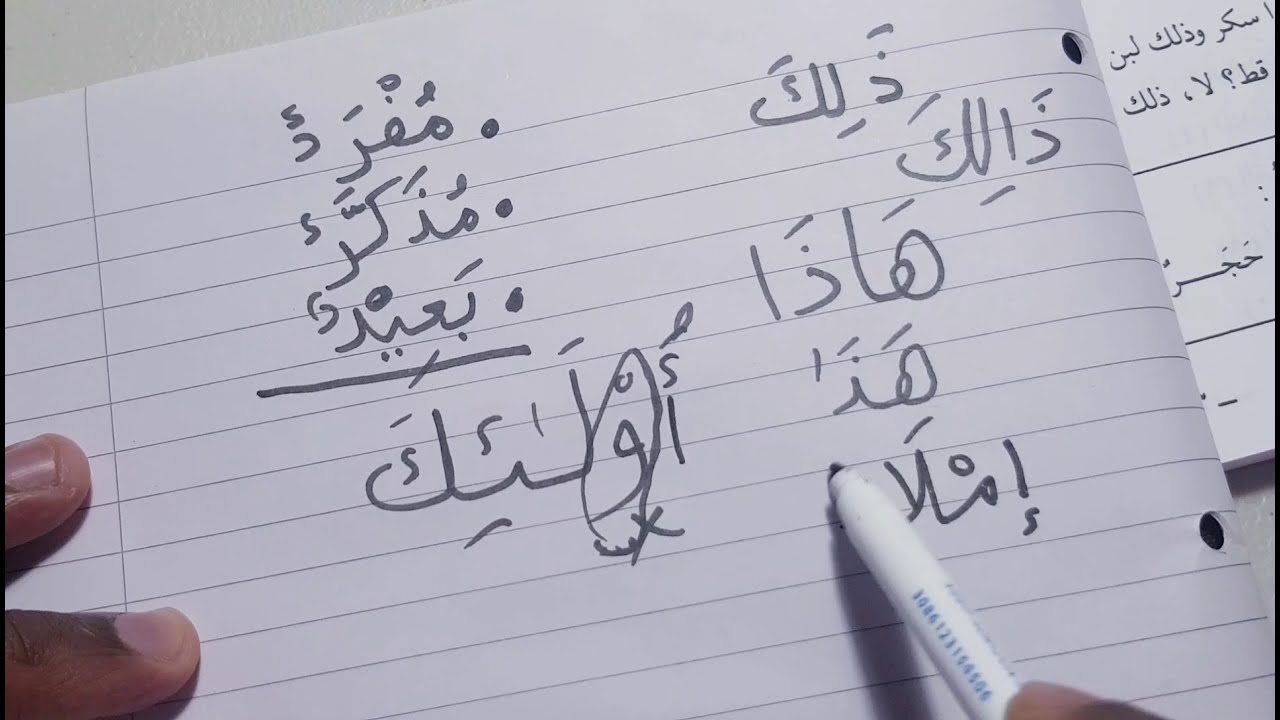
Introduction to Madinah Arabic Book 1 Lesson 1 focusing on vocabulary memorization, gender rules, and basic sentence construction.
Key Takeaways
- Memorizing vocabulary and using it in context is essential for learning Arabic.
- 'Haza' is a masculine singular demonstrative pronoun used for nearby objects.
- Arabic nouns have gender and learners must know whether words are masculine or feminine.
- Organizing vocabulary with pronunciation, meaning, gender, plural, and example sentences aids retention.
- Arabic is read and written from right to left, affecting punctuation like the question mark.
Summary
- Review of vocabulary from the previous lesson including common nouns like house, chair, pen, and mosque.
- Emphasis on memorizing vocabulary and using words in the correct context.
- Introduction to the Arabic phrase 'Kayfa taqul?' meaning 'How do you say?' with masculine and feminine forms.
- Explanation of the demonstrative pronoun 'haza' used for masculine, singular, and close objects.
- Guidance on organizing vocabulary notes including word, translation, gender, example sentence, and plural form.
- Discussion of Arabic noun gender (masculine and feminine) and grammatical categories: noun (ismun), verb (fi'lun), particle (harfun).
- Clarification on pronunciation, writing, meaning, gender, plural, and example sentence as key steps in learning new words.
- Encouragement to expand vocabulary beyond the textbook for richer language acquisition.
- Brief mention of Arabic reading and writing direction (right to left) and the orientation of the question mark.
- Plan to share vocabulary notes via Telegram for easier student access.