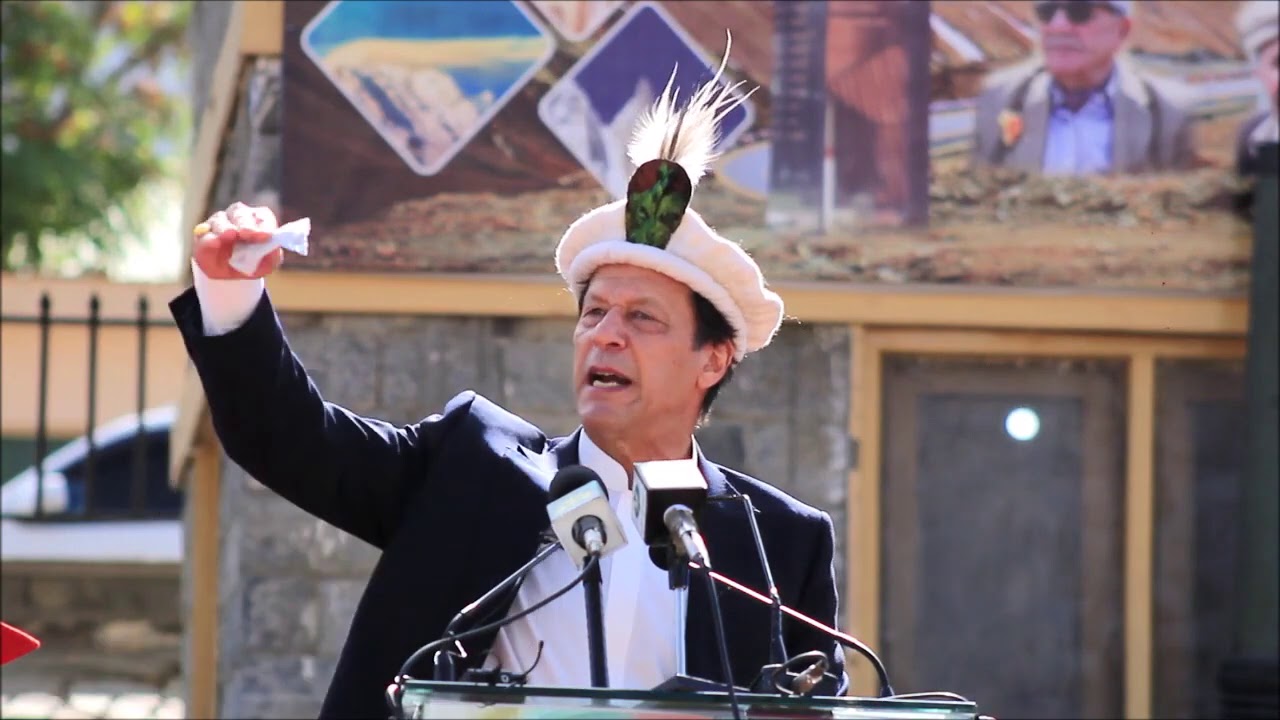
Prime Minister Imran Khan Speech at Margalla Dialogue |… — Transcript

PM Imran Khan discusses Pakistan's foreign policy lessons, regional peace efforts, China relations, and challenges with India at Margalla Dialogue 2019.

Key Takeaways

  • Avoid involvement in foreign wars to prevent societal harm and loss.
  • Focus on regional peacebuilding and diplomatic bridge-building roles.
  • Leverage China-Pakistan cooperation for economic and technological advancement.
  • Address challenges posed by extremist ideologies in neighboring India.
  • Promote internal reforms to attract investment and tourism.

Summary

  • Pakistan should avoid aligning with countries that drag it into wars, learning from past conflicts like the Afghan Jihad and war on terror.
  • Pakistan aims to become a bridge builder and conciliator between rival countries rather than a participant in conflicts.
  • China's infrastructure development model is praised as a superior foreign policy example compared to the US's war expenditures.
  • Pakistan is improving ease of doing business, tourism, and investor access to boost economic growth and regional peace.
  • Pakistan plays a significant role in promoting peace and political settlement efforts in Afghanistan.
  • Strong historical ties with Saudi Arabia and Iran are highlighted as important for regional stability.
  • Pakistan-China relations are at their best, with cooperation in agriculture, technology, special economic zones, and education.
  • Efforts to mend ties with India have failed due to the rise of extremist Hindu nationalism and racial superiority ideology.
  • The current political climate in India is compared to early Nazi Germany, with concerns about suppression of dissent and rising hate.
  • The speech emphasizes the need for Pakistan to focus on internal development and peaceful diplomacy for future progress.

Full Transcript — Download SRT & Markdown

00:00
Speaker A
Pakistan, Mr. Imran Khan, to kindly deliver his address.
00:07
Speaker A
Bismillah-ir-Rahman-ir-Rahim.
00:10
Speaker A
Ambassador Riaz, thank you very much for what the Margalla Dialogue has so far achieved, the 10 points, I think there were about 10 points which you elaborated.
00:27
Speaker A
Ladies and gentlemen, I think this is a great beginning, it's very important for Pakistan that we interact with minds outside the country, it's important to have think tanks which develop ideas and then exchange ideas with the outside world.
00:50
Speaker A
It's important that we portray Pakistan's point of view outside the country.
00:59
Speaker A
So this is a great beginning, when we started international cancer conference in Shaukat Khanum, so there were hardly any outsiders who came to attend the first few conferences.
01:40
Speaker A
But today, Shaukat Khanum's International Cancer Symposium is one of the most well-attended in the world, it has, it produces papers, exchange of ideas, and so the whole, the level of competence in SKMT has gone up by learning from ideas abroad.
02:16
Speaker A
Um, you've covered a lot of subjects, but let me just start by saying that what has Pakistan learned from its foreign policy in the last four decades?
02:31
Speaker A
The one main lesson we have learned is that we do not want to be aligning ourselves with any country where we have to fight someone's war.
03:30
Speaker A
I think Pakistan has suffered, we initially, our governments thought that they would gain by becoming a frontline state for some power, we gained something, we had aid given to Pakistan, but in the end we discovered that we lost far, far, far more than we gained.
04:00
Speaker A
We, in 80s, we were part of the Afghan Jihad, in fact, we were the frontline state, in 90s again we were the frontline state in the war against terror, and the impact joining these two conflicts, the impact it had on our society, I don't think it's been properly analyzed so far.
05:25
Speaker A
I think if we ever sit down and analyze the negative impact, we will find that a lot of problems we face today date back to the time we became part of the Afghan Jihad and then the war on terror was a disaster for Pakistan.
06:00
Speaker A
And so, what have we learned, that we will now be a bridge builder, we will try and play the role of a conciliator between rival countries, no longer will we become part of a conflict.
06:44
Speaker A
And I think once this realization goes through every strata of society, unfortunately some people still don't believe that we lost out in participating in these two conflicts, there are two countries we can learn from, the experiences of two countries, one is China, the other is the United States.
07:38
Speaker A
In the last 20 years, look at the infrastructure development in China, compare that to the United States, United States supposedly won the wars in Afghanistan, in Iraq, but the amount of money spent, God knows how many trillion dollars were spent in these wars, at the same time China was spending that money on its infrastructure.
08:27
Speaker A
And anyone who has seen the change in China in these past 20 years will understand that the Chinese way of running their foreign policy is much, much superior, they also have their conflicts, but nowhere did China commit to a, commit to fighting a war.
09:18
Speaker A
Pakistan has great opportunities, as you mentioned Ambassador Riaz, the geostrategic position of Pakistan is such that if we from now onwards put our house in order, and by that ease of doing business, making it easier for investors to come to Pakistan, our visa regime, making it easier for people to see Pakistan.
10:00
Speaker A
Previously, we made it so difficult for tourists to come to Pakistan, the investors, of course, the war on terror, that put paid to the investors, meetings would be held in Dubai, cricket teams wouldn't tour Pakistan.
10:27
Speaker A
I mean, the last 10 years we have trouble to attracting sports people to Pakistan, so now what we have, what we are trying to do is to make it easy to come to Pakistan, we are opening up all our areas, removing a lot of no objection certificates of going in the northern areas.
10:56
Speaker A
For me, the most beautiful areas in the world, and at the same time, trying to help in, helping our neighborhood and having peace.
11:20
Speaker A
I'm very proud to say that Pakistan is playing a very big role in peace in Afghanistan, we are hoping that the recent developments will move towards a ceasefire, talks, and a political settlement in Afghanistan.
12:01
Speaker A
Not easy, but it's the only way which the world now recognized, the only way forward is, is a political solution rather than a military one, Iran, Saudi Arabia, one of our, what should I say, one of the, Saudi Arabia has always been a friend in need for Pakistan.
12:37
Speaker A
Whenever we've needed help, Saudi Arabia has been there, and I can never forget my government when we came into power, the sort of economic challenges which we faced, Saudi Arabia was the first country to come forward and help us, and Iran is our neighbor.
13:18
Speaker A
In times, we can never forget in the 60s when Pakistan was involved in a conflict, Iran came to our help, so, two, one friend, one neighbor, facing a conflict situation.
13:44
Speaker A
Again, I'm very pleased to say that Pakistan has, is trying its best, has done its best to make sure that there is not, there is not a conflict in our neighborhood, having already suffered what is happening in Afghanistan and the war on terror in Pakistan.
14:26
Speaker A
Our relationship with China is better than it's ever been, China offers us the greatest hope of improving productivity in Pakistan, agriculture is the mainstay in our country and China has come forward and offered us new technologies, there are exchanges taking place, and if we can just double our yields.
15:27
Speaker A
In China, the yields are three times, four times of Pakistan, even if we double our yields, Pakistan becomes a net exporter of agricultural products, on top of it the special economic zones which I noticed you also mentioned, we are working on them to ask the Chinese industry to relocate in Pakistan.
15:50
Speaker A
And we are working on that, China is also helping us in various technologies, we are setting up a university in Pakistan where China is going to help us in the latest technologies of artificial intelligence and so on.
16:10
Speaker A
The problem is India.
16:20
Speaker A
We tried our best to mend fences with India, started dialogue, tried everything, unfortunately, India is in the grip of an extremist ideology.
16:51
Speaker A
I probably know India better than most Pakistanis, I have been to India more times, I have friendship there, I understood India, I had a lot of love and respect as a sportsman in India, what is happening in India right now is tragic.
17:38
Speaker A
India has been taken over by a racist, an ideology which believes in racial superiority, and an ideology which is built on hate, because whenever you, an ideology is sold as RSS has sold this ideology of Hindu superiority, it also sold the hatred.
18:18
Speaker A
The reason why they could not reach to their great Hindu civilization was because of Muslims, Christians, invaders.
18:22
Speaker A
So this hate, when the two get together, racial superiority and hatred for other races, it always ends up in bloodshed.
18:33
Speaker A
It's the nearest thing to Nazi Germany what is happening in India, in when the Nazi party came about in the 20s, no one quite understood where it was heading.
18:45
Speaker A
The Nazi party was in the beginning, all the intellectuals, people thought that the Nazi party was the best thing happening to India, to Germany, because they talked about nationalism, national pride, self-esteem, a country that had been defeated in the First World War.
19:03
Speaker A
No one understood where it was heading, in my opinion, not everyone understands where India is headed right now.
19:17
Speaker A
Between 1930 and 1934, in four years, Germany went from a liberal democracy to a totalitarian, fascist state, racist state, in India, their Nobel Prize winner, Amartya Sen.
19:59
Speaker A
He recently gave an interview to the New Yorker, where he said that he has never, he's never felt the fear in India, people are scared, no one talks about it now.
20:25
Speaker A
The media has been, has been scared into submission, opposition politicians are not allowed to, are scared to speak out because it's about Hindu nationalism, this is a genie where it, when it goes out of the bottle, it's very difficult to put it back in.
20:54
Speaker A
In my opinion, Narendra Modi is riding a tiger, he, the, with every passing day, it will be more difficult for him not to be controlled by this ideology, this ideology will win him votes, will give him a lot of electoral success, so did the Nazi ideology.
21:46
Speaker A
But eventually this will lead to destruction, in my opinion, India is going to suffer because India has almost 400 to 450 million people who will be marginalized by this ideology.
22:16
Speaker A
They are Muslims, they are Sikhs, they are Christians, they are the tribals, they are the Dalits, they will be excluded from this, this Hindutva, the Hindutva ideology.
22:23
Speaker A
And that's where the danger lies, it's for India, the greatest danger is right now for India.
22:30
Speaker A
But Pakistan also is, is not out of the danger zone because of Kashmir, what they have done is Kashmir, in Kashmir right now, I'm afraid, the Modi government has gone into a blind alley.
23:23
Speaker A
The moment they lift the curfew, and this is now almost over a hundred days of curfew, people of Kashmir are suffering, it's incredible that how eight million people could be put through this ordeal.
23:38
Speaker A
But it can only happen when you have this racist ideology which is built on hate, so 100, almost over 100 days these people are under curfew.
23:58
Speaker A
All the civil liberties have been taken away, their humanitarian, human rights been abused, their leadership, thousands of them put inside in jails all over India, young people picked up in the middle of the night, teenagers taken away, through fear, through 800,000 troops there in the valley, spreading fear, obviously not fighting terrorism, terrorizing the population.
25:00
Speaker A
So what happens at some point this curfew will have to be lifted, what happens then, I don't think this has been factored in because I think the Modi government thinks that they will be so by their tactics, they would make them submit to this illegal act which they have done, so it makes it very difficult for Pakistan.
25:38
Speaker A
How do we now extend a hand of friendship to India, which is vital for the subcontinent, peace is for the long-term future of the subcontinent is vital.
26:00
Speaker A
One of the things you mentioned, climate change, both countries are going to be affected by climate change, if the, the water shortage and the melting of the glaciers are connected, and so rather than the two countries fighting together, climate change, poverty, huge issue of poverty.
26:40
Speaker A
We are now stuck in the situation where this, this extreme ideology has taken over 1.3 billion people armed with nuclear weapons.
26:54
Speaker A
And that's why in my opinion, it's beyond Pakistan, the world has to step in, this is from dialogues like this, interaction of ideas, like the Margalla Dialogue, it's important for us to tell the outside world that this is a very serious situation developing.
27:30
Speaker A
I repeat, no one thought that the, when the Nazis started off that by the end there will be about 50 to 60 million people dead, no one thought that in the beginning, I don't think many people realize that with two nuclear armed countries face to face, and with this extremist ideology, where this can lead to eventually.
28:52
Speaker A
No one knows right now, but unless the world steps in, you, you hope for the best, but we should be prepared for the worst, but the world cannot be prepared for the worst if this goes wrong.
29:30
Speaker A
That's why it's very important for international community to step in now and stop worrying about India being a counterweight to China, the consequences, I repeat, of this going wrong will affect the entire world.
30:04
Speaker A
And that's why the United Nations, I appeal to the UN when I was there, we keep talking, I keep talking to all heads of states who I, who I've had the opportunity to talk to, I explain to them the situation that this can go wrong, and fortunately, I feel that from two months back when I used to talk to them, to now, I feel that there is much, much more awareness of the seriousness of the situation which is taking place in India.
30:42
Speaker A
Apart, aside from this situation developing on, on, on the eastern front, I'm very optimistic, I feel that the Afghanistan issue is heading in the right direction, and Central Asia, I visited Bishkek a few months back, met all the heads of the Central Asian Republics, and I feel that there is so much potential.
31:48
Speaker A
The moment there is peace in Afghanistan, the connectivity with Central Asia, there is enormous potential for Pakistan and those countries which are landlocked, Gwadar has the potential of developing into a future great port, access to, which most of the Central Asian countries along with Afghanistan would love.
32:25
Speaker A
I repeat again if, if things settle down, if the US-Iran relationship improves, Iran has the potential of becoming a real economic powerhouse if the sanctions are lifted, and of course Pakistan again benefits from that, so we are sitting on a, as I repeat, the geostrategic position of Pakistan right now is probably unique in the world.
33:33
Speaker A
And as I repeat again that the, the moment we keep improving our, the investment environment in Pakistan, spending more money on technical education, improving this country for foreigners, people to come, tourism, country has enormous tourist, tourism potential.
34:18
Speaker A
We have probably the most unique religious sites, country is probably the most right country for religious tourism, but also the northern mountains of Pakistan, whoever has ever been there to the northern mountains of Pakistan, they are the most unique places in the world, nowhere have you, you see such still hidden beauty, unexplored, people still haven't seen most of the northern areas.
35:14
Speaker A
So, aside from the problem with India, Pakistan right now, we see a lot of optimism, fortunately we are seeing a lot of investors heading to Pakistan, we are also seeing more increase in tourism in Pakistan, and inshallah, things, looking ahead, things look good, all we need is, we hope that in the next four years in India, elections deliver a favorable result, and then we will have proper relationship with India, and then imagine two of the greatest markets on either side of Pakistan, and that's where, the best way we will alleviate poverty in the country, we have a young population, we want jobs for them, the best way is if we can open trade or 360 degrees, trade opens with Pakistan, this is where we will be able to provide jobs for our people and lift people out of poverty, I again thank you for inviting me here, Ambassadors, ladies and gentlemen, I'm really pleased this dialogue has started, and I hope that we will keep improving this and make this into a real annual event internationally, thank you.
Topics:Imran KhanPakistan foreign policyMargalla DialogueAfghan peaceChina-Pakistan relationsIndia-Pakistan conflictregional stabilityeconomic developmentextremisminternational diplomacy

Frequently Asked Questions

What is Pakistan's main foreign policy lesson according to Imran Khan?

Pakistan has learned not to align with countries that involve it in wars, as past involvement in the Afghan Jihad and war on terror caused more harm than benefit.

How does Imran Khan describe Pakistan's role in Afghanistan peace efforts?

Pakistan is playing a significant role as a peace broker, supporting ceasefire talks and a political settlement as the only viable solution to the conflict.

What challenges does Pakistan face in its relationship with India?

Imran Khan cites the rise of extremist Hindu nationalism and racial superiority ideology in India, comparing it to early Nazi Germany, which has hindered dialogue and worsened tensions.

Get More with the Söz AI App

Transcribe recordings, audio files, and YouTube videos — with AI summaries, speaker detection, and unlimited transcriptions.

Or transcribe another YouTube video here →