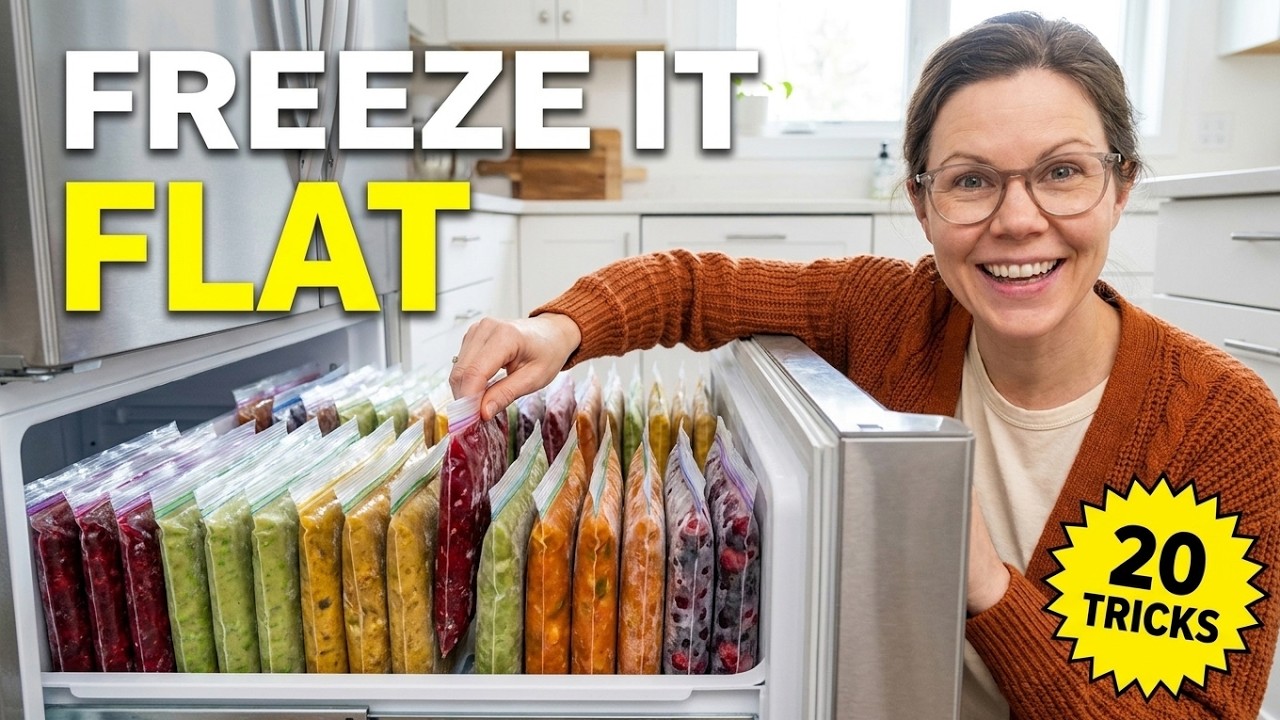
Learn 12 practical habits to prevent freezer burn and improve the taste of your frozen food, saving money and enhancing flavor.
Key Takeaways
- Proper packaging and minimizing air exposure prevent freezer burn and flavor loss.
- Faster freezing preserves food texture by reducing ice crystal size.
- Blanching vegetables is essential for maintaining their quality after freezing.
- Fatty foods spoil faster even in the freezer, so consume them quickly.
- Maintaining a full freezer and proper portioning maximizes efficiency and food quality.
What the video covers
- Frozen food often tastes bad not because of the freezer but due to improper handling before and after freezing.
- Remove meat from store packaging and rewrap tightly to prevent air exposure and freezer burn.
- Freezer burn is caused by dry air pulling moisture from food surfaces, not cold damage.
- Freeze food flat and thin to speed freezing and reduce ice crystal damage.
- Avoid putting large amounts of warm food into the freezer at once to prevent slow freezing.
- Blanch vegetables before freezing to preserve flavor and texture.
- Fatty foods have a shorter freezer life due to fat oxidation, so eat them sooner.
- Keep the freezer full to maintain stable temperatures and save energy.
- Freeze food in portions you will actually use to avoid repeated thawing and refreezing.
- Label and date frozen items and eat older food first to reduce waste.
Chapters
- 00:00Introduction: Why Frozen Food Tastes Bad
- 01:36Habit 12: Remove Meat from Store Packaging
- 02:16Habit 11: Understanding and Preventing Freezer Burn
- 03:01Habit 10: Freeze Food Flat and Thin for Faster Freezing
- 04:20Habit 9: Avoid Freezing Large Amounts of Warm Food at Once
- 05:20Habit 8: Blanch Vegetables Before Freezing
- 06:12Habit 7: Fatty Foods Have Shorter Freezer Life
- 07:06Habit 6: Keep the Freezer Full
- 08:13Habit 5: Freeze in Portions You Will Use
- 08:17Additional Tips and Conclusion
Full Transcript — Download SRT & Markdown
Speaker A
That bag of chicken you pulled out of the freezer last week, you cooked it, you seasoned it, you did everything right, and it still tasted like nothing.
Speaker A
Or worse, it tasted like the freezer, like cold cardboard with a chicken shape to it. So, you decided frozen food just tastes bad. Half the country has decided the same thing, and it's costing every one of those households real money.
Speaker A
Because the freezer is the single best money-saving appliance in your house, and most people use it like a garbage can with a light in it. Here's the truth up front. The freezer didn't ruin that chicken. The chicken was ruined on its
Speaker A
way into the freezer or on its way out. The cold gets blamed for what people do to the food before the cold ever touches it. So, today, 12 habits that fix it.
Speaker A
Every one of them is free or close to it, and number one is the one almost nobody knows. It's the reason your ice cream goes grainy, and it's happening inside your freezer right now, today, while you're watching this. Let's go.
Speaker A
Number 12. Get the meat out of the store packaging. That foam tray with the plastic stretched over it, that package was built for one job, to look pretty in the display case for 3 days. It was never meant to protect anything for 3
Speaker A
months. The plastic is thin, the tray traps a pocket of air right up against the meat, and air is what wrecks frozen food. We'll get to why in a second. So, when you get home from the store, before
Speaker A
it goes in the freezer, it comes out of that tray. Wrap it tight in freezer paper or a good bag. 2 minutes at the counter. It's the difference between a pork chop in February that tastes like a pork chop and one that tastes like
Speaker A
regret. Number 11. Understand what freezer burn actually is because once you do, you'll never get it again. Those white, dried-out, leathery patches, that's not cold damage. Cold doesn't burn anything. That's dry damage. The air inside your freezer is bone dry,
Speaker A
drier than a desert, and anywhere it can touch your food, it pulls the water right out of the surface. The water leaves, the flavor leaves with it, and what's left is that gray shoe leather patch you end up cutting off and
Speaker A
throwing away. So, the whole game is no air touching the food, ever. If you're using zipper bags, here's the trick, and it's free. Zip the bag almost closed, lower it into a bowl of water, and let the water press the air out for you.
Speaker A
You'll see the bag shrink wrap itself right around the food. Zip the last inch done.
Speaker A
They sell a $150 machine that does this. The bowl of water does most of the same job for nothing.
Speaker A
Freezer burn isn't a freezer problem, it's a wrapping problem. Fix the wrapping and it's gone. Number 10, freeze it flat and freeze it thin.
Speaker A
Here's a why nobody ever explains. When food freezes, the water in it turns to ice, and ice forms in little sharp bits.
Speaker A
Freeze something fast and those bits stay tiny, no harm done. Freeze it slow, and they grow big. And big ice tears the food up from the inside. That's why a thawed strawberry is mush.
Speaker A
That's why slow frozen meat leaks a puddle of juice when it thaws, all its own moisture ran out through the holes the ice made. You can't make your freezer colder than it is, but you can make the food freeze faster. A gallon of
Speaker A
chili in one big tub takes a day and a half to freeze through to the middle.
Speaker A
That same chili in bags, pressed flat like a book, freezes in a couple hours.
Speaker A
Flat bags, thin layers laid right against the freezer wall until they're solid. Faster in, better out.
Speaker A
And flat bags stack like books on a shelf, so you win twice. By the way, little habits like these, I've got a whole book of them. Every method I use to run this house for less, all written down in one place. It's on
Speaker A
my website and the link's right below the video. Go grab it. That's all I'll say about it. Number nine, don't pile a mountain of warm food in there at once.
Speaker A
I know the temptation. Big Sunday cooking day, six containers of soup, straight into the freezer, lid the door, feel accomplished. But all that warmth raises the temperature of everything already in there. Your ice cream softens, your meat half thaws at the
Speaker A
edges, and everything freezes slow, which we just covered. So cool it first. Not on the counter for 4 hours, that's asking for trouble. Pour it into something shallow, get it in the fridge.
Speaker A
And once it's cold, freeze it in batches instead of all at once. Your freezer can only freeze so much new food in a day, and it never once asked you to test that. Number eight, blanch your vegetables. And I mean actually do it,
Speaker A
because I know most people skip this. If you've ever frozen green beans from the garden and eaten them in January tasting like hay, this is why. There's something in a vegetable that keeps working after it's picked, the same
Speaker A
thing that ripens it keeps right on going, and freezing slows it down but does not stop it. Give it a few months in the cold and it's quietly turned your beans dull, tough, and off-flavored frozen solid the whole time. The fix is
Speaker A
a 2-minute dip in boiling water, then straight into ice water to stop the cooking. That knocks that process on the head. Beans, broccoli, corn, carrots, blanch first then freeze, and they taste like summer in the middle of winter.
Speaker A
It's the single reason the store's frozen peas taste better than most people's home frozen ones. The store blanches. Now you do, too. Number seven, fat has its own clock, and the freezer doesn't stop it. This one explains a lot
Speaker A
of frozen food tastes weird complaints. Freezing stops the stuff that spoils food. It does not stop air from getting at fat and slowly turning it that stale, painty, old nut taste.
Speaker A
Cold slows it. Nothing stops it. So the fattier the food, the shorter its freezer life. Lean beef will hold for close to a year wrapped right. Bacon and sausage, a month or two before they start tasting off. Oily fish, same
Speaker A
story. That's not the freezer failing you, that's the fat doing what fat does, just slower. So, the rule, lean things go in the back for the long haul, fatty things get eaten first. Stop giving bacon 6 months and then blaming the
Speaker A
freezer. Number six, keep the freezer full. A full freezer is a happy freezer. All that frozen food holds the cold. Open the door and the temperature barely moves because the food itself is doing the work. A half-empty freezer is mostly
Speaker A
air, and air loses its cold the second you open the door, then the machine has to run to win it back. Every one of those swings takes a little something out of your food and your electric bill.
Speaker A
Don't have enough food to fill it? Water jugs. Fill some, tuck them in the empty spots. Costs nothing, holds the cold, and if the power ever goes out, a packed freezer stays frozen a full 2 days. A half-empty one gives you maybe one.
Speaker A
That's your grocery money sitting in there, pack it in. Number five, freeze in the portions you'll actually use.
Speaker A
Everybody's got the same thing in their freezer right now, one giant frozen brick of something. 5 lb of ground beef frozen as one lump. So, the night you need 1 lb, you either thaw all five or you stand there going at it with a
Speaker A
butter knife. And thawed food should not go back in the freezer. Every trip through costs you texture and flavor and it's a food safety gamble besides. So, portion before you freeze. Ground beef in 1 lb flats, soup in meal-size bags,
Speaker A
bread sliced before it goes in so you can pull two slices and leave the loaf.
Speaker A
And the ice cube tray earns its keep here, leftover broth, tomato paste, chopped herbs packed in with a little oil. Freeze in the tray, pop the cubes into a bag, and all winter you're dropping real flavor into pans one cube
Speaker A
at a time instead of throwing out half a can of tomato paste every other week.
Speaker A
Freeze the way you cook and the freezer starts working for you instead of against you.
Speaker A
Number four, label it, date it, and eat the old stuff first. Here's a fact worth knowing. Food kept frozen solid at the right temperature is safe basically forever. Safe, but safe and good are two
Speaker A
the flavor slides a little. The freezer isn't a time machine, it's a pause button and the pause gets fuzzier the longer you hold it. So, masking tape and a marker right by the freezer. What it is, when it went in. 10 seconds. Because
Speaker A
I'll remember, no you won't, nobody does. That's how you end up holding a frost-covered mystery package in October playing a guessing game you can't win.
Speaker A
New stuff goes in the back, old stuff comes forward, old gets eaten first. Same as the grocery store does it and for the same reason. Number three, thaw it slow because half of frozen food tastes bad is really thawed food tastes
Speaker A
bad. You did everything right going in and then you leave the chicken on the counter all afternoon. Now, the outside is warm and weeping while the middle's still frozen. That's a texture disaster and a safety problem in one. Or, you
Speaker A
blast it in the microwave and half cook the edges gray before dinner even starts. Frozen food wants to come back the way it went in, slowly and cold.
Speaker A
Move tonight's meat to the fridge yesterday. That's the whole habit, think one day ahead. Slow thawing in the fridge lets the food take its own moisture back up instead of leaking it all over the plate. Forgot to plan?
Speaker A
Sealed bag, bowl of cold water, change the water now and then, a pound thaws in about an hour. And here's the one that saves weeknights. A thin piece of meat, flat frozen vegetables, soup in a flat bag, those don't need thawing at all.
Speaker A
Straight into the pan or pot. That flat freezing habit from earlier just paid you back. Number two, know the short list of things that don't freeze and work around them. Some foods just won't come back, and no habit fixes it. Cooked
Speaker A
potatoes in a soup or stew turn grainy and watery. The freezing breaks them apart. Cooked pasta comes back mush.
Speaker A
Lettuce, cucumbers, anything you eat for the crunch thaws limp, because that crunch was water, and the ice tore it up. Creamy, mayonnaise-y things split, but you don't skip freezing the stew, you work around it. Freeze the stew without the potatoes. Add fresh ones the
Speaker A
night you reheat. Freeze the sauce, cook the pasta fresh, it takes 10 minutes anyway. Half of what people call freezing ruined my dinner is one ingredient that never belonged in there dragging down a pot of food that would
Speaker A
have frozen beautifully without it. All right, number one. If you take one thing from this whole video, take this one, because it's the habit that sits underneath all the others. Know what temperature your freezer actually is.
Speaker A
Frozen food keeps right at 0°. Not pretty cold, zero. And that dial inside your freezer?
Speaker A
It says one to five. That's not a temperature, that's a suggestion. Most people have never once checked what their freezer actually runs at, and plenty run 10° too warm, which quietly cuts the good life of everything in there by half or more. A freezer
Speaker A
thermometer costs a few dollars at the hardware store. Set it in there tonight, look tomorrow. If it doesn't say zero, turn the dial down and check again. 5 minutes, and every single thing you freeze from now on keeps better. And
Speaker A
here's the part almost nobody knows. If your freezer is frost-free, and most are now, it keeps itself frost-free by warming itself up on purpose. Every day or so it runs a little heater to melt the frost off its own insides, and the
Speaker A
temperature in there swings up and back down. Your food rides that swing. The surface softens just a hair, then refreezes over and over, week after week. That's why ice cream goes sandy and gritty. It's been quietly melting and re-freezing a hundred times in your
Speaker A
door. It didn't get old. It got cooked, a whisper at a time. You can't turn that off, but you can outsmart it. The door and the top shelf swing the most. The bottom, the back, dead center of a
Speaker A
packed freezer barely at all. So, the door gets the quick movers, the stuff you'll eat this month. The long keepers get buried deep in the middle, packed in tight where the swings can't reach them.
Speaker A
And now that full freezer habit from number six makes even more sense. All that frozen food is a shield. Now, before you go, think for a second about why nobody ever taught you any of this.
Speaker A
There's no mystery to it, just follow the money. Every package of freezer burned chicken you throw out is a package you buy again. The grocery store sold it twice and only had to stock it once. And a family that doesn't trust
Speaker A
its freezer shops the expensive way, small amounts, full price, twice a week, and take out on the nights the plan falls apart. A family that runs its freezer right buys the big pack on sale, the garden extras in August, the turkey
Speaker A
in November, and eats well off it for months. One of those families is very good for business. It isn't the second one.
Speaker A
Nobody's hiding anything from you, there's just no money in teaching you, so nobody bothered. So, here's your one job this week. Don't try all 12 at once.
Speaker A
Buy the thermometer, put it in the freezer, and while the door's open, pick up the worst wrapped thing in there and wrap it right. That's it. 10 minutes and you're already ahead of most of the country. And tell me in the comments,
Speaker A
what's the oldest mystery package in the bottom of your freezer right now? No date, frost an inch thick, nobody in the house will claim it. I want to hear it, and I read every one of these. Half of
Speaker A
what I know I learned from you all comparing notes down there. Next time, I'm going to show you how I fill that freezer for cheap, how I shop the sales in the seasons, so I'm buying meat and produce at the year's lowest prices and
Speaker A
eating them all year long. Today's video is how to keep it good in there. That one's how to get it in there for half price. See you then.
Topics:frozen foodfreezer burnfood storagefreezing tipsfood preservationblanching vegetablesfreezer organizationfood waste reductionfreezer temperaturemeal prep