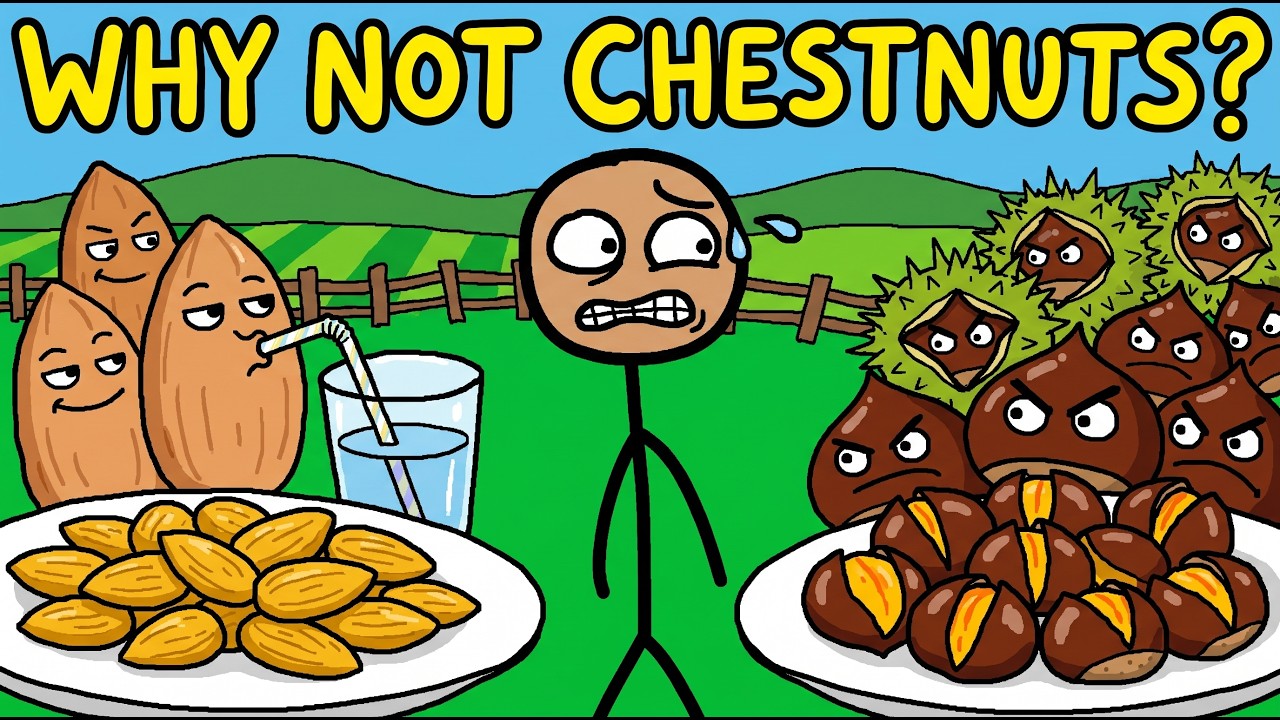
Cattails produce more flour per acre than wheat but aren't eaten due to harvesting challenges and contamination risks.
Key Takeaways
- Cattails can produce more flour per acre than wheat but are not farmed due to harvesting and processing difficulties.
- Cattail flour is edible and nutritionally comparable to other grain flours.
- Environmental contamination and plant identification risks limit cattail use as a food source.
- Wheat's domestication favored traits that make it easier to grow, harvest, store, and process.
- Cattails remain valuable for ecological functions but are not practical as a staple crop.
What the video covers
- Cattails grow abundantly in North American wetlands and all parts of the plant are edible, including roots that can be ground into flour.
- Estimates suggest cattail roots can yield around 6,400 lbs of flour per acre, surpassing typical wheat yields.
- Early 1900s experiments showed cattail flour is edible and comparable to wheat flour in taste and protein content.
- Cattail flour is one of the oldest known human foods, used by Ice Age hunters and indigenous peoples for thousands of years.
- Wheat was domesticated and bred for easy harvesting, storage, and processing, while cattails remain wild and difficult to harvest.
- Cattail starch is stored in underground rhizomes, making harvesting labor-intensive and slow compared to wheat.
- Cattails absorb pollutants and heavy metals from water, making many wild cattails unsafe for consumption.
- Young cattail shoots can be confused with toxic invasive plants, posing risks for foragers.
- Despite their food potential, cattails are often treated as invasive weeds and removed from wetlands.
- Wheat's domestication and farming advantages led to its dominance over cattails, which remain wild and unharvested.
Chapters
- 00:00Introduction to cattails and their edible parts
- 00:39Flour yield comparison: cattails vs wheat
- 01:22Historical experiments with cattail flour
- 01:59Ancient use of cattail flour by Ice Age humans
- 02:46Why cattails were left behind by farming
- 03:14Challenges of harvesting cattail rhizomes
- 04:32Environmental contamination risks in cattails
- 05:55Risks of misidentifying cattail shoots
- 06:24Cattails as invasive species and ecological role
- 07:01Summary: wheat domestication vs wild cattails
Full Transcript — Download SRT & Markdown
Speaker A
Drive along almost any highway in North America, and you'll pass a ditch full of tall green spears topped with brown fuzzy heads that look like corn dogs on a stick. Cattails. Most people never give them a second look. But under the
Speaker A
mud of that ditch sits a thick mat of white roots packed with starch. And according to the United States Department of Agriculture, every part of the plant is edible if you pick it at the right time. The young spring shoots
Speaker A
taste like cucumber when they're raw and like cabbage when they're steamed. The green flower spikes can be boiled and eaten like corn on the cob. The pollen is a bright yellow powder people mix into pancakes, and the roots can be
Speaker A
ground into flour. One estimate puts that at around 6,400 lb of flour from a single acre. A typical American wheat field produces closer to 3,000 lb of grain per acre before anyone mills it.
Speaker A
Wheat needs plowing, planting, fertilizer, and a harvest crew. Cattails need a wet ditch. So, why is there no cattail bread on the shelf? The first guess most people make is taste. Maybe cattail flour is gritty, bitter, or just
Speaker A
unpleasant. Except people have already tested that. In the early 1900s, a professor named P.W. Clawson took cattail roots, dried them, ran the starchy cores through a meat grinder, and sifted out a fine flour. He baked biscuits with it.
Speaker A
Biscuits made with half cattail flour and even with nothing but cattail flour turned out perfectly edible and barely different from the wheat kind.
Speaker A
He also used it in place of cornstarch for puddings, and they came out fine. A government plant chemistry lab in Washington analyzed the flour and found it carried about as much protein as rice or corn flour, so the food works. The
Speaker A
second guess is that nobody ever thought of it. Maybe cattails are a modern survival trick that simply showed up too late for farming. That one falls apart even faster because cattail flour might be one of the oldest foods humans have
Speaker A
ever made. In 2010, a team led by Italian archaeologist Anna Revdan examined grinding stones from Stone Age sites in Italy, Russia, and the Czech Republic. The stones were around 30,000 years old. When the researchers looked at the worn surfaces under a microscope,
Speaker A
they found tiny grains of starch stuck in the cracks. Some of that starch came from ferns. Some of it came from cattails. Ice Age hunters were digging up swamp roots, drying them, and grinding them into flour roughly 20,000
Speaker A
years before anyone planted wheat on purpose. And the habit never really disappeared. Many indigenous peoples across North America ate cattail shoots, roots, and pollen for generations. In 1962, the wild food writer Ule Gibbons called the cattail the supermarket of
Speaker A
the swamps. So, humans figured this plant out early. They used it for tens of thousands of years. Then, farming arrived, and cattails got left behind.
Speaker A
To understand why, you have to look at where the food actually sits on the plant.
Speaker A
Wheat keeps its food in the most convenient place imaginable. Dry seeds sitting at the top of a stiff stalk, waiting in the open air. When they're ripe, a combine drives through the field, cuts the stalks, knocks the seeds
Speaker A
loose, and pours them into a truck. The grain can then sit in a silo for years without going bad. Cattails keep their food in the worst place imaginable. The starch lives in the rhizomes, which are thick underground stems that spread
Speaker A
sideways through waterlogged mud and tangle into a dense mat. To get them out, you have to wade into cold water, pull or dig the roots free, and separate them from a mess of muck and other roots. In the late 1970s, Minnesota
Speaker A
looked seriously at cattails as an energy crop. The researchers flagged harvesting as a unique challenge because you have to tear the leaves away from the rhizomes and then pull the rhizomes out of the soil without hauling half the
Speaker A
swamp along with them. And getting them out is only the start. Each rhizome is mostly tough fiber wrapped around a thin core of starch about the width of your pinky. To make flour by hand, you wash the roots, peel them, crush them under
Speaker A
water, and work the starch loose from the fibers. Then you wait for the starch to sink to the bottom, pour off the water, and dry what's left. It's slow, wet work that can take an afternoon for a few cups. And nobody has built a
Speaker A
machine that does it cheaply at the scale of a wheat farm. This is also where the internet version of the story gets out of hand. Survival websites love to repeat a claim that one grower in Walcott, New York, pulled 140 tons of
Speaker A
rhizomes from a single acre, enough for 32 tons of flour. That would be more than 10 times a potato harvest.
Speaker A
The USDA's own estimate is about 3 tons of flour. Even the realistic number is impressive, but it comes from measuring wild stands, and nobody has shown it holds up on a working farm. So, the plant is hard to harvest and hard to
Speaker A
process. Then there's a bigger problem, and it has to do with what cattails are good at. Cattails are so efficient at pulling things out of water that engineers plant them on purpose to clean it. They're one of the most common
Speaker A
plants in constructed wetlands. The artificial marshes built to filter sewage, farm runoff, stormwater, and even drainage from old mines. As water moves through, cattails absorb nutrients and soak up heavy metals like lead, cadmium, and zinc. Studies on these
Speaker A
wetlands keep finding that the highest concentrations build up underground in the roots and rhizomes. That's the exact part you'd grind into flour. Now, think about where the cattails near you are growing. Roadside ditches that collect runoff from car exhaust and road salt,
Speaker A
retention ponds behind parking lots, drainage channels next to farm fields full of fertilizer and pesticides. The most convenient cattails are often the ones you'd least want to eat. And even if you find a clean marsh, there's another trap waiting in the shallows. In
Speaker A
early spring, before the brown spikes appear, young cattail shoots look a lot like yellow flag iris, an invasive plant that is toxic to eat.
Speaker A
Both grow in the same wet soil. Both send up long, flat leaves, and both can stand side by side in the same ditch.
Speaker A
Foragers learn to tell them apart by smell and by how the leaves are arranged at the base. But that's a lot to ask of someone who just wants a sandwich. Now, here's the part that makes this whole story backwards. In much of North
Speaker A
America, people are spending money to get rid of cattails. A hybrid cattail has spread through wetlands around the Great Lakes and across the northern prairies. It grows so thick that it crowds out almost everything else, turning diverse marshes into walls of a
Speaker A
single plant. Wildlife managers cut it, burn it, flood it, and spray it, and it keeps coming back. We have a plant that grows a staple food for free, and we're treating it like a weed infestation. So when you put it all together, wheat and
Speaker A
cattails took opposite paths. Wheat grows on dry land, stands upright, and drops its seeds straight into a machine.
Speaker A
Its grain stays fresh in storage for years. Thousands of years of farming bred it to hold its seeds tighter and grow them bigger until it fit the plow, the combine, and the bakery perfectly.
Speaker A
Cattails grow in water, hide their food in mud, and lock it inside fiber. Their roots rot within days of leaving the ground, and they pull in whatever is floating past, good or bad. Nobody ever domesticated them, so they never changed
Speaker A
to suit us. Farming chose the plants that were easiest to grow, harvest, store, and move, even when a swamp plant could outproduce them. Wheat won that contest by a mile. Cattails were never even entered. They stayed wild, doing
Speaker A
the same job they've done since the last ice age, which is soaking up water and spreading through every wet patch of ground they can find.
Speaker A
Nobody planted it, and nobody will ever harvest it. The flower is still there, packed into white roots under the mud.
Speaker A
The same kind of starch ice age hunters scraped onto their grinding stones 30,0
Speaker A
They didn't have a bakery down the road and they didn't have a combine. Every cup of that flour had to be earned by hand, one muddy route at a time. Today, almost everyone has bread on the counter that came from a field they've never
Speaker A
seen, harvested by a machine they'll never hear. And cattails just keep growing in the ditches, sitting on more food than most wheat fields, waiting for someone willing to get their feet wet.
Speaker A
So, the next time you drive past a row of those brown spikes swaying in the wind, you're looking at one of the first flowers humans ever made.
Topics:cattailsflour productionwild edible plantswheat comparisonforagingplant domesticationwetlandsfood historyancient dietsagriculture


![Психосинтез Роберто Ассаджиоли [Психотерапия #144] — Transcript](https://i.ytimg.com/vi/owVEFniaHT0/maxresdefault.jpg)