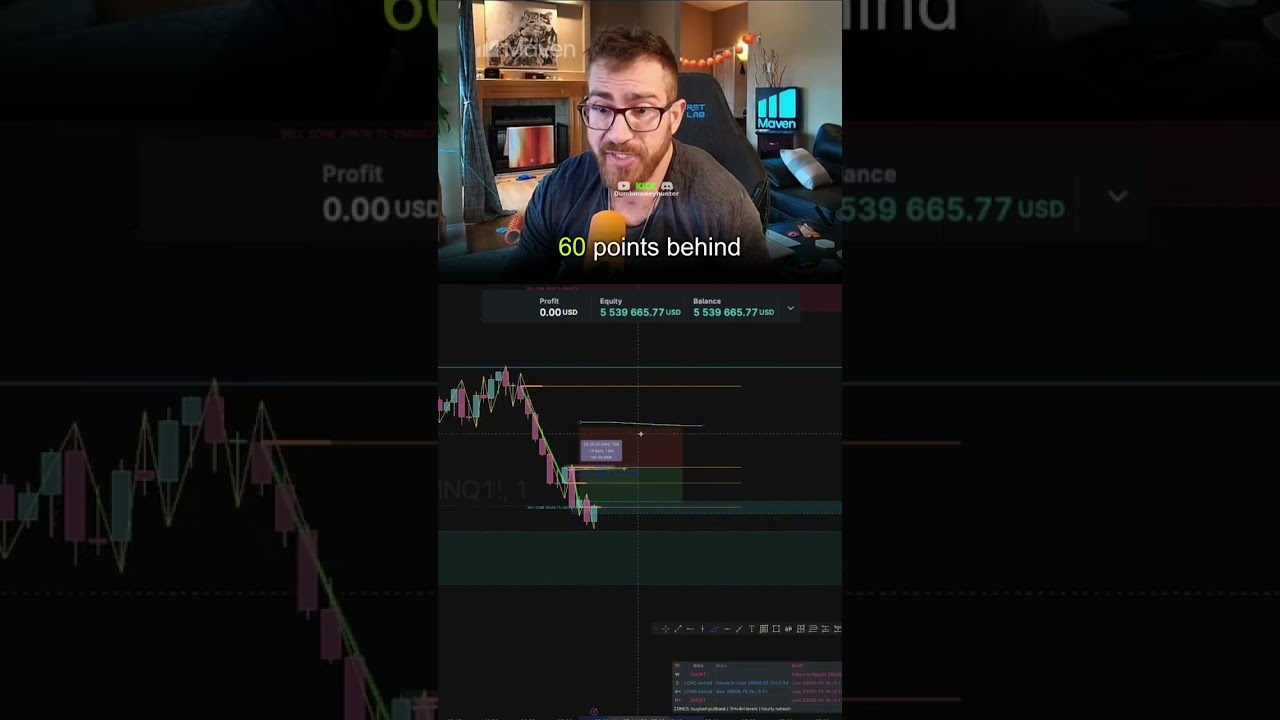
Built a working trading bot in one week using Claude AI, analyzing strategies and improving performance with live trade data.
Ask about this video. Answers come from its transcript only — with the timestamp, so you can check them.
Generated from the transcript and can be wrong — check the timestamp.
Key Takeaways
- AI can assist in coding complex trading bots without manual programming.
- Monte Carlo simulations help identify profitable strategy parameters and risk profiles.
- Current AI-generated bot performance is promising but still below expert human trading results.
- Continuous data feeding and training improve the bot’s understanding and profitability.
- Ongoing development and iteration are crucial for creating a reliable automated trading system.
What the video covers
- Created a trading bot in under a week using Claude AI without manually coding the strategy.
- Used Monte Carlo simulations to test different timeframe alignments and optimize the bot.
- The bot trades on 15-minute charts aligned with 1-hour or 4-hour charts, balancing profit and drawdown risk.
- Final bot achieved a profit factor of about 1.4, lower than the creator's personal trading profit factor of over 2.
- The bot trades mostly at market opens and uses limit orders based on retests of key levels.
- Currently, the bot has a 51% win rate, which is below the creator's actual 70-80% win rate.
- The creator uploads live trade data into Claude to teach the bot and improve its decision-making.
- Plans to continue refining the bot over the next month by categorizing and analyzing trades.
- The goal is for the AI to learn from the creator’s trades and eventually run a more profitable automated strategy.
- Future videos will show the bot’s real-time operation and ongoing development.
Chapters
- 00:00Introduction to building the trading bot with Claude AI
- 00:23Defining strategy levels and running Monte Carlo simulations
- 00:47Trade statistics and performance comparison of timeframes
- 01:12Profitability, drawdown, and coding challenges
- 01:42Coding process using Pine Script and AI error fixing
- 02:17Live trade data and profit factor updates
- 02:39Examples of trade setups and bot behavior
- 03:01Teaching the bot with live trades and future plans
- 03:39Summary of current bot performance and next steps
Full Transcript — Download SRT & Markdown
Speaker A
I made a working trading robot in less than a week using Claude and other AI to code for me without any coding experience. Actually, I do have coding experience. I do understand the logic of how to code, but I didn't actually code
Speaker A
a single thing myself. How this was done is I opened up Claude and I just started typing in what things looked like on my strategy without even explaining in detail how do I find a level? I said a
Speaker A
level was a candle body on a pivot point, and I had to adjust things along the [music] way and simply looking at which parts of my strategy made money and then having a bot running Monte Carlo simulation, which you can see on the
Speaker A
screen here. This is a Monte Carlo simulation of various different sims I ran, and the two best that I found was a 15-minute chart with a 1-hour or a 4-hour alignment. So, you can see that over the course of a year, it took
Speaker A
roughly 200 trades for the 4-hour and one and 500 trades for the 1-hour, and both of them performed roughly equally in terms of how much they make per trade.
Speaker A
The difference is the 4-hour is basically a 0% chance if you're looking at the probability of exceeding a drawdown limit. The 4-hour basically never goes beyond 2,000, or the 1-hour has a little bit more fluctuation. The maximum drawdown ranges
Speaker A
between $1,000 and $2,000, and the final profit after a year is again $2,500 to $5,000. So, it is very profitable with in terms of how much it's risking. Now, the issue with this is I wasn't able to code my strategy in all its nuances, and
Speaker A
when I was plugging in my actual trading results compared to the bot's trading results, it was nowhere near. This final bot that I was able to come to after about a week of coding was only about a 1.4 profit factor. I have a profit
Speaker A
factor of over two when I'm actually trading. So, it was nowhere near, and I wasn't happy with running this yet. All we would do in order to code this is I had a dumb script I had here as a new
Speaker A
project. I would ask it what I wanted, and then I say, "Spit me out a Pine Script for that." So, then open up Pine Script here, and I would just copy and paste all the code in. I didn't look at
Speaker A
it once. If there was ever an error, I would just tell it has an error and fix it. I would show the line number and everything like this, so everything it knew where to find it. And the final
Speaker A
kind of thing I've come up with now is I can show here because it got pretty messy is the trades in which I was taking were more or less mostly on the open and the final result. And you can
Speaker A
see a live profit factor here in the bottom corner of 1.58 right now for whatever's in the actual trade data. So, it would match up the high time frame with the low time frame, and then I finally got it down to only trading the
Speaker A
opens. So, for today, for example, both of the trades would have been canceled because they didn't come back to the levels I wanted. And you can see a couple days ago it would have taken a short off of a limit order after we
Speaker A
failed to make new highs. We would have filled on a retest. The stop would have been above there, and we would have targeted that low. Again, the day before, we can see we have failed to make a new low on the longs. We filled
Speaker A
an order on a retest, and then we targeted for the new high. So, this bot currently in its current state does for sure make money at 1.5 profit factor, but it's not good enough. So, what I've decided to do is now I am teaching the
Speaker A
bot. I'm uploading all of my trades that I take on live stream and throughout the day onto Claude here. And you can see a recent Sunday market open trade, trading style automation. Anyways, these are the some of the recent scripts. So, I was
Speaker A
doing a Sunday mark. I was doing an Asia session trade last night, and I uploaded all the trades I took. And I did one this morning, too. And why I took the trades, what was the profit from those
Speaker A
trades, and what I'm going to be doing is over the course of the next month getting it to sample all the driven trading strategies and why I am taking certain trades and categorize things for me so I can see which parts of my
Speaker A
strategy work the best and where I can improve on. In the current state of a bot running, it has a 51% win rate, and that's not good enough for how I actually trade. How I actually trade is much closer to like 70-80% actual in
Speaker A
reality win rate, and I need it to match that. Now, I've assumed that AI is now smarter than I am, so I will be continuing to feed it data and asking it the right questions so that I can learn
Speaker A
from it and then it can make a bot for me that can run for me. So follow along. There's going to be future videos about this, and I'm going to be showing you how the bot works as it's running in real
Speaker A
time.
Topics:trading botClaude AIautomated tradingMonte Carlo simulationPine Scriptalgorithmic tradingtrading strategyAI codingprofit factortrading automation