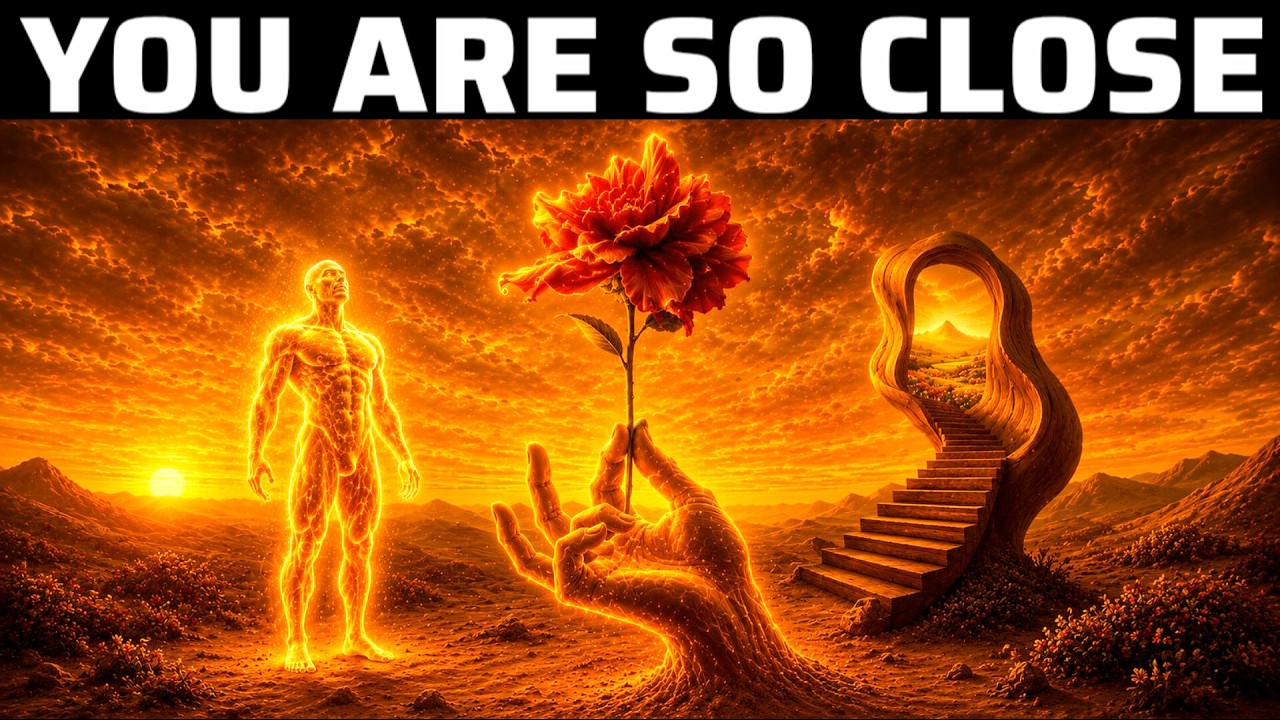
Explore Carl Jung's concept of enantiodromia and psychological bankruptcy as the precursor to your life's best chapter and true self.
Ask about this video. Answers come from its transcript only — with the timestamp, so you can check them.
Generated from the transcript and can be wrong — check the timestamp.
Key Takeaways
- Psychological breakdowns often signal a necessary transformation, not failure.
- The persona is a protective mask, not the true self; shedding it is essential for growth.
- Embracing the unlived life and shadow aspects leads to wholeness and individuation.
- True personal power arises when you stop seeking social approval and honor your authentic nature.
- Synchronicities and alignment with the self increase as you surrender to this process.
What the video covers
- Carl Jung's enantiodromia describes the psychological flip when internal forces reach their limit before life expansion.
- The persona is a social mask developed for safety and belonging but is not one's true identity.
- Psychological bankruptcy occurs when the ego can no longer sustain the persona, signaling a transformative phase.
- This phase feels like withdrawal, social disconnection, and loss of interest but is a divine setup for growth.
- The ego's collapse allows the emergence of the sovereign self and the reclamation of authentic personal power.
- The unlived life represents the parts of the self suppressed by societal and familial expectations.
- Individuation begins as the persona shatters, forcing one to live authentically and embrace their unique path.
- Synchronicities increase as internal and external worlds align during this transformative process.
- Integration of the golden shadow and past traumas leads to alchemical transmutation and personal wholeness.
- The best chapter starts when you stop performing for others and begin living your true self.
Chapters
- 00:00Introduction to Enantiodromia and Life Expansion
- 01:47The Persona: Social Mask and Ego Function
- 03:19Psychological Bankruptcy and Ego Collapse
- 04:55The Soul’s Strike and Birth of Sovereignty
- 06:30The Shattering of the Persona and Authenticity
- 09:25The Unlived Life and Its Psychological Impact
- 14:32Isolation, Loss of Identity Anchors, and New Vision
- 19:19Synchronicity, Shadow Integration, and Wholeness
Full Transcript — Download SRT & Markdown
Speaker A
There is a precise psychological phenomenon that occurs right before a human life undergoes a radical expansion.
Speaker A
[music] Carl Jung called it the enantiodromia, the moment an internal force reaches its absolute limit and is [music] forced to flip into its opposite. If you are watching this, you aren't failing.
Speaker A
You are at the tipping point. Think of a bow and arrow. To launch the arrow forward with power, it must first be pulled backward under intense tension into the dark. That tension, that feeling of being pulled back while
Speaker A
the rest of the world moves forward, [music] is the primary sign that your greatest launch is imminent. Jung observed that before the best chapter of a person's life, there is an almost [music] total withdrawal of psychological energy from
Speaker A
the outer world. Your career feels like a script you forgot the lines [music] to. Your social circle feels like a room with no oxygen. This isn't depression.
Speaker A
It is the ego's [music] final stand. The version of you that got you here cannot take you there. You are currently being dismantled so that the [music] unlived life within you can finally take form. Most people quit during this phase
Speaker A
because they mistake the silence for emptiness. But as Jung famously said, "In all chaos, there is a cosmos. In all disorder, a secret order." Today, we are going to explore the five [music] specific psychological markers that prove your current delay is
Speaker A
actually a divine setup for a life that will eventually give you goosebumps. To understand why your life feels like [music] it is currently dissolving, we must first confront the most sophisticated piece of machinery in the human psyche, the persona. In Latin, the word persona
Speaker A
did not refer to a person's character. It referred to the clay or wooden masks worn by actors in ancient Greek and Roman theater. These masks served a dual purpose.
Speaker A
They projected [music] a specific social role to the audience and they acted as a megaphone amplifying the actor's voice [music] so it could reach the back of the Coliseum. Carl Jung observed that every modern human being wears such a mask.
Speaker A
[music] It is the functional necessity of the ego. It is the professional you, the polite you, the accommodating you.
Speaker A
[music] It is the version of yourself you have spent decades perfecting so that society would grant you safety, [music] status, and a sense of belonging.
Speaker A
The persona is how you negotiate with the world. It is the social skin that protects your sensitive inner core from the harsh friction of the collective.
Speaker A
But here is the danger that Jung spent his life warning us about. The persona is a utility, not an identity. Jung famously wrote that the greatest tragedy of the human soul is [music] when we become identical with our masks.
Speaker A
When you spend 30 years being the reliable one, the successful provider, or the strong leader, the ego begins to fall into a dangerous trance. It starts to believe that the mask is the face.
Speaker A
[music] You stop being a living, breathing, multifaceted soul and start being a performance. [music] You aren't living your life anymore. You are managing a brand. You have sacrificed the gold of your authentic nature for the lead [music] of social
Speaker A
approval. The primary sign that you are standing on the threshold of your best chapter [music] is the sudden visceral onset of what Jungian analysts call psychological bankruptcy. Think of your psychic energy as a currency.
Speaker A
[music] Every time you smile when you are actually grieving, every time you say yes to a project that bores your soul, and every time you suppress a radical idea to avoid rocking the boat, you are paying a tax. It takes an immense amount
Speaker A
of soul capital to keep [music] the mask in place. For years, you have been running a hidden deficit. You have been borrowing energy from your future, from your health, and from your unlived dreams just to keep the performance of your
Speaker A
current life running. [music] Then, one day, the bank of the subconscious simply closes its doors.
Speaker A
Suddenly, you find yourself broke. This is the moment you realize you can no longer perform the role that once came so naturally. You sit in a meeting, and the corporate jargon feels like cold [music] sand in your mouth.
Speaker A
You go to a social gathering with old friends, and the small talk feels like a physical weight on your chest, [music] an invisible hand pressing against your throat. You look in the mirror and don't recognize the person looking back.
Speaker A
Not because you've changed physically, but because the mask has finally become too heavy for your spirit to support. To the outside observer, your boss, your spouse, your peers, this looks like a breakdown.
Speaker A
They might say you've lost your edge, that you're not yourself, or that you're burned out. But, in the Jungian perspective, this is not a sign of failure. It is a sign of subconscious rebellion.
Speaker A
[music] Your soul is currently on strike. It has realized that the vessel of your current life is too small for the person you are becoming. Jung believed that this bankruptcy is a divine intervention from the self, the totality of the psyche.
Speaker A
Your soul is intentionally withdrawing its investment from your old life. It is divesting from the persona because it needs that energy to build the sovereign self. In this stage, you might feel a strange cold indifference to things that
Speaker A
used to matter deeply. You might find yourself being difficult or unsociable for the first time in [music] your life.
Speaker A
You stop caring about being liked and start obsessing over being true. This isn't a loss of social skills. It's the birth of sovereignty.
Speaker A
You are finally realizing that your rare personality was never meant to fit into a standardized [music] mold. This is the death of the good child. Most of us are conditioned from birth to be the good child, the one who fulfills the unlived
Speaker A
dreams of our parents or the expectations of our culture. But as we approach our highest chapter, that good child persona begins [music] to rot. It smells of stagnation. This sudden selfishness you feel is actually the first spark of individuation.
Speaker A
You are no longer willing to trade your soul for a seat [music] at a table where you aren't truly seen. It is a violent, uncomfortable process. It feels like a loss of power because the only power you've ever known was the power of the
Speaker A
mask. [music] But Jung taught that the mask must shatter so that the gold of the golden shadow can be reclaimed.
Speaker A
[music] You have been projecting your greatness onto others, but the bankruptcy of the persona forces that greatness [music] back into your own hands.
Speaker A
When the mask shatters, you are forced to stand in the world naked. [music] You no longer have the shield of your title, your reputation, or your niceness. You are left with only what is real. And while that is terrifying, it
Speaker A
is also the only state in which you can actually receive the gifts of the best chapter. You cannot receive your true destiny [music] while you are wearing someone else's face. The bankruptcy of the persona is the clearing of the land
Speaker A
before the palace is built. If you feel like you can't keep it up anymore, if the act is failing and the audience's applause no longer satisfies you, do not panic. You aren't failing at life. You are failing at being a character in a
Speaker A
play that was never written for you. This is the first shock. The ghost is finally leaving the machine, and for the first time the machine is silent.
Speaker A
[music] In that silence, the real architect begins to speak. You are being dismantled not to be destroyed, but to be rebuilt.
Speaker A
If the first stage of your transformation was a withdrawal of energy from the world, the second stage is an invasion. Carl Jung famously stated, "Nothing has a stronger psychological influence on their environment, and especially on their children, than the
Speaker A
unlived life of the parents." But what most people fail to realize is that this unlived life doesn't just haunt the next generation.
Speaker A
It haunts you. As you approach the best chapter of your life, th
Speaker A
the invasion of the unlived life. In your earlier years, you made a series of necessary, yet [music] painful, trades to be successful.
Speaker A
You might have suppressed your creative eccentricity to be secure. You might have ignored your nomadic spirit.
Speaker A
To be accepted, [music] you might have buried your radical, rare personality under a layer of conventionality. Jung believed that these [music] suppressed parts of the psyche do not simply vanish. They go into the shadow, where they ferment.
Speaker A
They wait. When you are on the threshold of a major life shift, these ghosts [music] stop waiting. Suddenly, you find yourself possessed by irrational urges.
Speaker A
You might feel [music] a sudden, inexplicable obsession with a language you've never spoken, a craft you've never practiced, or a philosophy that contradicts everything you were taught.
Speaker A
You might find yourself staring out of office windows, feeling a pull toward a life that looks nothing like your current one. To your ego, the manager of your life, this feels like a midlife crisis or a loss of focus. But in the Jungian forge,
Speaker A
this is the blueprint of the new self leaking through the cracks. The best chapter of your life requires a version of you that is whole, not just good. Most people spend [music] their lives trying to be perfect, but Jung's
Speaker A
goal was wholeness. Perfection requires the exclusion of everything messy or unproductive. Wholeness, however, requires the integration of everything you've left behind. The unlived life is the collection of all those missing pieces.
Speaker A
It is the [music] gold you dropped in the dark because you thought it was too heavy to carry while you were climbing the social ladder. This is why, right before your life expands, you often feel a profound sense of grief. You grieve
Speaker A
for the artist you didn't become at 20. You grieve for the risk you didn't take at 30. This grief is a vital signal.
Speaker A
[music] It is the unlived life demanding to be mourned so that it can finally be integrated. You aren't just remembering the past.
Speaker A
You are reclaiming the energy that was trapped in those old versions of yourself. In this phase, you might experience what Jung called active imagination or vivid symbolic dreams.
Speaker A
You might dream of forgotten rooms in your childhood home, or find yourself meeting strangers in your subconscious who feel more familiar than your own family. These are the ambassadors of your unlived life. They are coming back to offer you the tools you will need for
Speaker A
your next chapter. [music] The artist you suppressed holds the vision you need for your new career. The rebel you [music] silenced holds the courage you need to break away from toxic cycles. The seeker you ignored holds the meaning that will sustain you
Speaker A
when the applause of the world fades. The world will tell you that it's too late to listen to these voices. They will call you a late bloomer as if it is a consolation prize.
Speaker A
But Jungian psychology teaches us that the most magnificent trees are those that grow the slowest. The unlived life isn't a list of missed opportunities.
Speaker A
It is a reservoir of untapped power. If you feel a sudden, irrational urge to change direction, if you feel a hunger that food cannot satisfy [music] and a thirst that status cannot quench, do not suppress it. You are being recruited by
Speaker A
your own soul. The unlived life [music] is the raw material of your best chapter.
Speaker A
You are being asked to stop living a life that was assigned [music] to you and start living the life that was designed for you. This is the moment the vessel of your life begins to change its shape. You are no longer just a
Speaker A
professional or a provider. You are becoming an alchemist. You are taking the lead of your past regrets and melting them down to find the gold of your true calling. The invasion feels like chaos because it disrupts your orderly life.
Speaker A
But as Jung famously [music] said, "In all chaos, there is a cosmos. In all disorder, a secret order." The chaos you feel right now is actually the secret order of your future self making room for its arrival. You are being
Speaker A
dismantled so that the unlived life can finally become the lived life. As you move through the dismantling of your persona and the invasion of your unlived life, [music] you enter the most silent and perhaps most terrifying stage of the
Speaker A
transformation. Carl Jung called this the withdrawal into the interior castle, but in modern terms, we call it the breaking of the social mirror. For the vast majority of your existence, you have lived reflectively. From the moment you were
Speaker A
born, you used the people around you, parents, teachers, peers, and partners, as a mirror to tell you who you were. If they smiled, you were good. If they promoted you, you were successful. If they sought your company, you were
Speaker A
worthy. This is the social mirror, and for most, it is the only way they know how to navigate reality.
Speaker A
[music] They are not directed by an inner compass, but by the consensus of the room. But as you stand on the precipice of the best chapter of your life, a strange and jarring phenomenon occurs.
Speaker A
The mirrors stop reflecting you. Suddenly, you find yourself in a state of sacred isolation. It often begins with a sense of frequency mismatch.
Speaker A
You sit with old friends, people you've known for a decade, and you realize with a sinking heart that you no longer [music] speak the same language. Their concerns feel trivial. Your internal shifts feel unspeakable to them.
Speaker A
[music] You try to explain the nigredo or the invasion of the unlived life, and you are met with blank stares or, [music] worse, practical advice on how to get back to your old self. This is the moment the mirror shatters.
Speaker A
You realize [music] that the people in your life cannot see the person you are becoming. They can only see the ghost of who you used to be. To the ego, this feels like a catastrophe.
Speaker A
[music] Feels like loneliness. Feels like you are being deleted from the [music] social fabric. You might experience a period where your phone stops ringing, where invitations dry up, or where you voluntarily withdraw from the world because [music] the performance of
Speaker A
social interaction has become too exhausting to maintain. Most people panic here. They try [music] to fix their relationships or fake their way back into the group. But Jungian psychology teaches us that this isolation is not a punishment. It is a
Speaker A
strategic incubation. Jung observed that no significant psychological growth can occur as long as you are constantly being verified by the outside world.
Speaker A
[music] As long as you are looking for a reflection, you are a slave to the mirror.
Speaker A
To become a sovereign individual, you must go through a period where there is no reflection at all. You must learn to exist in the darkness of the self until your own inner light becomes [music] strong enough to navigate by.
Speaker A
This is the birth of inner authority. [music] When the social mirror breaks, you are forced to ask the most dangerous question in the human psyche.
Speaker A
Who am I when no one is looking? Who am I when no one is clapping? Who am I when I have no title to hide behind?
Speaker A
Most people never answer these questions because they are too afraid of the silence. But for the rare personality, this silence is where the gold is found.
Speaker A
Jung believed that the best chapter of a life is always marked by a shift from external validation to internal verification. You stop being a reaction to the world and start being a source in the world. In this stage of sacred
Speaker A
isolation, you aren't just losing friends. You are losing the identity anchors that kept you moored to a smaller version of yourself. Your old social circle acted as a governor on your soul, [music] a psychic speed limit that kept you at a
Speaker A
pace the group could handle. By breaking the mirror, the universe is removing the speed limit. It is clearing the deck [music] so that your new life has room to land. You might feel invisible during this time. [music] You might feel like
Speaker A
the world has moved on without you, leaving you behind in a stagnant [music] pool.
Speaker A
But think of the bamboo tree. For years, it shows no growth above the ground. It is invisible to the world, [music] but beneath the surface, it is building a massive, complex root system. When the time is right, it grows 90 ft in a
Speaker A
single season. You are currently in the root phase. The isolation is the dirt that protects you while you are being rewired. Jung often spoke of the temenos, a sacred enclosed space [music] where the alchemical work could take place
Speaker A
without interference. Your current isolation is your temenos. It is a boundary that the subconscious has drawn around you to keep the static [music] of the world out while the music of your future self is being composed.
Speaker A
The sign [music] that this stage is nearing completion is a profound sense of indifference. You stop explaining [music] yourself. You stop trying to make them understand. You realize that you don't need a mirror because you have become the light. You find a strange
Speaker A
quiet joy in your own company. You realize that being out of sync with a world that is fundamentally out of its mind is actually the highest form of [music] sanity. When you stop looking for yourself in the eyes of others, you
Speaker A
finally have the vision to see the best chapter as it actually is. You are no longer performing for an audience. You are preparing for a calling. The mirror had to break so that the window could finally open.
Speaker A
After the persona has collapsed, the unlived life has invaded, and the social mirror has shattered, you arrive at the most counterintuitive gate [music] of the Union journey. This is the stage of active surrender. For the high achiever, the late bloomer, or the person who has
Speaker A
spent their life fighting [music] to make things happen, this stage feels like a betrayal of everything they've ever known. Feels like giving up. But in the architecture of the soul, it is the exact opposite.
Speaker A
It is the moment the owner of the house finally hands the keys to the architect.
Speaker A
Carl Jung observed that the modern ego is a colonizing force. It believes that through sheer willpower, logic, [music] and hustle, it can force the universe to yield. We are taught from birth that if our life isn't working, we must push harder,
Speaker A
do more, and grind. But as you approach the best chapter of your life, you realize a terrifying truth. The harder you push, the further the goal retreats.
Speaker A
This is because [music] the best chapter is not a destination you reach through effort. It is a frequency you achieve through alignment. [music] Jung called this the shift from the ego to the self.
Speaker A
The ego is the small conscious part of you that wants safety, money, and recognition. The self is the totality of your psyche, [music] the vast unconscious intelligence that knows exactly why you were born and what you are capable of. Before your
Speaker A
breakthrough, these two forces are often at war. The ego wants to be a doctor, but the self [music] wants to be an artist. The ego wants security, but the self [music] wants expansion.
Speaker A
The paradox of active surrender occurs when the ego finally realizes it is outmatched. It has tried every strategy, worked every hour, and exhausted every fix.
Speaker A
Yet, the life it wants remains just out of reach. This is the moment of strategic defeat. [music] Most people mistake this defeat for a crisis.
Speaker A
They see the stalling of their career or the emptiness of their efforts as a sign that they have failed. But, Jung would tell you that this is the most successful moment of your life. It is the moment [music] the ego's
Speaker A
interference finally stops. Active surrender is not passivity. Passivity is doing nothing out of despair. Active surrender is doing everything while being completely unattached to the [music] result.
Speaker A
It is the state of the master archer who pulls the bowstring with perfect tension, but lets the arrow fly without trying to hit the target. [music] The archer is the target. In this phase, you experience a radical shift in your
Speaker A
relationship with time and effort. [music] You stop chasing and start allowing. You realize that your delays [music] were not obstacles, but calibrations.
Speaker A
The universe wasn't denying you. [music] It was waiting for you to stop shoving, so it could finally lead.
Speaker A
Jung famously spoke about synchronicity, meaningful coincidences that appear when the internal world and the external world align. When you are in the state of active surrender, these synchronicities begin to accelerate. You stop looking for opportunities, and opportunities begin to find you. A
Speaker A
chance meeting, a book falling off a shelf, a sudden hunch that leads to a breakthrough.
Speaker A
These are the signs that you have moved from the victim, life is happening to me, to the creator, life is happening through me. This is the shift from willpower to willingness.
Speaker A
Willpower is the ego trying to bend the world to its image. Willingness is the self opening its doors to the infinite possibilities of the cosmos.
Speaker A
[music] When you are willing, you stop asking, when will my life start? And start asking, [music] what is this moment calling out of me?
Speaker A
You realize that the best chapter isn't something that happens in the future. It is a quality of being in the present [music] that eventually manifests as a result in the future. This is why, right before [music] the big shift, many
Speaker A
people feel a strange, quiet calm in the middle of the storm. Their life might still look unresolved to the outside world. They might still be unemployed or single or in transition, but the anxiety of the chase has died. They have
Speaker A
realized that they are the bamboo tree. They have done the deep work in the dark, and now they are simply waiting for the season of growth. They are no longer [music] pushing the river.
Speaker A
They have become the river. Jung taught that the self has a teleological urge. It has a goal it is trying to reach.
Speaker A
Your soul knows the best chapter better than your mind does. By surrendering the ego's limited map, you are finally allowing the soul's GPS [music] to take over.
Speaker A
You might find yourself saying, I don't know what's next, and for the first time, I'm okay with that. This not knowing is the most powerful state a human can inhabit. It is the void [music] of the alchemist, the place
Speaker A
where the old form has melted, and the new form hasn't yet solidified. It is the state of pure potential. The best chapter of your life requires a version of you that can handle success without attachment.
Speaker A
If the universe gave you your gold while [music] you were still in the hustle mindset, you would eventually lose it to the same anxiety that created it. You are being surrendered so that when the gold arrives, [music] you have a foundation strong enough to
Speaker A
hold it without being crushed by it. Active surrender is the moment you stop trying to be someone and finally accept the terrifying and beautiful reality of who you already are.
Speaker A
[music] You stop acting and start flowing. And in that flow, the best chapter doesn't just arrive. It overflows. We have reached the final gate. You have watched your persona go bankrupt. You have navigated the invasion of your unlived life. You have survived the
Speaker A
breaking of the social mirror. And you have mastered the paradox of active surrender. Now, you stand before the most formidable challenge of the Youngian journey.
Speaker A
The integration of the golden shadow. Most people are familiar with the shadow as the basement of the psyche.
Speaker A
The place where we hide our anger, our greed, and our shame. But Carl Jung made a startling observation. We are often more afraid of our light than our darkness. Within the shadow lies what Jung called the golden shadow. This is
Speaker A
the repository of your highest talents, your deepest wisdom, your rare personality, and your capacity for massive impact.
Speaker A
The best chapter of your life has been delayed not because you weren't good enough, but because you were too afraid to be great enough.
Speaker A
You have spent [music] years playing small, dimming your light so as not to intimidate others or invite [music] the evil eye of envy. You've told yourself that being average was a form of humility, but Jung would call it a spiritual
Speaker A
crime. [music] He believed that the refusal to realize one's own potential was the root of almost all psychological suffering.
Speaker A
[music] The stalling you have felt is actually the weight of your unclaimed greatness. The final sign that your life is about to shift into its highest gear is a sudden [music] terrifying realization.
Speaker A
You no longer have any more excuses. The victim narrative, [music] the story that you were too late, too broke, or too damaged finally stops working. You realize that your past struggles were not obstacles to your success, but the training grounds for it. Every
Speaker A
betrayal taught you discernment. Every failure taught you resilience. Every dark night taught you how to see in the dark. [music] This is the moment of alchemical transmutation. You take the lead of your past traumas and through the heat of the
Speaker A
crucible, [music] you realize they have always been gold. Integrating the golden shadow means finally owning your rare personality. If you are an outlier, you stop trying to fit in [music] and start building your own world.
Speaker A
If you are a late bloomer, you stop apologizing for your timing and realize that your late start gave you a depth of soul that early bloomers can never replicate. You stop looking for a master or a guide [music]
Speaker A
and realize that the authority you've been seeking has always been sitting in your own chair. In this stage, your language changes. You stop saying I hope and start saying I am. You stop asking, is it possible?
Speaker A
And start asking, how do I facilitate this? You move from the seeker who is always looking for the truth to the knower who is finally living it. Jung taught that the goal of human life is individuation, to become the specific, unique,
Speaker A
unrepeatable self that only you can be. The best chapter of your life is simply the outward manifestation of this inward wholeness. When you stop fighting yourself, the world stops fighting you.
Speaker A
The golden shadow brings with it a sense of objective responsibility. You realize that your talents are not yours to hide.
Speaker A
They are gifts that the universe has entrusted to you. Playing small isn't humility. It is a betrayal of the life force. When you finally claim your gold, you notice that the synchronicity we discussed in part four becomes a
Speaker A
constant companion. The red sea of your obstacles begins [music] to part. Not because you are lucky, but because you are finally in alignment.
Speaker A
You will know you have reached the end of the transition when the fear [music] of staying the same becomes greater than the fear of changing. You realize that the vessel of your old life is so shattered that there
Speaker A
is no going back. [music] The only way is through. This is the birth of the creator. You step into your new chapter not as a lucky survivor, but as a conscious architect. You look back at the dark night you just walked
Speaker A
through and you see it for what it was, a sacred setup. [music] The universe didn't want to break you.
Speaker A
It wanted to break the mask so that the soul could finally breathe. If you are watching this and you feel a strange shiver in your spirit, a sense of recognition that goes deeper than logic, [music] that is your golden shadow knocking. It
Speaker A
is your best chapter demanding to be let in. Jung's final message to us was one of radical hope.
Speaker A
I am not what happened to me. I am what I choose to become. [music] You have been through the fire.
Speaker A
You have paid the tax of the persona. You have survived the silence of the void. Now it is time to wear the gold.
Speaker A
Your arrival isn't a future event. It is a present decision. The best chapter begins the moment you stop asking for permission to be who you already are. We have traveled through the most difficult landscapes of the human psyche. We have
Speaker A
seen how the bankruptcy of your persona was not a failure, but a liberation. We have understood [music] that the invasion of your unlived life was a recruitment and that your sacred isolation was the necessary silence before the symphony begins. If you have
Speaker A
stayed until this moment, it is because you recognize the truth in these patterns. You are no longer the person who started this video. You have crossed the threshold from the victim of circumstance [music] to the architect of the self. The best
Speaker A
chapter of your life is not a distant land you are trying to reach. It is the ground you are currently standing on. The shift happens the moment you stop waiting for the world to validate your goals and start acting as the sovereign of
Speaker A
your own destiny. You have been in the crucible long enough. [music] The nigredo, the blackening is over. The albedo, the whitening and purification has done its work. Now the rubedo begins. This is the stage of the redness, the stage of life
Speaker A
action, and the manifestation of the true self in the world. But this journey of individuation is not a solitary one, though it often feels like it. It requires a community of like-minded outliers who understand the weight of the rare personality. If this deep dive
Speaker A
into Jungian alchemy has resonated with your soul, I invite you to join our collective.
Speaker A
Subscribe to Carl Jung Daily and turn on the notification bell. We are building a sanctuary for those who refuse to live a small life, a space for the late bloomers, [music] the seekers, and the modern alchemists who know that their greatest work is
Speaker A
still ahead of them. By subscribing, you are signaling to your subconscious that you are committed to the work of wholeness. Before you go, I want to see who is standing in the gold with us today. If you have felt the shiver of
Speaker A
recognition during this video, [music] if you are ready to stop playing small and finally integrate your golden shadow, [music] comment the word a l c h y m i a below.
Speaker A
When you type that [music] word, you aren't just leaving a comment. You are making a psychological mark in the world. You are declaring that the vessel has been rebuilt and you are ready to house the greatness you were born to
Speaker A
express. And finally, [music] if you know someone a friend a sibling, a fellow seeker who is currently in the heat of their own crucible [music] and feels like they are failing share this video with them. Be the synchronicity they have been praying
Speaker A
for. Your best chapter is no longer a dream. [music] It is an inevitability.
Topics:Carl Jungenantiodromiapsychological bankruptcypersonaindividuationshadow integrationself transformationauthenticitypsychologypersonal growth