Explore the weirdest aircraft ever made, from vertical takeoff jets to flying pancakes and asymmetrical designs, highlighting aviation's strangest experiments.
Key Takeaways
- Many experimental aircraft designs pushed the boundaries of conventional aviation but often faced stability and control challenges.
- Vertical takeoff and landing (VTOL) concepts were a major focus during the Cold War but were difficult to perfect.
- Some unusual designs, like the Airbus Beluga and Vought V-173, proved practical or successful despite their odd appearances.
- Asymmetrical and multi-wing designs offered unique advantages but rarely became mainstream due to complexity or competition.
- Experimental aircraft contributed valuable lessons that influenced future aerospace engineering and technology.
What the video covers
- The video showcases bizarre and experimental aircraft designs from the 1920s to the 1990s, including vertical takeoff jets, circular-wing planes, and asymmetrical aircraft.
- The Snecma Coleopter was a 1950s French jet that took off vertically but crashed after several test flights.
- The US Army's de Lackner HZ-1 Aerocycle was a one-man helicopter that proved unstable and was ultimately abandoned.
- Lockheed's Ringwing featured a giant circular wing but suffered from stability problems.
- The Airbus Beluga is a large cargo plane with an oversized fuselage designed to transport airplane parts efficiently.
- The Lockheed XFV was a vertical takeoff fighter that was difficult to land and never fully operational.
- The Vought V-173 'Flying Pancake' was a disc-shaped plane that flew well but was overtaken by jet technology.
- The German Blohm and Voss BV 141 was an asymmetrical reconnaissance aircraft that flew surprisingly well during WWII.
- The Caproni CA.60 Noviplano was a nine-wing flying boat that crashed during its only brief flight.
- The Steipa Caproni featured a hollow tube fuselage with a propeller inside, influencing future jet engine designs.
Chapters
- 00:00Snecma Coleopter - Vertical Takeoff Jet
- 02:54Airbus Beluga - Giant Cargo Plane
- 05:36Blohm and Voss BV 141 - Asymmetrical Aircraft
- 08:30Mi-32 - Flying Triangle Helicopter
- 11:02De Lackner HZ-1 Aerocycle - One-Man Helicopter
- 12:37Ringwing - Circular Wing Aircraft
- 15:20Lockheed XFV - Vertical Takeoff Fighter
- 18:22Caproni CA.60 Noviplano - Nine-Wing Flying Boat
Full Transcript — Download SRT & Markdown
Speaker A
Coleopter. No, this is not a science fiction spaceship. It was a real aircraft from the 1950s.
Speaker A
This is the Snecma Coleopter, a French experimental jet designed to take off and land vertically while standing straight up like a rocket. The pilot had to fly and land this thing while basically staring at the sky.
Speaker A
Engineers thought it could launch from tiny areas without a runway during the Cold War. It actually flew several test flights before losing control and crashing in 1959.
Speaker A
Thankfully, the pilot survived, but the project ended right there. Turns out flying inside a giant metal tube was harder than it looked. Aerocycle. The US military spent money building a one-man helicopter, and it went exactly how you think it did. In the late 1950s, the
Speaker A
Army wanted a cheap and simple flying machine that soldiers could learn in minutes. So, engineers built the de Lackner HZ-1 Aerocycle. It looked like a tiny helicopter mixed with a lawn mower, and the pilot literally stood on top of
Speaker A
it while flying through the air. The military hoped it could be used for scouting and fast movement across rough terrain. But during testing, the Aerocycle became extremely unstable, especially when flying higher than a few feet off the ground. Pilots struggled to
Speaker A
control it, and even small balance shifts could create dangerous oscillations. After several scary test flights, the Army decided maybe sending soldiers into battle on a spinning dinner plate was not the best idea. Circular-winged aircraft. The strangest part about this
Speaker A
aircraft is that it almost worked. In the 1950s, Lockheed experimented with an aircraft design that looked more like a flying donut than a plane. It was called the Ringwing, and instead of using traditional wings, the entire aircraft body was surrounded by one giant
Speaker A
circular wing. Engineers hoped the unusual shape would reduce drag and allow the aircraft to fly faster and more efficiently than normal planes. But once testing began, things got weird fast. The aircraft suffered from major stability problems and controlling it
Speaker A
became incredibly difficult. Eventually, the project was abandoned, but the ring wing still remains one of the strangest aviation experiments ever attempted.
Speaker A
Airbus Beluga. You ever look at a plane and think, there is absolutely no way that thing should fly? Because that's exactly what happened when the Airbus Beluga showed up. Officially called the Airbus A300-600ST Beluga, this thing looks like someone
Speaker A
inflated a normal airplane with a bicycle pump. The top of the fuselage is gigantic because it was built to carry entire airplane parts across Europe.
Speaker A
Wings, fuselage sections, even massive aircraft components were stuffed inside this flying whale. And somehow, despite looking like it eats smaller planes for breakfast, it actually became one of the most useful cargo aircraft ever made.
Speaker A
The best part? Pilots said it handled surprisingly well. So, yes, the giant smiling whale plane was not only real, it was actually good at its job.
Speaker A
Vertical Takeoff Plane. During the Cold War, the military became obsessed with one question. What if fighter planes didn't need runways? And that led to the absolutely insane Lockheed XFV, nicknamed the Salmon. This thing was designed to take off vertically while
Speaker A
standing on its tail like a rocket. The pilot basically launched straight upward, then tilted forward into normal flight, which sounds cool right up until you remember the landing part. To land, the pilot had to slowly back the aircraft down vertically while staring
Speaker A
over their shoulder at the ground the entire time. Imagine parallel parking except you're falling out of the sky.
Speaker A
Test pilots actually managed to fly it, but the engine wasn't powerful enough for true vertical takeoff and everyone slowly realized this idea was mildly terrifying. So, the project died before anyone accidentally turned themselves into a lawn dart. The flying pancake.
Speaker A
This might be the weirdest successful airplane ever built. The Vought V-173 looked less like an airplane and more like a UFO someone flattened with a frying pan.
Speaker A
People called it the flying pancake because, well, look at it. But weirdly enough, this bizarre disc-shaped aircraft actually flew incredibly well.
Speaker A
Its huge circular wing created tons of lift, meaning it could take off at super low speeds and remain ridiculously stable.
Speaker A
Test pilots said it was almost impossible to stall. At one point, aviation legend Charles Lindbergh even flew it himself. The military hoped the design could become a carrier-based fighter, but jet aircraft started taking over and suddenly nobody cared about
Speaker A
pancake planes anymore. Which is unfortunate because we were dangerously close to living in a world full of flying dinner plates.
Speaker A
Asymmetrical aircraft. Most airplanes are symmetrical for a very important reason. It helps them fly properly. The German Blohm and Voss BV 141 decided symmetry was optional. One side contained the engine and fuselage while the crew sat inside a giant glass pod
Speaker A
awkwardly hanging off the other side. It looks deeply wrong, like an airplane that loaded in incorrectly, but somehow it actually flew extremely well. The asymmetrical layout gave the crew incredible visibility for reconnaissance missions during World War II. Pilots
Speaker A
reported the aircraft handled surprisingly normally, despite looking like physics should reject it. The only reason it never became widespread was because Germany already had other reconnaissance aircraft in production, meaning this bizarre flying mutant almost became a standard military plane.
Speaker A
Nine-wing flying boat. In the 1920s, one Italian engineer looked at normal airplanes and decided they simply did not have enough wings.
Speaker A
So, he created the Caproni CA.60 Noviplano, a monstrous flying boat with nine wings stacked in three separate rows.
Speaker A
This thing looked like someone combined a cruise ship with a bookshelf. The goal was to carry 100 passengers across the Atlantic at a time when most airplanes could barely stay airborne.
Speaker A
Amazingly, the aircraft actually made it into the air during testing for about a minute.
Speaker A
Then, it immediately crashed into a lake and exploded into splinters. Witnesses described it as looking completely unstable, which honestly feels like the understatement of the century.
Speaker A
The wreckage was partially recovered, but the project was abandoned, leaving behind one of the most absurd aircraft ever attempted. The flying barrel. The Steipa Caproni might secretly be the ancestor of the modern jet engine, even though it looks like a flying barrel.
Speaker A
Built in the 1930s, the aircraft had a giant hollow tube as its fuselage with a propeller mounted inside it. The designer believed compressing airflow through the tube would increase thrust and efficiency. And weirdly enough, he was kind of right. The aircraft produced
Speaker A
a loud roaring sound and demonstrated concepts that later appeared in jet propulsion systems. The problem was that it was also painfully slow and aerodynamically cursed. Pilots described it as stable but not exactly impressive.
Speaker A
Even so, aviation historians still see it as one of the strangest and most important experimental aircraft ever built. It looked ridiculous, but it accidentally helped point aviation toward the future. Flying triangle. You probably think this helicopter was edited, but it was actually real. In the
Speaker A
1970s, the Soviet Union designed the Mi-32, a helicopter so weird it looked like someone glued three helicopters together. The plan was to create a giant heavy-lift aircraft capable of carrying huge construction equipment and military cargo across remote areas. Each corner
Speaker A
of the triangle had its own rotor and engine, making the whole thing look more like a boss fight than an actual vehicle. Engineers believed it could lift over 100 tons, but the project was eventually canceled because it was too
Speaker A
difficult and expensive to build. Even today, the Mi-32 is still one of the strangest aircraft concepts ever imagined. The real UFO.
Speaker A
This futuristic aircraft fail.
Speaker A
Engineers believed it could hover like a helicopter and fly faster than a jet. The circular design looked decades ahead of its time, but there was one huge problem. The moment it lifted a few feet off the ground, it became wildly
Speaker A
unstable. Pilots struggled to control it, and one even described the experience as trying to fly a manhole cover in a hurricane.
Speaker A
Despite years of testing and massive funding, the Avrocar never came close to meeting expectations and the project was abandoned in 1961.
Speaker A
Dragonfly. Modern helicopters might not exist without this flying eggbeater. The Sikorsky H-5 Dragonfly entered service in the 1940s and quickly became one of the first helicopters trusted for real rescue missions.
Speaker A
At a time when most people still saw helicopters as experimental machines, the H-5 was flying into mountains, forests, and combat zones to pull injured soldiers and downed pilots to safety. It could hover in place, land almost anywhere, and reach locations
Speaker A
normal aircraft simply could not. That made it a huge breakthrough for search and rescue operations during World War II and the Korean War.
Speaker A
By modern standards, it looks tiny, fragile, and slightly unsafe. But back then, this thing was cutting-edge technology.
Speaker A
The exposed tailboom, bubble canopy, and awkward shape gave it a very strange look, but the performance mattered more than appearances. Helicopters like the Dragonfly helped prove that vertical flight was practical, reliable, and incredibly useful in emergencies. A lot
Speaker A
of modern rescue helicopters can trace their roots back to machines exactly like this one. Skycrane. Imagine seeing a flying crane carrying an entire house over your city.
Speaker A
Most people would think they were looking at some kind of experimental machine from the future, but the Sikorsky S-64 Skycrane has been doing exactly that for decades. At first glance, this helicopter looks completely unfinished. It has a tiny cockpit, giant
Speaker A
landing legs, and almost no body at all. But that strange design was actually one of the smartest engineering decisions ever made in aviation.
Speaker A
The Skycrane was built for one purpose, lifting things that other helicopters simply could not handle.
Speaker A
Instead of wasting weight on passenger space, engineers stripped the aircraft down to the bare minimum, so it could carry massive cargo underneath its frame. That made it perfect for moving construction equipment, power transformers, military vehicles, giant trees, and even entire houses through
Speaker A
the air. One of the craziest things about the Skycrane is how precise it can be while carrying insane amounts of weight.
Speaker A
Pilots can carefully lower huge cargo onto mountaintops, deep forests, or crowded construction sites with incredible accuracy.
Speaker A
It became especially useful in places where roads were impossible to build or disasters made normal transportation useless.
Speaker A
The helicopter also became famous for fighting wildfires. Special firefighting versions can carry thousands of gallons of water and dump it directly onto massive fires in seconds.
Speaker A
Watching one fly overhead feels less like seeing a helicopter and more like watching a giant mechanical insect built to carry the impossible.
Speaker A
Even though it first flew in the 1960s, the Skycrane is still used today because very few machines can do what it does.
Speaker A
It might look weird, ugly, or even unfinished, but that strange design turned it into one of the greatest heavy-lifting aircraft ever created. The Hoverboard. Some people call this a genius invention. Others say it was one of the most useless military ideas ever
Speaker A
built. The Hiller VZ-1 Pawnee was an experimental US Army aircraft that took a very unusual approach to flight.
Speaker A
Instead of a cockpit, seat, or even a frame around the pilot, it was designed as a small circular platform that a person would simply stand on. Underneath were lift fans that pushed air downward to raise it off the ground. The goal was
Speaker A
to create a personal flying device that could hover and move in any direction based on how the pilot shifted their body. It was meant to be simple, fast to learn, and useful for battlefield mobility. But the reality was much less
Speaker A
smooth. It was hard to control, unstable in anything but ideal conditions, and required careful balancing just to stay level. While it did manage to fly in tests, it never became practical for real use.
Speaker A
Today, it is remembered as one of the most unusual experimental aircraft ever built. Sitting somewhere between brilliant idea and complete engineering curiosity. Flying donut. What if I told you this strange flying cylinder helped shape the future of military drones?
Speaker A
Back in the 1990s, Sikorsky was experimenting with a bizarre unmanned aircraft called the Cypher II.
Speaker A
At first glance, it looked less like advanced military technology and more like a flying kitchen appliance. But hidden inside that giant cylinder was some seriously forward-thinking engineering. The aircraft used a ducted fan system, meaning its rotors were enclosed inside the body instead of
Speaker A
sticking out like a normal helicopter. This allowed the Cypher II to take off vertically, hover with impressive stability, and operate in tight urban environments where traditional aircraft struggled. It was designed for reconnaissance and surveillance missions, giving the military a compact
Speaker A
unmanned platform years before drones became a battlefield staple. Despite successful testing, the project eventually faded away as military priorities shifted and newer technologies appeared. But many of the ideas tested on the Cypher II later showed up in modern drone development.
Speaker A
So, while most people forgot about the strange flying cylinder from the '90s, its influence may still be flying around today.
Speaker A
Skycar. Imagine driving a Jeep straight into battle and then lifting off like a helicopter. That sounds like science fiction, but the US Army actually tried to build it. In the late 1950s, Piasecki Aircraft created the VZ-8 Airgeep as
Speaker A
part of an experiment to reinvent battlefield transport. The idea was simple. Build a vehicle that could hover low to the ground, move over swamps, mud, and rough terrain, and avoid enemy radar better than helicopters. Instead of using traditional rotor blades, the
Speaker A
Airgeep had two giant ducted fans built into the body, giving it the look of a floating platform from the future.
Speaker A
During testing, it managed to fly successfully and even impressed some pilots with its stability. But, there were major problems. It was extremely noisy, vulnerable to enemy fire, and struggled with speed and performance compared to helicopters already in service. In the end, the Airgeep never
Speaker A
entered production, but it remains one of the strangest and most ambitious aircraft experiments ever attempted by the military. The Penetrator. The military made a plane so secret most people still think it never existed. And no, stealth aircraft are not actually
Speaker A
invisible. The Aero craft Stealth Star 204 SS became famous for looking absolutely ridiculous while also being strangely advanced for its time. The aircraft used unusual stealth-focused shapes designed to scatter radar signals and sneak through enemy defenses undetected. But, instead of looking
Speaker A
sleek like modern stealth jets, it looked more like a flying science project from the future. Its mission was to penetrate deep into hostile territory without being seen, which earned it the unforgettable nickname the penetrator.
Speaker A
And yes, military engineers somehow said that out loud in meetings without laughing. What makes the story even weirder is that very little official information about the aircraft ever surfaced, turning it into a legend among people obsessed with strange military
Speaker A
technology. Whether it was a revolutionary stealth project or just an ambitious experiment, the stealth star became proof that some of the weirdest aircraft ideas are also the hardest to forget. The banana. The military once trusted this flying banana to save
Speaker A
lives. The Piasecki HRP Rescuer looked like something straight out of an old cartoon with its long curved body and oversized spinning rotors. That strange shape earned it the nickname the flying banana. But the design actually solved a major problem. Its bent fuselage helped
Speaker A
keep the front and rear rotor blades from colliding during flight. Built in the 1940s, the HRP Rescuer became one of the first military helicopters used for rescue missions, troop transport, and cargo delivery. Its success helped inspire future tandem rotor helicopters
Speaker A
like the CH-47 Chinook that are still flying today. Rocket carrier. This is the Antonov An-225, the only aircraft ever built that could carry a full rocket on its back. That rocket was the Soviet Buran space shuttle, which needed a special plane
Speaker A
because nothing else was big enough to transport it. So engineers built a flying monster of a cargo aircraft just for jobs like this. The Mriya was so large it could make normal airplanes look like toys parked next to it. Even
Speaker A
crazier, it handled like a cargo jet despite carrying something as massive as a space shuttle. It is one of those machines that feels like it should not exist, but somehow did. The snout.
Speaker A
Imagine designing an airborne radar aircraft and deciding the best place for the radar is inside a giant nose bulge.
Speaker A
The Nimrod AEW.3 was Britain's attempt to create a homegrown airborne early warning aircraft. At first glance, the huge nose bulge looks strange, but it housed part of an advanced radar system designed to scan the skies without needing a giant rotating dome on top of
Speaker A
the aircraft. Another radar was installed in the tail giving coverage in multiple directions. Based on the Nimrod patrol aircraft, it was meant to replace older radar planes and become one of the most advanced aircraft of its type.
Speaker A
Unfortunately, technical problems with the radar system proved difficult to solve and the program was eventually canceled before it could enter operational service. Sea monster.
Speaker A
This is one of the most impractical military machines ever created and it still almost worked. The Lun class ekranoplan was one of the strangest inventions from the Soviet Union and it looks like it does not belong in any
Speaker A
category at all. It is not quite a plane and not quite a ship but something in between that skims over the surface of the ocean at high speed. Instead of flying high in the sky, it uses a special air cushion
Speaker A
effect created close to the water to stay just above the waves. This allows it to move faster than most naval vessels while staying low enough to avoid radar detection. It was even designed to carry anti-ship missiles which made it sound like a perfect
Speaker A
stealth weapon on paper. In practice, it was extremely difficult to operate. It needed calm seas, precise conditions, and careful handling because even moderate waves could make it unstable.
Speaker A
Despite all of that, it was built in massive scale and tested during the Cold War, showing how far engineers were willing to push experimental military technology. It remains one of the most unusual examples of innovation driven by urgency and imagination rather than
Speaker A
practicality. Mammoth Tula. This is what happens when engineers are told to get creative and nobody stops them. The Command K-16B was an experimental military aircraft concept built around combining helicopter style lift systems with fixed-wing transport design.
Speaker A
Instead of needing a runway, the aircraft was designed to lift off vertically using helicopter style principles, then shift into forward flight once it gained altitude and speed. The goal was to create a flexible military transport that could deliver
Speaker A
troops, equipment, or supplies directly into areas without prepared airfields, making it useful in situations where infrastructure was limited or damaged.
Speaker A
The challenge was that this kind of hybrid design pushed engineering complexity to its limits, balancing lift, stability, and efficiency in ways traditional aircraft did not attempt.
Speaker A
Although it never entered production, the concept remains notable for its ambitious approach to solving real logistical problems. It's unusual design language even carried into pop culture, where it later inspired the Mammoth Tula in GTA Online. The Ring Wing. Imagine
Speaker A
boarding a plane where the entire wing forms a giant ring around the aircraft. The Nemirovich Ring Wing is one of those unusual aviation experiments that looks more like something from a movie than real engineering. Instead of traditional wings sticking out from the sides, the
Speaker A
entire wing wraps all the way around the aircraft in a complete loop. The idea was to explore whether this closed shape could control airflow better, reduce drag, and possibly create more efficient lift. Engineers who studied unusual wing shapes were always trying to solve the
Speaker A
same problem. How to make aircraft fly smoother and use less energy. Even though the ring wing never became a mainstream design, it still stands out as a bold attempt to rethink the basic shape of an airplane.
Speaker A
It is a reminder that aviation history is full of strange ideas that may look ridiculous at first, but often help inspire future breakthroughs.
Speaker A
Tiltwing. You probably think World War II planes all looked similar, but this German design proves that's completely wrong. The Blohm & Voss P.111 looks like someone in the design office said, "What if we stopped copying normal airplanes and just made something weird on
Speaker A
purpose?" And everyone else just went along with it. It has that unmistakable experimental energy where nothing quite lines up the way your brain expects it to, but you still get the feeling it might technically work if you believe in
Speaker A
it hard enough. Back in the World War II era, especially in Germany, there were a lot of wild aircraft concepts being sketched out as engineers tried to imagine what the next generation of flight would look like. The P.111 sits
Speaker A
right in that category of we're not fully sure, but let's make it anyway. While it never made it into production, it was developed seriously enough that it almost feels like it should have been built. It's one of those designs that
Speaker A
proves not every aircraft has to be successful to be interesting. Some of them just have to exist long enough to make people today say, "Why does that look like that?" Madcap. They built a giant radar dome on top of a jet and
Speaker A
somehow made it fly. The Antonov An-71 was a Soviet attempt to create a next-generation airborne early warning aircraft during the Cold War. Instead of relying on ground-based radar, they wanted a plane that could watch the sky from above and detect
Speaker A
enemy aircraft at long range. To make it happen, engineers took a cargo aircraft design and added a massive rotating radar dome on top of the tail.
Speaker A
The shape alone made it look unstable, like it should struggle just to stay balanced. Despite that, it successfully flew and proved that a flying radar station was possible. The aircraft was meant to improve Soviet air defense by giving commanders a wider view of the
Speaker A
battlefield in real-time. However, the project was eventually canceled as the Soviet Union collapsed and priorities changed. Today, the Antonov AN-71 is remembered as one of the strangest and most ambitious experimental military aircraft ever built. The Kite.
Speaker A
At first glance, you'd think this was a kite that escaped a windy beach, but it's actually a military aircraft. The X-47A Pegasus was one of the earliest experimental unmanned combat aircraft built for the US Navy and DARPA.
Speaker A
Its job was not to fight, but to prove that a plane could take off, fly, and land without a pilot on board while still using stealth shaping. The design looks almost too simple, like a flat kite with an engine. But that shape is
Speaker A
actually very intentional because it helps reduce radar visibility. During testing in the early 2000s, it showed that autonomous flight systems could handle complex missions that were once only possible with human pilots.
Speaker A
Even though the X-47A itself was a demonstrator and not used in combat, it directly influenced later projects like the X-47B, which took things further by testing carrier landings on aircraft carriers.
Speaker A
In a way, this strange-looking kite-shaped machine helped open the door to a future where drones could handle missions that used to require entire cockpit crews. Flying radar. The MiG-17 PF Fresco D was a Cold War interceptor designed with radar, and its odd shape
Speaker A
actually came from its mission requirements. This aircraft is a good example of how engineering needs can completely change the look of a jet. The original MiG-17 was designed as a daytime fighter, but the PF version was upgraded with radar
Speaker A
so it could intercept enemy aircraft at night or in poor weather. To make that possible, engineers had to fit radar equipment into a fuselage that was never designed for it. That is why the nose and overall structure looks slightly
Speaker A
unusual compared to more streamlined jets of the same era. What looks like a strange design choice is actually the result of adapting older technology to meet new Cold War demands, turning a simple fighter into a more capable all-weather interceptor. Flying
Speaker A
tank. A tank with wings. The idea was simple. Tow it behind an aircraft, release it, and have it glide straight into battle ready to fight. In reality, it was wildly impractical. The tank was far too heavy, which meant the
Speaker A
towing aircraft struggled to even get it airborne. During the only real test, the plane had to release it early just to avoid crashing.
Speaker A
Once in the air, control was limited, landing was rough, and the whole setup depended on perfect conditions.
Speaker A
Even if it worked, you'd need a massive aircraft just to deliver a single lightly modified tank.
Speaker A
Compared to simply transporting tanks by train or truck, this was far more complex, risky, and inefficient.
Speaker A
After one attempt, the idea was dropped, proving that sometimes combining two machines just makes both worse. Flying car.
Speaker A
The future of transportation is already here, and almost nobody is talking about it. The Klein Vision AirCar is a strange mix of car and airplane that feels like it came straight out of a futuristic movie. On the ground, it drives like a
Speaker A
normal vehicle, but when it is time to fly, it transforms by extending wings and adjusting its structure so it can take off like a small aircraft. This is not just a design idea or a fake concept. It has already completed real
Speaker A
test flights and received official certification in Slovakia for air travel. That means it has proven it can safely operate both as a car and as a plane. It sounds almost ridiculous at first, like something that should not exist yet. But it does. If this
Speaker A
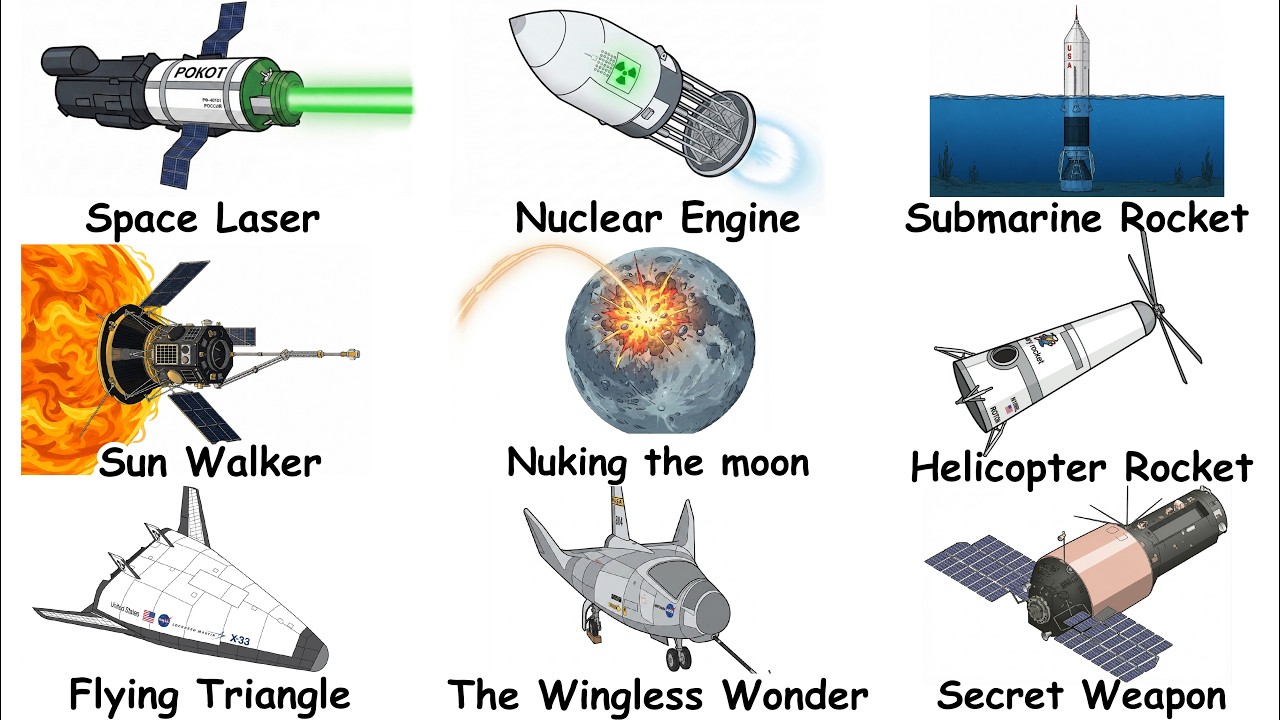
technology keeps developing, the idea of traffic jams might one day include cars literally lifting off the road and flying over them. Space laser.
Speaker A
Almost nobody knows the Soviet Union once tried to put a laser cannon in space.
Speaker A
The spacecraft was called Polyus, and it looked like something straight out of science fiction. During the Cold War, the idea was simple. If your enemy relies on satellites, why not build a spacecraft that can disable them? Polyus was reportedly designed to test a
Speaker A
powerful laser in orbit, making it one of the most ambitious military space projects ever attempted. If it had worked, it could have completely changed how countries thought about fighting in space.
Speaker A
But nobody ever found out what it could really do. Right after launch, a guidance mistake sent the spacecraft back toward Earth and it crashed into the Pacific Ocean before ever reaching orbit, wasting years of development and an enormous investment before it could
Speaker A
perform a single mission. Nuclear engine. Did you know scientists once wanted to fly a spaceship by setting off nuclear bombs behind it? As ridiculous as that sounds, it was a serious proposal called Project Orion. Instead of using normal rocket engines, the
Speaker A
spacecraft would eject small nuclear bombs behind itself and detonate them one after another. Each blast would slam into a massive steel plate under the ship and shock absorbers would smooth out the ride.
Speaker A
The calculations suggested it could carry enormous payloads and reach Mars in a fraction of the time of conventional rockets. So, why was it never built? Not because it could not work, but because exploding hundreds of nuclear bombs near Earth became
Speaker A
politically and environmentally unacceptable after nuclear test ban treaties. On paper, it could have worked. In reality, the world decided the risks were just too high. Submarine rocket. What if someone built a rocket as tall as a skyscraper and launched it
Speaker A
from the sea? Believe it or not, engineers actually wanted to do exactly that. The Sea Dragon was a serious 1960s rocket concept. Designed to stand roughly 550 ft tall and carry an enormous amount of cargo into orbit.
Speaker A
Instead of assembling it in a traditional factory, the plan was to build it in a shipyard, tow it into the open ocean, stand it upright in the water, fuel it, and launch it from the sea. The idea was that building giant
Speaker A
rockets like ships could dramatically cut costs while carrying payloads far larger than anything flying at the time.
Speaker A
It never got funding, but Sea Dragon is still remembered as one of the most ambitious and bizarre space projects ever conceived. Sun Walker. This spacecraft has actually flown through the sun's outer atmosphere and survived.
Speaker A
The Parker Solar Probe sounds like a mission that should be impossible, yet NASA built it to do exactly that. But getting close to the Sun wasn't as simple as flying straight toward it.
Speaker A
Instead, NASA used the gravity of Venus over several years to slowly pull the spacecraft closer and closer to the Sun until it was flying through its outer atmosphere. Even while traveling at nearly 430,000 mph, it survives because of a carbon
Speaker A
composite heat shield that keeps its instruments near room temperature. The data it collects is helping scientists understand why the Sun's outer atmosphere is hotter than its surface, how the solar wind is created, and how solar storms can affect satellites,
Speaker A
astronauts, and even power grids on Earth. Sometimes the strangest space projects end up answering the biggest questions. Helicopter rocket.
Speaker A
Imagine a rocket that flew to orbit and landed like a giant helicopter. That was the vision behind the Roton SSTO, one of the weirdest spacecraft concepts ever seriously developed. In the late 1990s, a company called Rotary Rocket wanted to build a fully reusable
Speaker A
spacecraft that could reach orbit without dropping any stages, making space flight much cheaper. What made Roton so unique was its landing system. After reentering Earth's atmosphere, giant rotor blades would deploy from the top of the vehicle and spin freely in the air, slowing its
Speaker A
descent. It was an incredibly ambitious idea, but the technology simply wasn't ready. Building a single-stage rocket light enough to reach orbit proved far more difficult than expected, and the company eventually ran out of funding. Roton never made it to space, but it remains
Speaker A
one of the boldest rocket concepts ever attempted, proving that even the strangest ideas can help shape the future of spaceflight. Flying triangle.
Speaker A
This flying triangle was supposed to replace rockets as we know them. VentureStar was a futuristic spacecraft designed by Lockheed Martin for NASA to reach orbit as a single-stage-to-orbit vehicle.
Speaker A
Instead of throwing away rocket stages during launch, it would take off, reach space, return to Earth, and fly again.
Speaker A
The biggest obstacle was its lightweight composite liquid hydrogen fuel tank, which failed during testing.
Speaker A
In the end, the technology wasn't ready, and the flying triangle never left the ground.
Speaker A
Even today, no true single-stage-to-orbit vehicle has ever reached orbit. The wingless wonder. This weird NASA aircraft flew like a spaceship, landed like a plane, and helped astronauts survive returning from orbit. In the 1960s, NASA was facing a massive challenge. After traveling
Speaker A
through space, how could astronauts return to Earth and land safely instead of crashing into the ocean? To solve this problem, NASA began testing something completely different from traditional spacecraft. They built lifting body aircraft, vehicles that had no normal wings, but used their own
Speaker A
shape to create lift. One of the strangest designs was the HL-10. It was flat, wide, and almost looked like a flying machine from another planet. But behind its strange appearance was advanced engineering. Its curved body allowed it to glide through the
Speaker A
atmosphere, make controlled turns, and approach a runway for landing. During testing, pilots flew the HL-10 at high speeds to prove that a wingless spacecraft design could actually work.
Speaker A
The lessons learned from this strange aircraft helped NASA develop better spacecraft designs, including technology that influenced the Space Shuttle program. Secret weapon. What if I told you one of the world's first space stations wasn't just a space station? It
Speaker A
was actually a secret military weapon. In 1974, the Soviet Union launched Salyut 3 and told the world it was another peaceful scientific mission. On the surface, that seemed believable.
Speaker A
After all, astronauts were living in orbit, running experiments, and pushing space exploration forward. But that story was only a cover. Behind the scenes, Salyut 3 was actually part of the highly classified Almaz military program, a Cold War project designed to
Speaker A
turn space into the ultimate surveillance platform. Instead of focusing on science, its real mission was to spy on Earth. The station carried enormous high-resolution cameras that could photograph military installations and troop movements from hundreds of kilometers above the planet. The crew
Speaker A
could even develop the film while still in orbit and send the images back to Earth, giving Soviet intelligence valuable information without relying on satellites alone. But the strangest part wasn't the cameras, it was the weapon.
Speaker A
Engineers believed an enemy spacecraft might try to inspect or even capture the station. So, they installed a modified 23-mm aircraft cannon directly onto Salyut 3. Near the end of the mission, after the crew had already returned home, the cannon was reportedly fired
Speaker A
remotely while the station was still in orbit. The recoil was so powerful that the station had to fire its own thrusters to to stable.
Speaker A
As far as we know, this is the only space station in history that was equipped with and tested a gun in space.
Speaker A
Salyut 3 wasn't just another step in space exploration. It was proof that during the Cold War, even outer space became another battlefield. Junkyard Dog. This might be the weirdest fighter jet the US Air Force ever flew. At first
Speaker A
glance, the Grumman X-29 looks like someone built a fighter jet backwards. Its forward-swept wings gave it amazing maneuverability, but they also created an aircraft so unstable that no human pilot could safely control it alone. A digital flight control system made tiny
Speaker A
corrections many times every second just to keep it flying. Engineers also used advanced composite materials to stop the wings from twisting apart under stress, solving a problem that had defeated earlier designs. The X-29 never became a frontline fighter, but it proved that
Speaker A
ideas once considered impossible could actually work. Black Widow II. The stealth fighter that might have been better than the F-22 was never built.
Speaker A
In the early 1990s, the United States wanted a new fighter jet that could dominate the skies, and two aircraft competed for the future of air combat.
Speaker A
One was the YF-22, which became the famous F-22 Raptor. The other was the weird-looking YF-23, a stealth aircraft that looked like it belonged in a futuristic movie.
Speaker A
The 23 had incredible speed, long range, and a design focused on staying hidden from enemy radar.
Speaker A
Many aviation fans still argue that it may have had advantages over the F-22, but the Air Force still chose the 22, and the 23 was never put into production.
Speaker A
Today, only two prototypes remain, making it one of the most fascinating fighter jets that almost changed history.
Speaker A
The Goblin. This tiny fighter jet looked like a joke, but it was actually a serious Cold War weapon. In the late 1940s, the United States faced a problem. Giant bombers could carry powerful weapons, but they had limited protection from enemy fighters during
Speaker A
long missions. So, engineers created a wild idea called the XF-85 Goblin, a fighter jet small enough to be stored inside a bomber. When the bomber was threatened, the Goblin would drop out, fight enemy aircraft, and then return home by attaching back to the bomber. On
Speaker A
paper, it sounded like the future of air combat. In reality, the tiny jet was difficult to control, and reconnecting with the massive bomber was almost impossible. The project was eventually abandoned, but the XF-85 Goblin became a legendary example of how far engineers
Speaker A
were willing to go to create the perfect fighter. The Draken. The Saab 35 Draken was so advanced that it could perform a maneuver many modern pilots still find impressive.
Speaker A
When Sweden introduced this fighter jet in the 1950s, many people wondered what they were looking at because its design was unlike anything else flying at the time.
Speaker A
Instead of copying traditional fighter shapes, Saab created a machine with a unique double delta wing that looked strange, but solved some serious engineering problems.
Speaker A
The Draken was built for one main purpose, defending Sweden during the Cold War. Its job was to take off quickly, intercept enemy aircraft, and operate from short runways and hidden airbases across the country.
Speaker A
The unusual wing design gave it incredible speed, high altitude performance, and impressive control during extreme flight conditions.
Speaker A
But the most famous thing about the Draken was not just how fast it could go.
Speaker A
Test pilots discovered that the aircraft could perform a dramatic maneuver called the Cobra, where the jet suddenly pitches its nose upward while maintaining control.
Speaker A
At the time, this was almost unheard of and showed just how much control the Draken had at high angles of attack.
Speaker A
Stiletto. You would think this jet was a supersonic monster. It was not. The Douglas X-3 Stiletto looked like someone forgot to finish building the wings. The plan was for it to cruise past Mach 2 and unlock the secrets of sustained
Speaker A
supersonic flight. But, the powerful engines it was designed around never became available, forcing engineers to install weaker ones that left the aircraft struggling to even break Mach 1 in level flight. On paper, it was a disappointment. In the air, though, it
Speaker A
revealed something unexpected. During one high-speed test, the aircraft experienced inertial coupling, a violent motion that nearly caused a crash and exposed a major danger facing future supersonic jets. Those lessons directly influenced later aircraft designs and flight testing, proving that even a
Speaker A
failed experimental jet could change aviation history. Flying Ram. Almost nobody knows America once tried to build a fighter that attacked enemy bombers by ramming into them. During World War II, Northrop developed the XP-79 Flying Ram, a futuristic flying wing
Speaker A
unlike anything else in the sky. Instead of relying only on guns, the aircraft was designed with a strong magnesium structure that engineers believed could survive glancing impacts with enemy bombers while tearing away parts of their wings or tails. To help handle the
Speaker A
intense forces, the pilot flew lying face down inside the aircraft. It was one of the boldest and strangest fighter concepts ever proposed. But, the dream ended almost as soon as it began. On its first test flight in September, 1945,
Speaker A
the XP-79 went out of control. The pilot was unable to escape, and the aircraft crashed, ending the project before its bizarre combat concept could ever be put to the test. Delta Dagger. What if I told you one tiny design change saved an
Speaker A
entire fighter jet? The F-102 Delta Dagger was built to defend America from waves of Soviet bombers during the Cold War, but its first prototype had a huge problem. Even with a powerful jet engine, it could not fly faster than
Speaker A
sound in level flight. That failure put the entire program in danger of being canceled. Engineers realized the engine was not the real issue. The shape of the aircraft was creating too much drag as it approached the speed of sound. Using
Speaker A
a newly developed concept called the area rule, they narrowed the fuselage where the wings met the body, giving the jet its unusual pinched waist. It looked strange, but the results were incredible. The redesigned F-102 finally broke the sound barrier, entered service
Speaker A
as the first operational supersonic interceptor in United States Air Force history, and went on to protect North American airspace for years. That one odd-looking design change did not just save the F-102. It helped shape the future of supersonic fighter aircraft
Speaker A
around the world. F7U Cutlass. This fighter jet scared its own pilots more than the enemy. When the F7U Cutlass entered service in the early 1950s, the US Navy expected it to be the next generation of carrier fighter. Instead,
Speaker A
it quickly became one of the most dangerous aircraft in its inventory. Its engines produced so little thrust that takeoffs could be terrifying, especially from aircraft carriers where every foot mattered. Hydraulic failures, unreliable systems, and landing gear that could
Speaker A
collapse without warning turned even routine flights into a gamble. Pilots gave it the nickname Gutless Cutlass because it often felt like it never had enough power when they needed it most.
Speaker A
Out of 320 aircraft built, 78 were destroyed in accidents and dozens of pilots lost their lives. The Cutlass never fired a shot in combat, but it still earned a reputation as one of the deadliest fighter jets ever to wear US
Speaker A
Navy markings. F-107 The XF-91 looked completely ridiculous, but there was actually some clever engineering hiding behind those strange wings. Built by Republic Aviation during the early Cold War, the Thunderceptor was an experimental fighter designed to deal with the problems of high-speed flight.
Speaker A
Its most bizarre feature was its variable incidence wing, meaning the entire wing could change its angle relative to the fuselage. The wings were also wider toward the tips, making the aircraft look almost backwards compared to a normal fighter. But this strange
Speaker A
design had a purpose. Engineers wanted to improve the aircraft's performance during both high-speed flight and slower approaches and landings. The XF-91 even used a combination of a jet engine and rocket engines for extra power. It never became a production fighter, but it
Speaker A
proved that sometimes the weirdest-looking aircraft can come from some surprisingly clever ideas.
Topics:weird aircraftexperimental planesvertical takeoffSnecma ColeopterAerocycleRingwingAirbus BelugaLockheed XFVVought V-173Blohm and Voss BV 141