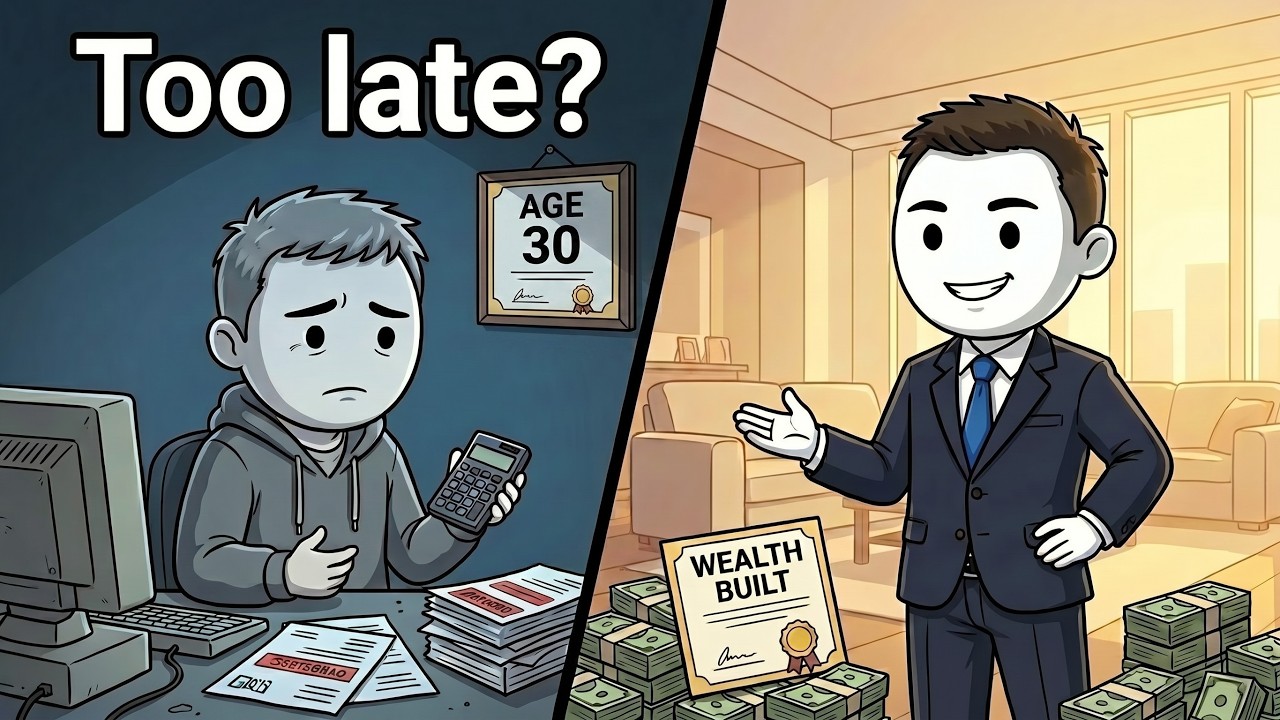
Explore how investing $5 daily transforms your financial future over 40 years, contrasting spending vs. saving habits.
Key Takeaways
- Small daily investments grow significantly over long periods due to compound interest.
- Consistent investing beats impulsive spending and risky quick-win schemes.
- Patience and discipline are the rarest and most valuable skills in personal finance.
- Market fluctuations should not deter long-term investors from continuing their contributions.
- Financial security is built quietly and steadily, not through loud or flashy actions.
What the video covers
- The video contrasts two paths: spending $5 daily on instant gratification versus investing the same amount in an index fund.
- It follows a person from age 25 to 55, showing how consistent $5 daily investments grow exponentially over decades.
- Initial returns seem small and unimpressive, but the habit of investing quietly builds wealth over time.
- The power of compound interest becomes evident after about 15 years, when investment gains surpass contributions.
- The video highlights the difference between short-term thrills and long-term financial security.
- It warns against chasing quick gains through risky investments, likening them to scratch tickets.
- Market downturns are inevitable, but staying invested and continuing contributions leads to recovery and growth.
- By 40 years, the invested $5 daily grows into a substantial nest egg, providing financial stability and peace of mind.
- The video emphasizes that the key to wealth is patience, discipline, and consistency rather than luck or timing.
- Ultimately, the $5 daily investment is portrayed as a silent, powerful habit that shapes your financial future.
Chapters
- 00:00The $5 Habit at the Convenience Store
- 00:59Choosing to Invest Instead of Spend
- 02:52One Year of Investing: Small Gains
- 03:51Five Years In: Building Wealth Slowly
- 05:10Market Volatility and Staying the Course
- 06:35Fifteen Years: The Power of Compound Interest
- 08:10Twenty Years: The Investment Habit Pays Off
- 09:08Twenty-Five Years: Financial Security Grows
- 10:00Thirty Years and Beyond: Wealth Becomes Self-Sustaining
- 11:22The Final Lesson: Patience and Discipline Win
Full Transcript — Download SRT & Markdown
Speaker A
It's 6:40 in the evening, and you are standing at a convenience store counter with a $5 bill already in your hand, an energy drink sweating in the other. A scratch ticket the cashier slides across the counter without looking up.
Speaker A
$5. You don't think about it. Nobody thinks about it. $5 is the price of not having to decide.
Speaker A
You scratch the ticket in the parking lot with a coin from the cup holder.
Speaker A
Nothing. You knew it would be nothing. You drop it on the passenger seat with the other three from this week. Drink half the can and drive home.
Speaker A
By tomorrow, you will not remember this happened. That is the entire point of $5. It is the exact amount that vanishes without leaving a mark.
Speaker A
Now, hold that $5 in your mind because this is a story about the same $5 every single day for 40 years.
Speaker A
And about the two different people it quietly decides you will become. You are 25. It's the next evening, the same counter, the same cashier.
Speaker A
This time, you don't reach for the ticket. You don't buy the can. You walk out with nothing in your hands, sit in the car, and open an app you downloaded the night before.
Speaker A
You move $5 into an index fund. The whole market, one button, no opinion required.
Speaker A
The screen says your balance is $5. It looks absurd. It looks like a child's bank account. You feel slightly stupid, like a man planting a single seed in an empty field and calling it a farm.
Speaker A
There is no rush, no thrill, no number scratched off to reveal a win. There is just $5 sitting in something that owns a sliver of every large company on Earth.
Speaker A
You do it again the next day and the next. You set it to happen on its own, so you never have to feel the decision. So, the $5 leaves before you can spend it on something with a wrapper.
Speaker A
A $152 a month leaves your account towards something you cannot touch. You barely notice it's gone.
Speaker A
That was always the strange part about the $5. It disappeared either way. You just changed where.
Speaker A
You were 26. A full year has passed. The balance reads about $1,900. You put in $1,825 of your own money and the market added the rest while you slept.
Speaker A
$75. A number so small, it's almost an insult. You mention it at lunch once to a coworker.
Speaker A
He asks how much you've made. You tell him. He laughs, not cruelly, just honestly.
Speaker A
"75 bucks in a year?" he says. "I make that in an afternoon." He's not wrong. He buys lunch out every day, a drink at the corner store every evening, a scratch ticket when the jackpot gets loud.
Speaker A
Roughly $5 a day, give or take, scattered across 100 tiny pleasures he will never be able to name later.
Speaker A
You say nothing. You close your laptop. The difference between you and him this year is $75 and a habit nobody can see.
Speaker A
The $75 is not the part that matters. The habit is. You are 30, 5 years in. The balance is around $11,000.
Speaker A
You contributed about 9,000 of it. The rest appeared out of time. $11,000 built entirely out of things you didn't buy.
Speaker A
You do the math one night and realize it equals every coffee, every energy drink, every impulse at every register you've stood at since you were 25.
Speaker A
Except instead of being in a landfill, it's in an account with your name on it.
Speaker A
That same month, a friend texts you a screenshot. A coin, a ticker you've never heard of, up 400% in a week.
Speaker A
He's put 2,000 in. He tells you to stop being a coward, that your boring fund makes in a year what his thing makes before lunch.
Speaker A
He's right about the speed. He's wrong about the direction. You've seen this exact shape before, on a counter, under a coin, in a parking lot.
Speaker A
The promise that a small amount becomes a large amount instantly, with no time in between.
Speaker A
That promise has a name where you grew up. And the name is a scratch ticket.
Speaker A
You text back that you'll pass. He sends a laughing emoji and buys more. Three months later, the coin is down 90% and he has stopped mentioning it.
Speaker A
You keep doing the most boring thing a person can do with money. You keep being early to bed and slow to rich.
Speaker A
You are 35, 10 years. The balance is roughly $27,800. You have put in 18,000 of your own dollars.
Speaker A
The market has handed you almost 10,000 more for the crime of not flinching. Then the year goes bad. The whole market drops. Headlines use the word crash.
Speaker A
Your balance falls by a third in a few weeks. More money lost on paper than you earned all year at your job. Your friend who sold everything at the bottom of the last one tells you he saw it coming,
Speaker A
that he's in cash now, safe. You don't sell, but it's softer than that, quieter than a decision. You simply don't open the app. You let the number fall and you keep the $152 going out the door every month, buying the same fund while it's
Speaker A
cheaper than it's been in years. You are not brave. You are just bored enough to do nothing, and doing nothing turns out to be the rarest skill in finance. By the time everyone agrees it's safe to come back in, your boring habit already
Speaker A
bought the bottom nobody could see. You are 40, 15 years. The market came back the way it always has so far, and the balance is around $52,600.
Speaker A
You have put in about $27,000 of your own. For the first time in your life, the account holds more money than you ever fed it. Read that twice because it's the moment the whole thing changes character. Up to now, you were pushing a
Speaker A
stone uphill $5 at a time, and the hill barely moved. Now the stone is rolling on its own, and your only job is to not stand in front of it. A coworker gets laid off that spring. He has nothing
Speaker A
behind him, no cushion, nothing between him and the first missed paycheck but the next one. You have a number you've never touched and never planned to touch sitting quietly in the background. And for the first time, you understand the
Speaker A
$5 was never only about some far-off retirement. It was always also a wall between you and the version of a bad year that ends in panic. You don't tell him about it. You buy his lunch and say nothing. You are 45, 20 years. The
Speaker A
balance is about $89,000. You have contributed $36,000 across two decades, five at a time, and the account has more than doubled it on its own. For the first time, something strange is true. The money the market gives you in a year is starting to rival
Speaker A
what you put in. Your account has begun working a second job you never assigned it. You go to a reunion that summer.
Speaker A
Someone pulls up in a car that costs more than you make in a year, least.
Speaker A
Someone else talks loudly about a watch. You drive the same paid-off car you've had for eight years, the one that owes you nothing. Your old co-worker is there, the one who laughed at your $75.
Speaker A
He still buys lunch out. He still buys the ticket. He asks, half joking, if you ever did anything with that little app.
Speaker A
You tell him you stuck with it. He asks, how much is in there now? You tell him.
Speaker A
The table goes quiet in a way you didn't ask for and don't enjoy. You change the subject. The $5 was never loud. It was the one thing in the room that never needed to be. You are 50, 25 years. The
Speaker A
balance is around $144,000. You have contributed about $45,000 in total, and the account has tripled it without asking your permission. You read the headlines differently now. They run stories about how most people your age have almost nothing saved, how a
Speaker A
comfortable retirement is slipping out of reach, how the math no longer works for ordinary earners. You are an ordinary earner. You did the same job as the people in those headlines, made roughly the same salary, paid the same
Speaker A
rent, sat in the same traffic. The only thing you did differently was refuse a scratch ticket and a cold can quietly for 25 years and route the difference into the most unremarkable fund in existence. Your friends your age talk
Speaker A
about retirement like a cliff they're being marched toward. You talk about it like weather, something that arrives whether you worry about it or not. You don't say that out loud, either. By now, you understand the number is loudest
Speaker A
when it stays silent. You are 55, 30 years. The balance is around $226,000. You've put in about $55,000 total across three dec
Speaker A
The other 170,000 was never yours to earn. It was times, and you simply let time have the room to do its work.
Speaker A
This is the year the math quietly flips for good. The account now grows more in a strong year from its own size than you could add by hand if you doubled your contributions. You have become a passenger to your own balance. The thing
Speaker A
you built is now bigger than the building of it. You don't talk about the number, not to your kids, not to your coworkers, not to the friend who once told you to stop being a coward. The number lives in a
Speaker A
place no one looks, which is exactly where it grew. You are 65, 40 years from the evening you didn't buy the scratch ticket. The balance is about $531,000.
Speaker A
Sit with the breakdown because it's the whole story in three figures. Of that half a million dollars, the amount you actually contributed, $5 at a time every day for four decades is $73,000.
Speaker A
The other 458,000 is growth. Money you never earned, never worked an hour for, never noticed leaving, and never watched arrive. You did not get lucky. You did not pick a winner. You did not time anything. You skipped a
Speaker A
scratch ticket and a can of something cold 40,000 times in a row, and let the smallest possible amount sit in the most boring possible place for the longest possible time.
Speaker A
That's the entire mechanism. There is no second secret. No version of this where someone hands you the 458,000 faster. The slowness was the price, and almost nobody is willing to pay in a currency that takes 40 years to clear.
Speaker A
Your old co-worker retires the same year you do. Same job, same salary the whole way. Decent man, never missed a shift.
Speaker A
He spent his $5 a day on a thousand small comforts he enjoyed in the moment and cannot point to now.
Speaker A
Over 40 years, his version of the $5 also added up to $73,000. The exact same money. He drank it, scratched it, ate it, tossed it on the passenger seat. You and he stood at the same counter, held the same $5 bill on
Speaker A
the same evenings for 40 years. He has a lifetime of small pleasures and a pension.
Speaker A
You have those same pleasures, mostly, and also half a million dollars sitting behind your life like a second person who has been working the whole time.
Speaker A
Nobody can point to the day the two of you split. There was no day.
Speaker A
There were just two different answers to the same tiny question asked again every evening until the answers stopped being choices and became two different lives.
Speaker A
Somewhere right now it's 6:40 in the evening and someone is standing at a convenience store counter with a $5 bill already in their hand. The energy drink, the scratch ticket the cashier slides over without looking up. They will
Speaker A
scratch it in the parking lot with a coin from the cup holder and it will be nothing and they will already know it was going to be nothing.
Speaker A
They are not doing anything wrong. $5 is nothing. That has always been the trap and the door at the same time. The $5 is too small to matter which is exactly why almost no one keeps it and exactly why
Speaker A
it quietly decides everything for the few who do. You were never going to feel the $5 either way. You only ever got to choose what it was turning you into while you weren't paying attention.
Topics:investingpersonal financecompound interestindex funddaily investingfinancial habitslong-term wealthmoney managementfinancial literacySonny Finance