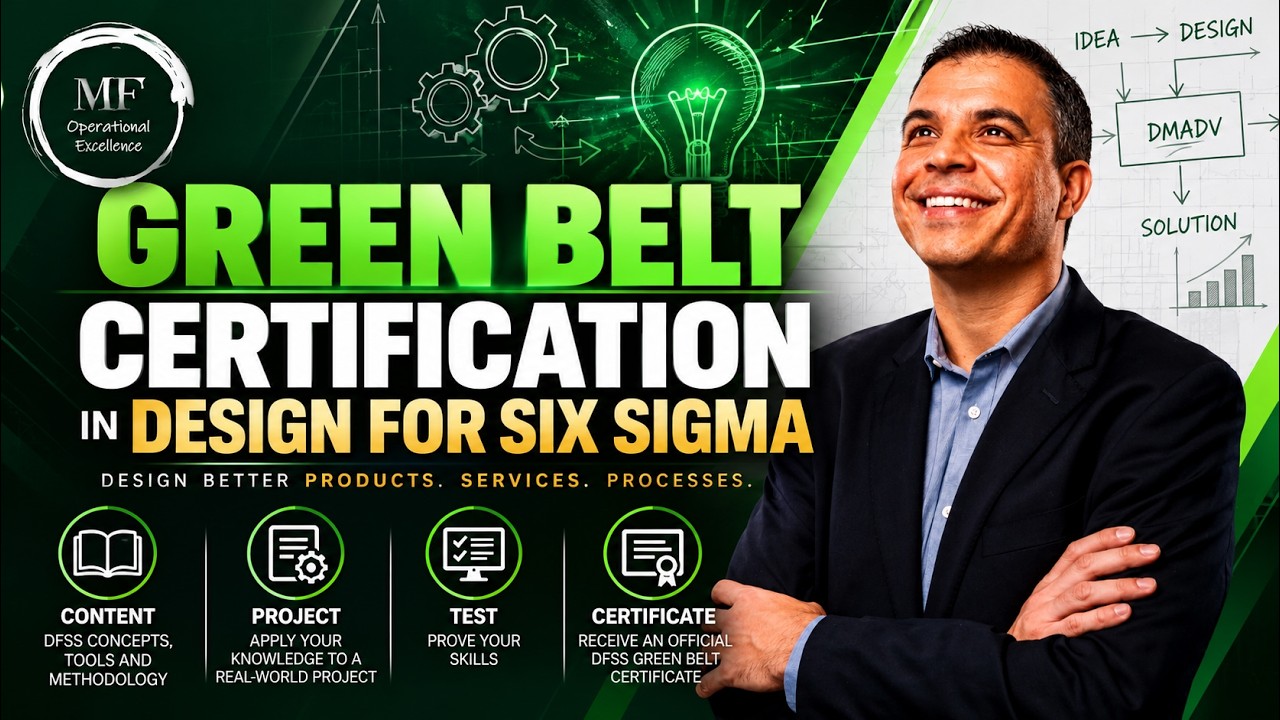
Prof. Marcelo Machado Fernandes runs Session 2 of a Design for Six Sigma Green Belt certification, using the Alice's Pizzeria case study to teach voice-of-customer prioritization and CTQ definition.
Key Takeaways
- DFSS is a separate learning path from Lean Six Sigma and requires no prerequisite belts.
- Expect roughly one hour of self-study for each live hour, totaling 20 hours including the final test.
- VOC items should be prioritized and rated for importance before defining CTQs.
- Each VOC can yield multiple CTQs, and the process is qualitative even when numeric ratings are used.
What the video covers
- Session 2 of a 20-hour Design for Six Sigma Green Belt certification (10 hours live, 10 hours self-study), with no prerequisites since DFSS differs from Lean Six Sigma.
- Participants are told to make a copy of the shared template and are encouraged to take notes within it.
- The certification ends with a test; passing grants a certificate with a unique number, verifiable by employers, and the instructor references ASQ affiliation.
- The course is framed around moving from job security to professional security, with the certificate supporting career mobility and potentially monetizing knowledge.
- The case study is Alice's Pizzeria, chosen for simplicity so attention stays on method rather than context.
- The session introduces the opportunity statement, noting DFSS creates something new rather than fixing a stated problem.
- Qualitative tools are discussed as powerful alongside quantitative approaches, with an emphasis that ranking and prioritization are qualitative.
- Voice of the customer (VOC) items are prioritized and assigned importance rates on a 1–10 scale.
- Critical-to-quality (CTQ) characteristics are derived from prioritized VOC items, with the note that one VOC may map to multiple CTQs.
- Consistency and volatility are highlighted as drivers of customer loyalty, especially for repeat-purchase businesses like pizzerias.
Chapters
- 00:00Welcome and course logistics
- 05:00Template setup and certificate overview
- 18:20Participant engagement and course framing
- 43:20Opportunity statement and qualitative tools
- 65:00VOC gathering and customer selection
- 83:20Prioritizing VOC items and importance rates
- 108:20Defining CTQs from VOC
- 121:40Wrap-up, homework, and closing remarks
Full Transcript — Download SRT & Markdown
Speaker A
Attention, ladies and gentlemen. Am I talking to the best of the best? Yesterday we had the best students. Today we had the best of the best.
Speaker A
Today we had the best of the best. Please on a scale from 0 to 10, how is my audio? I hope you can hear me okay and I hope you can see me okay. It's my absolute pleasure to be here with No,
Speaker A
Please, on a scale from 0 to 10, how is my audio? I hope you can hear me okay, and I hope you can see me okay. It's my absolute pleasure to be here with Nico, with Camila, with Randy, with Carlos, with Monteray, with Jones, with Benja, with Nelly. Wonderful. And let's get started.
Speaker A
Let's move on in our session number two. And let's get started with our let's move on with our design for six sigma green belt certification program and let's get started with our session number two. Okay guys, just a few
Speaker A
Let's move on to our session number two. Let's move on with our Design for Six Sigma Green Belt certification program, and let's get started with session number two. Okay, guys, just a few important reminders.
Speaker A
Do you guys understand that? Type okay if you understand that. So if you are not a white belt, a yellow belt in lin sigma that's okay. No problem at all.
Speaker A
Design for Six Sigma is an entirely different method in comparison to Lean Six Sigma. Okay. So it's like you are starting a completely different journey, a completely different learning path. So there are no prerequisites.
Speaker A
Amazing. The second reminder is uh this is a 20our certification process. 10 hours with me and 10 hours on your own.
Speaker A
Do you guys understand that? Type "okay" if you understand that. So if you are not a white belt or a yellow belt in Lean Six Sigma, that's okay. No problem at all.
Speaker A
I do expect that you spend one to one. Okay? For each hour that I spend here with you, I do expect that you spend on your own reviewing your notes, maybe reviewing the sessions. Okay? So, type 20 hours if you understand that
Speaker A
Okay. You are welcome to this training session, very much welcome. Okay. There are no prerequisites. Amazing.
Speaker A
We are here using a case study Alice's Pizzeria. And why are we using something so simple? Because then I can concentrate the usage of your energy on understanding the content itself. Okay, this is very much important, very much important that
Speaker A
The second reminder: this is a 20-hour certification process. Ten hours with me and ten hours on your own. Okay. I don't know if I reinforced this enough yesterday, so what do I mean by that? I do expect that you spend some time offline evaluating the content and also reviewing your notes. Do you understand that? So again, I do expect that you spend one hour for each hour that I spend here with you. On your own, reviewing your notes, maybe reviewing the sessions. Okay? So type "20 hours" if you understand that this is a journey formed by 20 hours in total. Okay. Amazing. Yeah, beautiful.
Speaker A
Yeah, you can find the template in the in the WhatsApp group. In the WhatsApp group and in the template, let me open up here for you.
Speaker A
We are here using a case study, Alice's Pizzeria. And why are we using something so simple? Because then I can concentrate the usage of your energy on understanding the content itself. Okay, this is very important, very important that I properly manage your energy. Beautiful.
Speaker A
template. Marcelo I want to add you know my notes here in this slide. I want to write down more things in this slide.
Speaker A
So, the case study template. If you have the template, type "here" for me. "Template." If you have the template, type "here" for me. "Template."
Speaker A
You need to come here in file. Whoa. Not here. Uh file make a copy. Do you guys understand that file boom make a copy of the entire presentation? If you do this, you can have your own version.
Speaker A
Yeah, you can find the template in the WhatsApp group. In the WhatsApp group. And in the template, let me open it up here for you.
Speaker A
material. I have I This is fancy. I have the best team in this planet. They bring me fresh coffee, you know, after the session starts.
Speaker A
In the template, if you want, you can make a copy. You can make a copy and then you can add to it. If you don't make a copy, you cannot add to it. Okay? So let me show you. This is the project template. Marcelo, I want to add my notes here in this slide. I want to write down more things in this slide. Can I do that? Yes. But then you need to let me zoom in for you.
Speaker A
I have the best studio. And I have the best team. Her name Her name is Rosie. Rose. Rose.
Speaker A
You need to come here, in File. Whoa, not here. Uh, File, Make a copy. Do you guys understand that? File, boom, make a copy of the entire presentation. If you do this, you can have your own version.
Speaker A
international. Yeah. Legendary Rose. Yeah, that's that's Rose. Okay. So, you can use you can use the template. That's beautiful. Not a problem. Not a problem. Okay. And I know that some people prefer to take notes pen and paper, but if you prefer on
Speaker A
Your own version. Yeah, of the file. And that's okay. Beautiful.
Speaker A
So you are receiving content we are running a project together you will be taking a test a certification test and you based on the result you'll be receiving your certificate. Okay, by the way, I believe I have here
Speaker A
Marcelo, can I use this in my company? Marcelo, can I use this in my day-to-day work? Guys, this is yours. This is yours. So you can do anything you want with this material.
Speaker A
the green belt level. Yes. And again, you'll be receiving this only if you are approved in the final test. Yes, we have the framework here. Uh there is my ASQ, the American Society for Quality um number. Yeah, so it has to do with the
Speaker A
I have... this is fancy. I have the best team on this planet. They bring me fresh coffee after the session starts.
Speaker A
There is a unique number. Yeah, all certificates they come with this unique number in case your employer wants to check if this is authentic or not. There is also the date when you take the certificate the certification test. Yes.
Speaker A
How blessed am I? How blessed am I? You guys tell me. I have the best students. I have the best studio. And I have the best team. Her name is Rosie. Rose. Rose.
Speaker A
and the day after tomorrow. Yes. So Monday, Tuesday, Wednesday and Thursday. And then I will be explaining how the test works. Beautiful. Amazing. And then we have our final session next Monday.
Speaker A
Let's make some noise for Rose here. Thank you, Rose. Uh, coffee. Make some noise for Rose. International. Yeah. Legendary Rose. Yeah, that's Rose.
Speaker A
10 hours on your own. Okay. Amazing. Beautiful. How excited are you? And I feel blessed to be with the best of the best. Type here for me best of the best because we know this is a funnal process. Yes, this is a funnel
Speaker A
Okay. So you can use the template. That's beautiful. Not a problem. Not a problem.
Speaker A
more reduced number of people. And I am getting the best of the best of the best of the best. And at the very end people that will receive this certificate are the best of the best of the best of the
Speaker A
Okay. And I know that some people prefer to take notes with pen and paper, but if you prefer the digital file, that's okay too. That's okay too. Okay. Beautiful. Beautiful.
Speaker A
is about professional security. So, take a look here. You guys know that professional security we want to move from job security to professional security.
Speaker A
Another thing: this is a formal certification process. So you are receiving content, we are running a project together, you will be taking a test, a certification test, and based on the result you'll be receiving your certificate. Okay. By the way, I believe I have here, uh, yeah, this is the exact certificate that you'll be getting. I hope you like it. Make some noise in this chat. This is the certificate. Come on. How beautiful is that?
Speaker A
that can take you to another company, to another industry, or maybe to another country. Yes. And you can eventually consider monetizing your knowledge and having your own business. Okay. So, type freedom if you understand that.
Speaker A
So your certificate is a 20-hour certificate in Design for Six Sigma at the Green Belt level. Yes. And again, you'll be receiving this only if you are approved in the final test. Yes, we have the framework here. Uh, there is my ASQ, the American Society for Quality, number. Yeah, so it has to do with the credentials. Yeah, I would say how solid this certificate is.
Speaker A
It's our responsibility. It is our responsibility to own our career. Okay, so I this is one of my favorite slides.
Speaker A
There is also a kind of DNA in your certificate. There is a unique number. Yeah, all certificates come with this unique number in case your employer wants to check whether it is authentic or not. There is also the date when you took the certification test. Yes.
Speaker A
I own my career. If we compare design for six sigma with the classic lin six sigma design for six sigma is less intensive in terms of quantitative tools. I don't know if this is a good news for you or
Speaker A
So, um, that's it. That's it. And the test is a multiple-choice question test. Okay, you will be receiving the link. I will be explaining this in a few days, because we have sessions, uh, we had yesterday, we had today, tomorrow, and the day after tomorrow. Yes. So Monday, Tuesday, Wednesday, and Thursday. And then I will be explaining how the test works. Beautiful. Amazing.
Speaker A
approach approach. Okay. But qualitative tools are very much powerful and to be honest qualitative tools are less dependent on soft type value if you understand that. Yeah, we should be yeah we should consider that.
Speaker A
And then we have our final session next Monday. Is that clear? Is that clear? So it's a one-week, a one-week journey. Ten hours with me and ten hours on your own.
Speaker A
From where are you taking this training? Philippines, Malaysia. South Africa, S. Paulo, Guatemala Botswana Cameroon, Idaho, United States, Japan, UAE, Trinidad, Tobago. Many students from Trinant Tobago, Portogria, Kenya Jamaica.
Speaker A
Ten hours on your own. Okay. Amazing. Beautiful. How excited are you? And I feel blessed to be with the best of the best. Type here for me "best of the best," because we know this is a funnel process. Yes, this is a funnel process.
Speaker A
um you please let me know. Okay. So we are working on our case study about Alissi that always dreamed about having you know offering the best pizza in this planet. We had a very good conversation about defining customer
Speaker A
We had a number of people who registered for the training. Then we had a reduced number of people who came to session one. We have an even more reduced number of people in session two. Tomorrow we will have an even more reduced number of people. And I am getting the best of the best of the best of the best. And at the very end, the people who receive this certificate are the best of the best of the best of the best of the best. The crème de la crème. Yeah, that's the process. That's the natural process. That's the natural process. We pretty much exclude the people who are not fully connected to our mission. Okay.
Speaker A
then we had a chance to collect a good sample that was sufficient contextual. So here I'm talking about sample size.
Speaker A
And what is our final mission? Our final mission is about professional security. So take a look here. You guys know that professional security, we want to move from job security to professional security.
Speaker A
that we did previously. And here we had a very good conversation about the importance of getting uh collecting our sample randomly. Okay. So once again we found our niche, we collected the voice of the customer and we were able to classify the voice
Speaker A
We are focused here on guaranteeing that you have professional freedom. And what is professional freedom? I want you to have these three doors. Door number one: you become more valuable where you are. Door number two: you have capabilities that can take you to another company, to another industry, or maybe to another country. Yes. And door number three: you can eventually consider monetizing your knowledge and having your own business. Okay. So type "freedom" if you understand that.
Speaker A
content review about yesterday's topics and then we move on with our content for session two. Okay. So type here, type here your questions and I'll try to pick you know u at least three questions okay to reply.
Speaker A
Yeah, I hope this is clear for you. I hope this is clear for you. And remember, I always love this message.
Speaker A
Regarding the kennel model that we'll be using in the case study, do we have any checklist? How can we know if the classification would fall under must be linear or delighter? Yeah, that's a that's a great question. That's a great
Speaker A
It's our responsibility. It is our responsibility to own our career. Okay, this is one of my favorite slides.
Speaker A
the definition is pretty simple Jay pretty simple. So the mechanics is we define our customer segment. We go ahead and we collect the voice of the customer normally via interviews slash one-on-one conversations. Okay, so we have uh a
Speaker A
Your company can own your position. It should never own your career. So make some noise here and write down: I own my career. I own my career.
Speaker A
know the message from different voices. So we have we shrink down the the list and we have at the end um um a final list of the voices. Okay, so that's where we are.
Speaker A
I own my career. If we compare Design for Six Sigma with classic Lean Six Sigma, Design for Six Sigma is less intensive in terms of quantitative tools. I don't know if this is good news or bad news for you, but in Design for Six Sigma you will find fewer statistical tools in comparison to Lean Six Sigma. Again, in Design for Six Sigma you will not find as many statistical tools as you find in Lean Six Sigma. It's more of a qualitative approach.
Speaker A
If the customer if the customer experiences a broccoli for example that is expired you know that is not fresh and then I will not develop the consequences of having a broccoli that's not healthy. Yeah you know about that. I
Speaker A
Okay. But qualitative tools are very powerful, and to be honest, qua
Speaker A
That's okay. Yeah. And if they are if they are fresh, they will not celebrate.
Speaker A
If they are not fresh, they will complain. Do you understand that? Yeah. uh linear linear. We have an example here that is a pizza that fits my student budget. So imagine that the pizza costs uh $30.
Speaker A
If the price goes down 25, the satisfaction goes up. 25 to 24, satisfaction goes up. 24 to $23, satisfaction goes up. So see there is a correlation. Yeah, a clear mathematical correlation. Yeah, beautiful. And then we have the lighter.
Speaker A
The lighter. We were talking about exciting. Take a look in this picture here in this image here. Uh exciting vegetarian toppings, not just tomatoes and onions.
Speaker A
So I mean a pizza that you take a look and you say, "Wow, this pizza is beautiful." This is not mandatory.
Speaker A
But if you create a pizza that people look and there is the face of Ronaldo, there is the face of Pelle, you know, you look and the way the ingredients were placed, you know, it looks like Pelle, it looks like
Speaker A
Ronaldinho. I mean I was not expecting this but if that happens for example for example then we feel extremely extremely happy. So see the definition presented here in our template is pretty amazing pretty accurate. these unexpected unexpected I was not expecting features
Speaker A
that create excitement and can differentiate the pizza from competitors. Okay, so the way to classify is pretty simple. Okay, was that helpful? Yes, beautiful. So let me unpin your uh question and let me find two more questions.
Speaker A
Do we need to create a project charter for define phase just like in the make or this is optional as long as we have the customer segment? That's a great question. You need to do the project charter. Yeah. and I I decided to talk
Speaker A
about project charter in the the FSS black belt. By the way, guys, some students uh no, let me go back. First of all, thank you for your messages. We got so many emails, so many WhatsApp messages uh on LinkedIn as well. Thank you so
Speaker A
very much. So, first of all, thank I am still I am still learning where to find the things in this in this new studio.
Speaker A
Attention. Wow, the echo is a little bit uh intense in this studio. Okay, attention ladies and gentlemen.
Speaker A
Thank you so very much for your messages. Thank you so very much for your messages yesterday and also today about session number one. Thank you. And among the messages I got many me uh not many people I got a few people
Speaker A
asking about black belt. Do we have a black belt in design for six sigma? Yes, we do have a black belt in design for six sigma. Now focus on green belt.
Speaker A
Okay. But in our design for six sigma black belt certification program then I talk in more details about the other tools including project charter okay but it's pretty much the same as in the make you need uh we don't call problem statement
Speaker A
we call opportunity statement because in fact we are creating something new so we do not consider that we have like a a clear problem that was stated that is there in place. We consider that we have an opportunity to design
Speaker A
something new in terms of service and um and our product. Okay, is that clear?
Speaker A
Yes, we need to run a project in the as we do for Linix Sigma.
Speaker A
Great question. Um, let me see if I can take another one. Uh, Francis, thank you. Hi, coach. I looked up Kenomodo and found there are other categories. Yeah, for all the tools that I'm presenting here, it's like cyborg in six sigma. You can find
Speaker A
many different templates here. I'm keeping it as simple as possible. So like Ishikawa that you can have a 7 a.m.
Speaker A
7th a.m. um like in uh like in project charter that you have so many different templates here I'm keeping as as you know if you guys were my students before I love to simplify things as much as possible. Why? Why?
Speaker A
Because when I simplify the tools, techniques, principles, and concepts, I touch your heart first.
Speaker A
If you guys fall in love with that, you don't need me anymore. And this is important.
Speaker A
the the real educator does not think on LTV on lifetime value. Lifetime value is a commercial strategy. You know, I do have my commercial drivers here, but I do consider myself as an educator.
Speaker A
You may believe, you may not believe, but I care I truly care about your professional development. I truly care about your professional development. I truly care about your professional development.
Speaker A
And that's why you don't see many people using this commercial funnel, you know, where I use 100% of my marketing budget to certify people for free. This is not very much um commercial effective. But I am okay with that. I am okay with that
Speaker A
because I'm gaining in other dimensions. I know about my legacy to this planet. I know I know I know very much. So why am I saying that? The way I teach the way I teach is described I teach anything is
Speaker A
described in this slide here. Take a look. I truly believe in this. Education is not the feeling of a pale but the lighting of a fire. Again, education is not the feeling of a pale but the lighting of a fire. So what do I
Speaker A
mean by that? I could easily easily start vomiting here. so many fancy, you know, expressions and tools and techniques that probably you would see myself as a a smart guy, a knowledgeable guy. But what about you?
Speaker A
The focus here is not me. I am just an instrument. I am just a vehicle again. I am just an instrument.
Speaker A
The protagonism should be totally on you. On you. So what do we want to do here? I want you to fall in love with design for six sigma. And then you feel the desire to research.
Speaker A
You feel the desire. You feel hungry for more. You know, do you guys understand that?
Speaker A
From 0 to 10, how much sense does it make for you? No, it's my pleasure. It's my pleasure and this is working for so many years because I have the right students and as I said before the funnel you know keeps going on so we
Speaker A
just get the best of the best of the best of the best of the best of the best. Is that clear? Yeah.
Speaker A
Which which audio do you prefer? Okay. Listen to the voice of the customer. Audio uh option one in blue. Hello. Hello.
Speaker A
Hello. Hello. Or option two in green. So blue. This is green. Green audio. Green audio.
Speaker A
Yeah. Do you prefer green or do you prefer blue? Type here for me. Green or blue?
Speaker A
Green or blue? Hello. Hello. Hello. Hello. Let me listen to Hello. This is green.
Speaker A
Green or blue? This is green. And this is blue. Blue. Blue. Blue. Hello. And this is blue. Blue.
Speaker A
Hello. Hello. Hello. Hello. We got 5050. Okay. Okay guys. Okay. So, let's move on here in our training content. And now I have an objective with you that is on measure phase we do have take a look here on
Speaker A
measure phase we need to prioritize VC we need to translate VC into CTQs and I need to prioritize CTQs. So once again I need to prioritize the voice of the customer. I need to translate VC into CTQs and I need to prioritize CTQS.
Speaker A
Okay. So when I go ahead and I prioritize the voice of the customer, what do I want to do? I want to take this list. I want to take this list and run and use a technique named pair
Speaker A
wise comparison. Okay. So guys, just give me one Second. Hello. Hello. Hello. Can you guys hear me?
Speaker A
Yeah that's that's interesting. As you guys know, I've I've moved from an apartment to a house. And I don't know if you guys were listening, but the dog was very annoying. So, I did my best here to negotiate
Speaker A
to negotiate uh with the neighbor, you know, for just let's say for just 90 more minutes, you know. Yeah, that's the that's the that's the risk you know of uh running for the very first time. I am collecting data. I am still collecting
Speaker A
data. I'm still collecting data. Uh uh still collecting data in this new studio. Yes. How is the audio now?
Speaker A
No, the the you guys were not listening to the dog probably because of the noise cancelling. And by the way, type yes if you were listening to the dog.
Speaker A
Barking. Yeah. And type no. And type no if you were not listening. But it was annoying me. Yeah. I am strange. You guys know that I am a I am a strange instructor.
Speaker A
But this is real life. You You guys It's like you guys are here in Brazil with me.
Speaker A
It's like you guys are here in Brazil with me. You know that. You know that.
Speaker A
Beautiful. Beautiful. So we are together guys. I need to prioritize the voice of the customer. And how do we do that? How do we do that? We'll be using a tool named pairwise comparison.
Speaker A
Okay. So, take a look here. Where are we in measure phase? Where are we? Uh let me open up here. I prefer to explain this using an Excel. Okay. An Excel file.
Speaker A
So, take a look here. I'm going to take one by one. Okay. Going to take one by one. Uh by class.
Speaker A
So what do I mean by that? Uh must be are always the most important ones. So let me show you guys this. Okay.
Speaker A
Uh fresh vegetables. Fresh vegetables. Okay. Then we have another voice that is uh uh enough cheese.
Speaker A
Enough cheese. Uh not being not greasy. Okay. 10. Um, every pizza tastes just as amazing as the last one. So, let's say um, consistent quality. Yeah, consistent quality.
Speaker A
So, Ctrl C. I'm going to paste. I'm going to transpose transpose. uh transpose. Yeah. Beautiful. So um if I ask you if I ask you which one is more important fresh vegetables or fresh vegetables it doesn't make any sense. Yeah. But if I
Speaker A
ask which one is more important fresh vegetables or enough cheese and let me call this uh A B C. Okay. ABC, ABC, and ABC.
Speaker A
Okay. And here we don't need to have this. What's Yeah, I hope you guys are following me.
Speaker A
From 0 to 10, how much are you following me so far? I just put the three uh voices here, the three voices here. And I am trying to compare. Okay, I'm trying to compare.
Speaker A
Uh it's a pairwise comparison. The name of these two is pair-wise comparison. So what I'm trying to do is this.
Speaker A
And here you tell me, imagine that you are the customer. What would be more important? I know they are mandatory, but if you had to pick just one, fresh vegetables or not being greasy, which one is more critical for you, A or B? A
Speaker A
or B? A or B? Okay. So, let's suppose it is A for you guys as a customer. Yeah.
Speaker A
And how would you do this in your project? you would need to select out of that 100 people that you interviewed or they uh answered your questionnaire, you would need to pick a few super important customers to help you replying to this. Okay. Um
Speaker A
making these decisions. Uh, fresh vegetables versus consistent quality. Okay. Which one is more critical for you? A or C? A or C.
Speaker A
Okay. So, let's suppose it is C. We don't need to evaluate this because this is A or B nor this nor this. Okay. Uh which one is more critical B or C?
Speaker A
B or C. Yeah. And here it's something interesting because see that the voices are not mutually exclusive. One is somehow connected to the other because when I say consistent quality not being greasy is somehow connected to somehow no it's totally connected to quality.
Speaker A
Yeah. So I'm going to go with C. I'm going to go with C. So see that.
Speaker A
See that how many wins you know A had. Take a look here. How many wins A had?
Speaker A
How many wins? One. Just one. How many wins B had? zero. And how many wins? C had two. And every time that you have one zero, you need to add up one to everybody. Okay?
Speaker A
So everybody, every time that I have a zero, I should add up. So here it's 1 + 1, 2, one, and three.
Speaker A
Okay? And then summation, summation. and you just do one divide it by the other.
Speaker A
So what I did here was pretty much to pretty much to uh define a rank. Okay. So the most important thing is quality. And again I know that quality is a little bit too broad too open. Maybe we should define
Speaker A
quality better. And second place is fresh vegetables that has always that has also uh a connection with quality. Yeah. here uh maybe we can say that this is more associated to consistency.
Speaker A
It has to do with quality all three items. But the third one has a specific message on consistency. So we can say the most important thing is consistency.
Speaker A
Because see, many times it's better for you to have a pizza that is eight from 0 to 10, but it's always eight versus a pizza that sometimes is five, sometimes is 10, sometimes is four, sometimes is nine. Yeah.
Speaker A
Or many times it's better to have 8 88 88 88 888 versus 10 8 10 10 8 10 8 10 8.
Speaker A
Believe me, it's better to have a consistent eight versus 8 10 8 10 8 10 but 8 10 8 10 on average it's nine. So nine it's better than eight but consistency matters.
Speaker A
Inconsistency annoys customers. Do you guys understand that? Yes. Volatility volatility kills loyalty. This is serious.
Speaker A
Volatility inconsistency kills loyalty. And especially on a business like a pizzeria that we are talking about selling to the same person the same product many times.
Speaker A
Consistency matters a lot. Yeah. So again we can we can go much deeper on that as I mentioned before but I hope you understand I hope you understood the mechanics. So type here for me if you understood the
Speaker A
principles and concepts from 0 to 10 how much did you understand the principle the principles and concepts. Can you feel the flow tonight?
Speaker A
voice of the business, voice of the customer. Now I know the niche that I want to work. I know the customer segment. I have collected the voice of the customer. I have a list of the voice of the customer. They duplicate it. I
Speaker A
classify. Now I take this classified voice of voices and I want to I want to prioritize. I just want to rank. Okay. I just want to rank. Beautiful.
Speaker A
And this is for for the must be. Okay. This is for must be must be must be.
Speaker A
Okay. Then let me go back here. Prioritize VC. This is for must be. Okay. And then we need to repeat that.
Speaker A
Prioritize VC. This is for must B. We need to repeat that for linear. Okay.
Speaker A
For linear. So the first one is must be must be. Yeah. The second one is linear.
Speaker A
For linear we have We have the most delicious. Let me make a copy. So now this is for linear linear. Uh, so we have uh the most delicious pizza.
Speaker A
Most delicious pizza. Uh, there's also another voice that is pizza that fits my budget. Pizza that fits my budget.
Speaker A
Then we have um short waiting time. Short waiting time. Then we have Then we have um crispy and crust. Crispy crust on the outside but soft on the inside.
Speaker A
Crispy outside and soft inside. Okay. And uh big pizza to share. So I'll do the same. I'm going to transpose cell transpose.
Speaker A
Okay. Then I have A B C D E. Yeah. And A B C D. It's the same mechanism. Yeah. Type following. If you are following A B C D E A B C D E.
Speaker A
So the Yeah. And then now you guys help me which one is more important. I am evaluating I'm evaluating uh here this spot. And by the way in this spot I am evaluating what?
Speaker A
I'm evaluating what? In this spot here. in this spot. I'm evaluating what you guys tell me.
Speaker A
No, I mean in this in this spot here. Take a look here. What What am I evaluating here?
Speaker A
Perfect. Here I'm evaluating A versus B. Okay. I'm evaluating this guy here. versus this guy. In this spot, I'm evaluating B versus D.
Speaker A
In this spot here, I'm evaluating D versus E. Okay. So, you tell me which one is more important, A or B. And again guys, just be flexible with the the fact that be flexible with the fact that there are
Speaker A
items that are not mutually exclusive that they are somehow connected but try to focus on the mechanics on the prioritization on the ranking mechanics.
Speaker A
Okay, this is the most important thing. So which one is more important A or B?
Speaker A
So let's suppose it is A. Yeah. Which one is more important? A or C? And let's suppose it is A. Uh A or D?
Speaker A
Let's suppose it is A. A or E. Let's suppose it is A. Pizza that fits my budget versus waiting time. No, it's budget. Here it's budget.
Speaker A
Here it's budget. Yeah. Short waiting time versus crispy. I love crispy. So let's suppose it's D.
Speaker A
Yeah. Big pizza to share or short waiting time. Uh let's suppose it's E. Yeah. Crispy outside and soft inside versus big pizza. No, it's big pizza.
Speaker A
And again you should do this with you know full rigor with your customers. I am doing here kind of uh fast just so you understand the mechanics. My objective is for you to understand the mechanics. Okay. So type vote not
Speaker A
voting. So type judgment if you understood that here I need to make these judgments with my customers to understand what's more important for them.
Speaker A
You got it. Pairwise comparison is a simplification of AHP analytic hierarchy process. Perfect. Perfect.
Speaker A
Yes. Now you tell me uh how many how many how many how many letter A's do we have? I'm going to wait for you. How many letter A's?
Speaker A
How many letter A's? here. How many letter A's we got here? Perfect. We had four.
Speaker A
Four. One, two, three, four. Yeah. How many letter B's we got? Three. How many letter C? Zero.
Speaker A
So, see, our customers, they don't care about uh waiting time. Interesting. Um how many letter this one and how many letter is two. Okay. Every time that you have one zero you need to add up one. So five 4 one two and three. Okay. So I
Speaker A
just did this guy plus one. Yeah. So you fully understand what I did. Uh then I just want to translate this into percentage. Very simple. Very simple.
Speaker A
This guy divided by this guy. Yeah. And then now I have a rank. Now I have a rank. And if you want you can, for example, if you prefer You can copy and paste here.
Speaker A
No, I'll do this later. I'll do this later. Okay, let's go little by little.
Speaker A
Yeah. So let me copy and paste this to linear and maybe we want to do something here.
Speaker A
I believe it will be helpful. I believe it will be helpful. Let's just uh rank.
Speaker A
We'll just rank Ctrl C. It's like this is the final final final result. Right guys, this is simple but powerful.
Speaker A
Simple but powerful. Simple but powerful. This is extremely extremely simple. This is a qualitative tool.
Speaker A
Not as fancy as you know a statistical analysis that you may love but there is a lot of value in it. In ranking tools you have no idea.
Speaker A
How much a simple tool like this can be helpful? Do you understand that prioritization tools, ranking tools are gold type gold? If you understand that these tools when used in the right way, they are very much powerful. Very much
Speaker A
powerful. You can reduce you know a discussion of 5 hours to an exercise of 20 minutes if you use this in the right way with the right people. Okay.
Speaker A
This is goat. This is pure goat. If you use in the right way. If you use in the right way and I know that you will be using in the right way. Okay.
Speaker A
Simple, simple, simple. Amazing. And now I need to do the same thing with the lighter. But the lighter, how many voices do I have for the lighter? You guys tell me. How many voices do I have for the lighter?
Speaker A
Yeah. So for two, you don't need you don't need to use you don't need to use a proper a proper uh ranking tool. Okay, you don't need to use a proper ranking tool.
Speaker A
Okay. And because this is a qualitative a qualitative approach. I'm going to show you now how to rank everything.
Speaker A
Uh because this is a qualitative approach. uh you should be careful in the intensity, okay, of the distances.
Speaker A
You should be very careful with that. Let me let me explain what I'm talking about here.
Speaker A
What I'm talking about here. Um, so for the lighter for the lighter I'll just go ahead and for the lighter I'll just go ahead. I'm going to represent here just so you know that we are doing for the three
Speaker A
dimensions. Okay. The lighter exciting exciting uh toppings. That's funny. exciting toppings toppings. Okay. And um customizable customizable pizza. Okay. Just that. So in fact you would have A and B only. And then you just need to to select
Speaker A
which one is the most um important one and if you want you can you know apply the two as we are applying just to guarantee.
Speaker A
So let's suppose customizable pizza is more important than uh exciting topics. Okay. So let's suppose this is the most important. So we would have we would have um we would have one and zero.
Speaker A
So that would come one and two. Yeah. Um notice it's three and then insert and then we would have this guy divided by this guy.
Speaker A
Yeah. And you know it will always be it will always be 33 and 66. Yes. uh percent it will always be 33 and 66%.
Speaker A
Yeah, we're 66.6 that is 67. So, Ctrl Ctrl V 33 and 67. Yeah, just to just to keep the same mechanics.
Speaker A
And now I need a final list of the VC uh ranked customized. Okay, I need this final list. I do need this final list.
Speaker A
And so who comes first? Who comes first? So must be should come first. Yeah. Should come first.
Speaker A
Should come first. So in my ranking. So this is the final ranking. Final ranking.
Speaker A
Final ranking. I come here with must be Ctrl C. Ctrl V. Yeah. Then I have linear.
Speaker A
Then I have the lighter. Then I have the lighter. Yes. So again these are from must be.
Speaker A
These are must be must be. This is linear and this is the lighter. Okay. From 0 to 10, how much how how much are we on the same page?
Speaker A
When you see this final list here, this is just a ranking of the VC ranking.
Speaker A
This is VC. This is uh let's say importance. Yeah. And this is kenno classification and this is within inter internal importance. Let's say internal internal importance.
Speaker A
Yeah. And then there are basically two ways for you two ways for you to create the final ranking final um importance importance rate. Okay, I'm going to call like this trying to make it as simple as possible. Final
Speaker A
importance rate. Okay, so the easiest way is just for you to list all of them respecting must be first then linear then the lighter and just do 10. You start as we have 1 2 3 4 5 6 7 8 9 10. Then we start from 10 to
Speaker A
one. That's it. Simple like that. Uh just one thing. Uh the lighter. Yeah, the lighter is the other way around.
Speaker A
Okay guys. Uh one second. The lighter is the other way around. Yeah. So let me just just to guarantee it is super easy.
Speaker A
Okay, Marcelo, I should go ahead and ask AI to rank for me. I should go ahead and ask AI to rank for me. Yes, go ahead, do that and prepare your resume because you very likely will be fired. Okay?
Speaker A
Don't do that. As I say in Lin Sigma, don't use AI for root cause analysis. We still need people. We still need you. We still need your brain. We still need you to listen to real people to promote
Speaker A
debates. AI is not the salvation of this planet. Guys, we still need people. Yeah.
Speaker A
Take a look on how many mistakes the this planet is making with AI. AI is there to support us in specific tasks with full rigor in the prompt and being extremely critical in the output.
Speaker A
Don't use AI to prioritize the voice of the customer. Don't do that. Use AI to review your text, your grammar to you know for for classification for classification in the first version but for ranking no for prioritization no
Speaker A
don't do that don't do that don't do that to review the final list maybe and you are the FSS project do as I did promote the discussions with your key customers.
Speaker A
Yeah. All models are wrong. Some are useful. George box. All models are wrong. Some are useful.
Speaker A
There are things that we can simply not model. We need people. We need people.
Speaker A
We still need people. And we may need people always forever. Okay. Um, so the final ranking, the only thing that I need to do here is two.
Speaker A
Yeah. So the easiest way to have a final ranking is to put here 10.
Speaker A
Okay. Nine. And then This is the easiest way. Yeah, this is the easiest way and that's that's my recommendation for you. That's my recommendation for you.
Speaker A
uh if you want to grade for example Marcelo, but I can argue that you know consistent quality is three times more important than enough cheese not being greasy. Be careful with that because these numbers came from judgment.
Speaker A
This this is not a measurement. It's not like measuring time, measuring pressure. These these numbers came from judgment.
Speaker A
Okay. So the only thing that we want to do here is to rank is to prioritize. Do you guys understand that this is you see numbers but this is not a quantitative approach. This is a qualitative qualitative approach.
Speaker A
Do you understand that? So so be careful. Be careful. Let me color code here. uh this is extremely critical. So my recommendation is for you to keep it uh keep it simple. Keep it simple and just use these rankings. Okay. In
Speaker A
our black belt I show another approach but I am um concerned that I may overwhelm you. Okay. But you may try to use here for example times three. Okay.
Speaker A
So this guy here times uh three. And then you do this guy here times 2 times two. And then you do this guy here times one. Obviously, you don't you didn't need to do that. Yeah. And then you check if
Speaker A
um this guy here is is less than. So the top linear should be less than the bottom must be. Yeah. So again, this is a more advanced approach.
Speaker A
I don't know if we need that. Now the same thing here. So see that this is an inconsistency. So you change you increase from three to four. You increase from three to four.
Speaker A
Okay. It's not greater. So you increase to from four to five. Four to five.
Speaker A
Okay. So now, so now the bottom must be is greater than the top linear. Beautiful.
Speaker A
Excellent. Amazing. And then you come to the lighter. You need to check if the top delighter is less than the bottom linear. It is not. And then you reduce it. You reduce from one to.5 for example.
Speaker A
No, not yet. So from 0.5 to 2. Okay. From point 2 to 0.1. Yeah. And always um the must be you go one by one and on the delighters you go 0.1 to 0.1 reducing. Yeah. It's a little bit more
Speaker A
advanced, but again, we still want we still just want to have a final um rank. Okay, we just want to have at the end a final rank. And what's the meaning of 2.5? 2.5 what? 1.6 what? No, no, no. There is we don't have a unit
Speaker A
for that. There is no real meaning but ranking. Okay, you will see in the following tool that we will need we will need some sort of importance rate for that. Okay, so again I strongly recommend for green belts for green belts. Okay, just to
Speaker A
keep it simple if you have 20 voices you just rank them all and you put 20 19 18 17 that's it until one. You cannot have zero.
Speaker A
Okay. The entire conversation about quantitative qualitative approaches. Is this eye opening for you? Type eye opening if you are excited with that.
Speaker A
Type eye opening. This is a serious conversation. Okay. So, I'm going to take this guy here.
Speaker A
I'm going to take this guy here. And so, uh, one second. Prioritize VC. This is still prioritize VC.
Speaker A
Um, don't duplicate this light. Prioritize VC. Need one more. So this is the final list of BC with the importance rate.
Speaker A
With the importance rate and here I want to take this one. Yeah. Beautiful. Excellent.
Speaker A
Now, in order to translate the voice of the customer into CTQ's, I am happy and honored to introduce the translate FC into CTQs. I will be talking about the famous quality function deployment.
Speaker A
Okay. Famous QFD. Famous QFD. Famous QFD. Amazing. Energized. Uhoh. Uhoh. Now is my connection.
Speaker A
Refresh. Refresh your session. Here it is. Good for me. From 0 to 10. How is the How is the connection? From 0 to 10. How is the connection?
Speaker A
From 0 to 10. Yes. If you are facing problems, please refresh refresh your your browser. Okay.
Speaker A
Okay. Do you guys know what is CTQ? What is a CTQ? CTQ critical to quality.
Speaker A
I need to translate each VC into something measurable. Measurable uh quality function deployment. Quality function is synonym of voice of the customer. So quality function deployment means I am translating the voice of the customer into CTQs. And then in our
Speaker A
black belt course we have another house of quality that is from CTQs to uh to product characteristics. Then we have another house of quality product characteristics to process characteristics and then a final house of quality process characteristics to
Speaker A
process controls. Okay. But the thing is um we must in our green belt I will be approaching the house of quality one. We need to translate the VC into something measurable. That's our mission today. Okay. So let's keep it super simple. Let's keep
Speaker A
it super simple and type here for me simplicity. If you understand that simplicity matters.
Speaker A
simplicity. I am doing all my best here to keep things as simple as possible so you fall in love with the with the method. Okay.
Speaker A
So, QFD quality function deployment. I just want to take a look here. I just want to take the views.
Speaker A
Okay. Uh the views and I want to translate the views into CTQS. So what do I mean by that? What do I mean by that?
Speaker A
How can I measure? How can I measure if my quality is consistent or not? The voice of the customer is imagine a customer here. Whoa, I want consistent quality. Now I need you to put a hat of operations manager and how can I
Speaker A
check? How can I check? No, how can I measure? How can I measure quantitatively or qualitatively? How can I measure if my quality is being consistent or not? Take a look here.
Speaker A
Sorry. I'm sorry guys. So now it's the time to deploy consistent qual to define quality into many different CTQs.
Speaker A
So you can say that quality has to do with pizza temperature. And then you measure the temperature.
Speaker A
You can say that quality has to do with the the density of the dough for example or the proportion of cheese versus dog versus flour. Yeah. Do you guys understand? I can define many different quantitative variables to associate to quality.
Speaker A
And by the way, many times in a real project you will be doing that.
Speaker A
Okay, here I'll try to keep it as simple as possible and uh define one CTQ per VC just to keep it as simple as possible.
Speaker A
Okay. So, I'm going to say that consistent quality will be measured by quality score from 1 to 10. Okay? So, I'm going to ask I ask you guys so many times. I'm constantly measuring your satisfaction uh you know doing that. So
Speaker A
uh format cell so quality score. Okay. And here we have VC. Here we have a VC importance rate. Yeah.
Speaker A
And uh I will just put an X here so I know that quality score has to do with consistent quality. Okay, with consistent quality.
Speaker A
Um how can I check if my vegetables are fresh or not? So I can say fresh vegetables yes or not.
Speaker A
or or vegetables that were that were bought you know in the same day. Okay, a vegetables from the same day for example I can use something like that can use something like that. Uh yeah okay and this is associated
Speaker A
uh enough cheese not being greasy. So uh enough cheese. Um or I can measure by the amount of cheese in uh grams in grams and I can also do um um fresh vegetables. Yes or not? So it's a
Speaker A
discrete data. Yeah, discrete data. Bio uh greasy pizza. Greasy pizza. Yes or not? Okay. So, I'm sorry I said one by one, but here I'm going to I'm going to do for two. Okay.
Speaker A
For two. Uh then we have most delicious pizza. How can I measure that? H interesting. How can I measure that?
Speaker A
Uh I'm going to make it super simple and create a discrete binary binary binary CTQ that is um is pizza delicious.
Speaker A
Yes or not? Okay, I'm going to keep it super simple. So this is connected to um pizza that fits my budget. So it's pizza price in uh US dollars. Okay. US dollars.
Speaker A
US dollars. Okay. Amazing. Amazing. Uh big pizza to share pizza. Uh size in inches. In inches. Okay.
Speaker A
In inches. Um what else? From 0 to 10, how much are you guys following on what I am doing here? I'm trying to associate. Yeah, you can have more than one CTQ per VC, but here I'm trying to keep, you know, one by one
Speaker A
just to make it as simple as possible. Crispy outside, soft inside. Um, crispy outside and soft inside. So, I'm going to make it uh binary, too. Okay.
Speaker A
My true quality score from one to to 10. That's it. Yeah. And then uh short waiting time. How can I measure that? Pizza waiting time in uh minutes in minutes. Okay.
Speaker A
Uh beautiful. Then customizable pizza. I'm going to make it simple. Customizable pizza. Just yes or not.
Speaker A
Yeah, just yes or not. and um uh exciting topics. I'll keep it simple and um I'll make it exciting topics. Exciting top things.
Speaker A
Yes. Or not. Yeah. Beautiful. Excellent. Excellent. Excellent. Excellent. Okay. So, are you guys following me?
Speaker A
Going to make this just to guarantee it's clear to everyone. Yeah. Probably you know where I am going. I want to have a list of CTQs with the CTQ importance rate for each of them because if I have a list of CTQs
Speaker A
tomorrow when I start designing this then I'll be talking about the product the vegetarian pizza I will have a reach a robust set of criteria to help me making the right decision. Do you guys understand? Can you feel the
Speaker A
flow? You understand the niche? You understand your target audience. You listen to their voices. You classify their voices. You prioritize their voices. You translate their voices into CTQs, into things that are measurable just to have a list of
Speaker A
elements to help you as the criteria to make the right decisions. Isn't it beautiful? Am am I too emotional? Am I chino?
Speaker A
Am I chino? Or do you guys understand that this is professional? This is beautiful. This is beautiful.
Speaker A
And I'm trying to simplify here as much as possible. So you feel the flow, you understand the flow, you understand that things are connected. And in order to translate these things, these VOCC items into CTQs, we need to
Speaker A
put some numbers here. So come here with me. The X I'm going to translate into nine.
Speaker A
You will understand why. Okay? So 999 9 9 and99. Okay. The original QFD recommends threes, ones, and zeros. Why? Because now we need to evaluate if quality score is somehow related to fresh vegetables. Because it is. It is.
Speaker A
So I'm going to put a three. Is quality score somehow related to pizza not being greasy? Yes. So, it's a three with most delicious pizza. Absolutely. Three. That fits my budget. Uh not necessarily.
Speaker A
You can have an amazing pizza that fits customers budget and you can have a terrible pizza that fits their budget.
Speaker A
So, I'm going to leave it as zero. So, I understand that there is not necessarily um a connection. Okay. Or or or the best way to place this is there is a chance that quality is not related to budget at all. There's it's
Speaker A
possible to make an expensive pizza that is terrible. That's the point. Okay. So, I'm going to put a zero here. That's where if you are using the original QFD, the full QFD, you should put you you could put a one here. Yeah. But I want
Speaker A
to keep it as simple as possible. Can you make a big pizza that is terrible?
Speaker A
Yes. So, zero. Crispy outside, soft inside. Uh, it has to do with quality. Waiting time not necessarily connected to quality. Customizable pizza.
Speaker A
I'm going to put a zero exciting topics too. Okay. And then the recommendation is that you just copy Ctrl C and you transpose you transpose here. Okay. So the same numbers that are here in your column you can just do the
Speaker A
same here. Okay. You can put in the in the if this is one on one greasy pizza amount of pizza. Yeah. Yeah. Yeah.
Speaker A
Correct. Correct. And again I am simplifying so much here. I hope you understand that I'm keeping things extremely simple. I have a three-year-old son.
Speaker A
Now he can differentiate what's a car from a truck from a bus, you know. So I can talk about car bus. But when he was one year old, it was everything was kaka kaka bus buzz car kaka kaka. It's the
Speaker A
same for you guys. I am simplifying things as much as possible so you feel the two. I hope you can feel the two and you feel the desire to deep dive more.
Speaker A
Yeah, the idea to use nines and threes is to force extremes. If if I use twos and ones, I'm going to I'm going to make um I'm going to face that challenge that we faced in VC. And for VC, it's okay.
Speaker A
But for CTQS, no, for CTQs, I want to it's it's a way to make it discrete.
Speaker A
Uh I don't like this word but the technical word is discrimination. Discrimination you want to guarantee that you are discriminating you know that you are properly separating. You will see where where I am going with that. Okay. Now I need to
Speaker A
evaluate if take a look here. If fresh vegetables is somehow connected to being greasy. No, it has nothing to do. Fresh vegetables with most delicious pizza.
Speaker A
Yes. With uh fresh vegetables with budget. Interesting. So maybe fresh vegetables will impact budget. Yeah. Uh fresh vegetables with pizza size.
Speaker A
Nothing to do. Fresh vegetables with crisp outside. Nothing to do. Short waiting time. Nothing to do.
Speaker A
customizable, not with fresh vegetables. No exciting topics. Yes, because maybe it impacts the color.
Speaker A
And then I go ahead and I Ctrl C and transpose. Uh, is that correct? Let me see if this is correct.
Speaker A
No, no, no. This is this is um this is not correct, guys. So, there's a three here. Okay. Yeah, because it's interesting because we have we had here uh two city cues. two CTQs okay for one VOC then we will have an inconsistency
Speaker A
so what I will propose for you is what I will propose just for simplification purpose okay I will propose that we eliminate the amount of cheese so just to keep it as simple as possible so we have the perfect diagonal okay we have
Speaker A
the perfect diagonal so we save some time in the explan explanation because then now I can go ahead and I can transpose. Okay, I want to keep it as simple as possible, my dear friends. I want to keep it as simple as possible.
Speaker A
So, I'm going to translate uh this. Beautiful. Excellent. So, let's move on. Greasy pizza. Is it connected to the most delicious pizzas pizza? Yes. A greasy pizza with budget? No. With pizza size? No. With crisp outside and soft
Speaker A
inside? Definitely. Yes. Short waiting time. No customizable pizza. No exciting topics. No. So, Ctrl C and transpose.
Speaker A
Yeah. Now I'm talking about Now I'm talking about uh is the pizza delicious versus budget. I will say no. Uh delicious with size. No. With crispy outside? Yes. With waiting time? No.
Speaker A
Customizable? Yes. Exciting topics? Yes. Ctrl C. And transpose. Yeah. Uh pizza price with size. Yes.
Speaker A
Yes. Pizza prices associated to pizza sides. Uh pizza price with crispy outside. No. With waiting time, no.
Speaker A
Customizable. Definitely. Yes. Exciting topics. Yes. Ctrl C and transpose. Guys, when you are running your project, if you want you can do like all the all the evaluations because you will uh check consistency as well. Okay, you can
Speaker A
do this but remember that every time that you have a qualitative tool, you need to call the right people to help you. Okay.
Speaker A
Now, uh, pizza size versus crisp outside has nothing to do. Waiting time, nothing to do. Customizable with pizza size, nothing to do. Not toppings.
Speaker A
Crispy outside with waiting time. No. Uh, crisp outside uh with customizable pizza. Yes. So, and exciting topics. Slow. So we are almost there.
Speaker A
Um boom boom boom. Let me make this diagonal or clear for you. Yeah. And then um customizable pizza with pizza waiting time. Yes, there is a connection with exciting topics. Waiting time. No. So three and zero. And the
Speaker A
very last one is customizable pizza versus exciting topics. Definitely. Definitely. Definitely. Okay. Huh? Remember that I do expect you to spend some time offline.
Speaker A
So please make sure type here review. I do expect that you review this session that you watch again that you take notes.
Speaker A
Okay. I do expect that you spend some time maybe you want to create to play with that to practice that. Okay. It's part of your certification process. Of your certification process. Yes.
Speaker A
Now it's when the magic happens. Take a look here with me. Take a look here with me. Now I want to have a rank for the city cues. For the city cues. So I will be Yeah. Let me let me place like this.
Speaker A
This is the This is the CP. importance rate. Okay. So, what is the CTQ importance rate?
Speaker A
I want to take for a quality score. Okay. Something that I call some product. I'm going to explain what is this some product with this versus this four. I'm going to I'm going to explain what I'm doing. Okay, I'm going to
Speaker A
explain what I'm doing. I'm doing 10 * 9 + 9 * 3 + 8 * 3 + 7 * 3 + 4 * 3. Do you guys understand that? And then here so 174 is the score is the CTQ importance
Speaker A
rate for quality score for fresh vegetables 3 * 10 plus 9 * 10 it's a sum summation of products products one number times another are you guys understanding the mathematics that I am using here so because I I I
Speaker A
froze controls these cells. I can just go ahead and do this. So I have different scores per CTQS. So this is the version the version of QFD that I am looking for.
Speaker A
That's the version of QFD that I am looking for. Just that just that. So I have properly translated properly translated VOC into CTQS. I had the voice of the customer that was translated into CTQS.
Speaker A
And then now I want to have a prioritized list of CTQs. So I want to prioritize CTQS using QFD. Very simple. Very simple. I will just take the CTQs.
Speaker A
Okay. Ctrl C. I'm going to transpose here. Yeah. Uh the format is this one here. Yeah.
Speaker A
And I will just take these numbers. And again don't worry about 174 81. they don't have exactly um you know a meaning uh ctrl x and uh let me see if I can I don't know ctrl c and uh transpose
Speaker A
ctrl c as a value say special transpose. Okay. And then obviously you can you can rank that and if you want if you want it's not mandatory if you want you can just create like a percentage percentage rank
Speaker A
you know so in terms of importance you may argue that quality score is responsible for 16% saying it, you know, if you want it's not mandatory just to be, you know, um maybe easier to understand and maybe you
Speaker A
want to you want to hide this column if you want. If you want it's not it's not mandatory. Okay. So if you had to pick okay just one CTQ in your project which CTQ would be that quality score the second one is pizza
Speaker A
delicious this the third one fresh vegetables greasy pizza for each one of these you should have one KPI one key performance indicator here. Do you guys understand? Ideally, from now on, we should have one key performance indicator for pizza price,
Speaker A
for greasy pizza, for fresh vegetables. Are you guys following me? Are you guys following me?
Speaker A
So, now I have a prioritized list of CTQs. Okay. And by the way, for the for our reference here, I I'll not use this guy here. So, let me hide. I want to keep it as simple as possible. I want to keep it as simple as
Speaker A
possible. That's our Okay. That's our list of prioritized CTQs. Okay. So, can you see that quality is important?
Speaker A
Price is also important and waiting time is not very much important. It is not very much important. And then if you know a little bit about lining sigma for each of these CTQs we should measure compare with the
Speaker A
specification limit and they should be six sigma for all of them design for six sigma sigma level for each CTQ should be six that's our So type click if everything is starting to click. Can you see we have listened
Speaker A
to the voice of the business voice of the customer. We have collected the voice of the customer. We have classified the voice of the customer.
Speaker A
Prioritized the voice of the customer. Translated the voice of the customer into CTQs. And now I have a dashboard. I can have a dashboard. I am measuring the quality score from 1 to 10 each customer.
Speaker A
I I need to check what's the percentage of people that said, "Wow, this pizza is delicious." I want to know what's the percentage of vegetables that were truly fresh from the same day. I want to know the percentage of pizzas that were
Speaker A
greasy. I want to know the percentage of pizzas that got a yes for crispy outside and soft inside. I want to know the pizza price and every time that we see price it's important to have a KPI for because
Speaker A
price is not operations it's not operational so we should have a KPI for key performance indicator for cost for cost because cost varies cost varies per pizza you can be sure cost is not the same you know per unit so you have
Speaker A
different costs per unit. So we should monitor you know the cost and knowing the price we would know our margin.
Speaker A
Yeah. We should check if our pizzas are being customized or not. You know if our pizzas are considered the toppings are considered exciting our pizza size because it varies per pizza and waiting time. Beautiful.
Speaker A
Beautiful. Are you guys can you feel the flow? Because then tomorrow I'll be talking about analyze phase. And what do we have in analyze phase?
Speaker A
In analyze phase, we identify potential concepts meaning potential ways to create an amazing pizza uh vegetarian pizza. Then we'll be prioritizing the different concepts and validating and finding I'm sorry finding what we call the winning concept. I do consider
Speaker A
tomorrow's session the most important session. Type here most important tomorrow's session I do consider the most important session. And tomorrow we will have the best of the best of the best. Yesterday we got the best students. Today the best of the best.
Speaker A
tomorrow the best of the best of the best and that's it. It's a funnel. It's a funnel. Yeah, it's a funnel. Only few people will really really really really really deserve you know and get the green belt uh certificate in design for
Speaker A
six. Guys, if you are enjoying this journey, please subscribe to my YouTube channel. Subscribe to my YouTube channel.
Speaker A
Yeah, it would be an honor for me to have you as a subscriber. Uh, if you use LinkedIn, please go ahead and follow me on LinkedIn.
Speaker A
Follow me on LinkedIn. Follow me on LinkedIn. Um, if you want to invite more people to uh the certification program, you can. The registration link is placed in the description of this video. I can't be thankful enough for all of you guys
Speaker A
being here with me. It's a pleasure. It's an honor. Um, I am doing my 200% to simplify this as much as possible and to present a content for you that is at the same time valuable, relevant, and digestible.
Speaker A
Digestible. Okay. Thank you so so so very much. And I'm looking forward to being with you guys uh tomorrow. Okay.
Speaker A
Uh I don't know. I think yesterday I made a mistake. I think because I was talking about my amazing team and I did not talk about Lara. Did I talk about Lara? Lara is my niece that is here with
Speaker A
me 100% of the time helping you guys with the chat. Yeah. So, thank you so very much. Carlos Nunes, Alejandra Fona, uh, Maris Barbosa, Arthur Barbosa, Vindra, uh, Sifuna. Uh, it's a pleasure to be here with you guys and obviously
Speaker A
to Lara. Thank you, Larina. Guys, stay blessed, stay safe, and I'll see you guys tomorrow in the most important session.
Speaker A
Okay, let's design, let's analyze. Yeah. and get close to the final design of our vegetarian pizza. And I hope you understand why I am simplifying things truly to penetrate your heart and then you can fly your own flights and fly
Speaker A
higher flights in comparison to Marcelian's flight. Okay guys, thank you so very much. See you tomorrow.
Topics:Design for Six SigmaDFSSGreen Belt certificationVoice of the CustomerVOCCTQCritical to QualityAlice's PizzeriaCase studyPrioritization