Skip to content
Get App

SESSION 01

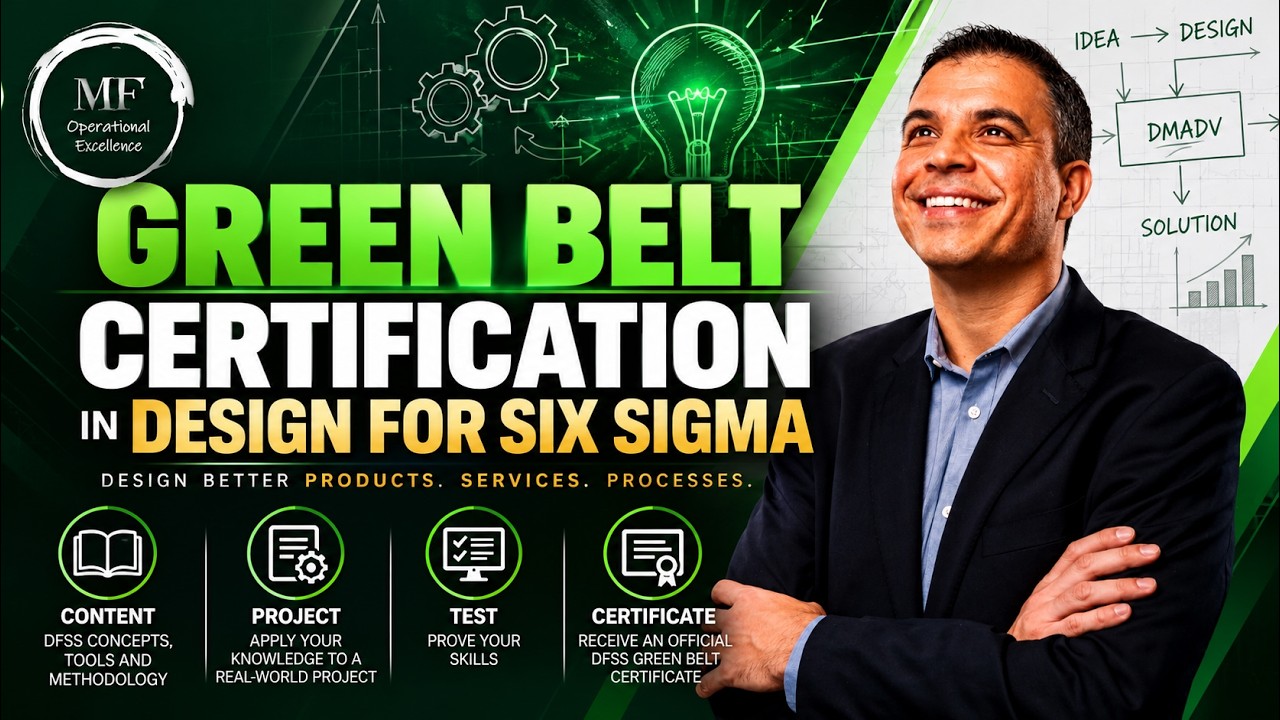
Prof. Marcelo Machado Fernandes opens a free Green Belt certification program in Design for Six Sigma, contrasting it with Lean Six Sigma and outlining the course structure.

Key Takeaways

  • DFSS is designed for creating new products, services, and processes, unlike Lean Six Sigma which improves existing ones.
  • The Green Belt certification is offered free of charge in this program and requires passing a final open-book test.
  • Defining the customer segment is the first step, followed by collecting the voice of the customer.
  • The Kano model helps classify customer needs into must-be, linear, and attractive requirements.

What the video covers

  • Introduces the first-ever free Green Belt certification in Design for Six Sigma (DFSS) delivered by Prof. Marcelo Machado Fernandes.
  • Certification consists of a series of sessions, a simulated project, and a final open-book multiple-choice test.
  • Explains that Lean Six Sigma improves existing processes, while Design for Six Sigma focuses on creating new products, services, and processes.
  • Traces Lean's origins to Japan and Six Sigma's origins to Motorola in the 1980s, with General Electric (under CEO Jack Welch) as the most prominent deployer.
  • Notes that GE developed DFSS because Lean Six Sigma did not fit well when creating things from scratch.
  • Emphasizes that there are no prerequisites and that students may range from complete beginners to certified belts.
  • Encourages note-taking since the final test is open book and writing helps internalize concepts.
  • Introduces the DFSS process starting with defining customer segments and then collecting the voice of the customer (VOC).
  • Stresses that customer samples must be contextual and that survey data requires deduplication and careful sampling.
  • Applies the Kano model to classify customer requirements into must-be, linear, and attractive categories.

Answers

Questions about this video

Is this Green Belt certification free?

Yes, the speaker states this is the very first time a Green Belt certification in Design for Six Sigma is offered for free, including the certificate upon passing the test.

What is the difference between Lean Six Sigma and Design for Six Sigma?

The speaker explains that Lean Six Sigma focuses on improving existing processes, while Design for Six Sigma is used to create new products, services, or processes from scratch.

Are there prerequisites for this course?

No, the speaker explicitly says there are no prerequisites, and participants from beginner to master black belt levels are welcome.

Full Transcript — Download SRT & Markdown

00:02
Speaker A
It is my absolute pleasure to be here with Lexine, with Jedsil, with Chris, with John, with Claire. Please, on a scale from zero to 10, how is my audio? And welcome to the Green Belt certification program in Design for Six Sigma.
00:28
Speaker A
Sigma. This is the very very first time that we offer Green Belt certification for free. Okay?
00:40
Speaker A
This is the very, very first time that we offer Green Belt certification for free. Okay?
00:49
Speaker A
Excellent. Excellent. So, it's important to reinforce that we will have a series of sessions where I'll be sharing content with you all.
01:04
Speaker A
Amazing. So, audio from zero to 10, I see a lot of 10s. That's wonderful.
01:12
Speaker A
There will be a test, a certification test, and then based a multiple-choice um question test, and based on the result, you will be receiving your Green Belt certificate. So, type free if you understand that What about the guitar? Let's see. Depending on the number [snorts] of students
01:39
Speaker A
Excellent. Excellent. So, it's important to reinforce that we will have a series of sessions where I'll be sharing content with you all.
01:48
Speaker A
So, type free if you understand that this is a free certification program. Probably, you have participated in other events with me. Sometimes I offer a free content without a certificate.
02:08
Speaker A
We will also be running a simulated project as part of the certification program.
02:17
Speaker A
This event that you are participating now, it is included a free certificate. So, it's the entire certification experience um free of charge, okay? And again, it's the very first time that I offered this a green belt certification for free. And it's a very special green belt certification because
02:41
Speaker A
There will be a test, a certification test, and then based on a multiple-choice question test, and based on the result, you will be receiving your Green Belt certificate. So, type "free" if you understand that.
03:06
Speaker A
Maybe you have never heard about lean six sigma nor design for six sigma. Maybe you are starting from scratch. Yeah, so if you are starting from scratch, type I'm starting from scratch. [snorts] If you are a yellow, type yellow. I see many yellows. I see white.
03:38
Speaker A
What about the guitar? Let's see. Depending on the number of students that get certified, I'll be playing the guitar at the end of the journey. Thanks for asking.
03:54
Speaker A
Marcelo, I'm starting from the very beginning. That's okay. Welcome to my to my training, to my certification program. Marcelo, I am a certified white belt.
04:08
Speaker A
So, type "free" if you understand that this is a free certification program. Probably, you have participated in other events with me. Sometimes I offer free content without a certificate, and many times I offer free content associated with a certificate.
04:23
Speaker A
We can improve processes and we can create things from scratch. And let me make this extremely simple to understand, okay? Again, we can improve processes and we can start things from scratch.
04:44
Speaker A
So, take a look here in my eyes. This event that you are participating in now includes a free certificate. So, it's the entire certification experience, free of charge, okay? And again, it's the very first time that I've offered a Green Belt certification for free. And it's a very special Green Belt certification because it's a Green Belt in Design for Six Sigma.
05:05
Speaker A
Lean Six Sigma. Maybe you are a master black belt in Lean Six Sigma. So, you know how to improve existing processes. Type clear if you understand that. Type clear if you understand that.
05:24
Speaker A
And before I explain this in more detail, tell me where you are. Where are you in the learning journey with me? Because maybe you are a certified White Belt in Lean Six Sigma. Maybe you are a certified Yellow Belt in Lean Six Sigma. Maybe you have never heard about Lean Six Sigma nor Design for Six Sigma. Maybe you are starting from scratch.
05:45
Speaker A
in terms of deployment, GE, General Electric, uh, because of, uh, the CEO, Jack Welch, at that time.
05:54
Speaker A
Yeah, so if you are starting from scratch, type "I'm starting from scratch." If you are a Yellow Belt, type "yellow." I see many yellows. I see white.
06:18
Speaker A
things from scratch, okay? And so, GE proposed a method some people call, as an evolution of Lean Six Sigma, the Design for Six Sigma, okay? So, Design for Six Sigma was created by I am I am running this session. It's a It's the very first time that I deliver Green Belt
06:54
Speaker A
Okay, starting from scratch. So, one important thing to let you guys know is there are no prerequisites. Do you understand that? There are no prerequisites.
07:18
Speaker A
to a house, yeah? And uh, pretty much because of my son. So, it's the very first A a lot of, uh, first, you know, first experiences, first time delivering Green Belt for free, and first time in this new studio. I hope you guys enjoyed the new background, the new studio,
07:37
Speaker A
Marcelo, I'm starting from the very beginning. That's okay. Welcome to my training, to my certification program. Marcelo, I am a certified White Belt. That's amazing. Marcelo, I am a certified Yellow Belt. That's amazing. Marcelo, I am a certified Black Belt. That's amazing. Wonderful.
07:47
Speaker A
Thank you. Thank you, guys. [clears throat] Thank you. And so, GE proposed Design for Six Sigma. And some authors place Design for Six Sigma as an evolution evolution of Lean Six Sigma. I prefer to see Design for Six Sigma as an alternative method.
08:09
Speaker A
So, let me differentiate something here for you. We can improve processes, and we can create things from scratch. And let me make this extremely simple to understand, okay? Again, we can improve processes, and we can start things from scratch.
08:31
Speaker A
beautiful. Uh so, you are not only part of a Green Belt certification process, but a Green Belt in a method that many authors consider as the evolution of Lean Six Sigma.
08:48
Speaker A
When we talk about Lean Six Sigma, we are talking about improving existing processes, okay? So, maybe you are a White Belt in Lean Six Sigma. Maybe you are a Yellow Belt in Lean Six Sigma. Maybe you are a Green Belt in Lean Six Sigma. Maybe you are a Black Belt in Lean Six Sigma. Maybe you are a Master Black Belt in Lean Six Sigma. So, you know how to improve existing processes. Type "clear" if you understand that. Type "clear" if you understand that.
08:56
Speaker A
So, Design for Six Sigma is a very special method focused in the creation of new products, new services, new processes, okay? How exciting is that?
09:17
Speaker A
And Lean Six Sigma is, obviously, the combination of Lean and Six Sigma. Lean, we can say, has its origin in Japan. And Six Sigma has its origin in the United States, at Motorola, in the 1980s. But the company that best used Six Sigma was, no doubt, in terms of deployment, GE, General Electric, because of the CEO, Jack Welch, at that time.
09:26
Speaker A
That you have pen and paper. Please take notes. Please take notes. It's very much important that you take notes, okay? Why? Because the final certification test at the end of the journey is uh open book. And also because when you take notes, you are internalizing the concepts, okay?
09:50
Speaker A
So, the percentage of employees that had some knowledge of Lean Six Sigma was very, very close to 100%. And then GE started noticing that something was not fitting very well when you wanted to create things from scratch, okay? And so, GE proposed a method that some people call an evolution of Lean Six Sigma: Design for Six Sigma, okay? So, Design for Six Sigma was created by... I am running this session.
10:12
Speaker A
Okay, but I need you to tell me. Take a look here. Take a look here. What if your company says that tomorrow your position no longer exists?
10:31
Speaker A
It's the very first time that I deliver a Green Belt for free, and it's the very first time that I deliver an entire certification process from the new studio. Yeah, we have just moved. I have a three-year-old son, and so we used to live in an apartment, a kind of small apartment, and now we've moved to a house, yeah? And pretty much because of my son. So, it's the very first... a lot of first experiences, first time delivering a Green Belt for free, and first time in this new studio.
10:52
Speaker A
Okay, so I see sad, lost, devastated, worried. Okay. And why am I asking this? Because I will be teaching you a method. It's a formal certification process, but I do have a final objective with you that is related to this question. Okay, I need you to reflect about how many options do you have
11:28
Speaker A
I hope you guys enjoyed the new background, the new studio, the new vibe. I like this atmosphere, and this is a special one for you guys too.
11:37
Speaker A
We need to talk about that because my goal this week is not to make your job completely safe. Nobody can promise you that. My goal is to show you how to become less dependent on one single job. Is that clear? I want to talk about job security versus professional security.
12:03
Speaker A
Thank you. Thank you, guys. Thank you.
12:31
Speaker A
humor of your boss, how is your competitors going. Do you guys understand that? But we can control professional security because it has to do with the capabilities that travel with you. And so, talking about professional freedom, we need to consider these three doors. Marcelo I'm going to
13:01
Speaker A
And so, GE proposed Design for Six Sigma. And some authors place Design for Six Sigma as an evolution of Lean Six Sigma. I prefer to see Design for Six Sigma as an alternative method. I always say, imagine that you have two wings, yeah? One to improve existing processes, and one to create things from scratch. And when I say things, I'm talking about creating new processes, new products, new services, okay? Wonderful.
13:24
Speaker A
Clear? Becoming a certified green belt in design for six sigma for sure. And I am not talking only about the document, about the PDF. I am talking about the amount of value that you will be able to put, to present at the table. More important than the certificate, the PDF itself,
13:53
Speaker A
Guys, beautiful. So, you are not only part of a Green Belt certification process, but a Green Belt in a method that many authors consider the evolution of Lean Six Sigma.
14:20
Speaker A
you are able to. This is very serious. This is very serious. If you are not happy where you are, if you feel undervalued, if you feel that you should go to another place, you should never, never associate this only to your boss,
14:48
Speaker A
So, type "DFSS" if you understood that. Design for Six Sigma if you understood that.
15:11
Speaker A
something that you can control. Simple like this. Simple like this. Okay? So, if you want to move as I did, I started my career in electronic sector at Philips and then I moved to automotive sector. Why? Because the amount of value that I could bring to the table. And then from automotive sector
15:34
Speaker A
So, Design for Six Sigma is a very special method focused on the creation of new products, new services, new processes, okay? How exciting is that?
15:43
Speaker A
And then with the green belt in design for six sigma you can also consider monetizing your knowledge through projects, consulting, training and consider having your own business.
16:05
Speaker A
Clear? Is that clear? Beautiful.
16:20
Speaker A
So that's door three. Door three if you understand that it may be an option for you.
16:35
Speaker A
Huh. I do strongly recommend that you have pen and paper. That you have pen and paper. Please take notes. Please take notes. It's very important that you take notes, okay? Why? Because the final certification test at the end of the journey is open book. And also because when you take notes, you are internalizing the concepts, okay? Internalizing the concepts that I'm sharing here. Once again, this is a formal certification process. So, it's very important that you take these sessions seriously, okay?
16:54
Speaker A
I am not talking about you creating a business necessarily a business with 100 employees.
17:02
Speaker A
Beautiful. I have a question that may be a little bit hard to digest. Okay, but I need you to tell me. Take a look here. Take a look here. What if your company says that tomorrow your position no longer exists?
17:23
Speaker A
The number of resources that we can use to operate as an independent consultant as a self-employed professional. Do you guys understand that? The number of alternatives that we have to automate processes is just insane. It's just amazing.
17:44
Speaker A
How would you feel? So, type here in one word, how would you feel if your company simply communicated that your position does not exist anymore?
18:09
Speaker A
even if you are super happy where you are, there are very high chances that this is temporary.
18:18
Speaker A
Okay, so I see sad, lost, devastated, worried. Okay. And why am I asking this? Because I will be teaching you a method. It's a formal certification process, but I do have a final objective with you that is related to this question. Okay, I need you to reflect on how many options you have if something goes wrong in your current job today. Is it a fair question? Is it a relevant question?
18:31
Speaker A
This is a characteristic of the system. That's this is corporate, guys. This is corporate. You receive a salary. You need to uh bring value to the company where you are that is more than your salary. Yeah, that's that's the game. This is door one. And there is a lot to learn in corporate.
18:54
Speaker A
We need to talk about that because my goal this week is not to make your job completely safe. Nobody can promise you that. My goal is to show you how to become less dependent on one single job. Is that clear? I want to talk about job security versus professional security.
19:05
Speaker A
What I am saying is many people consciously or unconsciously want to go to an amazing company and they think that they will be there for the rest of their lives or they think that because the situation is so amazing there they don't need to do anything. This is a mistake.
19:28
Speaker A
Many people want job security, but job security is associated with the organization, and we cannot control how your company is doing. We cannot control that. Nobody can control variables like currency fluctuations, or exactly how the economy in your country is, or the mood of your boss, or how your competitors are doing. Do you guys understand that? But we can control professional security, because it has to do with the capabilities that travel with you. And so, talking about professional freedom, we need to consider these three doors.
19:52
Speaker A
Type here for me options. You must have options. You must have alternatives. What would you do if your position no longer exists tomorrow? [snorts] What would you do? You would just cry, you would just be depressed, you just feel bad, devastated, but what would be the next steps? And so
20:21
Speaker A
Marcelo, I'm going to... I will be certified as a DFSS Green Belt.
20:49
Speaker A
learning into alternatives in your professional life. Again I I will be celebrating with you. Yay!
21:02
Speaker A
Design for succeeding my green belt means but so what? So what? So what that you are a Green Belt?
21:13
Speaker A
So, as a certified Green Belt, I hope you can take this knowledge and translate into more choices. Type here choices. Type here choices. You must have more choices.
21:30
Speaker A
You can be more relevant where you are. You can be more employable, more desirable in other companies, in other industries. And when I say other companies, I'm talking about the same industry, but I don't know, maybe a competitor. I'm talking about different industries as I
21:50
Speaker A
did. I started in electronics, then I moved to automotive, and then I went to market research, and then I started my career as a full-time um independent consultant. Then, you may consider door three that has to do with creating your own business as an educator, as a consultant for SMEs,
22:14
Speaker A
for small and medium enterprise, for multinational companies. Uh educator as I do here for you guys.
22:22
Speaker A
You can take a topic that you master and you can teach that. And obviously, obviously, you can work with a mix of all of that. But at the end of the day, I want you to have more options and so you don't feel anxious about losing your job. I don't want you to feel
22:46
Speaker A
any level of anxiety in case something happens to the job that you have today.
22:57
Speaker A
Are we together in this mission? Yes or not? Are we together in this mission? Yes or not?
23:03
Speaker A
And for the people that are meeting me for the very first time, guys, my name is Marcelo Fernandez. I am based out of Brazil. I am doing this here with thousands and thousands of people. By the way, thank you so very much. Even knowing that this is a funnel,
23:24
Speaker A
today we have the best students, tomorrow we'll have the best of the best. Uh on day three, we'll have the best of the best of the best. I know it's natural that it's a funnel. I hope you stay strong here with me, yeah? But I know it's a funnel. I feel honored to see the number of
23:46
Speaker A
people that we have here um live with me. And I am 100% sure that it will be a transformative week.
23:56
Speaker A
We will end this year in a very special way. Very special way. Very, very special way. Uh I am from Brazil, [clears throat] but I am doing this for the past 25 years, yes? So, we have students from Brazil, obviously. We have students from the United States. These
24:16
Speaker A
are real students from LinkedIn, okay? Uh UAE and literally from all over the globe, okay?
24:25
Speaker A
And at this point, we have more than 150,000 students from 108 countries. And they are from the very different industries. For example, uh Geraldine from Emirates, we have Lanka from Crystal, we have Sujaya from Grainger, and then we have students
24:45
Speaker A
literally from all sorts of industries. We have students that work for the United Nations, um banks, insurance companies, manufacturing. We have people that work from very very very different industries. And uh probably you know [laughter] the story that I'll be telling.
25:06
Speaker A
Uh how much do you guys know about Brazil? Um do you believe Brazil um especially in the 1980s, uh how was Brazil in terms of economy? I don't know how much you guys know in terms of history, but nowadays I can say that the situation is much much better, but especially in the
25:28
Speaker A
1980s we were suffering uh very much in terms of inflation. Very much in terms of inflation. And um I can just reduce a little bit the fan of the yoohoo of the air conditioning.
25:51
Speaker A
Yes, so the background noise is reduced. Once again, from zero to 10, how is my audio? I found that the background noise noise a little bit annoying. Guys, I want the best for my students.
26:07
Speaker A
Uh so the situation in Brazil was very terrible in the 1980s. Yes, thank you. Thank you guys.
26:14
Speaker A
And uh I come from a very poor family. Um my father and my mother um were professors. Yes, and um we were in six in total, me and my three siblings. So imagine um in 1988, you know, Marina uh she was 12 years old, I was nine years old, uh Paulinho,
26:43
Speaker A
my brother, was six years old, and Ana Luiza, the youngest, two years old, [clears throat] you know, a literally chaos in my house, inflation like crazy. Um we were literally suffering to pay the bills and to put uh food in our table. Yes, and uh in the middle of this very challenging situation,
27:06
Speaker A
I was always talking to my mother that someday I would be traveling the world, you know, and uh doing amazing things, inspired maybe by the Hollywood movies, you know, and my mother obviously always uh motivating me so very much. And then unfortunately, my mother got uh divorced
27:30
Speaker A
to my father, and I say uh unfortunately uh because all of you guys know the impact that it may bring to to the structure of a family when it does not happen in the most peaceful peaceful way. Don't get me wrong. I love my mother. I love my father. We have
27:55
Speaker A
a great relationship. They are both um alive. I know that they did the best that they could um with the resource that they had, but the fact is that uh there are there are consequences, right? Cause and effect. Cause and effect, simple, very simple, very simple. And then I have to tell
28:16
Speaker A
you that we struggled very much. And then um I had a chance to go to a good university, and when I got my very first opportunity in terms of job at Philips, my very first project, believe or not,
28:33
Speaker A
was internationally recognized, internationally recognized. And so, believe or not, I was sleeping literally on the floor. I did not have a proper bed, but I had a mattress. Yeah, and I was there with my passport, with my tickets to the United States, and there was Marcelinho
28:58
Speaker A
starting to you know, to live a dream that was dreamed with my mother in the sofa of a small house in Itajubá, Minas Gerais, Brazil. Yeah, going to present his project on a limo. Come on, guys, make some noise in this chat. And then, from there, I have more than 25 years living this
29:20
Speaker A
dream of being interviewed by American TVs and uh participating in many conferences and workshops, you know? And I had a chance to lead projects in India, in South Africa.
29:32
Speaker A
I had a chance to go to the United States so many times, to go to Poland and different countries in the United States, in the in Europe, I'm sorry. And because it worked with me.
29:49
Speaker A
A regular person, I don't have special powers. I don't have anything, to be honest.
29:55
Speaker A
I don't I don't have, you know, any special super special talents, but I am a person that I truly believe in the power of right mentor and right method. Right mentor and right method.
30:12
Speaker A
I had so many amazing mentors, and I hope I can be the right mentor for you, and you can get the same results that I get or better results. I do have already I am an old man. [laughter]
30:29
Speaker A
I do have already students with results that are better than my results. I do have students that started from scratch with me that have results that are better than my results, okay?
30:45
Speaker A
And that's success for me, yeah? Wonderful. From zero to 10, how excited how much excited are you?
30:54
Speaker A
Once again, before we start the DFSS course itself, remember that your company can own your position, but it should never own your career, okay? From zero to 10, how much you agree with that? Type here for me, I own my career. I own my career.
31:45
Speaker A
Amazing. Amazing. Amazing. So, let's go ahead and start. Type pen and paper if you have pen and paper.
32:15
Speaker A
Type pen and paper if you have pen and paper. If you had a chance to be my student before, you know that I love. I just love to simplify things as much as possible. Okay, so I will be
32:49
Speaker A
I will be using elements of a method named PBL, problem-based learning. I will be using a very simple case study, very simple case study. Why? Because I don't want you to suffer in this learning journey. Okay? And by the way, this [snorts] learning journey doesn't need
33:16
Speaker A
doesn't need to be a suffering journey. We can have fun. I hope you can take this very seriously and at the same time you have fun. There is no problem in having fun, okay? So please let me know if you can see my template. Type template if you can see my template.
33:57
Speaker A
Okay. Okay. Uh [clears throat] even knowing you will be receiving a copy of this material, uh please take notes. Take notes, okay? So if you want to take like snapshots of the screen, that's okay.
34:26
Speaker A
But please take notes. Use a pen and paper to write down the things that you are learning, okay? The very first thing that I need you to understand is that we have a framework, we have a road map, define, measure, analyze, design, and verify. So,
34:46
Speaker A
I'll be covering the content using define, measure, analyze, design, and verify, okay? In this sequence, in this sequence, define, measure, analyze, design, and verify. And for each phase, we have sub steps, okay? So, let's properly understand how to define customer segment,
35:12
Speaker A
how to collect the voice of the customer, how classify voice of the customer, how to prioritize the voice of the customer, how to translate voice of the customer into CTQs, how to prioritize CTQs, how to identify potential concepts, how to find the best concepts, how to use the
35:33
Speaker A
beautiful beautiful technique of super concept or hybrid concept to get the winning concept. And then, on design phase, how to identify the critical factors, how to model your process according to one or more CTQs, how to optimize the process according to one or more CTQs,
35:54
Speaker A
and then we run a final evaluation of the risk, we verify the performance, let's see if we have designed for Six Sigma, and let's create a standard operating procedure, okay? [snorts] The case study is very simple. The case study is very simple. So, see that we'll be talking about
36:18
Speaker A
Alice that has always dreamed of creating a signature pizza that people would love and recommend to their friends and family. She knows that an unforgettable customer experience depends on not only on outstanding quality, but also on delivering every pizza quickly and consistently.
36:45
Speaker A
Instead of hoping customers will like the final result, Alice wants to create a pizza that exceeds their expectations from the very first order and keeps them coming back for more. Guys, again, from 0 to 10, how is my audio?
37:08
Speaker A
Hello, hello. We just saw people people talking about internet issues. Yeah. Okay, so that's okay, beautiful. Yeah, any feedback, even knowing that we have thousands and thousands of people here.
37:26
Speaker A
Uh keep uh you can I'll keep my eyes on the chat and also we have my team uh helping me on the chat, okay? So, if you have any problem in terms of sound or image, I want you to have the very best experience, okay, guys? So, I believe I believe we are good, right?
37:55
Speaker A
So, just to reinforce, uh this template will be shared with you. Uh it's a Google um it's a Google file. And so, when I update the file, you will be um receiving the you see me updating uh real time, yes? And then obviously, you cannot edit it, but you can make
38:21
Speaker A
a copy. I'll be explaining at the end at the end of the session at the end of the session. Yeah?
38:27
Speaker A
And once again, I am using a very simple case study. Marcelo, why don't you use, you know, a multi-wide copper cable? Something that is fancy or how to design an ER, you know, emergency room for a hospital with this No, because if I use a complex case
38:49
Speaker A
study, I'll be spending your energy on the case study and I'll be spending your energy that should be used for you to understand the method. So, simple is powerful. Type here for me.
39:09
Speaker A
Simplicity Simplicity is powerful. Simplicity is powerful. Yeah. And it's it's not easy to Yeah.
39:24
Speaker A
To speak like this topic in simple words, but I want to do this in very simple words because I want this content to penetrate to penetrate in as many people as possible. Okay? So, once again, we have basically a licensee
39:43
Speaker A
that owns a pizzeria and she wants to create a signature pizza that people would love and recommend. So, we need to design a pizza. Simple like that. Simple like that. Let's develop. Let's Let me show you all the toolbox of the Green Belt Design for Six Sigma certification program
40:08
Speaker A
um in a very simple case study. Pizza. Okay? You guys know what's a pizza, right?
40:16
Speaker A
Beautiful. Wonderful. So, let's go ahead and start with define. Start with define. Okay? Wonderful.
40:49
Speaker A
[snorts] Please. Please. When we want to create something new, a product, a process, a service, when we want to create something new, we must listen to two things, voice of the business and voice of the customer.
41:23
Speaker A
Don't start thinking of the idea, how will be my pizza with pepperoni, no pepperoni. Oh, I had an idea. I love pepperoni. Oh, I love it. Maybe if we use this kind of cheese with pepperoni and this kind of dough. Don't think of the product, service, process characteristic
41:49
Speaker A
when you are starting a design for Six Sigma project. Design for Six Sigma project, you should listen to the voice of the business and the voice of the customer.
42:04
Speaker A
Forget. Forget your insights, your ideas, the things that maybe you have now forget that. [clears throat] So, the very first thing is very first thing is define your customer segment. And guys, [clears throat] customer segment, believe or not,
42:39
Speaker A
has more to do with VOB than VOC. Write down that. Defining customer segment has more to do with VOB than VOC. Let me write down this. [clears throat] This is extremely critical. Extremely critical.
43:04
Speaker A
Extremely critical. Defining customer segment has more to do with voice of the business, VOB, than voice of the customer. Okay? VOC. Why? Why? [cough and clears throat] Uh you need to understand what kind of game your customer, your
43:55
Speaker A
What kind of game um business owner wants to play. Do you guys understand that?
44:08
Speaker A
So, what do I mean by that? What do I mean by that? What do I mean by that?
44:20
Speaker A
Do I want to serve cheap pizzas? Low-cost pizzas, low-price pizzas. Or do I want to offer extremely high-quality premium pizzas?
44:47
Speaker A
Marcelo, you are overcomplicating. It's It's pizza. It's pizza. Marcelo, pizza. Flour, egg, water, oil, dough, cheese, tomato sauce. It's pizza. [snorts] No, it is not.
45:09
Speaker A
Type different games if you understand that. You need to understand if you want to produce low-cost cars or if you want to produce Ferrari. And when I say you, it's you if you are the business owner. [clears throat] If you are the consultant or the employee
45:39
Speaker A
that is running a Design for Six Sigma project for a business owner, you need to fully understand what kind of game they are playing. [clears throat] Because it will define the kind of customer that you will work to meet their needs because it is impossible
46:10
Speaker A
impossible to make 100% of the people in this planet happy. I'll say that again. [snorts] It is impossible for you to design a product, a process, a service that will make 100% of the people happy. Impossible. So, you must find your niche. You must find your customer segment.
46:45
Speaker A
You must find the group of people that you want to please. And this is first of all based on the customer segment that must be completely connected to the voice of the business. So, everything starts by the voice of the business.
47:07
Speaker A
In this very simple example you would [clears throat] talk to Elise. You would understand their current business. You would understand what kind of game she's playing right now.
47:24
Speaker A
If you work for a corporate, you need to understand what are the requirements of your manager. What are the requirements of your director? What are the requirements from your company? What kind of game your company plays? It's not your game. And see that I'm not
47:46
Speaker A
talking about the idea. I'm not talking about what you want to create. I'm talking right now about listening to the voice of the business. Listen to the voice of the business. And then how can we listen to the voice of the business? How can we listen to the voice of the business?
48:08
Speaker A
How can we listen to the VOB [clears throat] and understand the type of game business wants to play.
48:33
Speaker A
Okay? So, how can we do that? First of all, one-on-one interviews with business owner. One-on-one interview one-on-one interviews with business owner to understand business strategy. Strategy spoken and unspoken. Um spoken and unspoken voice of the business.
49:21
Speaker A
Voice of the business. And why do I say spoken and unspoken voice of the business? Because maybe you talk to a licensee and she says, uh "You know what? I just want, you know, people for everybody.
49:35
Speaker A
I want pizza for everybody." But then she wants to use the most expensive ingredients, you know? She wants to promote the most amazing uh service. So, see that there's a disconnection. May maybe a licensee doesn't know as a business owner that this is not to everyone.
49:55
Speaker A
That this is not to everyone. Yeah? Do you guys understand that? Do you guys understand that? So, interviews with business owner to understand business strategies, spoken and unspoken voice of the business. The other one is observe and investigate.
50:17
Speaker A
Observe and investigate current business nature. Okay? Type of current products and services. Okay? And the another one is talk to people that know the business.
50:57
Speaker A
Okay? Not necessarily the the business owner. Not necessarily the business owner. Okay? Not necessarily the business owner. So, what is this?
51:22
Speaker A
In this pizzeria, maybe you want to talk to even to the chef that knows very much about the product characteristics. Do you guys understand that? Maybe you want to talk to the most senior waiter that has a very good very good picture of the current business and now the customers. Do
51:47
Speaker A
you understand that? I'm trying to simplify as much as possible. So, the core principle Okay, I can teach tools, techniques, concepts, and principles, but if you understand the principle at some point you don't need me anymore. So, I hope you understood the principle.
52:09
Speaker A
The principle is every time that you are trying to create something new stop thinking about the idea, about the product characteristic, the service characteristic.
52:20
Speaker A
Think of what's the voice of the business, business strategy, and base based on the business strategy, the voice of the business, what kind of game we want to play.
52:33
Speaker A
And then let's suppose by talking to Alice by talking to Alice, we understand that Alice Alice wants to promote the most amazing explosion of flavor [laughter] possible possible um to people that does not like meat, so she wants a vegetarian vegetarian pizza. um
53:33
Speaker A
to the largest number of people possible. Okay? So, so the price, final price, price should be as low as possible. No, no, no, this is wrong. This is wrong. We should not talk about this now, okay?
54:05
Speaker A
We should just talk about customer segment. We should talk about customer segment. Um she wants to promote an amazing experience in terms of pizza to people that normally would never have [snorts] the chance to pay for expensive pizzas. So, basically [clears throat]
54:54
Speaker A
a premium pizza to people that struggle financially. [snorts] Do you guys understand that? Yeah? Do you guys understand that?
55:26
Speaker A
Beautiful. So, now I know that I want it's challenging. It's challenging. I want to Alisha want to create a premium vegetarian pizza.
55:46
Speaker A
Not to them to to reach people. Not necessarily to reach people. And by the way, she she wants to target, you know, kind of simple people. And by talking to Alice, we understood that she wants to target specifically specifically
56:10
Speaker A
students. undergrads young undergrad students. Do you guys understand that? She wants that. It's her business. She wants to have a premium vegetarian pizza [snorts] for undergrad students because here in Itajubá we have many universities. Beautiful. Beautiful. No, no, no. She should not
56:36
Speaker A
play this game. She should target rich people. No, no, no. In Design for Six Sigma, we don't do that.
56:47
Speaker A
This is a master black belt conversation. This is a uh a project portfolio management.
56:55
Speaker A
This is another animal. In Design for Six Sigma, what we do is let me fully understand what's the voice of the business. And now that I fully understood the voice of the business, that's it. Now I want to have more characteristics
57:15
Speaker A
of my [snorts] target customer, of my customer segment, target audience. Beautiful. From zero to 10, how much sense it is making what I'm talking about here?
57:29
Speaker A
From zero to 10, how much sense does it make? Okay. Marcelo, what about a corporate if I'm running and designing for a Six Sigma project within a company, you know?
58:12
Speaker A
Well, you have a portfolio of customers. You need to understand from the business from the business.
58:20
Speaker A
What is the target audience, the target customer? This it's the same mechanism. It's not from the top of your mind. No, no, no, it must from business strategy. Okay? Is that clear? And then I will try to unless it's
58:43
Speaker A
spend too much time. Let me see if I can ask AI to generate generate a cartoon image for my students.
58:59
Speaker A
For about a customer segment [clears throat] that is undergrad university students [clears throat] having the best vegetarian pizza ever. [clears throat] Okay?
59:26
Speaker A
From time to time I'll try to create a cartoon image. So, it [clears throat] is easier to understand. Okay? But, now guys, help me here.
59:38
Speaker A
On the customer segment customer segment characteristics. So, customer segment characteristics. Okay? You guys tell me. You guys tell me.
60:04
Speaker A
So, do you understand that I want to talk to young people. So, maybe I am targeting from 18 to I don't know. Uh maybe 25. 18 to 25. Yeah? Years old. Years old. Um years old. People that is studying in universities. Yeah?
60:49
Speaker A
Uh I am also talking about um people in Itajubá, [laughter] Minas Gerais, Brazil. This is my city. So, you guys can come here, visit me. Okay? [laughter] The attorney in Itajubá, Minas Gerais, Brazil. Yeah? What else? You guys tell me. What else?
61:30
Speaker A
debt the financial difficulties Yeah? Yeah? And here, guys, [clears throat] this is an interesting conversation. Alici wants to [clears throat] wants to do um create a vegetarian pizza.
62:16
Speaker A
Is this right or wrong? Because who should define that, you may think. If customers, if they want, you know, if they like meat, you know, pepperoni, bacon, and everything, Alici should Alici Alici should not limit on vegetarian pizza, you know? Is this right or wrong? This is a gray area,
62:41
Speaker A
guys, to debate. Why? Because you guys tell me, especially for a small businesses, [clears throat] does the passion, passion, you know, the love involved in the product and service impact quality? Yes or not? You guys tell me. Do Do you believe that the business owner, if
63:08
Speaker A
the business owner has a passion for the topic, in love for the topic, does it impact impact quality?
63:19
Speaker A
Yes, it does impact. But remember that you should not focus 100% of the VOB on what you love because we are not children. We don't do just the things that we love.
63:39
Speaker A
So, do you understand that there is a balance? There is a balance There must be a balance.
63:46
Speaker A
You know, between what you like to do because if you are doing something that you hate, if you hate pepperoni, you know, how how can you run a business on something that you hate? Do you guys understand that? In life, we will need to do things that we
64:06
Speaker A
don't like, but it doesn't mean that we should do only things that we hate. Do you understand that?
64:15
Speaker A
We should should balance that. We should balance that. Yeah. We should balance that. Um I need to be careful to talk this because it's not a joke. It's not a joke.
64:30
Speaker A
But if you focus only on the financial performance of the business, only on EBITDA margin profit, you know, if you focus only on that, everybody would be doing bad websites. You know what I am talking about, adult adult content. And things that we should not be using.
64:56
Speaker A
You know, drugs and everything. Yeah, these kind of so bad things, you know, they are very profitable. Very much profitable. Very much profitable. So, if you focus only on the financial performance, revenue, profit, everybody would be doing, you know, these these bad things.
65:19
Speaker A
So, you should balance with who you are, what do you like to do, your legacy, what kind of legacy you want to [clears throat] you want to leave to this to this planet. This is very much important, too. Okay? And again, if you only consider your voice, then probably you don't have a business.
65:43
Speaker A
Yeah? The very classic mistake is when you listen only for your voice, then it's then that's that's a problem. You need to balance. Is that clear? Yeah? [snorts and clears throat] Beautiful. People that study in universities, people in Itajubá, people that have financial
66:08
Speaker A
difficulties, and maybe we can say people that like pizzas um without meat, you know? Uh bacon, pepperoni, pepperoni, etc. Yeah? It's okay to say that. It's okay to say that. So, now you know the game that you want to play. And then, you have now a very clear picture of the customer
66:44
Speaker A
segment. So, type customer segment. Type customer segment if you understand that. Now, we start something very cool. By the way, this is one of my favorite parts in the in the design for Six Sigma project. From around 40% of my career was dedicated, fully dedicated to design for Six Sigma.
67:45
Speaker A
40%. There was a time in my career that I took a break from Lean [clears throat] Six Sigma and I was dedicating 100% of my time to design for Six Sigma. This is so exciting. I hope you guys
68:02
Speaker A
are feeling the same. And every time that after defining the [clears throat] customer segment and we started collecting, VOC collection, that was one of my favorite parts in the any design for Six Sigma project, okay? So, the very first thing is
68:23
Speaker A
define customer segment. We already did that. Now, let's talk about collecting the voice of the customer. Do you understand that now we need to fully understand what is important to my customers in this segment. From zero to 10, how clear is that for you? Now, our mission
68:51
Speaker A
our mission is to fully understand what is important to my customers of specifically of this segment. Do you guys understand that?
69:08
Speaker A
So, let's do that. Let's talk about that. I'm just creating a defined customer segment. This is 1.1, so it's easy for you guys to understand. Let me see if we got [laughter] Yeah, let me see if I can do one of these per
69:33
Speaker A
per [groaning] subsection, okay? Beautiful. So, now it's time to define customer segment. No. Now, it's time to collect the voice of the customer. Okay? Collect the voice of the customer. Now, we are starting step two. Okay?
70:11
Speaker A
Collect voice of the customer. Voice of the customer. Voice of the customer. Yeah? Beautiful. I hope you feel the connection when we are building and running this project together. Type PBL, project-based learning or problem-based learning.
70:38
Speaker A
If you like this approach, instead of me showing slides of theory, theory, theory, theory, we are here hands-on creating something, you know? I hope you guys like it.
71:00
Speaker A
It is scientifically um scientifically validated that this approach maximizes the internalization. Okay? Of the of the content. Okay, beautiful. The collection of the voice of the customer.
71:26
Speaker A
Now I know that I need to find in Itajubá, Minas Gerais people that study in universities. Probably they are from 18 to 25. My my sister is um 40 and uh she's uh taking a medicine uh school. Yeah, she's studying to become a doctor. Yeah.
71:57
Speaker A
And she's 40. It's her 30 degree. Yeah. So if she sees that I put here 18 to 25, I will be in trouble. You You guys help me. [laughter] Uh yeah, maybe.
72:23
Speaker A
Yeah, because there is a correlation. I don't know if you guys agree. If we want to target people that struggle financially, uh age may be a factor. Do you guys understand that? Normally yeah, the the young people [laughter] they will tend to struggle a little bit more
72:50
Speaker A
because they still did not build their career, yeah? Amazing. Amazing. So, we need to find these people. We need to find these people. Do you guys understand that?
73:07
Speaker A
Can you feel the flow tonight? Can you feel the flow? Everything is connected. So, the output the output of step one will be used as an input of step two within define. So, collect the voice of the customer. And here I need to talk about sampling. We need to talk about sampling.
73:33
Speaker A
We need to talk about sampling, okay? And then let's not over complicate. Let's keep it as simple as possible. Let's talk about sampling.
73:55
Speaker A
We need to talk about sampling. Our sample must be one sufficient sufficient and again let I want to keep it as simple as possible as simple as possible.
74:36
Speaker A
You know that we will not be able to listen to the voice of the customer to to all customers. You guys understand that, right? Type sample if you understand that. Sample.
74:56
Speaker A
Guys, don't keep don't do that because my team will exclude you from the channel.
75:01
Speaker A
Don't keep like capital letters copying and pasting the same question. Don't don't be impolite. We have thousands of people here from all over the globe. Yeah, behave. Behave.
75:17
Speaker A
Yeah, behave, please. With love. With love, okay? Yeah, my team will exclude you from the from the channel. And then you will lose the opportunity to become a certified green belt, yeah?
75:30
Speaker A
It is so good. It is so good that the atmosphere is so good. Yeah, type here behave. [laughter] Now it's uncle uncle Marcelo. Uncle Marcelo say, "Behave." And normally when people keep like and there are just few people that do that, you know, but
75:57
Speaker A
it's kind of disrespectful, you know? And normally the questions are, "When is the test?" Right? And then copying and pasting, "When is the certification test?" Instead of paying attention in the content. Guys, if you understood what I just said in terms of sequence, VOB, VOC,
76:20
Speaker A
you are already a different person. The selection of the content, the learning strategy, everything is designed as a surgery. Nothing here is random. Nothing here is random. There is a reason why this movement is happening. Nothing is random. So, pay attention. Even if you think this is
76:51
Speaker A
too simple, sometimes even too repetitive, there is a reason for that. And you will notice that not tomorrow, not in 1 week from now. You will truly check you know, the impact of the things that I'm talking about in your career in 6 months from now,
77:19
Speaker A
in 1 year from now. Do you guys understand what I'm talking about? This is serious stuff, guys.
77:24
Speaker A
If you understand that, first of all, you listen to VOB and then VOC. If you fully understand that, you are another person. Type here eye-opening. Eye-opening, if you understand that this simple.
77:37
Speaker A
Simple. You know, simple concept of listening first to the VOB and then VOC, this is gold.
77:45
Speaker A
This is gold. You know, when is the test? When is the certification test? When is the certification test? It's in 6 months from now. When I check what happened in your career.
77:58
Speaker A
Yeah, that's that's when the certification test, you know, comes. With love. I hope you feel the love and I hope you feel the respect that I have for you.
78:10
Speaker A
But my team, they have sharp eyes and they will exclude you from the channel. I don't want you to to be excluded. [clears throat] And you broke my flow. And you broke my flow. Where am I? [laughter] Don't feel guilty, okay? Just a little bit. Just a little bit. Guys, sample must be sufficient. So,
78:42
Speaker A
you will not be able to collect the data from 100% of your people. You will not be able to collect the data from 100% of your target audience. So, you must pick a sample.
78:58
Speaker A
Marcelo, let me talk to one people, one person, to two people, to three people. [snorts] What's the difference between talking to one person and 10 people? One person and 50 people? The thing is, every time that you are sampling, imagine a blood test that you take just a little
79:21
Speaker A
bit of your blood and then you can expand the conclusions to your entire body, yeah? Because the blood is so homogeneous that if you take a little bit, yeah? You can assume that this this small amount of blood represents your entire amount of blood, yeah?
79:45
Speaker A
Do you guys understand that? Sampling, it's beautiful. It's beautiful. [clears throat] But normally, the results that come from sampling, they come with a margin of error, margin of error. The result is X plus or minus something. The margin of error
80:07
Speaker A
is inversely proportional to the sample size, almost always. Again, [clears throat] margin of error is inversely proportional to the sample size. So, when sample size goes up, margin of error goes down. Yeah, there is a limit to that. So, you should be careful with
80:34
Speaker A
your sample size. And there are ways to calculate the optimal sample size according to the research objective. As [clears throat] a green belt, I'm going to give you a general number. Okay, a general number. Come here. My recommendation is [clears throat]
81:00
Speaker A
um as a simple reference, consider consider having 100 data points. So, in this case, 100 students. Do you guys understand that? 100 data points, 100 students in in this case. [sighs] Minimum minimum 30 data [clears throat] points. But ideally, as a starting point, again, ideally,
81:34
Speaker A
as a starting point, as a simple reference, consider as [clears throat] a starting point.
81:54
Speaker A
100 data points. Okay? Oh, Marcelo, it is so hard. Maybe the population is [clears throat] is small.
82:03
Speaker A
It is so hard to talk to people. They don't want to reply. Blah blah blah blah blah, minimum 30 data points. Do you guys understand that? So, you cannot run a design for Six Sigma project if you did not um got [clears throat] at least 30 data points in terms of the voice of the customer.
82:23
Speaker A
So, your your sample must be sufficient. Okay? From 0 to 10, how much did you understand that?
82:36
Speaker A
Yeah, the second dimension is your sample must be contextual. Contextual. [snorts] Yeah, because uh sufficient has to do with how many data points.
82:59
Speaker A
Contextual has to do with when. When. So, um pay attention to the context um when you are collecting your VOC. It must be connected to the [clears throat] research objectives. And I'm again, I'm trying to keep it as simple as possible. So,
83:40
Speaker A
why why am I saying that [clears throat] your sample must be contextual? Imagine that you are collecting the voice of the customer and you are talking to a student um about a potential vegetarian pizza, but the student is extremely hungry. Extremely hungry. [snorts]
84:04
Speaker A
Do you understand that the result will be biased? Do you understand that? Because then do you believe that olive is important in a vegetarian pizza? Because the student is so hungry. Yes, yes, yes, yes. Do you like cheese? Yes, yes, yes, yes. Do you like tomato? Yes, yes,
84:24
Speaker A
yes, yes. Do you understand that? So, you need to be careful in the context. And if you talk to a potential customer that is not hungry at all, not hungry at all, you may have a biased result as well. So, maybe you want to pick, I don't know, in the middle of the afternoon
84:47
Speaker A
cuz it has to do with when you collect your data. Maybe you don't want to collect at 11:00 a.m.
84:53
Speaker A
because it's right before lunch. Or maybe you don't want to collect 1:00 p.m. just after lunch.
85:01
Speaker A
Do you understand that? Maybe at 3:00 p.m., at 4:00 p.m. Yes? Beautiful? Are we good on the same page? Yeah? On the same page? And then, our sample must be sufficient, contextual, must be reliable.
85:28
Speaker A
Must be reliable. So, data should be collected should be collected um using reliable um measurement systems. So, let's talk about that. Let's talk about that.
86:02
Speaker A
There is something that is worse than not having data. If you don't have data, many times you don't do anything. But if you have bad data, you do very likely bad things.
86:17
Speaker A
So, what's a reliable data measurement system? Questionnaire, for example. So, if you are listening to the person, if you are interviewing one-on-one, and the person the person says, "I like tomato." And then you make a mistake and you write down,
86:34
Speaker A
"Customer doesn't like tomato." You know, you may have the right sample size, the right context, but because of the measurement system, the person that was taking notes, you know, you made a mistake. So, that's [clears throat] why in call centers,
86:50
Speaker A
many times you record you record a call. In the interviews, maybe you want to have two people or maybe to record to check repeatability and reproducibility. Do you guys understand that?
87:04
Speaker A
So, your sample the your view see sample must be obviously reliable. Yeah? It must be well segmented. We have already talked about this, well segmented. Yeah?
87:26
Speaker A
Well segmented. So, what do I mean by that? Um your sample must be totally connected to the um previously defined customer segment. Okay? This is very important. And the last one [clears throat] is your sample must be random. So, what do I mean by that? Random.
88:05
Speaker A
Um if sample size equals 100. The entire population should have the same or [clears throat] no chances to be selected. This is interesting because this is one of the hardest principles, sampling principles, to meet, guys. This is one by far one of the hardest, one of the most difficult.
88:46
Speaker A
Let me talk about this, one second. Let me talk about this. be selected. Um Don't really know.
89:04
Speaker A
The entire population should have the same or no chances to be selected. And again, I'm trying I'm making a huge effort here for not using technical terms to Uh tell me here if you feel that simple is powerful. Type here if you feel simplicity
89:24
Speaker A
simple is powerful. So [clears throat] imagine that you want to select to talk to 100 people, 100 students here in Itajubá. And I And And we understand that there are 5,000 students. So, out of the 5,000 students, how do you pick? How do you pick the 100, you know? So, you need to use
89:50
Speaker A
some sort of mechanism to randomize. And uh when I say your sample is random, it's free of It's unbiased. Is this too technical? Unbiased. So, you took in order, for example, not talking to the person that is easier for me to talk to. Do you understand? That you don't want
90:20
Speaker A
to bias your sample like this. Oh, you know what? Uh my sister My sister is a is a student. It's so easy to talk to my Let me WhatsApp my sister and she will reply to me. You know, don't do that because you are biasing. You should use Let me show you guys. You should use
90:41
Speaker A
something like this. Something like this. Um in Excel, you have a you have a function that is rand between. Randbetween. Okay? So, let's suppose you have uh 1 to 5,000. You have 5,000 students, you know? Uh it's I'm sorry.
91:14
Speaker A
1 to 5,000. So, um and imagine that you have all the 5,000 people, the the names, you know, from the universities and blah blah blah. And when I talk about well segmented, maybe you want to segment from different universities. Maybe you want to have
91:32
Speaker A
out of the 100 samples, you want to have 10 from um um from engineering, 10 from uh nursing, okay? 10 from the law school. Do you guys understand that? And so, you have uh subsegments. We have our segment, but then we have subsegments. Yeah? We call this uh
91:57
Speaker A
stratum. You have many strata, many strata. Many different strata. That is the plural of a stratum.
92:08
Speaker A
And so, let's suppose you need 10 students of production industrial engineering. Okay, out of 10 out of 1,000 of of 5,000. So, you can use a function like that. You can use a function like that. And I don't know if you can see, but if you hit F9, it keeps changing.
92:31
Speaker A
If you hit F9, it keeps changing, you know? So, you can do something like this and then you stop. Boom. Okay, so I need to find the student number 3389, you know? And let's suppose you have a list of the students and then you So, this is a mechanism of randomization.
93:00
Speaker A
Yeah? Yeah, randomization. Many experts, they believe that randomization, the the principle number five of sampling, is the most important one.
93:22
Speaker A
Yeah? [clears throat] I am learning here. I'm so happy to know that. Chuck, yeah. If you are happy because you've learned something special today, type happy. If you are happy because you've learned something special today, type happy.
93:52
Speaker A
Yes, I am equally happy to be with you guys. We are getting close to the end of this session.
94:01
Speaker A
I hope this is going as fast for you as it is [clears throat] going to me.
94:10
Speaker A
And uh, if you are enjoying in this session, you may want to consider subscribing to my channel, to my YouTube channel. If you do that, you get notified, yeah, um, when we start uh, an event. So, this is my Obviously, you know, [laughter] this is my YouTube channel.
94:31
Speaker A
If you want to subscribe, it will be an honor for me. If you are a LinkedIn user, you may consider you may consider following me on LinkedIn as well. Okay, this is the largest uh, YouTube and LinkedIn uh, account of an educator. Um, I am an independent educator, yes. It's um,
95:00
Speaker A
door number three. [laughter] So, uh, when a person comes here, uh, open up uh, a camera, a mic, and start teaching uh, people from all over the globe, I would never imagine to reach um, thousands and thousands of people right now, literally more than 150,000 people
95:26
Speaker A
in more than 108 more than 100 countries. Uh, this is very special, very special, and um, I feel honored and blessed because you are giving me the chance to be your educator [clears throat] and chance to leave a legacy to this world, to this planet, yeah?
95:49
Speaker A
It's [clears throat] good when we practice. It's not exactly part of our nature, right? Our nature is to be selfish. And uh maybe we want to fight that. Maybe we want to create opportunities to help other people. When you do this, you feel so amazing. So amazing.
96:14
Speaker A
Even the most uh selfish person in this planet, if he knew the sensation of having the opportunity to help thousands of people for free, the sensation is so amazing. I [clears throat] think he would he or she would reconsider [laughter] being so selfish. Yeah? It's wonderful.
96:41
Speaker A
And this is because of you guys. Thank you. Thank you so very much. Thank you so very much. So now, in terms of VOC collection, let's suppose let's suppose we got these ones, okay? And um here I'm trying to simplify as much [clears throat] as possible.
97:03
Speaker A
So uh it's not part of the green belt. It is part of the black belt, the design for Six Sigma black belt certification program. Uh more tools, more tools. And one of them is affinity diagram. I do not present here for green belt this, but imagine that when you
97:20
Speaker A
were collecting the voice of the customer from different sources, you have a lot of duplication.
97:28
Speaker A
Thank you guys. Thank you. Thank you. You have a lot of duplication. So, you need to deduplicate.
97:37
Speaker A
To deduplicate. Yeah? You need to reduce. Um And so let's suppose the final the final VOC list is 1 second.
98:10
Speaker A
Vegetarian pizza, okay? So, let's suppose we have collected um [snorts] the voice of the customer and we have the results, you know, compiled, summarized in a list of 10 VOCs, okay? So, let's suppose 10 VOCs. Are you guys following me? Are you guys following me?
98:36
Speaker A
And then how can we collect VOC? Interviews and one-on-ones. For 100 data points, it's very hard to run individual interviews. Do you guys understand that? It's very hard.
98:55
Speaker A
So, you may want to consider, you know, running questionnaires. Questionnaires, you need to be careful because the response rate normally is from 10% to max 20%. Do you guys understand that?
99:14
Speaker A
Response rate normally is from 10% to 200%. It is easier, it is faster, but you need to consider that there is a higher chance to be biased, but it's very powerful. It's very powerful. At the right time, I'll be talking about the importance
99:37
Speaker A
of using AI, artificial intelligence, and AI can be very helpful in supporting the design of the questionnaire. The questionnaire should be designed. Do you guys understand that?
99:54
Speaker A
I think I'm going to break into to to to to to maybe Yeah, I can see if you guys can Let me know if you guys can see the list of them. I have just requested you know.
100:13
Speaker A
Take a look here. Is that too small? So, let's suppose we got [clears throat] these voices. I want the most delicious vegetarian pizza I have ever tasted. Beautiful. Kind of more a general voice. I need a pizza that fits my student budget. Beautiful. I want fresh vegetables, not frozen or
100:33
Speaker A
soggy toppings. Wow, interesting. I hate waiting too long for my pizza, especially between classes.
100:41
Speaker A
Very interesting. I want a crispy crust on the outside, but soft on the inside. Wow. [laughter] I want enough cheese, but I don't want my pizza to feel greasy.
100:59
Speaker A
I want a pizza big enough to share with my friends. I want exciting Wow, exciting vegetarian toppings. Not just tomatoes and onions. I want to customize my pizza according to my preferences. Wow. I want every pizza to taste just as amazing as the last one.
101:21
Speaker A
Okay, so did you guys understand example this This is an example. Let's consider this to our project. Yeah, and this is not classified. I'm sorry, guys. This is uh Listen to the VOC, okay? So, So, is VOC collect the voice of the customer. Collect VOC.
101:45
Speaker A
Collect VOC. [clears throat] Question for you guys. All the voices, they have the same importance.
102:05
Speaker A
All the voices have the same importance. Yes or not? Type here for me. Do you believe all the voices, they have the same importance. Yes or not?
102:26
Speaker A
No, they do not have the same importance. So, now it is the last part of our session today.
102:35
Speaker A
We need to classify VOC. Classify, classify voice of the customer. [clears throat] Okay. Classify voice of the customer. And based on what? Let me show you guys here.
102:51
Speaker A
Classify voice of the customer. Classify voice of the customer. How do we do that?
103:02
Speaker A
Do you guys know um Kano model? Have you guys heard about Kano Kano model?
103:17
Speaker A
Yeah, Kano model propose that VOC, you have things that are non-negotiable. We call these must-be's or must-haves. [clears throat and snorts] There are things that are linear. Linear is the more the better. Yeah? Or the less the better.
103:41
Speaker A
And we have the lighters. The lighter is something that I was not expecting. If it happens, I am happy. If it does not happen, it's okay. So, again. Again. Again. Again.
104:10
Speaker A
Ingredients should be fresh. This is obvious. This is mandatory. All right. Ingredients should not be expired. Yeah, I I I should not ask for that. I want a vegetarian pizza with ingredients that are not expired. I should not be asking for that. That's
104:35
Speaker A
why normally must be's or must have's are mandatory items. They are unspoken. Unspoken. Meaning, you you must do that. If you do If you do that, people will not applaud you.
104:55
Speaker A
But if you don't do that, people will beat you up. Do you understand that?
105:02
Speaker A
If the coffee If the coffee is not is not cold, I mean, I do not Yes! I got a hot coffee. Yes, that's amazing. No, no, no, no. It's It's It's expected. It's basic. Basic.
105:24
Speaker A
But if the coffee is cold, then I complain. Then do you guys understand that?
105:31
Speaker A
So, if I don't have my satisfaction, drastically goes down. And if I have, I'm just zero.
105:40
Speaker A
Then you have what we call linear. The cheaper the better. Yeah? So, if price goes down, if price goes down, happiness goes up. Do you guys understand that?
105:54
Speaker A
Price goes down, happiness goes up. Quality goes up, happiness goes up. Delivery time goes down, happiness goes up. Yeah? Linear. Linear. And then you have delighter, for example. Let's suppose Uh I don't know if this is a delighter. There There is a risk.
106:17
Speaker A
There is a risk on what I am doing here. Let me see. [laughter] [clears throat] You came You came for a green belt You came for a green belt course. Yeah? To to a green belt certification. [music] I don't know if this sound is good.
106:40
Speaker A
From zero to 10, how is How is my audio? The The audio of the guitar. [music] Yeah?
106:52
Speaker A
[music] And then I am from Brazil, and then maybe I want to I don't know, to play a samba for you guys.
106:59
Speaker A
[music and singing] [music] [singing] You can tell [music] [singing] [music] [music] [cough] So, if you like music, if you like samba, if you like the Brazilian culture, uh you may got delighted now. You were not expecting a guitar, for example, you know? So,
108:02
Speaker A
that would be an example of delighter. Delighter a a characteristic, for example, in a service.
108:08
Speaker A
This is a service that you were not expecting and brought some So, I have many students from Asia.
108:18
Speaker A
If you are from [music] Asia, I know that you love Many people from Asia love bossa nova. [music] [singing] [music] [music] [music] [music] [music] Yes. Or maybe [clears throat] you don't like Brazilian music and you like I don't know. [music]
109:37
Speaker A
[music] [music] [music] [music] [music] [music] [music] [music] [music] Next time I'm going to tune my guitar. [laughter] My niece [clears throat] is part of the of the support team. And she's an amazing musician.
111:17
Speaker A
So, I'm sorry. I think the guitar was a little bit out of tune. In tune.
111:24
Speaker A
So, guys, the lighter. Now, we need to classify we need to classify [clears throat] our we need to classify the voice of the customer into these three classes.
111:41
Speaker A
Do you understand that? So, let me write down let me quickly write down. I just added another cartoon image for you guys, okay? And uh [clears throat and cough] [snorts] classify VOC. Let me take this one here.
112:04
Speaker A
We will be using Kano model, okay? There are basically um must We call must I know it's strange must be's must have's. So, I'm going to put must be and must have. It's mandatory must have.
112:26
Speaker A
Mandatory. Mandatory. [cough] Mandatory [clears throat] voice. So, what is this? What is this? Um known negotiable um characteristics of the product/service, okay?
112:49
Speaker A
Um then we have linear. Linear. Linear. Uh linear. Um Correct. current characteristics like more is better quality [clears throat] and less is better Yeah?
113:31
Speaker A
The more the better. [clears throat] Less is better. For example, delivery time and price.
113:39
Speaker A
Okay? Beautiful. And then, we have the last one that is the lighter. the lighter the lighter characteristics unexpected unexpected characteristics unexpected positive characteristics in the product and service. Okay? Is that clear? [clears throat] [snorts] Is that clear?
114:29
Speaker A
So, this is part of the classification of the voice of the customer. [clears throat] Questions? Questions? And so, let's think the 10 [snorts and clears throat] the 10 voice of the customers [snorts] the 10 VOCs into must be linear and the lighter. This kind of classification,
115:04
Speaker A
this is a good task to be supported by AI. I'll be talking about this, okay?
115:12
Speaker A
At the right time. I'll be talking about this at the right time, but this is definitely one of the things that you can do using AI. I'm going to explain how to do this with AI, but this is definitely one of the best ways to use to use AI, okay? So,
115:33
Speaker A
let's see if that makes sense or not. If that makes sense or not. Let me share with you guys.
115:46
Speaker A
Let me share with you guys. [snorts] Uh most delicious vegetarian pizza I have ever tasted. Linear, absolutely. The more The more delicious, the better. Pizza that fits my student budget. Beautiful. So, if price goes down, then my satisfaction goes goes up. Fresh vegetables, it's non-negotiable. It's a must be.
116:15
Speaker A
Short waiting time, it's linear. The shorter, the better. Crispy, the crispier, the better. Enough cheese without being greasy. Beautiful. Amazing. If the pizza is greasy, I don't want to have it. Yeah? Big pizza enough to share with friends. Linear. Exciting vegetarian toppings.
116:37
Speaker A
Delighter. I mean, if there is no exciting, I don't know, in terms of colors and everything, like visually, that's okay, [clears throat] but if it is visually, you know, amazing, wonderful. [snorts] Ability to customize my pizza, it's a delighter, as well. And consistently
116:58
Speaker A
excellent taste every time, it's a must be. And now, a tricky question. What's the most important class? Must be linear or the lighter? Type here for me. What's the most important class? Must be linear or the lighter?
117:26
Speaker A
Yeah, it's must be. It's must be, for sure. [clears throat] For sure. For sure.
117:38
Speaker A
That's it for day one. [laughter] Exact Exactly, that's it. Uh I'm just asking AI to create an image for us. Thank you so very much, so very much for joining us in this program. If you know people that would truly
118:06
Speaker A
enjoy this experience, the link for registration is in the description of this video. Even knowing that, I mean, it's amazing to see the number of people here live, I know this is a funnel.
118:25
Speaker A
So, I know that tomorrow I'll have only the best of the best. Type here for me, best of the best.
118:32
Speaker A
Yeah, not not everyone will finish this journey. [clears throat] And I want to know if you really want to have your career transformed, if you really want to have more choices, if you really want to have your professional security, if you really want to have your anxiety reduced because
118:54
Speaker A
you are afraid of losing your job, your company should never own your career. You own your career.
119:01
Speaker A
So, I know that tomorrow maybe we'll have half of the people. I truly I truly truly hope [clears throat] you understand that the effort that you are having here will pay off. The efforts, the amount of energy that you are spending here will be translated
119:27
Speaker A
into amazing things for you, for your family. Okay? So, I am very much looking forward to seeing the best of the best tomorrow. Yes, thank you so so so very much. I will be sharing in our WhatsApp group, okay, [clears throat] this slide that I have created for you.
119:54
Speaker A
Uh and you not be able to edit it. You will need to make a copy. I Let me show you how you do that.
120:04
Speaker A
That's what we have created today, ladies and gentlemen. Uh we are trying to help Alitsi to create the best pizza ever. So, we have defined our niche, the customer segment that we want [clears throat] to attack, you know? So, uh student ranked
120:32
Speaker A
and classified as basic expectations, performance requirements, and attractive requirements. Okay? Tomorrow we'll be working on translating the voice of the customer into CTQs in our measure phase. Once again, remember that simplicity is power. I am here doing 200%
120:57
Speaker A
giving my 200% to simplify this as much as possible because if you grasp the concept, you are unstoppable. I don't want to overwhelm you with technical terms and with fancy and a complex, you know, tools. I want you to truly learn that because the real educator does not create any
121:20
Speaker A
sort of dependence on the students. If you fully grasp and understand the concepts, at some point, you don't need me anymore and then you fly your own flights and much higher flights in comparison to my flights. You guys are very much special. Today, October 19th, we got the world record for
121:43
Speaker A
MFO packs uh in terms of number of participants. There we got at some point more than 5,000 people simultaneously and that this record happened not only because of me, but because of my amazing team. I will always be grateful to everyone that helps me in this journey. Um including Carlos
122:07
Speaker A
Nunes, including uh Gabino Nunes, including Maria Alice Barbosa, including Arthur Barbosa, including Alexandre Fonseca, Sifuna, Vindra, the entire team. It's impossible to run an event like that just by myself. So, thank you so very much at the MFO packs. To anyone at MFO packs and obviously,
122:29
Speaker A
thank you so very much for the most important people in this journey, you guys. So, thank you Nisa. Thank you so very much Jessica, Jennifer. Thank you so very much Michelle. Thank you so very much May. Thank you so very much Alexander. Thank you Grace. And I'm looking forward to seeing
122:48
Speaker A
the best of the best tomorrow in session two. We are just getting started. Bye-bye guys.
Topics:Design for Six SigmaGreen Belt certificationLean Six SigmaDFSSvoice of the customerKano modelprocess improvementGE Six Sigmacustomer segmentationfree certification

Get More with the SozAI App

Transcribe recordings, audio files, and YouTube videos — with AI summaries and speaker detection. 30 minutes free.

Or transcribe another YouTube video here →