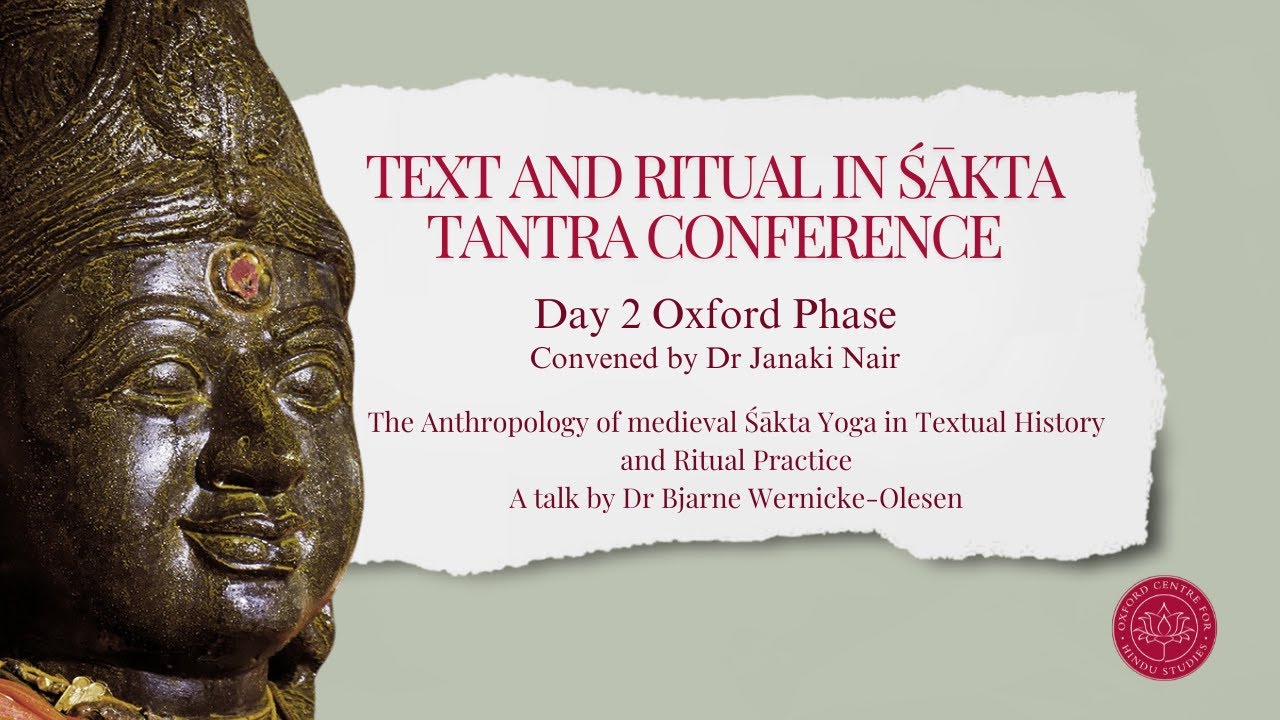
Dr. Bjarne Wernicke-Olesen explores the history, development, and scholarship of Shaktism and goddess worship in South Asia.
Ask about this video. Answers come from its transcript only — with the timestamp, so you can check them.
Generated from the transcript and can be wrong — check the timestamp.
Key Takeaways
- Shakta traditions do not form a direct continuity with Vedic goddess worship, which was limited and subordinate.
- The concept of a singular great goddess and Shakti theology developed later, outside the Vedic Brahmanic framework.
- Goddess worship grew through a complex interaction of local, Puranic, and Tantric traditions.
- Tantric Shakta traditions maintained independent ritual systems and contributed to philosophical developments in Hinduism.
- Shakta ideas influenced yoga traditions, integrating spiritual and physical practices.
What the video covers
- Dr. Bjarne Wernicke-Olesen, a Sanskritist and fieldworker, presents on Shaktism and Shakta traditions focusing on the classical formative phase.
- The lecture critiques the continuity between Vedic religion and Shakta traditions, noting the limited role of goddesses in Vedic texts.
- Important Vedic goddesses like Saraswati and Prithvi survived into classical Hinduism, but major goddesses like Durga and Kali are absent from Vedic corpus.
- The Devi Sukta hymn is highlighted as a key Vedic text influencing later Shakta and Tantric traditions.
- The emergence of a unified great goddess concept (Mahadevi) and Shakti theology is traced to the second half of the first millennium CE, especially the Devi Mahatmya.
- The lecture discusses goddess worship in Indian epics and Puranas, showing a gradual assimilation of local goddess cults into Brahmanic Sanskriti.
- Archaeological and literary evidence from South India and other regions illustrate diverse local goddess traditions.
- The Brahmanical synthesis and interaction between Puranic, Tantric, and popular Shaktism are examined as key to the rise of goddess worship.
- Later sections cover tantric traditions, including the Trika and Kapalika traditions, their ritual practices, and philosophical developments.
- The lecture also touches on the integration of Shakta concepts into yoga and meditation practices, such as Kundalini and Hatha Yoga.
Chapters
- 00:00Introduction and speaker background
- 03:07Female deities in Vedic religion
- 06:20Roots of Shaktism beyond Vedic Brahmanism
- 09:51Brahmanical synthesis and local goddess traditions
- 13:30Goddess worship in epics and Puranas
- 17:36Interaction of Puranic, Tantric, and popular Shaktism
- 22:23Tantric traditions: Trika and Kapalika
- 25:16Ritual practices and philosophical developments
- 29:56Integration of Shakta concepts into yoga traditions
Full Transcript — Download SRT & Markdown
Speaker A
Hello everyone. It's a great pleasure to introduce our next speaker, Dr. Bjarne Wernicke-Olesen, who is a research lecturer at the Oxford Centre for Hindu Studies.
Speaker A
Bjarne has been doing work on the Shakta traditions for a long time, and he did work on the Devi Mahatmya. He's a Sanskritist and also a field worker as well. So, he's got these two dimensions to his study, or three dimensions actually, because he's also interested in philosophical and metatheoretical concerns on Hinduism and the study of religions more generally.
Speaker A
So, it's a great honor to introduce him because he's one of these scholars who is a very rare scholar because he has expertise in Sanskrit philology.
Speaker A
So, he does what we might call deep philology, and indeed he's written a grammar in Danish of Sanskrit, a Sanskrit grammar, and produced several translations of texts for the first time in that language, such as the Bhagavad Gita, and also texts of the Yoga tradition. The Hatha Yoga Pradipika, I think, is one of them. So, he does that deep level particularity of philological scholarship, but he's also interested in what we might call structurally higher issues concerning the meaning of these texts, how they fit into the larger history, big history if you like, and also how they're relevant to the contemporary world. So, he's done field work in Nepal on the Shakta traditions, and his field work informs his philology, and his philology informs his field work.
Speaker A
He's also a very great linguist, in my view, and he's very widely read. He has command of the secondary literature in most European languages, which is a very rare trait in a scholar these days.
Speaker A
So, it's a great pleasure and honor to introduce Bjarne, who's going to give a lecture on Shaktism and Shakta traditions, part two.
Speaker A
Over to you, Bjarne.
Speaker A
Thank you very much, Gavin, for the very kind introduction.
Speaker A
In this second part of my lecture on the goddess and Shakta traditions, I'll continue to grow up from the particular and attempt an overview of the history and development of goddess worship and the Shakta traditions in South Asia,
Speaker A
with a focus on the classical formative phase of Shaktism. I'll also provide a small orientation or review of scholarship and discussion about it.
Speaker A
But this time it is more of an introduction to the state of the art and the research desiderata, rather than research history.
Speaker A
So, in my last lecture I addressed the problem of origins and the Indus Valley civilization. And we now turn to the goddess in Vedic religion.
Speaker A
And unfortunately, the position that Shakta traditions form a continuity with Vedic religion is weakened by the fact that goddess worship plays a rather insignificant role in the Vedic textual corpus.
Speaker A
The most important Hindu goddesses, such as Durga, Kali, Parvati, Radha, and Sita, are unknown in the Vedic texts, although some Vedic goddesses, such as Saraswati and Prithvi, have survived into later classical Hinduism.
Speaker A
And we find that female deities are subordinated to male deities, and female deities play an insignificant role in the Vedic sacrifice, which constitutes the center of the religion.
Speaker A
There are, however, elements to be found in the Rigveda hymns which have become important in later Shaktism, and they have no doubt formed the important doctrinal attaching points for later Shakta traditions to justify goddess worship in a Brahmanical context as being in compliance with the Vedas.
Speaker A
And these instances of Vedic references found in later Shakta literature can therefore not be taken as points of departure for conclusions about Shakta practices in the Vedas.
Speaker A
But unfortunately, they often form the basis for retroactive projections which are not historically valid.
Speaker A
Some of the most important hymns in the Rigveda from a Shakta perspective concern the goddess Vach or speech, Nirrti destruction, and Prithvi, earth.
Speaker A
And amongst these, the most significant hymn is the Devi Sukta, in which the mighty goddess Vach praises herself as the magical power behind the words and the mantras and the meaning of language.
Speaker A
The Vach came to play an important role in later Hindu philosophy and Tantric traditions.
Speaker A
The Devi Sukta itself came to play an important role in later Tantric ritual as well as in the recitation of the Devi Mahatmya, as C. Mackenzie Brown has pointed out in her work.
Speaker A
However, neither Vach nor any of the other Vedic goddesses are related directly to war and blood sacrifices, bali, which are among the primary characteristics of later Devi cults as we know them from local and village Shaktism and especially in the worship of Devi as the warrior goddess Durga.
Speaker A
The closest we get to a fierce goddess in the Rigveda is the wild goddess Nirrti, an inauspicious goddess of destruction and female power which the Vedic Aryans sought to avoid by asking the male deities for protection and imploring her to go away, as we find it in the 10th book of the Rigveda, hymn 59. We may guess that she is an index of a non-Aryan local goddess, but that is guessing.
Speaker A
To this we may add the anticipation of the later conception of Shakti, female power or force, mainly in the many female consorts to the male deities such as the goddess Indrani, Sachi, the female power of the war god Indra. And in the Vedic pantheon, Indra was considered the most important deity next to the fire god Agni and the god of the hallucinogen Soma.
Speaker A
Another consort is the fertility goddess Prithvi, who is always related to Dyaus Pitri, the father sky.
Speaker A
Together they formed the divine parents who created the world and the gods in it. While Prithvi becomes an independent goddess in the Atharvaveda and later Vedic literature, nevertheless, as pointed out by Heinrich von Stietencron, David Kinsley, Jan Fontein, and others, we do not find any myth in the Vedic corpus concerning Devi and her cult and nothing to suggest that the authors of the Vedas conceived the different Vedic goddesses as a manifestation of a singular great goddess Mahadevi or divine female energy Shakti.
Speaker A
Thus, it is difficult not to conclude with Thomas Coburn that the conception of a great goddess and the worship of the goddess as Shakti is the expression of a much later systematic Shakta theology or theology which was not formulated until the second half of the first millennium CE in the Devi Mahatmya when the goddess worship culminated as an independent Puranic and Brahmanic Sanskrit textual tradition.
Speaker A
Furthermore, our evidence strongly suggests that its roots are to be found outside the Vedic Brahmanic context.
Speaker A
So, turning now to Brahmanic Sanskriti Shaktism, goddesses in the epics and the Puranas.
Speaker A
Excuse me. Following the time of the Vedas and the formation of the ascetic traditions, we find an increasing number of references to goddess worship in the Indian epics, which seem to indicate diverse and well-established local goddess traditions at the time, as Pinchman has shown.
Speaker A
However, goddesses in the epics play a subordinate role as consorts and wives of the male gods and do not yet possess independent cosmological or sociological functions.
Speaker A
It is a time of transition, and the goddesses are only gradually being assimilated into the Brahmanic Sanskriti world.
Speaker A
And the many literary references to local goddess worship found in the epics are backed by archaeological findings from the ascetic traditions, such as the Jain and Buddhist stupas in Bharhut and Sanchi from the first and second century CE, depicting female deities, supposedly Yakshis, related to fertility and vegetation.
Speaker A
In the south of the Indian subcontinent, located at the very tip of Tamil Nadu, we find a famous example of Dravidian goddess worship in the temple of the virgin goddess Kanya Kumari from the 1st century CE. And in the South Indian Sangam literature written in Tamil in the same period, we find references to Korravai, a mountain goddess of war and victory, w
Speaker A
So, turning now to um Brahmanic Sanskriti Shaktism, uh goddesses in the epics and the Puranas.
Speaker A
Uh excuse me. Following the time of the Vedas and the formulation of uh formation of the ascetic traditions, we find an increasing number of uh references to goddess worship in the Indian epics, which seem to indicate diverse and well-established local
Speaker A
goddess traditions at the time, as Pinchman has shown. Uh however, goddesses in the epics play a subordinate role as consorts and wives of the male gods and do not yet possess independent cosmological or sociological functions.
Speaker A
It is a time of transition, and the goddesses are only gradually being assimilated into the Brahmanic Sanskriti world.
Speaker A
And the many literary references to local goddess worship found in the epics are backed by archaeological findings from the ascetic traditions, such as the Jain and Buddhist stupas in Bharhut and Sanchi from the first and second century CE,
Speaker A
depicting female deities, supposedly Yakshis, related to fertility and vegetation. Um in the south of the Indian subcontinent, located at the very tip of Tamil Nadu, we find a famous example of Dravidian goddess worship in the temple of the virgin goddess Kanya Kumari from
Speaker A
the 1st century CE. And in the South Indian Sangam literature written in Tamil in the same period, we find references to Korravai, a mountain goddess of war and victory, who received the blood sacrifices of buffaloes and other animals.
Speaker A
In addition, the forest warriors, the Maravars, were encouraged to commit ritual suicide in her honor.
Speaker A
And indeed, war itself was seen as a sacrifice to this goddess. As John Brockington has suggested that the Devi Mahatmya myth of Durga slaying the buffalo demon, the Devi Mahisha Shura Mardini, may be a North Indian adaptation of this
Speaker A
myth. Likewise, the goddesses mentioned in the Sanskrit epics are first and foremost linked to war, victory, death, and destruction, and are located in the periphery of Brahmanism of the Brahmanic Sanskritic world.
Speaker A
So, in in the 7th and 12th book of the Mahabharata, we have we find perhaps one of the oldest myths about a dark and fierce Ugra goddess born out of the aggression of Brahma and identified with the Vedic goddess Mrtyu or death.
Speaker A
Although she may be uh as she the Bible has expressed it, just as much a reflection of the goddesses Durga and Kali at a point where these uh latter, or at least their prototypes, are breaking into the literary
Speaker A
tradition. We also find in the goddess Kalaratri, uh later identified with Kali, a personification of the horror of battle in the eighth chapter of the Mahabharata, while the victory and nobility of battle is personified in two important hymns to the warrior goddess
Speaker A
Durga in the fourth and sixth book. In the Durga Stotra, inserted just before the Bhagavad Gita and recited by Arjuna before the battle, uh Durga is depicted as a virgin goddess, a demon slayer, and notably of the demons Mahisha and Kaitabha,
Speaker A
uh later mentioned in the Devi Mahatmya and a protector of her devotees. So, she's identified with the Kali, Bhadrakali, and Chandi and associated with the Vindhya Mountains and the consumption of meat, alcohol, and blood sacrifice in the Durga Stava.
Speaker A
So, the goddesses of the Sanskrit epics therefore stand in in stark contrast to the mild and benevolent goddesses of Vedic religion, except perhaps for the Vedic goddess Nirrti.
Speaker A
We find a growing scholarly consensus in epic Puranic studies. Um, such as uh, uh Donegan Flood, and Pinchman concerning the the overall assimilation pattern in the post-Vedic development of the Devi mythology from the time of the great Indian Sanskrit epics, the Mahabharata
Speaker A
and the Ramayana, to the time of composition of the major Puranas. The Devi Mahatmya, portion of the Markandeya Purana, marks the culmination of this long process in which the goddesses transcend the male gods to be united into a single great goddess,
Speaker A
uh, Devi or Mahadevi, who is subsequently identified with Shakti as ultimate reality. And this, uh, process of assimilation can be divided into two phases in relation to the epics and the Puranas.
Speaker A
In the first phase, spanning the period from the Mauryan Empire to the Gupta Dynasty, we find that local, non-Aryan, and Dravidian female deities, usually of a fierce nature, are slowly upgraded and assimilated into the Brahmanic Sanskritic pantheon.
Speaker A
And through processes of, uh, Sanskritization, Srinivas has expressed it in inclusivism, a term by Paul Hacker, these, uh, non-Aryan deities become the consorts of the male and mostly Indo-Aryan gods.
Speaker A
The result of these processes has been referred to as the Brahmanical synthesis by um uh Thomas Hopkins and described by uh Coburn as a simultaneous twofold movement. On the one hand, there is an effort to broaden the appeal of the Aryan world by
Speaker A
enfolding into it various elements of popular religion, and on the other hand, there is an effort to provide uh those elements with a new dignity in the form of verbal compositions in Sanskrit, uh the language that was once uh
Speaker A
uh one of the major carriers of Aryan culture. So, one of the reasons for the complexity and encyclopedic quality of the Sanskrit Puranas is that they are the meeting ground for these two mutually reinforcing inclinations.
Speaker A
And it is likely that these processes also implied transformation of local aniconic deities represented by stones, pillars, weapons, etc. into iconic representations of goddesses.
Speaker A
In addition, we tend to find long lists of uh goddesses grouped together as if they were mutually related, such as the Matrikas in the Mahabharata and the Matsya Purana.
Speaker A
These identifications of uh goddesses are an important step towards a a larger conception of Devi as a high goddess encompassing all the individual goddesses as her manifestations.
Speaker A
We also see goddesses represented as instrumental to the deeds of the male gods, and sometimes even as superior.
Speaker A
In the second phase, or the Puranic period, the fierce goddesses gained an increasingly high degree of independence and significance, after which they uh fuse with the milder and more benevolent Brahmanical goddesses into the conception of the free goddess Devi, who
Speaker A
is superior to the male gods. Although the warrior goddess Durga appears as an important and powerful goddess in the sixth book of the Mahabharata and in a number of installations into the Mahapuranas, um the fifth chapter of the Vishnu Purana,
Speaker A
uh chapter 17 to 21 of the Vamana Purana and uh 21 to 28 of the Varaha Purana, uh 11 to 12 in Kurma Purana, and so on. It is not until the 8th century that she is worshipped as the high goddess
Speaker A
Devi in the Devi Mahatmya portion of the Markandeya Purana, or what David Kinsley has called the crystallization of the goddess tradition.
Speaker A
In the following centuries, the basic principles for a Puranic Shakta theology presented in the Devi Mahatmya are further developed in the Shakta Upapuranas and the Shakta Upanishads.
Speaker A
However, the the greatest elaboration of these concepts is found in the Shakta Tantras of the so-called Kulāmārga and uh what may be referred to as high cultural Shaktism of Kashmir in the 8th to 13th century, when the goddess is worshipped
Speaker A
as the Shakti under the influence of the philosophical non-dualism of the Trika. In her book, The Rise of the Goddess in the Hindu tradition, Tracey Pintchman has identified the three cosmogonic principles: uh Shakti, energy, and Maya, a creative yet delusive power,
Speaker A
and uh Prakriti, materiality, as the symbolic complex of the great goddess that forms a continuity in the Puranas and indeed in the history of Shaktism.
Speaker A
In the Devi Mahatmya, the goddess is directly identified with these concepts which used to have negative connotations in earlier philosophical theological discourse.
Speaker A
Now, the concepts Maya and Prakriti are reinterpreted in a more positive light in a Shakta context.
Speaker A
Um and conflict with the concept of Shakti. On a cosmological level, the goddess is identified with these impersonal abstract principles that transcend all particularities.
Speaker A
On a theological level, however, these principles are embodied in different individual goddesses said to be the manifestations of a single great goddess. While on an anthropological level, they form the essence of women.
Speaker A
Pinchman shows the evolution and elaboration of Shakti, Maya, and Prakriti through the layers of Brahmanical texts from the Vedic, Sankhya philosophical, and even Tantric antecedents via the Devi Mahatmya to the highly sophisticated synthesis that one finds in the Devi Bhagavata Purana.
Speaker A
The goddess is viewed as a manifestation and personification of these concepts. And she appears dynamic, powerful, and material as well as ambiguous, um mild and wild, uh creative and delusive.
Speaker A
Uh reference to Maya. Pinchman argues that although the impulse to elevate female divinities to supreme status properly originates primarily from non-orthodox, autochthonous religious systems, the mechanisms by which the feminine principle is elevated in orthodox literature uh are borrowed from the orthodox
Speaker A
tradition itself. Thus, in the Shakta Puranas and Upa Puranas, the goddess takes the place normally held by Vishnu in Vaishnava Puranas and Shiva in Shaiva Puranas.
Speaker A
In the famous Devi Bhagavata Purana, we find well-known myths drawn from the Vaishnava Bhagavata Purana, but with the alteration that it is now Devi and not Vishnu or Krishna who's viewed as the supreme manifestation of the divine that is superior to the male
Speaker A
gods. Uh for example, controlling Vishnu through her yogic sleep, the Yoga Nidra. The work even contains a part referred to as the Devi Gita or Song of the Goddess, and that is an alternative to the Vaishnava Bhagavad Gita or Song of God.
Speaker A
The Devi becomes the source of all other gods and uh manifest forms, whether male or female, and is even described as sitting on a throne composed of the Trimurti, that is of different manifestations of the gods Brahma, Vishnu, and Shiva.
Speaker A
The Devi Bhagavata Purana thereby continues the theological vision of the Devi Mahatmya by drawing on Vaishnava myths and extolling Devi as the highest deity and ultimate reality, Brahman, personified as the goddess Durga along with her maternal, erotic, and
Speaker A
aggressive manifestations. The Devi Mahatmya is the first and arguably the most important text concerning the great goddess Devi or Maha Devi.
Speaker A
And in the course of three dramatic accounts, Prathama Charita, Madhyama Charita, and Uttama Charita, relating to her victories over the demons Madhu and Kaitabha, Mahisha and Shumbha and Nishumbha, the Devi's cosmological status as creator, maintainer, and destroyer of the universe is proclaimed.
Speaker A
And more specifically, she emanates the world, she sustains it and protects it, and in the end she annihilates it. So, the goddess um furthermore demonstrates her epistemological abilities to conceal Maya and reveal Darshana herself through her divinities, uh as well as her soteriological ability
Speaker A
to grant liberation or moksha. In her mild manifestations, she's identified with the benevolent goddesses Parvati and Gauri, while in her fierce manifestations, she's identified with the goddesses of war and blood thirst, such as Durga and Kali and Chamunda.
Speaker A
The designations Devi, the goddess, and Durga, the one who is difficult to approach, are often used as synonyms, since it is in her manifestation as Durga that the goddess demonstrates her superiority over the male deities.
Speaker A
Uh this is most famously depicted in the narrative of her victory over the buffalo demon Mahisha, called Devi Mahishasuramardini in the second chapter of the Markandeya Charita of the Devi Mahatmya.
Speaker A
However, the the designation Devi is in principle referring to a higher ontological status, since the warrior goddess Durga is just one of her many manifestations as um Coburn and Kinsley have pointed out.
Speaker A
Um In the centuries following the composition of the Devi Mahatmya, the goddess traditions spread, and the mythological and philosophical dimensions of Shaktism were elaborated and disseminated in such Upapuranic works as the Devi Purana, the Kalika Purana, the Devi Bhagavata Purana, uh
Speaker A
Mahabhagavata Purana, um the Prakriti Khanda in the Brahma Vaivarta Purana. The the female deities found in the Upa Puranas are generally of fierce and warrior-like nature, pleased with blood sacrifice and alcohol.
Speaker A
And except for a few Vedic references, such as Prithvi and the earth mother, uh these goddesses are mainly non-Vedic in origin and most likely modeled on popular local deities, often associated with vegetation and mountains as suggested by Hazra.
Speaker A
The Upa Puranas are therefore expressions of a trend to incorporate aspects of fierce local goddess cults into a more traditional Brahmanic and Sanskritic framework in an attempt to harmonize between the competing spheres of orthodox Brahmanism and popular practice.
Speaker A
Uh James B. Hare has noted that, unlike the other Shakta Upa Puranas, the Devi Purana seems to moderate the goddess by uh as he says, "invariably coupling her with a pragmatically oriented masculine authority." The ferocious Matrikas become the brain shaktis of the gods.
Speaker A
The independent goddess of the Vindhyas merges with the wife of the motherly Parvati of the Himalayas, becoming merely an inherent secondary portion of Shiva.
Speaker A
Indeed, this development formed part of what Sanderson has called the early medieval process when new regional kingdoms arose and expanded by associating themselves with powerful religious traditions as we find expressed in the Devi Purana.
Speaker A
While the goddess achieved independence in the Puranic and Upa Puranic literature, worship of the goddess was simultaneously being extensively incorporated into the Tantric literature and the royal cult of Shaivism.
Speaker A
The pervasive influence and popularity of Shakta traditions at the time now included royal religions in the subcontinent and also found its way to kingdoms in Southeast Asia and beyond to Java and Bali.
Speaker A
Nevertheless, a few kings seem to have identified directly as deities of the goddess as Bhagavati bhaktas.
Speaker A
Although the divine power of the goddess was identified with the power of the king in different regions such as Vijayanagara and royal devotion to a goddess as a uh dynasty's lineage deity, the Kuladevi, uh was quite common in early medieval
Speaker A
India. And in more traditional accounts of Hinduism, the tantras have uh often been depicted as later esoteric scriptures commenting upon and elaborating thoughts that were initially presented in the Puranas in a mythological form.
Speaker A
Um uh we may refer to Klaus Mylius' uh history of of literature here. Um however, the relation between the Puranas and tantras has proven to be more complex.
Speaker A
And although generally distancing themselves from the tantras, the Purana and Upa Puranas have also adopted numerous tantric elements.
Speaker A
Uh recent scholarship has provided us with more nuanced picture of this interplay and overlap between esoteric tantric traditions and popular Puranic traditions.
Speaker A
Uh for example, in the case of the Shiva Skanda Purana, uh on on which important work has been done by uh Hans Bakker and Harunaga Isaacson.
Speaker A
Uh by the 11th century, uh tantric ideas and practices had become absorbed by the Smarta Brahmanical mainstream to an extent where it had become almost impossible to meaningfully distinguish between Smarta and tantric ritual uh practice.
Speaker A
As um uh Elmore has pointed out. Um this interplay and overlap is also found in relation to the developments of Puranic and Tantric Shaktism. And if we accept your Kuczkies' revised dating of the Devi Mahatmya to the 2nd half of the
Speaker A
8th century, we find that this is more in alignment with the recent chronology of the Tantric traditions.
Speaker A
Um so the theology of the Devi as Shakti found in the Devi Mahatmya was was much more widespread in the Tantric traditions in the 8th century.
Speaker A
Uh but not much in the 5th or 6th century, which is the more conventional dating of the Devi Mahatmya.
Speaker A
Uh Uh this would imply that the culmination of the Puranic Devi mythology does not constitute the starting point for the rise of the goddess in the Tantric traditions.
Speaker A
Rather, the rise of goddess worship in early medieval India happened more or less simultaneously in Puranic and Tantric traditions and was a result of a complex interaction between the two forms of religion and that of popular and local Shaktism.
Speaker A
As Bhayani Sarkar has suggested, the Devi Purana may be the first Shakta work to bridge this distinction between the popular Puranic traditions and the esoteric Tantric traditions with orthodox pragmatic and practices and transgressive Tantric practices overlapping.
Speaker A
According to Sarkar, uh the work also marks the most formative moment in the development of an independent goddess theology and a new form of religion opens all kinds of followers, including women, outcasts, and worshipers from heterodox traditions such as Buddhism,
Speaker A
uh who are interested in the uh safety and strength in dangerous magical powers and liberations.
Speaker A
Um quote from Sarkar, Likewise, the Maha Bhagavata Purana contains numerous uh Tantric elements such as Tantric worship, a manifestation of Shakti as the terrifying goddess Kali, and the first mentioning of the 10 Mahavidyas, or great wisdoms, from which
Speaker A
Shiva tries to flee in horror. The Kalika Purana, on the other hand, is related to the Kamakhya Temple in Assam, and um uh is um notorious for its broad chapter on Rudhiradhyaya, uh with detailed ritual instructions for animal and human sacrifice,
Speaker A
and that of Bali. And uh the ritual truth of Tantric Shaktism, while uh Brahmanic Sanskritic religion is associated with Vedic, Puranic, and Smarta forms of worship, or what Axel Michaels has termed a basis religion, namely a type of religion that one is
Speaker A
born into. There's also a non-Puranic form of religion, which is voluntary, initiatory, and relating to esoteric forms of worship based on the group of texts known as uh the Tantras.
Speaker A
And these texts were first and foremost associated with non-Puranic Shaivism. However, in the long duree of the Shaiva age and the classical formative phase of Shaktism, we see a tendency of these Shaiva traditions developing from dualism towards non-dualism, from an emphasis on
Speaker A
the masculine to an emphasis on the feminine, and from exoteric worship to esoteric private practices.
Speaker A
Uh the latter became increasingly transgressive and shocking in its practices, and this development was mirrored in the iconography of the traditions, depicting increasingly ferocious deities, such as the goddess Kali and Chamunda.
Speaker A
Indeed, one may argue that towards the end of this development, these traditions, although many of them continued to be formally labeled as Shaiva had in fact become Shakta at heart. The ultimate reality perceived of as a single feminine deity such as
Speaker A
Kalasamkarshini in the 10th century of Krama tradition of Kashmir. Thus while Shiva in the form of Sadashiva was worshipped without a consort in the Shaiva Siddhanta, it was now the goddess without the consort who was worshipped in the Krama.
Speaker A
Um liberation was conceived of as a transformative monistic realization of the identity with Kalasamkarshini as an absolute undifferentiated consciousness, chit or samvit.
Speaker A
This remained the core teaching of the related Trika tradition or what has become known as Kashmir Shaivism, which is a label that has been strongly opposed by Alexis Sanderson.
Speaker A
The rise of goddess worship in the tantric traditions of early medieval India remains a very complex phenomenon and much research still needs to be done.
Speaker A
Uh the overlap between Shaiva and Shakta tantrism has long constituted an area of confusion really, but Alexis Sanderson's more recent work on manuscript sources has helped clarify the picture.
Speaker A
Although scholars such as Heinrich von Stietencron have long argued for the independent existence of Shaktism as a major Hindu religion next to Shaivism and Vaishnavism, uh this has been much challenged by the fact that the Kula and Kaula texts of tantric Shaivism and
Speaker A
tantric Shaktism uh overlap and seem to be the product of an internal development within Mantramarga Shaivism.
Speaker A
And thus Shaktism has often been reduced to a subset of tantric Shaivism. This view was based on the assumption that all tantric traditions, Siddhantic as well as non-Siddhantic, have relied on the common ritual system of the Siddhanta since there was nothing to
Speaker A
indicate the existence of an independent tantric goddess tradition outside of the mantra marga of tantric Shaivism.
Speaker A
So in in the development of Shaivism and the tantric traditions, Alexis Sanderson has shown that how the non-Puranic Shaiva devotees, as opposed to the Puranic Maheshvaras, had undergone an initiation, diksha, into one of two paths, the atmamarga or
Speaker A
outer path for those ascetics who sought liberation, mukti, from this world, and the mantra marga or path of mantras for those ascetics as well as lay people who sought pleasure, bhukti, and powers, siddhi, in this or higher worlds.
Speaker A
The majority of tantras associated with these systems follow the common ritual structure. Um uh which uh Gudrun Ishakson uh done some important work on. In his more recent work, however, uh Sanderson has described an independent status to a
Speaker A
third path, that of the kulamarga or path of the family of goddesses, with its own distinct ritual system, which seems to have originated in an external and independent Shakta milieu.
Speaker A
It was rooted in the cremation ground asceticism of the Kapalikas, but was gradually uh transformed and incorporated into the household life of Kashmiri Brahmins.
Speaker A
So it is to this development of goddess traditions within the confines of tantric Shaivism that we now turn.
Speaker A
Uh Sanderson's Sanderson has uh identified the roots of the kulamarga in an independent Shakta or proto-Shakta tradition that appeared first in the atmamarga in the 5th century CE in relation to a group of skull-carrying Kapalika ascetics known as the Somसिद्धান্ত system
Speaker A
um also referred to as the Atimarga three. And this Shakta Kapalika tradition then existed refined within the Shaiva Mantramarga and was assimilated to various degrees but maintained an independent ritual system.
Speaker A
One of the most distinctive features of this Shakta ritual system was the Chakra Yuga also known as Chakra Milaka or Vira Milapa.
Speaker A
That is a collective of the astic worship including initiates and low-caste women in which the individual identity was merged into a group.
Speaker A
Uh this was a stark contrast to the mainstream Shaiva tradition but also to Indian ritual in general. But it's usually an an individual activity.
Speaker A
Other distinctive features of this uh Shakta tradition as um pointed out by Alexis Sanderson uh included uh possession by the goddess Avesha and consumption of consecrated liquor in relation to initiation Diksha consumption of impure and forbidden substances the Charu Prasana
Speaker A
with the focus on sexual bodily fluids uh Virya Dravya attainment of supernatural powers Siddhis through the extraction of the vital essences of living beings. Uh we have private erotic ritual with a consecrated consort uh Duti Yaga and uh blood sacrifice Bali.
Speaker A
So we we also find the use of self-induced states of possession by the use of yogic techniques resulting in the raising of the inner central energy which became known as Kundalini in later sources.
Speaker A
Indeed several of these features are found in other forms of Shaktism in different combinations.
Speaker A
However, it is this uh Shakta Kapalika uh ritual system that's prototypical features that allows us to uh contrast this Shakta Kulamarga with the Mantramarga of Tantric Shaivism.
Speaker A
Uh the Kulamarga of the Kaulas uh was never not a creation of or a reformation within the Mantramarga, but rather as seen from the outside, an ancient Shakta tradition preserved at the margins of all esoteric groups.
Speaker A
Its uh ritual system was described in its own text, uh variously referred to as the Kula Shastras, the Kula Shasana, or Kulamnaya, such as the Kula Panchashika, the Kularnava, the Kulasara, uh the Kaulajnana Nirnaya, and the Timirodgathana, uh but also within texts assigned to the
Speaker A
Mantramarga. It was centered on the goddess Kulishwari uh with or without its male consort, uh Bhairava, fierce form of Shiva, and surrounded by eight mothers, the Ashtamatrika.
Speaker A
In time, the identity of the central deity, its uh pantheon, uh mantras, etc., were altered, and different traditions and liturgies arose.
Speaker A
An early and influential classification of these Kula traditions according to the four cardinal directions is found in the text the Chinchinimatsyasarasamuchchaya.
Speaker A
And here, the Kula ensemble is divided into four currents, Amnayas, namely the the eastern tradition, the Purvamnaya, of the Trika with the goddesses Para, Apara, and Parapara, the northern tradition, the um Uttaramnaya, of the Kramakula or Kalikula, with the goddesses Kalas and
Speaker A
Karshini, the western tradition, the Pashchimamnaya, with the group goddess Kubjika, and the southern tradition, the Dakshinamnaya, worshipping the Nitya goddesses, Kameshvari, and later the gentle and erotic goddess, Tripura Sundari.
Speaker A
To this classification was added a fifth Amnaya, the Urdhvamnaya, or upper tradition, with the Kularnava Tantra, and a sixth Amnaya, the Shatamnaya, or all schools, Sarvamnaya, tradition, encompassing the Kaula traditions in the Kathmandu Valley from the 13th century
Speaker A
onwards. The Kulāmārga ritual system seems to appear in its most original form uh in the early Trikka, or eastern transmission, uh but it also found its way into texts of Shakta orientation, uh assigned to the Mantramārga's Vidyāpīṭha division, such as the
Speaker A
Brahmayāmala among the Yāmala texts, and the Jayadrathayāmala. Mhm. Uh Shaktas, uh two, three, and four, and the Mālinīvijayottara, uh the 11th chapter in the corpus of Shakta Tantras.
Speaker A
In these traditions, as Sanderson has shown, we find two distinct cults of the same deities. In the Jayadrathayāmala, we have a distinction between a Mantramārga system expressed in the first Shakta of the work, and the Kaula system for the propitiation of the
Speaker A
goddess Kāli as Kālasamkarṣiṇī, expressed in the following three Shaktas. The Mālinīvijayottara also clearly distinguishes between these two systems, that is, between a Tantric system, a Tantra Prakriyā, following the Shaiva Mantramārga, and the Shakta system, a Kula Prakriyā, or Kauliki Prakriyā,
Speaker A
um following the Kulāmārga. And the latter was seen as a more elevated form of practice, with an emphasis on possession and collective orgiastic worship reserved for elite practitioners and requiring a special initiation and kuladiksa.
Speaker A
And following this initiation the tantric practitioner or sadhaka became a kaula. The historical development of the kulamarga has tentatively been divided into three phases. The kula phase from the 5th to the 8th century, the kaula phase 8th to 10th century, and what may
Speaker A
be called the high cultural shaktism from the 11th to the 13th century. Also referred to as high Hindu tantra or simply tantrism by um Sanderson, David White, and Geoffrey Samuel.
Speaker A
The distinctions between the phases still needs clarifying and are not always warranted as the terms kula and kaula are often used interchangeably, but the periodization is useful in emphasizing important shifts in the history of tantric shaktism which may
Speaker A
otherwise run the risk of being overlooked. When there are no surviving texts from the somasiddhantins or shaktikaplikas in the so-called atmakarika tree, we find expressions of the antinomian cult and practices in texts from the vidyapitha and kulamarga as
Speaker A
Judy Cercek has shown. The early kula phase was dominated by visionary trans- gressive cults based on the cremation ground asceticism of these kapalikas who were once widespread from Kashmir and the border to the Tamil Tamil speaking south.
Speaker A
Their observance, the kapala vrata or mahavrata, included covering themselves in ashes from the cremation ground and wandering around while carrying a skull topped staff, a khatvanga and an armed bow fashioned of a human head a Kapala.
Speaker A
The practice centered on the fearsome deities Bhairava and Chamunda surrounded by circles of secondary deities and was conducted in the wilds and the charnel grounds.
Speaker A
In its Shakta version the central deity was the goddess um for example Aghori uh without a male consort uh but surrounded by clans or families um uh so-called Kulas of wild Yoginis reflecting the power of the goddess and
Speaker A
pervading the universe with the energy. For this reason the early Kulas often referred to as the cult of Yoginis.
Speaker A
Uh offerings included ontologically impure substances such as meat, blood, alcohol and sexual fluids as means of pacifying, controlling or negotiating with the Yoginis who would sometimes bestow the Tantric practitioner with supernatural abilities.
Speaker A
Thus the Tantric practitioner was a religious virtuoso who sought dangerous contact Milap with the Yoginis who could also possess women and thus partake in sexualized rituals as the consort as the Shakti or duty of the male Sadhaka.
Speaker A
Uh as um Shobha Deva has written about, however, we also find that women were allowed full initiation in the Kapalika as opposed to most other ascetic traditions and that the term Yogini tended to be used for independent female
Speaker A
ascetics although we still know very little about the lives and practice. Tantric holy places or seats the Pita of the goddess power played an important role in Tantric Shaktism from an early time onwards. Most important being Kamarupa in Assam.
Speaker A
Uh absent female Tantric practitioners were sometimes associated with these places and said to bestow cities on the lucky tantric sadhakas.
Speaker A
The pithas were later supplemented by a significant number of round and open yogini temples across India from the 8th to 11th centuries made by royal patrons.
Speaker A
Uh Vidya Dehejia and Shaman Hatley have has written on this. The Kaula phase or Kaulism marked a reformation of the Shakta Kapalika tradition. It questioned the meaning and purpose of external rituals and rejected the cremation ground asceticism, the Kapala vrata, in
Speaker A
favor of more visionary, erotic, and what may be termed shubist forms of practice oriented towards an aestheticized mystical experience, as um Sanderson and Vasudeva have pointed out. While the Tantraprakriya ritual emphasized the external worship of the linga, uh
Speaker A
visiting tantric holy places, and offering substances into a consecrated fire ahutidīkṣā the Kulaprakriya practice featured an internalized linga as the bodily image of axis mundi. The pithas were identified with the body, the ahutidīkṣā became a fireless internalized form of
Speaker A
the ritual, and so on. In addition to these internalizations, Kaulism offered the practitioner a kind of um ritual discourses, um as Wallis has pointed out, as a way of uh worshipping any of the deities of the Mantramarga as either Kulīśvarī female
Speaker A
or Kulīśvara male, as we see described in chapter 12 of the uh Netra Tantra, which has currently been translated by uh Gavin Flood, uh Katya Boothroyd, and myself.
Speaker A
In this way, any tantric cult could be reinterpreted in a calmer version. The domestication of the Kapalika practices also indicated a shift in context from the wild ascetic practicing in the cremation grounds to also more respectable householder practicing at
Speaker A
home or perhaps at secret Kula gatherings. This counter reformation including the rejection of the Kapala vrata and all external signs of sectarian affiliation the Vyakta Alingata is usually associated with the Guru Macchendranath from the western transmission Paschimamnaya but the northern Kaula
Speaker A
Krama tradition retained the insignia the tilaka of the Kapalika ethos. A further reform took place in Kashmir in the 11th century.
Speaker A
The Kula Marga found its way into the Kula Prakriya practice of the Malini Vijaya Uttara which became the root text of the Trika tradition.
Speaker A
In this way the Kula Marga flowed into the high cultural world of the Brahmanic Sanskrit in reason which became evident in the works of the great Shakta and Shaiva philosopher Abhinavagupta who lived around 1000 CE.
Speaker A
He came from a Krama Shaiva tradition but intellectualized it and reinterpreted it in the form of the Trika as part of a new kind of cultural self-understanding for learned Brahmans in in Kashmir and of course Alexis Sanderson's very important work
Speaker A
on this. Abhinavagupta based his Opus Magnum Tantraloka or Light on Tantra as well as his Tantrasara the Essence of Tantra on the Malini Vijaya Uttara translated by K.C. Pandey and Sanderson which is forthcoming.
Speaker A
Thus Abhinavagupta stands out as a combination of the process of intellectualization of the Kula marga or high cultural Shaktism that begins in Kashmir in the 9th century and culminates in the late 10th century through commentaries on specific tantric
Speaker A
scriptures Tantra Shastra Abhinavagupta and the Shakta Shaiva theologians of the Trika school developed a sophisticated scholastic basis for Kula worship and this included a public version of the Tantra prakriya for householders while the Kula prakriya initiates continued to practice the
Speaker A
original Kula and Kaula rituals in secret including the sexualized rituals and the consumption of impure substances.
Speaker A
Which Dyczkowski has written on in his exegesis on the Kula marga Abhinavagupta transformed ritual to gnosis through jnana that is from a form of doing to form of knowing whereby he sublimated and semanticized many of the Kula practices
Speaker A
into a type of meditative asceticism aimed at the realization of a transcendent or absolute subjectivity.
Speaker A
The meditation sought to the reverse the cosmological process of manifestation in light and sound along the practitioners who identify with its divine origin as a path to liberation and also release from the cycle of rebirth samsara.
Speaker A
The high cultural Shaktism spread beyond Kashmir and was later taken up in South India by the very successful Tripura Sundari cult also known as Srividya kind of purified and domesticized domesticized sweet Shaktism if I can and erotic mysticism that can be
Speaker A
contrasted to the somewhat older and more um, the Shaktism of North India. The Trika and its philosophy of non-dualism permeate the early texts and terminology of the Tripura Sundari cult as as the the 10th or 11th century Yoginihridaya, which is
Speaker A
said to form part of the tradition's foundational text, the Bhavakishvara Tantra. Um, I do have some excellent translations of the Yoginihridaya.
Speaker A
In some cases, the Trika goddess Para was even regarded as the inner essence of Tripura Sundari, who is manifested in the tradition's characteristic Srividya mantra and its three-chakra diagram.
Speaker A
The meditative reversion of the cosmological process of manifestation was conceived as a gradual journey back towards divine source, the goddess, and also as a journey through the corresponding levels of the esoteric yogic body.
Speaker A
This tantric model of the human as a homology to the hierarchical levels of the universe became central to the theology and practice of the Srividya, as was the case in most tantric traditions.
Speaker A
It became the standard model in Hatha Yoga, namely the rising of the goddess Kundalini along a vertical axis in the yogic body, piercing various centers of energy, chakras, uh, in the central channel, the Sushumna, on her way up to the crown of
Speaker A
the head. The South Indian Tripura Sundari cult was assimilated by the orthodox smarta brahmanical system and the monastic tradition of the Shankaracharyas, as well as by other tantric traditions, such as Pancharatra, Vaishnavism, and the Nath Sampradaya.
Speaker A
It was even assimilated by Digambara Jainism and later Shvetambara Jainism, as Sanderson has shown, indicating the widespread influence and popularity of Shakta traditions and goddess worship at the time.
Speaker A
In later Srividya tradition, uh which has lasted until today, uh we continue to find a distinction between the Tantra Prakriya and Kula Prakriya practices, also known as the right-hand practice, the Dakshinachara, and left-hand Kaula practice, the Vamachara respectively.
Speaker A
Thus, the the 16th century Srividya theologian Lakshmidhara rejected the use of sexualized ritual and impure substances, the Panchamakara, while the 18th century theologian Bhaskararaya continued to promote its uh secret use.
Speaker A
Now, we turn to uh Shaktism and yoga. In the 13th century, we see the end of Shaivism's period of dominance, including the Kula Marga, uh due to significant political changes caused by invasions, the Delhi Sultanate, and the introduction of Islam on a large scale.
Speaker A
After this time, the Tantric, Shakta, and Shaiva traditions lose their political influence in Kashmir and North India, but continue to thrive in South India, as well as most Northeast India and Nepal under the Malla kings uh from the from the 12th to the
Speaker A
18th century. Um and especially in the 15th to the 12th centuries in what has been referred to as the Tantric Renaissance.
Speaker A
Indeed, several medieval Kaula traditions, such as the cult of Tripura Sundari and the goddess Kubjika, are still living traditions in Nepal.
Speaker A
Um uh uh and it cast on fine work in the Samar Kosh key as well.
Speaker A
Um a very important work, The Decline of the Shaiva in North India was followed by a rise of Tantri yoga in the following centuries, as G. Mallinson has pointed out.
Speaker A
This became one of the ways that Shaktism endured after its classical formative phase. And then somewhat paradoxically, Shaktism gained influence in one of its most esoteric forms, when the western Kaula transmission by Śrīman Mahāya, later known as the the Natha Sampradāya.
Speaker A
It's a kind of a collective term for several Sampradāyas. Adopted Hatha yoga and popularized it in a Shakta version in the locus classicus of Hatha yoga, 15th century Hatha Pradīpikā.
Speaker A
Uh in this way, Shakta and Tantri forms of yoga became accessible to laymen and householders, as well as women and lower castes.
Speaker A
As opposed to the more body-rejecting practices of classical yoga, the Shakta anthropology of Tantri yoga aimed at the affirmation and deification of the body.
Speaker A
It is first mentioned in the chapter on subtle visualizing meditation, the Sūkṣma Dhyāna, in the 8th century Netra Tantra, which is one of the also the earliest known Tantra to mention the Kula Mārga and to teach a system of six
Speaker A
bodily centers called chakras, with the meditating yogis supposed to pierce this inherent power. Uh especially in chapter seven of the Netra Tantra.
Speaker A
The Shakta anthropology is presented in the first few verses of chapter seven and then elaborated. I'll just read a bit the first few verses of chapter seven.
Speaker A
Uh in our translation here, the the lord spoke, uh now I will tell you about the excellent supreme subtle visualizing meditation, which comprises the six chakras, the 16 supports, the three focal points, and the five voids, 12 knots, the three shaktis, the path of
Speaker A
the three luminaries, and the three channels. And having realized the body of fair-haired one as the goddess as a body that follows the path of 10 channels and 35 million channels by the 72,000 channels, and as a body overrun by a
Speaker A
host of channels ridden with diseases in the fire, the yogi then fills the highest self or the others, his own self and that of another, with the nature of the subtle visualization proclaimed as the highest.
Speaker A
It becomes a divine body bereft of all disease. The text presents an early Shakta appropriation of older yogic models of knots, the granthis, supports, adharas, and so on for grounding the central channel, the sushumna, and the notion of
Speaker A
how the yogi causes the ascent of his inner power as an early form of Kundalini yoga.
Speaker A
This pattern was repeated, as James Mallinson has shown, when the visualizing meditation of the Kundalini yoga model was overlaid onto the physical Hatha yoga practices in the Hatha Pradipika by the early Naths in the 15th century.
Speaker A
For example, in in the first few verses of the third chapter in the Hatha Pradipika, the Nitra Tantra chapter on subtle meditation is significant in that it presents two different anthropologies and systems of visualization, which the Trika commentator Kshemaraja refers to as
Speaker A
exactly the the Tantra Prakriya and the Kula Prakriya. And while the inherent power only rises up through the sushumna channel in the Tantra Prakriya, the same power rises up in the Kula Prakriya and reaches a reservoir of nectar of amrita in the head, which then
Speaker A
drenches the body on its way down through a multitude of subtle channels, the nadis, causing somatic joy and immortality.
Speaker A
The yogi becomes a divine body bereft of all disease. And we also learn that the yogi should become of the same essence as yoginis in this uh uh version of the Nityatantra, the the oldest surviving manuscript, the Bliss manuscript.
Speaker A
Um And that is why a yogic technique mudra known as the sky goer sky goer once you become of the same essence as yoginis.
Speaker A
The Kula Prakriya system of visualizing meditation also forms part of a distinctive Shākta anthropology, which is later combined with the physiologically fixed model of the six chakra system found in the 10th century Kubjikāmata Tantra of the western Kaula
Speaker A
transmission transmission of the Paścima Mnāya. And I'll just read from Malananda Singleton's translation here.
Speaker A
This is significant versus the the anus is called the base, the ādhāra. The svādhiṣṭhāna arises at the penis.
Speaker A
The maṇipūraka is in the navel and anāhata is in the heart. Viśuddhi is in the region of the throat and ājñā is between the eyes.
Speaker A
This uh standardized version of the six chakra system in combination with Kundalini yoga became prevalent from the 12th century onwards and was further developed when adopted by the Śrīvidyā tradition.
Speaker A
In the 14th century, Śivasamhitā's seventh chakra was added to the six chakra model. When adopted by two of India's most successful ascetic orders, the tantric Nāth yogis and ascetic sannyasins, the chakra model became pan-Indian.
Speaker A
in the 20th century. A high court judge in the British colonial administration in Calcutta, uh Kolkata, Sir John Woodroffe, uh writing under the under the plume Arthur Avalon, decided, with the help of local pandits, to translate several Tantras into English.
Speaker A
Elizabeth Taylor's written a interesting um biography of Arthur Avalon, Sir John Woodroffe. One of the most popular and influential of these translations was The Serpent Power from 1919, based on the 16th century Śrī Vidyā text, the Ṣaṭ Chakra Nirūpaṇa, or
Speaker A
Explanation of the Six Chakras, promoting a Shakta anthropology based on the Kundalinī Chakra model, very similar to the one found in the Śiva Saṃhitā.
Speaker A
In this way, a Shakta anthropology originating in in the newly Indian colonial market eventually became part and parcel of global religious history.
Speaker A
Um and I would like to to round this lecture off by pointing out some of the research desiderata in the study of Shakta traditions that we are working on in this uh research program.
Speaker A
And firstly, in in relation to yoga and Shaktism, um Gavin Flood has mentioned and has pointed out that and I quote here each from the groundbreaking book, Roots of Yoga, that uh scholarship on the yogic body interested on to develop particular has
Speaker A
been a comprehensive study of the multiple conceptions of the body taught in Tantric texts, which form the basis of treatment of the subject in subsequent teachings on yoga.
Speaker A
And um uh furthermore, what what we need to do more work on remains um the the clarification of the distinction between Shaiva and Shakta traditions, questions about Shakta textual lineages and their interrelationship, clarification of doctrines and practices of the different Shakta schools,
Speaker A
questions about the relationship between the Tantric and the Puranic Goddess traditions, questions about the relationship between local Goddess traditions and the pan-South Asian traditions, and questions about the relationship between esoteric practices and the exoteric temple cults. They're asking
Speaker A
what the delimitation of Shakta doctrine is, and also what developments there are in the contemporary Shakta worship.
Speaker A
So, research continues. Thank you very much.
Topics:ShaktismShakta traditionsHinduismgoddess worshipDevi MahatmyaVedic religionTantraSanskrit philologyKundaliniPuranas