Free Token is a new local AI engine enabling huge models on single GPUs with superior efficiency and speed compared to current engines like Llama.cpp.
Ask about this video. Answers come from its transcript only — with the timestamp, so you can check them.
Generated from the transcript and can be wrong — check the timestamp.
Key Takeaways
- Free Token enables running extremely large AI models locally on single GPUs with impressive speed and efficiency.
- Sparse mixture of experts models allow only a small fraction of parameters to be active per token, reducing compute needs.
- Dynamic routing-aware caching significantly reduces memory bus misses compared to static heuristics.
- Tail latency is critical for practical usability, and Free Token shows much better worst-case performance than competitors.
- The project is very new, with ongoing development and no independent benchmarks yet, so cautious optimism is advised.
What the video covers
- Free Token runs a 753 billion parameter model on a single workstation GPU without clusters or rented nodes.
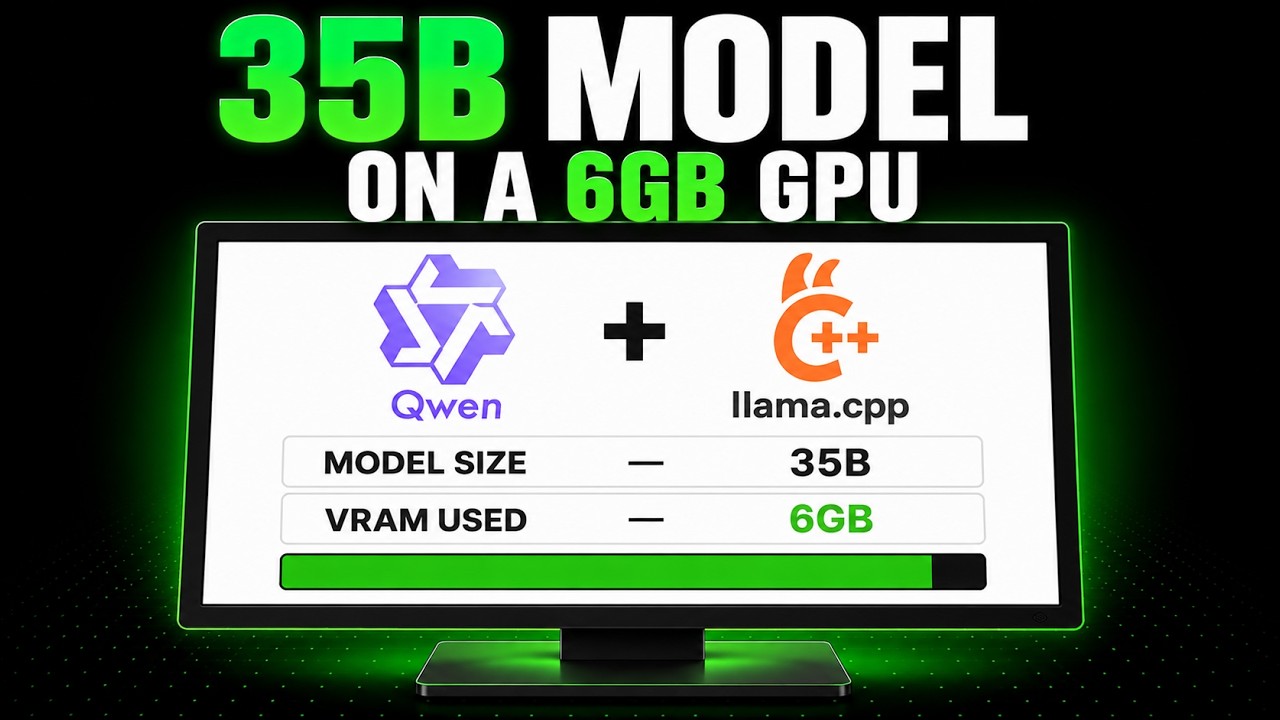
- It achieves 15 tokens per second on high-end GPUs and 39 tokens per second on an 8 GB laptop, close to desktop performance.
- The engine uses a mixture of experts model architecture, activating only about 5% of parameters per token to reduce compute.
- All parameters reside in system memory due to sparse compute but dense memory requirements, with efficient caching strategies.
- Free Token outperforms Llama.cpp in benchmarks, especially in cache miss rates and tail latency, which affects usability.
- Llama.cpp uses a static split heuristic for expert placement, while Free Token uses a dynamic routing-aware cache.
- Benchmarks were done rigorously with bit-identical weights, but third-party independent benchmarks are not yet available.
- The Free Token repository is very new and still addressing issues like older hardware support, multi-GPU, Docker, and Mac OS compatibility.
- The video discusses the importance of tail latency and real-world performance beyond peak throughput numbers.
- Predictions suggest that by 2027, Llama.cpp may adopt routing-aware expert caching inspired by Free Token's innovations.
Chapters
- 00:00Introduction to Free Token and its capabilities
- 01:06Benchmark results and comparison with Llama.cpp
- 02:17Sparse mixture of experts model architecture explained
- 03:23Memory challenges and caching strategies
- 04:22Static vs dynamic routing and cache miss impact
- 05:34Benchmark methodology and limitations
- 06:40Interpreting benchmark charts and real-world performance
- 07:46Current issues and development status of Free Token
- 09:06Real coding agent session analysis and practical considerations
- 10:08Future outlook and potential adoption by 2027
Full Transcript — Download SRT & Markdown
Speaker A
One graphics card, one desk, and a model with 753 billion parameters running on it. There is no cluster behind it, and no rented node in somebody's data center. One workstation card serving all of it. Fifteen tokens a second in the team's own measurements. Slow enough that you notice, fast enough that you would sit and watch it work. The same software puts a 35 billion model on an 8 GB laptop at 39 tokens a second. That paper went up on the archive five days ago. The code behind it had gone public six days earlier. Eleven names are on it. Ion Stoka, Mate Zaharia, Sanghan, people whose earlier work you already use. Stoka co-wrote the paper behind VLLM, the engine underneath a great deal of the inference you pay for. So this is not a weekend project. The crowd who built the cloud serving stack just turned around and aimed it at your desk. The engine is called Free Token. Apache licensed, eleven days old in public, written by two contributors. What it has to beat is Llama.cpp, Gorgi Gurgenoff's engine, three and a half years old, and what you run today.
Speaker A
Free Token wins the benchmark, and it wins it clearly, and the benchmark is not the thing it had to beat. That gap is the whole video. Start with the part that sounds impossible because that part is the clever bit. Seven hundred fifty-three billion parameters do not fit in 96 GB of card memory. That is not a near miss. Even quantized down to 4 bits, the weights on disk come to 433 GB. You are off by a factor of four and a half before you start.
Speaker A
They fit because of how the model is built. It is a mixture of experts, and the word doing the work in that phrase is mixture. Instead of one enormous feed-forward layer, each layer holds hundreds of small ones, and a router picks a handful per token. Deepseek's V4 Flash has 256 of them in each of its 43 layers. I did not take that from a blog post. It is in the model's own configuration file, which anyone can open in about 10 seconds. For any single token, six of those 256 fire, six. The other 250 sit there doing nothing. And then the next token arrives, and the router picks six again, possibly a completely different six. So of 284 billion parameters, roughly 13 billion do the work for any given token. Under 5% of the model is awake at once. That is why a desktop is in this conversation at all. But sparse compute is not sparse memory. All 284 billion parameters still have to exist somewhere you can reach in a couple of milliseconds because you cannot know which six the next token wants. So they live in your system memory, and the card holds whichever ones it can. Every time a token routes to an expert that is not already on the card, that expert has to cross the bus or be computed where it sits. That crossing is the entire game. Every design decision in either engine is a different answer to one question. What do you do in the microcode after a token asks for an expert you do not have? Llama.cpp has an answer, and it has had one for a long time. You can tell it to keep the expert weights on the processor instead of the card, and it will run them there rather than shipping them back and forth. The flag is minus n minus cpu minus, and the documentation for it is one line long, which is unusual because that one line is also the entire strategy. Keep the mixture of experts weights of the first end layers on the processor. The first end layers—that phrasing does all the work here, and it is the easiest thing in the sentence to skim past. It is a split by layer number, and you pick the number before the model has seen a single token. You pick it, the split is fixed, and it stays fixed for the entire run, which would be fine if routing were fixed. Routing is not fixed. Routing changes token by token, and the model decides it at runtime long after you picked your number. A split by layer index cannot see any of that. It is not a bad heuristic. It is a fast, predictable, sensible heuristic. It is simply blind to the one signal that decides everything. Free Token's paper measures what that blindness costs, and it measures it the fair way by replaying identical routing traces through all three engines' placement policies at the same cache size. Same traces, same memory, different policy at the memory a 5090 can spare. Free Token's cache misses 16% of expert reads. The static split misses 62. That is a 46-point gap.
Speaker A
Near enough four times the miss rate. And a miss is not a rounding error. A miss is the bus every single time. Which raises the question I want you holding for the rest of this. If the fix is that legible, why has Llama.cpp not simply done it? A clever mechanism that does not show up in the numbers is just a nice paragraph. This one shows up. Then we come back to that question. On a 5090 serving Quen 35B, the paper reports 77 to 83 tokens a second. That is between 1.88 and 2.3 times the strongest engine it tested against, depending on the workload. On Deepseek V4 Flash, 22 to 25 tokens a second, 1.5 to 1.9 times. And on the workstation card running GLM, 5.2 to 14.9 tokens a second against Llama.cpp's 7.3. The one I keep coming back to is the laptop. Eight GB of card memory, a half-width bus, 39.3 tokens a second, which the paper puts at 92% of what a desktop 4090 manages. That is the machine most people actually own. Now, the caveat, and I would rather say it plainly than bury it in a corner of the frame. Every one of those numbers was produced by the people who wrote the engine. That is normal for a systems paper. It is still not independent. To their credit, they did the rigorous version. Every engine served bit-identical weights, which is the step most comparisons skip without saying so, and it is the difference between a benchmark and an advertisement. But on the day I wrote this, I could not find a single third-party benchmark of Free Token anywhere.
Speaker A
And the result I would make a decision on is the tail, not throughput. Not how fast it goes when it goes well, but how slow it gets when it goes badly. Free Token's worst single turn stays under 44 seconds. The paper reports Llama.cpp CPP crossing 232 seconds somewhere. Alama 179 and K Transformers 946, almost 16 minutes on one turn. And the paper's point about that is sharper than a speed comparison. OpenClaw ships a 2-minute idle watchdog. A turn that takes 232 seconds does not run slowly. It gets killed. Tail latency is not a latency statistic there. It is whether the software works. So the case is strong, which is exactly when you should look harder. And there is a crack in how it is presented worth seeing because it is the kind of thing that decides whether you trust the rest of the chart. Across its headline figure, the paper draws a dashed line marking what a cloud coding agent actually delivers measured from real production traces. Thirty-three tokens a second against bars at 77 and above—that reads like a route. So I went and read the trace paper it cites. Thirty-three point nine is its normalized decode speed. And by that paper's own definition, the figure includes time to first token and all the reasoning in between. It is an end-to-end number. The same paper's pure decode median for OpenAI's Codex is 61.3. That is the figure that belongs next to a decode throughput bar because that is the same measurement. Put those two side by side, and the like-for-like ratio is about 1.3, not 2.4. Still a win, a much smaller one than the chart implies. Both figures sit in the source correctly cited. So, this is not deception, but a comparison is only as good as its denominator. And this one changes the size of the claim by nearly half. None of which would matter much if you could just install it tonight. So, look at what the repository looked like in the 24 hours after that launch post went up. Eight issues. Please support older hardware, 1080 and 2080 series. Support for dual GPU. Docker support. GGUF support. The engine install fails on Windows. And the one with the most comments on it: Feature request, Mac OS, Apple Silicon support. Those eight requests are things Llama.cpp already ships. Seventeen hardware backends, Apple...
Speaker A
Free token wins the benchmark and it wins it clearly and the benchmark is not the thing it had to beat. That gap is the whole video. Start with the part that sounds impossible because that part is the clever bit. 753 billion
Speaker A
parameters do not fit in 96 GB of card memory. That is not a near miss. Even quantized down to 4 bits, the weights on disc come to 433 GB. You are off by a factor of 4 and a half before you start.
Speaker A
They fit because of how the model is built. It is a mixture of experts and the word doing the work in that phrase is mixture. Instead of one enormous feed forward layer, each layer holds hundreds of small ones and a router picks a
Speaker A
handful per token. Deepseek's V4 flash has 256 of them in each of its 43 layers. I did not take that from a blog post. It is in the model's own configuration file, which anyone can open in about 10 seconds. For any single
Speaker A
token, six of those 256 fire, six. The other 25 sit there doing nothing. And then the next token arrives and the router picks six again, possibly a completely different six. So of 284 billion parameters, roughly 13 billion do the work for any given token. Under
Speaker A
5% of the model is awake at once. That is why a desktop is in this conversation at all. But sparse compute is not sparse memory. All 284 billion parameters still have to exist somewhere you can reach in a couple of milliseconds because you
Speaker A
cannot know which six the next token wants. So they live in your system memory and the card holds whichever ones it can. Every time a token routes to an expert that is not already on the card, that expert has to cross the bus or be
Speaker A
computed where it sits. That crossing is the entire game. Every design decision in either engine is a different answer to one question. What do you do in the microcond after a token asks for an expert you do not have? Llama.cpp has an
Speaker A
answer and it has had one for a long time. You can tell it to keep the expert weights on the processor instead of the card and it will run them there rather than shipping them back and forth. The
Speaker A
flag is minus n minus cpu minus and the documentation for it is one line long which is unusual because that one line is also the entire strategy. Keep the mixture of experts weights of the first end layers on the processor. The first
Speaker A
end layers that phrasing does all the work here and it is the easiest thing in the sentence to skim past. It is a split by layer number and you pick the number before the model has seen a single
Speaker A
token. You pick it, the split is fixed and it stays fixed for the entire run, which would be fine if routing were fixed. Routing is not fixed. Routing changes token by token and the model decides it at runtime long after you
Speaker A
picked your number. A split by layer index cannot see any of that. It is not a bad heristic. It is a fast, predictable, sensible heristic. It is simply blind to the one signal that decides everything. Free Tokens paper
Speaker A
measures what that blindness costs and it measures it the fair way by replaying identical routing traces through all three engines placement policies at the same cache size. Same traces, same memory, different policy at the memory of 5090 can spare. Free tokens cache
Speaker A
misses 16% of expert reads. The static split misses 62. That is a 46 point gap.
Speaker A
Near enough four times the miss rate. And a miss is not a rounding error. A miss is the bus every single time. Which raises the question I want you holding for the rest of this. If the fix is that
Speaker A
legible, why has llama.cpp not simply done it? A clever mechanism that does not show up in the numbers is just a nice paragraph. This one shows up. Then we come back to that question. On a 5090 serving Quen 35B, the paper reports 77
Speaker A
to 83 tokens a second. That is between 1.8 8 and 2.3 times the strongest engine it tested against depending on the workload. On Deepseek V4 Flash, 22 to 25 tokens a second, 1.5 to 1.9 times. And on the workstation card running GLM,
Speaker A
5.2, 14.9 tokens a second against llama.cpps 7.3. The one I keep coming back to is the laptop. 8 GB of card memory, a half width bus, 39.3 tokens a second, which the paper puts at 92% of what a desktop
Speaker A
4090 manages. That is the machine most people actually own. Now, the caveat, and I would rather say it plainly than bury it in a corner of the frame. Every one of those numbers was produced by the people who wrote the engine. That is
Speaker A
normal for a systems paper. It is still not independent. To their credit, they did the rigorous version. Every engine served bit identical weights which is the step most comparisons skip without saying so and it is the difference between a benchmark and an
Speaker A
advertisement. But on the day I wrote this, I could not find a single third party benchmark of free token anywhere.
Speaker A
And the result I would make a decision on is the tail, not throughput. Not how fast it goes when it goes well, but how slow it gets when it goes badly. Free Token's worst single turn stays under 44
Speaker A
seconds. The paper reports llama.cpp CPP crossing 232 seconds somewhere. Alama 179 and K Transformers 946 almost 16 minutes on one turn. And the papers point about that is sharper than a speed comparison. Open claw ships a 2minute idle watchdog. A turn that takes
Speaker A
232 seconds does not run slowly. It gets killed. Tail latency is not a latency statistic there. It is whether the software works. So the case is strong, which is exactly when you should look harder. And there is a crack in how it
Speaker A
is presented worth seeing because it is the kind of thing that decides whether you trust the rest of the chart. Across its headline figure, the paper draws a dashed line marking what a cloud coding agent actually delivers measured from
Speaker A
real production traces. 33 tokens a second against bars at 77 and above that reads like a route. So I went and read the trace paper it cites. 33.9 is its normalized decode speed. And by that paper's own definition, the figure
Speaker A
includes time to first token and all the reasoning in between. It is an endto-end number. The same paper's pure decode median for OpenAI's codeex is 61.3. That is the figure that belongs next to a decode throughput bar because that is
Speaker A
the same measurement. Put those two side by side and the like forl like ratio is about 1.3, not 2.4. Still a win, a much smaller one than the chart implies. Both figures sit in the source correctly cited. So, this is not deception, but a
Speaker A
comparison is only as good as its denominator. And this one changes the size of the claim by nearly half. None of which would matter much if you could just install it tonight. So, look at what the repository looked like in the
Speaker A
24 hours after that launch post went up. Eight issues. Please support older hardware 1080 and 2080 series. Support for dual GPU Docker support. GGUF support. The engine install fails on Windows. and the one with the most comments on it. Feature request, Mac OS,
Speaker A
Apple silicon support. Those eight requests are things llama.cpp already ships 17 hardware backends, Apple's metal, AMD, Vulcan, even a Snapdragon phone. Quantization from 1 and a half bits up to 8. Apple silicon described in its own readme as a first class citizen.
Speaker A
Free token's own packaging says the same thing with no spin at all. Its published classifiers read development status beta environment Nvidia CUDA operating system Pix Linux. That is the supported world written by the people who built it.
Speaker A
There is no Mac build, not a slow one, not a fallback. The download pages own platform list offers Windows, Abuntu, Arch, and an app image and hands a Mac visitor nothing at all. Two contributors, 30 commits of public
Speaker A
history, 408 stars on the day I checked against llama.cpp's CPP's 446 contributors and 25,000 downloads of one nightly build in its first day, which leaves the argument that will get repeated most, the one in the launch post itself. Run your coding agent
Speaker A
against a Frontier model for $0. So, I priced it from a real trace rather than a VIP. Researchers released 4,200 real coding agent sessions. The median step reads about 119,000 tokens of context and writes 214. They measured what that
Speaker A
step cost them. 11 cents on Anthropics Claude or OpenAI's codeex. The same step on DeepS's own published price list for the exact model free token demonstrates costs somewhere between a tenth of a cent and 5 cents depending on caching
Speaker A
and the hour of the day. The model you would buy a graphics card to run at home is also the cheapest thing on the menu.
Speaker A
And the card is not free. One tracked 5090 listing sat above $4,000 all through July against a $2,000 list price. $4,000 buys about 500 median agent sessions at Claude prices and somewhere between a,000 and 40,000 at Deep Seeks prices. The invoice was never
Speaker A
the argument, which means the argument has to be something else. And it is. Nothing you type leaves the room.
Speaker A
Nothing rate limits you at the worst possible moment. Your model does not get deprecated out from under you 6 months into a project built on it. None of that shows up on an invoice and all of it is
Speaker A
real. So, which one runs local AI better? Llama.cpp for most people watching this and it is not close because the first thing an engine has to do is run on the hardware you already own. And that is the one
Speaker A
benchmark nobody plots. But free token wins outright for one specific person. And if that is you, it is not a marginal win. You own a recent Nvidia card. You have plenty of system memory. You run mixture of experts models. and you point
Speaker A
a coding agent at them all day. For that person, 44 seconds against 232 is not a percentage on a chart. It is the difference between an agent that finishes the task and one that gets killed halfway through. And I would
Speaker A
install it today at twice the setup pain for that alone. The title says everyone will be using this in 2027. I do not think that is how this ends. So here is the version I will be judged on. By the
Speaker A
end of 2027, llama.cpp CPP will have merged a routing aware expert cache and a measured split between the bus and the processor. Free Tokens ideas running inside the engine you already have. I lose that bet if free tooken ships Apple
Speaker A
silicon and passes 10,000 stars first. Their own paper names the precedent. Fiddler proposed treating a missed expert as work rather than data. K Transformers made that fast. Neither is a household name and both of those ideas are table stakes today. Which is the
Speaker A
part I keep turning over. If the winning move in open source is always to fold the good new idea back into the old engine, what is left for anyone who writes a new one?
Topics:Free Tokenlocal AI enginemixture of expertslarge language modelsLlama.cppGPU inferenceAI benchmarkstail latencymodel cachingAI 2027