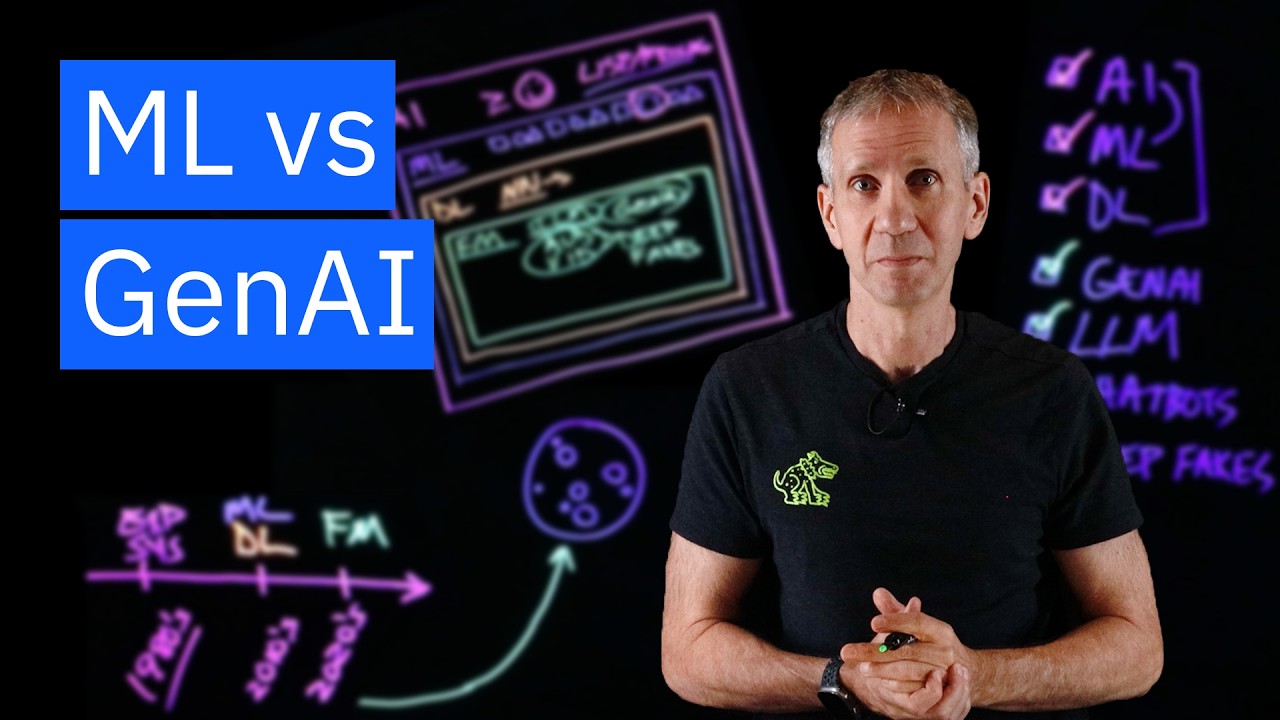
A clear 12-minute explanation of machine learning, its core components, and how it powers AI using data, algorithms, models, and training.
Key Takeaways
- Machine learning enables computers to learn and improve from data without explicit instructions.
- High-quality data is more important than sheer quantity for effective machine learning.
- Algorithms act as the learning mechanism, tuning parameters to reduce prediction errors.
- Models represent learned knowledge and vary in complexity depending on the task.
- Training and evaluation are essential to develop and validate a reliable machine learning model.
Summary
- Machine learning teaches computers to learn from data and experience without explicit programming.
- It is a subset of artificial intelligence (AI), which broadly covers systems performing human-like tasks.
- Deep learning is a further subset of machine learning using neural networks to learn complex patterns.
- Four key components of machine learning systems are data, algorithms, models, and training/evaluation.
- Quality data is crucial and must be accurate, relevant, and clean to ensure effective learning.
- Algorithms process data to extract patterns and iteratively adjust parameters to improve predictions.
- The model is the output of the learning process, representing a mathematical function for predictions or classifications.
- Training involves exposing the model to data to learn and reduce errors, while evaluation tests its performance.
- Data is divided into training, validation, and test sets to optimize and assess the model.
- Loss functions and optimization methods like gradient descent guide the model to improve accuracy.