Speaker A
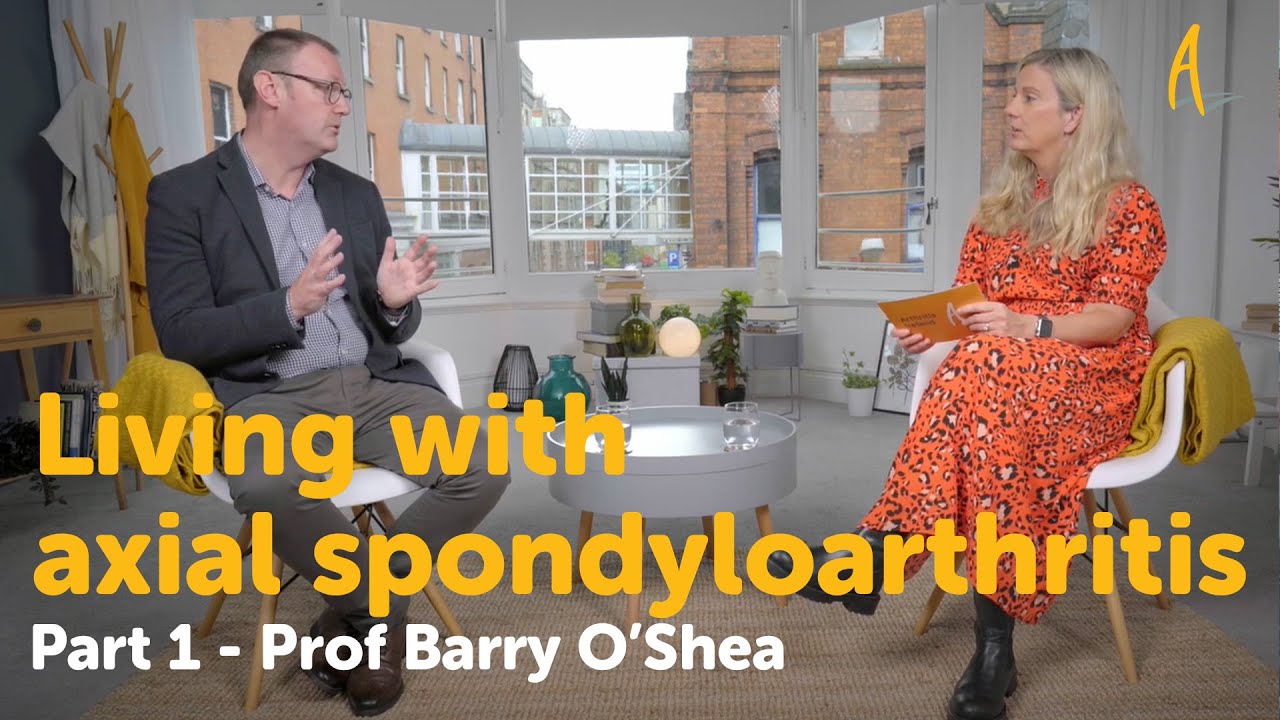
Hi guys, my name is Kami and I'm a doctor of physical therapy. In this video, we are talking about exercises we can do to help with a condition called ankylosing spondylosis. So if you already landed on this video, it means that you've probably been diagnosed by your doctor with this condition. I'm only going to give you a quick overview of what the condition is, and then we're going to jump into the exercises. I'll make sure to put the minutes to that on the side of this video. And as always, make sure to read the indications, contraindications, and red flags before you do any of these exercises. And don't forget to subscribe to our channel. This condition is a systemic inflammatory issue that hits especially our spine, our SI joint, or pelvis. And what ends up happening is that the inflammation in the joints eventually causes the joints to fuse together. And that means that eventually you have that, you know, bent forward posture. The range of motion is lost in our upper back, on our neck, and our lower back, in our pelvis. And the biggest problem we'll end up having aside from lower back pain is going to be with breathing, right? Because if you imagine your ribs are kind of attached to your spine, and if your spine is stuck, their ribs are stuck. Then you can't really open and close your chest as you're breathing. Now, this is a progressive condition, meaning that we can't really cure this problem with exercises, but we can definitely try to improve or maintain the range of motion that we currently have at whatever stage we're on, and we can slow down the progress of that loss of function. Okay, so you have to make sure that you try to incorporate, and if not all, some of these exercises into your daily routine. I promise they'll be super simple ones. So as I mentioned, the first thing we want to do is to be able to maintain that range of motion, especially with extension. That is the movement that helps us stay up tall. And so what I want you to do is go ahead, lie on your mat. We are going to go into an extension, so all you're doing here is propping up on your elbows. Your glutes are super relaxed. Squeeze your shoulder blades back and look forward. So you want to try to maintain this posture throughout the day for at least 10 to 15 minutes. And you know, you can maybe even start playing video games so you can stay like this or watching TV in this position. And again, you can hold this posture for between 5 to 15 minutes. The second movement I want you to incorporate is a press-up. And so again, I'm relaxing my glutes, so shake your bum left to right. Make sure your glutes are super relaxed. Hands are a little more forward than where if I were to do an actual push-up, so my hands are a little more forward. I'm taking inhale. As I exhale, come all the way up. Now here, squeeze your shoulder blades back and down. Look forward. Relax that bum. Feel that nice extension in your lower back. So feel super tight. That's okay. We're just going to hold it and exhale. Relax your belly and come all the way back there. So these ones can repeat 10 of them. We'll relax your bum, relax the belly, calm down. So inhale up. As you exhale, relax the belly, let those muscles go. So the gravity will even create more of a curve in your lower back. Look up and back down. So from this position, now we are going to go up into a quadrupedal. So again, that's going on all fours. Make sure that your wrist is right underneath your shoulder. Your knee is right underneath your hips, so you're not here. Okay? And all we are going to do is to do a couple of cat and cows. Okay? Supporting those of you who don't know what that is, that's just when we curve all the way down and then look all the way up. Okay, so let's do a couple of those. And this is to kind of warm up your spine. After you do like, let's say, three, four, we are going to now do segmental cat and cows. That means that we are going to think about where our spine sits. So that says your lumbar spine, your lower back, your upper back is your thoracic spine, your neck is your cervical spine. We are going to move our lumbar spine first, then thoracic spine, then cervical, and then back down. So it won't be like what I did at the beginning when you move the whole spine at the same time. So let's go to that neutral spine first. Then you're going to hurt your lower back all the way down. Okay, so I'm all the way down. Then I'm going to move to my upper back here. I want to squeeze my shoulder blades together, drop my chest all the way down. Lastly, I'm going to bring my neck all the way up. Then we are going to do exactly the opposite of this. So first bring your neck all the way down, then push your body up, carve your upper back. But you guys look at my elbows. I'm not cheating. I'm not bending my elbows. Elbows are straight. I push into the mat, create that curve in my upper back, and then I create that curve in my lower back. And you can repeat this. So press my lower back one vertebrae at a time, then my upper back, then I slowly bring my neck up and reverse. Neck all the way down, the thoracic spine up, then I'm bringing my lumbar spine in. Okay, and you can repeat this exercise about ten times. From there, we are going to turn around, lie on our back. The first movement is going to be rotation. So far, we've done the extension movements. Now we are going to incorporate some rotation. Now you might tell me that you don't have that range of motion to go all the way down. That's okay. You guys just go as far as you can. Back to center, then to the other side. You can either do this ten times going side to side, or you can just drop your knees to one side, hold. But you want to make sure that your shoulders are glued to the mat. You come up, go to the other side, hold again. You can hold between five to ten seconds. Repeat it five to ten times on each side. Then after our rotations, we are going to move into our flexion movement. So have one leg out, bring the other knee all the way up towards your chest. You can either hold on top or go underneath and pull that knee up towards your chest. So this is a great glute stretch. That's the muscle right here, but also it's stretching your lower back. It's creating that arch in your lower spine. You can hold this for 30 seconds, then switch to the other side. Again, hold 30 seconds. I would like to do these about three times if I'm holding them for thirty seconds. And the last one is a double knee to chest. So again, bring both knees to your chest. Again, hold on top or underneath. You can always interlock your fingers, bring your knees apart, pull your knees with your biceps into your chest, and you can even go side to side. So this is an amazing flexion stretch. You're still stretching your glutes too and giving your lower back a massage. Again, you hold this 30 seconds, repeat 3 times. The next exercise will be a posterior pelvic tilt. Take your hands, put it right on your pelvis, so the two bones we have on either side. Grip those two bones. You want to rotate your lower back, so your lower back tucks in. Okay, from here I'm going to go down one, two, three, four, five, relax. One, two, three, four, five, relax. Again, two, three, four, five, relax. So every time I'm rotating, I'm pushing my lower back into the mat, holding that spot for about five seconds, relaxing it. Can you repeat this exercise three sets of ten? Now we are going to add our bridge to our posterior pelvic tilt. So what I'm wanting to do is first of all make sure that your feet are close to your bum. Feet are hip-width apart. Knees are hip-width apart. You're creating that tilt first, so I'm tilting my lower back into the mat first. Squeeze your glutes, lift up. Two, three, four, five, and down. And then you guys just like the posterior pelvic tilt, so you're going to repeat this three sets of ten. This is again a great extension exercise, creating that mobility in your lower spine. The next two exercises we're going to do on the mat are going to help us open up our chest. So I'm going to be using a roller for this exercise. And now the size of the roller doesn't really matter. You guys pick whatever you're comfortable with. If you don't have a ro-