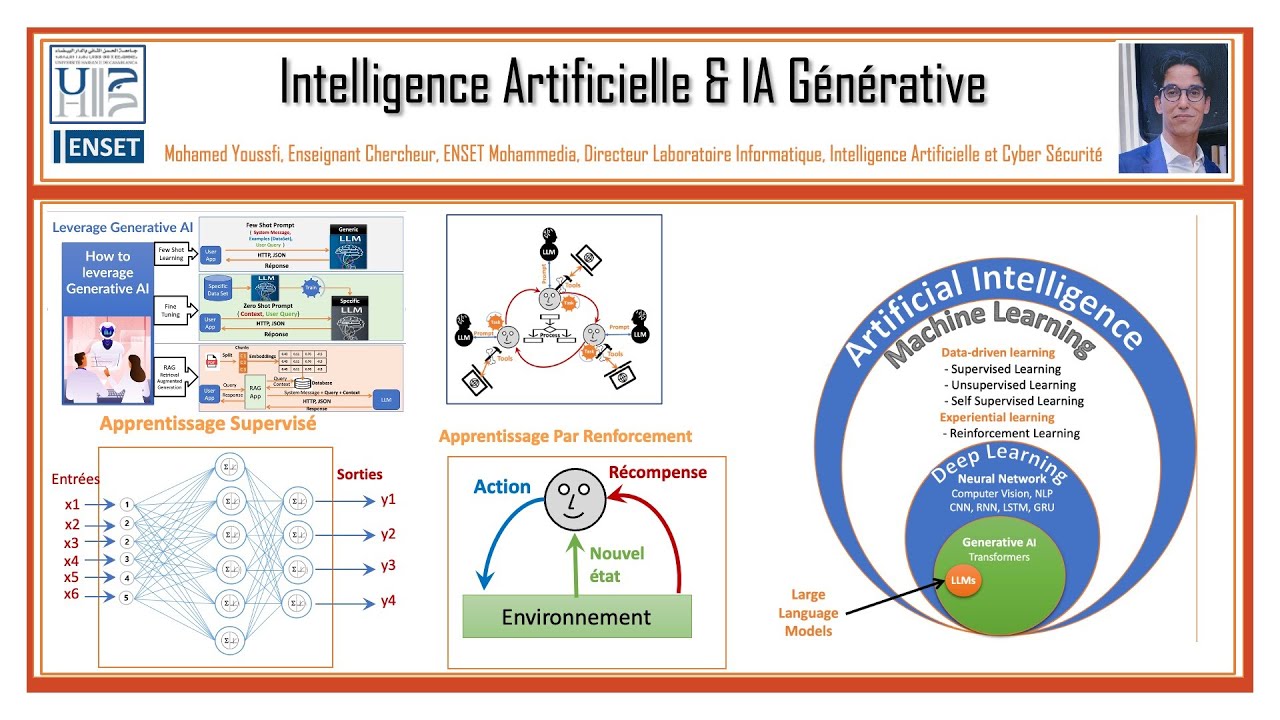
What is Artificial Intelligence? | Quick Learner — Transcript

An introduction to artificial intelligence, explaining its capabilities, limitations, and real-world applications beyond science fiction.

Key Takeaways

  • AI mimics certain human cognitive functions but remains specialized and limited in scope.
  • Data is crucial for AI to learn and make decisions.
  • AI is prevalent in everyday technology but has not reached human-level general intelligence.
  • Human intelligence remains superior in flexibility and adaptability compared to AI.
  • AI achievements like AlphaGo demonstrate strengths in specific domains but not general tasks.

Summary

  • Artificial intelligence (AI) involves using computers to perform tasks that typically require human intelligence.
  • Humans process visual information, understand environments, recognize patterns, and comprehend spoken language.
  • AI is a broad field within computer science encompassing many related terms and technologies.
  • Large data sets are essential for AI algorithms to identify patterns, make predictions, and recommend actions.
  • AI is already integrated into many aspects of daily life.
  • Current AI systems, despite massive computing power, cannot match the versatility of the human brain.
  • Example: AlphaGo defeated a professional Go player but cannot perform unrelated tasks like driving or playing Monopoly.
  • Human brains can handle a wider variety of data types and problem-solving methods than AI today.

Full Transcript — Download SRT & Markdown

00:00
Speaker A
Quick learner: What is AI?
00:05
Speaker A
When you hear the term artificial intelligence, what comes to mind?
00:09
Speaker A
Superpowered robots, hyperintelligent devices?
00:14
Speaker A
Science fiction has familiarized the world with the concept.
00:18
Speaker A
But outside of Hollywood, what is artificial intelligence and what can AI actually do?
00:23
Speaker A
For starters, AI involves using computers to do things that usually require human intelligence.
00:30
Speaker A
Humans can see with their eyes and process what they see.
00:34
Speaker A
We can understand our environments and move around within them.
00:37
Speaker A
Our brains have the ability to see patterns.
00:41
Speaker A
And we have the ability to understand spoken language.
00:44
Speaker A
Artificial intelligence is a broad branch of computer science that includes many different terms.
00:50
Speaker A
In order for computers to achieve these capabilities, they require lots and lots of data.
00:55
Speaker A
Large data sets allow AI algorithms to identify patterns, make predictions, and recommend actions.
01:03
Speaker A
Artificial intelligence is already all around us.
01:06
Speaker A
But today's best AI still can't compete with the human brain in some ways.
01:10
Speaker A
For example, in 2016, the computer program AlphaGo defeated a legendary professional Go player.
01:17
Speaker A
But if you asked that same computer to drive a car or walk or even play Monopoly,
01:23
Speaker A
it wouldn't be able to do so on its own.
01:26
Speaker A
AI's computing power is massive, but our human brains are able to tackle a much wider set of data and methods.
Topics:artificial intelligenceAImachine learningdata scienceAlphaGohuman intelligencecomputer sciencepattern recognitionAI limitationstechnology

Frequently Asked Questions

What is artificial intelligence according to this video?

Artificial intelligence is the use of computers to perform tasks that usually require human intelligence, such as pattern recognition, understanding language, and making predictions based on data.

Why does AI need large data sets?

AI requires large data sets because they enable algorithms to identify patterns, make predictions, and recommend actions effectively.

Can AI perform all tasks that humans can?

No, while AI can excel in specific tasks like playing Go, it cannot perform a wide range of tasks such as driving a car or playing Monopoly without human intervention.

Get More with the Söz AI App

Transcribe recordings, audio files, and YouTube videos — with AI summaries, speaker detection, and unlimited transcriptions.

Or transcribe another YouTube video here →