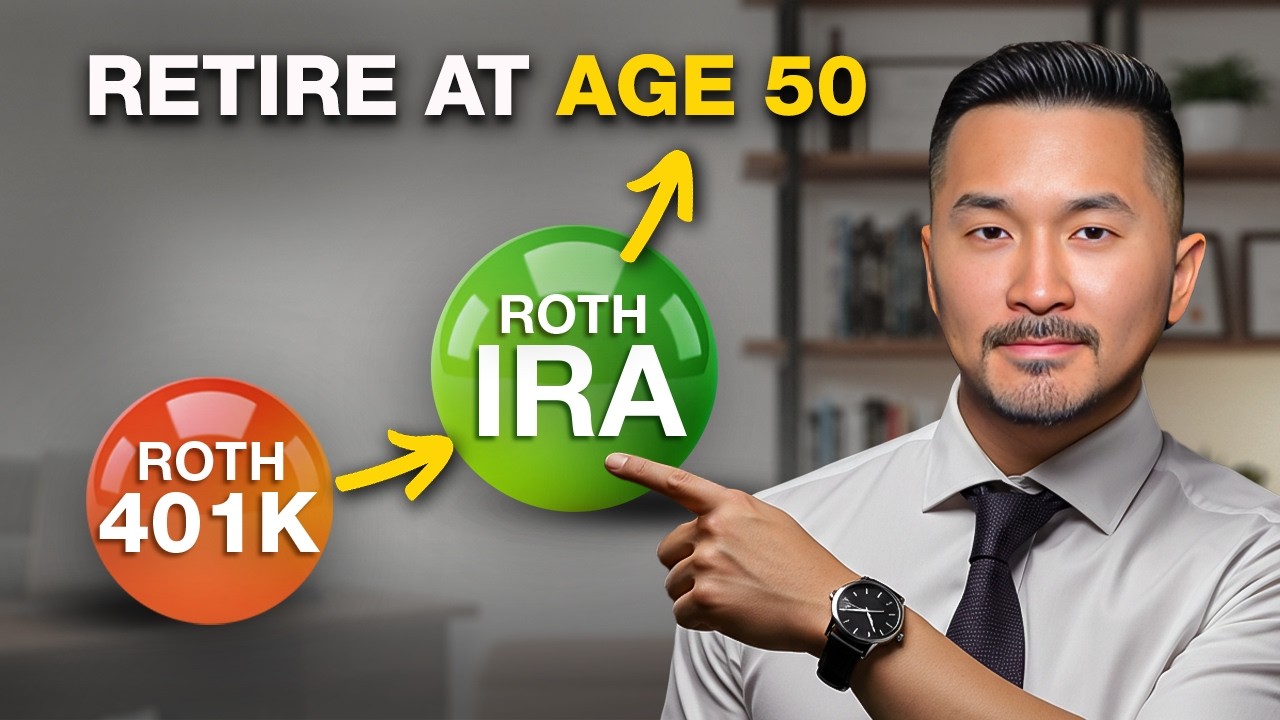
Mega Backdoor Roth vs Regular 401K | The $276,000 Diffe… — Transcript

Explore the Mega Backdoor Roth strategy to save up to $47,500 extra for retirement beyond standard 401k limits in 2026.

Key Takeaways

  • Mega Backdoor Roth enables significant additional retirement savings beyond standard limits.
  • Not all 401k plans support the necessary features, limiting accessibility.
  • Conversion of after-tax contributions to Roth is essential to maximize tax benefits.
  • It is distinct from the regular backdoor Roth IRA and designed for higher contribution amounts.
  • Understanding the three tax buckets in 401k plans is crucial to implementing this strategy.

Summary

  • Mega Backdoor Roth allows high earners to contribute up to $47,500 in after-tax dollars to a Roth account in 2026.
  • This strategy is for those who have already maxed out their standard 401k and IRA contributions.
  • It requires 401k plans to offer non-Roth after-tax contributions and either in-service withdrawals or in-plan Roth conversions.
  • Many plans do not offer this due to administrative complexity and IRS non-discrimination testing requirements.
  • The Mega Backdoor Roth differs significantly from the regular backdoor Roth IRA, which has lower contribution limits.
  • There are three tax buckets in 401k plans: traditional pre-tax, Roth after-tax, and after-tax 401k contributions.
  • After-tax 401k contributions can be converted to Roth 401k or rolled over to a Roth IRA to avoid taxation on earnings.
  • Without conversion, after-tax 401k earnings are taxed as ordinary income upon withdrawal.
  • The total 401k contribution limit in 2026 is $72,000, including employee and employer contributions.
  • This strategy is a powerful way for high-income earners to save additional tax-free money for retirement.

Full Transcript — Download SRT & Markdown

00:00
Speaker A
If you're making good money and you've already maxed out your 401k, and you're sitting there thinking there's got to be a way to save even more for retirement without the IRS taking a big bite out of it later, well, there is. It's called a mega backdoor Roth. And in 2026, you could potentially contribute up to $47,500 in additional after-tax dollars into a Roth account. Now, before you close this video thinking, "This sounds way too complicated," let me break this down in
00:14
Speaker A
mega factor Roth. And in 2026, you could potentially contribute up to 47,500 in additional after tax dollars into a Roth account. Now, before you close this video thinking, "This sounds way too complicated." Let me break this down in
00:28
Speaker A
a way that actually makes sense because this strategy could be one of the most powerful retirement moves you make this year. And I did this strategy for three straight years when I worked for a private sector company many years ago.
00:41
Speaker A
And my Roth 401k and Roth IRA balances jumped significantly using both inservice withdrawals and in plan rollovers. Let me explain how this works. So you might be wondering why this strategy is a lot less common. And the truth is it's a major headache for
00:57
Speaker A
And my Roth 401k and Roth IRA balances jumped significantly using both in-service withdrawals and in-plan rollovers. Let me explain how this works. So you might be wondering why this strategy is a lot less common. And the truth is it's a major headache for
01:02
Speaker A
First, many 401k plans do not offer the mega backdoor Roth because the plan has to allow two specific features, non-roth after tax contributions and either inservice withdrawals or inplane Roth conversions. And I'll get into those later on in this video. Even when
01:21
Speaker A
the people in HR, and that's why you do not see it in every company handbook. First, many 401k plans do not offer the mega backdoor Roth because the plan has to allow two specific features: non-Roth after-tax contributions and either in-service withdrawals or in-plan Roth conversions. And I'll get into those later on in this video. Even when
01:40
Speaker A
And because only high income earners typically have the extra cash flow to contribute large after tax amounts, many 401k plans fail these test a lot of times. When that happens, employers have to refund contributions to high income earners or modify the 401k plan and
01:58
Speaker A
technically possible, employers still avoid it due to compliance risk. After-tax contributions are subject to IRS ACP non-discrimination testing, which makes sure that highly compensated employees are not receiving disproportionate tax benefits compared to average workers.
02:16
Speaker A
not confuse this mega strategy with a standard backdoor Roth IRA. And I know the naming convention is about as creative as a tax form, but they are completely different animals. The regular backdoor Roth IRA is just a smaller scale workaround for when you
02:33
Speaker A
And because only high-income earners typically have the extra cash flow to contribute large after-tax amounts, many 401k plans fail these tests a lot of times. When that happens, employers have to refund contributions to high-income earners or modify the 401k plan, and
02:47
Speaker A
Roth IRA, right? As for the mega backdoor Roth, this is a highlevel retirement strategy designed for individuals who have already maxed out their standard 401k and IRA contributions but still have a significant amount of disposable income to save. It allows eligible high earners
03:06
Speaker A
that's going to create additional administrative burden and potential employee dissatisfaction. And that's why many companies just simply choose not to offer the feature at all. Now, before you automatically connect this to something you've heard before, let's draw a clean line here. All right, let's
03:23
Speaker A
contribute nonroth after tax money into your 401k after you have reached your normal employee 401k contribution limit of $24,500 and still have remaining contribution space under the total 401k annual limit, which is actually $72,000.
03:40
Speaker A
not confuse this mega strategy with a standard backdoor Roth IRA. And I know the naming convention is about as creative as a tax form, but they are completely different animals. The regular backdoor Roth IRA is just a smaller scale workaround for when you
03:58
Speaker A
three different tax buckets. Bucket number one is a traditional 401k that you put pre-tax money in and then it grows tax deferred and you'll pay taxes later when you start taking distributions. And bucket number two is a Roth 401k. You contribute after tax
04:14
Speaker A
earn too much to put money directly into a Roth IRA, and it caps you at a relatively modest $8,600 for the 2026 tax year if you're 50 or older and $7,500 if you're younger than 50. So this is a
04:22
Speaker A
Bucket number three is an after tax 401k which is not the same as a Roth 401k. In this bucket or the third bucket, contributions go in after taxes, but the earnings are still taxable as ordinary income when you withdraw them or convert
04:39
Speaker A
Roth IRA, right? As for the mega backdoor Roth, this is a high-level retirement strategy designed for individuals who have already maxed out their standard 401k and IRA contributions but still have a significant amount of disposable income to save. It allows eligible high earners
04:55
Speaker A
a transient account or a temporary bus stop. And remember, without the conversion step, the after tax 401k is actually the least tax efficient 401k option. So, let's break them all down.
05:08
Speaker A
who might otherwise be barred from direct Roth IRA contributions due to income limits to move up to an additional $47,500 into a tax-free Roth account for the 2026 tax year. The mega backdoor Roth works in two steps. First, you
05:13
Speaker A
Now, when you put money here, it lowers your taxable income for the year. In 2026, you can stash up to 24,500 in this bucket. However, if you're over the age of 50 and you made over $150,000 in 2025
05:29
Speaker A
contribute non-Roth after-tax money into your 401k after you have reached your normal employee 401k contribution limit of $24,500 and still have remaining contribution space under the total 401k annual limit, which is actually $72,000.
05:49
Speaker A
catch-up dollars will not lower your current tax bill. Instead, they'll go straight into your tax-free Roth bucket for the future. For bucket number two, there's the Roth 401k. Think of it as the mirror image of the pre-tax one. And
06:02
Speaker A
This is the money you have already paid income tax on. And second, if your plan allows it, you either perform an in-plan Roth conversion by moving it into a Roth 401k or an in-service rollover to a Roth IRA. It helps to think of a 401k as
06:14
Speaker A
cent when you turn 59 and a half and satisfy the 5-year rule. It shares the same 24,500 annual limit as the pre-tax bucket for 2026, but you cannot contribute 24,500 in a traditional and another 24,500 to a Roth. Instead, you
06:33
Speaker A
three different tax buckets. Bucket number one is a traditional 401k that you put pre-tax money in, and then it grows tax deferred, and you'll pay taxes later when you start taking distributions. And bucket number two is a Roth 401k. You contribute after-tax
06:50
Speaker A
for those two buckets is $24,500. And if you're age 50 or older, again, you can add an additional $8,000 in contributions, bringing your total to 32,500. If you're age 60 to 63, you'll get a higher catch up limit of $11,250
07:09
Speaker A
money. That money grows tax-free, and if the withdrawal is qualified, the money and its growth comes out tax-free.
07:23
Speaker A
video. For bucket number three, there's the after tax 401k. And this is the secret sauce bucket that makes the mega back to Roth strategy possible. And like the Roth, you contribute money that has already been taxed. However, unlike a
07:37
Speaker A
Bucket number three is an after-tax 401k, which is not the same as a Roth 401k. In this bucket, or the third bucket, contributions go in after taxes, but the earnings are still taxable as ordinary income when you withdraw them or convert
07:54
Speaker A
tax deferred and are taxed as ordinary income if withdrawn or converted. If you simply just leave the money here long-term, the IRS will eventually tax the gains. That's why this account is best viewed as a temporary holding place. You contribute to this bucket
08:12
Speaker A
them. That's why the strategy requires converting the money very quickly. The after-tax account is only a temporary holding place to move large amounts into a Roth account where future growth is tax-free. So, think of this bucket like
08:28
Speaker A
going forward. Finally, we have bucket number four, the employer contribution. And this is where your employers matching or profit sharing contributions go. While some plans are beginning to allow Roth style employer matches under secure act 2.0, most employer
08:44
Speaker A
a transient account or a temporary bus stop. And remember, without the conversion step, the after-tax 401k is actually the least tax-efficient 401k option. So, let's break them all down.
09:05
Speaker A
The more your employer contributes, the less remaining space you have available for after tax contributions used in the mega backdoor Roth strategy. The amount you can place into the after tax bucket is not a fixed number. It equals the
09:20
Speaker A
For bucket number one, there's the traditional 401k. This is the classic retirement bucket most of us start with.
09:40
Speaker A
traditional or bucket number two in a Roth, meaning they cannot be placed into the after tax bucket. So, imagine you're 45 years old and earning $200,000 a year. You're disciplined, so you've already checked the first box by maxing
09:55
Speaker A
Now, when you put money here, it lowers your taxable income for the year. In 2026, you can stash up to $24,500 in this bucket. However, if you're over the age of 50 and you made over $150,000 in 2025
10:18
Speaker A
that 72,000 and subtract your $24,500 in contributions and your employer's $10,000 match, you are left with a $37,500 gap. This is your bucket number three or after tax capacity. And instead of letting that space go to waste, you can
10:36
Speaker A
in FICA income, the IRS now requires that the additional $8,000 or $11,250 if you're in that 60 to 63 super catch-up window must be made as Roth contributions. This means while your base $24,500 still gives you a tax break today, your
10:56
Speaker A
overflow valve and is sensitive to any changes in your total compensation. So let's say you perform really well and you get a 2% raise right away in the same year or if your employer suddenly decides to increase their matching
11:10
Speaker A
catch-up dollars will not lower your current tax bill. Instead, they'll go straight into your tax-free Roth bucket for the future. For bucket number two, there's the Roth 401k. Think of it as the mirror image of the pre-tax one. And
11:26
Speaker A
up to $10,200, your available after tax base does not stay at 37,500. It automatically shrinks to $37,300.
11:37
Speaker A
you don't get a tax break today. Instead, you're putting in money that has already been taxed. The upside is huge, though. Once the money is in this bucket, it grows completely tax-free, and you won't owe the government a single
11:52
Speaker A
trophies for overcontributing, but they will give you headaches for paperwork and nightmares for more administrative work. Now, you have to be proactive about adjusting these dials whenever your income or benefits package changes to keep the strategy running smoothly.
12:08
Speaker A
cent when you turn 59 and a half and satisfy the 5-year rule. It shares the same $24,500 annual limit as the pre-tax bucket for 2026, but you cannot contribute $24,500 in a traditional and another $24,500 to a Roth. Instead, you
12:22
Speaker A
While your contributions have already been taxed, any earnings that build up in the after tax 401k are taxable as ordinary income when they're withdrawn or converted. In other words, the after tax account is not meant to be a
12:36
Speaker A
get to decide how to split that $24,500 between the two. Some people divide it evenly, and while others choose strategically based on their current tax bracket versus their expected retirement tax bracket. Now keep in mind that the combined annual employee deferral limit
12:52
Speaker A
contributions land in the after tax bucket or bucket number three, earnings can begin accumulating. And when you convert to a Roth 401k, the contributions move tax-free. But any earnings that occurred before the conversion are taxable in the year of
13:09
Speaker A
for those two buckets is $24,500. And if you're age 50 or older, again, you can add an additional $8,000 in contributions, bringing your total to $32,500. If you're age 60 to 63, you'll get a higher catch-up limit of $11,250
13:23
Speaker A
transfer so that almost all future growth happens inside the Roth account or bucket number two where qualifying withdrawals can be tax-free. Now, let's take a look at this example of what happens if you're a little slow on the
13:36
Speaker A
instead of $8,000, bringing your total to $35,750. I have to make sure that you understand these rules because if you don't, you're going to get very lost in what I'm about to talk about in the remainder of the
13:50
Speaker A
appreciated to, let's say, $1,100. You can still move the original $1,000 into your Roth 401k or bucket number two without any tax hit because you already paid taxes on that principle. But that extra $100, that's what the IRS calls
14:06
Speaker A
video. For bucket number three, there's the after-tax 401k. And this is the secret sauce bucket that makes the mega backdoor Roth strategy possible. And like the Roth, you contribute money that has already been taxed. However, unlike a
14:19
Speaker A
to pay for on a hundred bucks, but imagine if you were doing this with $30,000 or $40,000. Those small tax bills add up and eat into the efficiency of your plan. And that's why the goal is to always move the money before it has a
14:34
Speaker A
Roth 401k or bucket number two, the earnings do not become tax-free on their own. Inside this bucket, your contributions are tracked separately from the growth. The contributions can come out tax-free because you already pay taxes on them, but the earnings grow
14:46
Speaker A
split the move. You can take your original $1,000 contribution and shift it into your Roth 401k tax-free. That's bucket number two. But you take that $100 of growth and slide it over to your traditional 401k or bucket number one.
15:02
Speaker A
tax deferred and are taxed as ordinary income if withdrawn or converted. If you simply just leave the money here long-term, the IRS will eventually tax the gains. That's why this account is best viewed as a temporary holding place. You contribute to this bucket
15:15
Speaker A
mind that you're basically just kicking the can down the road. You will eventually have to pay ordinary income tax on that 100 bucks and everything it earns when you take it out in retirement. It's a useful escape valve
15:28
Speaker A
specifically so you can move the money into a Roth 401k or Roth IRA as quickly as your plan allows. The faster the conversion happens, the less earnings accumulate in this bucket and the closer you get to completely tax-free growth
15:41
Speaker A
under its own playbook and not all of them are built for aggressive savers. And some companies intentionally keep their plan simple to reduce administrative burden. For the meabactor Roth to actually work, the plan has to do two things. First, it must allow
15:58
Speaker A
going forward. Finally, we have bucket number four, the employer contribution. And this is where your employer's matching or profit sharing contributions go. While some plans are beginning to allow Roth-style employer matches under Secure Act 2.0, most employer
16:12
Speaker A
And other plans instead allow an inservice withdrawal which lets you perform a direct rollover of those after tax funds into an external Roth IRA while you're still employed. And here's the part that catches people off guard.
16:28
Speaker A
contributions are still made on a pre-tax basis. And these contributions are important because they count towards the total 401k annual additions limit, which is $72,000 in 2026. This limit includes your reg
16:35
Speaker A
In that situation, the mega back to Roth strategy is basically dead on arrival because the money gets trapped in the after tax bucket. And that's why you should always review your summary plan description before contributing to bucket number three. You're specifically
16:50
Speaker A
looking to confirm that the plan allows after tax contributions and also permits either inplane Roth conversions or inservice withdrawals while you're still working. Otherwise, you could start funneling large amounts of money into the after tax bucket only to discover
17:06
Speaker A
there is no exit ramp into a Roth account until you leave the company. There's also another way to run the mega backdoor Roth and many people prefer moving the money into a Roth IRA instead of keeping everything inside a company
17:18
Speaker A
plan. It's really your personal preference in my opinion. And if your 401k allows inservice withdrawals, you can roll the after tax funds directly into a Roth IRA while you're still working. When done as a direct rollover, the money goes trustee to trustee and is
17:36
Speaker A
not treated as an early withdrawal or subject to penalties. And this is where the mega part really shows up because this transaction is a rollover and not a contribution. It does not count towards your annual Roth IRA contribution limit.
17:50
Speaker A
You can still max out your regular Roth IRA contribution or perform a normal backdoor Roth IRA and also move additional after tax 401k dollars into a Roth IRA through the mega backdoor Roth.
18:03
Speaker A
And once the money lands inside the Roth IRA, future growth can become tax-free under the Roth rules. you already pay taxes on the original contributions and now the goal is to have decades of growth occur inside a tax advantage
18:17
Speaker A
environment rather than a taxable one. However, Roth IRA still follows a 5-year rule. So, qualified withdrawals of earnings require both reaching age 59 and a half and satisfying the Roth IRA 5-year clock, which begins on January 1st of the year you first funded any
18:33
Speaker A
Roth IRA. The good news is that if you already have an older Roth IRA, rolling mega backdoor funds into a Roth IRA does not restart the clock and timing still matters though. The after tax 401k bucket is meant to be temporary, right?
18:49
Speaker A
And any earnings that accumulate before the rollover are taxable when converted to Roth. The longer the money sits there, the more taxable earnings you're going to create. And if your plan allows it, you can't even split the transaction. The after tax contributions
19:03
Speaker A
can be rolled into a Roth IRA taxfree while the earnings portion can be rolled into a traditional IRA or traditional 401k which is bucket number one that I talked about earlier that keeps the earnings tax deferred and avoids
19:17
Speaker A
creating taxable income in the current year. And to be honest, this strategy is not simple. It requires some setup, some ongoing attention and you need to have the cash flow to support it. But for those of you who are in the position to
19:30
Speaker A
use it, the Mega Back Roth is one of the most powerful tools available for building tax-free wealth. And if you're serious about executing this strategy, here's my advice. Don't try to figure it all out on your own. Talk to a
19:43
Speaker A
professional who understands the mega back door Roth. Talk to a CPA who can help you think through the tax implications. Make sure you understand your company's specific plan rules. This is not something you want to mess up because you didn't ask the right
19:58
Speaker A
questions or you misunderstood how something worked, the stakes are too high and the benefits are too valuable.
20:05
Speaker A
So, if you're a super saver with the income, the cash flow, and the right 401k plan, this could be the strategy that takes your retirement savings to the next level, then this has been another piece of a video, and we got a
20:17
Speaker A
lot out of it.
Topics:Mega Backdoor Roth401kRoth IRAretirement savingsafter-tax contributionsin-service withdrawalsin-plan Roth conversionshigh income earnerstax-free growthretirement planning

Frequently Asked Questions

What is a Mega Backdoor Roth?

A Mega Backdoor Roth is a retirement savings strategy that allows high earners to contribute up to $47,500 in after-tax dollars into a Roth account via their 401k plan, beyond the standard contribution limits.

How does the Mega Backdoor Roth differ from a regular backdoor Roth IRA?

The Mega Backdoor Roth allows much larger contributions through after-tax 401k contributions and conversions, while the regular backdoor Roth IRA has lower contribution limits and is designed for those who cannot contribute directly to a Roth IRA due to income limits.

Why don’t all 401k plans offer the Mega Backdoor Roth option?

Many 401k plans do not offer it because it requires specific features like non-Roth after-tax contributions and in-service withdrawals or conversions, which add administrative complexity and compliance risks, especially related to IRS non-discrimination testing.

Get More with the Söz AI App

Transcribe recordings, audio files, and YouTube videos — with AI summaries, speaker detection, and unlimited transcriptions.

Or transcribe another YouTube video here →