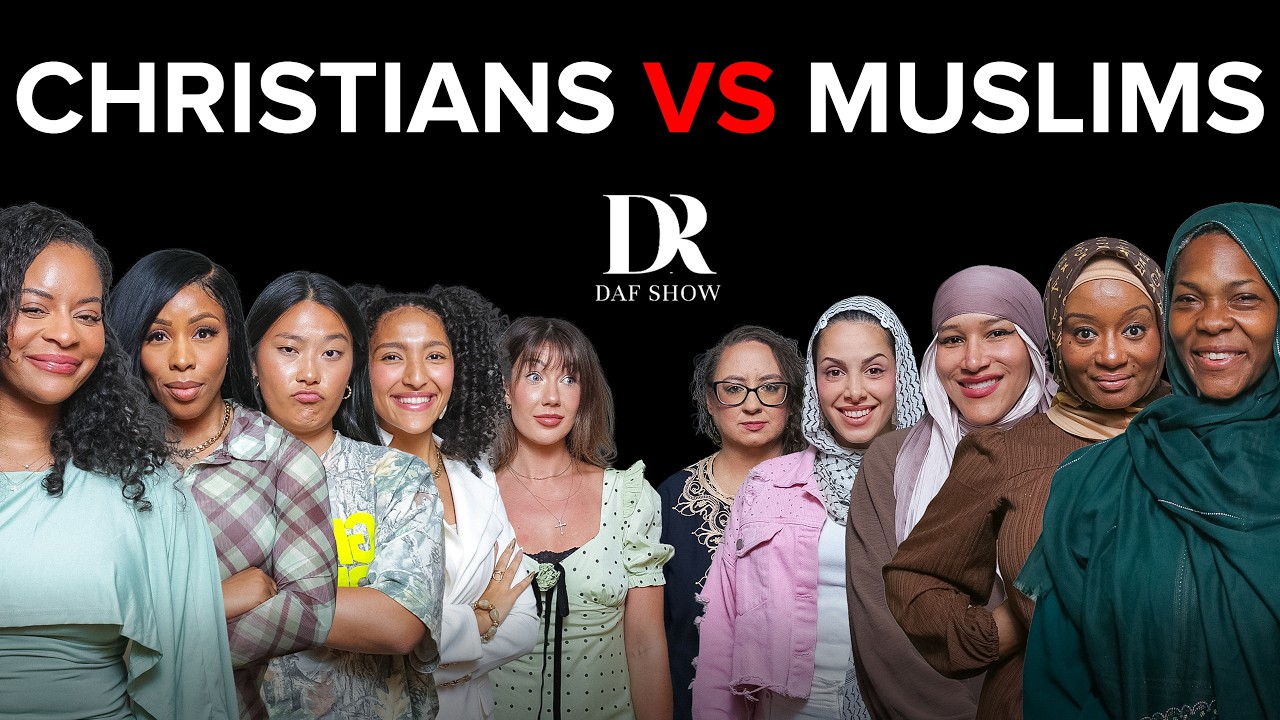
Christian vs Jewish vs Muslim Women | The Bridge — Transcript

Six women from Christian, Jewish, and Muslim faiths discuss their beliefs, scriptures, and common misconceptions in a respectful interfaith dialogue.

Key Takeaways

  • All three faiths worship one God but differ in understanding and revelation.
  • The Torah is viewed by Jews as an unaltered divine revelation witnessed historically.
  • Christians emphasize belief in Jesus as essential to knowing God.
  • Muslims see Islam as the final and complete message from God through Prophet Muhammad.
  • Interfaith dialogue helps confront misconceptions and fosters mutual respect.

Summary

  • The video features two women each from Christian, Jewish, and Muslim backgrounds discussing their Abrahamic faiths.
  • They explore the similarities and differences between the Torah, Bible, and Quran and their views on God.
  • Jewish participants emphasize the unchanging nature of the Torah and the historical revelation at Sinai.
  • Christian participants discuss the significance of Jesus and the concept of the Trinity in relation to God.
  • Muslim participants highlight the continuity of prophetic messages culminating in Prophet Muhammad.
  • The discussion addresses whether God continues to reveal Himself beyond the Hebrew scriptures.
  • Participants reflect on moral values, salvation, and the role of prophets across their faiths.
  • The conversation touches on misconceptions and stereotypes that divide their communities.
  • The dialogue promotes understanding and respect among the three Abrahamic religions.
  • The host, Dr. Michelle Da, facilitates the discussion to build bridges between faiths.

Full Transcript — Download SRT & Markdown

00:00
Speaker A
Is Mahatma Gandhi in hell because he was a Hindu? If anyone is not in Christ, they rejected the way.
00:07
Speaker A
So Mahatma Gandhi, who spent his whole life doing goodness, is in hell. Good by what standard? That's the problem. Like, I mean, morality, acting, behaving morally with a wicked heart does not get you into heaven.
00:21
Speaker A
Because he wasn't a Christian. No, because he was a racist. Jesus was so for that time. So the people who existed during that time were supposed to follow Jesus. Peace be upon him. However, God sends prophets to every nation, every nation.
00:35
Speaker A
And God sends prophets to every time. So from as Muslims, we believe that Jesus was sent for his time with his message and that today the prophet for the end of time, like the last prophet, the prophet for all of mankind, the mercy to the world, is Prophet Muhammad, peace be upon him. I don't necessarily know that you guys would recognize the Messiah even if there was a Messiah because the pattern is killing any prophet that says not to do a certain—
00:48
Speaker A
You killed Moses. You murder your—I didn't say all of your prophets. You just said all of your—You just said all of your—Let me clarify.
01:00
Speaker A
You murder your prophets. You said all of your prophets. Please stop cutting me off. I'm communicating.
01:07
Speaker A
In this episode, two Jewish, two Christian, and two Muslim women sit face to face to explore the core differences behind their Abrahamic faiths. Judaism, Christianity, and Islam.
01:12
Speaker A
Together, they will discuss how their beliefs guide their values, relationships, and their everyday choices while confronting the misconceptions that often keep their communities divided. I'm your host, Dr. Michelle Da.
01:25
Speaker A
Welcome to The Bridge. My name is Ana, and I'm a Muslim. My name is Maja, and I'm a Muslim.
01:39
Speaker A
My name is Lauren, and I am an Orthodox Jew. Hello, my name is Raala Taktuk. I'm an Orthodox Jew. I was raised Orthodox, very passionate about the Bible, the Torah, Jewish history from Florida. Very happy to be here.
01:48
Speaker A
My name is Shanasa, and I'm a Christian. My name is Kalia, and I'm a Christian.
02:01
Speaker A
Welcome, ladies. Thank you so much for being here today. And the first prompt is the Torah, Bible, and Quran all point to the same God. Three, two, one.
02:05
Speaker A
Okay, anyone can discuss. So, I think for a long time I believed that they all point to the same God as far as their Abrahamic religions. But I feel like the more that I studied the word of God in comparison to the Quran and the Tanakh, I came away with more so they're related to the same region. I wouldn't necessarily say they're related to the same God. I would concede that the Tanakh is talking about the Yahweh of our Bible. But I don't think you can deny Jesus and then still have the same God. I would say that yes, all of the Quran, the—I try not to call it the Old Testament. I call it the Torah obviously and the Christian Bible, they do point to the same God, but I do believe it matters how you get there.
02:21
Speaker A
Obviously, as a Jew, I believe the Torah is the truth. Moses said that, you know, Moses said to the Jewish people in Deuteronomy, which great nation has had a Torah like this? And he was basically saying, there is not ever going to be another revelation like this. There hasn't been a people ever, even with these great world religions that are presented here by these gorgeous women, that has ever claimed this unbelievable revelation like the ones that the Jews have claimed they saw on Sinai. Millions of people as God ripped open the heavens and made this connection between heaven and earth. And no other people has claimed that. And by the way, I talk about this with my husband all the time who's a rabbi and my father who's a rabbi. Not a single word of the Torah has ever changed. Not once, ever. And that is a testament not just to me, the truth of the Torah, but the fact that we literally witnessed that revelation actually, and it was passed down from father to son, mother to daughter, whatever you want to say, until us Jewish women here. We still have, you know, we don't say we're believers. We're knowers. We know God exists because our ancestors actually saw it. There's something different between believing and seeing. So, I believe it matters how you get there. Although I do know that I've studied the Trinity. I've studied Islam a little bit less just because Christianity and Judaism are much more connected in my opinion. But I would say they do point to the same God, but it matters how you get there. I believe that. Thank you. Thank you.
02:35
Speaker A
Uh, yes. So the Bible, Torah, and Quran being birthed from Prophet Abraham, the Quran is like a summation of the previous text, major text and even texts that we don't know about that maybe were lost and the previous prophets. So we believe as Muslims that Islam has always been and that the previous messages confirm that there is only one God, and then whatever particular prophet was endowed with the message at that time, whatever laws were given for that particular people. So thank you. Do you believe that God continues to reveal himself beyond the Hebrew scriptures?
02:48
Speaker A
So in my opinion, the way that Jews see things, we have the Torah. That's what we believe. I think God is in, as Jews believe, we believe that God is in a little bit of him is in every second of our life. So I don't think revealed in terms of like the Torah is going to change. It's not. That's what it is. But it is something that as Jews we bring into our life every single day. So for me personally, I like to believe that God reveals himself to me every day. He reveals himself to the Jewish people every day.
03:01
Speaker A
But that being said, history is not changing. The Torah is not changing. Our guidelines of how we choose to live our life are not changing. But I do, you know, on my good days, I hope that God is with me always, revealing himself to me in ways that sometimes you get the blessing of clarity.
03:08
Speaker A
Yeah, that's true. What about you, sweetie? Do I believe that God reveals himself beyond the Hebrew scriptures?
03:20
Speaker A
Yes, beyond the Hebrew scriptures. So that was a beautiful answer and no, I don't believe that God reveals himself beyond the Torah. Something I guess we'll get into later is that Moses continuously, constantly says the Torah doesn't change. And when I research or look into other world religions, I do find that there are lots of changes. But you can also just see—I don't like to work usually backwards, like look at the world and look back at scripture, but I do just so often think of, you know, not only can we not change the Torah, but it's also so perfect. What other moral set of beliefs, which other set of laws like the Ten Commandments has influenced the world the way the Ten Commandments have? I mean, they are just eternal. And I mean, I listen to a lot of podcasters, Christian podcasters, Muslim podcasters and classes. And a lot of people say, let's say for the Christians, you know, Judeo-Christian values.
03:34
Speaker A
And I'll say, well, and then they'll quote like the Ten Commandments or the Bible, do not murder. These are, by the way, revolutionary things because if you read history, people were slaughtering each other day and night really for no reason other than territorial gain. And God said, "No, you may not murder." And that is the Ten Commandments are the basis of our civilization in America. But a lot of these podcasters will quote the Bible and then say, see Christianity is the foundation of civilization. And I want to remind them that the Ten Commandments come from the Torah which is not originally a Christian book. It's a Jewish book which beautifully Christi—
03:45
Speaker A
talk about this with my husband all the time who's a rabbi and my father who's a rabbi. Um not a single word of the Torah has ever changed. Not once, ever. And that is a testament not just to me, you
03:56
Speaker A
know, the truth of the of the Torah, but the fact that we literally witnessed that revelation actually, and it was passed down from father to son, mother to daughter, whatever you want to say, until, you know, us Jewish women here,
04:07
Speaker A
we still have, you know, we don't we say we're not believers. We're knowers. We know God exists because we are our ancestors actually saw it. You know, there's something different between believing and seeing. So, I believe it matters how you get there. Although I I
04:20
Speaker A
do know that, you know, I I've studied the Trinity. Um, I've studied Islam a little bit less just because, you know, Christian Christianity and Judaism are much more connected in my opinion. Um, but I would say they do point to the
04:31
Speaker A
same God. Um, but it matters how you get there. I believe that. Thank you. Thank you.
04:38
Speaker A
Uh, [snorts] yes. So the Bible, Torah and Quran um being birthed from prophet Abraham um the Quran is like a summation of the previous text, major text and even texts that we don't know about that maybe were lost um and the previous prophets. So we
05:01
Speaker A
believe as Muslims uh that Islam has always been uh and that the previous messages confirm that there is only one God um and then whatever particular prophet was endowed with the message at that time uh whatever laws were given
05:17
Speaker A
for that particular people. So thank you. Do you believe that God continues to reveal himself beyond the Hebrew scriptures?
05:28
Speaker A
So in my opinion, the way the way that Jews see things, we have the Torah. That's that's what we believe. I think God is in as as Jews believe, we believe that God is in a little bit of him is in every second of
05:44
Speaker A
our life. So I don't think revealed in terms of like the Torah is going to change. It's not. That's what it is. But he it is something that as Jews we bring into our life every single day. So for
05:56
Speaker A
me personally, like I I like to believe that God reveals himself to me every day. He reveals himself to the Jewish people every day.
06:05
Speaker A
But that being said, history is not changing. The Torah is not changing. Our guidelines of how we choose to live our life not changing. But I do, you know, on my good days, I hope that like God is
06:16
Speaker A
with me always, you know, revealing himself to me in ways that sometimes you get the the blessing of clarity, you know.
06:23
Speaker A
Yeah, that's true. What about you, sweetie? Um, do I believe that God reveals himself beyond the Hebrew scriptures?
06:29
Speaker A
Yes, beyond the Hebrew scriptures. Um, so that was a beautiful answer and uh, no, I don't believe that God reveals himself beyond the Torah. Um, uh, something I guess we'll get into later is that, you know, Moses continuously, constantly says the Torah
06:44
Speaker A
doesn't change. Um, and when I research or, you know, look into other world religions, I do find that there are lots of changes. Um, but you can also just see I don't like to work usually backwards, like look at the world and
06:55
Speaker A
look back at scripture, but I do just so often think of, you know, not only can we not change the Torah, but it's also so perfect. Um, what other moral uh set of beliefs, which other, you know, set
07:09
Speaker A
of laws like the ten commandments has has influenced the world the way the ten commandments have? I mean, they are just eternal. Um, and I mean I listen to a lot of uh podcasters, Christian podcasters, Muslim podcasters and
07:23
Speaker A
classes. Um, and a lot of people say, let's say for the Christians, you know, Judeo-Christian values.
07:30
Speaker A
And I'll say, well, and then they'll quote like the Ten Commandments or the Bible, do not murder. These are, by the way, revolutionary things because if you read history, people were slaughtering each other day and night really for no
07:40
Speaker A
reason other than like territorial gain. Um, and God said, "No, you may not murder." And that is the ten commandments are the basis of our civiliz civilization in America. But a lot of these podcasters will quote the Bible and then say see Christianity is
07:53
Speaker A
the um you know the foundation of civilization. And I want to remind them that the ten ten commandments come from the Torah which is not originally a Christian book. It's a Jewish book which beautifully Christians adopted. Um, I
08:07
Speaker A
think the Torah is so perfect and Moses in him saying he said, "Do not change it." Because God revealed himself to the world through the Jewish people, not meaning only to the Jewish people, were like a conduit for the world. Um, and
08:21
Speaker A
that revelation was perfect. And I don't think we need to add or change it at all.
08:26
Speaker A
So, I don't think anything else uh is is a revelation besides the Torah. Okay. I have a question for you ladies.
08:33
Speaker A
Christians believe that Jesus is God. Okay. Can people who reject Jesus as divine still worship the same God?
08:42
Speaker A
No, they cannot because the Christian believes that Jesus Christ is a part of the Godhead. Um, I wanted to answer that and also touch on a couple of things that you guys said which I think was really fascinating. Um,
08:58
Speaker A
obviously the nature of God for us is trinitarian and we get that from the Torah. We get that from the Tanakh. I and most Christians subscribe to a belief called progressive revelation.
09:10
Speaker A
And it's something that you see in everyday life when you have children. You do not tell them as soon as you have them everything about the birds and the bees or what your how old you are or this. You wait until they mature and
09:21
Speaker A
then you begin to reveal things. And you said something about clarity. And I feel like that's exactly the Christian's perspective. The New Testament is not changing anything necessarily. It's it's providing more clarity as to God's loving nature. It's an expression of
09:35
Speaker A
God's love to the highest degree. And um I agree with you that it's perfect. But the problem is that we are imperfect.
09:41
Speaker A
Which is why in Jeremiah Jeremiah highlights this. In Jeremiah 31, I believe it is 31:31. He says, "I'm going to make a new covenant because the previous one y'all broke." That's literally the words that he uses, not y'all. God didn't say it like that. I'm
09:57
Speaker A
making God Texas. But [laughter] he's like, "The previous one you broke because I was a husband to you guys, but you guys broke the covenant." Then he uses other language, Jeremiah 32:4. He said, "I'm going to now give you all one
10:09
Speaker A
heart and one way to worship me, and I'm going to give you an everlasting covenant." Why all of a sudden in Jeremiah halfway through history is God now talking about an everlasting covenant? That implies, and these are God's words, not mine, that the previous
10:22
Speaker A
one was broken somehow. it wasn't everlasting, which is why he's alluding to something that's going to come. So, the idea that um it's closed contradicts what is revealed in scripture because it would be one thing if I would say like I
10:38
Speaker A
have no reference points to point back to the idea that Christianity is founded upon, but all throughout scripture, you see that Jesus or God, who I believe is Jesus, gives nuggets like this is going to happen. Last thing I'll say is one
10:52
Speaker A
great example for this and I hope that you guys would look into it is the story of Abraham. I study that story a lot because I can really relate to him. But when you when you first meet Abraham,
11:00
Speaker A
you meet him in Genesis 11 and then in Genesis 12:2, God talks to him out of nowhere and says, "I'm going to make you a nation." And so he he he says, "Get up and go." Abraham doesn't know what he's talking
11:11
Speaker A
about. He just gives him a little nugget, but he gets up and he goes. And then in the same chapter, Genesis 12:7, he said, "I'm gonna give you descendants." So now God is giving him a little bit more and he what does Abraham
11:21
Speaker A
do? He gets up and he makes an altar and then he gives him the most clarity in Genesis 13 14-1 17 he says look at the the the sand on the seashore. If you can count them you'll be able to count your descendants
11:33
Speaker A
and I'm going to make a great nation from you. He's giving him little by little by little. And Abraham is responding. And then Genesis 15:6 you see the pivotal verse. He says um and Abraham finally believed God and it was
11:44
Speaker A
accounted to him as righteousness at that point. So God is a God that continues to bring clarity. God is perfect, but we are not. So the Christian God is Jesus and he's not random. He He's been there all along.
11:59
Speaker A
Thank you. I would like her I would like her to respond. I just wanted to ask a question. You said that the Torah affirms the Trinity.
12:06
Speaker A
Yes, absolutely. Also, can you would you like to respond to that or did you want me? I I would love to respond. So, um yes, absolutely.
12:13
Speaker A
So, in the beginning, I mentioned this in a previous episode, um, the very first book, it says in the beginning, God. And it uses the word Elohim, which we know is a word to use to describe God or to call God. But the
12:30
Speaker A
interesting thing about it is it's a plural word. So, L is just L is actually just a generic word for God. Like you see bel for bell, it's a very generic word in the Seemitic language for God.
12:42
Speaker A
But then you have Elohim, which is God. And it's a plural form. And in the same chapter, you see God speaking and he says, "Let us go down and make man in our image." You see little things like
12:53
Speaker A
that all throughout. Even when it says about the Holy Spirit, it says, "In the beginning, God created the heavens and the earth." And it says, "And then the Holy Spirit was hovering over the deep." It's it's showing a spirit that has some
13:02
Speaker A
independent agency apart from God, who we just saw in the very first verse. I can list probably 30 things like that throughout the Old Testament where you see that it's not simply just a strict I guess monotheistic God as maybe you guys
13:17
Speaker A
would understand it. Right. Right. I've I heard of this in like the Arabic where it's like the the royal eye. That's what that's what my teachers would say like the royal eye.
13:25
Speaker A
This God [snorts] is so great that like he can speak to us in this kind of way.
13:30
Speaker A
But can I I just wanted to ask one more question really quickly about um I think that um what is the Hebrew word for image?
13:40
Speaker A
Well, okay. Can I respond to you in one second for so Shinasa, you quoted Jeremiah 31? Yes. Jeremiah 31 when he said, "I will make a second covenant." He uses the word Israel and Judah. He actually says, "I'm creating a second
13:53
Speaker A
covenant with Israel and Judah." Meaning he's talking to the Jewish people. That's number one. Uh, number two, you quoted Jeremiah. Jeremiah, which verse did you 32:40?
14:02
Speaker A
What did it say again? It says that I'm going to give you all one heart with one way to worship me, and I'm going to make an everlasting covenant.
14:09
Speaker A
Yes. Again, uh, towards Judah and the Jewish people. He's just talking. He's reiterating what Moses has been saying for 40 years, an eternal covenant, eternal covenant. By the way, it is literally impossible, at least for us Jews, that Jeremiah would ever imply uh
14:24
Speaker A
for anyone to worship Jesus because most of the book of Jeremiah is him going crazy about idol worship. And the definition of idolatry in Judaism, again, Christianity didn't ex exist yet.
14:37
Speaker A
So Jeremiah was a Jew, uh is like the second uh commandment of the ten commandments, the likeness of anything above or below. Moses said said this in Deuteronomy 4. uh the likeness of a man or a woman. So to me at least it is
14:51
Speaker A
impossible that Jeremiah would be talking about a human being because the entire book of Jeremiah as him saying if you guys don't stop idolatry the bdashes the holy temple is going to be destroyed.
14:59
Speaker A
I wanted to know the Hebrew word for image salum. Salum okay cuz I know like Arabic rasim I believe is image and isim is name. And I wonder if those ever like because in Islam we would understand that like the human beings
15:16
Speaker A
are an embodiment of the names of God of the names of God. So I would I would I I just always wonder like is it like a difference of um the wording or something like translating what Jesus peace be upon him said into English if
15:32
Speaker A
there is like some type of mixup between um the words image versus name possibly like Arabic is rosim and isim you want to answer well for us shame is name so it's not really so right that that's what it is
15:44
Speaker A
even so the image is what in Hebrew again salam salam and the word in Hebrew for uh name Shame.
15:51
Speaker A
Shame. Okay. I was thinking with based on what she said, Eloh Kim being a plural. There are many names for God. That doesn't mean that we're talking about many different people. It's still the same person, just many different names, which I think
16:03
Speaker A
that's where that pluralistic piece could have come in. So, I would just say um yes and amen to everything you said about the Torah. We believe that the Torah is true and it is the revelation of God. Um we just
16:13
Speaker A
believe that Jesus is the fulfillment of everything that was said in the Torah. What does that mean?
16:18
Speaker A
Okay. So when Jesus is asked what what the greatest command is, he says to love God, the Lord your God with all your heart, soul, and mind. And the second is like it to love others as yourself. The
16:28
Speaker A
law and the prophets hinge on these two commandments. So it's not an undoing of the commandments. It's saying that the commandments are fulfilled through the person of Christ because Christ is the sacrificial lamb. to the point about Elohim. When we understand the Trinity,
16:40
Speaker A
which I know we'll get to the Trinity, so I'm not going to go deep into this, but when we when we understand the word Elohim, and when we understand the Trinity, we're not understanding the Trinity as three different people. And
16:49
Speaker A
so, I see how that's confusing when we say, "Oh, there are three different people that are God." That's not what we're saying. God is spirit. Jesus is the person of God. He's the incarnation of God on earth, and then there's God,
17:00
Speaker A
the Father, and the three of them make up the Godhead. They're not like three individuals in the same way that we're all sitting here. Um, and then I would say in Daniel 7:13-14, it talk Daniel is talking about the ancient of days giving
17:12
Speaker A
dominion and keys over to the son of man. It says that this son of man will have glory, have sovereign power, and that the nations will bow down to him.
17:20
Speaker A
So then even if you deny that Jesus is the Messiah, you have to deal with the fact that there is a son of man or a messiah, you have to deal with the fact that there is some concept of a
17:29
Speaker A
pluralistic God in the Old Testament. And then Proverbs 34 says, "Who is this God who's gathered the ends of the earth, who's cloaked the waters?" And then it says, "What is his name and what is his son's name?" So I think we have
17:41
Speaker A
to deal with that question. So ladies here, what does it mean when the Quran says it came as a confirmation of what was revealed before?
17:52
Speaker A
Beautiful. Um, okay. So for me growing up, my father is a Baptist Christian and um we were just kind of raised to believe in God and do good deeds, not necessarily like with this particular religious uh you know mindset. So um my mother is a
18:12
Speaker A
Muslim, father is a Baptist Christian. So when I was a child, I used to read the children's Bible. That was like my favorite book. Like I would literally carry it around all the time and I would just read it over and over and over
18:23
Speaker A
again. like I would finish it, read it again, finish it, read it again. And it's not like, you know, the the you know the original Bible, but um the children's Bible, it had just like many stories of the prophets and I just I
18:36
Speaker A
just fell in love with each and every one of their stories. And um as an adult I I became Muslim around the age of 18 and um went to study some Islam and I did a class on the history of prophets
18:50
Speaker A
and uh I was reintroduced to the prophets in a different kind of way. Uh for example, I was introduced to the story of Adam peace be upon him and um how God created him from the soil of the
19:02
Speaker A
earth and um I I love that story. I was I was introduced to Eve or Howa in Arabic. Um I was introduced to like Shaon, Satan, who is the devil. I initially I thought uh growing up that maybe he was like a fallen angel or
19:17
Speaker A
something like that. But um when I was taking the class uh on history of prophets, it became clear that he wasn't a fallen angel because in Islam, angels do not disobey God at all. Um but that there is another creation that has free
19:31
Speaker A
will um called jin. um they have free will just like human beings and um that the Quran says that shaon was a jin. So um also going to the story of Abraham. I remember I love that story in the Bible.
19:46
Speaker A
This that story is like in the Quran and I was like okay. Um so Abraham he had these two sons and different things happened. Um and um you have uh was Hagar um you have Hannah Sarah right? Sarah
20:00
Speaker A
Sarah and um I just felt like that um Islam, the stories within the Quran about the prophets affirmed the stories that I had read as a child in the Hebrew Bible and kind of expounded on them for me. Um even the story of Noah and the
20:19
Speaker A
ark that's there. Um Moses is also mentioned more times in the Quran than Jesus peace be upon him as well as Muhammad peace be upon him. And um um in addition to that, lastly, the story of prophet Jonah is mentioned in the Quran
20:35
Speaker A
as well as the Bible. And um I just personally really resonate with those stories and I found that those stories were also present in the Bible.
20:44
Speaker A
So So are is what you're saying that the Quran confirmed what was revealed before in the Bible? Is that what you're saying? Right. What I'm saying is that the Quran I believe that the Quran it confirms the stories of the prophets
20:58
Speaker A
that exist within the Bible. Okay. Got it. So again the the Quran is um we believe as Muslims that revelation came in stages right not just in the for the Quran being compiled but the message of again there is no God but one God. Mhm.
21:16
Speaker A
Um, so that came over obviously centuries and eons, right? Going all the way to back to Adam. Then you Adam, Noah, uh, I'm not saying it in in succession, right? But Adam, Noah, Jonah, Joseph, Abraham, Ishok, and or
21:34
Speaker A
Isaac and Ishmael, um, and David, Solomon, right? Even like more obscure stories like the seven sleepers, right?
21:43
Speaker A
um uh prophet Enoch etc. Right? That all and that and then many prophets Allah tells us in the in the Quran um some you know of some you do not know of right so meaning as far as the um revelation
21:58
Speaker A
being being given right can I so quickly um let me just one second if I land this way so um so essentially the previous message the central themes of this previous messages are that again there is only one god that we need to
22:15
Speaker A
come back to the worship of the one God going to like the testament right or the 10 I'm sorry not testament I'm sorry the ten commandments right like one of the ten commandments is um no graven images before god right no idols before god
22:28
Speaker A
right um something I was also raised Christian so my grandma would tell me it's like you know god is a jealous god like you don't make a you know partners with him so the emphat so just about the
22:40
Speaker A
Quran being a confirmation it's like this emphatic confirmation of that central theme and that these prophets did exist that Jesus uh is of virgin birth and that he did ex you know that he did exist um and that um the also I'm
22:59
Speaker A
sorry here's the point the original uh the original um confir not confirmation but the original revelation of those texts unfortunately texts have been altered they have been adjusted for various reasons and means over time. Um, so the Quran is like this emphatic like
23:18
Speaker A
this is what was said. These are the these are the stories that are valid and and and um sure, you know, not to dismiss, you know, um ones, you know, NIA or, you know, our intentions like, okay, you know, because we know we have
23:33
Speaker A
a a reverence of course, you know, following as Jews or Christians, but that's just that, you know, these are the confirmed valid stories.
23:43
Speaker A
Thank you. You know that feeling when payday is just around the corner, but you really need your money now? Yeah, [music] that's where Current comes in. Current is a modern banking app that actually gives [music] you more for your
23:56
Speaker A
paycheck. Once you qualify, you can get a paycheck advance up to $750, [music] so you can access your money when life doesn't wait. And with the Build card, you can safely build your credit. Users have seen an [music] average increase of
24:11
Speaker A
over 80 points in six months. It is a secured Visa charge card, so you're building credit without [music] piling on debt. Plus, you can overdraft up to $200 without getting any overdraft fees.
24:24
Speaker A
Get your direct deposit up to 2 days faster and earn up to 4% [music] bonus on your savings pod. There is also 247 live support and over 40,000 [music] feef free ATMs, so you're covered pretty much anywhere. Honestly, what I love
24:41
Speaker A
most about Current is how easy it is to use. Managing my money feels simple, stress-free, and built for real life.
24:49
Speaker A
So, don't wait. Get Current. [music] Sign up at current.com/drdaf and use my promo code drdaf to get $50 and unlock tools like paycheck advance, credit building, and more. And the next prompt is, "My religion holds the complete and final revelation of God." 3
25:08
Speaker A
2 1 Okay, maybe from someone who hasn't spoken much. What about you? Go ahead.
25:16
Speaker A
It's so funny you picked me because I'm usually the talkest talker in the whole world.
25:20
Speaker A
Yeah. As listen, as Jews, we believe that there is one God. The Torah there meaning actually from what you said before that um that the Quran kind of solidifies that that these are the stories and these are the truth, right?
25:36
Speaker A
But the stories are still based on Torah from my understanding. So, so well as one of the confirmed books, right? The Torah, the original inal gospel. Not to cut you off, I want you.
25:48
Speaker A
No, no. I want to understand. Yeah. The Torah, the NGO, the Gospel, um the Zabore or the Psalms of David. Um and then Muslims have to believe in those books.
25:59
Speaker A
All of them. Yeah. Okay. Um so my understanding is that other religions branched out from the original which would be Judaism. So that I mean that's that's how I feel about it. I just think that yes, there were translations and different things
26:16
Speaker A
and things got lost based on um societal different things for whatever the reason is, but the bottom line is is like the the Torah is the bottom line. That's it.
26:27
Speaker A
Anyone want to speak on that? The purpose of revelation, I would say the sole purpose of revelation is to keep the laws. When God comes to humanity and says this is evil, this is good, this is immoral, this is
26:45
Speaker A
moral, the entire purpose of revelation is to keep the law. When I obviously I have so much respect for Christians and Muslims, of course, God forbid, for anything else, but the Jewish people are the only people who actually keep the
26:59
Speaker A
law. Moses continuously says, and he, you know, the whole book of Deuteronomy, it takes 37 days. He's about to die.
27:06
Speaker A
It's very tragic. I cry every time I read it. You know, we have the cycle that we read every uh year. And he says, "I'm going to die. Do not become corrupt and change the Torah." He He's begging.
27:18
Speaker A
And again, Revelation is for observance. The only people who actually observe the Torah exactly how it is are the Jewish people. So yes, I I echo what Lauren said that the Bible is the complete and full revelation um which is open to
27:34
Speaker A
everyone but we cannot add and uh we cannot change. I would respectfully disagree on your definition of revelation. Revelation is not specifically to keep the law because obviously we cannot. The law was given to us to allow us some form or fashion
27:54
Speaker A
to be able to relate to God because God is a holy God and we are imperfect people. So he gives us this like kind of as a governance so that we can at least be able to approach him. The problem
28:05
Speaker A
with it is going back to that same exact scripture. It it's it highlights the fact that we broke and it says the covenant that was given to you on Mount Si. So it's literally referring to Moses's words.
28:16
Speaker A
Which verse? Jeremiah 31 31 through 34. Is it? I'm just confused by that only because yeah, they they broke the ten commandments. We got new ones. I don't understand.
28:28
Speaker A
So that that that that goes against I guess your position if if if you if you have new ones from God.
28:33
Speaker A
They're the exact same. Let's be clear. The exact same ones. Moses came down, dropped them, broke them, went back up, got another set from God directly, and brought them back down to the Jewish people. That's what we believe,
28:43
Speaker A
right? I I understand that. But the point that I'm making is that even with those laws that were broken, even in that moment came down, you see the golden calf, he goes up, he gets the law again, the cycle still continues. You
28:54
Speaker A
see that? That's why they were exiled. That's why we believe you we need the ultimate sacrificial system found in Jesus Christ because we continue the same tragic, I guess, trajectory, if you will.
29:07
Speaker A
Do you believe Jesus saves you? Yes. Yes. That is probably the biggest difference between Judaism and Christianity. You keep bringing up struggles the Jewish people had. By the way, this is one of the reasons you know that the Jews did not write the Bible
29:21
Speaker A
because it makes us look really bad. In Judaism, struggle is not is key. By the way, how do you become like God? You said revelation is not for keeping observing. You become like God through action. So, first of all, in Judaism, we
29:34
Speaker A
don't have any human sacrifice ever. Um, it almost happened, didn't happen. We believe that we are our own saviors. We have to become good people. save ourselves to be close to God. God gave us moral law. You become like God by
29:48
Speaker A
becoming a moral human being. You're a partner in creation with God. We don't believe that we're fallen and someone needs to save us. We all have a soul.
29:56
Speaker A
All of us in this room. Sorry. Not just Jews. Something's wrong with me. It's fine. [laughter] Go for it.
30:01
Speaker A
Not just Jews. Obviously, God, everyone has a soul. You and I and all of us in this room have the potential to uplift and elevate ourselves to be godlike. to be like God, moral good. We don't need someone to save us. That is like the
30:17
Speaker A
tenant of Judaism. So yes, the Jews broke the law. I break the law sometimes and I feel what is wrong with me? We continue. It's like a marriage, right?
30:26
Speaker A
You continue. No one is coming to save us. We save ourselves. We have to earn Messiah Messiah. We'll get there. But that is a main difference in uh in in Christianity. I'm I'm not going to go into the verses cuz
30:39
Speaker A
do you view later scriptures like the New Testament or the Quran as human writings or as possible divine revelations that simply don't apply to Jews?
30:50
Speaker A
Human writings. What do you think? Um yes. Uh interestingly enough, sorry to always talk about Christianity. I just study it a lot more. Um I have studied Islam, but I have a lot more to learn. Um human writings uh well also
31:05
Speaker A
Okay. Okay, but that's another point. But um I believe that the man that Christians worship Jesus, he himself would not have wanted people, not wanted. He would have told he was an Orthodox Jew just like me. He was a
31:18
Speaker A
rabbi. He kept chabas. He kept kosher. He had muzzas on his door. He kept sukkot and Passover. And he did not believe that human beings should ever be worshiped. So that is the way that I that is one of the reasons I believe
31:32
Speaker A
that the Christian Bible uh is human written. It was human man-made because the very man that is at the foundation of the text would have completely condemned human worship.
31:44
Speaker A
Let me say something to that if you don't mind. Are you familiar with the story of Mary Magdalene?
31:49
Speaker A
Somewhat. Okay. So Mary Magdalene apparently had seven demons and Jesus cast the demons out and there's a scene in the Bible where Mary Magdalene is bowing down and taking her hair crying and washing his feet and um the
32:05
Speaker A
Pharisees get offended by that because they say the same thing that you just said that that's worship and Jesus doesn't rebuke her he affirms her. He says you know what this woman's story is going to be repeated throughout history
32:17
Speaker A
or something along those lines. Which book of the New Testament is this? This is in the Gospels. I think the account is in it's it's probably in all four accounts. I'm not exactly sure, but Jesus receives worship uh many times
32:29
Speaker A
throughout the Gospels. Um even the the rich young ruler, if you're familiar with that story, he he gave him the ten commandments. He says, you know, he says, "Good teacher, what must I do to be saved?" And he says, "You know the
32:40
Speaker A
commandments." He points him back to the commandments. Do this, do this. He said, "I've done all those things. I'm good.
32:44
Speaker A
I'm great." He said, "Sill one thing you lack." He said, "Sell everything that you have and follow me." So he was pointing at the as God or as Messiah as who who else should we follow? Like I'm not following you. I'm not
32:56
Speaker A
following. But it's different if it's God or Messiah. In the first three gospels, Jesus never deifies himself. It's only the last one. And from what I've read, the last one is uh John, right?
33:05
Speaker A
That was way after Jesus died. And uh the Roman Empire hated Jews. uh and uh whoever you know I'm not exactly sure who wrote the last book of the gospels but they were very much trying to make a
33:17
Speaker A
break with Judaism by deifying Jesus. That's not true. He deifies himself in Mark 14 when the Pharisees ask when the Pharisees ask him if he's the son of man and he says yes.
33:26
Speaker A
What? I'm a son of man? No. No. Let me finish please. He calls himself the son of man and the Pharisees take offense at that because if he just meant that he was a human being they would not have taken offense at it. And
33:36
Speaker A
he references the Daniel 7 passage when he says this. who is coming on the clouds, who ascends to the right hand of the father specifically. So he is deifying himself and saying I am that I am. He we also see this angel of the
33:48
Speaker A
lord typology in the old testament. Jesus echoes a lot of that language. The I am that I am in Exodus 3:20 when we're talking about the burning bush scene.
33:57
Speaker A
Also when Hagar is fleeing the abuses of her mistress Sarah and she sees an angel in the wilderness, the angel of the Lord, she calls the angel of the Lord Yahweh. She said, "This is the Lord who sees me, Elroy." Why would she call an
34:09
Speaker A
angel of the Lord Elroy, the God who sees me, if that wasn't an incarnation of who God is? We know that God is spirit. So, who is this incarnation? We would argue that that's the second person of the Trinity. But to say that
34:21
Speaker A
Jesus doesn't deify himself in the New Testament, that's not true. It was mostly Paul who who deified him.
34:26
Speaker A
And the first gospels deify him. The first three gospels, Jesus never deifies himself ever. Not once. I've read the entire thing. He doesn't deify himself. He does not say, "I am God, son of man." basically means anyone can be a
34:38
Speaker A
son of God second also son of man. Maybe he was referring to himself as a messiah and other Jews said you're not. But Jesus never said I am God. He never said it because he was an orthodox Jew. That is
34:50
Speaker A
complete heresy. He would not. I admit in the New Testament others deify himself. Jesus unless I'm reading the wrong New Testament in the first three gospels he does not say that he is God.
35:03
Speaker A
He is encouraging other Jews to keep hala which is crazy. Halaka is Jewish law.
35:08
Speaker A
If it was he wouldn't sorry he wouldn't have been crucified if he didn't call himself God.
35:12
Speaker A
So to you ladies here do you believe that Jesus is the fulfillment of God's revelation? Does that mean revelation ended with him and the New Testament?
35:21
Speaker A
Yes. Jesus is the fulfillment of God's revelation because all throughout the Old Testament you see um nuggets I like to say of a version of God that we don't readily identify with God. For example um in Genesis 18 Abraham is having a
35:39
Speaker A
conversation with um three people. So they three people, three angels I guess or whatever you want to call it initially approach him and they are telling him about Sarah about to she's going to have a kid. Two of those angels
35:52
Speaker A
turn back and go away and then one figure remains and they walk over to the precipice of Sodom and they they have this conversation. Abraham and this person is having this conversation about the future of Sodom and Abraham
36:05
Speaker A
responds. He says, "Will you destroy Sodom?" Obviously his nephew lives there. He's trying to plea for Sodom.
36:09
Speaker A
Will you destroy it if it's 50 people, 40 people? And then he turns to him. He says something very curious. Shall not the judge of all the world do right? Why would you call an angel the judge of all
36:18
Speaker A
the world? Again, there's so many things like this. You you see when Moses is about to become a prophet. You see that um he's told to take his shoes off. He's standing on holy ground. And then you see the same thing when Joshua is
36:31
Speaker A
becoming a prophet. Joshua chapter 5, Joshua is walking and he sees a physical man. The man pulls out a sword and Joshua says, "Friend or foe." He says, "Neither I have come as the commander of the army." And then he bows and he says,
36:43
Speaker A
bows down to him. He says, "What would you have me do? What what does the Lord say to me?" He says, "The same thing that Moses heard at the burning bush and we all know he was talking to God. Take
36:51
Speaker A
your shoes off. You're standing on holy ground." So Jesus Christ is a fulfillment of scripture. There are scriptures that point directly to the fact that the idea of strict monotheism, as I guess you you um you both would
37:05
Speaker A
understand it, is not the way that is revealed in scripture. And I do want to say something to what you said previously. You mentioned that Jesus doesn't deify himself and that's just simply not true. And then I don't also
37:16
Speaker A
like the fact that John is discredited because it's discredited from like talking points I believe that is not to be disrespectful that may be heard online because when you actually read John it's not actually a later gospel.
37:27
Speaker A
John five it's one of my favorite chapters. John 5:2 it says that it describes the pool of Bethesda. It says there in Jerusalem there was a pool of Bethesda whatever whatever the temple had been destroyed in 70 AD. It makes no
37:40
Speaker A
sense for John to write a book and says there in Jerusalem there's a temple.
37:44
Speaker A
It wasn't written while the temple was being destroyed. It doesn't make sense. It's much later.
37:47
Speaker A
It How do you know that? From reading a thousand books and uh reading historians. It was by the way I just looked on a Christian website.
37:57
Speaker A
Everyone knows it was written after Jesus was killed. Dating for the gospels. Do you know how dating for the Gospels is done?
38:03
Speaker A
Probably not as well as you do, but yeah. Dating for the Gospels is not some robust system. We have no original manuscripts. We only have copies. So, what they do is they look at the eternal facts. If I wrote you a letter and I
38:14
Speaker A
started talking about B2K and I'm like, I'm going to the concert, you would know that I'm probably writing this letter from 2005. They do the same thing when they're reading it. So, when you look at the internal evidence, you find that the
38:23
Speaker A
book John 5:2, I encourage you to go back and look at it. In that same chapter, it discusses a practice that only Jews would know in that time, the stirring of the water to go down in the pool of Siloam. It doesn't talk of it as
38:34
Speaker A
a Jews were still alive, but they would have known that at the time, right? But it talks about it in a present tense. That's the key difference. It's not talking about there's other parts of the of the gospel
38:44
Speaker A
that talks about things in a past tense solidifying the fact that the temple was destroyed, but that one particular passage makes it seem like the temple is still there. The temple was destroyed in 70 AD. So, this couldn't be something
38:54
Speaker A
long 50. That's just something that people say online. It doesn't line up with the with the I haven't heard it online. I read it in uh at least 10 different books on Christianity. But I will say that uh
39:03
Speaker A
reading Jesus into the scriptures, Jewish scriptures, is is Jesus is reading backwards. Um and and I don't know how Christians account for the fact that multiple times in the Torah, 24 books of Tanakh consistently says that God is not man. Samuel says to King Saul
39:24
Speaker A
literally when Saul was too cowardly to kill you know the story to kill the king of Amal Amalik.
39:31
Speaker A
He says Samuel literally says this for God is not a man that he will change his mind. What were you thinking? God told you what to do and you didn't do it. God is not a man that he should he should
39:41
Speaker A
change his mind. Again, Deuteronomy, Moses about to die. He says, "Beware. You will become corrupt and you will worship something in the likeness of a man or a woman." So, you obviously know more about the New Testament than I do.
39:54
Speaker A
Obviously, because it's your faith, but I definitely know a lot more, I believe, about the Torah. I don't call it the Old Testament because there's nothing old about it besides the fact that it was given a long time ago. You cannot read
40:06
Speaker A
Jesus into the Torah because it is explicit multiple times. Multiple times, God is not a man.
40:13
Speaker A
Numbers 23, Moses says it again. Is God a man? God, sorry. God is not a man that he shall relent.
40:21
Speaker A
So my question for you ladies, can there ever be a prophet or revelation after Muhammad or is prophethood completely sealed?
40:31
Speaker A
Okay. Can we both answer if you want to say something? Okay. So in short, no. Uh we believe as Muslims that Muhammad is the last and final messenger. Um Allah tells us in the Quran um surah 33 um ayat number 40
40:48
Speaker A
that um verily Muhammad is not a father of of any of you men but he is a messenger of Allah and the last and he's the last of the prophets. Um we do believe though in the return of Jesus.
41:03
Speaker A
Um and that will come later. We can talk about that. Yeah. Um so yeah. No and that's actually a good thing, right? that there's no extra profits to like look for um so we don't get confused.
41:16
Speaker A
Thank you. Um I wanted to uh speak to what you guys were talking about a second ago.
41:20
Speaker A
That was good. Um get that. So as as Muslims, we would agree with what you're saying about Jesus peace be upon him not deifying himself. I feel like throughout the like is like uh the history of the the
41:35
Speaker A
children of prophet Abraham peace be upon him. Um God is very clear about who he is and who he is not and he does not allow for um anyone to worship anything other than him.
41:47
Speaker A
So Jesus um however there is this challenge of like there was a continuation but the Jewish people they were killing their prophet.
42:02
Speaker A
They killed Zachariah. They killed they tried they killed John the Baptist. Um and then for Jesus peace be upon him they they they constantly would either kill or like so how can there be like a contin continuation if whenever
42:19
Speaker A
God sends messengers they are being killed and um and then for Jesus peace be upon him who um prophet Muhammad peace be upon him he said I am the prayer of my father Ibrahim Abraham I am the good news of my brother Jesus and I
42:35
Speaker A
am the dream of my mother Amina So um saying that to say that just as the Christians do not just as the Jewish do not accept the uh prophet Jesus peace be upon him the Muslim you the Christians do not accept prophet
42:52
Speaker A
Muhammad peace be upon him as a prophet and um I believe it's clear that it's a it's a continuation and also to just answer the question I just wanted to address that really quickly if you guys want to chime in
43:04
Speaker A
and one more and to add to that too is like we need we do need to acknowledge the special station of the children of Israel, right? for sure, right? Moses having freed the children of Israel from that the Pharaoh of that
43:18
Speaker A
time. Um that was a big deal obviously right and um the however the um and many of the prophets come through the line of Issha right um so there's like it's not to like we have to remember that we're
43:36
Speaker A
related in a way right so um the issue is that the children of Israel were were repeatedly obstinate um and like a bit and rebellious about the laws or whatever rules and that's why another prophet is sent and another prophet is
43:54
Speaker A
sent and another messenger is sent like you know we're kind of hard-headed [laughter] and then also sent to different right it shows God's love for for the children of Israel it shows God's love for the children of Israel that he continued to send
44:08
Speaker A
messengers to guide right the the the the family of prophet Abraham peace be upon him also the Quran does say that God sent messengers to every nation.
44:18
Speaker A
Exactly. So different times and periods. Different times and different periods, different places that God sends me messenger sent messengers to every nation to every people, every nation. It does.
44:29
Speaker A
It does. So that everybody, all mankind will know that there is one God. And usually the main message that is sent is to believe in one God and to know that there will be a day of judgment.
44:41
Speaker A
Yes. And to do good deeds. Those are like the And that there will be a day of resurrection and there will be accounting. Those are the major things.
44:48
Speaker A
So, but according to the Quran, resurrection is Jesus, correct? No, no, no, no, no, no. Resurrection of all peoples.
44:53
Speaker A
The resurrection, right? Yeah. Everybody knows like on the day we die, we're in the grave for a while and then there will be a resurrection where everyone will be called forth to God and the trumpet will be blown. This is where
45:03
Speaker A
you might hear about the trumpet being blown. I I cut you off. I'm so sorry.
45:06
Speaker A
Oh, no. I was just basically saying that um God sent prophets to every nation um messengers to every nation teaching them about belief in God knowing that there will be a day of judgment and doing righteous deeds.
45:19
Speaker A
So thank you. Hi loves. It's me again, Dr. Michelle Dav. We've really been enjoying producing these [music] meaningful conversations for the Dr. Dav Show.
45:28
Speaker A
However, they are very costly to produce with our large team, equipment, studio, and [music] cast and everything that goes on behind the scenes. If you've been enjoying these thoughtprovoking [music] conversations and want to support what we're building here, I would love for
45:43
Speaker A
you to check out my fragrance brand, [music] Find Forever. Fine Forever is more than just a fragrance brand. It is a celebration [music] of faith, purpose, and beauty. We currently have three signature scents, each [music] inspired by a unique Bible scripture and has with
46:00
Speaker A
it its own story and meaning. First, we have 29:11. Inspired by the scripture [music] Jeremiah 29:11. It's a delicate yet vibrant fragrance that combines lush florals with soft, sweet undertones. It is a celebration [music] of gratitude and the blessings that unfold when we
46:20
Speaker A
walk in faith. Next is Silent [music] Storm. Inspired by Psalm 107:28 and 29, it's a bold, captivating scent that balances strength and serenity. With warm woods [music] and a touch of spice, it's a reminder to find peace and
46:36
Speaker A
purpose even in life's storms. And lastly, we have Mustard Seed. Inspired [music] by Matthew 17:20, it is a fresh and uplifting fragrance inspired by faith and growth. It opens [music] with a bright citrus and soft florals symbolizing the beauty of small
46:54
Speaker A
beginnings and [music] the incredible potential within. Every purchase directly supports this show and [music] helps us to keep bringing you meaningful content. So, if you're looking for a signature scent that not only smells amazing, but also carries a message of
47:09
Speaker A
faith and empowerment, [music] then visit fineforever.com and shop now. Your support means the [music] world to me and I truly believe that these fragrances will bless you as much as they have blessed me. And the next prompt is the Trinity is
47:24
Speaker A
polytheistic. Three two one. Oh, okay. Christians, can people who reject Jesus as divine still worship the same God?
47:38
Speaker A
No. No, they cannot. And I did I did want to speak briefly to the to the prompt um because just in research I find that um I've heard that the trinity is quote unquote polytheistic whereas we believe it's one god expressed in three persons
47:53
Speaker A
and I do find it interesting that when you say like for example like I know in Islam you have the shahada strict monotheism and you have that on paper but in practice what I see is you see there are sects of Islam that say that
48:07
Speaker A
the Quran is eternal. So if the Quran is eternal, then that poses a problem for strict monotheism because you have two essences or beings that are eternal.
48:15
Speaker A
Allah is eternal and the Quran is eternal. And then you look at how some Muslims interact with the Quran. Some believe that if you put the Quran on the floor, that is a sin. There are some nations that say if you burn it, that's
48:27
Speaker A
blasphemy. There are some that say if you write in it, that's offensive. And then you have the Cabba. Um, there are some that visit visit the the Cabba and they say, you know, we're going to kiss this black stone because it can forgive
48:39
Speaker A
our sins and all these things. And I'm I'm going to concede in just a second.
48:44
Speaker A
And and so you have that and then you also have uh some sects of Islam that um believe that Muhammad is an intermediary. So you have the on paper you have strict monotheism, but in practice you have something different.
48:55
Speaker A
And I found something similar even with Jewish practices because on paper it's the shama instead of the shahada. here.
49:01
Speaker A
O Israel, the Lord, our God is one God. But there are some that will take the Torah when it comes into the synagogue.
49:06
Speaker A
They'll stand up. If it's desecrated, they actually hold funerals for it. They put crowns and and and certain things on it.
49:12
Speaker A
But that's because it's a holy writing, not because we think it's a a person.
49:16
Speaker A
But that's the that's the thing. Like on paper it's a holy writing, but in practice it's different. They visit the hotel, the wall. Some Jews kiss the wall. Um that's part of the B. Yeah, but that's part of the basic.
49:26
Speaker A
That's the point I'm making. I'm almost done. I promise. and and even there are some that uh maybe I guess mystical Jews that maybe pray to angels. The point that I'm trying to make is the Christian on paper is a strict monotheist. And in
49:41
Speaker A
practice, we believe that the word of God, if someone burned the Bible, that would be tragic, but it's not blasphemy because you can only blasphe God. We believe that the word of God is a person and his name is Jesus Christ. We believe
49:52
Speaker A
that like the prophet David says, "Do not kiss the wall or the or the cube.
49:56
Speaker A
Kiss the son lest he be angry. Proverbs uh or Psalms 2:12. And we do not have to have anyone other than Jesus Christ to pray to because he is our mediator.
50:07
Speaker A
Psalms 2:12. It says Jesus Christ. It says kiss the son. The point I'm making is like we don't have to kiss. It doesn't say Jesus Christ. It says the sun and the sun. Yeah. The kiss the sun lest
50:15
Speaker A
he be enemy. And it does have to if it's no because it affirms the trinity. So you can So I don't think that you can practice Judaism with intellectual honesty without affirming the trinity. Even if you don't believe that Jesus is the
50:27
Speaker A
Messiah, you have to deal with the fact that the trinity is a very clear principle in the Old Testament. Even in Genesis 20:13 when Abraham is talking to Limchc, I think is how you say his name.
50:39
Speaker A
Um, and he says, "They caused me to wander." Elohim, halaku, not hale, but halaku, which is the plural verb. They cause me to wander. We see this again in the Psalms 58:11 when it says that God will come to judge the earth. It says
50:53
Speaker A
soapetim instead of soapet. They will judge the earth versus he will judge the earth. And then I don't think that's I don't think the majestic clause necess the um majestic we is not something associated with Judaism ancient Israel. That's a
51:09
Speaker A
later linguistic invention. So when you see let us go down and make man in our image, it's not a majestic thing. It's God speaking in a plural form because it's a trinitarian aspect. And I still want to hear from both of you guys one
51:20
Speaker A
thing. Genesis 18. Who is he talking to when he says, "Shall not the judge of all the earth?" Do right. It's a physical person that he's calling the judge of all the earth. Who would you guys he's it he's standing next to him. He's
51:31
Speaker A
he's he physically sees him. Genesis 18. There's three people. He bakes him a cake.
51:36
Speaker A
That's a different story. When he when he arrives at at their tent, this is about Sadome Genesis.
51:42
Speaker A
When God and Abraham are talking, and this is what makes Abraham a Jew, he defies God and said, "Will the judge of the whole earth not do justice?" Who is he talking to? And it's a physical person standing next to it's in the
51:53
Speaker A
text. Can I can I reiterate the text for you? And if I'm wrong, it's not a physical person, if I may.
51:58
Speaker A
Um, okay. I I want to go to your points about the um as far as what Muslims do like with our Quran and the Cabba. But just to there's a verse um in the Quran and I'm I'm paraphrasing, forgive me, I
52:11
Speaker A
believe it's in Bakar, but Allah tells us um and they pretty much they go back and forth about whether or not Abraham or was it Issa but or whether if they go back and forth about whether or not he
52:27
Speaker A
was Jew or Christian, but they read the same book, right? Like so this is this is a age-old argument you know that's one thing to think about to go to your questions about like the um like what do we do like if the Quran
52:42
Speaker A
is put on the floor yes that is sinful um just because it's a holy revelation we don't want to put our not in the on the floor in the bathroom or any unclean place we try to hold it up high as much
52:52
Speaker A
as possible even even there are some um some practices where like if a woman is on her menstrual cycle she wouldn't touched a Quran a Arabic a completely Arabic Quran. Not that you can't read it, but you could read like in you could
53:07
Speaker A
read like on your tablet or something or like in English or in another translation, but not the Arabic cuz that's like re revealed scripture like hold it like you know sacred, right? If you think of it as like God's
53:17
Speaker A
love letter to humanity, it's like you want to respect it. You wouldn't want to, you know, crumble it up and throw it in the trash or something outrageous.
53:24
Speaker A
The second I'm sorry. Do you think that's deifying it if a woman No, we don't worship. We don't worship the Quran, but we do definitely I mean obviously we rever the Quran. We actually wait a minute. We could say
53:34
Speaker A
that we use we use Quranic verses in our prayers. So when we pray five times a day, we recite directly from the Quran whatever whatever we've memorized for our prayers. So um but it's it is as a recitation to worship the creator not
53:51
Speaker A
worshiping just like like not worshiping the book. There is a distinct separation within Islam. I believe in Judaism as well that there is a creator of all things and then everything else is creation.
54:03
Speaker A
What does Islam teach about God's oneness? That makes it distinct from Jewish or Christian understandings.
54:13
Speaker A
Okay. Sohed um is absolute indivisible oneness of God. Right? We're not saying that um God is necessar like well God created everything but we're not so we're not saying worship everything though. Let's be clear about that. Um so
54:30
Speaker A
um absolute oneness of the creator. God is the creator. Everything else is the creation. Um surah 42 ayat 11 it says and there is nothing comparable like there's nothing like god. Um surahlas which is the last surah last no one
54:52
Speaker A
surah 112 um say he is one the absolute the eternal he begets not nor is he begotten meaning he is not um he was not born nor does he has he a son right um and there's nothing like compro there is
55:17
Speaker A
nothing like unto him you know um so the essential and not only that in order to even be Muslim you have to say Muhammad soolah right there is no god but the one god and Muhammad is the last
55:31
Speaker A
and final messenger you cannot we cannot be Muslim until you admit that that's why we say Islam is the emphatic uh re like summation of what the previous messages brought which is that there is only one God and we really have
55:48
Speaker A
to revere our like because we can attach our hearts to so many things, right? But we really have to revere that the emphatic confirmation of that is this is why we have these continuations, right?
55:59
Speaker A
Right. Like summize in the Quran, right? To remind people like so Islam essentially everything is orienting the Muslim. A Muslim is one who submits to the will of God. when we say uh you know when we say Islam we're saying
56:15
Speaker A
peace because you have submitted to the will of God. So essentially all of our orientation, all of our actions, all that we do is to orient us to that one to that utter reverence and oneness to God, right? Like we we even ourselves,
56:31
Speaker A
right? Even our own personal desires and and ego or the way we want to see things and the way we want to do things like no, God said do it like this, you know? Um so thank you. Yeah. So I just wanted to say
56:42
Speaker A
that I feel that um one thing that makes um Islam distinct not necessarily from Judaism because I think there monotheism ted something that is like very much so within the Jewish tradition but there is no partners. God has no partners. Like
56:58
Speaker A
you cannot have two all powerful things, right? That if you had two all powerful things and they were to go against each other and then one of them um you know didn't win then we would be worshiping that that creator of all
57:10
Speaker A
thing that most all powerful um beginning the end alpha omega all of those kind of things. And also this um this the verse the chapter that you quoted um in the Quran themed um is say Allah is one and um he is als
57:33
Speaker A
that nothing is that everything is in need of him for everything and he is in need of nothing for anything and he does not he does not sleep. He does not eat. He is completely self-sufficient in and of himself and
57:47
Speaker A
everything else is dependent upon him. In Judaism, how is Jesus viewed in relation to God's plan or story for humanity?
57:55
Speaker A
Um, in Judaism, like Ra explained before, he's viewed as a orthodox Jewish human being. He's not, we don't view Jesus as a uh as anything godly or like a deity.
58:08
Speaker A
Messiah. What about Messiah? Messiah's that's different. Um he's not Can you maybe you can explain that a little bit more?
58:14
Speaker A
He's neither a god nor a messiah. Uh because he did not fulfill messianic. Oh meaning you're asking if Jesus is a messiah if you got neither god neither um Jesus is not a messiah either.
58:23
Speaker A
And I will say also 10 seconds I promise. Um in terms of Jew of the world we actually believe that Jesus fulfilled some kind of godly mission by bringing billions of people to the Bible and spreading this knowledge of Messiah.
58:37
Speaker A
But and this is important in the Jewish history. It has brought us and and we have a beautiful relationship now, but it was 2,000 years really of persecution where Jews shared the Torah with the world and the well with Christians and
58:51
Speaker A
then Christians kind of took the Torah and used it against Jews and said you must worship this man when we had been learning for you know more than a thousand years that you can't. So it did cause us a lot of heartbreak and at the
59:02
Speaker A
same time Jesus brought you know billions of people to the Bible. I have a question like so even with all of the miracles that Jesus peace be upon him did why wouldn't he be able to have the title as Messiah within the Jewish
59:14
Speaker A
tradition um uh death will be swallowed up forever didn't happen uh world peace didn't happen the Jews are not collected back to Israel didn't happen um right there are so many things we need that that Jews believe that we need in
59:29
Speaker A
order for Msiah to come so what do you do with the miracles they happen and the resurrection we don't believe in the testament Yeah, we don't believe in that.
59:36
Speaker A
You just don't. The next prompt is people of other faiths can still be saved. Three, two, one.
59:47
Speaker A
Okay. So, yeah. So, no, you can't you can't be saved if you don't acknowledge Jesus Christ as the Messiah because he does deify himself. The last supper, he deifies himself. When he says, "Take of this bread. My body will be broken for
60:01
Speaker A
you. Drink of this blood. My blood is what atones you. He calls himself the savior essentially through through the process of communion. Um and so if you don't have a sacrifice and an atoner for your sin, you will constantly be in this
60:15
Speaker A
workbased cycle. And so as believers, we don't believe our own works get us to heaven, but we believe that Jesus did the final work on the cross. And I don't even know how that is uh okay in Judaism
60:27
Speaker A
because you guys are making these claims about the fact that God said says there is only one God. So why doesn't the entire world have to acknowledge Yahweh to get to heaven?
60:36
Speaker A
I have a question. If somebody is like on a mountain far away and they never heard about Jesus, they never heard about Abraham, peace be upon him, Jesus peace be upon him, Moses, that person, would they be responsible?
60:49
Speaker A
So Romans 1:19-20 says that God has made himself plain in creation so that you can look around the world and be able to observe the truth of God. Um, I believe that because God is sovereign and because he has grace, he probably
61:01
Speaker A
extends or reveals himself to people in some way. Maybe that's when they die, maybe that's before. But I do believe that everybody has an opportunity to accept Jesus Christ.
61:09
Speaker A
I would definitely I agree 100% with that. But as far as Jesus, peace be upon him specifically because God definitely reveals his perfection throughout nature always.
61:19
Speaker A
Even Yeah, I'll say something to that. So in Acts 17, it says that he's created every person from one man, Adam. Um, and he's given them their pre-appointed boundaries and their dwelling p places so that they would grope for him, reach
61:32
Speaker A
for him, search for him, though he's not far from any one of them. So, this is very comforting to me because it doesn't matter if you were born in 1800s or 2,000 years ago, you have the opportunity to be saved. And the idea is
61:43
Speaker A
that God obviously being omnisient, he can see our hearts. He can see those that are searching. I've seen Muslims come to Jesus Christ through dreams.
61:50
Speaker A
They don't they they didn't know who Jesus Christ is. So we can't limit the way God would reach someone, but the foundation is still true that you must accept Jesus Christ as your Lord and Savior to be accepted into heaven.
61:59
Speaker A
You two had different answers though. So why did you have a different Let's finish. Were they different?
62:05
Speaker A
Yeah, you're you're so wrong. Okay. No, we both Yeah, we're both Everyone can be saved is what?
62:13
Speaker A
Oh, no. Oh, I was the wrong way. She went I think so. Yeah. Oh, you were saying you can't be saved.
62:18
Speaker A
No, anyone can be saved if they believe if they accept Christ. Right. So the So this was the prompt. The prompt is people of other faiths can still be saved.
62:26
Speaker A
Oh, I Oh, you know what? I don't understand the question. That's my problem. So you're saying like if they stay in their position, can they still Oh, no, no, no. If you stay in your position, then you are denying God's
62:37
Speaker A
revelation about the way to be saved. I believe that um the Passover lamb was a foreshadowing of Jesus Christ. The Passover lamb is described in Exodus 12.
62:47
Speaker A
It says, "Get a lamb. Don't break any of his bones." He has to be male. He has to be without blemish. Then you fast forward to the New Testament. Jesus Christ calls himself the lamb of God.
62:56
Speaker A
Not just because it's a cute name because he's telling you who he is. He was never he was without sin. He didn't and no bones were broken. He was the the ultimate sacrifice for our sins. So if you stay in your position, then no,
63:08
Speaker A
you're rejecting the the the saving grace of God. But if you receive Christ is what I thought the question was asking, then you can be saved.
63:15
Speaker A
Can I respond? Uh I'm going to end off this thought with a question. Um, in Judaism, God is not here for us. We don't do things so that God will save us. It's the opposite way around. That's why when people don't have a mission or
63:27
Speaker A
a purpose in their life, they get very depressed because that is the meaning of life. We are here for God. We are, by the way, heaven, hell is really not mentioned at all. No one really cares in Judaism. I've had this conversation
63:38
Speaker A
maybe once in my life. We're very much focused on making this world a place and a home for God. It's called a deeronimum, a home for God in this world. Um, that's number one. Again, we don't look at God as you are my way into
63:51
Speaker A
salvation. It is the complete opposite. Back to revelation, God reveals so that we fulfill what he wants. I don't give a crap where I go. I want to bring God into this world more than anything. Um the other thing I will say is is Mahatma
64:05
Speaker A
Gandhi in hell because he was a Hindu. If anyone is not in Christ, they rejected the way.
64:11
Speaker A
So Mahatma Gandhi who spent his whole life doing goodness is in hell. Good by what standard? That's a problem.
64:18
Speaker A
people moral morality act behaving uh behaving morally with a wicked heart does not get you into heaven because he wasn't a Christian no because he was a racist and there are other controversy so let's find let's find I didn't know
64:30
Speaker A
he was let's find someone else but that's no that's the very point that is the very point you're both talking then you stop talking so she can answer your question okay but you answer you stop [clears throat] talking so she can
64:46
Speaker A
answer your You asked the question, she's answering it. I thought you answered it. Sorry.
64:51
Speaker A
So the point about Gandhi is a very good point because this is the point that somebody can appear morally and they can do good things and yet inwardly they can be far from God. They could even be doing good things with good with bad
65:04
Speaker A
intentions. A lot of people give to charity because it helps them clear their conscience because it makes them feel better. And so God knowing the inward appearance of our heart, knowing that we're wicked. Psalm says that our righteousness is like filthy rags. Our
65:18
Speaker A
good works cannot get us into heaven because a lot of the times our heart posture is not there.
65:23
Speaker A
Yeah. I just wanted to add really quickly. Um there was a a companion, Prophet Muhammad peace be upon him was telling his companions that um no one will enter paradise except by God's mercy.
65:34
Speaker A
And he was like, "Even you, oh prophet." He said, "Even me." And um and that just goes to show that it's not like yes, we want to do good, but ultimately also going back to what you were talking
65:45
Speaker A
about about purpose. Um the Quran says clearly that Allah created human beings to worship him. And this word that is used for worship, when you look at like the essential meaning, it can mean to worship. And it also can mean to adore
65:59
Speaker A
that we were created to adore God. Not necessarily like, oh, I'm afraid I'm going to go to hell, so I'm going to worship him. or oh I really want to go to heaven making idols out of those things too but just um to present
66:10
Speaker A
yourself before God as someone who is witnessing his be his beauty and his majesty all of all of the time.
66:17
Speaker A
So in your faith do you believe that good deeds are necessary for salvation because you did bring up good deeds a few times. So deeds. Okay. So yeah, most def most definitely good deeds are important. Faith without works is dead.
66:29
Speaker A
And also the Quran says this um by time surely man is at loss. Um except for those who do good who believe and do good deeds and urge one another to truth and urge one another to perseverance right?
66:55
Speaker A
Good deeds are like and good deeds are what are going to be weighed a part of our judgment, right? You're going to we we believe on the day of judgment you will receive your book of your of your
67:05
Speaker A
life essentially um in your right or your left hand. If you receive it in your right hand, this means that you did a lot of good work, right? And that work was preserved. Um so good deeds are definitely very important. However, I
67:17
Speaker A
mean the also the examining of our life and the examining of our intentions. The prophet sallallahu alaihi wasallam tells us that actions are uh based upon intentions. Right? So let's say you could be a very charitable person. You
67:30
Speaker A
could be a very you know building hospitals. You could be doing helping a whole bunch of people. However, what's your intention by it? Right? So preservation of our good deeds is really important because if we did these things
67:41
Speaker A
for the glory and the large of of God then sincerely as best of our ability then that's awesome. But if you did it for like show and so people could say oh yeah you're really generous. Oh yeah you're famous. Oh yeah you're really
67:53
Speaker A
intelligent. Um then you really did it for that you know. I feel like so much of what you guys are sharing is informed by the gospel which is cool. Here you go. And I have a question um just based on salvation. Um
68:06
Speaker A
I know there's a verse in the Quran is surah 4 157 I think it is and it says um and boasting it's attributing a statement to the Jews. So I'd like to hear from both sides. It says in
68:16
Speaker A
boasting they said we have killed the Messiah son of Mary messenger of Allah. Um but they did not kill him. Allah only made it to appear so. So my question is like historically you guys study the Tanakh and the Torah. Is there any time
68:30
Speaker A
at any point in history where there was a statement that could have been made by the Jews that would have acknowledged that they killed the Messiah? Because the Quran states that that is something that the Jews said. So I'm just curious
68:41
Speaker A
because I know that you guys don't acknowledge him as the Messiah. And secondly, I've always wanted to know like if Jesus was not not crucified and it was only made to appear so, how does that align with a loving God? How does
68:53
Speaker A
that make Allah loving if he knows that as a result of this crucifixion, billions of people are going to put their faith and trust in Jesus Christ, but they are in a deception? And then the verse 159 goes on to say, and then
69:03
Speaker A
um that Issa is going to judge um be a witness to them against them in the day of judgment. So it's like, how does that align with a loving God if he only made it to appear like he was crucified?
69:13
Speaker A
Why deceive so many people? It's not it's not a deception. So I remember when I first became Muslim and I heard this, I was like, he didn't die on the cross. What are you talking about? Right. Um, we believe that Jesus
69:27
Speaker A
was switched honestly um with another person. The go I don't know if you listen to the Gospel of Barnabas, but they say that um possibly that it was actually Judas that was um crucified because he told the Roman soldiers where
69:41
Speaker A
Jesus was and um that God saved him, that God was like, "No, you're not going to harm one of my beloved servants." So he removed him from the situation and took him to paradise.
69:52
Speaker A
But and then also suicide. But sorry, go ahead. But and also with Jesus, I mean Jesus is a let's let's get it clear. Jesus is a very special prophet and being period.
70:03
Speaker A
He's not like he's endowed with a lot of supernatural like kamat or miracles. Mhm.
70:08
Speaker A
So you're going to when we're talking about him, it's like, well, how you he like healed the, you know, healed the leopard, walked on water, raised the dead, you know, healed the blind, gave life to the, you know, so we're not
70:20
Speaker A
trying to to diminish Jesus. We just we don't worship Jesus, right? Um, so yeah, so that's just a but it's just that essentially that he was switched with another person, but Jesus is to return and we can get to that. Allah is okay
70:33
Speaker A
with that knowing that basically I'm going to hell because he's he's no no no everyone is guided was sent for his time. Jesus was sent for that time.
70:42
Speaker A
So the people who existed during that time we're supposed to follow Jesus peace be upon him. However God sends prophets to every nations every nation and God sends prophets to every time. So from as Muslims, we believe that Jesus
70:56
Speaker A
was sent for his time with his message and that today the prophet for the the end of time like the last prophet the secret prophets for all of mankind the mercy to the world is prophet Muhammad peace be upon him and that does
71:10
Speaker A
mean that also that includes that Jesus will come back in the end of time. Sarah in the Quran chapter 47 Quran they attribute a state statement of boasting to the Jews and it says in boasting the Jews said we have killed Jesus the
71:24
Speaker A
Messiah um prophet of Allah. Is there anything historical that can affirm that statement cuz to my understanding you guys do not believe he's the but we also don't believe that we killed him.
71:34
Speaker A
Right. So that's that that was what I wanted to know. Yeah. Correct. Yeah. I know there's nothing that I know of unless you know.
71:38
Speaker A
How does one make it to heaven in your religion? Okay. um you do the best that you can, good deeds, you do what God told you to do and stay away from what he told you not to do.
71:50
Speaker A
Um you try to keep your actions sincere for him alone, but ultimately entry into the into the Jenna or into paradise is by the mercy of God, right? We can't afford none of us can afford paradise, right? Even if we lived like like the
72:05
Speaker A
most pristine life, none of us can afford paradise. So we believe like you have to like keep s keep sincerity in your heart for God alone, right? Um and and do and and keep consistent with that. Let your actions follow up with
72:18
Speaker A
that. Keep up with your prayers because we believe on the day of judgment the first thing that you're going to be judged on are your prayers, right? And if they are um sufficient, then the rest of your deeds should be sufficient. If
72:28
Speaker A
they are deficient, then the rest of your deeds and actions will also reflect that. And so you want to make sure that you keep up with your prayers daily.
72:36
Speaker A
Yeah. And can I add to Assaj? I wanted to add as well. Thank you. That was beautiful. Um um the the Quran also does say that um if Allah wanted everybody to be the same on one religion, he would
72:49
Speaker A
have made them the same. So um there is this understanding that God gave us what he gave us to to how do I explain it?
72:59
Speaker A
Like to manifest all of his majesty in any way that he that he wanted that he wanted. his attributes in whatever way he wants. And um so for um Muslims, you have to believe in the oneness of God and you have to do good deeds.
73:18
Speaker A
Thank you. Um in Judaism, uh this was the point I was trying to make before. It doesn't matter if you believe, it doesn't matter how you feel. Um actually, you were mentioning intentions. I would say most of the horrible things that happened in
73:30
Speaker A
world history were done with good intentions. So that's number one. Um, in Judaism it's all about action. Which is why I also think it's sad that, you know, Christians kind of, you know, let go of the law. It's not even law, it's
73:41
Speaker A
connection. But we'll get, we don't have time for that. Um, it's all about action. Which is why the Torah, which is like this sublime book that has changed the course of humanity forever, is filled with the most practical these
73:52
Speaker A
sometimes very burdensome laws. How to eat, how to sleep, how to uh be intimate with your spouse, how to live as a person. It is all about action pointing towards morality. So when I was asking you, you know, with in Christianity, I
74:05
Speaker A
as a Jew, I believe I'm a moral person. I do not believe I believe Jesus was a a rabbi that lived and died just like most other people do. I find it, you know, interesting that good people who just
74:16
Speaker A
don't have that belief in Jesus don't uh they go to hell. But in Judaism, so in Judaism, you need only to be a good moral person.
74:26
Speaker A
Doesn't matter if you're a Muslim, a Hindu, Buddhist, Jew, good person. morality, you go to heaven, right?
74:32
Speaker A
Did Did you want to say something to that? I was going to say also we as Jews, we have like our like Jewish New Year yum kipper where we have those days of atonement where we pray for all the sins
74:45
Speaker A
that you know you Yes, we're supposed to pray daily. That is a big part of our religion. But we also have that day of atonement where it's like, "All right, God, I'm here." You know, and and it goes, "Let's do I
74:56
Speaker A
forgot the English word for repentance. Yeah, let's repent. you know, and then it's kind of like, all right, we washed it off. Let's start again. Like in the Jew Jews believe, which I mean, Jews believe that God wants us to go to
75:10
Speaker A
heaven. You know what I'm saying? Like that's what we believe. There is also this concept of um when somebody dies um we um not sit, what's the word? When you're in ais, we're in um a year of like um
75:24
Speaker A
mourning. Thank you. Mourning. Um, for that person, it's for 11 months, not a full year. Why? Because every person, no matter how great they are, go through this like process of like a real like clean out, I guess. I don't know how
75:37
Speaker A
else to explain it, of their soul and of their sins for that 11 months. And then at the 11 month mark, no matter how bad you were, you're going to heaven like that. But you're in this um, from
75:47
Speaker A
what I've read and what I've heard, it's kind of this like weird purgatory space.
75:50
Speaker A
You're not in hell, but you're not in heaven either. And everyone goes through it, right? Islam it would be like a right and everyone goes through that process for 11 months and they say not a year why 11 months not a year because we
76:04
Speaker A
want to hope that everyone's righteous enough that they don't need a year and that's it and that's and that's what we and that's that's what we do as Jews.
76:10
Speaker A
Thank you. Um, so I think we can all agree that God's mercy is the key factor in getting to heaven. And the Christian would just say that his mercy, which we can't dictate to him how he's going to show
76:22
Speaker A
it, was demonstrated by dying for us. Like God loves us so much that he took on flesh and said, "You guys are never going to measure up." I I don't I think the most people think it's arrogant for
76:34
Speaker A
me to say that I know I'm going to heaven because I have Christ. But I think it's arrogant to say you're a good person because first of all you have to define by which standard you're you're good because there are some people like
76:42
Speaker A
you said Hitler thought it was good to kill the Jews. They thought that they were exterminating the worst people. So it's like there's different subjective standards but there there's an objective standard that we never measure up to.
76:54
Speaker A
We're always going to fall short. We're thou shalt not lie. How many lies do we tell each day? We lie all the time. And it's not just the Bible says in Leviticus 17:11 that I've given you blood to make atonement for your sins.
77:06
Speaker A
And if God doesn't change, you guys say that, then what blood is going to atone for our sins? That system didn't just disappear. It would still be in place because it's the old covenant or the the permanent covenant. So the blood that
77:16
Speaker A
atones for our sins is the blood of the holy God, the holy savior, Jesus Christ.
77:21
Speaker A
So the only way for us to get into heaven or humans to get into heaven is to understand we're not good people. We always fall short. We always do things that are offensive to God, but God is so
77:29
Speaker A
merciful that he sent us a life rope or a rafter to pull us in. But we have to actually accept that rafter. We can't define it and say, "Well, God would never come in on earth when he's done it
77:39
Speaker A
in Genesis 3, Genesis 18." He's come to earth. He's he's told us this beforehand so that we could accept him. Yeah. So, Romans, which is in the New Testament, Romans 9:10-9 says, um, if you confess in your heart and believe if you confess
77:51
Speaker A
with your mouth and believe in your heart that Jesus Christ is Lord, you will be saved. I'm referencing a New Testament passage because the New Testament does have validity. It has over 5,800 Greek manuscripts. We have P-52, which is the papyrus of John's uh
78:03
Speaker A
gospel, and it matches up 99% with some of the fragments. Um, we have the ouary of Jesus's brothers James bones. We have the bone box. Um, so there's a lot of legitimacy to the text. And then I think
78:14
Speaker A
it's interesting that the Quran incorporates so much of the inje kind of denies like the validity of it. Um, but yes, the New Testament is very clear that the way to make it to heaven is through salvation. in Jesus Christ
78:24
Speaker A
affirming that he is the son of God and bowing down to him. Thank you. And the next prompt is the Messiah has already come.
78:33
Speaker A
Yes. Okay. Oh, you're paddle. I put it I put it down because [laughter] because um in our understanding Jesus peace be upon him is the Messiah and that he is in paradise waiting to come back to.
78:49
Speaker A
So it's like did he come back yet? I don't know. I don't think so. No sir.
78:54
Speaker A
But um will he come back? Yes, you can discuss. So we believe that um Jesus Christ is the Messiah that has been anointed to set the captives free. Like the scroll of Isaiah says, we believe that because the Hebrew the Tanakh and the Torah
79:11
Speaker A
paint a picture of a suffering servant that's going to suffer for the sins of all humanity. Isaiah 53 says that in verse 6 it says that all of us like sheep have gone astray and we've all turned aside to our own way. But the
79:24
Speaker A
Lord, it pleased the Lord to lay upon him the sins of us all. So in that same text, you see multiple references to someone that's going to come and that's going to suffer for humanity. And we see that happening when Jesus Christ
79:37
Speaker A
literally died on the cross for the sins of humanity. And it only makes sense in the context of a good God. Because if if Jesus Christ is God, that means he's sinless and he can do what he wants in
79:47
Speaker A
in an attempt to redeem us. And what he decided to do is demonstrate his love for us on the cross.
79:52
Speaker A
Isaiah 53 is talking about the Jewish people. And you can see that from Isaiah 44 where he literally says, "Yakob Abdi." He says, "Jacob, my servant." And he talks about them in a singular form and it continues on until chapter 53. Uh
80:06
Speaker A
in chapter 53, he's talking about the Jews who uh are a an ambassador of God.
80:11
Speaker A
We we're not we don't own the Torah. We're a channel for uh the Torah to give it to the world or looim a light unto the nation. And when the world is particularly evil, the people who suffer first are Jews. Um I believe we're
80:24
Speaker A
seeing this right now with uh what's happening in Israel. We saw it with the Nazis. Um no nation has been persecuted like the Jews have because we represent morality. We don't own it. We are just a channel for it. Um Isaiah is very
80:38
Speaker A
clearly talking about the Jewish people even though it's in the singular form. So, I'm going to answer the question.
80:42
Speaker A
Um, Messiah has not come yet because none of the uh it could be none of the signs have really happened yet. Um, and um, it could be that we're I believe we're in the birth panges of Msiah.
80:54
Speaker A
There's this concept in Judaism called the birth panges. You know, I just had a baby a few months ago. It's horrible.
81:00
Speaker A
Congratulations. Thank you. [laughter] My mom is watching him right now and my husband. Um, and it could be that we're in the in the birth panges of Msiah, which is why the world is so chaotic.
81:08
Speaker A
But I would say almost none of the messianic prophecies have come true. Um, okay. I I um so again uh Jesus is to return and to destroy what we call the edel, what would translate to the Christian faith
81:25
Speaker A
as as the antichrist. Um and re and also prepare the people for the day of judgment. Um we are in the like we would say that the the our prophet uh taught us that the at the gel um he's he's the
81:39
Speaker A
prophet sallallahu alaihi wasallam said I will tell you something that none of the other prophets told you about him is that he has one eye right not that he literally is like a cyclops but like that he has like one eye that is like
81:50
Speaker A
more bulging than the other um the so that's like we need to talk about that and the fact that Jesus is to return to um establish a certain kind of uh correction of of error, right? Not that he is to be worshiped, but um the the uh
82:10
Speaker A
the correction of like the for example the his deification um and certain other corruptions that have happened prior and just to reset and reorient everybody to day of judgment and that there is one creator. Right.
82:22
Speaker A
So this is this is what you are saying that in Islam this is the view of Jesus in the end times.
82:28
Speaker A
Yes. the Islamic eschtology. I'm sorry to clarify. So yes. Um so we're in we believe we're in like some of the pre-signs, but we believe that Djal is an actual being. He will be very powerful and he will also do a lot he
82:43
Speaker A
he's like a false messiah, right? A false prophet. He's going to do a lot of illusion and this is important for us to talk about. Maybe you want to bring this up at another time. He's going to perform a lot of seemingly miracles and
82:53
Speaker A
he's going to tell a lot of illusions to worship and he's going to tell people to worship him. We [snorts] need to be clear like that this is these are tricks, right? Because we have to because associating partners with God is
83:04
Speaker A
like the ultimate one of the like pretty much the ultimate sin and you don't want to fall into that error.
83:08
Speaker A
So we need to be clear about that. Go ahead. Okay. Yes. Go ahead. Yeah. So I would say that the Isaiah 53 passage is very clearly talking about a messiah. I don't think that Israel can atone itself.
83:19
Speaker A
Obviously, as we've already discussed, Israel is a stiff neck nation. They've fallen into idolatry many times. And like Majida so eloquently pointed out earlier, they murder their prophets. And so I don't necessarily know that you guys would recognize the Messiah even if
83:33
Speaker A
there was a Messiah because the pattern is killing any prophet that says not to do a certain You killed Moses.
83:39
Speaker A
You murder your I didn't say all of your prophets. You just said all of your You just said all of your Okay, let me clarify. You murder your prophets. All of your Please stop cutting me off. Please communicating.
83:48
Speaker A
So you can respond to me, but don't cut me off. Just said something not true about respond to me when I'm done.
83:53
Speaker A
Please don't murder all of our prophets. No, stop cutting off. She can say she can rephrase it. She can say that's all I asked. I'm not fighting with her. We don't kill all of our prophets.
84:01
Speaker A
She spoke an error and now she's going to rephrase it. You guys murder a lot of your prophets.
84:07
Speaker A
So if there were a Messiah, I'm not sure that you would necessarily have the ability to know who that Messiah is.
84:14
Speaker A
That is that is the that is the primary point. And I think that there are many prophecies throughout the scriptures that have been such as the virgin birth, such as Jesus um getting on a donkey and riding into Jerusalem. Um the the
84:27
Speaker A
destruction of the temple, his life, death, and resurrection. You guys can debate about the resurrection, but we have an empty tomb. So, it's like where is the body? Um I think there are many prophecies that point to So, for Christians, do you believe that
84:37
Speaker A
Jesus's first coming fulfilled all of the messianic prophecies? So, I believe that they he I sorry, let me calm down real quick. I believe that Jesus fulfilled the some of the messianic prophecies in his first coming, particularly those about us
84:52
Speaker A
reconciling us to to God. So I don't think that you can deal with the physical world until you deal with the spiritual world. I think it's interesting that there's con there's this concept in Judaism of Jesus has to
85:04
Speaker A
come. He has to be a king. He has to gather all the Israel to himself, Israelis to himself, and everything has to be perfect. But it's not going to be perfect if Jesus doesn't first deal with the sin issue. If God doesn't deal with
85:14
Speaker A
the sin issue, then all of that is going to fall apart very quickly as we see in Kings when God gives the nation a king and the civiliz civilization very soonly deteriorates. So I think that Jesus dealt with the spiritual issue and when
85:28
Speaker A
he's coming back he's going to deal with the the physical issue obviously world peace and the things that are wrong in our world. I love that you guys are talking about the Antichrist because I actually think that people who practice
85:37
Speaker A
Judaism are primed for him because you guys want somebody to come and perfect the world instead of dealing with the sin issue in your hearts. And so that's just that's kind of my prayer that like your eyes will be open before that
85:49
Speaker A
point. 10-second response. Uh we're not waiting for anyone to come and perfect the world. We want to perfect the world ourselves. Like I said before, we do not believe in a savior that will save us.
85:58
Speaker A
We believe in saving ourselves and we earn Messiah. We earn Msiah. So we're not waiting for anyone. It is us. We are all before Mashiach comes. Mashiach is the Hebrew for Messiah. We all become our own Messiahs first. We do not have
86:11
Speaker A
human sacrifice in Judaism. It says that clearly in the text in multiple multiple areas. So just want to clarify that.
86:17
Speaker A
But you earlier said that the Messiah is going to gather all of the when we earn Msiah, right? But you still have an expectation of world peace from the Messiah. Of course, that's my point.
86:25
Speaker A
But that's through the law again. When you have the Ten Commandments, you stop killing each other. You're not allowed to. You're not allowed to murder. You're not allowed to steal. That is for us human beings to create a dwelling for
86:36
Speaker A
God in this world. Messiah who will come when the world is ready for him.
86:40
Speaker A
This is just a joke. We're from Brooklyn. You didn't just refer to us as Goyam. A couple of [laughter] joking. He was calling us Goyam. I was just joking. I just No. Wait. When did I say No. More people. I'm just
86:52
Speaker A
joking. Okay. Yeah. Well, some people don't [laughter] joke about light unto the world like Goyam literally means nations. So I quoted a verse the and the non-goy.
87:02
Speaker A
I don't believe in that. So I have a question for you ladies. Do you believe that the Messiah will fulfill specific prophecies yet to come?
87:09
Speaker A
Absolutely. Do you want to go ahead? Yeah. No. Um yeah, that's the the whole point is that it's going to be like a a new world. But again, the points that you're making that Jews might not notice and
87:21
Speaker A
antichrist and all. No, like we have a very clear like understanding of of what's going to happen and exactly what Ra said before, like with everything going on in the world right now, that is something that people are starting to
87:34
Speaker A
say like, wait, like maybe it's starting to happen. Um, so yeah, when I go to Walmart and I see everything caged up, yeah, if the whole world kept the ten commandments, they wouldn't have to cage up a setaphil.
87:48
Speaker A
But how can we keep the ten commandments? Like, is it going to be like one day we all just like, "Oh, wow.
87:51
Speaker A
How do we stop killing each other? Yes. How? Give me a like a practical way that we we would stop killing each other apart from what I suggest is a complete heart change. Like how is that going to
88:00
Speaker A
happen? To say something. One of the I I just have to say something. Christians believe in original sin, right? We're not going to go into the whole thing. Judaism truly to the depths of Judaism believes in original greatness and original holiness. And so
88:13
Speaker A
yes, we are capable of being moral human beings and stop killing each other and stop stealing. It is absolutely definitely um something we can do.
88:22
Speaker A
Not capable, but how do we get there? Yeah. How do we get there practically? I just I'm c I'm so curious to know.
88:28
Speaker A
That's a good question. By being moral people. I don't understand the question. No. So, do you steal? I'm guessing you don't steal, right? You're doing it.
88:35
Speaker A
I could probably go and steal. This could be my sister's sweater for you. Even that's not stealing. You're saying going and stealing a centaphil?
88:40
Speaker A
But still, like the point is like how like no one can ever answer this for me.
88:44
Speaker A
It's like, are we going to just wake up and like, oh, the Torah, I'm gonna obey.
88:48
Speaker A
Judaism is called avoid. It's called work. Which is why I think Judaism is not a very popular religion. It is hard work. It is toil. You need to struggle with yourself every day to be a good moral person.
89:00
Speaker A
Okay. You want to respond to um Okay. Just your question as far as about correction of yourself.
89:07
Speaker A
How can we reach this world peace like practically like what Okay. We believe in in in this world or like as we say dunya like there everything there will always be imbalance because this is a a place of
89:19
Speaker A
like where we essentially we earn our deeds. We earn we do what we're going to do and then we're going to be judged on the day of judgment. So we want as far as world peace that we don't really
89:27
Speaker A
believe that that may happen here. But as far as like working on yourself to second what you're saying this is where the confusion about the word jihad for example comes. Jihad is usually is not just some religious holy war and we want
89:41
Speaker A
to kill all the non-Muslims and all that. No, jihad usually is referring to the the struggle with the self to correct and work and um adj and and modify one's actions and deeds and um just daily character, right? In order to
89:57
Speaker A
become a better person, you have to like and and constantly referencing to as as we as Muslims, Muslims meaning those who submit to the will of God, submitting to what God has told us to do, following those instructions and and like repeat,
90:12
Speaker A
rinse and repeat, rinse and repeat, making tab, repenting, rinse and repeat, rinse and repeat. Like so that you after a while after all that conditioning and training like like working out, right?
90:22
Speaker A
You might be a little overweight, right? you keep going to the gym, you're going to, you know, [laughter] so I love So this is that's like I believe that that not all Muslims [laughter] are representing the faith the way that
90:38
Speaker A
Oh, most definitely. I mean, we have, you know, there's great Muslims and there's Muslims who who do rob and steal and do, you know, horrible things just like every other religion.
90:45
Speaker A
In every religion, every Exactly. So in your religion, how you were talking about being morally right and if everyone could just do the right thing, then everything would be fine because fundamentally it sounds like there's just a difference in the way
90:57
Speaker A
that you think people began. Why hasn't that been able to happen even for people who are Jewish for them to just do the right thing and be that moral? Because we're still human beings.
91:08
Speaker A
So then I think that goes back to her question, how do you do it? Yeah. Like what is it?
91:12
Speaker A
And then it's so many practical questions like how do we do it? Let's say all of us in this world spontaneously have world peace, how long would it have to last? And is that how is that attainable? What if someone
91:21
Speaker A
stops having peace for a second and they go be jealous? Like how does that address the heart? Like if I'm jealous of you right now, this goes back to um uh action over emotion. In Judaism, we truly don't not
91:34
Speaker A
not care at all, but like you know, you've read the the Torah. It's all actionable commands. That's what matters. If I'm very jealous of you and I'm like, "Oh, I want that sweater so bad." But that I don't steal your
91:44
Speaker A
sweater. It's a beautiful sweater. That's a great thing. Will will I want to work on my jealousy? Yeah, I want to reign in my jealous. That's not nice.
91:52
Speaker A
But I I acted morally. That is like the most important thing. It's called which means action is the main thing. So I think we can all create we can all uh control our actions. I'm not saying it's easy, but it is doable.
92:05
Speaker A
I can't always control my actions. I I'll be the first to say that I don't ever think I will be able to perfectly ever do that.
92:11
Speaker A
Yeah. You ever read the book and I think the answers for me? I just have a quick question I want to ask.
92:15
Speaker A
So, okay. Do do people of the Jewish faith feel as though they are exempt from they're exempt pretty much from being I guess accountable um in in ways as as far as their relation to like the rest of humanity um because they deem
92:32
Speaker A
themselves the chosen people. And I'm thinking about and this might relate to like the concept in Islam of uh Khalifa, right? Allah says that we are a khalif upon the earth, a vice regent for God, meaning like oh not God but like a representation of
92:45
Speaker A
God on you know like and of his you know like we we get to run this you know so is that is it like that kind of idea vice yeah you feel like you're they're ch well no can you explain it a little bit more
92:57
Speaker A
I went into my definition as far as Khalifa but do because Jews feel like that they're chosen people that they are exempt from accountability um for evil I don't think um for just Yeah. Or evil or just like
93:10
Speaker A
in in like how in relation to the rest of humanity and what they I don't think that that's the truth at all.
93:17
Speaker A
The exact opposite. The Jews are in service of the nations because we were given by the we don't think we're the chosen nation. It literally says it in the Bible and I think we all agree that the Bible is valid. Um it's the exact
93:28
Speaker A
opposite and this has been so misconstrued and we Jews have suffered a lot for this. We never said we're superior to anyone. We never said we're better than anyone. God forbid that anyone would say that if they do, they are not walking in
93:39
Speaker A
the Jewish tradition. We are in service of the other nations. Um and you can see this in lots of different ways, but um the exact opposite. Like you ladies said, the whole Bible is filled with Jews being punished. They're not exempt.
93:52
Speaker A
Every time we killed a prophet, every time we acted God, we're in an exile right now. Exiled us from the But I just want to say we're in service of the of the nations. um because we we are
94:03
Speaker A
conduit for that Torah and it's supposed to reach the four corners of the earth.
94:07
Speaker A
Okay. I was just going to quickly button up and say that the this so the difference between Christianity and Judaism and Islam is that Jesus comes and he makes us morally right internally. He makes us internally right. It's not just an
94:21
Speaker A
action thing. Jesus says if you look upon a woman with lust, you've committed adultery in your heart. And so that's kind of the distinction specifically between us and Jews is like yes your actions matter but what happens in your
94:32
Speaker A
heart from the overflow of your heart the mouth speaks that comes from the Old Testament. I think that's a psalm. So it's like whatever is in here bleeds out and that's what Jesus comes to correct.
94:42
Speaker A
And I just wanted to kind of piggyback on that because I'm in Jeremiah right now and I I put a heart next to every time I see the word heart and it's it's there so much and it's always describing
94:52
Speaker A
an evil heart. It says Jeremiah 17, the heart is desperately wicked. Who can know it? Jeremiah, I think 910 24, it says, "The other nations are physically uncircumcised, but you guys are uncircumcised in your heart." And then towards the end of the chapter, you see
95:06
Speaker A
him shifting to having a new heart. I'm going to give you a new heart. I'm going to make it new because it all starts with the heart. Like that's where it pours out of as she said. So, I don't
95:16
Speaker A
ever believe we're going to have world peace without a heart change. And I think obviously that's what Jesus Christ came to do.
95:23
Speaker A
Ezekiel 36, I'll take your heart of stone and make it flesh. Yeah, I love that you just um brought it back to that um because Prophet Muhammad peace be upon him, he said that everything has a center and the center
95:32
Speaker A
of the human is the heart and that God is so great that he cannot fit anywhere, but if he was to fit somewhere, it will be the heart of the believer. And so um also there is this verse that's talking
95:43
Speaker A
about the the successful are those who purify it. And so this kind of um the purify it the heart. [laughter] And so um I think that that is very invaluable even in how we exist as people of the book
95:58
Speaker A
because I feel like like Allah says in the Quran that you have in a clear enemy.
96:07
Speaker A
You have in him a clear enemy. And the I really believe that it is the devil that like may Allah protect us from him.
96:14
Speaker A
Amen. that is that causes division and that wants people waring and fighting against each other and wants people because of his um his hatred for the first human being Adam peace be upon him for all of humanity that um that we have
96:31
Speaker A
to purify our hearts from his whispers. We have to purify our hearts from our lower desires so that we can um bring about God like more be more beauty in the world more love more belonging more safety in these kind of things and that
96:45
Speaker A
if we believe in God and we are purifying our heart then we will all be successful. We agree it's definitely if I may just just one second now about so just um it is that key point about division and
97:01
Speaker A
the devil like the devil wants everybody in the hellfire with him let's be clear about that all people Jews Christians atheists Buddhist right where he gets us is that is through these we're again Abraham is our father of our faiths
97:16
Speaker A
right so why are we necessar why are we splitting hairs in some in some to some degree, right? Let's think about that, right? It is we have and we're in a time, right, where the devil is obviously rife, right? It is this is so
97:30
Speaker A
powerful and I want to thank you, Dr. Daff. This is so powerful because women as of faith need to be at the forefront talking about coming back to the remembrance of God.
97:39
Speaker A
So true, right? Um so and purification of the heart. Um El Salim, right? Verily um the the one who comes to God on the day of judgment with a sound heart is the one who's successful.
97:51
Speaker A
So we keep keep working and keep gleaning. let's not like um necessarily um try to dismiss one another but use our practices through our faiths to become um the examples of of of God's creation um and and conduits as you
98:06
Speaker A
would say of his mercy conduits of his uh of his generosity especially in this time of ad of of coming being in there's a lot of illusion right and there's a lot of confusion so we need to like this
98:19
Speaker A
this is that's what's pressing on my heart that's what I was thinking before I came here. It's just that we are as women of faith and as daughters of Abraham as you could say, right? Um coming to like one God, right? Um that
98:31
Speaker A
is uh that's immense. I don't think I've ever seen a conversation like this. Um beautifully said.
98:37
Speaker A
So, we need to focus on that. Amazing. Ladies, thank you so much for being here. This conversation was very powerful and I appreciate your time just being able to share the things that you've shared and representing your faiths. I would love to hear from you.
98:50
Speaker A
If anything stood out to you, if there's anything you want to share, please let us know.
98:56
Speaker A
Thank you for having us. That's what I'll say. I just appreciate the open dialogue, right? I was just going to say for me, I don't uh I seldom get an opportunity to like pause my everyday life and just be
99:07
Speaker A
able to like come and learn about other people's culture and religion. Um, so this was amazing for me. It was a great opportunity.
99:14
Speaker A
I so appreciate that these are all female voices. I think this is truly messianic that like the feminine voice will rise and will be so knowledgeable.
99:22
Speaker A
It's amazing how much all of you know. Um and I'm just very grateful to be here. Thank you.
99:27
Speaker A
Thank you. I had a really good time talking to you all. Um yeah, this was incredible learning from all of you and learning about the Messiah and yeah, pointing people back to Jesus. I think thank you.
99:40
Speaker A
Yeah, I appreciate the sincerity that I hear in every one of your one of our voices. Um that's That's really touching. So, and thank you for inviting all of us here.
99:51
Speaker A
Of course. Yes. Um I also just want to echo the thank you um to you and your family for um putting together a program like this for uh hearts to be shared. It's a it's a it's actually a beautiful way to
100:06
Speaker A
connect hearts actually. So, I just wanted to thank you guys for the work that you're doing and uh continue on and I think it's going to result in something beautiful. Thank you.
100:14
Speaker A
Thank you. Thank you ladies and to you at home watching, thank you for watching this episode. Leave us a comment. Let us know what you thought of this discussion. And until next time, bye-bye.
100:26
Speaker A
[laughter]
Topics:ChristianityJudaismIslamInterfaith dialogueAbrahamic religionsTorahBibleQuranProphetsReligious beliefs

Frequently Asked Questions

Do the Torah, Bible, and Quran worship the same God according to the video?

The participants agree that all three scriptures point to the same God, but they emphasize that the understanding and path to God differ among Judaism, Christianity, and Islam.

What is the Jewish view on the Torah's revelation and its permanence?

Jewish participants state that the Torah is an unchanging divine revelation witnessed by millions at Sinai and has been passed down without alteration through generations.

How do Muslims view the role of prophets in relation to previous scriptures?

Muslims believe that God sends prophets to every nation and time, with Prophet Muhammad being the final prophet who confirms and completes the messages of previous prophets.

Get More with the Söz AI App

Transcribe recordings, audio files, and YouTube videos — with AI summaries, speaker detection, and unlimited transcriptions.

Or transcribe another YouTube video here →
