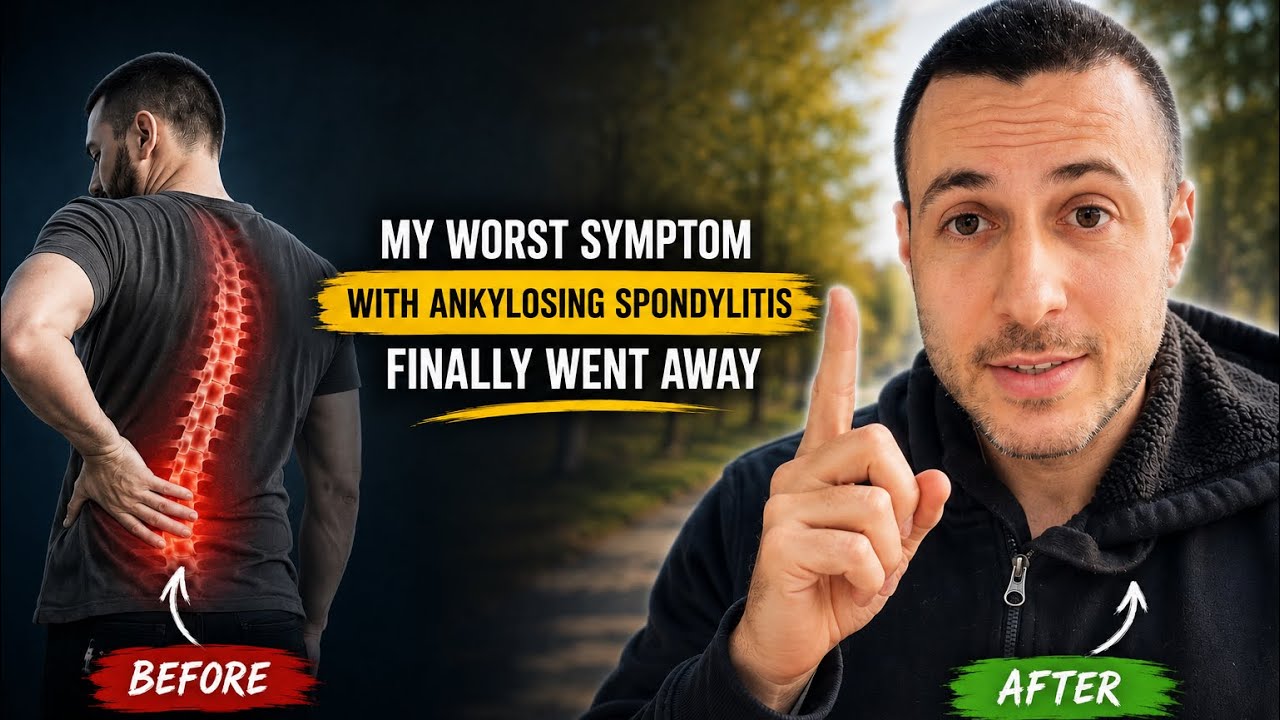
When Exercise Causes MORE Pain With Ankylosing Spondyli… — Transcript

Learn how to manage ankylosing spondylitis pain during exercise and find effective movement strategies to avoid flares and soreness.

Key Takeaways

  • Exercise can cause more pain in ankylosing spondylitis if not tailored properly.
  • Tracking pain and soreness after activities is crucial to find safe exercises.
  • Start with gentle movements and gradually build strength and flexibility.
  • Avoid overstretching inflamed areas to prevent symptom flares.
  • Personalized exercise plans are necessary due to individual differences.

Summary

  • Exercise is often recommended for ankylosing spondylitis, but many experience increased pain and flares from certain movements.
  • Symptoms can worsen with common activities like walking or stretching due to inflammation and muscle stiffness.
  • It's important to track which exercises cause pain and which do not, noting duration and intensity thresholds.
  • A personalized training program focusing on gentle movement, circulation, and gradual strength and flexibility gains is essential.
  • Muscle guarding and compensations can occur throughout the body, not just in the spine or SI joints.
  • Reduced range of motion and supported stretches can help manage symptoms without causing flares.
  • Keeping a detailed log of exercises and symptoms helps identify safe and effective movements.
  • Avoid overstretching or over-rotating inflamed areas to prevent worsening symptoms.
  • Progression should be gradual, with attention to soreness after exercise to adjust intensity.
  • Individual responses vary greatly, so customization and careful monitoring are key to successful exercise management.

Full Transcript — Download SRT & Markdown

00:01
Speaker A
You're told with ankylosing spondylitis, get moving, get exercising, try physical therapy, try swimming, try anything you can to keep moving, but a lot of exercises are causing more pain, they're causing flares, they're causing more soreness afterwards, and they're making symptoms worse.
00:17
Speaker A
symptoms worse. This is something I hear so often with ankylosing spondylitis. Exercise, even walking, are making symptoms worse, so then we don't want to do them because of that. No one wants to be in more pain. We're trying to get rid
00:30
Speaker A
This is something I hear so often with ankylosing spondylitis. Exercise, even walking, is making symptoms worse, so then we don't want to do them because of that.
00:46
Speaker A
symptoms worse, and this is one of the biggest factors of spondylitis because it's true.
00:53
Speaker A
No one wants to be in more pain. We're trying to get rid of the pain, we're trying to reduce symptoms.
01:08
Speaker A
really stiff and tight, getting really weak also, so we start dealing with all these different compensations, not just in the spine, not just in the SI joints, but it can be throughout the whole body. It can be the feet, the foot
01:21
Speaker A
So, this is something I hear very, very, very often with ankylosing spondylitis, and this happened to me, too. Certain exercises, certain stretches even, even if it seemed like a pretty easy stretch, were making my symptoms worse, and this is one of the biggest factors of spondylitis because it's true.
01:37
Speaker A
different problems other than the main kind of primary inflammation in different areas. And this is where we need a training program. First, we need a training program to get started, just to get movement, circulation, and blood flow, but we also need kind of long-term
01:56
Speaker A
We need to get stronger, we need to get as flexible as humanly possible at any stage in this journey. We want flexibility everywhere, everywhere, we want strength everywhere, because what happens is the inflammation leads to the muscles start guarding themselves, getting really stiff and tight, getting really weak also, so we start dealing with all these different compensations, not just in the spine, not just in the SI joints, but it can be throughout the whole body.
02:12
Speaker A
for ankylosing spondylitis. I'm stretching the upper body, I'm overly rotating the upper body, um strength training, but I keep having um an increase in symptoms, and my soreness is too much, and I'm just getting into flares, I'm making flares
02:29
Speaker A
It can be the feet, the foot pain, plantar fasciitis, Achilles pain. We're talking about injuries that can start popping up in the elbow, tennis elbow can start popping up from the tightness in the chest that can go down the arm, the neck pain, so we can start dealing with a lot of different problems other than the main kind of primary inflammation in different areas.
02:40
Speaker A
Especially, a client comes to me and they say, you know, it seems like all I can do is walk or for some clients, they're trying to walk, and the walking's even causing pain in the low back. So, let's break
02:51
Speaker A
And this is where we need a training program. First, we need a training program to get started, just to get movement, circulation, and blood flow, but we also need kind of long-term strength and flexibility for the whole body.
03:06
Speaker A
this is where we need to first keep track of everything. Keep track of even the simplest things. Okay, I can walk for 10 minutes without pain, but once I get above that threshold, that's where I get pain or
03:21
Speaker A
So, a problem I see a lot, like I was saying, is exercise is causing more pain, stretching's causing an increase in symptoms. This happened to me where I'm trying all these things that I think are great for ankylosing spondylitis. I'm stretching the upper body, I'm overly rotating the upper body, um strength training, but I keep having um an increase in symptoms, and my soreness is too much, and I'm just getting into flares, I'm making flares worse.
03:30
Speaker A
Uh for me, I was jotting down stretches that were really simple stretches I was doing around the house, and I was reducing the range of motion on them. I was jotting down what worked for me, even if it was calf raises, calf
03:42
Speaker A
So, I want to give the tips that have helped me that have transformed my life with ankylosing spondylitis, but also the tips I've given clients who were really in this rut.
03:56
Speaker A
What are the movements I can just do that don't cause any pain? That's where we start.
04:01
Speaker A
Especially, a client comes to me and they say, you know, it seems like all I can do is walk or for some clients, they're trying to walk, and the walking's even causing pain in the low back. So, let's break this down.
04:16
Speaker A
First make a list of exercises that work for you. So, those are the exercises we can at least start to build on while we try to figure out the rest of the body.
04:26
Speaker A
The first thing is, everyone is completely different with this. Some people, one exercise could be perfect for them, it could really just be perfect for the body, and that same exercise could be horrible for someone else, and this is where we need to first keep track of everything.
04:36
Speaker A
If you're getting way too sore after the workout, say you do a routine that feels good, but you keep getting this increased soreness afterwards, we want to jot these things down cuz then we're going to have to reduce the
04:47
Speaker A
Keep track of even the simplest things. Okay, I can walk for 10 minutes without pain, but once I get above that threshold, that's where I get pain or I'm trying different exercises for my low back, and it just seems to make things worse.
04:57
Speaker A
make sure we're feeling good after we do things. Even if the even if the movement, the exercise feels good in the moment, but afterwards you're way too sore, we just want to make sure we're keeping track of that because we don't want we want
05:10
Speaker A
First is jot down everything. I don't care how simple it is.
05:17
Speaker A
So, paying attention to everything, jotting everything down, what movements work, what movements don't work, and this is to a T. So, we want to make sure, all right, this movement works, but if I do too many repetitions, it starts causing
05:32
Speaker A
Uh for me, I was jotting down stretches that were really simple stretches I was doing around the house, and I was reducing the range of motion on them. I was jotting down what worked for me, even if it was calf raises, calf stretches, supported downward dog, so a downward dog holding onto the wall.
05:43
Speaker A
Maybe it's the form, but these are all things we want to keep track of because maybe the exercise is fine, but we're just doing too much of it, and that could be with anything, with walking, also. Maybe a 10, 15-minute walk feels good, but
05:56
Speaker A
I was jotting down things that just didn't cause pain, and I was making kind of my beginner my the the the guide, the basics for me.
06:01
Speaker A
So, duration is a thing, but also maybe we want to do things around that movement that could help. So, before a walk, maybe you can walk a little bit before it causes pain, but if that pain's happening after 20 minutes, maybe
06:16
Speaker A
What are the movements I can just do that don't cause any pain? That's where we start.
06:28
Speaker A
reduce some of that soreness. So, this is where it's so important to start keeping track of everything and piecing together what works for you. For me, I know in the mornings, I have the very particular routine.
06:42
Speaker A
Anything. I don't care if it's supported stretches, reduced range of motion. I don't care what part of the body it is, it could be curls with weights, it could be band pull-aparts for the upper back, it could be machines that work.
06:53
Speaker A
house, and I start putting together some of these reduced ranges of motion stretches because when I wake up and that low back's tight, I don't want to just get right into stretching the low back, it always makes it worse. So, I learned for me I was
07:06
Speaker A
First make a list of exercises that work for you. So, those are the exercises we can at least start to build on while we try to figure out the rest of the body.
07:17
Speaker A
thing for progressing exercise with ankylosing spondylitis. We want to stay away from that inflamed area. For some, maybe they can get into some stretches. Say you wake up with that low back pain and stiffness, and you start stretching it, and it feels
07:31
Speaker A
Number two is going to be paying attention to the aftereffects of exercises, and this goes with jotting down everything.
07:45
Speaker A
about the rest of the body. I'm thinking about things that have nothing to do with the low back, and this is where I'm jotting things down.
07:50
Speaker A
If you're getting way too sore after the workout, say you do a routine that feels good, but you keep getting this increased soreness afterwards, we want to jot these things down because then we're going to have to reduce the duration of the workout.
08:04
Speaker A
from trying things and then just saying, forget about it, it's not working for me, to okay, I can do different things.
08:11
Speaker A
We want to make sure it's not too much on the body, that we're progressing it gradually. So, first we have the list of exercises that feel good. Second's going to be we want to make sure we're feeling good after we do things.
08:27
Speaker A
you know, if the low back's bothering us, and we're trying to stretch the low back, and it's aggravating it, we can have different options to help the low back, and then it's really uplifting the whole day, transforming the day, and
08:41
Speaker A
Even if the movement, the exercise feels good in the moment, but afterwards you're way too sore, we just want to make sure we're keeping track of that because we want reduced soreness with this.
08:56
Speaker A
these trends. All right, in the morning, I'm going to stay away from that. All right, for some reason, when I try to overly rotate the back and do all these twisting things, it just makes things worse. I'm going to get rid of it for
09:07
Speaker A
We want to build so there's reduced soreness, so maybe we start a little slower with that.
09:21
Speaker A
when I have a new client, and nothing seems to work, we're kind of starting from scratch.
09:26
Speaker A
So, paying attention to everything, jotting everything down, what movements work, what movements don't work, and this is to a T.
09:35
Speaker A
What can we build on right now? And I'll have clients where say we have five exercises, maybe one exercise we're doing six repetitions cuz that's the perfect place, no pain.
09:46
Speaker A
So, we want to make sure, all right, this movement works, but if I do too many repetitions, it starts causing pain.
09:58
Speaker A
place where we can keep perfect form, perfect posture, no risk of injury. So, it's very, very particular how we're building. And you know, there's a way for us to move where we don't have to track everything.
10:12
Speaker A
That's where we have to really carefully jot down, all right, I can do six repetitions, eight repetitions of a bridge, but if I start doing 10, 15 reps, for some reason my low back hurts.
10:24
Speaker A
I said, we need to focus on strengthening and flexibility for the whole body. The last thing I'll say is when I've had different areas, the low back, the neck, the mid back, sometimes when I stay away from that area and I
10:38
Speaker A
Maybe it's the form, but these are all things we want to keep track of because maybe the exercise is fine, but we're just doing too much of it, and that could be with anything, with walking, also.
10:49
Speaker A
some blood flow into the mid back, work on the core, the neck gets better. So, it's a it can become a really complex thing where it's like what should I do with this because it seems like I'm try I'm trying to get the low back
11:05
Speaker A
Maybe a 10, 15-minute walk feels good, but then when you get to 20 minutes, the low back starts to grab, or the hip feels off.
11:17
Speaker A
different things. That's where a lot of people get kind of held up where even they go to physical therapy and they're getting injured or tweaking something because they're just sticking to the same program. For me, I'm always keeping track of everything,
11:29
Speaker A
So, duration is a thing, but also maybe we want to do things around that movement that could help.
11:41
Speaker A
progress our movement to become much better flexibility and strength, keeping track of everything. So, I want folks to really, if you're really struggling, nothing seems to work, start from scratch. Jot down what works, what doesn't cause pain, start building the
11:59
Speaker A
So, before a walk, maybe you can walk a little bit before it causes pain, but if that pain's happening after 20 minutes, maybe we think about the warm-up.
12:17
Speaker A
good. That also is a big part of this. Jot that down. It doesn't mean the exercise is no good. Sometimes, guys, we just fall into these kind of areas of inflammation and holes with this, but we know the trends generally,
12:32
Speaker A
Maybe you want to do a few things before we walk, get the body going, get the body activated, the core, the hips, the hamstrings, or we want to think about maybe stretching after the walk to reduce some of that soreness.
12:44
Speaker A
try different things, but this is where we keep track of everything, and overall the trends will really help us, and you'll start to understand your body type, what helps, what helps the symptoms, what doesn't help, and you can
12:55
Speaker A
So, this is where it's so important to start keeping track of everything and piecing together what works for you.
Topics:ankylosing spondylitisexercise painphysical therapyinflammationpain managementstretchingstrength trainingflexibilityflare managementchronic pain

Frequently Asked Questions

Why does exercise sometimes cause more pain in ankylosing spondylitis?

Exercise can increase pain due to inflammation, muscle stiffness, and compensations in the body. Overstretching or over-rotating inflamed areas can trigger flares and soreness.

How can I safely exercise with ankylosing spondylitis?

Start with gentle movements that do not cause pain, track your symptoms closely, reduce range of motion if needed, and gradually build strength and flexibility with a personalized program.

What should I do if walking causes pain in my low back?

Monitor how long you can walk without pain and avoid exceeding that threshold. Incorporate supportive stretches and exercises that improve circulation and strength without aggravating symptoms.

Get More with the Söz AI App

Transcribe recordings, audio files, and YouTube videos — with AI summaries, speaker detection, and unlimited transcriptions.

Or transcribe another YouTube video here →