1.7.2. Capstone project Overview — Transcript

Overview of the capstone project to design a startup venture with teamwork, strategic questioning, and evaluation on the Smile platform.

Key Takeaways

  • Capstone project focuses on practical startup creation through teamwork and strategic inquiry.
  • High-quality, original questions are critical to uncovering and addressing startup weaknesses.
  • Collaboration and transparency among team members are essential for evaluation.
  • Strict adherence to project structure, naming, and quality standards is mandatory.
  • The project is competitive and requires serious commitment and intellectual discipline.

Summary

  • The capstone project marks the transition from learning to founding a startup, requiring teamwork of exactly seven participants.
  • Teams must create a startup venture on the Smile platform, following a structured process with 12 activity stages covering the full startup journey.
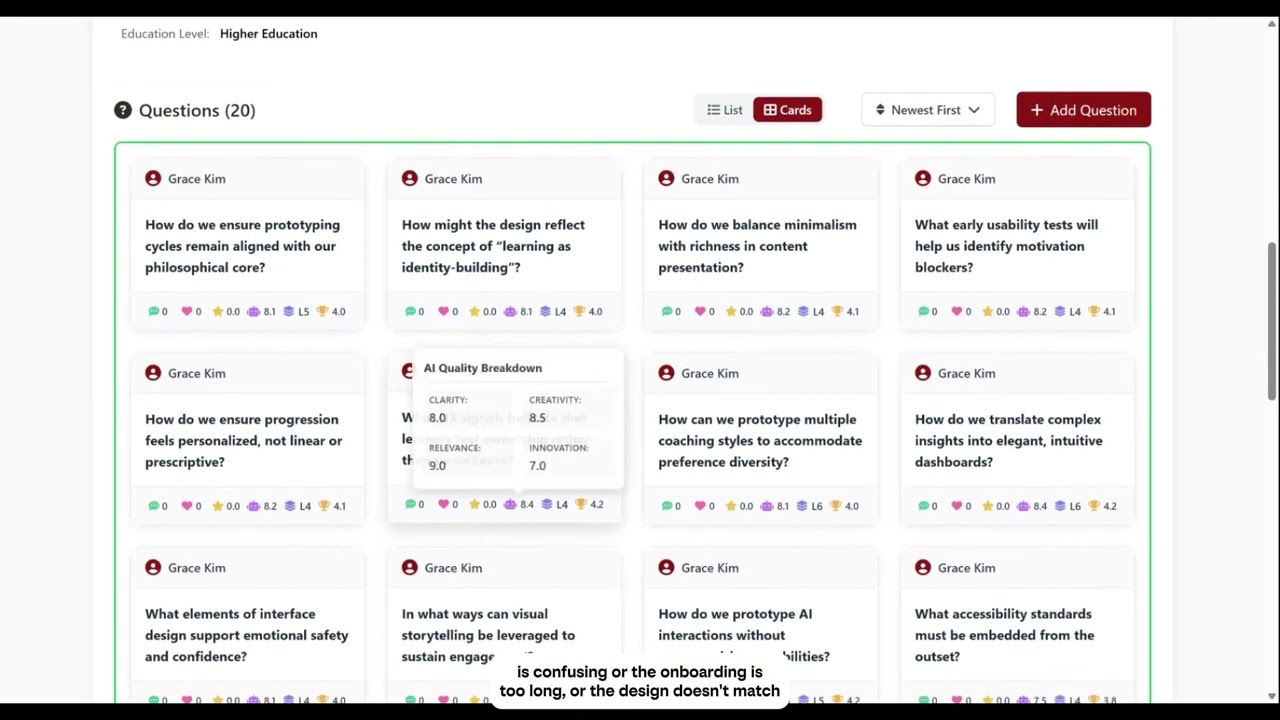
  • Each stage requires posting exactly 20 original, high-quality critical questions, totaling 240 questions per team.
  • Questions must meet strict quality standards, including Bloom's taxonomy level 4 and a minimum AI evaluation score of 5 out of 10.
  • AI auto-generation of questions is prohibited; the project emphasizes deep strategic thinking, debate, and intellectual collaboration.
  • Teams must name their group 'Kazak Venture' and ensure all members join to demonstrate real collaboration.
  • Evaluation criteria include completeness, question quality, venture concept depth, full startup journey coverage, and team collaboration.
  • The project requires about 10 hours of focused teamwork and is competitive, with only the top 60% of participants advancing.
  • The Swiss cheese model is used to illustrate how aligned weaknesses cause startup failure, emphasizing the importance of identifying and addressing gaps early.
  • Successful completion grants an official certificate of completion and eligibility to progress to the next course stage.

Full Transcript — Download SRT & Markdown

00:05
Speaker A
Welcome to the final and most important stage of program one, the capstone project: design your startup venture.
00:12
Speaker A
Over the past weeks, you have studied AI fundamentals, entrepreneurship, industry trends, real-world case studies, and design thinking. Now it is time to move from theory to execution. This project marks your transition from learner to founder. You are no longer just
00:28
Speaker A
analyzing startups. You are building one. You will work in teams of seven participants. Each team will form one startup venture and develop it step by step inside the Smile platform. This is not a theoretical assignment. Your work will be structured, visible, and
00:44
Speaker A
evaluated directly in Smile. This capstone is built on a simple but powerful principle. Startups fail not because of one dramatic mistake but because of unanswered questions. If critical questions are not raised early, weaknesses remain hidden. When those weaknesses accumulate and align, the
01:02
Speaker A
venture collapses. To understand this, consider the Swiss cheese model. In aviation, catastrophic accidents rarely occur because of a single flaw. They happen when multiple small weaknesses across different layers of a system align. One gap may not be dangerous on
01:18
Speaker A
its own, but when several gaps line up, failure becomes inevitable. Startups operate in the same way. A slightly weak value proposition may survive. An imperfect go-to-market strategy may be adjustable. A partially validated market assumption may still be fixable.
01:35
Speaker A
However, when weaknesses align across problem framing, user segmentation, market analysis, business model design, execution strategy, and scaling logic, the probability of failure increases dramatically. Your responsibility as a team is to ensure that those gaps do not align. Before you begin, carefully
01:55
Speaker A
review the sample Smile group featuring the fictitious company Inspire. Study its structure, depth, and logic. In addition, you must watch all Loom videos attentively and read the written instructions in full. The Loom videos explain the exact workflow, naming
02:11
Speaker A
requirements, quality standards, evaluation logic, and common mistakes. Skipping this step will likely lead to technical errors or lower scores. Now, let's clarify what you must do. First, form your team of exactly seven participants and agree on a single
02:29
Speaker A
startup idea. Alignment at this stage is critical. Make sure you clearly define the problem you are solving, who you are solving it for, and why it matters.
02:39
Speaker A
Second, create a Smile group named exactly Kazak Venture. The naming format is mandatory and will be used for evaluation tracking. Third, ensure that all seven team members join the group so their names appear in the membership list. This is part of the evaluation
02:55
Speaker A
criteria and demonstrates real collaboration. Fourth, create 12 activity stages that cover the complete journey of launching a startup. These stages should follow the structure demonstrated in the Inspire sample group.
03:08
Speaker A
Moving from vision and philosophy to problem reframing, validation, market strategy, business model design, execution, scaling, and sustainability.
03:20
Speaker A
Your 12 stages must represent the full logical architecture of building a venture. Fifth, for each of the 12 stages, you must post exactly 20 critical questions. That results in a total of 240 questions. You may review the sample questions for inspiration,
03:38
Speaker A
but you must not copy them. Your team must collaboratively develop original questions that reflect deep strategic thinking. Each question must include the name of the team member who formulated it. This ensures transparency and demonstrates distributed intellectual contribution within the team. There are
03:55
Speaker A
strict quality standards. Every question must reach at least level four on Bloom's taxonomy and score at least five out of 10 on the AI evaluation scale.
04:05
Speaker A
This means your questions must involve analysis, evaluation, strategic comparison, tradeoffs, risk assessment, or scenario modeling. Simple descriptive or surface-level questions will not meet the required standard. It is also important to state clearly, you must not use AI to auto-generate your questions.
04:25
Speaker A
This project is about thinking, debating, and building intellectual discipline as a team. The discomfort that arises during discussion is not a problem. It is evidence of serious thinking. There is no separate document submission. Your project will be evaluated directly
04:41
Speaker A
inside the Smile platform. What matters is what you build, how you structure it, the depth of your inquiry, and the visible collaboration among team members. The evaluation criteria include completeness, question quality, venture concept depth, full coverage of the
04:57
Speaker A
startup journey, and evidence of team collaboration. The passing threshold is 70%. All students who successfully complete the course and pass the required assessments will receive an official certificate of completion.
05:10
Speaker A
However, progression to the next stage is competitive. From a total cohort of 100,000 students, only the top 60,000 participants who complete the final assessment and receive certification will advance further. The selection process will be evaluated by artificial intelligence based on objective
05:29
Speaker A
performance metrics, structural quality, depth of inquiry, and demonstrated strategic thinking. This capstone requires approximately 10 hours of focused teamwork. Approach it seriously.
05:43
Speaker A
Challenge assumptions. Debate respectfully. Ask difficult questions. Reframe problems until your solution feels inevitable rather than optional.
05:52
Speaker A
Founders are not those who have perfect ideas. They are those who systematically eliminate blind spots. Now, build.
Topics:capstone projectstartup ventureteamworkstrategic questionsSmile platformentrepreneurshipAI evaluationbusiness modelstartup failureSwiss cheese model

Frequently Asked Questions

How many participants are required per team for the capstone project?

Each team must consist of exactly seven participants to form one startup venture and collaborate on the project.

What are the quality standards for the questions posted in the project?

Every question must reach at least level four on Bloom's taxonomy and score at least five out of 10 on the AI evaluation scale, involving analysis, evaluation, or strategic thinking.

Is it allowed to use AI to auto-generate the critical questions?

No, using AI to auto-generate questions is prohibited. The project emphasizes original thinking, debate, and intellectual discipline within the team.

Get More with the Söz AI App

Transcribe recordings, audio files, and YouTube videos — with AI summaries, speaker detection, and unlimited transcriptions.

Or transcribe another YouTube video here →