Boom Bap Drums Tutorial (How To Make Your Own Kit) — Transcript

Learn how to create authentic boom bap drum kits using the 3C method: character, cohesion, and content for better beats.

Key Takeaways

  • Use the 3C method (Character, Cohesion, Content) to craft boom bap drum kits.
  • Layering drum sounds is essential to achieve a full and natural boom bap drum sound.
  • Ensuring cohesion between drum elements prevents the beat from sounding disconnected.
  • EQ analysis helps identify frequency gaps that layering can fill.
  • Avoid digital or trap-style sounds that don't fit the boom bap aesthetic.

Summary

  • The video teaches how to transform existing drum sounds into boom bap drums using a step-by-step approach.
  • Navie D introduces the 3C method: Character, Cohesion, and Content for selecting and layering drum sounds.
  • Character involves choosing drum sounds that fit the boom bap style.
  • Cohesion ensures that all drum sounds work well together and feel connected.
  • Content focuses on layering sounds to create a full and complete drum presence.
  • The tutorial starts with high hats, explaining how to pick and layer them for fullness.
  • Navie D demonstrates how to use EQ to analyze frequency ranges and improve drum sound fullness.
  • The same 3C method is applied to snares, emphasizing the importance of punch and cohesion with other drums.
  • Free downloadable drum kits are provided via a link in the video description.
  • The video highlights common mistakes like using digital or 808-style sounds that don't fit boom bap.

Full Transcript — Download SRT & Markdown

00:00
Speaker A
So you want to make a boom bap beat, but you don't have the right drums?
00:00
Speaker A
You want to go and buy a drum kit, or maybe you have, and the sounds in them just aren't that great.
00:00
Speaker A
In this video, I'm going to be showing you guys step-by-step how you can take your drums that you already have and turn them into boom bap drums and make your beats better.
00:00
Speaker A
So I'm going to be using the beat that you guys heard in the intro as a step-by-step example of how to make your own boom bap drums.
00:00
Speaker A
All the drums that you heard are actually stock sounds. I was able to turn them into boom bap drums using this formula that I came up with.
00:00
Speaker A
I've used this thousands of times whenever I'm making a new kit for the beat that I'm working on.
00:00
Speaker A
I call this formula the 3C method. What that stands for is character, cohesion, and content.
00:00
Speaker A
Now, what does that mean exactly? What I want you to do is follow these three steps whenever you're making your drums.
00:00
Speaker A
Step one is picking the right sounds for the type of beat that you're making, that's character.
00:00
Speaker A
Step two is playing the sound with the rest of the sounds that you've already chosen to make sure it feels like it belongs and it doesn't feel disconnected, that's cohesion.
00:00
Speaker A
Step three is picking other sounds to layer on top to make sure the sound that you've already chosen feels full and complete, that's content.
00:00
Speaker A
Now I'll show you what I mean in more detail here with this beat.
00:00
Speaker A
So at the beginning stages of your beat, you already have your loop ready, and now it's time to add on the drums.
00:00
Speaker A
Usually with a boom bap beat, I find a good place to start is with the high hats.
00:00
Speaker A
The high hats and the snares are usually the most prominent part of boom bap drums, and so it's just naturally a good place to start.
00:00
Speaker A
In this example, I will start with the high hats.
00:00
Speaker A
So, using the 3C method, let's start with character. What that means is finding a high hat that fits the character of a boom bap beat.
00:00
Speaker A
If I'm making a boom bap beat, using a high hat that sounds like this, it's just not going to sound right.
00:00
Speaker A
This is a high hat from an 808 pack, and so just naturally it's not going to feel like it fits the character of a boom bap type beat.
00:00
Speaker A
What we need to do is find a high hat that actually fits.
00:00
Speaker A
So going through my drums, I eventually found this one here.
00:00
Speaker A
So as you can hear, it just has the right character to it. It feels like it would fit in a boom bap beat, compared to the other wrong high hat that I showed you guys prior that just feels a little bit more digital and too computerized to fit with a boom bap beat.
00:00
Speaker A
So, since this high hat here has the right character to it, let's move on to step two.
00:00
Speaker A
By the way, guys, I put all these drums in a drum kit for you guys to download for free, so a link to that is in the description below.
00:00
Speaker A
So step two is cohesion. What that means is, does this sound like it fits with the other sounds that we've chosen?
00:00
Speaker A
Since we've just started here and this is the first sound that we're choosing, we can skip this step for now, but this is going to be more important later on in the video when I show you guys what I did for the kicks and the snares.
00:00
Speaker A
So after skipping the cohesion step because we only have one sound so far, let's move on to step three, which is content.
00:00
Speaker A
What this means is, does this high hat have the right presence in the beat?
00:00
Speaker A
For example, this high hat does sound good, it does have the right character, but does it sound full? Let's take a listen.
00:00
Speaker A
This high hat feels kind of weak actually. It does have the right character that we're looking for, but it doesn't feel like it fills out the entire beat.
00:00
Speaker A
If I open up an EQ here, I can show you what I mean. So when I play the high hat, it only takes up a certain part of the frequency range.
00:00
Speaker A
This high hat mostly resides in the 2 to 10K range.
00:00
Speaker A
But when you're making a boom bap beat, what you want to do is make sure that all of your drum sounds have more of a full range compared to other types of beats.
00:00
Speaker A
The reason why is because in boom bap beats, the drums sort of have to feel like they come from the same drum break almost.
00:00
Speaker A
So you want to do is make sure all the sounds that you choose have more of a full frequency range.
00:00
Speaker A
Otherwise, what could happen is that your drums will sound very disconnected from each other and they won't really feel natural in the beat.
00:00
Speaker A
This isn't that big of a problem for beats like trap, for example, but for a boom bap beat where we want to make sure the drums sound like they actually come from the same drum break, it's a very important thing to consider.
00:00
Speaker A
So when it comes to fixing the content of this high hat, what I need to do is find another high hat that fills out what this high hat doesn't have.
00:00
Speaker A
What I want to do is find another high hat to layer on top and also sounds like it has what the first high hat was missing.
00:00
Speaker A
I ended up using this high hat here, and I layered it on top of the first one.
00:00
Speaker A
As you can hear, it just feels a lot more different than the first one that I chose.
00:00
Speaker A
The first high hat that I chose has good character, but it doesn't have the full content that I need.
00:00
Speaker A
The reason why is just because it feels so thin, it doesn't feel like it has a full presence in the beat.
00:00
Speaker A
So what I need to do is add layers on top to make sure my high hats do fill up enough space.
00:00
Speaker A
So I added this second high hat on top to make sure it sounds more full.
00:00
Speaker A
So now let's hear how the high hat sounds with the rest of the beat now.
00:00
Speaker A
So if we look at the EQ here, the high hats now have a lot more of a presence compared to just the first high hat that I played.
00:00
Speaker A
Once again, this only has a 2 to 10K presence, whereas if I add the other high hat back in, it just takes up a little bit more room down here and sounds a lot more full.
00:00
Speaker A
So again, first I found a high hat that has good character to it.
00:00
Speaker A
I don't have to worry about cohesion so far just because this is the first sound that we've chosen.
00:00
Speaker A
And then after the fact, I found a good high hat to layer on top just to fill out the content that the first high hat was missing.
00:00
Speaker A
So now we're going to move on to the snares.
00:00
Speaker A
So again, step one, we find a snare that has the right character.
00:00
Speaker A
Again, these types of snares here won't do us any good.
00:00
Speaker A
These snares don't fit the character of the beat that we're making, and so it's just a good idea to avoid these types of snares.
00:00
Speaker A
They are way too digital and computerized sounding.
00:00
Speaker A
So going through all my sounds, I eventually found this snare here, which feels like it fits a boom bap type of beat.
00:00
Speaker A
So, this is a good starting point.
00:00
Speaker A
This snare has the right character to it, and so we will move on to step two, which is cohesion.
00:00
Speaker A
Since we have the high hats programmed in already, at this point, we have to make sure that every single sound that we choose going forward fits with what we've already chosen before.
00:00
Speaker A
We have to make sure everything works well together. This is the idea of cohesion.
00:00
Speaker A
For example, if I played one of the wrong snares with the high hats, tell me if this sounds good to you.
00:00
Speaker A
Now if we compare that to the snare that I did choose, it just sounds a lot more cohesive. It doesn't feel like it's out of place now.
00:00
Speaker A
Again, cohesion is a very important step in making sure that your drums don't feel disconnected or disjointed from each other.
00:00
Speaker A
Skipping this step can really lead your beat to sounding really amateur and just a lot worse.
00:00
Speaker A
So we've got character and cohesion done. Now step three is content.
00:00
Speaker A
So let's check the content of the snare by playing everything all together and making sure it feels like it's full.
00:00
Speaker A
To me, this snare sounds like it's kind of weak. It feels like it's missing something.
00:00
Speaker A
It doesn't have the content that I need out of a snare. It doesn't feel like it has the punch that a snare should have.
00:00
Speaker A
Again, like that first high hat that I chose, it just feels a bit too thin.
00:00
Speaker A
So what I'm going to do now is find another snare that helps fill the content that the first snare is missing.
00:00
Speaker A
Eventually, I found this snare here.
00:00
Speaker A
As you can hear, it just has a little bit more punchiness to it, a little bit more presence, which is exactly what the first one was missing.
00:00
Speaker A
Let's look at the snares themselves though.
00:00
Speaker A
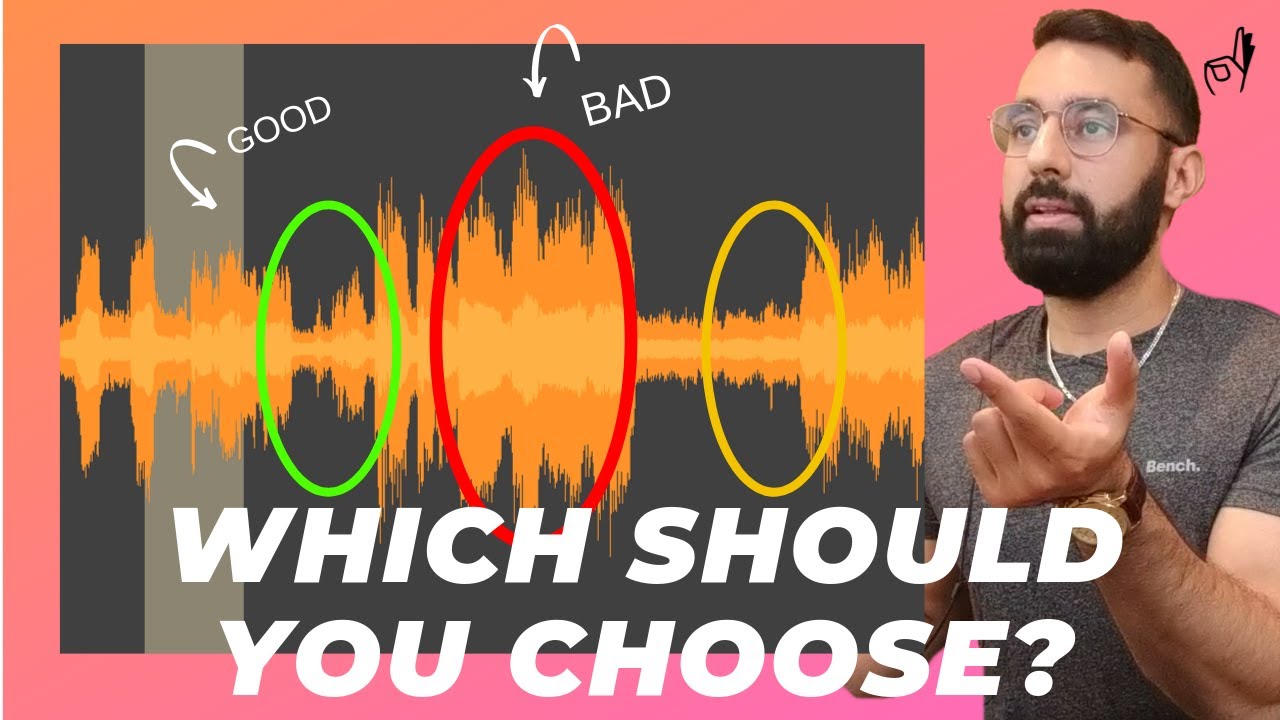
So this is our first snare here. While it did have good character, it looks like a pretty dull snare.
00:00
Speaker A
Just by looking at the shape of it, you can see it doesn't have much attack, much punch to it in the beginning.
00:00
Speaker A
If we compare this to our second snare, the shape is just much different.
00:00
Speaker A
This snare just has a lot more punch and a lot more attack to it.
00:00
Speaker A
Lastly, as a bonus tip, I also added a clap on top as you can see here, just to add a little bit more character to the snare.
00:00
Speaker A
Adding things like claps, cowbells, or claves can just help bring a different type of character to the snare.
00:00
Speaker A
So feel free to just experiment with this idea.
00:00
Speaker A
So if we were to compare how this snare sounds now with a little bit more content, let's hear how the beat sounds.
00:00
Speaker A
So as you can hear, it just feels a lot more full.
00:00
Speaker A
All right, lastly, let's move on to the kicks.
00:00
Speaker A
Again, step one, character.
00:00
Speaker A
Again, we're looking for a kick that has the right character for a boom bap type of beat.
00:00
Speaker A
Choosing a kick like this, it's just not going to fit.
00:00
Speaker A
I mean, I've heard thousands of boom bap songs, I've never heard a kick like that in one for good reason too.
00:00
Speaker A
Eventually though, I did find this kick here.
00:00
Speaker A
Again, this is the exact type of kick that we're looking for. It fits perfectly with the type of beat that we're making.
00:00
Speaker A
Step two, once again, cohesion. Let's play this kick with the other drum sounds that we've made so far to make sure it feels like it gels well.
00:00
Speaker A
So it sounds cohesive to me.
00:00
Speaker A
As an example of what doesn't sound cohesive, I'll play that wrong kick that I showed you guys first.
00:00
Speaker A
Yeah, I really shouldn't have to explain why that sounds awful, it just does.
00:00
Speaker A
So step three is content, and let's hear how this kick sounds with the rest of the beat.
00:00
Speaker A
So you might need headphones or speakers to hear this, but the kick doesn't really feel like it's cutting through.
00:00
Speaker A
Once again, it just sounds like it's weak.
00:00
Speaker A
Something in that kick isn't present, and so we have to find another kick, a sub kick, underneath in order to make it sound a lot more full.
00:00
Speaker A
All right, so now let's hear how this sounds all together.
00:00
Speaker A
All right, so we have the high hats, we have the snares and the kicks, and we were able to put our own drum kit together using the 3C method.
00:00
Speaker A
And we did so using stock sounds as well.
00:00
Speaker A
So now let me show you how this beat would sound if we didn't follow the 3C method and we just chose any old drums.
00:00
Speaker A
So as you can hear, it just sounds like junk.
00:00
Speaker A
Following the 3C method has helped us make a much better beat.
00:00
Speaker A
So to summarize, when you're making your own drum kit for a beat, what you need to do is follow these three steps.
00:00
Speaker A
Step one is picking a sound that feels like it fits with the type of beat that you're making, character.
00:00
Speaker A
Step two is play the sound with the rest of the sounds that you've already chosen to make sure it feels like it fits and it feels like there is a connection between them, that's the idea of cohesion.
00:00
Speaker A
Step three is to pick other sounds that help complement the sounds that you've already chosen in order to make them feel more full and complete, that's content.
00:00
Speaker A
And that is how you make your own boom bap drums.
00:00
Speaker A
If you found this video helpful, please leave a like, a comment, and please do subscribe and hit the bell notification.
00:00
Speaker A
Again, free boom bap drum kit can be found in the description below. See you guys next Tuesday.
Topics:boom bap drumsdrum kit tutorialmaking drum kits3C methodcharacter cohesion contenthip hop drumsdrum layeringbeat makingNavie Ddrum sound design

Frequently Asked Questions

What is the 3C method mentioned in the video?

The 3C method stands for Character, Cohesion, and Content. It is a step-by-step formula for selecting and layering drum sounds to create authentic boom bap drums.

How do I make my high hats sound fuller in a boom bap beat?

You can layer multiple high hat sounds that complement each other’s frequency ranges to create a fuller, more complete sound that fits the boom bap style.

Why is cohesion important when making drum kits?

Cohesion ensures that all drum sounds fit well together and don’t feel disconnected, which is crucial for making professional-sounding boom bap beats.

Get More with the Söz AI App

Transcribe recordings, audio files, and YouTube videos — with AI summaries, speaker detection, and unlimited transcriptions.

Or transcribe another YouTube video here →