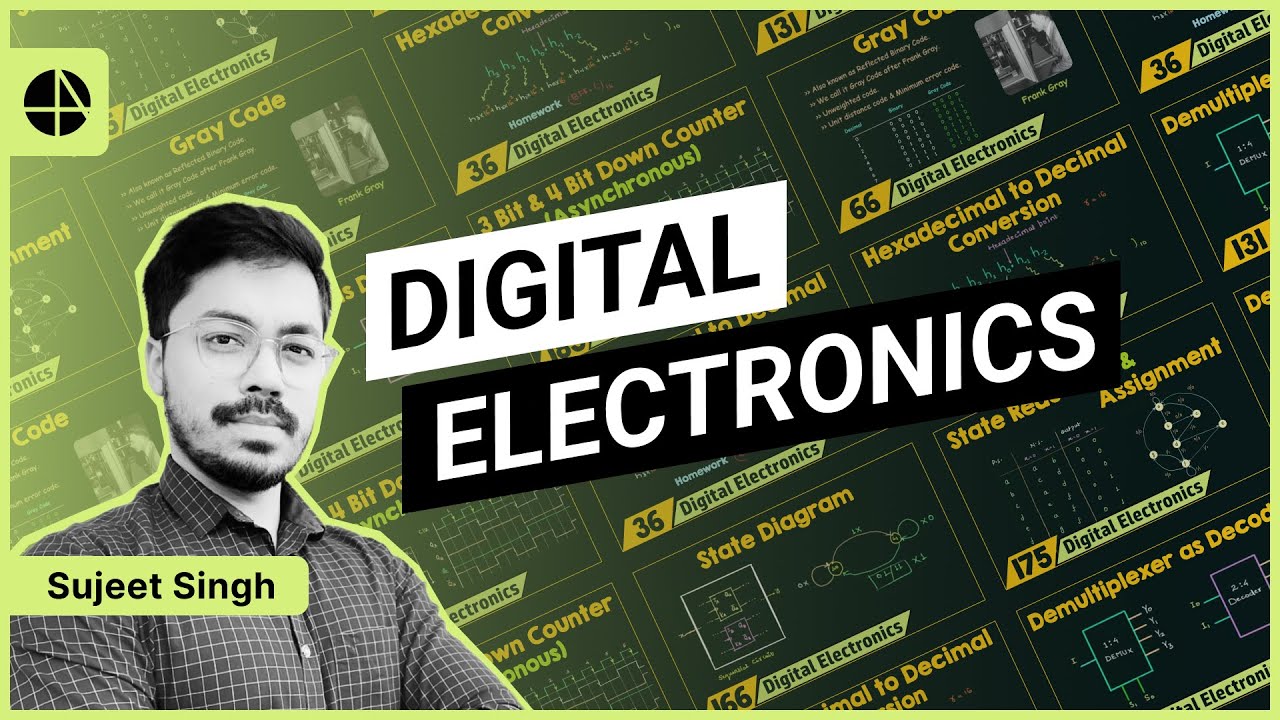
Introduction to Network Theory — Transcript

Comprehensive introduction to Network Theory covering syllabus, key concepts, and exam-focused examples for GATE preparation.

Key Takeaways

  • The course is designed to cover 80-90% of previous GATE exam questions with examples and homework.
  • Strong emphasis on understanding basics as they form the foundation for advanced topics.
  • The syllabus is structured into ten chapters covering theoretical and practical aspects of Network Theory.
  • Important theorems and analysis techniques are thoroughly discussed for both AC and DC circuits.
  • The course includes practical applications like resonance, filters, transients, and graph theory.

Summary

  • The video introduces the syllabus of Network Theory with a focus on GATE and competitive exam preparation.
  • Chapter 1 covers Basics including charge, current, voltage, power, energy, circuit elements, Kirchhoff's Laws, Mesh and Nodal Analysis, and transformations.
  • Chapter 2 discusses Two-Port Networks with parameters like Z, Y, H, G, T and interconnection models.
  • Chapter 3 explains Sinusoidal Steady State Analysis including phasors and steady-state analysis of various circuits.
  • Chapter 4 covers important theorems such as Superposition, Thevenin, Norton, Reciprocity, Millman, and Maximum Power Transfer.
  • Chapter 5 focuses on Transients in circuits with energy storing elements and Laplace Transform applications.
  • Chapter 6 explains Resonance including series and parallel resonance, quality factor, bandwidth, and dynamic impedance.
  • Chapter 7 introduces Graph Theory concepts like trees, co-trees, matrices, and their relations.
  • Chapter 8 covers different types of Filters including low-pass, high-pass, band-pass, band-elimination, and all-pass filters.
  • Chapters 9 and 10 discuss Magnetic Circuits and Locus Diagrams respectively, explaining dot polarity and current vector tracing.

Full Transcript — Download SRT & Markdown

00:00
Speaker A
Welcome to the first lecture of Network Theory. In this lecture, I will give you the syllabus of the subject, but before moving to the syllabus of the subject, I want to make one thing very clear to the Indian students.
00:16
Speaker A
If you are preparing for GATE or any other competitive examination, then the lectures are more than enough.
00:31
Speaker A
We will solve many examples to understand the core concepts of the subject, and I will solve almost 80 to 90% questions which appeared in the previous GATE exams.
00:46
Speaker A
And I will also give you homework problems so that you can practice the concepts on your own.
00:50
Speaker A
So let's move on to the syllabus of the subject. Chapter number one is Basics.
01:00
Speaker A
And this particular chapter is the most important chapter in the whole course. This is important because all the other chapters are based on the concepts of the Basics chapter.
01:41
Speaker A
Therefore, pay more attention to this particular chapter and try to understand all the basics so that it will be easy for you and also for me to complete the remaining chapters.
02:00
Speaker A
In the first chapter, the important topics are understanding of charge, current, voltage, power, and energy.
02:08
Speaker A
And once we are done with them, we will move on to the circuit elements, the first circuit element is resistor, and after this, we will discuss capacitor, then we will discuss inductor, and finally, we will talk about sources.
02:35
Speaker A
In sources, we will talk about ideal and practical voltage source, ideal and practical current source, dependent and independent sources, and there is one more topic in the sources, which is source transformation, but we will not discuss source transformation in the Basics chapter, we will discuss it in the Theorems chapter.
03:37
Speaker A
Because after having the understanding of Thevenin's and Norton's theorem, it is easy to understand the source transformation, and once we are done with all the different circuit elements, we will move on to the next topic, which is Kirchhoff's Laws.
04:16
Speaker A
In Kirchhoff's Laws, there are two laws, the first one is Kirchhoff's current law, and the second one is Kirchhoff's voltage law.
04:43
Speaker A
Then we will have discussion on Mesh Analysis, there are different models in Mesh Analysis, and we will understand all the different models one by one by the help of different examples.
05:16
Speaker A
Then we will understand Nodal Analysis, and again we have different models in Nodal Analysis, then we will move on to the series and parallel combinations of resistors, series and parallel combinations of capacitors, series and parallel combinations of inductors, and finally, we will have the discussion on Star-Delta Transformation and Delta-Star Transformation.
06:00
Speaker A
Remember, these are the important topics, there are many small-small topics in the chapter, and there are many different questions based on those topics.
06:12
Speaker A
So right now, we are only looking at the important topics we are having in the different chapters.
06:22
Speaker A
So this is all for the first chapter, now we will move on to the second chapter, which is Two-Port Networks.
06:30
Speaker A
And in this chapter, we will have discussion on different parameters, and they are Z parameters or impedance parameters, Y parameters or admittance parameters, H parameters or hybrid parameters, G parameters, T parameters or transmission parameters or ABCD parameters.
07:34
Speaker A
After this, we will talk about conditions for symmetry and reciprocity, then we will move on to the Bartlett Bisection Theorem, then we will have discussion on relation between two-port parameters, and finally, we will understand different interconnection models of two-port networks.
08:03
Speaker A
Different interconnection models are series-series interconnection, parallel-parallel interconnection, series-parallel interconnection, parallel-series interconnection, and the last one is cascade interconnection.
08:20
Speaker A
So these are the important topics in chapter number two, Two-Port Networks.
08:29
Speaker A
Now we will talk about chapter number three, which is Sinusoidal Steady State Analysis.
08:39
Speaker A
In this chapter, we will start our discussion with phasors, and then we will perform the steady-state analysis of resistor, the steady-state analysis of inductor, and the steady-state analysis of capacitor.
09:06
Speaker A
And then we will perform the steady-state analysis of series RL circuit, then we will perform the steady-state analysis of series RC circuit, in the same way, we will perform the steady-state analysis of series RLC circuit, parallel RL circuit, parallel RC circuit, and parallel RLC circuit.
09:40
Speaker A
And after this, I will explain what is root mean square value and the average value.
09:50
Speaker A
And the final topic will be complex power.
09:55
Speaker A
The fourth chapter will have different theorems.
10:00
Speaker A
And the theorems are Superposition Theorem, Thevenin's Theorem, Norton's Theorem, Reciprocity Theorem, Millman's Theorem, Compensation Theorem, Substitution Theorem, Tellegen's Theorem, and the last but the most important Maximum Power Transfer Theorem.
10:29
Speaker A
We will discuss Maximum Power Transfer Theorem for both AC and DC.
10:38
Speaker A
So this is all for the fourth chapter, and the fifth chapter is Transients.
10:53
Speaker A
Transients are present in the circuit whenever the circuit is subjected to any change and the circuit is having the energy storing elements like capacitor and inductor.
11:13
Speaker A
In this chapter, we will find out the transients in source-free RL circuit, transients in source-free RC circuit, we will also understand what is time constant, then we will find out transients in RL circuit with source, and transients in RC circuit with source.
11:53
Speaker A
Then we will talk about AC transients, and we will find out transients in series RLC circuit and parallel RLC circuit.
12:10
Speaker A
And finally, we will understand the application of Laplace Transform in finding out the transients.
12:20
Speaker A
The sixth chapter is Resonance, and in this chapter, we will first talk about series resonance.
12:29
Speaker A
And we will also talk about the quality factor and the bandwidth.
12:40
Speaker A
Then we will talk about parallel resonance, then we will talk about tank circuit, and finally, we will understand what do we mean by dynamic impedance.
12:54
Speaker A
The seventh chapter is Graph Theory, and in this chapter, we will understand what is tree, what is co-tree, what is subgraph, connected graph, and loop.
13:09
Speaker A
Then we will understand what do we mean by incidence matrix, tie-set matrix, and cut-set matrix.
13:24
Speaker A
We will also find out the relation between cut-set matrix and tie-set matrix.
13:34
Speaker A
The eighth chapter is on Filters, and in this chapter, I will explain low-pass filter, high-pass filter, band-pass filter, band-elimination filter, and the all-pass filter.
13:50
Speaker A
The ninth chapter is Magnetic Circuits, in this chapter, I will explain how to deal with the dot polarity.
14:00
Speaker A
And the final chapter, which is the tenth chapter, is Locus Diagram. In this chapter, I will explain how we can trace the path which will be formed by the tip of the current vector by varying any one circuit element or the frequency of the circuit.
14:35
Speaker A
So this is all for the syllabus of Network Theory, and I hope you will watch all the lectures in the proper sequence to avoid any confusion.
15:03
Speaker A
And from the next lecture, we will start with the basics of Network Theory, which is our chapter number one.
15:15
Speaker A
So this is all for this lecture.
15:16
Speaker A
See you in the next one.
Topics:Network TheoryGATE preparationCircuit AnalysisKirchhoff's LawsTwo-Port NetworksSinusoidal Steady StateElectrical TheoremsTransientsResonanceGraph Theory

Frequently Asked Questions

What topics are covered in the Basics chapter of Network Theory?

The Basics chapter covers charge, current, voltage, power, energy, circuit elements like resistors, capacitors, inductors, sources, Kirchhoff's Laws, Mesh and Nodal Analysis, resistor/capacitor/inductor combinations, and Star-Delta transformations.

How does this course help in GATE exam preparation?

The course solves 80-90% of previous GATE exam questions with examples and provides homework problems to practice, making it highly relevant for GATE preparation.

What is the focus of the Transients chapter in this course?

The Transients chapter focuses on analyzing transient responses in RL, RC, and RLC circuits with and without sources, understanding time constants, AC transients, and applying Laplace Transform techniques.

Get More with the Söz AI App

Transcribe recordings, audio files, and YouTube videos — with AI summaries, speaker detection, and unlimited transcriptions.

Or transcribe another YouTube video here →