My Multi-Agent Team with OpenClaw

Full Transcript — Download SRT & Markdown

00:00
Speaker A
Well, sitting on my desk is a new Mac Mini that I set up just for the purpose of running my team of AI agents.
00:07
Speaker A
Using Openclaw.
00:08
Speaker A
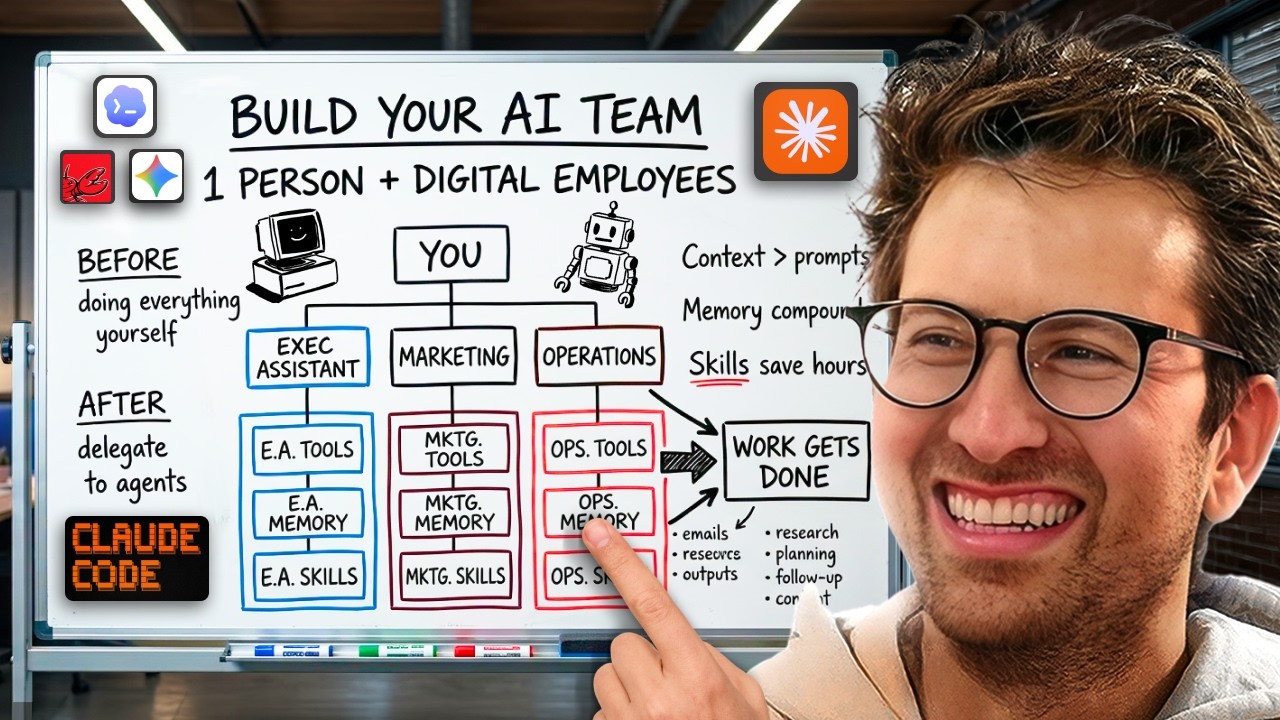
I've got a developer, a marketer, a project manager, a system admin.
00:13
Speaker A
They each have their own personality, they've got a queue of tasks tracked in this custom dashboard that I built.
00:17
Speaker A
And I'm chatting with them in Slack, just like I would with my real team members, except they're agents powered by Openclaw and various large language models.
00:26
Speaker A
What a time this is.
00:28
Speaker A
But, you know, getting this up and running was not a plug-and-play situation over the past week and many late nights, I had to figure out my answers to question after question, some technical, some strategic.
00:40
Speaker A
Like, should I order a new Mac Mini or can I run Openclaw on a VPS?
00:44
Speaker A
And what's this going to cost me in API tokens and could I use my Claude Max plan?
00:49
Speaker A
And what chat tool is best for my agents, Telegram or WhatsApp or Slack?
00:53
Speaker A
Should I have it power one agent or can I set up a team of agents?
00:57
Speaker A
And am I going to need a custom dashboard for managing them?
01:00
Speaker A
And let's not forget about security, what should my agents be able to access and how should I think about safeguards?
01:06
Speaker A
And most importantly, what's my use case here?
01:10
Speaker A
What will I have my team of agents actually do for me?
01:14
Speaker A
So, today I'll share where I've landed on all of those questions and I'll show you my setup for all of it.
01:19
Speaker A
You know, to be honest, I didn't see the appeal of Openclaw at first.
01:22
Speaker A
Back when it was called Claude Bot and then Multibot and it was buzzing around Twitter a couple weeks ago.
01:28
Speaker A
Everyone was talking about having their agent respond to their emails for them or book flights or order takeout.
01:34
Speaker A
And I don't want or need an AI agent in my personal life and I don't even want it to manage my calendar.
01:40
Speaker A
But then I started thinking about a real challenge that I've been having in my business and how setting up Openclaw could help me solve it.
01:47
Speaker A
You know, I run this YouTube channel and Builder Methods Pro and my courses and a weekly newsletter.
01:52
Speaker A
And thanks to things like Claude Code, of course, building things has never been easier.
01:56
Speaker A
But building is only half of what I do.
01:59
Speaker A
I develop training content, I manage a publishing pipeline.
02:02
Speaker A
And I oversee my membership business.
02:04
Speaker A
But lately, I've been bottlenecked, there's so much more that I want to create and deliver if only I had the bandwidth.
02:09
Speaker A
In my past businesses, I solved this by hiring real teams and building processes to help us scale.
02:14
Speaker A
And that worked, but the overhead was real too.
02:16
Speaker A
So, when I gave Openclaw another look, I asked a different question.
02:20
Speaker A
Not, do I want a personal assistant, but what if this could fill roles on my team?
02:26
Speaker A
And now I'm convinced that this paradigm, autonomous agents with defined roles running on their own machines, I think this is here to stay.
02:32
Speaker A
Now, Openclaw is just the first generation of what I think will be much bigger.
02:36
Speaker A
So, I want to be figuring this out now.
02:40
Speaker A
And maybe this video can help you get started too.
02:43
Speaker A
If you're new here, I'm Brian Casel.
02:45
Speaker A
I help builders stay ahead of the curve with AI.
02:50
Speaker A
And every Friday, I send my Builder Briefing, that's a free five-minute read where I give you my no-hype take on making this transition to adopting AI.
02:57
Speaker A
You can get yours by going to buildermethods.com.
03:00
Speaker A
And if you're serious about leveling up, check out Builder Methods Pro where you can join our community and get training for builders.
03:07
Speaker A
All right, so what actually is Openclaw?
03:10
Speaker A
It used to be called Claude Bot and then Multibot.
03:13
Speaker A
And how is this actually different from how you might use Claude Code or any other agent?
03:18
Speaker A
The core of Openclaw is what's called the Gateway.
03:21
Speaker A
That's a process running on a machine, which shouldn't be your personal machine, but we'll talk about security in a moment.
03:28
Speaker A
The Openclaw Gateway can run tools, it can use a browser, it can execute bash scripts.
03:33
Speaker A
Of course, Claude Code can do a lot of that too.
03:35
Speaker A
But what makes Openclaw different is that it's always on.
03:40
Speaker A
It maintains a persistent workspace with memory and session logs.
03:44
Speaker A
So, you can chat with your agents through Telegram or Slack and delegate tasks that they can do on their own in the background.
03:51
Speaker A
So that's a fundamentally different paradigm from you personally managing Claude Code sessions in your terminal.
03:58
Speaker A
Openclaw is closer to having teammates who do their work on their own workstations.
04:03
Speaker A
The first question is, where should this thing run?
04:06
Speaker A
Now, I don't recommend you run Openclaw on your daily driver machine.
04:13
Speaker A
You don't want to give it unfettered access to your files and your accounts.
04:16
Speaker A
And even if you isolate it with something like Docker, your machine would need to be on and awake 24/7 for your agents to work.
04:21
Speaker A
So, Openclaw needs its own dedicated machine.
04:25
Speaker A
That could be a cloud VPS starting at around five bucks a month.
04:29
Speaker A
Or it could be a physical machine.
04:32
Speaker A
Doesn't have to be a Mac Mini.
04:34
Speaker A
Any kind of computer on your network.
04:35
Speaker A
Both are valid and a lot of people are doing well with the VPS setups.
04:39
Speaker A
But I went ahead and I spent the 600 bucks on a new Mac Mini M4.
04:45
Speaker A
And call me old school, but I like to be able to screen share into it.
04:50
Speaker A
See the desktop, install things and manage it visually.
04:53
Speaker A
And I SSH in too when I just need to run a quick command.
04:58
Speaker A
And if I end up using my agent team for all the use cases that I have in mind, I'll need more storage and bandwidth than the cheap VPS tiers offer.
05:04
Speaker A
So, the cost would start to balance out anyway.
05:08
Speaker A
And hey, if none of this works out, I'll throw that Mac Mini up in my home music studio.
05:11
Speaker A
I'll use it up there.
05:13
Speaker A
So, I've got the dedicated machine.
05:16
Speaker A
But that's just the first layer, I need to think carefully about what my agents can and can't access.
05:21
Speaker A
Now, this is where the hiring metaphor really kicked in.
05:25
Speaker A
If I'm bringing someone onto my team, I wouldn't give them access to my personal laptop or let them loose on a browser where I'm logged into everything.
05:32
Speaker A
No, an employee would get their own machine, their own email, access to the files and services that they need with the right permissions.
05:39
Speaker A
Nothing more.
05:41
Speaker A
So, that's what I did, I set up a dedicated email address for my agents, I created a GitHub username that I can invite to specific repos.
05:50
Speaker A
I can grant and revoke access to services just like I would with any other team member.
05:55
Speaker A
Now, files were a bit trickier.
05:57
Speaker A
I want easy two-way syncing between my computer and the Openclaw workspace on the Mac Mini.
06:03
Speaker A
Especially since I'm developing a brain system where all my business activity gets logged into markdown files that my agents can access and work with.
06:10
Speaker A
More on the brain, maybe another time.
06:13
Speaker A
So, all my files live either in GitHub repos or my main Dropbox account.
06:19
Speaker A
But I don't want to just share my personal Dropbox with Openclaw.
06:22
Speaker A
That gives it access to way too much.
06:24
Speaker A
So, I had Openclaw set up its own Dropbox account and so the specific folders that I want to share between my main Mac and the Openclaw Mac Mini, both Dropbox accounts have access to those.
06:34
Speaker A
And so everything else stays walled off.
06:37
Speaker A
All right, let's talk about costs.
06:39
Speaker A
Because if you're not careful, you can easily run up hundreds or even thousands of dollars in token costs just chatting with your agents and running tasks.
06:46
Speaker A
I blew past $200 in the first two days of setting up my system.
06:51
Speaker A
Now, I already pay for a Claude Max plan.
06:54
Speaker A
And I was hoping that I could just use that.
06:56
Speaker A
But then I heard the stories of accounts being shut down because this type of usage might be against Anthropic's terms of service.
07:03
Speaker A
And then within a few days he upgraded to the $200 subscription.
07:06
Speaker A
Oh, euros, because he's in Australia.
07:08
Speaker A
And he was in love with that thing.
07:11
Speaker A
That for me was like a very early product validation.
07:15
Speaker A
It's like, I built something that captures people.
07:19
Speaker A
And then a few days later Anthropic blocked him because they said their rules using the subscription is problematic or whatever.
07:25
Speaker A
So there's real ambiguity there and I genuinely wish that there would be some official word one way or the other.
07:31
Speaker A
Now, I intend to play by the rules.
07:33
Speaker A
So here's where I landed.
07:35
Speaker A
My Claude Max plan stays for my personal use with Claude and Claude Code on my devices when I'm working.
07:40
Speaker A
My Openclaw agents use API tokens, completely separate.
07:44
Speaker A
I'm running those tokens through Open Router, which centralizes all my API usage and makes it easy to select from hundreds of models and providers.
07:50
Speaker A
More importantly, it lets me carefully optimize which agents use which models for which tasks.
07:57
Speaker A
You know, honestly, that optimization is probably where I spent the most time this past week.
08:03
Speaker A
Just figuring out which tasks need the power of Opus and which can run on cheaper, faster models.
08:09
Speaker A
Still, running this team of agents is not cheap.
08:12
Speaker A
And if you've been building with the frontier models, then you already know this isn't a free ride.
08:16
Speaker A
And from a business standpoint, if you compare the token costs to the cost of hiring multiple team members to do the work that can, maybe should be delegated to agents.
08:24
Speaker A
The ROI math gets pretty compelling.
08:26
Speaker A
Now, to the question of chatting with my agents.
08:28
Speaker A
Openclaw supports a wide range of chat tools.
08:31
Speaker A
I started with Telegram since that was the easiest to get up and running.
08:34
Speaker A
It worked for a few days and I was even able to set up separate Telegram bots for each agent.
08:38
Speaker A
I'll talk about my multi-agent configuration in just a minute.
08:42
Speaker A
But after a few days on Telegram, I found the interface just wasn't comfortable, especially when agents would send me markdown formatted content.
08:49
Speaker A
Which kind of works, kind of doesn't.
08:51
Speaker A
So, again, I'm working with my agents like I tend to work with teammates and my teams have always used Slack.
08:59
Speaker A
So, I set up Slack bots for each of my agents and that was super easy.
09:03
Speaker A
And Slack has great markdown support and I really like how we can use threaded replies and that makes it easy to manage multiple agents with multiple requests and responses flying around.
09:11
Speaker A
Now, here's what made Openclaw really click for me.
09:14
Speaker A
Instead of using it as a single agent, I set up a multi-agent configuration so that I can build an actual team of four agents.
09:21
Speaker A
Claw is my system admin, who I work with when I'm tinkering with my Openclaw system itself.
09:26
Speaker A
Bernard is my developer.
09:28
Speaker A
Vale works on marketing tasks.
09:30
Speaker A
And Gumbo is my general assistant.
09:33
Speaker A
Each agent runs as its own Slackbot with its own conversations.
09:38
Speaker A
And I experimented with having them all in a group chat, which kind of works, but has some quirks.
09:45
Speaker A
So, I assigned a default model to each agent, Opus for Bernard, the developer and Claw, the system admin.
09:52
Speaker A
That's where reasoning power really matters.
09:56
Speaker A
And then Sonnet for Vale, the marketer and Gumbo, the assistant.
10:00
Speaker A
That's where speed and efficiency make more sense.
10:03
Speaker A
But I often direct them to delegate parts of their work to sub-agents for tasks where I need to specify a more expensive model or a cheaper model.
10:10
Speaker A
Now, I decided to have them all share one workspace.
10:14
Speaker A
Which means they all access the same memory and I can manage configurations and agents MD directives all in one place.
10:20
Speaker A
Also, my brain folder lives in this workspace and that's where all of our work gets synced up.
10:25
Speaker A
And if you want to hear more about my productivity system with my agents, let me know in the comments and I'll make another video all about that.
10:31
Speaker A
Now, Openclaw has an identity.md file and that's typically used to define a single agent's identity.
10:37
Speaker A
But I use it to define multiple identities, one for each agent on my team.
10:42
Speaker A
I even used Claude and Gemini to develop unique personality traits and a visual avatar for each agent.
10:49
Speaker A
I wanted to have fun with it.
10:52
Speaker A
You know, my bots are characters inspired by one of my favorite bands, Gorillas.
10:57
Speaker A
Now, I did run into some challenges with Openclaw's built-in cron system for scheduled tasks.
11:02
Speaker A
It was hard to associate those tasks with specific agents on my team.
11:07
Speaker A
And so that ended up being one of the main reasons I built my own custom dashboard and task dispatching system.
11:14
Speaker A
So, naturally, I built one.
11:17
Speaker A
Any excuse to build something, right?
11:20
Speaker A
I used Claude Code and my Design OS process and I had a working app in about a day.
11:26
Speaker A
It's a simple Rails app that connects to Openclaw's Gateway.
11:30
Speaker A
And gives me a clean interface for managing everything.
11:34
Speaker A
Honestly, that HQ dashboard was just the beginning, now I'm building another app for editing and reading markdown files in my brain system.
11:42
Speaker A
So that I can easily manage what my agents have access to.
11:46
Speaker A
This is what I love about this moment for builders.
11:50
Speaker A
When a tool that I need doesn't exist yet, I just build it.
11:55
Speaker A
In a day.
11:57
Speaker A
Now, the most important question and the one that I keep hearing everywhere is, what are you actually going to use your agents for?
12:02
Speaker A
So, I've identified a few specific areas where my agents can fill real gaps in my business.
12:10
Speaker A
Let's start with the content that I publish.
12:12
Speaker A
Now, I only put things out when I have something to say.
12:16
Speaker A
And that'll never change.
12:17
Speaker A
But the truth is, so much happens inside my projects and in my conversations with other builders that never makes it to a video or a social post.
12:27
Speaker A
So, I'm building systems now that let my agents observe and capture more of that work and help me share more of it across my platforms.
12:35
Speaker A
Second is development.
12:36
Speaker A
Now, I still love to spend most of my time in Claude Code and Cursor, designing and architecting products.
12:42
Speaker A
That's not going to change.
12:44
Speaker A
But I'm having Bernard, my developer agent, pick up backlog issues and track production errors and submit PRs during times when I can't get my hands on those things.
12:53
Speaker A
Third is the glue work.
12:56
Speaker A
This is a bottleneck that I feel every single day.
13:01
Speaker A
Every minute that I spend project managing or copying and pasting or scheduling content or documenting things, that's time that I'm not thinking, creating or building.
13:10
Speaker A
And those tasks should be automated or delegated.
13:13
Speaker A
And that's exactly what my general assistant, Gumbo, is for.
13:18
Speaker A
And the use case that has me most excited is reporting.
13:23
Speaker A
So, having my agents surface trends and patterns and new ideas on a regular basis, helping me see blind spots that I wouldn't notice on my own.
13:34
Speaker A
That's the kind of insight that helps me teach ideas that actually help builders get ahead.
13:39
Speaker A
And helps me create tools that solve real problems.
13:43
Speaker A
Now, I've already started assembling the building blocks, the processes for my agents to follow.
13:49
Speaker A
The automations, the custom tooling.
13:51
Speaker A
And I'd love to report back on a future video to show you how all that's coming together.
13:57
Speaker A
So, make sure you subscribe to the channel.
14:00
Speaker A
Now, I want to be careful not to oversell Openclaw.
14:03
Speaker A
It's still very early, very raw.
14:05
Speaker A
And I spent more late nights than I'd like to admit just getting things configured.
14:11
Speaker A
But there's no denying the breakthrough as a concept that Openclaw has broken open here.
14:17
Speaker A
At least in our circles of AI-pilled builders.
14:20
Speaker A
And I see this as one of those things that's worth our extra effort to be an early adopter on.
14:27
Speaker A
Because systems like this are only going to become more commonplace as this year and next year play out.
14:33
Speaker A
And that gets at something that I think is a fundamental skill for us as builders in 2026.
14:39
Speaker A
We have to be willing to explore and tinker to figure out how new tools can help us make real progress in our business.
14:48
Speaker A
That's the value that we bring to the table and it's one of the five essential skills that I think we need to master to go from being overwhelmed by the speed of change to actually thriving in this new environment.
14:55
Speaker A
And I cover all five in my video on going from an AI skeptic to building an unfair advantage.
15:01
Speaker A
So, right after you hit subscribe on the channel, I'll see you on that one next.
15:05
Speaker A
Let's keep building.

Get More with the Söz AI App

Transcribe recordings, audio files, and YouTube videos — with AI summaries, speaker detection, and unlimited transcriptions.

Or transcribe another YouTube video here →