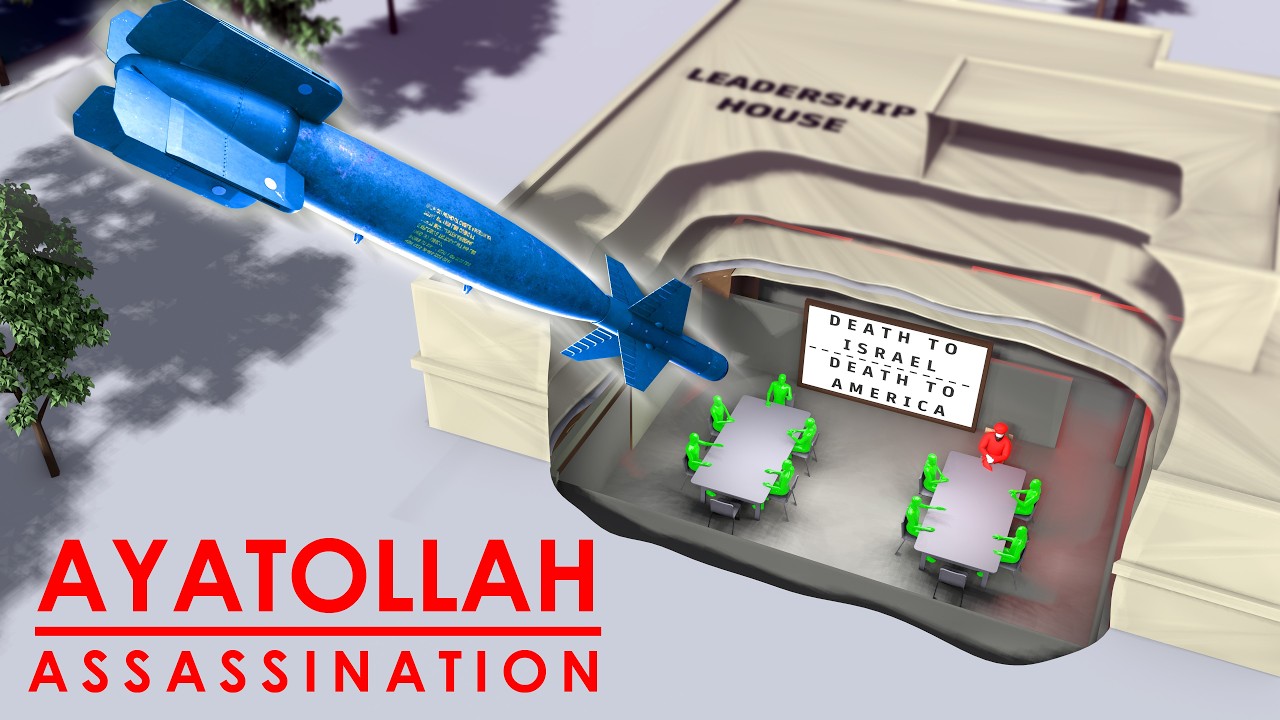
How Did the U.S. and Israel Track Down Khamenei’s Secret Compound?

Full Transcript — Download SRT & Markdown

00:00
Speaker A
Welcome to The War Archive, where wars become stories.
00:03
Speaker A
The radar screen flickered, then went black.
00:07
Speaker A
For a split second, the room inside the underground command center fell silent, lit only by the glow of secondary monitors struggling to recalibrate.
00:16
Speaker A
Somewhere above Tehran, something had slipped through the defensive grid, and deep beneath layers of reinforced concrete, the most protected man in Iran was already running out of time.
00:27
Speaker A
In another room, thousands of miles away, an analyst leaned forward and whispered, "Cluster confirmed.
00:34
Speaker A
Multiple high-value signals, all in one place, the convergence was rare, almost unthinkable, months of tracking had led to this single moment.
00:44
Speaker A
The ground trembled before anyone inside the compound understood what was happening.
00:50
Speaker A
It was not the sharp crack of a surface explosion, but a dull, heavy impact, something driving downward through concrete and earth, the kind of force designed not to shatter from above, but to collapse from within.
01:42
Speaker A
But this story did not begin with falling bombs, it began months earlier, in orbit, in encrypted signals, in the slow and patient mapping of a routine that was never meant to be seen.
01:55
Speaker A
To understand how the United States and Israel tracked down one of the most heavily protected leaders on the planet, we have to step back to when the sky was still quiet.
02:03
Speaker A
Long before any strike aircraft were fueled or flight paths drawn, a quieter operation was already underway, high above the earth, low orbit surveillance satellites passed over Iran several times a day, each sweep collecting fragments, signal emissions, encrypted bursts of communication, electronic patterns that seemed meaningless on their own, nothing dramatic, just data.
02:27
Speaker A
American intelligence agencies began stitching those fragments together, encrypted Iranian military channels were intercepted and analyzed, not necessarily cracked in full, but studied for timing, frequency, and repetition, even secure systems leave fingerprints, when a line activates, when it goes silent, how long it stays open, patterns form before meaning does.
03:30
Speaker A
Israeli intelligence units worked alongside them, pooling signal intercepts and human source reporting, a convoy leaving at the same hour each week, a secure line that lit up minutes before certain vehicles moved, a building whose internal communications surged every Tuesday morning, individually, these were trivial observations, together, they formed a map.
03:52
Speaker A
What emerged was not a pinpoint location, but a rhythm, the Supreme Leader did not advertise his movements, but power leaves traces, guards rotate, advisors travel, meetings require coordination, over months, that rhythm became predictable enough to forecast, not just where he had been, but where he was likely to be next.
04:14
Speaker A
This was the invisible net, it did not rely on dramatic betrayals or cinematic spycraft, it relied on patience, on watching until routine hardened into vulnerability.
05:04
Speaker A
Power survives on secrecy, but it also depends on repetition, convoys cannot teleport, meetings cannot materialize without preparation, even the most guarded leader in the region had a schedule, not public, not fixed, but patterned enough to sustain governance, and governance by its nature, leaves traces.
05:24
Speaker A
Analysts began to notice subtle consistencies, secure communications inside Tehran would spike shortly before certain motorcades moved through restricted corridors, underground lines activated at predictable intervals, internal security units shifted positions on days when senior commanders were scheduled to brief, it was not one signal that revealed the pattern, it was dozens aligning over time.
05:48
Speaker A
The Supreme Leader's official residence and office complex, known as Beit Rahbari, appeared outwardly unremarkable, a six-story structure in central Tehran, solar panels on the roof, urban density on all sides, from the street, it blended into the capital's administrative landscape, but beneath it lay reinforced subterranean levels designed for crisis.
06:51
Speaker A
The deeper bunkers were built to withstand bombardment, escape tunnels reportedly branched outward beneath surrounding streets, air defenses layered the skyline above, on paper, it was a fortress within a fortress.
07:11
Speaker A
Yet the more the intelligence picture sharpened, the clearer it became that physical fortification was only part of the equation, because the vulnerability was not in the walls, it was in the timing, and once analysts could anticipate when senior leadership would gather beneath that building, not just individually, but together, the compound ceased to be merely protected.
07:27
Speaker A
It became predictable, the breakthrough came when multiple streams of intelligence converged on a single date, encrypted traffic intensified across secure channels, motorcade activity increased within a restricted perimeter, internal communications inside the Pasteur Street compound spiked beyond their usual baseline, it was the signature of something rare, a full leadership gathering.
08:28
Speaker A
This was not a routine advisory session, senior revolutionary guard commanders, national security officials, and political advisors were all scheduled to be present, for a brief window, operational command, strategic planning, and political authority would sit beneath one roof, opportunities like this do not announce themselves, they reveal themselves in data.
08:50
Speaker A
Pasteur Street was heavily fortified, both physically and electronically, Iran's domestically developed Bavar missile system stood ready across Tehran, supported by radar arrays positioned throughout the capital, on paper, the airspace was protected by a layered umbrella designed to deter precisely this kind of intrusion.
09:15
Speaker A
The leadership inside had every reason to feel secure, but intelligence had shifted the equation, analysts were no longer guessing, they were forecasting, when signals confirmed that the Supreme Leader had entered the compound that morning, and that multiple high-ranking officials were already inside, the window narrowed from theoretical to immediate.
10:12
Speaker A
The question was no longer whether they could find him, they had, the question now was whether they could reach him before the window closed.
10:20
Speaker A
Finding the target was only half the battle, reaching it required dismantling the protective dome that guarded Tehran's skies, Iran's air defense network was layered, radar installations spread across the capital, mobile surface-to-air missile batteries on standby, and Bavar missile systems designed to intercept high-altitude threats.
10:44
Speaker A
To strike the compound, that shield had to fracture first, the first wave did not begin with fighter jets screaming across the horizon, it began with precision-guided cruise missiles, US Tomahawk missiles were reportedly tasked with disabling key radar nodes, command centers, and anti-air installations that coordinated the defensive grid, flying low and fast, they targeted the nervous system rather than the muscles.
11:45
Speaker A
As radar arrays flickered and communication links faltered, electronic warfare units added confusion, frequencies were jammed, signals distorted, surviving systems were fed incomplete or misleading data, in modern air campaigns, blindness spreads faster than destruction.
12:06
Speaker A
Once sensors fail, response time collapses, this suppression phase unfolded across multiple locations simultaneously, missile silos were struck to prevent retaliation, secondary defense batteries were neutralized before they could reposition, each strike widened the corridor in the sky, carving a path toward the heart of Tehran.
12:24
Speaker A
When the shield cracked, it did not shatter loudly, it dimmed, and through that dimming sky, the next phase of the operation began to move.
12:33
Speaker A
With the air defenses weakened, the operation shifted from invisibility to momentum, across Israeli airbases, fighter squadrons prepared for a mission that stretched far beyond routine range, nearly 200 aircraft, strike fighters, electronic warfare platforms, and aerial refueling tankers, were mobilized in coordinated waves, it would become one of the largest long-range air operations in Israeli military history.
13:39
Speaker A
The distance alone required precision, refueling tankers met strike aircraft mid-air, extending their reach deep into contested space, every movement was timed, altitude, speed, approach corridors, all synchronized with the suppression of Iranian radar systems.
14:04
Speaker A
The margin for error was narrow, and the timing had to align with the leadership still gathered inside the compound, at the center of this formation were F-15 strike fighters equipped with heavy precision-guided munitions, their assigned focal point was Beit Rahbari, the Supreme Leader's compound on Pasteur Street, while other targets were designated across Iranian territory, this structure anchored the entire operation.
15:06
Speaker A
The mission's success would be measured there, electronic warfare aircraft continued to distort surviving radar signals, as the strike package approached, for Iranian operators watching their screens, the sky became uncertain, returns flickered, disappeared, reappeared, confusion buys seconds, and seconds decide outcomes, by the time clarity returned, aircraft were already in release position.
15:29
Speaker A
Below, beneath reinforced concrete and layered earth, the leadership believed the bunker provided certainty, above, nearly 200 jets aligned across invisible corridors in the sky, the final approach had begun.
15:42
Speaker A
To collapse a subterranean facility, the blast must occur inside it, that requires a weapon designed not to explode on impact, but to burrow first.
15:55
Speaker A
The bunker buster carried by the strike aircraft, was engineered for precisely that task, its hardened steel casing, often forged from repurposed artillery barrels, gave it the structural strength to survive high-speed penetration, narrow in diameter and dense in weight, it displaced less material as it drove downward, allowing it to punch through layers of soil and reinforced concrete.
17:00
Speaker A
At its core sat hundreds of pounds of high explosive, commonly a trinal mixture combining TNT and aluminum powder to amplify blast temperature and pressure, but the true advantage was the delayed action fuse, instead of detonating the instant it struck the surface, the fuse allowed the weapon to travel deeper into the structure before triggering.
17:20
Speaker A
Once released, guidance fins adjusted mid-flight, steering the bomb toward pre-loaded coordinates with remarkable precision, upon impact, the casing forced its way through earth and concrete, sometimes several meters, before the detonation sequence completed, the explosion occurred inside the bunker's protective envelope, turning fortification into confinement.
18:20
Speaker A
Against a shallow subterranean level, the effect is catastrophic, structural supports buckle inward, corridors compress, air pressure multiplies in enclosed space, in that moment, depth becomes destiny, and not all levels of protection are equal.
18:37
Speaker A
In the hours that followed, analysts returned to one decisive detail, the Supreme Leader had not been positioned in the compound's deepest hardened bunker that morning, instead, he occupied a shallower subterranean facility, reinforced, secure, but not engineered to withstand the heaviest specialized ordnance designed for maximum depth penetration.
18:58
Speaker A
The compound reportedly contained multiple underground levels, with two primary maximum security bunkers built for prolonged siege scenarios, those deeper chambers would have required even more advanced, highly specialized munitions to breach, but on that particular morning, perhaps for logistical convenience, perhaps due to the summit's configuration, he remained in a higher-level underground space.
20:00
Speaker A
When the bunker buster struck, they encountered less resistance than the deepest fortifications could have offered, the delayed fuses allowed the munitions to burrow before detonation, collapsing structural supports from within, the reinforced concrete ceiling that was meant to shield became a weight pressing downward, survival narrowed to a matter of meters.
20:20
Speaker A
Descended further into the maximum security chamber, the strike might have required additional waves, heavier ordnance, or more time, time that may not have been available.
20:32
Speaker A
But operations are decided not by perfect hypotheticals, only by real-time placement, and on that morning, beneath Pasteur Street, depth was the difference between theoretical protection and fatal exposure.
20:45
Speaker A
When confirmation began to filter through intelligence channels, the scope of the strike came into focus, this was not simply an attempt on a single life, it was a coordinated effort to remove the operational core of Iran's leadership in one concentrated moment, the summit that had created vulnerability now magnified the consequences.
21:44
Speaker A
Reports indicated that several senior revolutionary guard commanders were present inside the compound when the munitions penetrated, high-ranking national security advisors, figures deeply embedded in strategic planning, were also gathered beneath the structure, in modern warfare, removing command cohesion can be as decisive as destroying hardware.
22:05
Speaker A
The objective was clear, decapitation, not symbolic damage, but structural disruption, if leadership is concentrated and eliminated simultaneously, the chain of command fractures, response slows, and retaliation becomes uncertain, for planners, this was not about spectacle, it was about paralysis.
22:25
Speaker A
Yet even the most precise operation carries human cost, family members and aides reportedly inside the compound would have been caught within the collapse, in confined underground space, blast pressure multiplies without discrimination, precision does not eliminate tragedy, it only narrows its radius.
23:24
Speaker A
By the end of that morning, what had been a secure leadership summit had transformed into a void at the center of the command structure, and while the compound on Pasteur Street symbolized the strike, the campaign did not end there, it expanded outward, across radar arrays, missile fields, and command hubs, ensuring that shock turned into strategic control.
23:45
Speaker A
While the compound beneath Pasteur Street absorbed the most symbolic blow, the wider campaign unfolded across the country, according to US Central Command assessments, approximately 2,900 targets were struck within a single day, this was not an isolated assassination, it was a synchronized suppression designed to prevent immediate retaliation.
24:08
Speaker A
Missile silos were targeted before launch sequences could be initiated, command centers coordinating regional defense networks were hit in rapid succession, radar arrays that once scanned the horizon for incoming aircraft went dark, their operators cut off from reliable data, the objective was speed, overwhelmed before response could organize.
25:09
Speaker A
Israeli aircraft continued their runs across multiple provinces, releasing precision-guided munitions against strategic infrastructure, each strike aligned with the broader timing window created by electronic warfare and cruise missile suppression, by attacking across hundreds of nodes simultaneously, the campaign diluted Iran's ability to prioritize defense.
25:30
Speaker A
Electronic interference compounded the effect, surviving communication channels struggled under jamming and signal distortion, units attempting to coordinate countermeasures, faced incomplete information and delayed confirmation, in modern conflict, confusion is a weapon, and that weapon had been deployed deliberately.
25:50
Speaker A
By the time the airspace stabilized, the damage extended far beyond one compound, the leadership void intersected with a fractured defense network, delaying any immediate organized response, the strike was not simply about eliminating a target, it was about controlling the aftermath.
26:47
Speaker A
Yet beneath all the hardware and flight formations, one question lingered, how did they know he was there, months of surveillance created probability, but probability is not enough to release nearly 200 aircraft into contested airspace, there had to be confirmation.
27:03
Speaker A
One possibility involved a human source positioned close enough to observe the arrival of senior leadership, an operative watching motorcades pass through controlled gates, could have transmitted a simple signal, confirmation that the summit was underway, in such a scenario, a strike aircraft equipped with a targeting pod would illuminate the precise structure, guiding the bunker busters with laser accuracy.
27:26
Speaker A
Another scenario suggests ground-based designation, without deep infiltration, a nearby asset, not embedded in the regime, but operating within proximity, might have relayed exact GPS coordinates once the target's presence was verified, the aircraft would then rely on pre-programmed guidance systems, releasing multiple munitions to ensure total structural collapse.
28:29
Speaker A
The third, and widely considered most plausible explanation, centers on long-term interception of encrypted communications, intelligence services had reportedly monitored Hezbollah-linked and Iranian secure channels for years, mapping leadership travel patterns without deploying visible agents into sensitive areas, when encrypted traffic surged, and internal confirmations aligned with satellite tracking, the picture became clear enough to act.
28:56
Speaker A
In reality, the answer may have combined all three, modern intelligence rarely depends on a single source, it layers signals, human insight, and technical analysis until uncertainty narrows to confidence, by the time the strike aircraft crossed into release position, the decision was not impulsive, it was the culmination of accumulated certainty, the moment when watching turned into action, in the end, the operation was not defined by the sound of collapsing concrete, it was defined by months of silent observation that made collapse possible, satellites traced invisible arcs overhead, encrypted signals flickered across secure networks, analysts mapped routine until routine became exposure, the strike was sudden, the preparation was not.
30:22
Speaker A
The question that framed this story, how did the United States and Israel track down one of the most heavily protected leaders on the planet, finds its answer, not in a single bomb, or a single aircraft, it lies in the quiet accumulation of data, in the ability to recognize patterns where others see noise, an understanding that even power must move, communicate, and gather.
30:45
Speaker A
For months, nothing appeared to happen, no explosions, no public warnings, just observation, then in a narrow morning window on Pasteur Street, observation reached its conclusion, the signal went dark, and the most protected man in Iran was no longer hidden, in modern warfare, secrecy is temporary, patterns are patient, and those who control the data control the moment when silence breaks.

Get More with the Söz AI App

Transcribe recordings, audio files, and YouTube videos — with AI summaries, speaker detection, and unlimited transcriptions.

Or transcribe another YouTube video here →